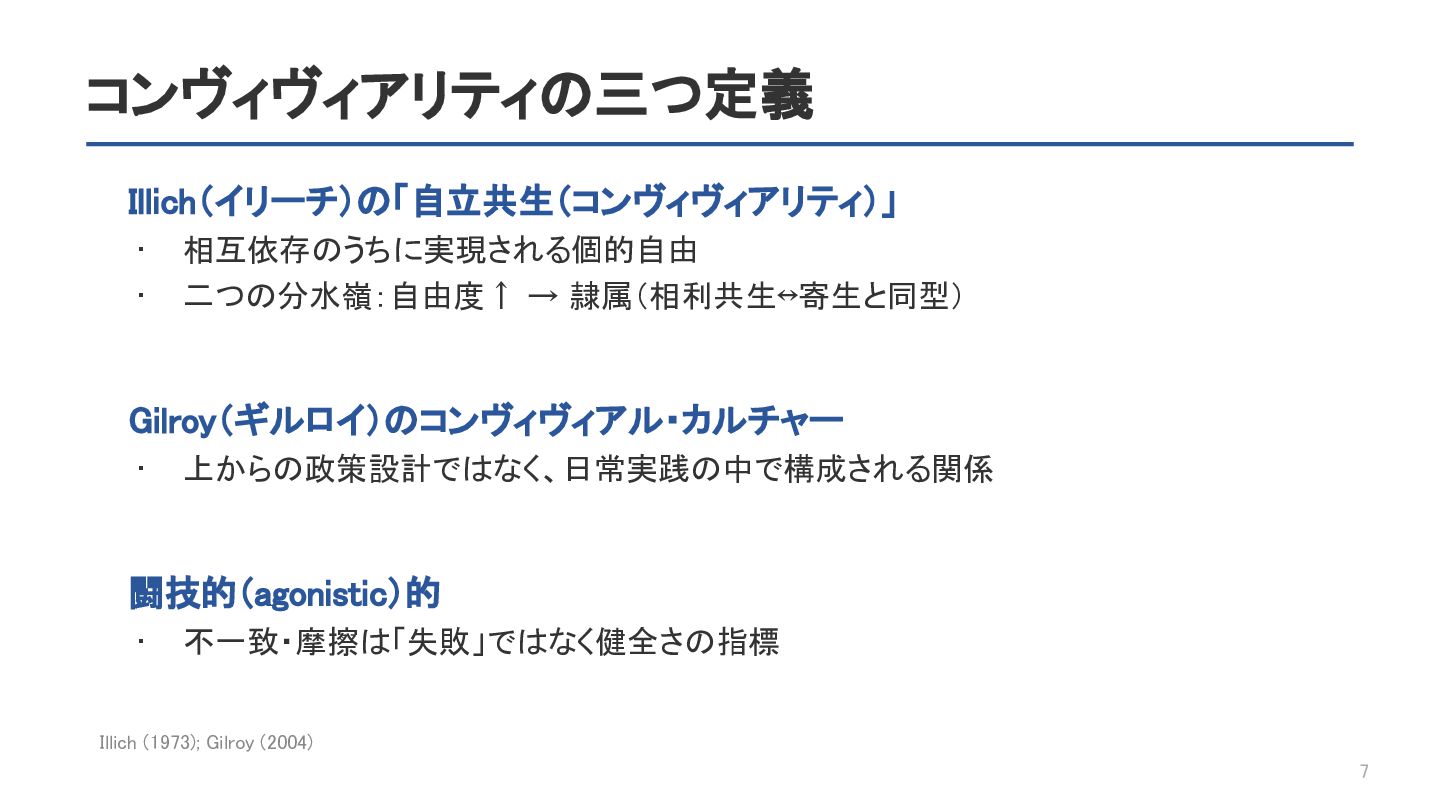
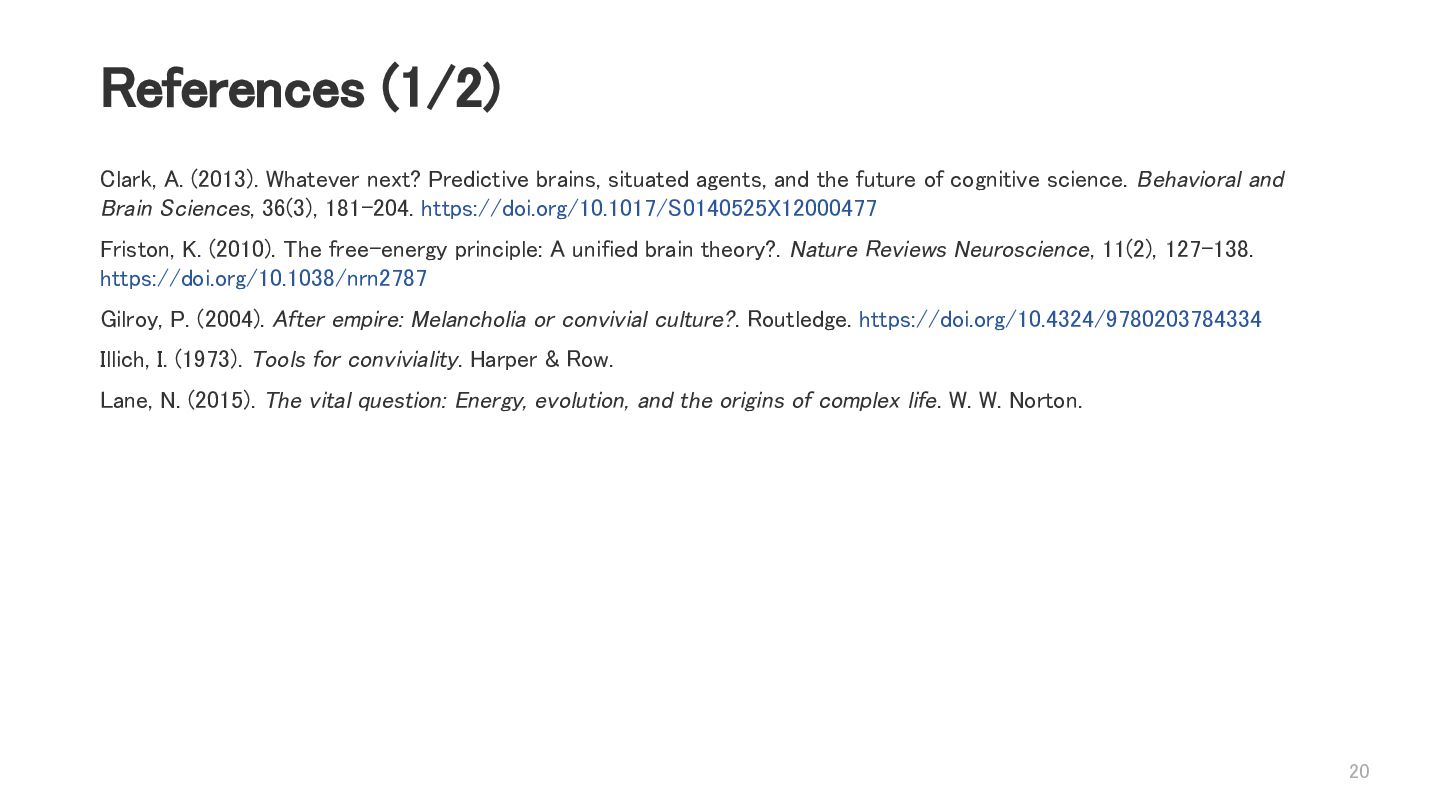
agents, and the future of cognitive science. Behavioral and Brain Sciences, 36(3), 181–204. https://doi.org/10.1017/S0140525X12000477 Friston, K. (2010). The free-energy principle: A unified brain theory?. Nature Reviews Neuroscience, 11(2), 127–138. https://doi.org/10.1038/nrn2787 Gilroy, P. (2004). After empire: Melancholia or convivial culture?. Routledge. https://doi.org/10.4324/9780203784334 Illich, I. (1973). Tools for conviviality. Harper & Row. Lane, N. (2015). The vital question: Energy, evolution, and the origins of complex life. W. W. Norton. 20
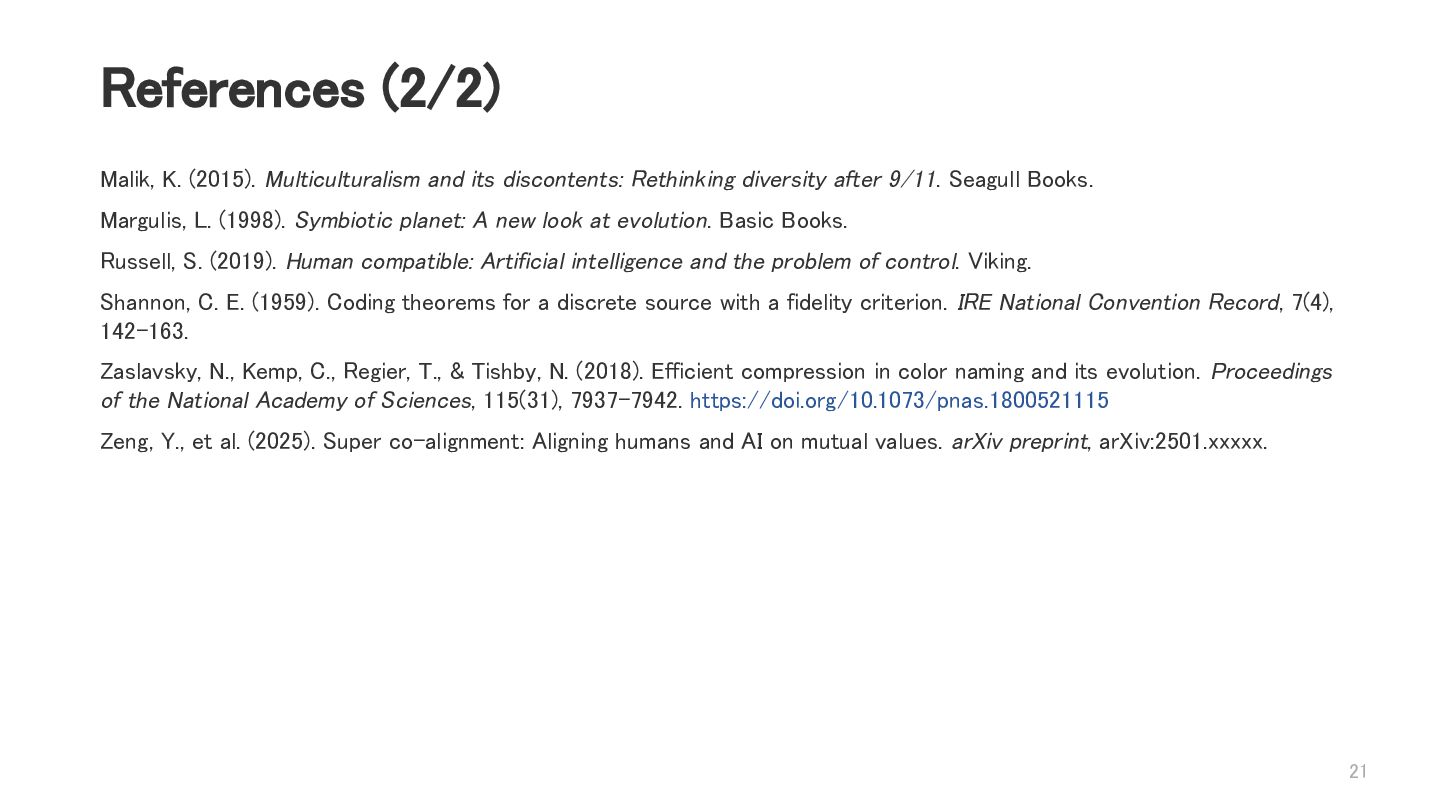
diversity after 9/11. Seagull Books. Margulis, L. (1998). Symbiotic planet: A new look at evolution. Basic Books. Russell, S. (2019). Human compatible: Artificial intelligence and the problem of control. Viking. Shannon, C. E. (1959). Coding theorems for a discrete source with a fidelity criterion. IRE National Convention Record, 7(4), 142–163. Zaslavsky, N., Kemp, C., Regier, T., & Tishby, N. (2018). Efficient compression in color naming and its evolution. Proceedings of the National Academy of Sciences, 115(31), 7937–7942. https://doi.org/10.1073/pnas.1800521115 Zeng, Y., et al. (2025). Super co-alignment: Aligning humans and AI on mutual values. arXiv preprint, arXiv:2501.xxxxx. 21


 hiroakihamada
 arfon
arfon
 tsoh
tsoh
 xleitix
 hf149
hf149
 ykiyota
 trycycle
 masakiokuda
 rlifchitz
 ianozsvald
 tagtag
 rmaruy
 konakalab
 cassininazir
 baasie
 lara
lara
 kimpetersen
 charlesmeaden
 lauravandoore
 samanthasiow
 mkilby
 sachag
 philnash
 soysaucechin
 bkeepers