Upgrade to Pro — share decks privately, control downloads, hide ads and more …

How You Can Prevent AI from Creating Bottleneck...

How You Can Prevent AI from Creating Bottlenecks in Your Effective Product Development

Many managers are accelerating the use of “AI” in product development, often focused on making a single person more “productive.” They think this will increase their agility.

However, too often, that one person is not more effective because that person needs to work with others. When every person goes off in their own direction, the work becomes more fractured and the organization’s agility goes down.

However, there are ways to use AI to be more effective. Instead of handing off product development tasks to AI, we can use AI to:

- Visualize the bottlenecks in a given team.
- Clarify the age of all the items in progress, or in backlogs or roadmaps.
- Create and validate throw-away prototypes.
- Add more tests—not code—so the team can safely change the product at will.

We can use AI to support the very human work of effective product development. But not because the current “AI” models can think. They cannot. Instead, they can support humans thinking and learning more effectively.

Avatar for Johanna Rothman

Johanna Rothman PRO

May 31, 2026

More Decks by Johanna Rothman

Other Decks in Business

Transcript

  1. How You Can Prevent AI from Creating Bottlenecks in Your

    Effective Product Development Johanna Rothman [email protected] www.jrothman.com
  2. © 2026 Johanna Rothman Let’s Discuss Productivity & Agility •

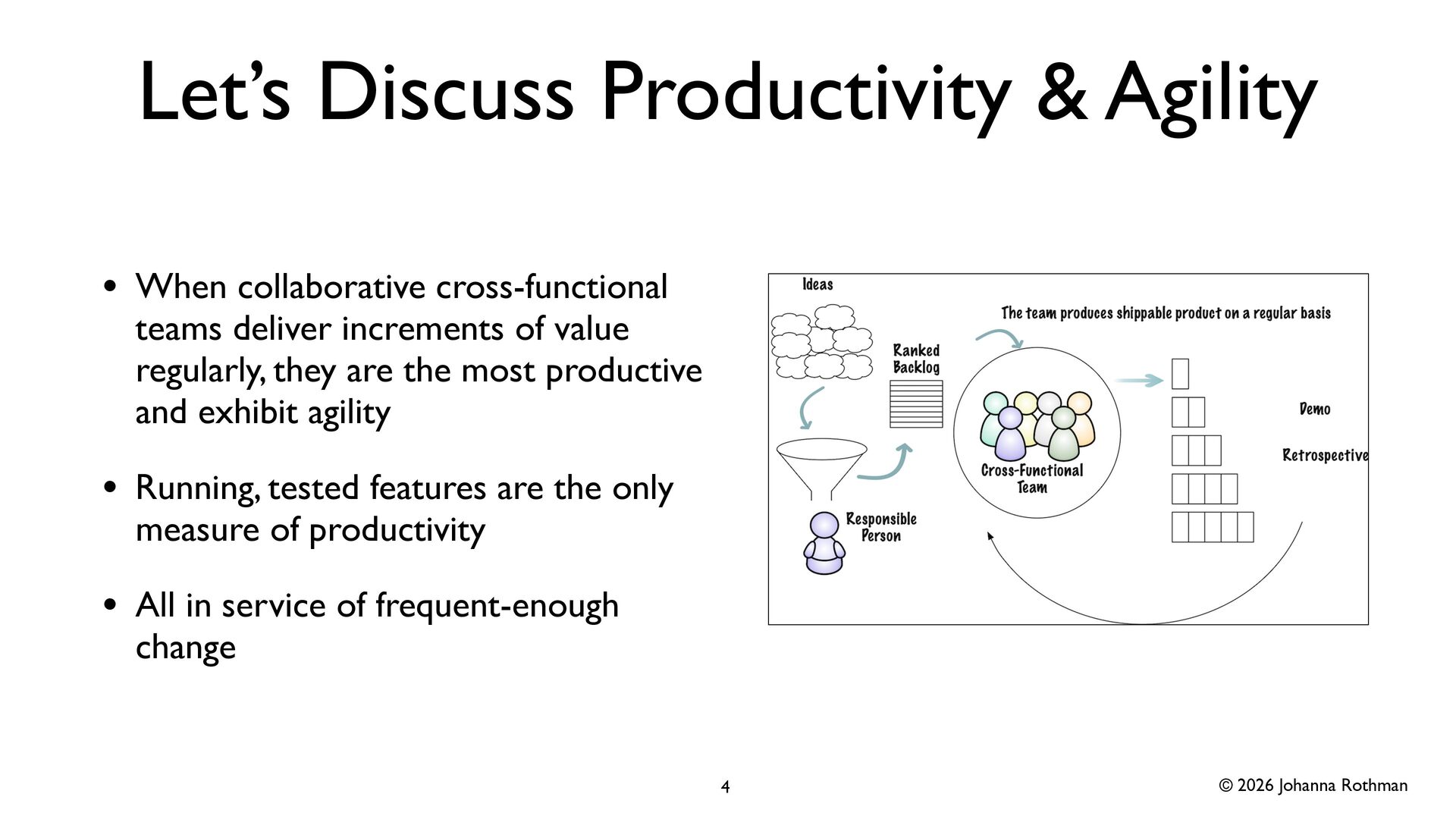
    When collaborative cross-functional teams deliver increments of value regularly, they are the most productive and exhibit agility • Running, tested features are the only measure of productivity • All in service of frequent-enough change 4
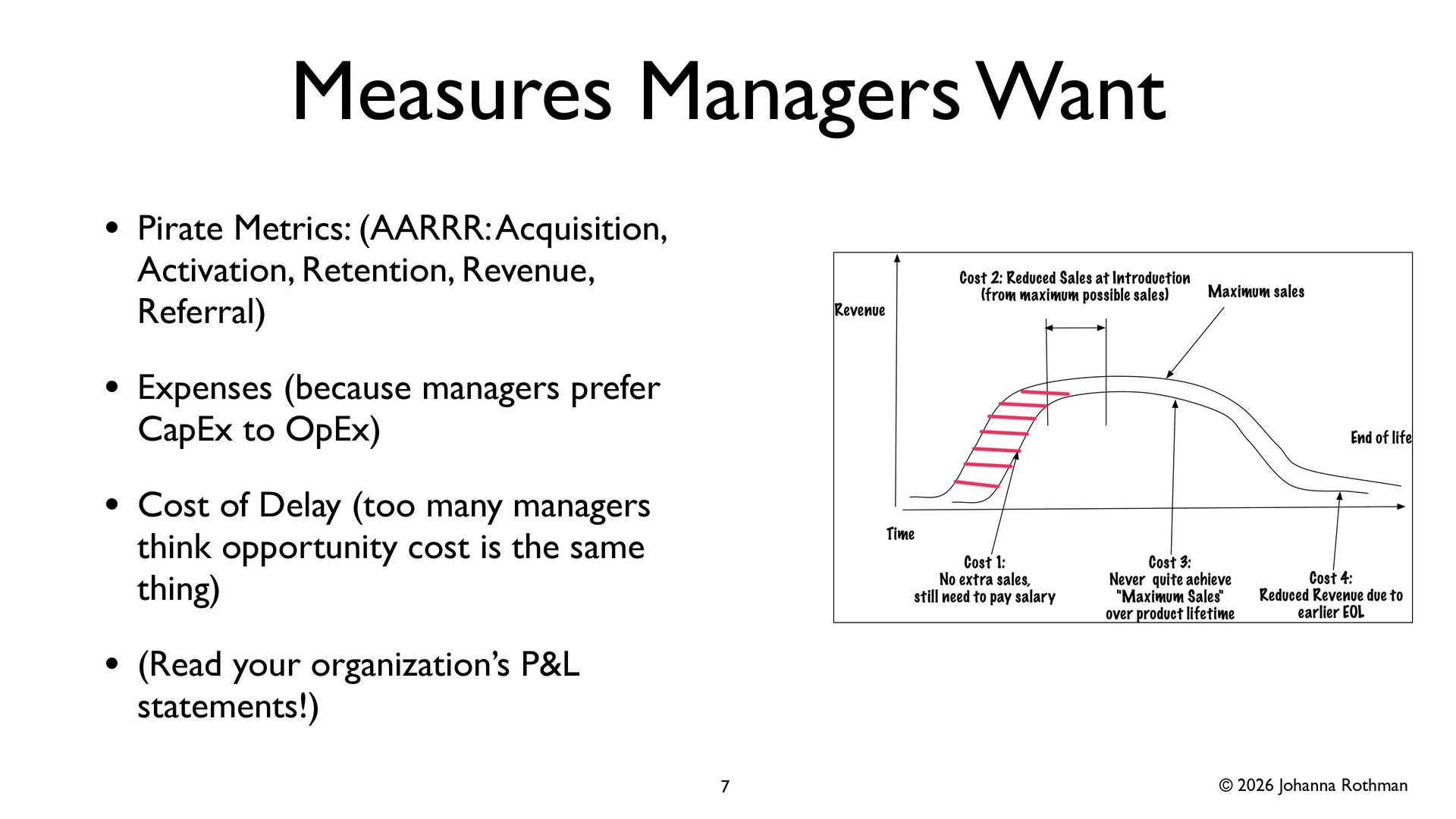
  3. © 2026 Johanna Rothman Measures Managers Want • Pirate Metrics:

    (AARRR: Acquisition, Activation, Retention, Revenue, Referral) • Expenses (because managers prefer CapEx to OpEx) • Cost of Delay (too many managers think opportunity cost is the same thing) • (Read your organization’s P&L statements!) 7
  4. © 2026 Johanna Rothman Value Stream Maps Show How Your

    Team Creates Running Tested, Features 9
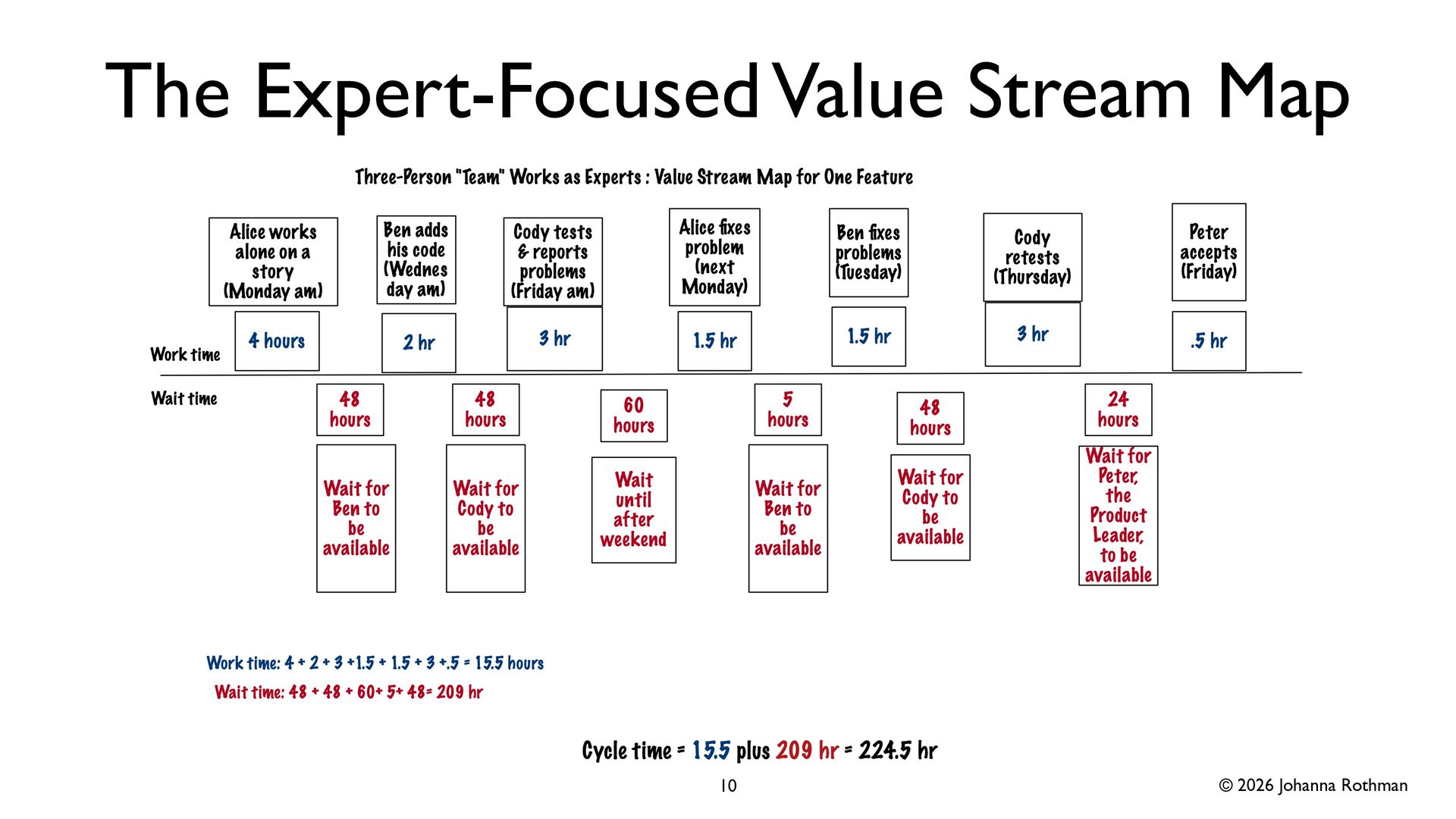
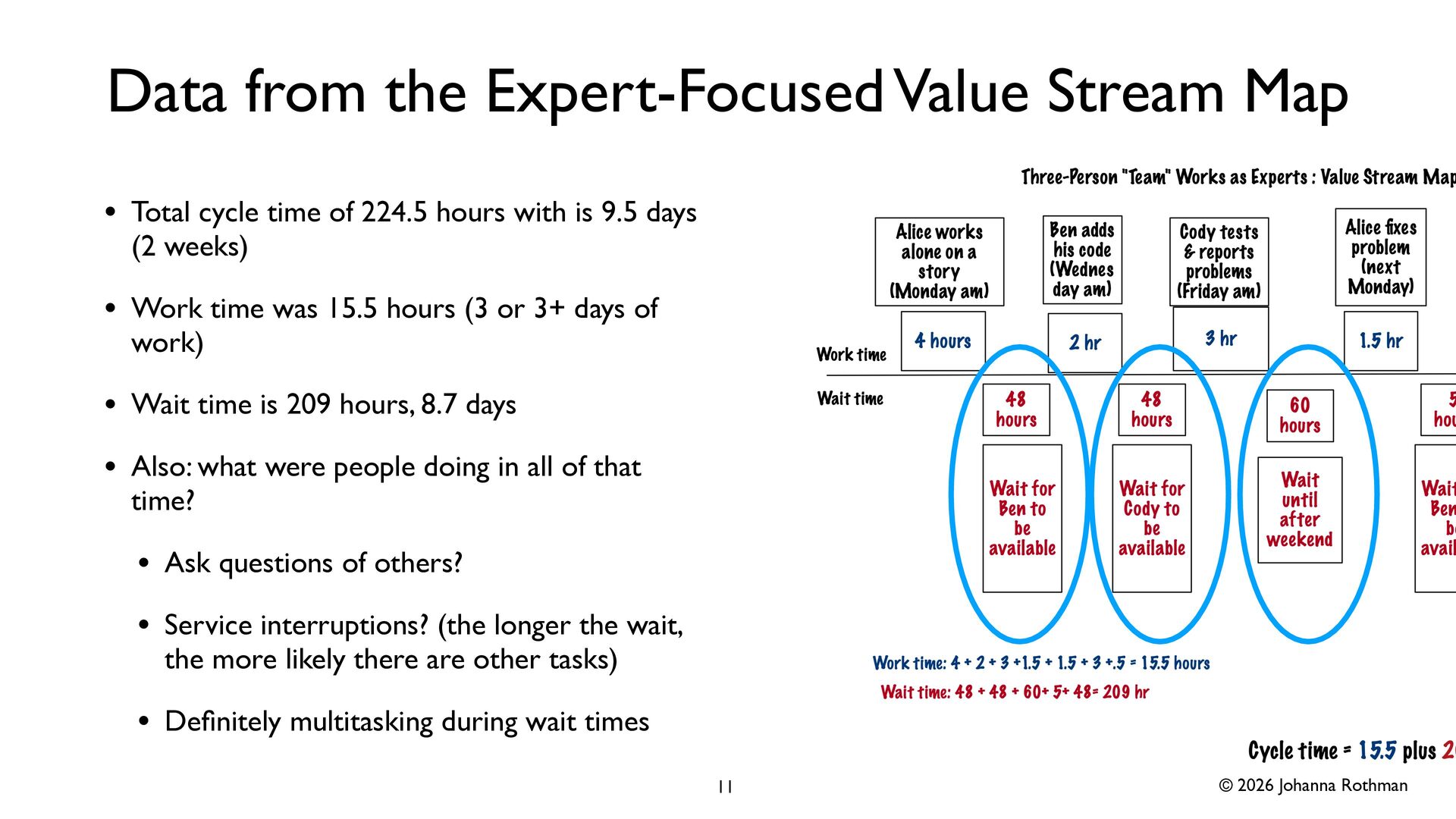
  5. © 2026 Johanna Rothman Data from the Expert-Focused Value Stream

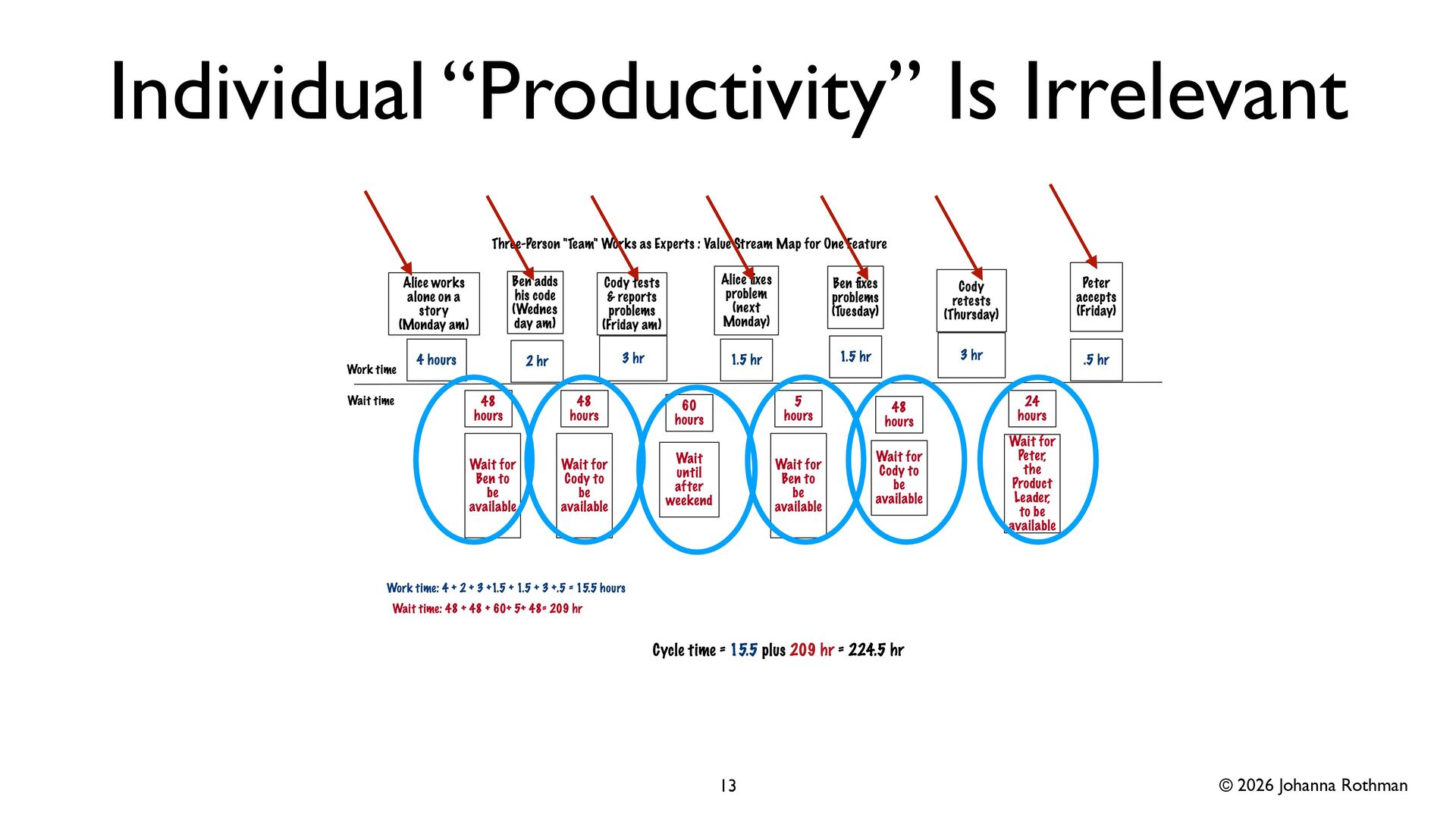
    Map • Total cycle time of 224.5 hours with is 9.5 days (2 weeks) • Work time was 15.5 hours (3 or 3+ days of work) • Wait time is 209 hours, 8.7 days • Also: what were people doing in all of that time? • Ask questions of others? • Service interruptions? (the longer the wait, the more likely there are other tasks) • De fi nitely multitasking during wait times 11
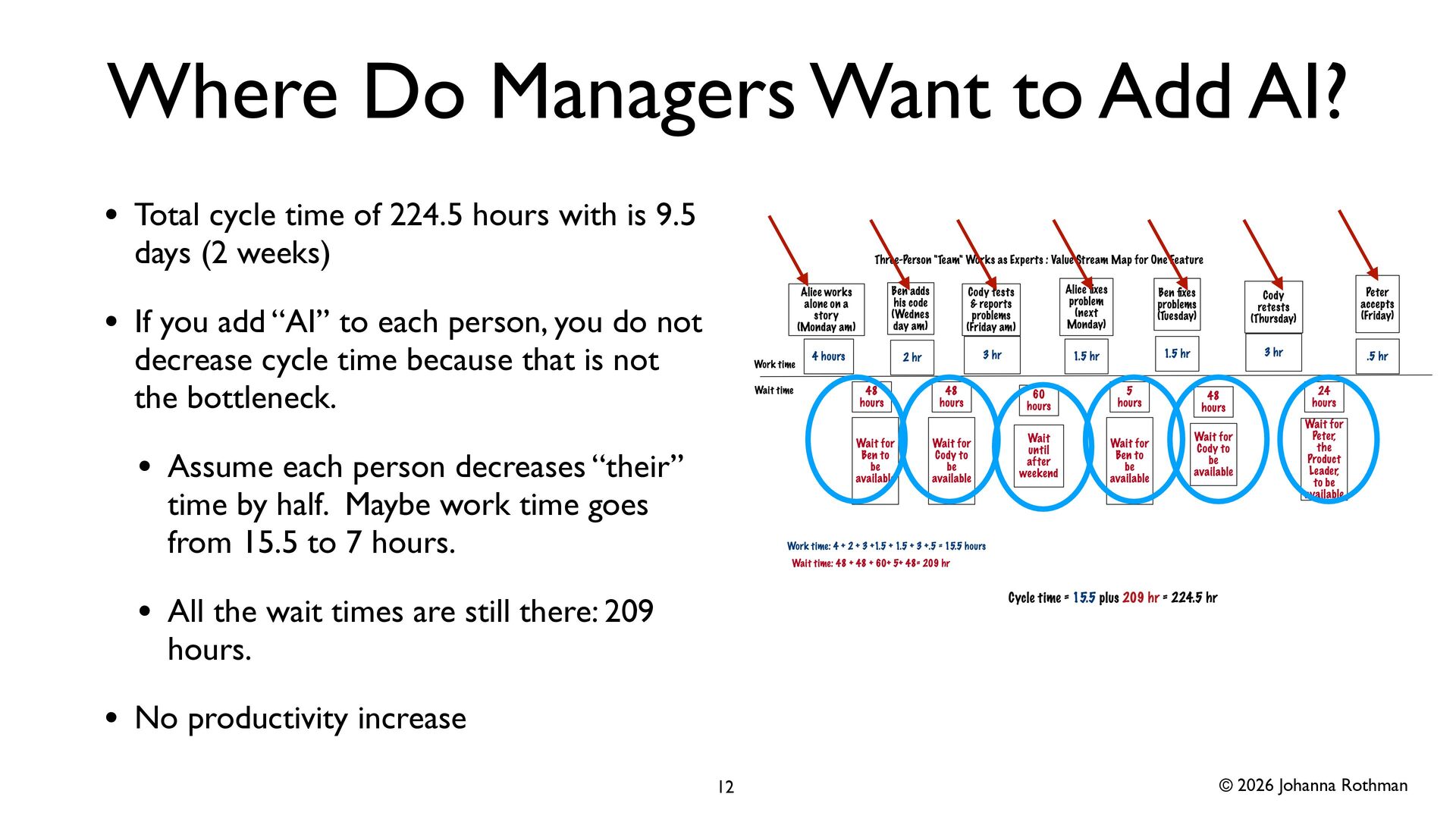
  6. © 2026 Johanna Rothman Where Do Managers Want to Add

    AI? • Total cycle time of 224.5 hours with is 9.5 days (2 weeks) • If you add “AI” to each person, you do not decrease cycle time because that is not the bottleneck. • Assume each person decreases “their” time by half. Maybe work time goes from 15.5 to 7 hours. • All the wait times are still there: 209 hours. • No productivity increase 12
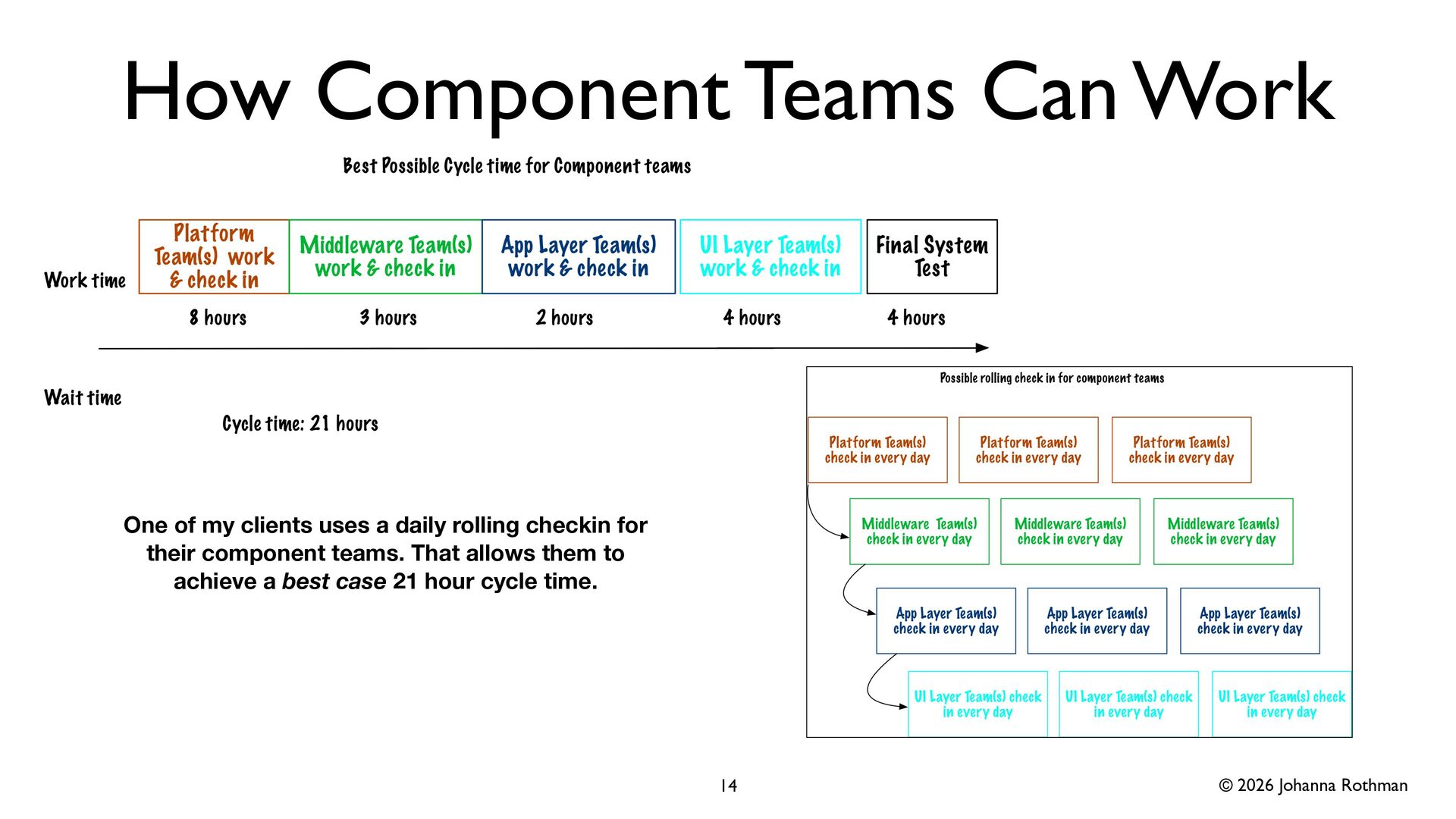
  7. © 2026 Johanna Rothman How Component Teams Can Work 14

    One of my clients uses a daily rolling checkin for their component teams. That allows them to achieve a best case 21 hour cycle time.
  8. © 2026 Johanna Rothman AI value: Ask how to eliminate

    component teams (or read my books) 15
  9. © 2026 Johanna Rothman Data from the Cooperative Value Stream

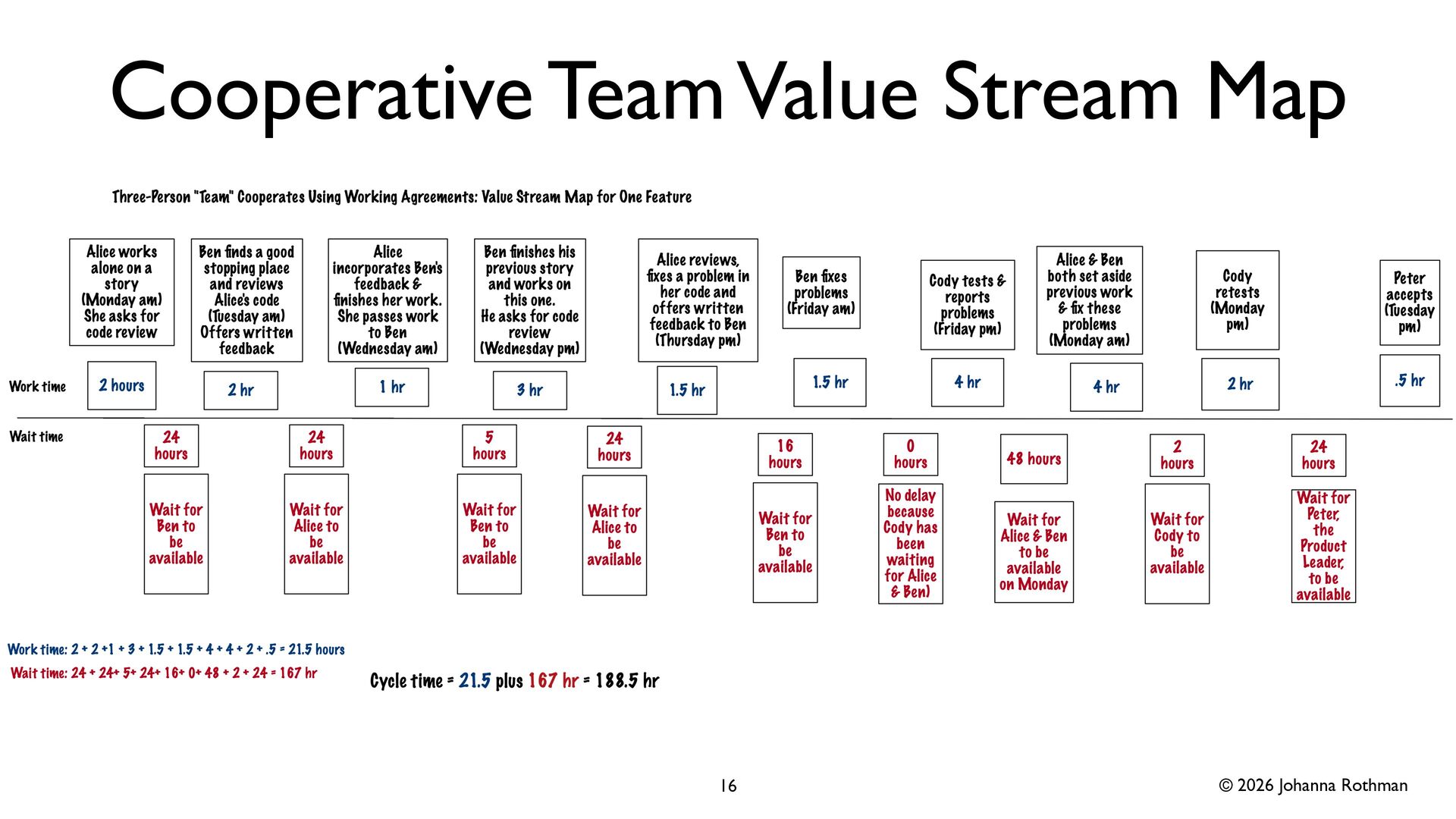
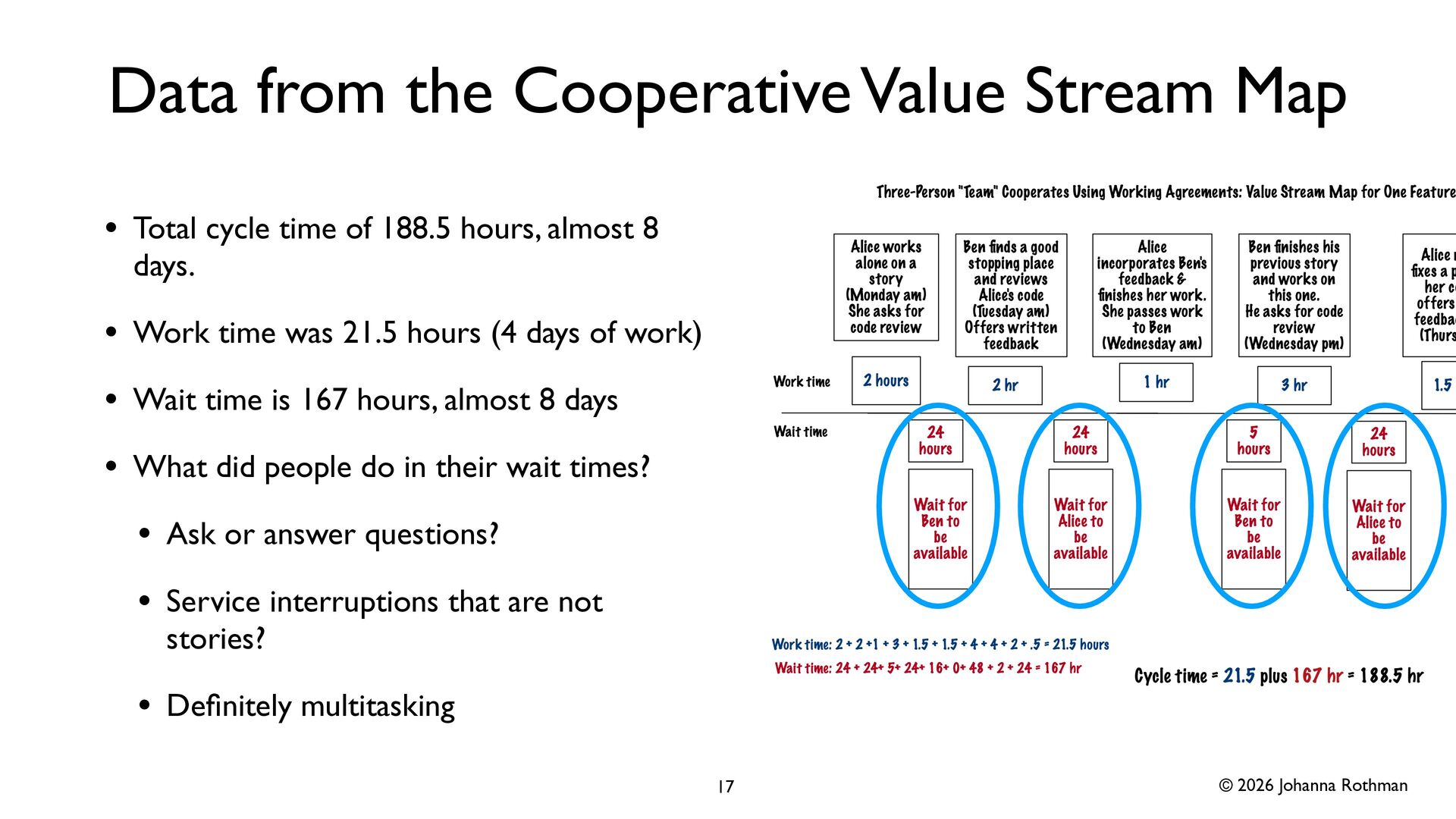
    Map • Total cycle time of 188.5 hours, almost 8 days. • Work time was 21.5 hours (4 days of work) • Wait time is 167 hours, almost 8 days • What did people do in their wait times? • Ask or answer questions? • Service interruptions that are not stories? • De fi nitely multitasking 17
  10. © 2026 Johanna Rothman AI might “see” where everyone spends

    their time. So would a retrospective. 18
  11. © 2026 Johanna Rothman Typing is never a bottleneck or

    a delay. All the delays are in understanding what the customer needs and how to create that. 19
  12. © 2026 Johanna Rothman How the Flow Metrics Work •

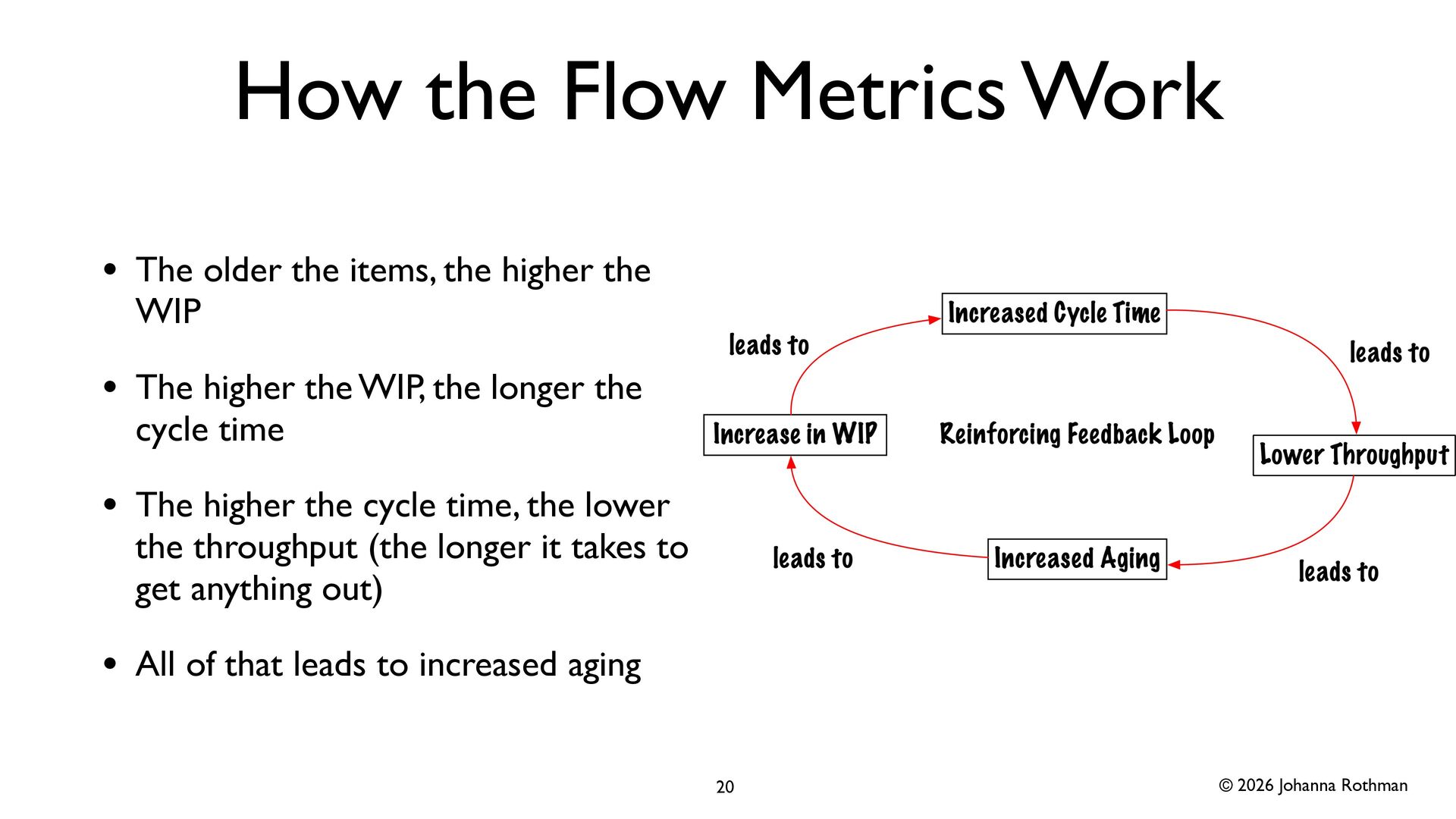
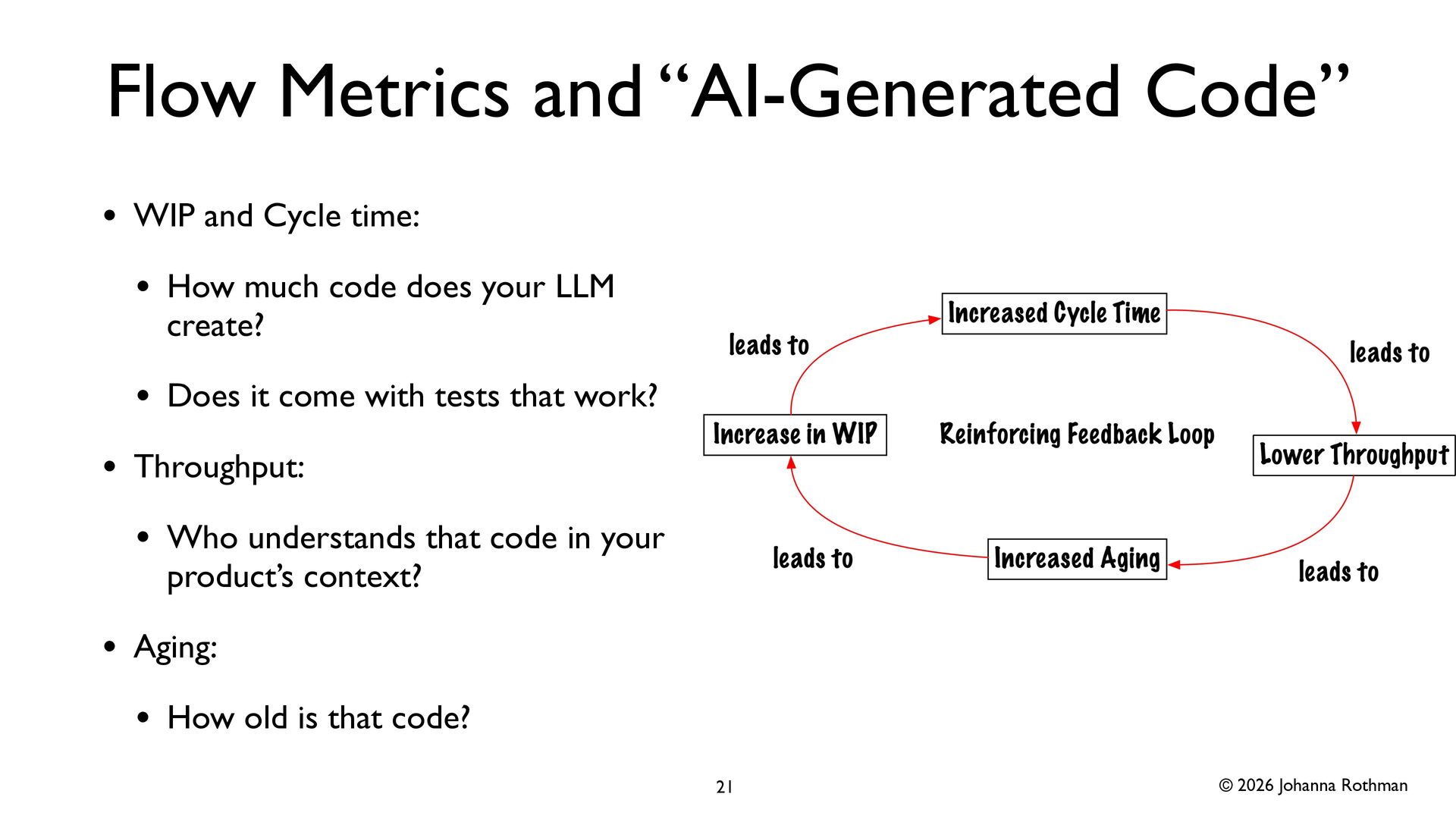
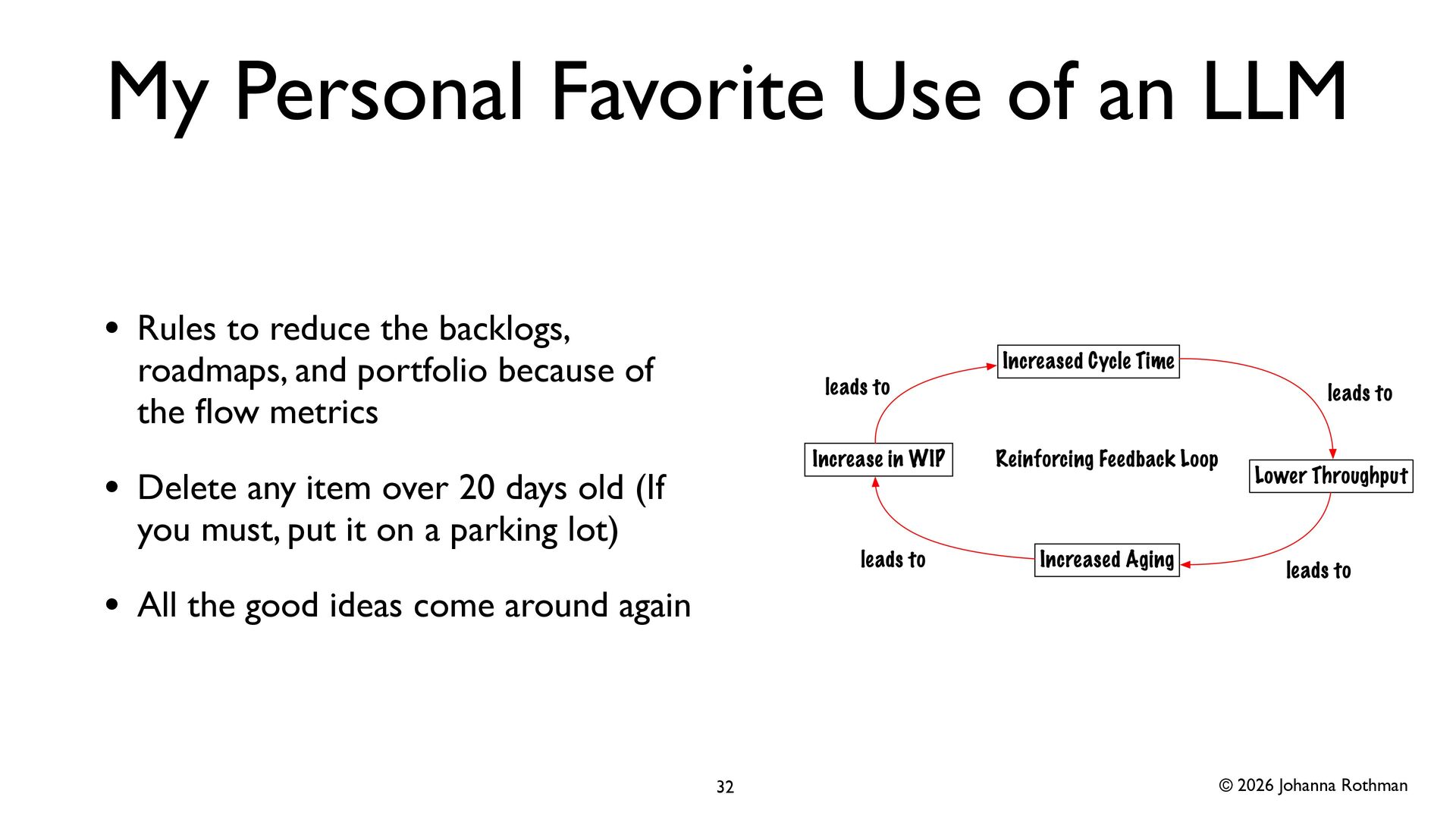
    The older the items, the higher the WIP • The higher the WIP, the longer the cycle time • The higher the cycle time, the lower the throughput (the longer it takes to get anything out) • All of that leads to increased aging 20
  13. © 2026 Johanna Rothman Flow Metrics and “AI-Generated Code” •

    WIP and Cycle time: • How much code does your LLM create? • Does it come with tests that work? • Throughput: • Who understands that code in your product’s context? • Aging: • How old is that code? 21
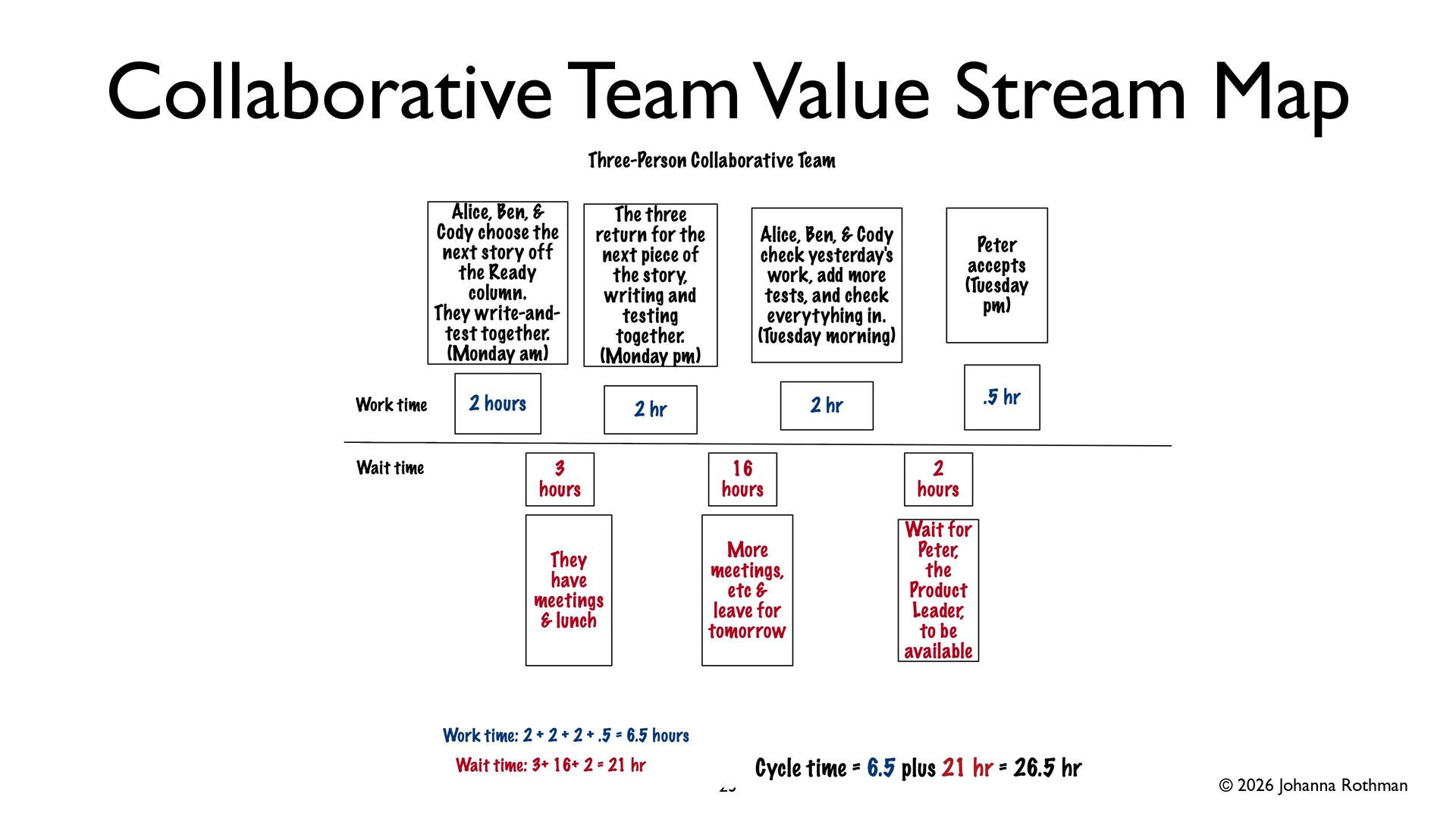
  14. © 2026 Johanna Rothman Data from the Collaborative Value Stream

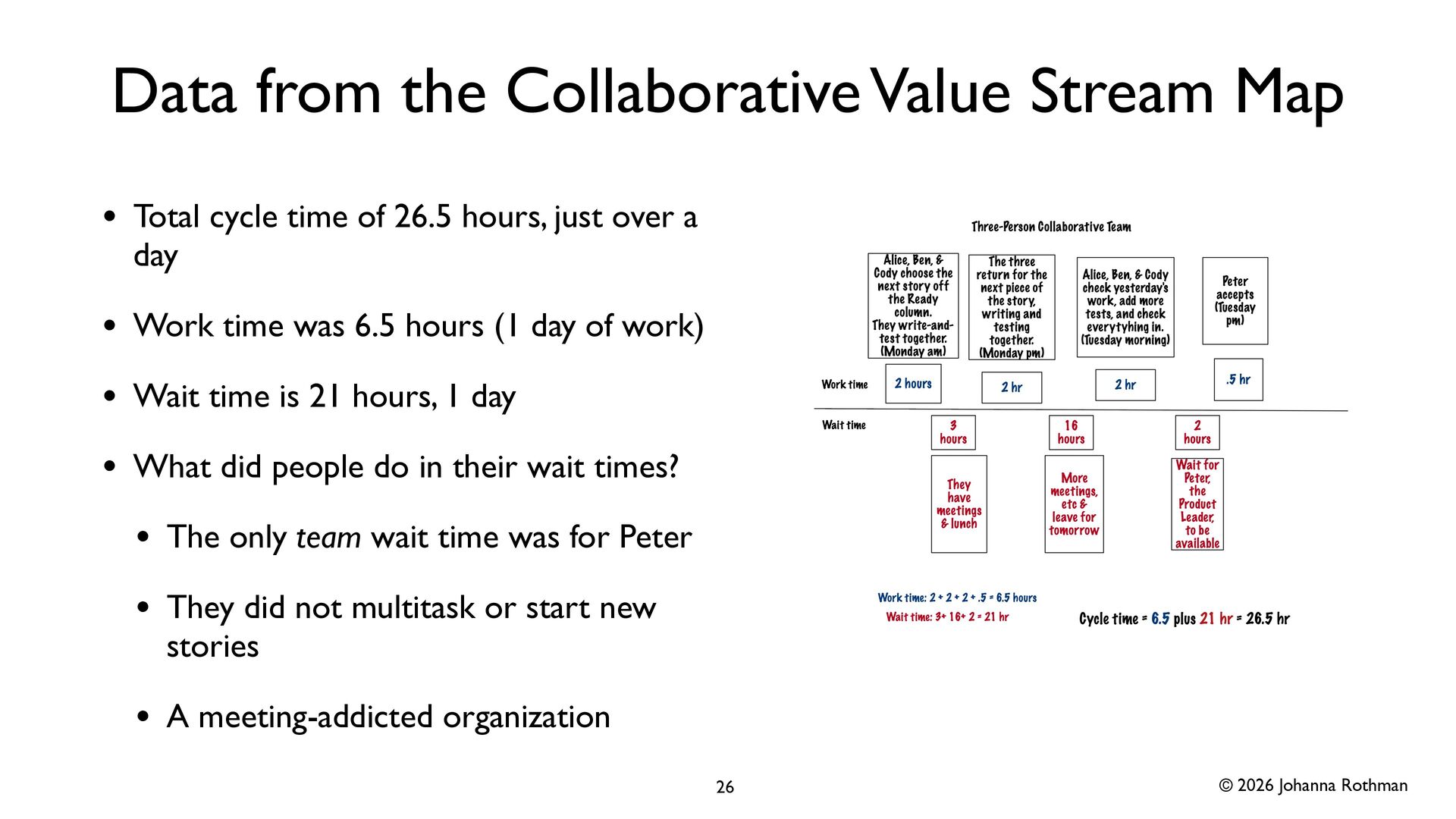
    Map • Total cycle time of 26.5 hours, just over a day • Work time was 6.5 hours (1 day of work) • Wait time is 21 hours, 1 day • What did people do in their wait times? • The only team wait time was for Peter • They did not multitask or start new stories • A meeting-addicted organization 26
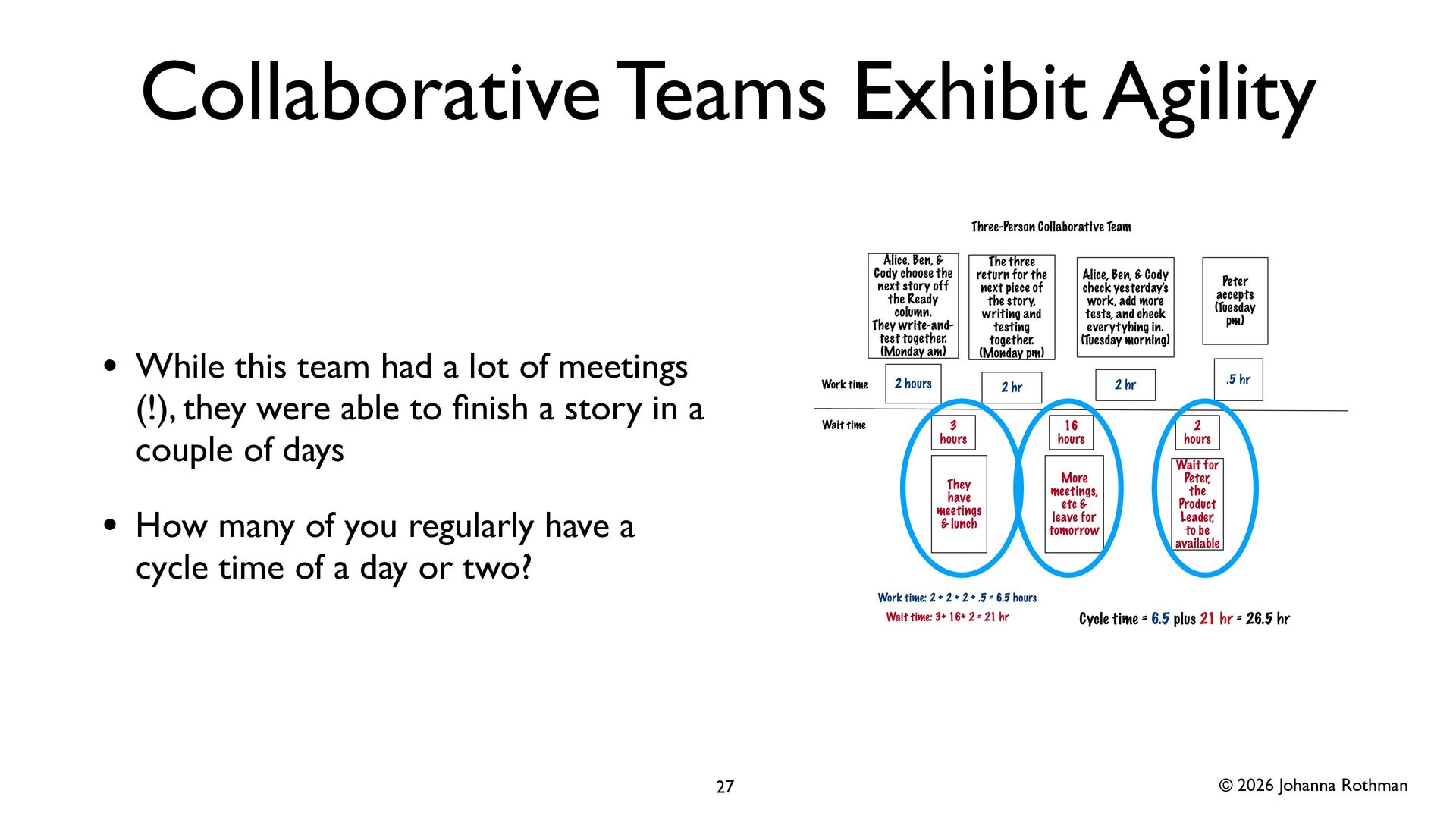
  15. © 2026 Johanna Rothman Collaborative Teams Exhibit Agility • While

    this team had a lot of meetings (!), they were able to fi nish a story in a couple of days • How many of you regularly have a cycle time of a day or two? 27
  16. © 2026 Johanna Rothman Avoid These AI Traps • Generate

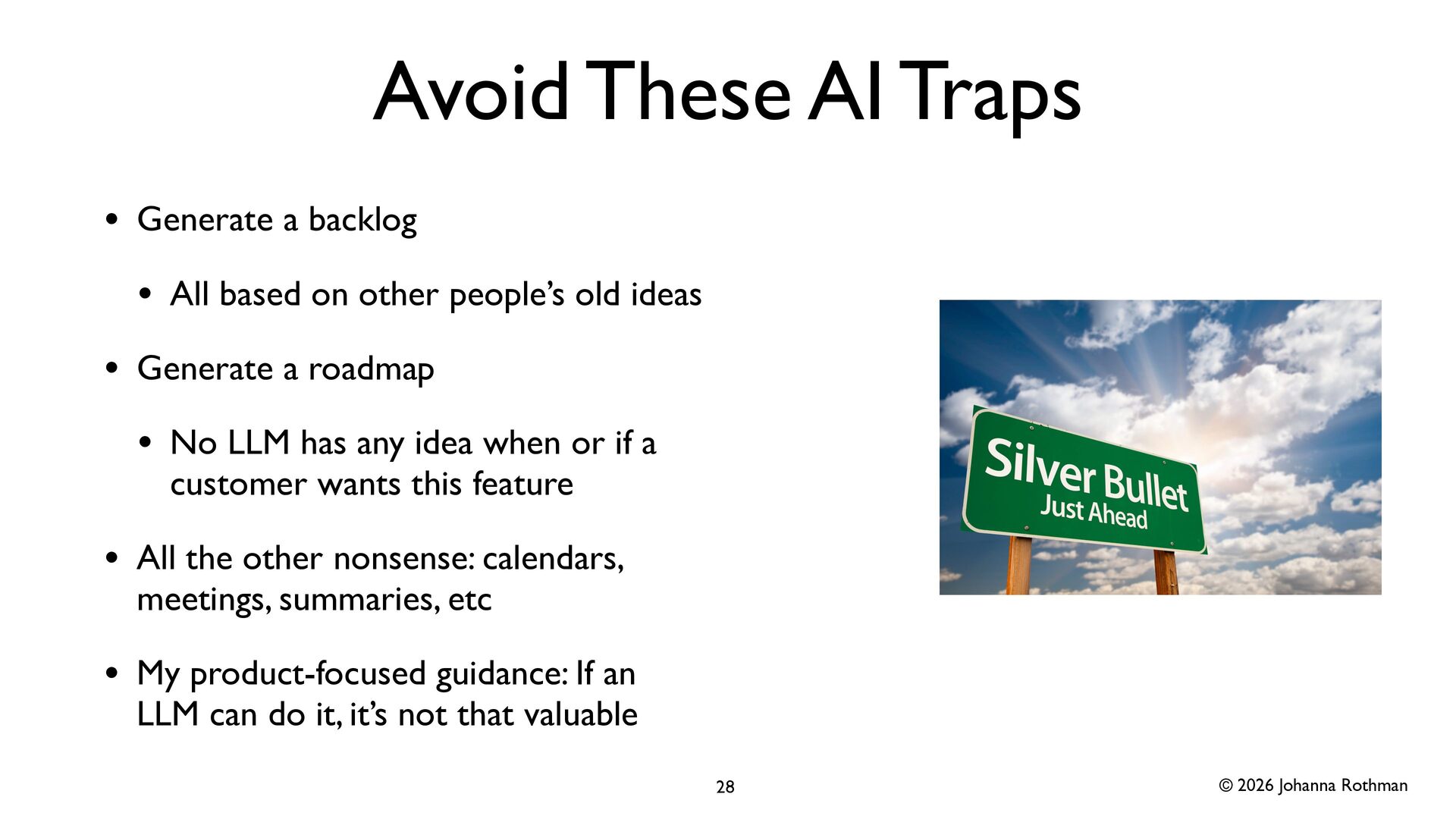
    a backlog • All based on other people’s old ideas • Generate a roadmap • No LLM has any idea when or if a customer wants this feature • All the other nonsense: calendars, meetings, summaries, etc • My product-focused guidance: If an LLM can do it, it’s not that valuable 28
  17. © 2026 Johanna Rothman Assess the Value Before Considering an

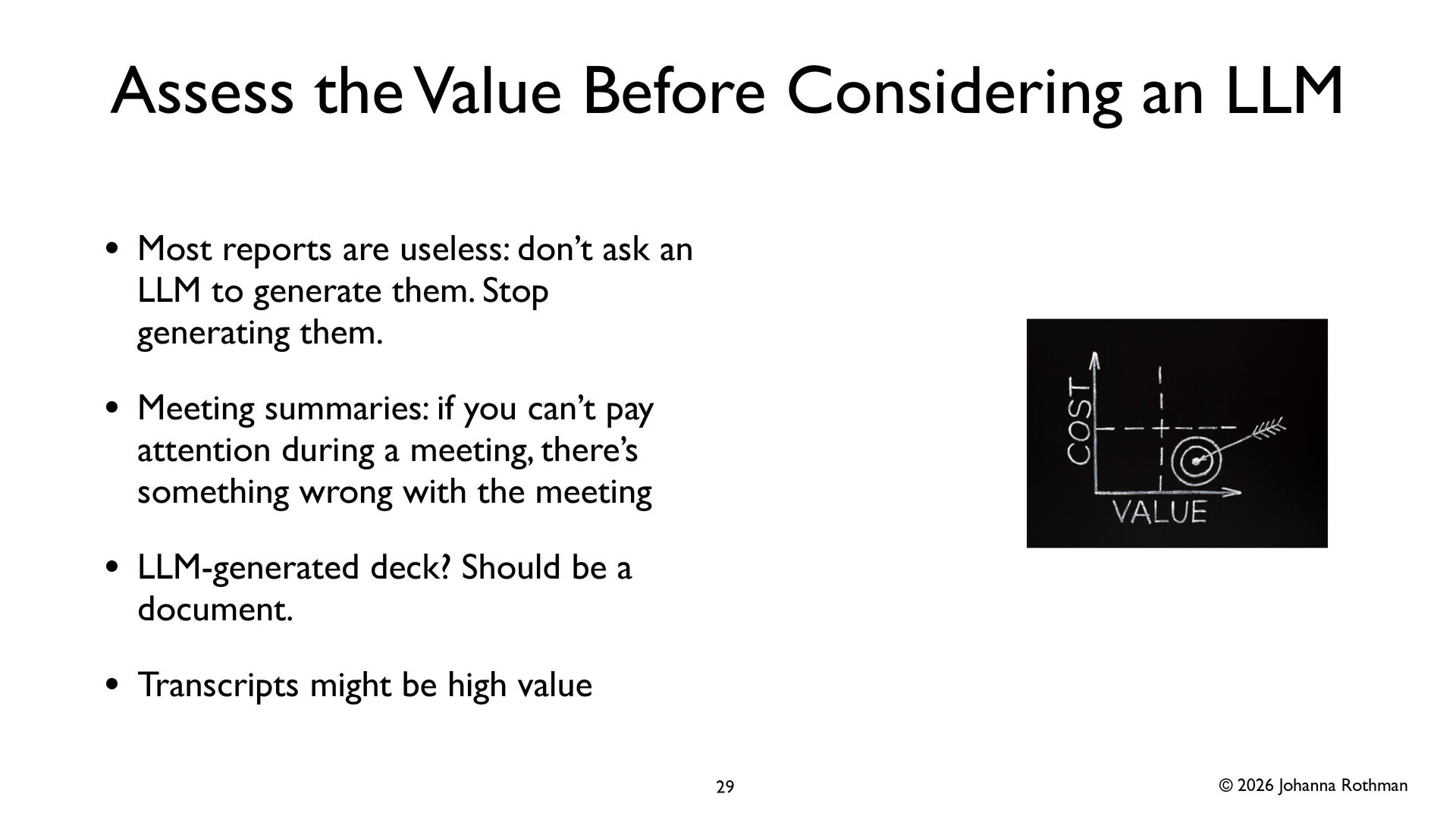
    LLM • Most reports are useless: don’t ask an LLM to generate them. Stop generating them. • Meeting summaries: if you can’t pay attention during a meeting, there’s something wrong with the meeting • LLM-generated deck? Should be a document. • Transcripts might be high value 29
  18. © 2026 Johanna Rothman Add AI to a Collaborative Team?

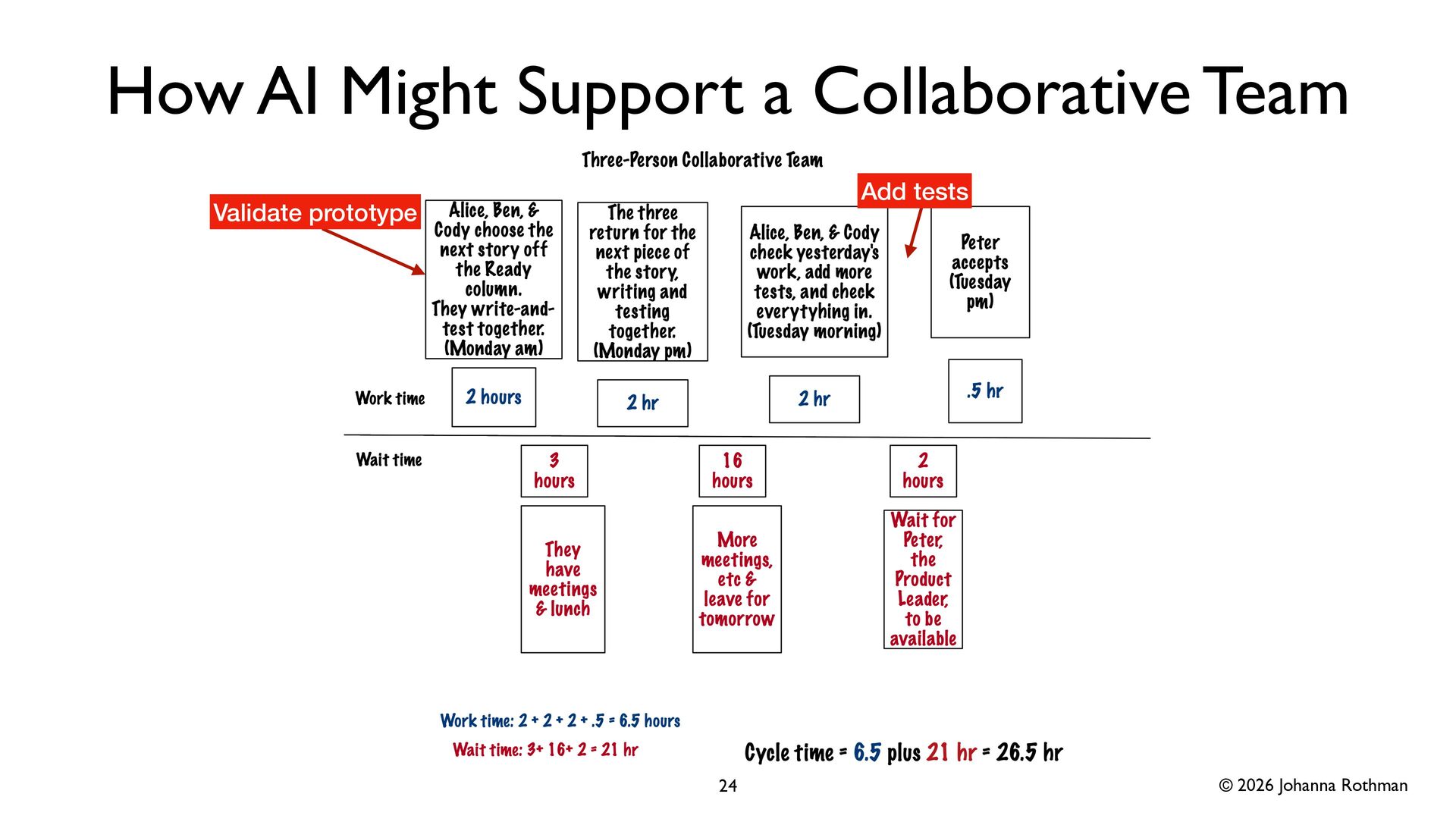
    • Consider the ways a team can use AI: • Extract the value stream map from the team’s process • Ask questions about bottlenecks and delays (LLMs can mine data for insights we do not yet see) • Create and validate prototypes • Add more tests to an insuf fi ciently tested piece of the product • Use rules to reduce Aging and WIP 30
  19. © 2026 Johanna Rothman Several Collaboration Options • Agility requires

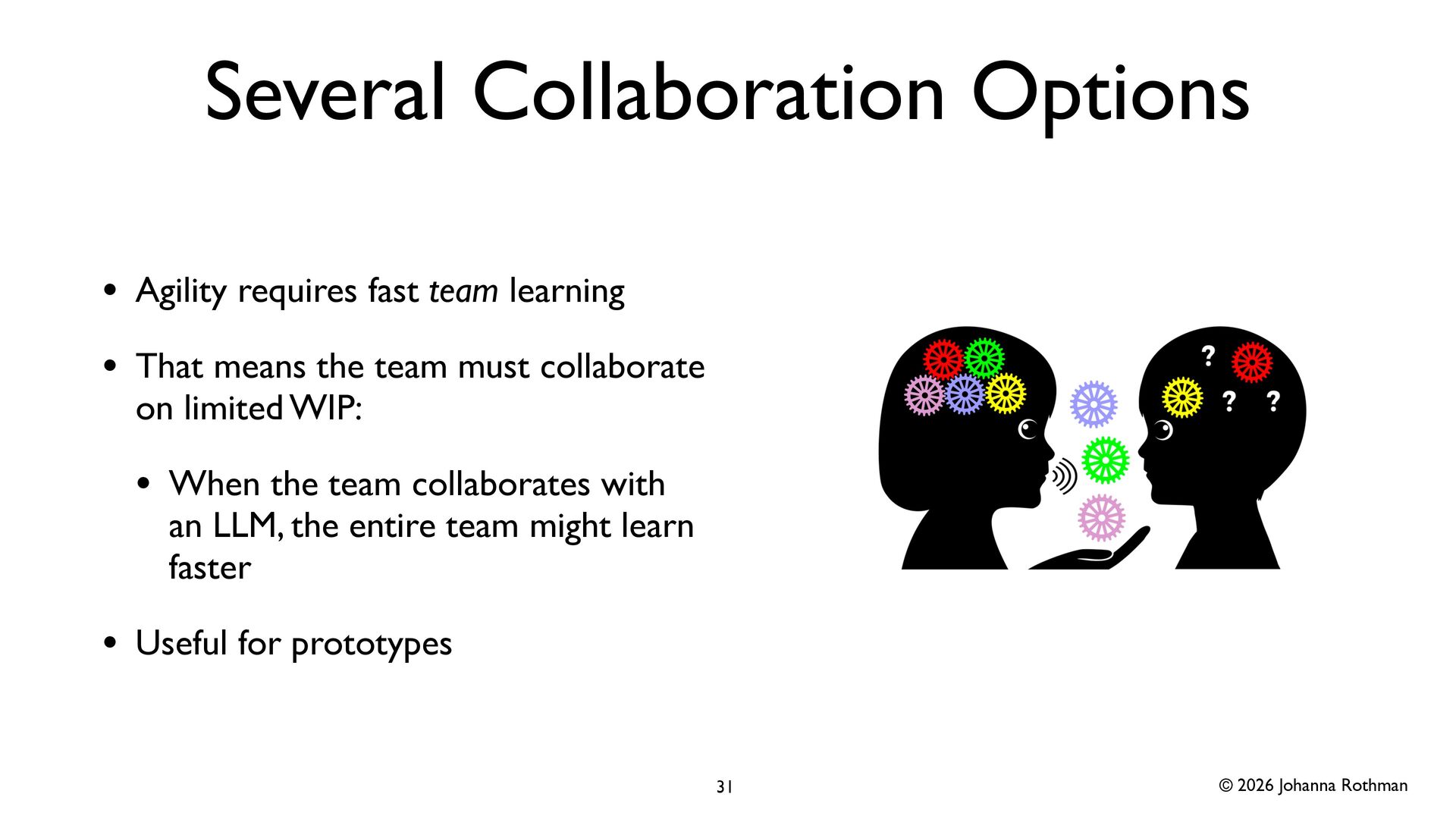
    fast team learning • That means the team must collaborate on limited WIP: • When the team collaborates with an LLM, the entire team might learn faster • Useful for prototypes 31
  20. © 2026 Johanna Rothman My Personal Favorite Use of an

    LLM • Rules to reduce the backlogs, roadmaps, and portfolio because of the fl ow metrics • Delete any item over 20 days old (If you must, put it on a parking lot) • All the good ideas come around again 32
  21. © 2026 Johanna Rothman Remember what productivity is: A reasonably

    priced outcome that allows a customer to buy something useful 33
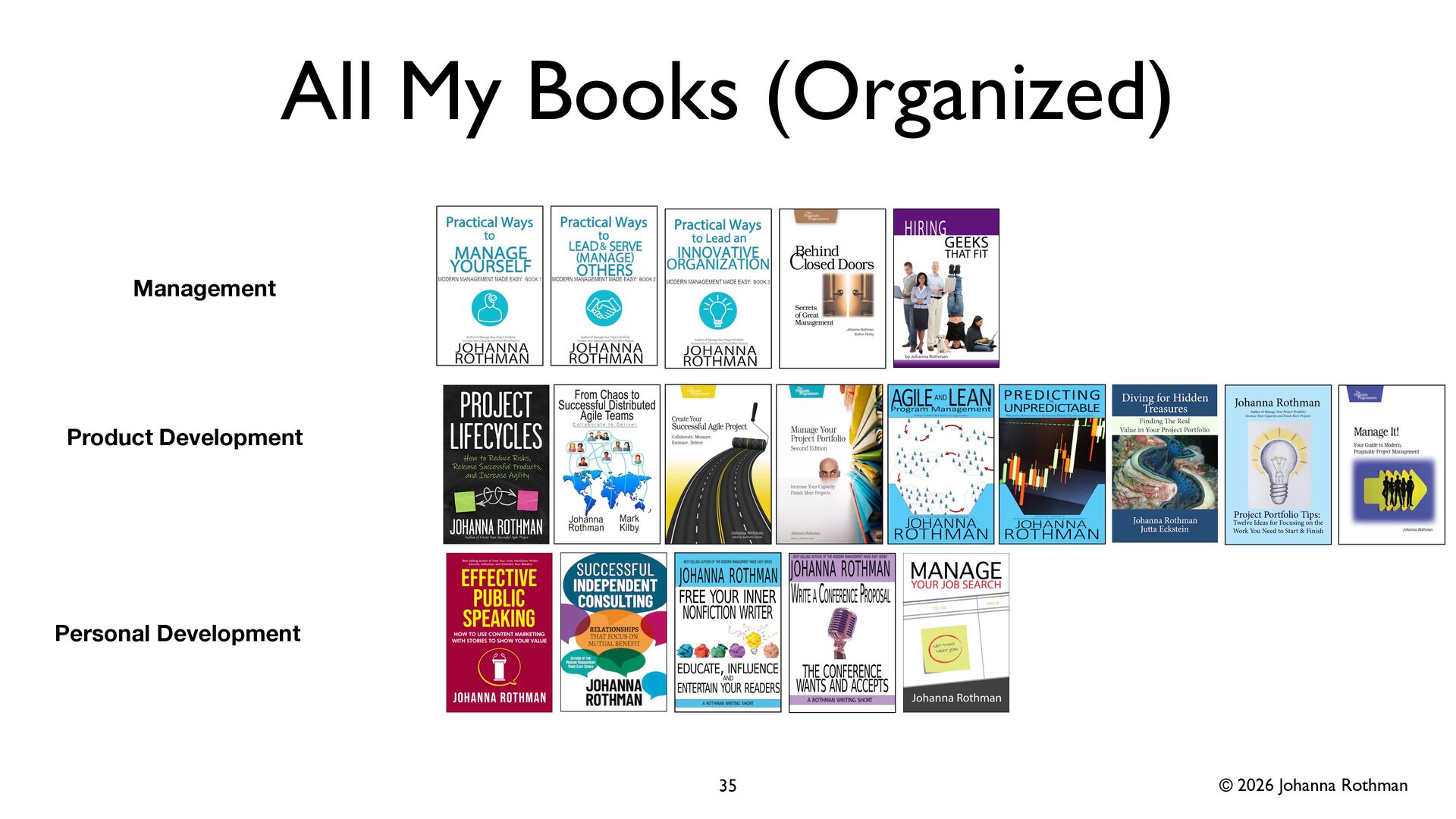
  22. © 2026 Johanna Rothman All My Books (Organized) 35 Product

    Development Management Personal Development
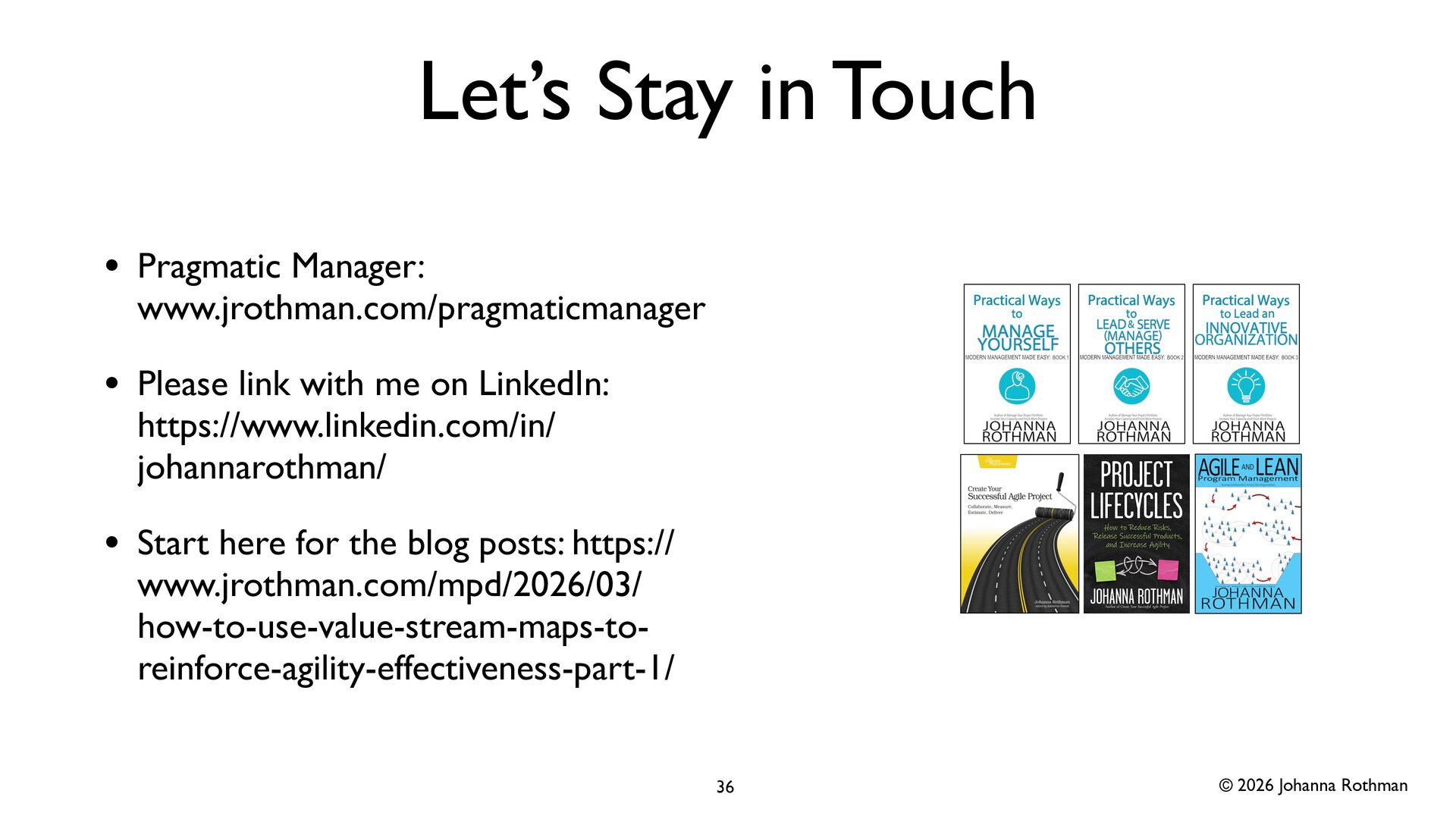
  23. © 2026 Johanna Rothman Let’s Stay in Touch • Pragmatic

    Manager: www.jrothman.com/pragmaticmanager • Please link with me on LinkedIn: https://www.linkedin.com/in/ johannarothman/ • Start here for the blog posts: https:// www.jrothman.com/mpd/2026/03/ how-to-use-value-stream-maps-to- reinforce-agility-effectiveness-part-1/ 36