Upgrade to Pro
— share decks privately, control downloads, hide ads and more …
Speaker Deck
Sign up for free
Menu
Search
Features
All features
Private URLs
Password Protection
Custom URLS
Scheduled publishing
Remove Branding
Restrict embedding
Deck Collections
Notes
Features
All features
Private URLs
Password Protection
Custom URLS
Scheduled publishing
Remove Branding
Restrict embedding
Deck Collections
Notes
Explore
Featured decks
Featured speakers
Programming
Technology
Storyboards
Explore
Featured decks
Featured speakers
Programming
Technology
Storyboards
Pricing
Search
Sign in
Sign up for free
Working With Binary Data in Swift
Search
Sponsored
·
Your Podcast. Everywhere. Effortlessly.
Share. Educate. Inspire. Entertain. You do you. We'll handle the rest.
→
JP Simard
October 29, 2015
Programming
1.3k
4
Share
Embed
Copy iframe code
Copy JS code
Copy link
Start on current slide
Working With Binary Data in Swift
Presented at Swift Summit SF 2015.
Source available here:
https://github.com/jpsim/talks
JP Simard
October 29, 2015
More Decks by JP Simard
See All by JP Simard
Unconventional Swift Patterns
jpsim
0
3.5k
Pushing Envoy Beyond the Edge
jpsim
0
79
Lessons from Mobile Networking at Scale
jpsim
0
100
Bespoke, Artisanal Swift Static Analysis
jpsim
2
1.8k
Performance Profiling Swift on Linux
jpsim
4
1.6k
Realm Mobile Platform Experience
jpsim
3
170
"Watch Your Language!": The road to clean code with SwiftLint
jpsim
6
79k
Mastering Realm Notifications
jpsim
1
34k
Realm 1.0 Party
jpsim
1
160
Other Decks in Programming
See All in Programming
パーソナライズPodcastを作った話
repunit11
0
120
コードレビューのボトルネックを"する側"と"される側"の両面から解消する
yub0n
2
1.5k
Herb in Rails 8.2: Your ERB views, now HTML-aware @ Rails World 2026, Austin, Texas
marcoroth
0
190
半永久的に提供し続けられるプライベートクラウドを目指して ― 利用者の認知負荷を抑えるAPI抽象化とハードウェア世代交代の基盤設計
tomokon
0
440
The Rails Doctrine Decade
koic
2
490
App Storeの外へ──日本のiOSサイドローディング入門 for iOSDC Japan 2026
yuukiw00w
0
310
iOS 27でニュースアプリはどう変わる!? 〜日経電子版の新機能対応と、開発事例から〜
lynnswap
7
13k
スマートフォンでモールス信号を送受信する 〜スマートフォンのLEDとカメラで作る光通信の設計と実装〜
atsuki_seo
0
230
Rでドレミ/Do-Re-Mi_with_R
florets1
0
120
GemmaをJevのように使ってみる / Use Gemma like Jev
kishida
5
680
wkhtmltopdfの次どうするか問題2026
willnet
2
1.8k
Androidだけじゃない、DroidKaigiで広がった私の技術スタック
akkeylab
0
120
Featured
See All Featured
How To Speak Unicorn (iThemes Webinar)
marktimemedia
1
590
Chrome DevTools: State of the Union 2024 - Debugging React & Beyond
addyosmani
10
1.4k
HTML-Aware ERB: The Path to Reactive Rendering @ RubyCon 2026, Rimini, Italy
marcoroth
5
770
Build your cross-platform service in a week with App Engine
jlugia
234
19k
The Cost Of JavaScript in 2023
addyosmani
55
10k
The Curious Case for Waylosing
cassininazir
1
550
JavaScript: Past, Present, and Future - NDC Porto 2020
reverentgeek
52
6.1k
Bash Introduction
62gerente
615
220k
The Hidden Cost of Media on the Web [PixelPalooza 2025]
tammyeverts
2
510
Building AI with AI
inesmontani
PRO
1
1.3k
実際に使うSQLの書き方 徹底解説 / pgcon21j-tutorial
soudai
PRO
203
76k
The B2B funnel & how to create a winning content strategy
katarinadahlin
PRO
1
550
Transcript
Working with Binary Data in Swift
JP Simard @ Realm
None
Options → NSData → [UInt8] → withUnsafePointer() → ???
Layout-Aligned Structs
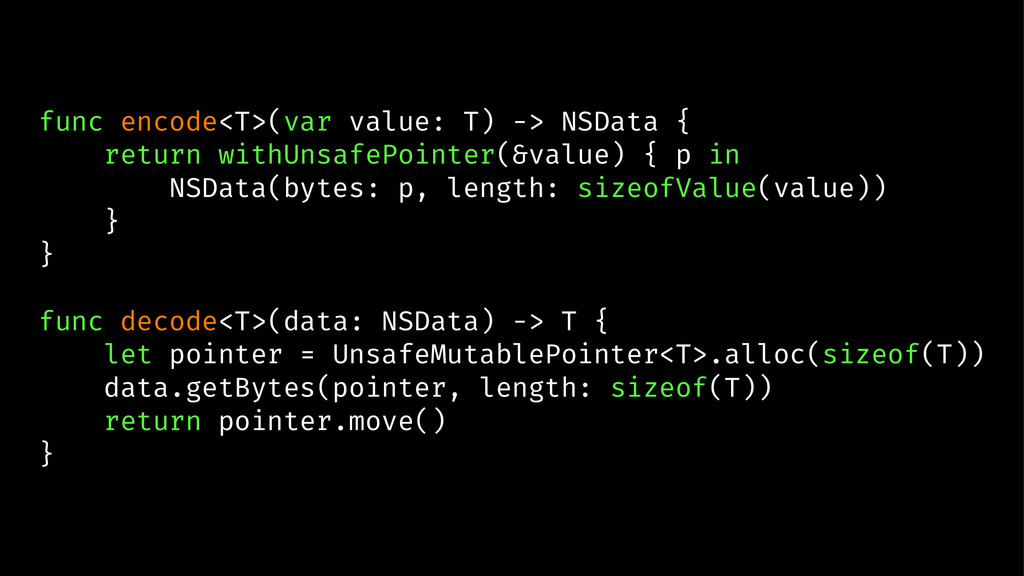
func encode<T>(var value: T) -> NSData { return withUnsafePointer(&value) {
p in NSData(bytes: p, length: sizeofValue(value)) } } func decode<T>(data: NSData) -> T { let pointer = UnsafeMutablePointer<T>.alloc(sizeof(T)) data.getBytes(pointer, length: sizeof(T)) return pointer.move() }
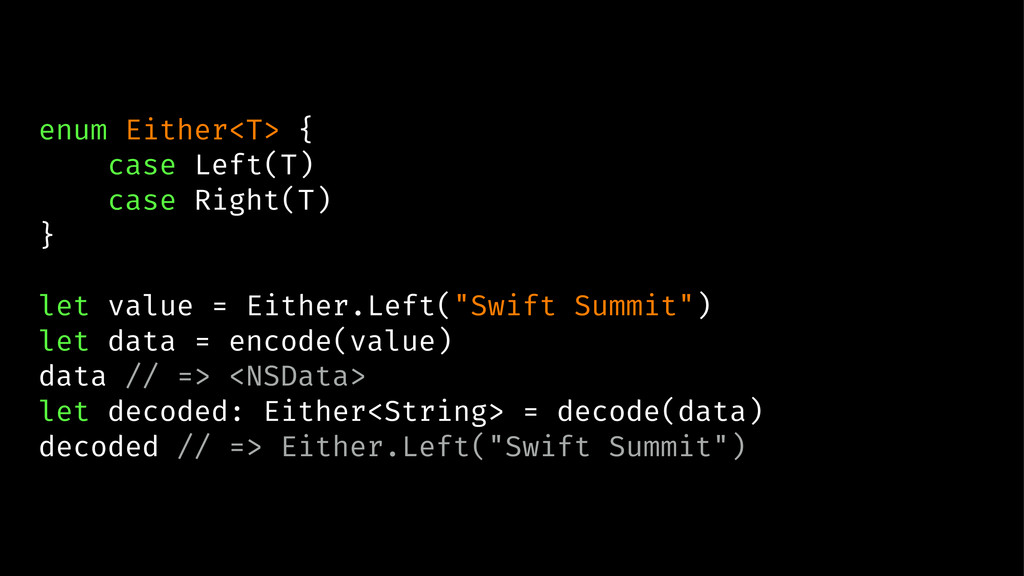
enum Either<T> { case Left(T) case Right(T) } let value
= Either.Left("Swift Summit") let data = encode(value) data // => <NSData> let decoded: Either<String> = decode(data) decoded // => Either.Left("Swift Summit")
None
None
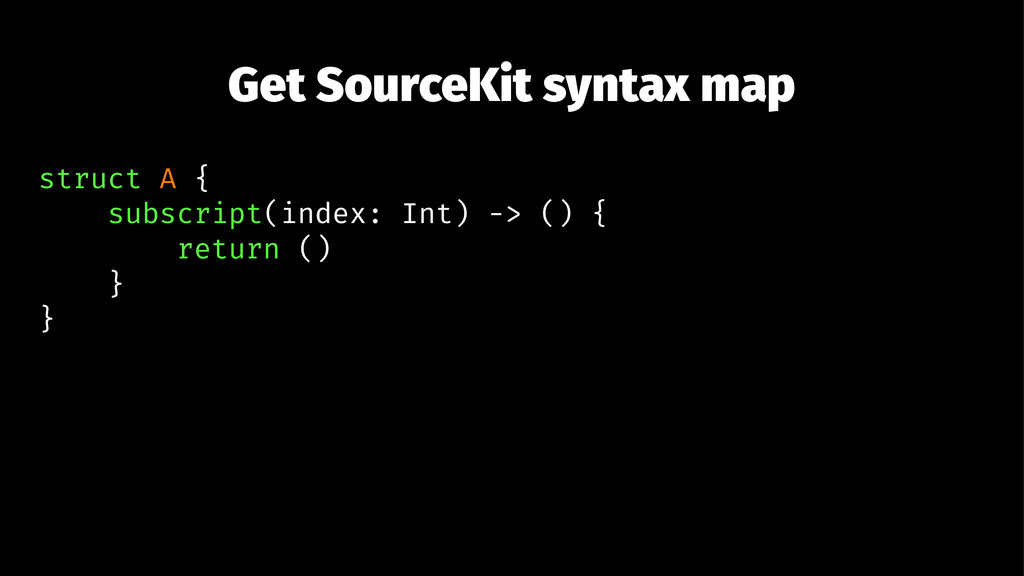
Get SourceKit syntax map struct A { subscript(index: Int) ->
() { return () } }
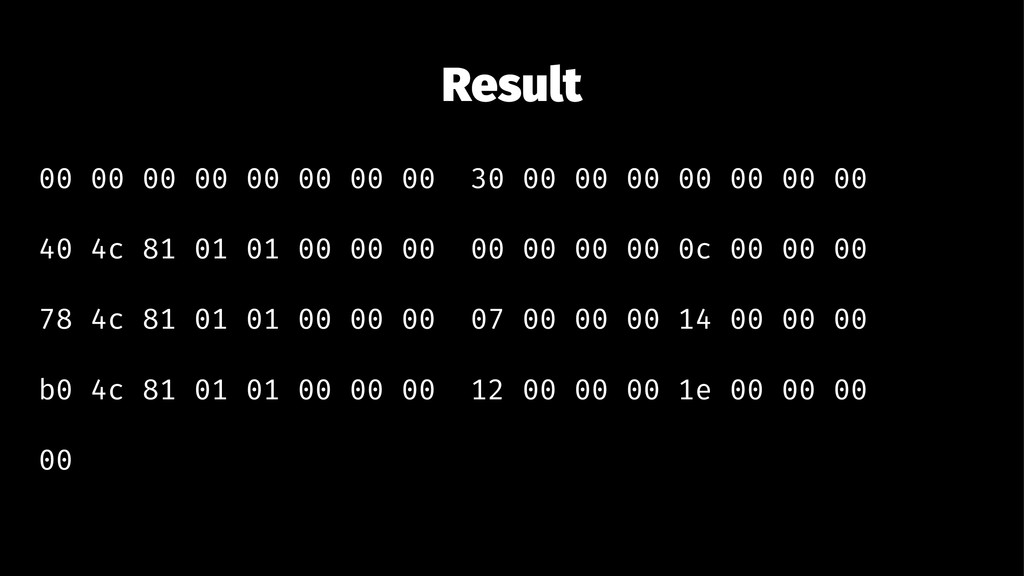
Result 00 00 00 00 00 00 00 00 30
00 00 00 00 00 00 00 40 4c 81 01 01 00 00 00 00 00 00 00 0c 00 00 00 78 4c 81 01 01 00 00 00 07 00 00 00 14 00 00 00 b0 4c 81 01 01 00 00 00 12 00 00 00 1e 00 00 00 00
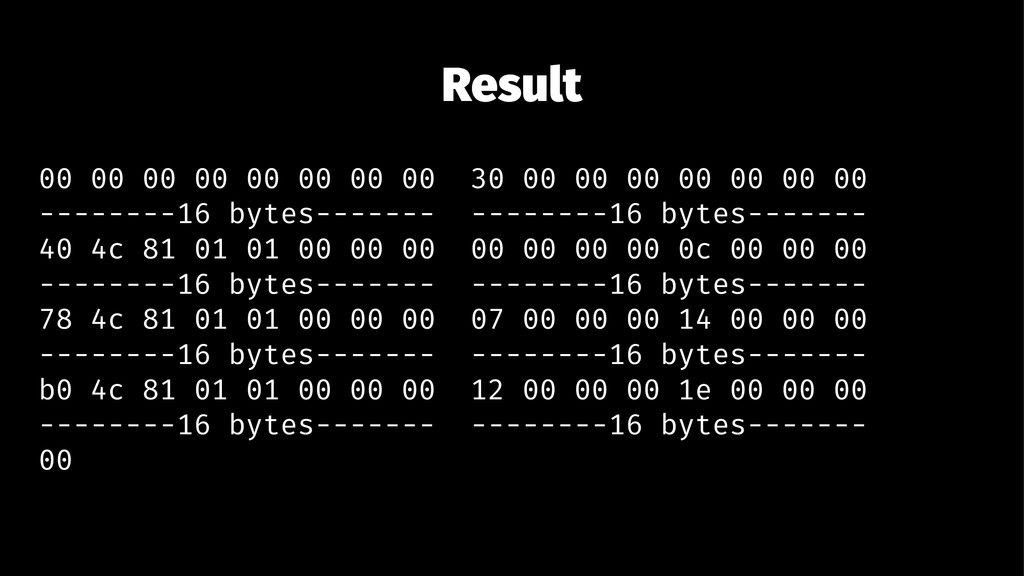
Result 00 00 00 00 00 00 00 00 30
00 00 00 00 00 00 00 --------16 bytes------- --------16 bytes------- 40 4c 81 01 01 00 00 00 00 00 00 00 0c 00 00 00 --------16 bytes------- --------16 bytes------- 78 4c 81 01 01 00 00 00 07 00 00 00 14 00 00 00 --------16 bytes------- --------16 bytes------- b0 4c 81 01 01 00 00 00 12 00 00 00 1e 00 00 00 --------16 bytes------- --------16 bytes------- 00
!
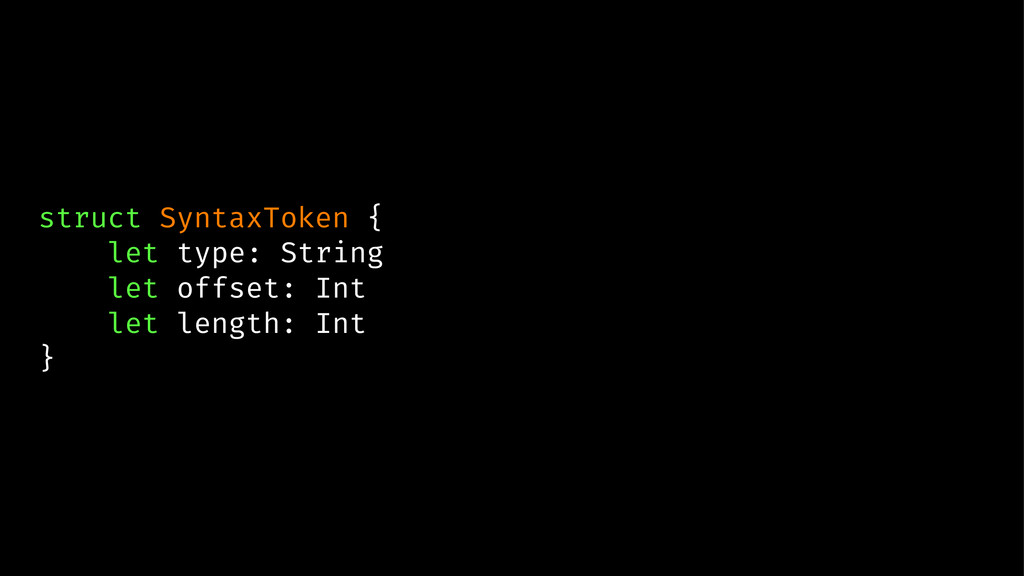
struct SyntaxToken { let type: String let offset: Int let
length: Int }
Strideable
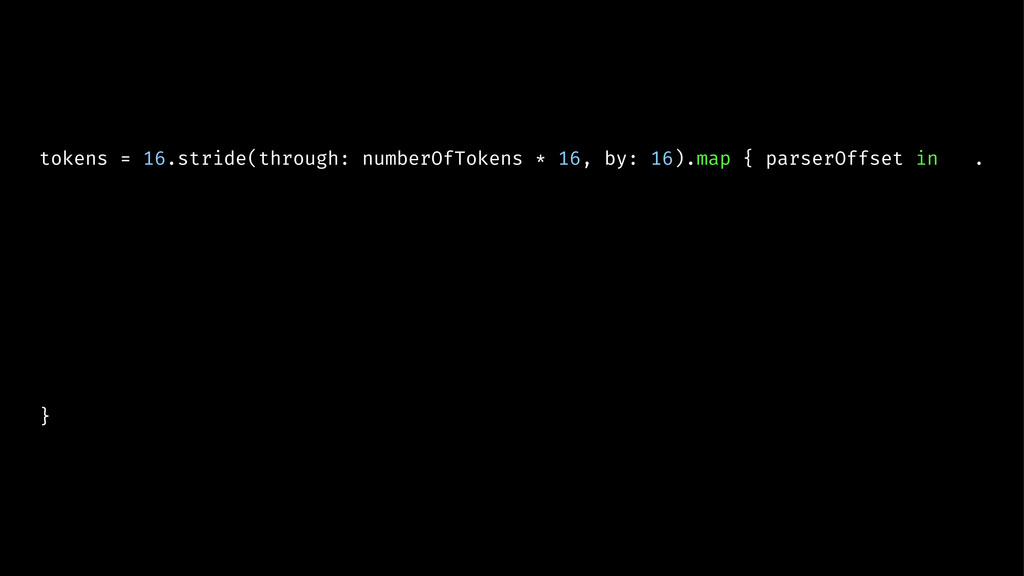
tokens = 16.stride(through: numberOfTokens * 16, by: 16).map { parserOffset
in . }
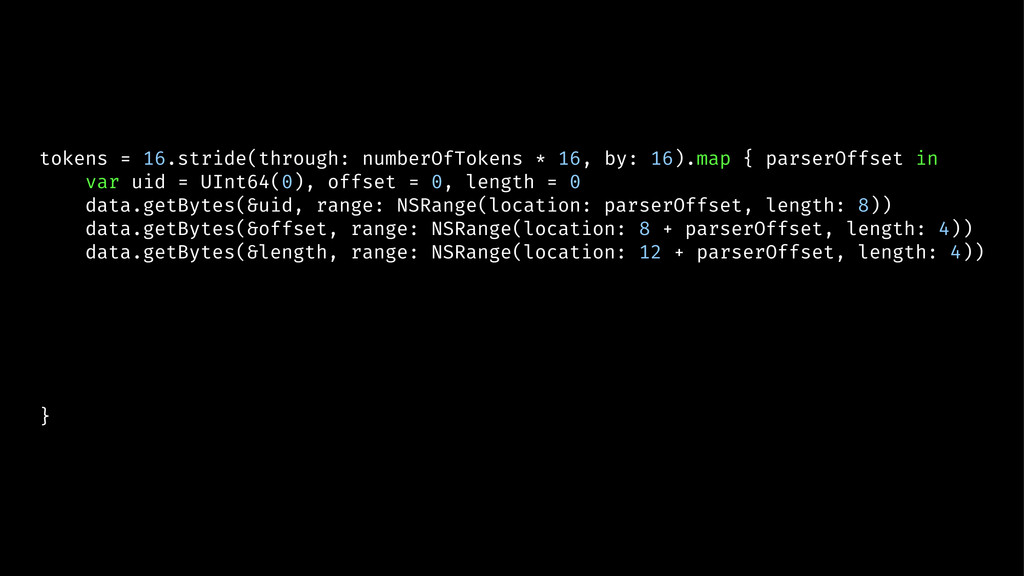
tokens = 16.stride(through: numberOfTokens * 16, by: 16).map { parserOffset
in var uid = UInt64(0), offset = 0, length = 0 data.getBytes(&uid, range: NSRange(location: parserOffset, length: 8)) data.getBytes(&offset, range: NSRange(location: 8 + parserOffset, length: 4)) data.getBytes(&length, range: NSRange(location: 12 + parserOffset, length: 4)) }
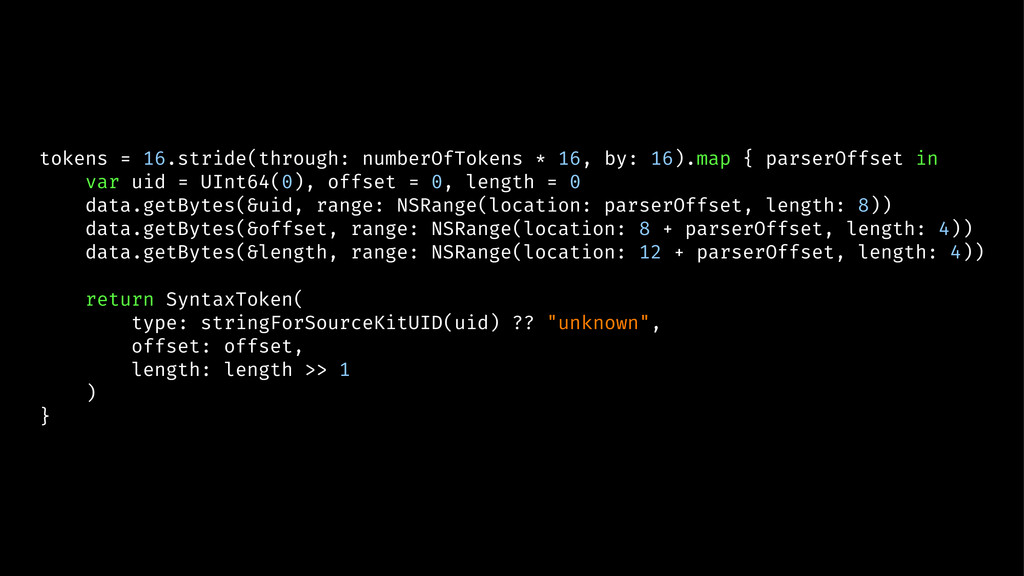
tokens = 16.stride(through: numberOfTokens * 16, by: 16).map { parserOffset
in var uid = UInt64(0), offset = 0, length = 0 data.getBytes(&uid, range: NSRange(location: parserOffset, length: 8)) data.getBytes(&offset, range: NSRange(location: 8 + parserOffset, length: 4)) data.getBytes(&length, range: NSRange(location: 12 + parserOffset, length: 4)) return SyntaxToken( type: stringForSourceKitUID(uid) ?? "unknown", offset: offset, length: length >> 1 ) }
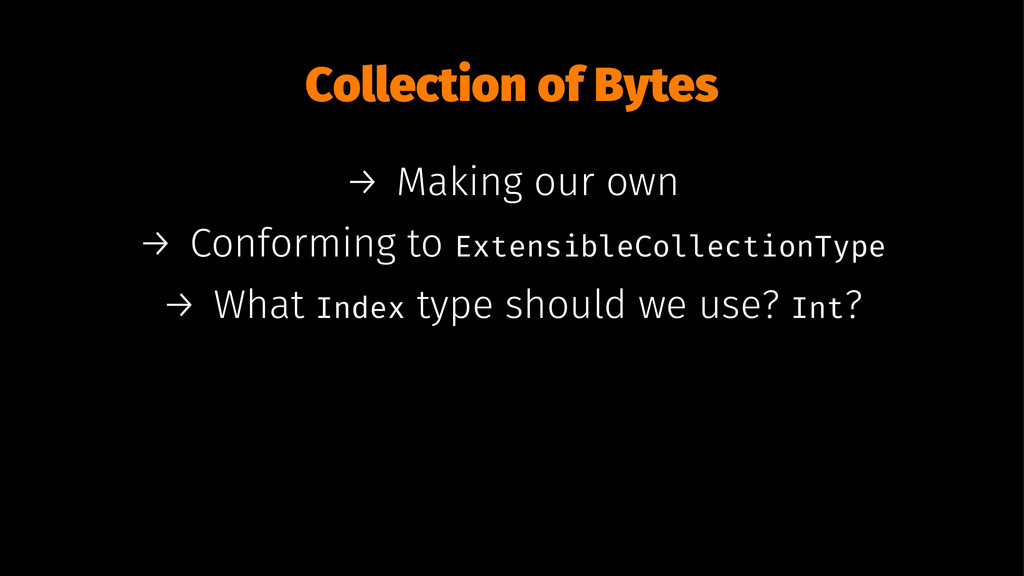
Collection of Bytes → Making our own → Conforming to
ExtensibleCollectionType → What Index type should we use? Int?
Just end up with [UInt8]
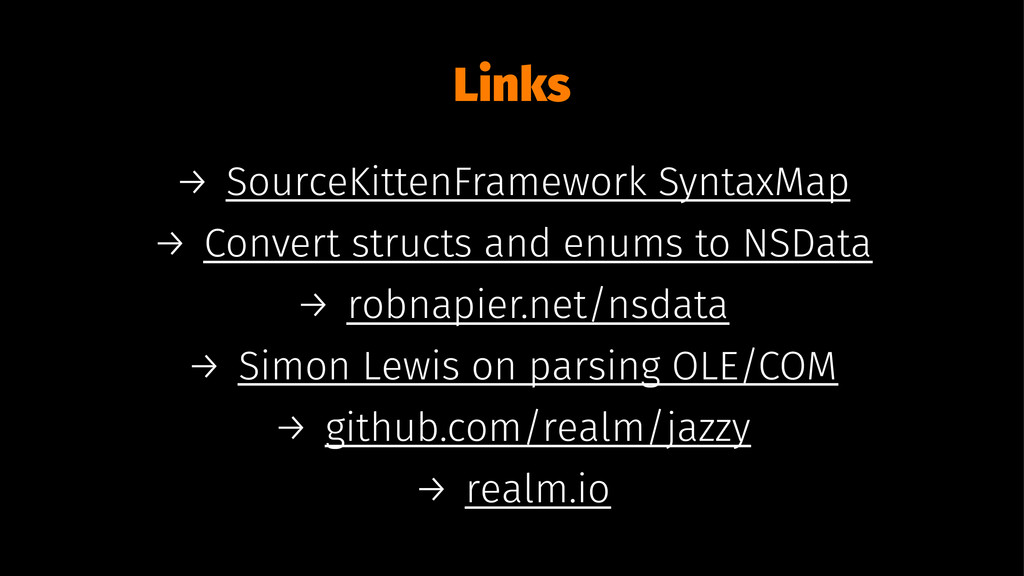
Links → SourceKittenFramework SyntaxMap → Convert structs and enums to
NSData → robnapier.net/nsdata → Simon Lewis on parsing OLE/COM → github.com/realm/jazzy → realm.io
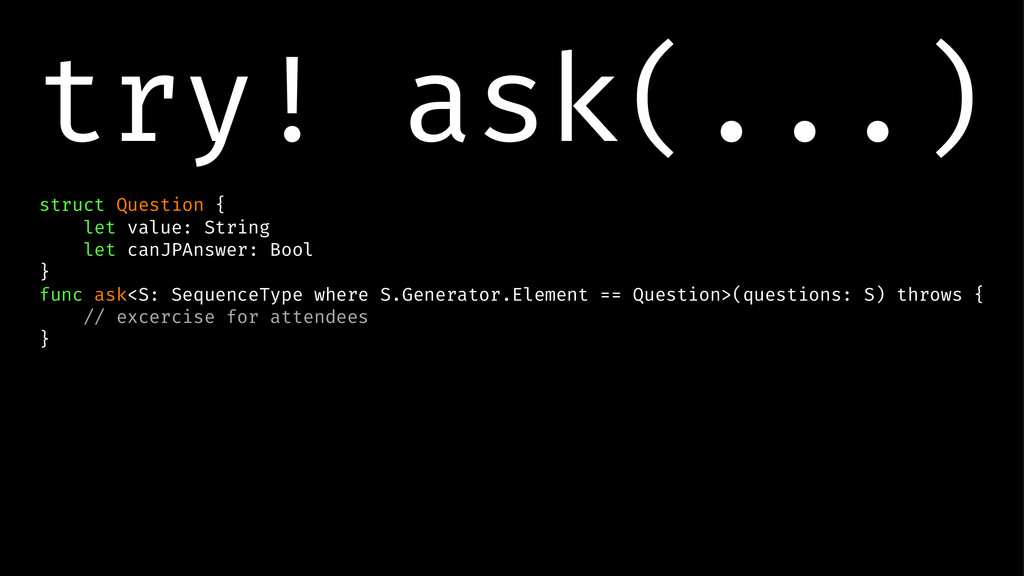
try! ask(...) struct Question { let value: String let canJPAnswer:
Bool } func ask<S: SequenceType where S.Generator.Element == Question>(questions: S) throws { // excercise for attendees }


 jpsim
jpsim
 repunit11
 yub0n
yub0n
 marcoroth
 tomokon
 koic
koic
 yuukiw00w
 lynnswap
 atsuki_seo
 florets1
 kishida
 willnet
 akkeylab
 marktimemedia
 addyosmani
 jlugia
 cassininazir
 reverentgeek
 62gerente
 tammyeverts
 inesmontani
 soudai
 katarinadahlin

![Options → NSData → [UInt8] → withUnsafePointer() → ???](https://files.speakerdeck.com/presentations/082378c1d84b45eba416386abc870337/slide_3.jpg)



![Just end up with [UInt8]](https://files.speakerdeck.com/presentations/082378c1d84b45eba416386abc870337/slide_19.jpg)