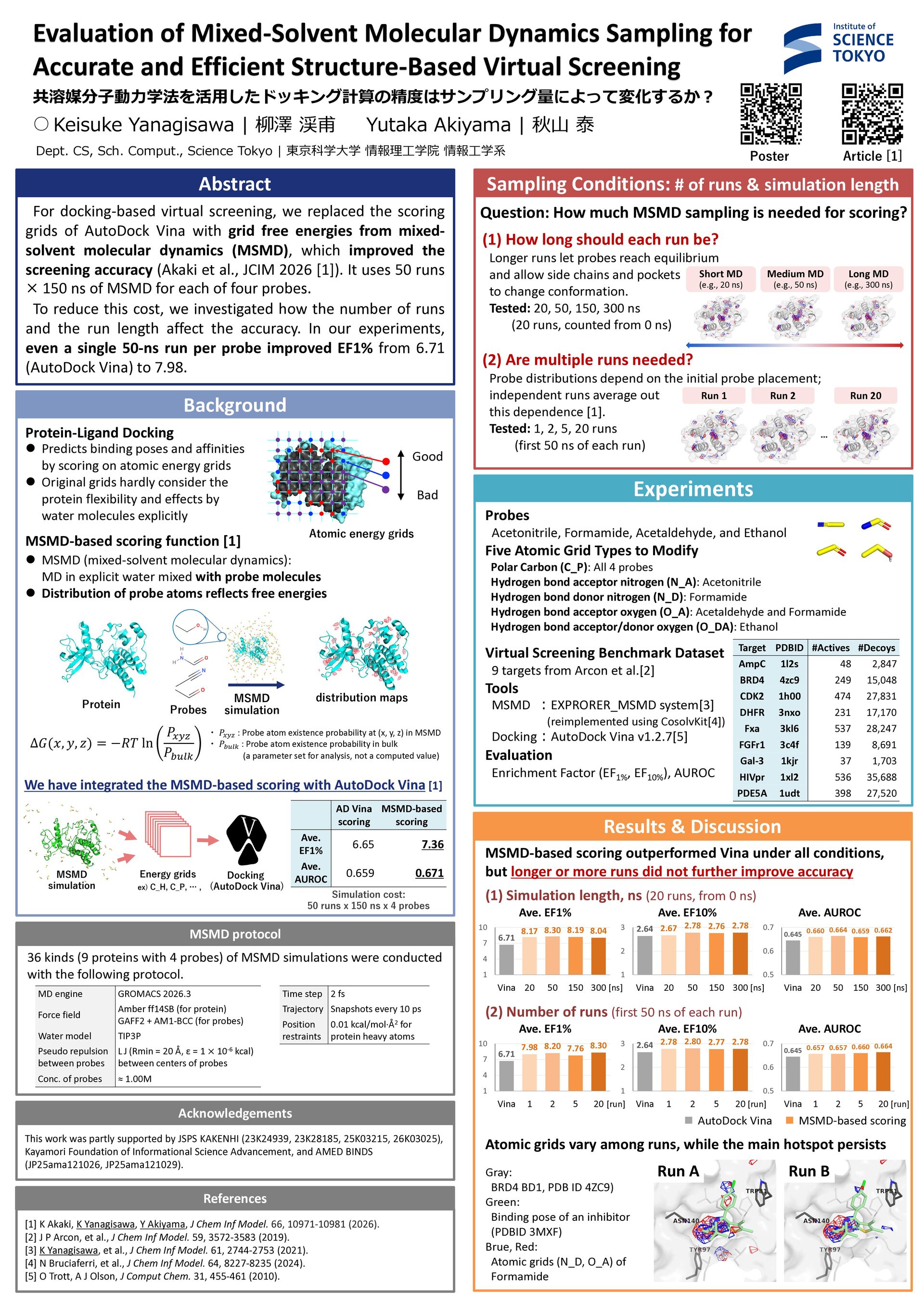
Structure-Based Virtual Screening 共溶媒分子動力学法を活用したドッキング計算の精度はサンプリング量によって変化するか? ◦ Keisuke Yanagisawa | 柳澤 渓甫 Yutaka Akiyama | 秋山 泰 Dept. CS, Sch. Comput., Science Tokyo | 東京科学大学 情報理工学院 情報工学系 Poster Article [1] Abstract Sampling Conditions: # of runs & simulation length For docking-based virtual screening, we replaced the scoring grids of AutoDock Vina with grid free energies from mixedsolvent molecular dynamics (MSMD), which improved the screening accuracy (Akaki et al., JCIM 2026 [1]). It uses 50 runs × 150 ns of MSMD for each of four probes. To reduce this cost, we investigated how the number of runs and the run length affect the accuracy. In our experiments, even a single 50-ns run per probe improved EF1% from 6.71 (AutoDock Vina) to 7.98. Question: How much MSMD sampling is needed for scoring? (1) How long should each run be? Longer runs let probes reach equilibrium and allow side chains and pockets Short MD (e.g., 20 ns) to change conformation. Tested: 20, 50, 150, 300 ns (20 runs, counted from 0 ns) Good Acetonitrile, Formamide, Acetaldehyde, and Ethanol Atomic energy grids Five Atomic Grid Types to Modify Polar Carbon (C_P): All 4 probes Hydrogen bond acceptor nitrogen (N_A): Acetonitrile Hydrogen bond donor nitrogen (N_D): Formamide Hydrogen bond acceptor oxygen (O_A): Acetaldehyde and Formamide Hydrogen bond acceptor/donor oxygen (O_DA): Ethanol Virtual Screening Benchmark Dataset 9 targets from Arcon et al.[2] Tools distribution maps MSMD simulation MSMD :EXPRORER_MSMD system[3] ・ 𝑃𝑥𝑦𝑧 : Probe atom existence probability at (x, y, z) in MSMD ・ 𝑃𝑏𝑢𝑙𝑘 : Probe atom existence probability in bulk (a parameter set for analysis, not a computed value) (reimplemented using CosolvKit[4]) Docking:AutoDock Vina v1.2.7[5] Evaluation Enrichment Factor (EF1%, EF10%), AUROC We have integrated the MSMD-based scoring with AutoDock Vina [1] AD Vina MSMD-based scoring scoring MSMD simulation Energy grids Docking ex) C_H, C_P, … , (AutoDock Vina) Ave. EF1% Ave. AUROC 6.65 7.36 0.659 0.671 Simulation cost: 50 runs x 150 ns x 4 probes GROMACS 2026.3 Amber ff14SB (for protein) Force field GAFF2 + AM1-BCC (for probes) Water model TIP3P Pseudo repulsion L J (Rmin = 20 Å, ε = 1 × 10⁻⁶ kcal) between probes between centers of probes Conc. of probes MSMD-based scoring outperformed Vina under all conditions, but longer or more runs did not further improve accuracy (1) Simulation length, ns (20 runs, from 0 ns) Ave. EF1% 7 36 kinds (9 proteins with 4 probes) of MSMD simulations were conducted with the following protocol. Position 0.01 kcal/mol·Å2 for restraints protein heavy atoms 6.71 Ave. EF10% 8.17 8.30 8.19 8.04 4 1 Vina 20 Time step 2 fs Trajectory Snapshots every 10 ps 50 This work was partly supported by JSPS KAKENHI (23K24939, 23K28185, 25K03215, 26K03025), Kayamori Foundation of Informational Science Advancement, and AMED BINDS (JP25ama121026, JP25ama121029). References [1] K Akaki, K Yanagisawa, Y Akiyama, J Chem Inf Model. 66, 10971-10981 (2026). [2] J P Arcon, et al., J Chem Inf Model. 59, 3572-3583 (2019). [3] K Yanagisawa, et al., J Chem Inf Model. 61, 2744-2753 (2021). [4] N Bruciaferri, et al., J Chem Inf Model. 64, 8227-8235 (2024). [5] O Trott, A J Olson, J Comput Chem. 31, 455-461 (2010). Ave. AUROC 2.64 2.67 2.78 2.76 2.78 0.7 2 0.6 1 0.5 Vina 20 50 150 300 [ns] 0.645 0.660 0.664 0.659 0.662 Vina 20 50 150 300 [ns] (2) Number of runs (first 50 ns of each run) Ave. EF1% 10 7 6.71 Ave. EF10% 7.98 8.20 7.76 8.30 1 Acknowledgements 3 150 300 [ns] 4 ≈ 1.00M Target PDBID #Actives #Decoys AmpC 1l2s 48 2,847 BRD4 4zc9 249 15,048 CDK2 1h00 474 27,831 DHFR 3nxo 231 17,170 Fxa 3kl6 537 28,247 FGFr1 3c4f 139 8,691 Gal-3 1kjr 37 1,703 HIVpr 1xl2 536 35,688 PDE5A 1udt 398 27,520 Results & Discussion 10 MSMD protocol MD engine Run 20 Probes ⚫ MSMD (mixed-solvent molecular dynamics): MD in explicit water mixed with probe molecules ⚫ Distribution of probe atoms reflects free energies 𝑃𝑥𝑦𝑧 Δ𝐺(𝑥, 𝑦, 𝑧) = −𝑅𝑇 ln 𝑃𝑏𝑢𝑙𝑘 (e.g., 300 ns) Experiments Bad MSMD-based scoring function [1] Probes (e.g., 50 ns) Probe distributions depend on the initial probe placement; Run 1 Run 2 independent runs average out this dependence [1]. Tested: 1, 2, 5, 20 runs … (first 50 ns of each run) Protein-Ligand Docking Protein Long MD (2) Are multiple runs needed? Background ⚫ Predicts binding poses and affinities by scoring on atomic energy grids ⚫ Original grids hardly consider the protein flexibility and effects by water molecules explicitly Medium MD Vina 1 2 5 3 Ave. AUROC 2.64 2.78 2.80 2.77 2.78 0.7 2 0.6 1 0.5 20 [run] Vina 1 2 5 20 [run] 0.645 0.657 0.657 0.660 0.664 Vina 20 [run] 1 2 5 ▪ AutoDock Vina ▪ MSMD-based scoring Atomic grids vary among runs, while the main hotspot persists Gray: BRD4 BD1, PDB ID 4ZC9) Green: Binding pose of an inhibitor (PDBID 3MXF) Brue, Red: Atomic grids (N_D, O_A) of Formamide Run A Run B


 keisukeyanagisawa
 nzw0301
 sishi2026
 institutdelelevage
 ldcn
 rikkabotan7
 fr0gger
 sishi
 stktu
 yumaichikawa
 de9uch1
 ayaniwa
 smashingmag
 davidcarrasco
 thekraken
 reverentgeek
 notwaldorf
 jct
 addyosmani
 danielanewman
 asonas
 codingconduct
 matthewcrist
 aleyda