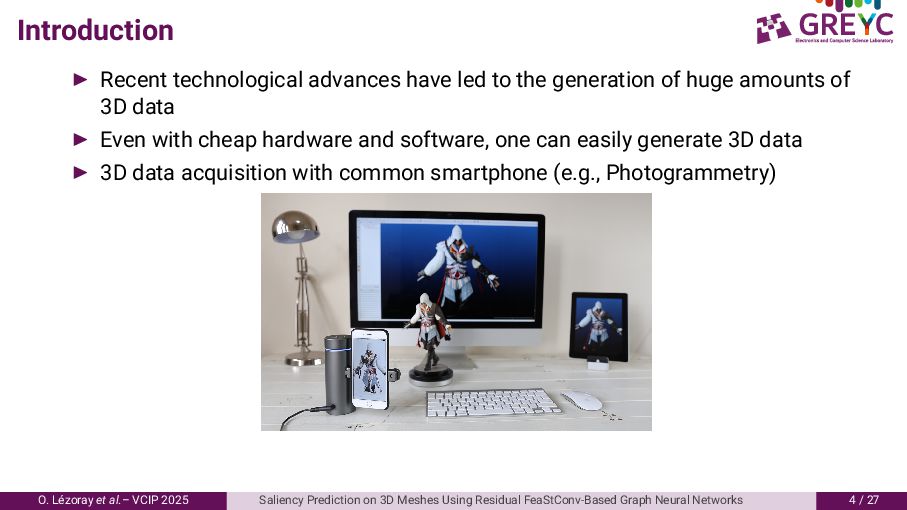
of huge amounts of 3D data ▶ Even with cheap hardware and software, one can easily generate 3D data ▶ 3D data acquisition with common smartphone (e.g., Photogrammetry) O. L´ ezoray et al.– VCIP 2025 Saliency Prediction on 3D Meshes Using Residual FeaStConv-Based Graph Neural Networks 4 / 27
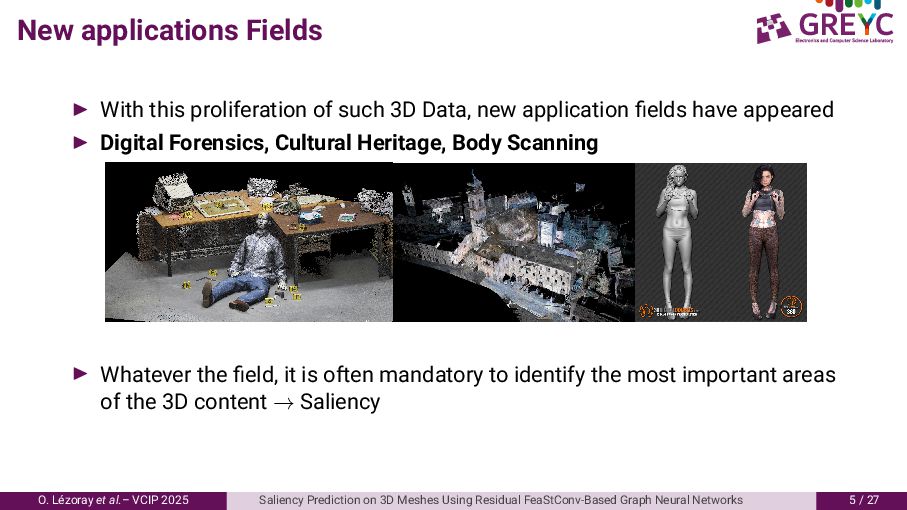
Data, new application fields have appeared ▶ Digital Forensics, Cultural Heritage, Body Scanning ▶ Whatever the field, it is often mandatory to identify the most important areas of the 3D content → Saliency O. L´ ezoray et al.– VCIP 2025 Saliency Prediction on 3D Meshes Using Residual FeaStConv-Based Graph Neural Networks 5 / 27
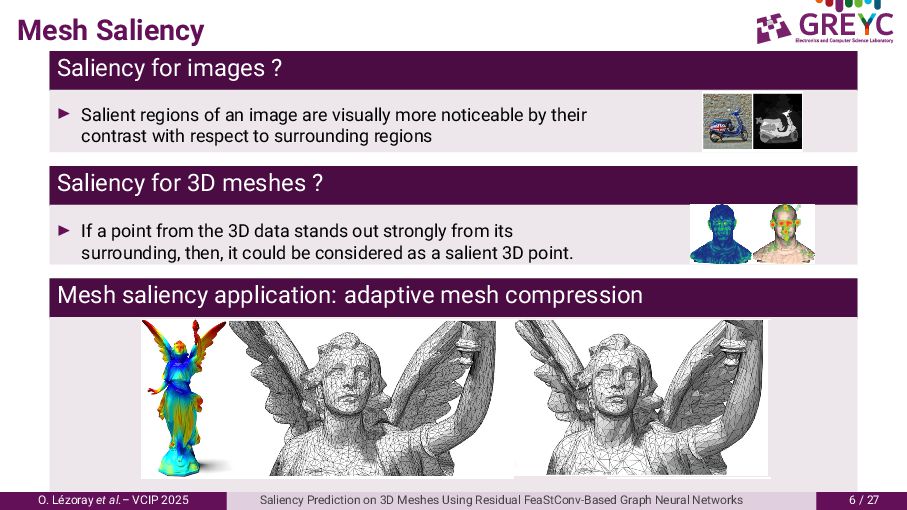
an image are visually more noticeable by their contrast with respect to surrounding regions Saliency for 3D meshes ? ▶ If a point from the 3D data stands out strongly from its surrounding, then, it could be considered as a salient 3D point. Mesh saliency application: adaptive mesh compression O. L´ ezoray et al.– VCIP 2025 Saliency Prediction on 3D Meshes Using Residual FeaStConv-Based Graph Neural Networks 6 / 27
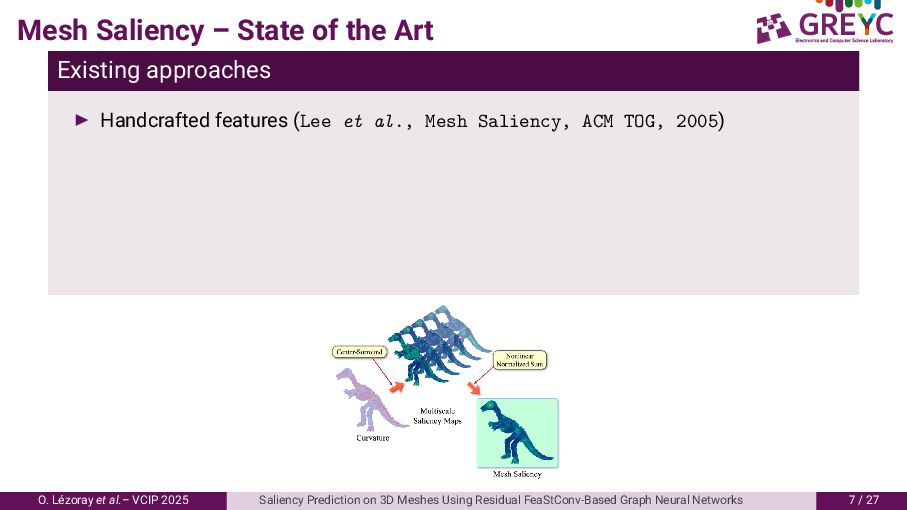
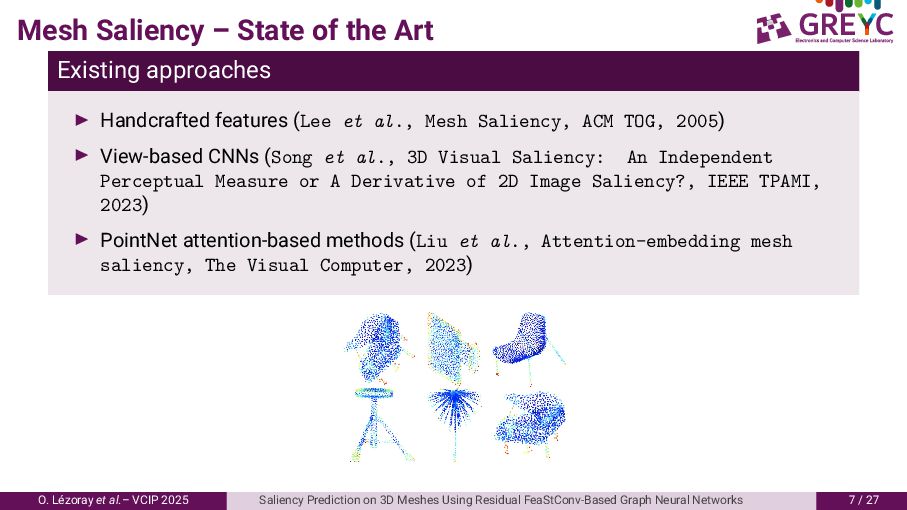
Handcrafted features (Lee et al., Mesh Saliency, ACM TOG, 2005) O. L´ ezoray et al.– VCIP 2025 Saliency Prediction on 3D Meshes Using Residual FeaStConv-Based Graph Neural Networks 7 / 27
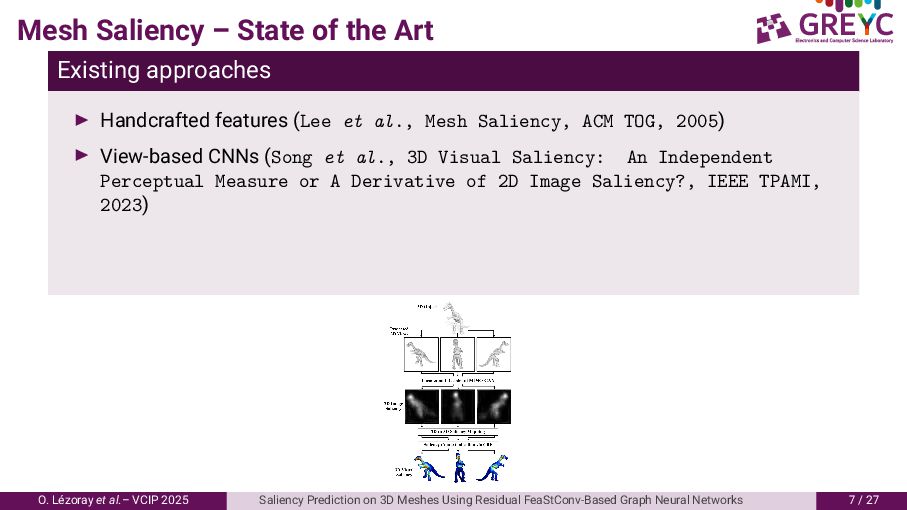
Handcrafted features (Lee et al., Mesh Saliency, ACM TOG, 2005) ▶ View-based CNNs (Song et al., 3D Visual Saliency: An Independent Perceptual Measure or A Derivative of 2D Image Saliency?, IEEE TPAMI, 2023) O. L´ ezoray et al.– VCIP 2025 Saliency Prediction on 3D Meshes Using Residual FeaStConv-Based Graph Neural Networks 7 / 27
Handcrafted features (Lee et al., Mesh Saliency, ACM TOG, 2005) ▶ View-based CNNs (Song et al., 3D Visual Saliency: An Independent Perceptual Measure or A Derivative of 2D Image Saliency?, IEEE TPAMI, 2023) ▶ PointNet attention-based methods (Liu et al., Attention-embedding mesh saliency, The Visual Computer, 2023) O. L´ ezoray et al.– VCIP 2025 Saliency Prediction on 3D Meshes Using Residual FeaStConv-Based Graph Neural Networks 7 / 27
Handcrafted features (Lee et al., Mesh Saliency, ACM TOG, 2005) ▶ View-based CNNs (Song et al., 3D Visual Saliency: An Independent Perceptual Measure or A Derivative of 2D Image Saliency?, IEEE TPAMI, 2023) ▶ PointNet attention-based methods (Liu et al., Attention-embedding mesh saliency, The Visual Computer, 2023) Observation Surprinsingly, no approaches based on Graph Neural Networks (GNNs) ⇒ Our proposal O. L´ ezoray et al.– VCIP 2025 Saliency Prediction on 3D Meshes Using Residual FeaStConv-Based Graph Neural Networks 7 / 27
per vertex on a 3D mesh ▶ Saliency represents the perceptual importance of each region ▶ We propose a tailored Graph Neural Network (GNN) that operates directly on the geometric and topological structure of triangular meshes ▶ Model name: SARMA – Saliency Analysis with a Residual Mesh-based Architecture O. L´ ezoray et al.– VCIP 2025 Saliency Prediction on 3D Meshes Using Residual FeaStConv-Based Graph Neural Networks 10 / 27
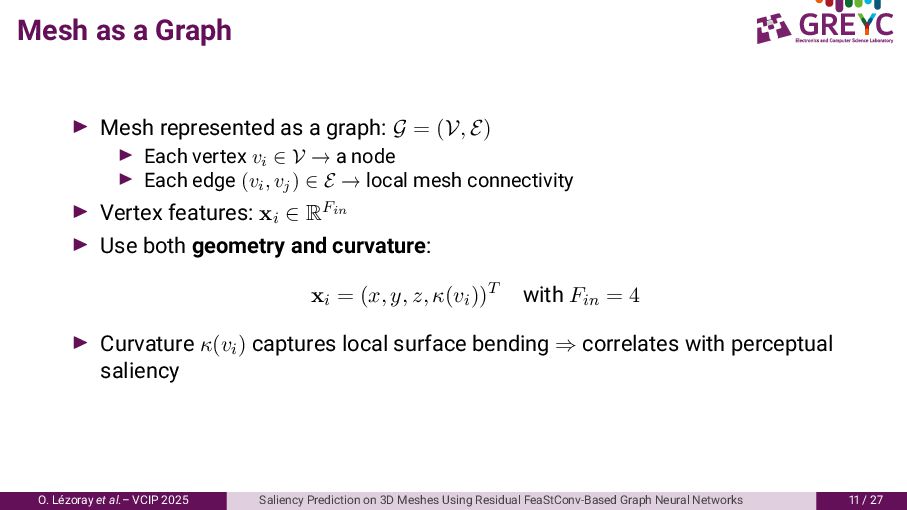
G = (V, E) ▶ Each vertex vi ∈ V → a node ▶ Each edge (vi , vj ) ∈ E → local mesh connectivity ▶ Vertex features: xi ∈ RFin ▶ Use both geometry and curvature: xi = (x, y, z, κ(vi ))T with Fin = 4 ▶ Curvature κ(vi ) captures local surface bending ⇒ correlates with perceptual saliency O. L´ ezoray et al.– VCIP 2025 Saliency Prediction on 3D Meshes Using Residual FeaStConv-Based Graph Neural Networks 11 / 27
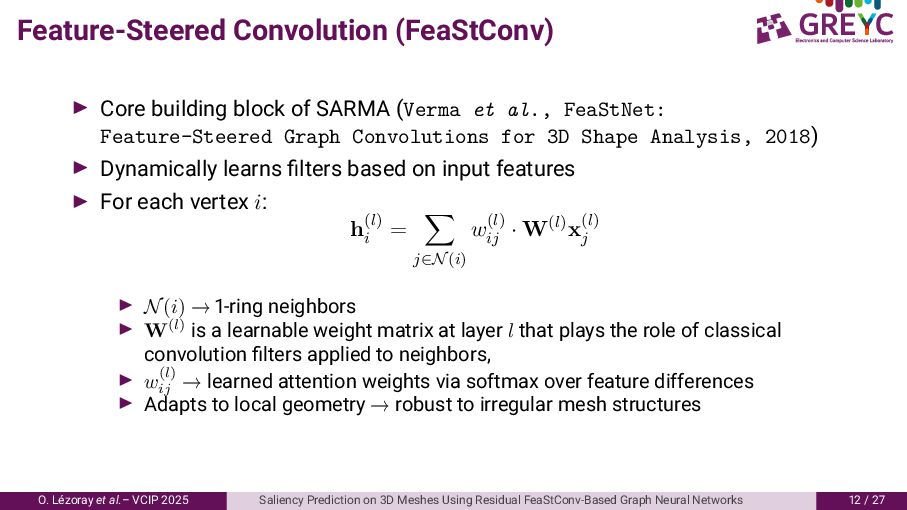
et al., FeaStNet: Feature-Steered Graph Convolutions for 3D Shape Analysis, 2018) ▶ Dynamically learns filters based on input features ▶ For each vertex i: h(l) i = j∈N(i) w(l) ij · W(l)x(l) j ▶ N(i) → 1-ring neighbors ▶ W(l) is a learnable weight matrix at layer l that plays the role of classical convolution filters applied to neighbors, ▶ w(l) ij → learned attention weights via softmax over feature differences ▶ Adapts to local geometry → robust to irregular mesh structures O. L´ ezoray et al.– VCIP 2025 Saliency Prediction on 3D Meshes Using Residual FeaStConv-Based Graph Neural Networks 12 / 27
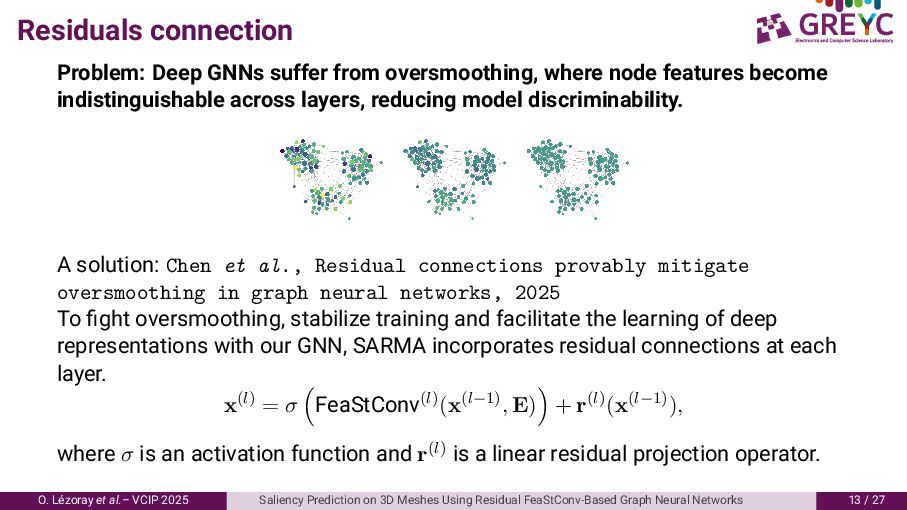
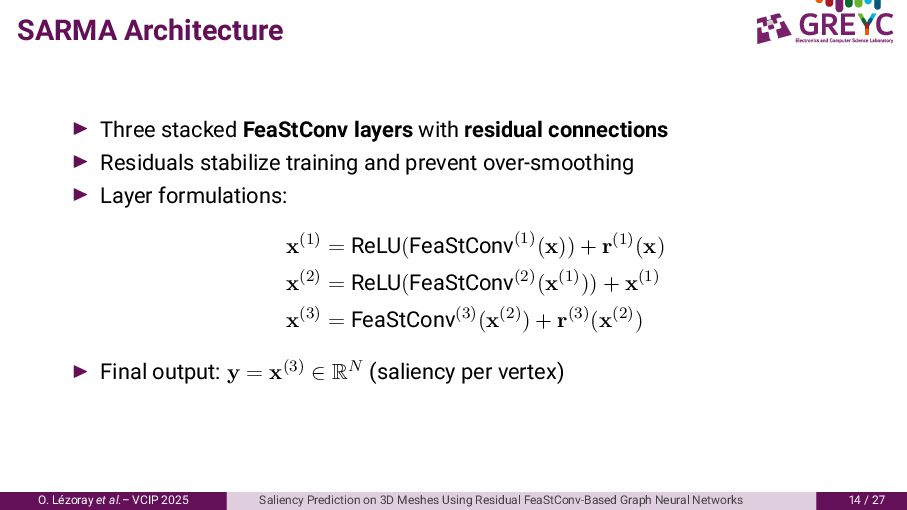
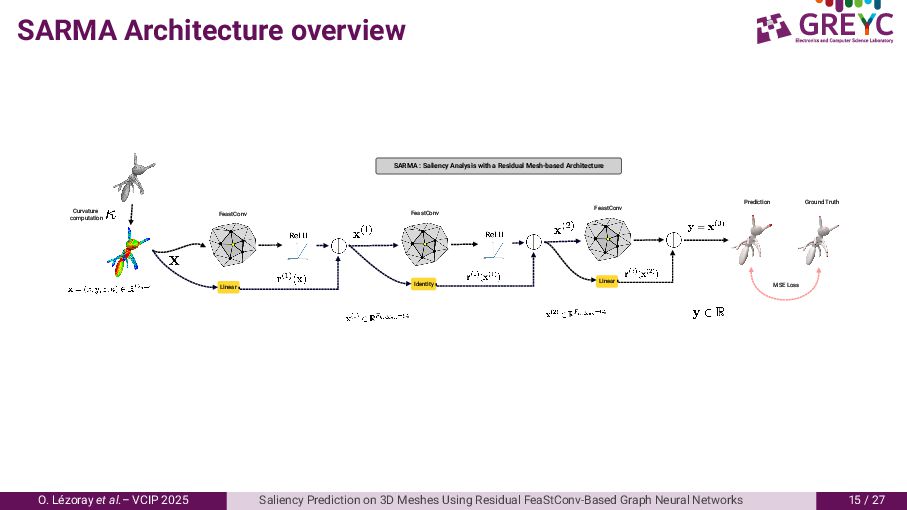
features become indistinguishable across layers, reducing model discriminability. A solution: Chen et al., Residual connections provably mitigate oversmoothing in graph neural networks, 2025 To fight oversmoothing, stabilize training and facilitate the learning of deep representations with our GNN, SARMA incorporates residual connections at each layer. x(l) = σ FeaStConv(l)(x(l−1), E) + r(l)(x(l−1)), where σ is an activation function and r(l) is a linear residual projection operator. O. L´ ezoray et al.– VCIP 2025 Saliency Prediction on 3D Meshes Using Residual FeaStConv-Based Graph Neural Networks 13 / 27
Mesh-based Architecture Curvature computation FeastConv Linear FeastConv Identity FeastConv Linear Prediction Ground Truth MSE Loss O. L´ ezoray et al.– VCIP 2025 Saliency Prediction on 3D Meshes Using Residual FeaStConv-Based Graph Neural Networks 15 / 27
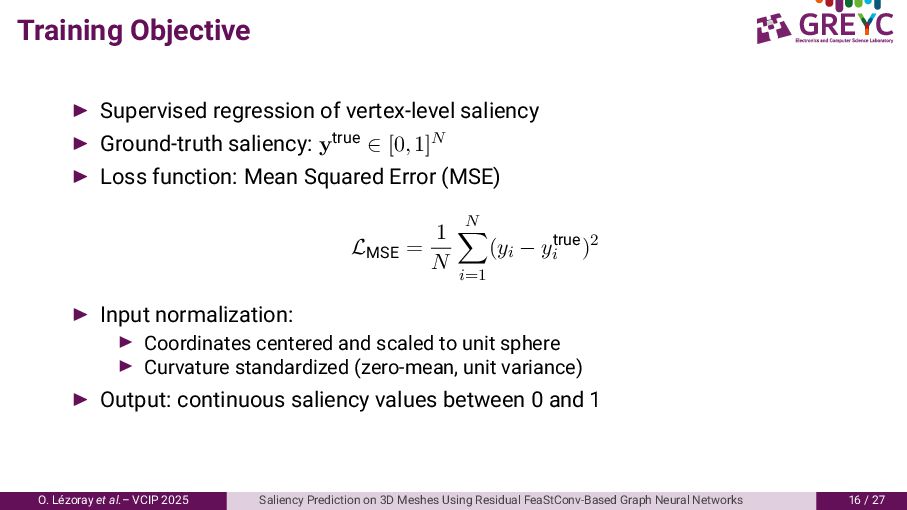
saliency: ytrue ∈ [0, 1]N ▶ Loss function: Mean Squared Error (MSE) LMSE = 1 N N i=1 (yi − ytrue i )2 ▶ Input normalization: ▶ Coordinates centered and scaled to unit sphere ▶ Curvature standardized (zero-mean, unit variance) ▶ Output: continuous saliency values between 0 and 1 O. L´ ezoray et al.– VCIP 2025 Saliency Prediction on 3D Meshes Using Residual FeaStConv-Based Graph Neural Networks 16 / 27
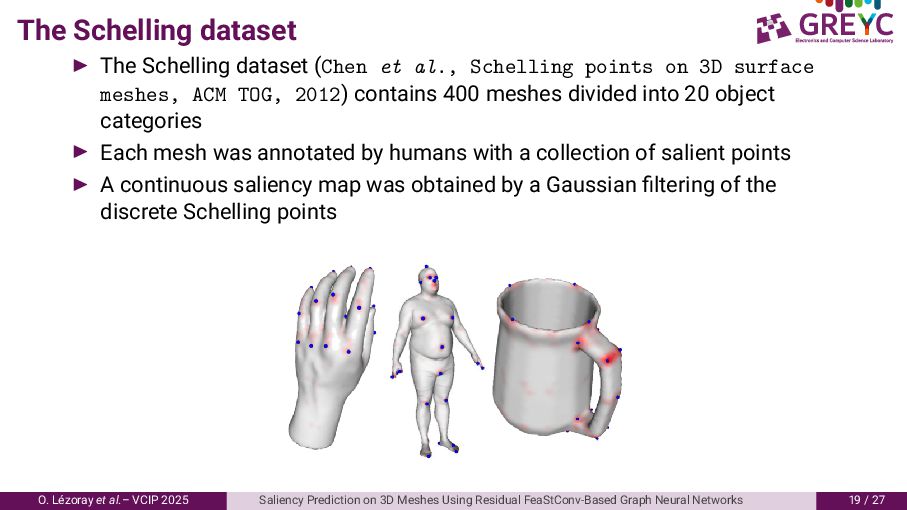
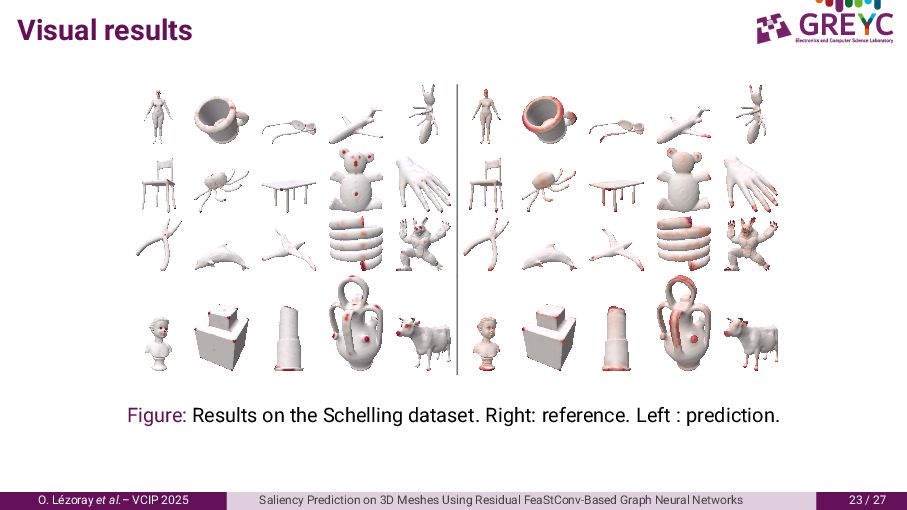
Schelling points on 3D surface meshes, ACM TOG, 2012) contains 400 meshes divided into 20 object categories ▶ Each mesh was annotated by humans with a collection of salient points ▶ A continuous saliency map was obtained by a Gaussian filtering of the discrete Schelling points O. L´ ezoray et al.– VCIP 2025 Saliency Prediction on 3D Meshes Using Residual FeaStConv-Based Graph Neural Networks 19 / 27
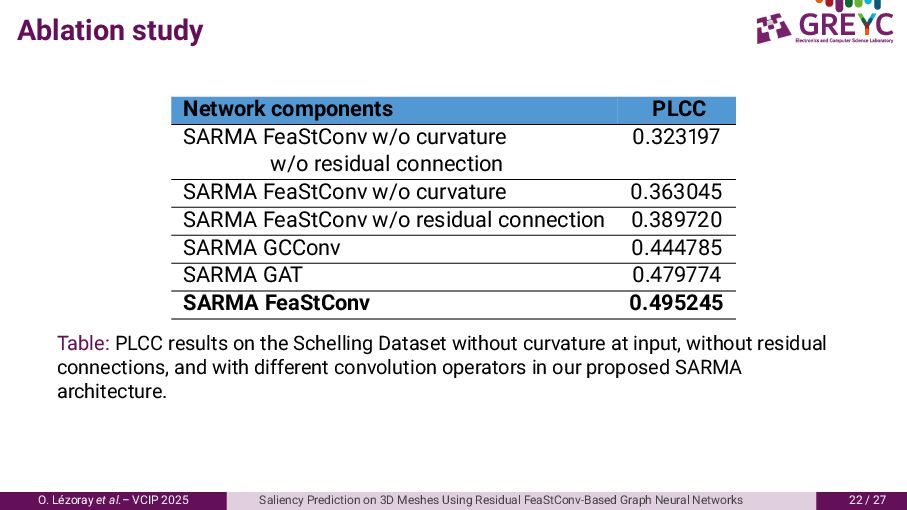
w/o residual connection SARMA FeaStConv w/o curvature 0.363045 SARMA FeaStConv w/o residual connection 0.389720 SARMA GCConv 0.444785 SARMA GAT 0.479774 SARMA FeaStConv 0.495245 Table: PLCC results on the Schelling Dataset without curvature at input, without residual connections, and with different convolution operators in our proposed SARMA architecture. O. L´ ezoray et al.– VCIP 2025 Saliency Prediction on 3D Meshes Using Residual FeaStConv-Based Graph Neural Networks 22 / 27
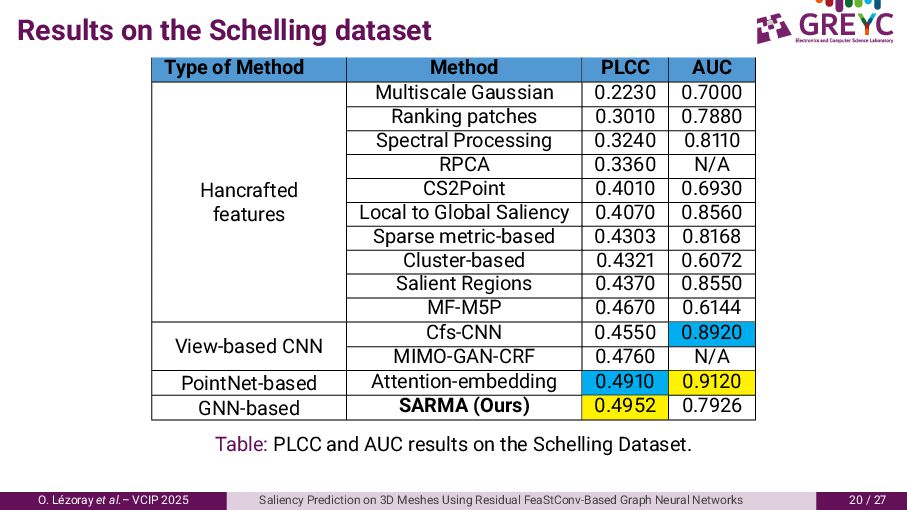
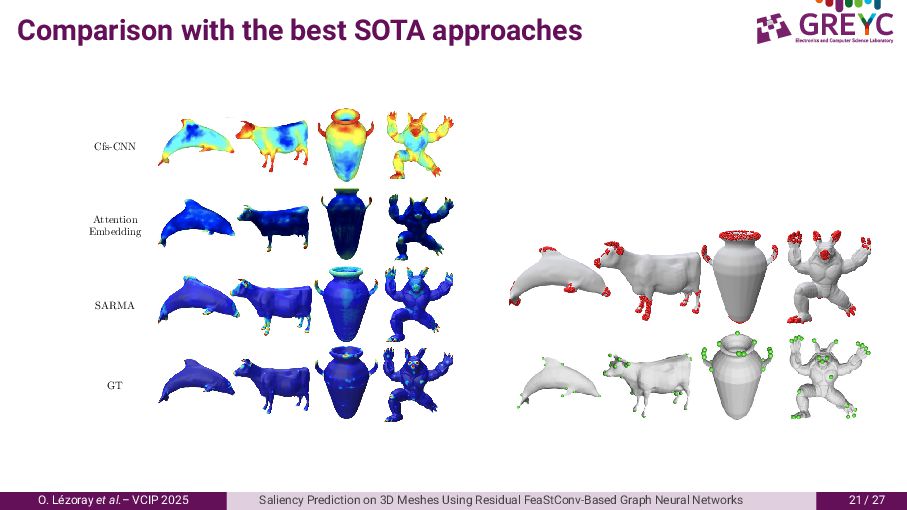
on 3D meshes ▶ Uses Feature-Steered Convolutions (FeaStConv) for end-to-end learning ▶ Uses residual connections to prevent over-smoothing ▶ Combines geometric and topological cues with curvature-based features ▶ Outperforms SOTA methods on the Schelling dataset (highest PLCC, strong AUC) ▶ Ablation study confirms the key role of FeaStConv, curvature and residual connections in model accuracy O. L´ ezoray et al.– VCIP 2025 Saliency Prediction on 3D Meshes Using Residual FeaStConv-Based Graph Neural Networks 26 / 27


 lezoray
 baasie
 marcoroth
 tmiket
 stephaniewalter
 sstephenson
 lemiorhan
.jpg) cargoodrich
cargoodrich
 shlominoach
 marktimemedia
 lynnandtonic
 elsirapls
 retrage