Vice President of the Scientific Society for Mechanical-Electromechanical- Mechatronics-Automotive Engineering (SCEIMEMA) at UMSA RT-2: VISION-LANGUAGE- ACTION MODELS PAPER EXPLANATION Scientific Society of Mechanical-Electromechanical-Mechatronic-Automotive Engineering Students at UMSA
Vision-Language-Action Models 03 Experiments 04 Limitations 05 Conclusions 06 SECOND CHECK Scientific Society of Mechanical-Electromechanical-Mechatronic-Automotive Engineering Students at UMSA
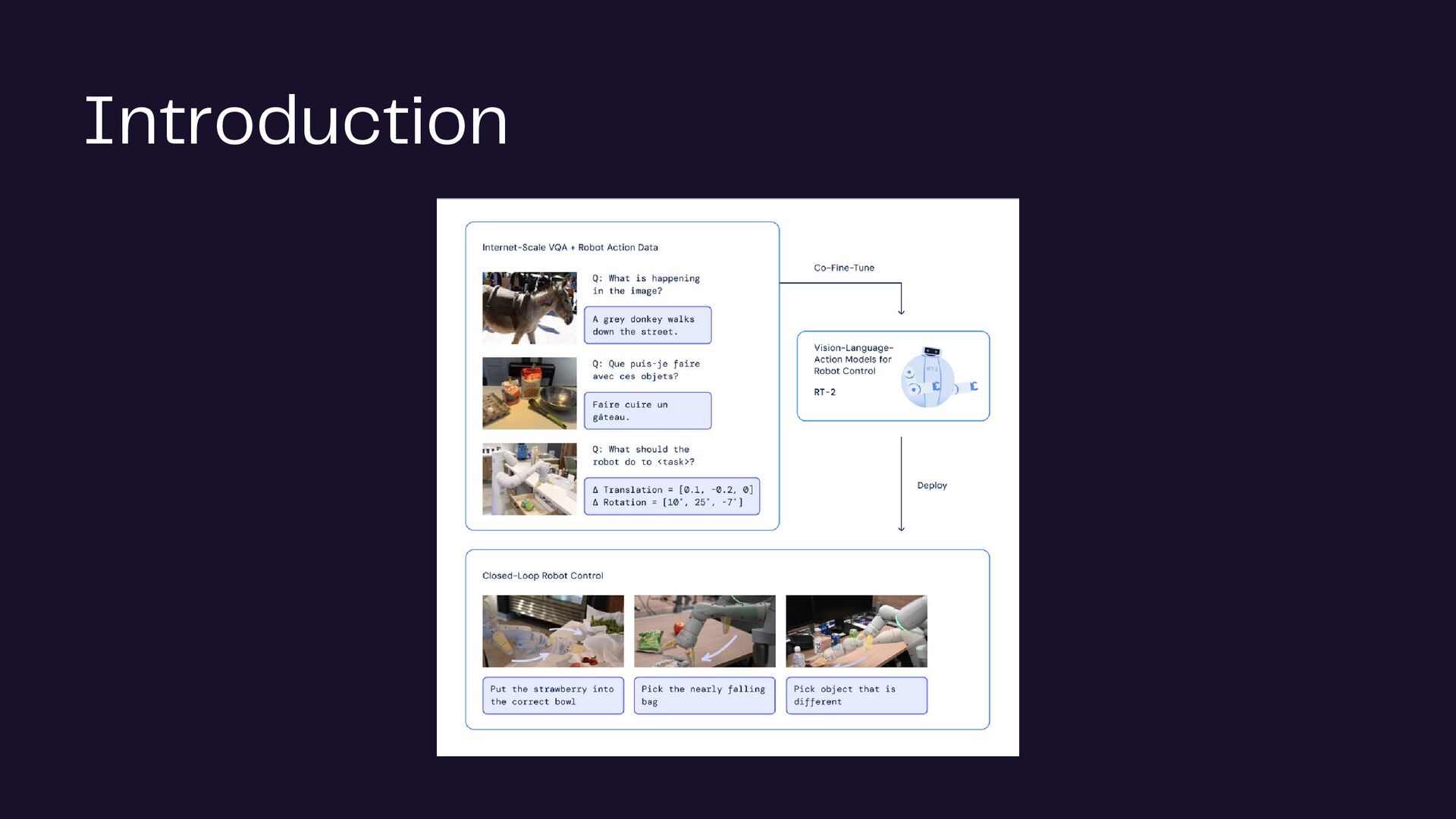
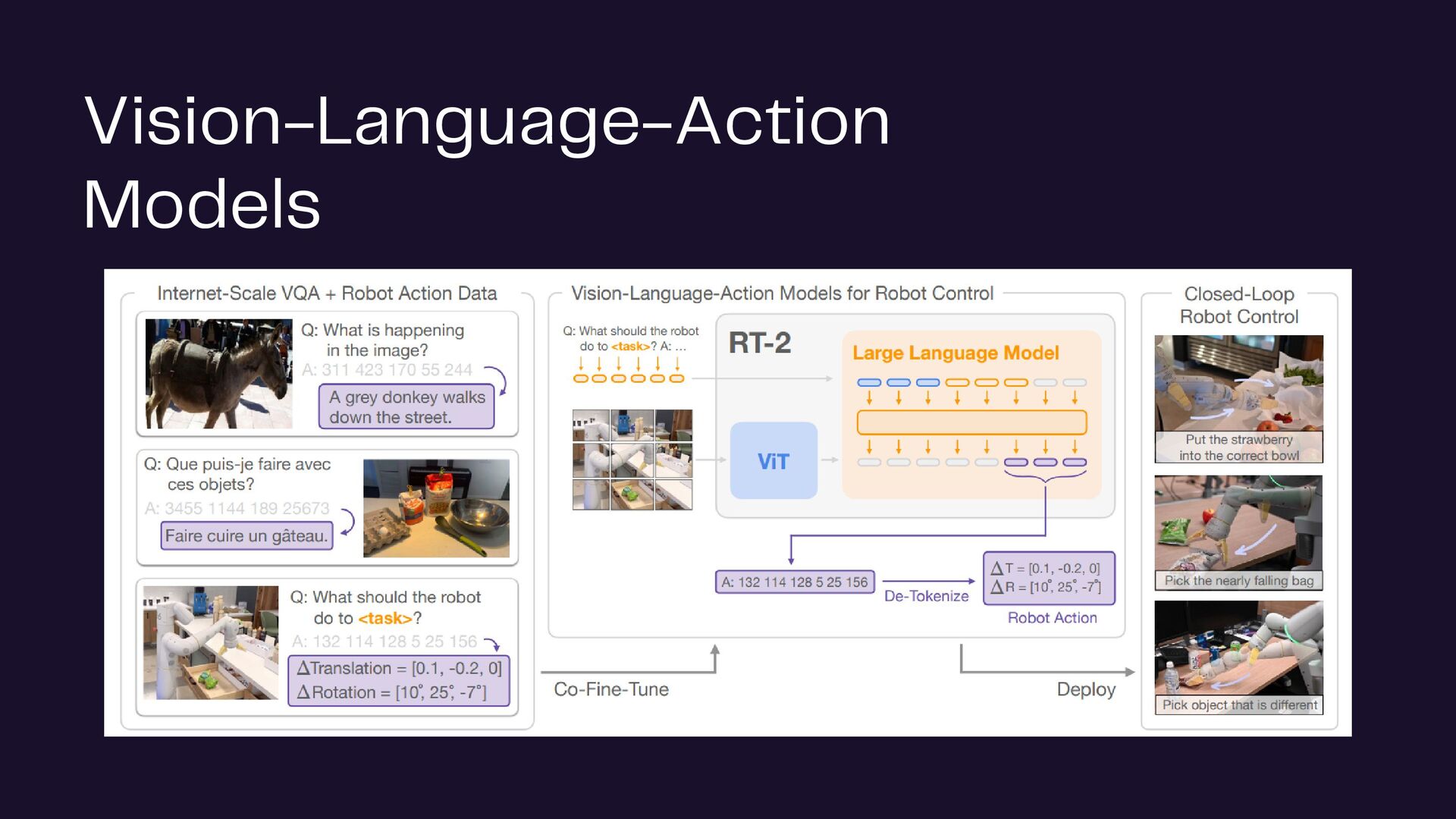
and engage in semantic reasoning by directly integrating vision-language models trained on internet-scale data into their control. They propose training vision- language models on both robotic trajectory data and large-scale vision-language tasks. Scientific Society of Mechanical-Electromechanical-Mechatronic-Automotive Engineering Students at UMSA
tokens and incorporate them into the model alongside natural language. These models are referred to as "vision-language-action models" (VLA), with an example being RT-2. The results demonstrate significant improvements in generalization, interpreting new commands, and reasoning in response to user commands, including multi-stage reasoning. Scientific Society of Mechanical-Electromechanical-Mechatronic-Automotive Engineering Students at UMSA
tasks, such as image captioning, vision-question answering (VQA), and general language tasks on multiple datasets at the same time. While prior works study VLMs for a wide range of problems and settings including in robotics, our focus is on how the capabilities of VLMs can be extended to robotics closed-loop control by endowing them with the ability to predict robot actions, thus leveraging the knowledge already present in VLMs to enable new levels of generalization.
robotic learning. Most works focus on pre- trained visual representations that can be used to initialize the encoder of the robot’s camera observations,
perform such a wide range of tasks 4 RT-2: Vision-Language-Action Models Transfer Web Knowledge to Robotic Control requires large models and web-scale datasets. In this work, we adapt two previously proposed VLMs to act as VLA models: PaLI-X (Chen et al., 2023a) and PaLM-E (Driess et al., 2023).
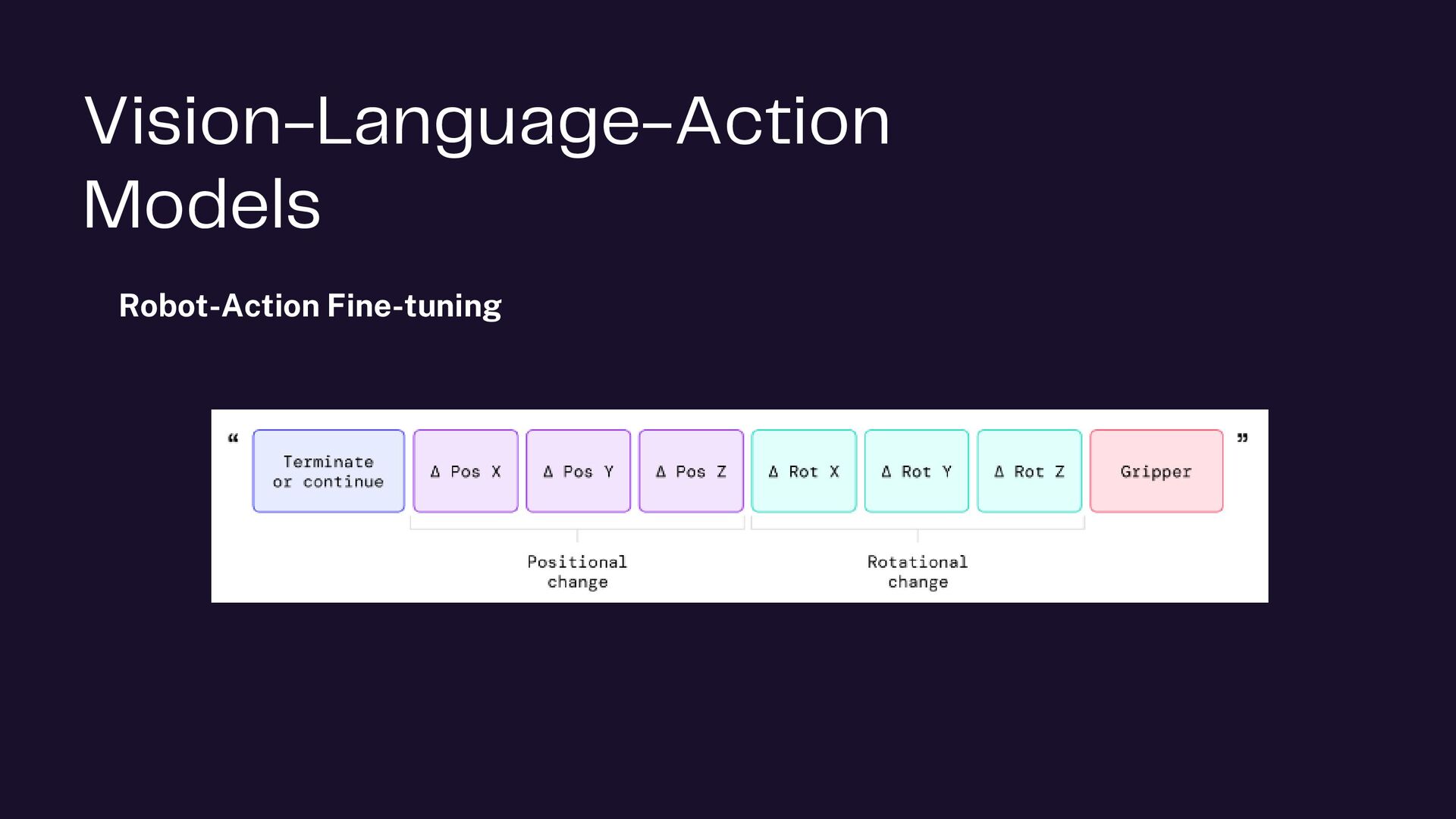
positional and rotational displacement of the robot end-effector, as well as the level of extension of the robot gripper and a special discrete command for terminating the episode, which should be triggered by the policy to signal successful completion. In order to define a target for VLM fine-tuning we convert the action vector into a single string by simply concatenating action tokens for each dimension with a space character: “terminate ΔposX ΔposY ΔposZ ΔrotX ΔrotY ΔrotZ gripper_extension”
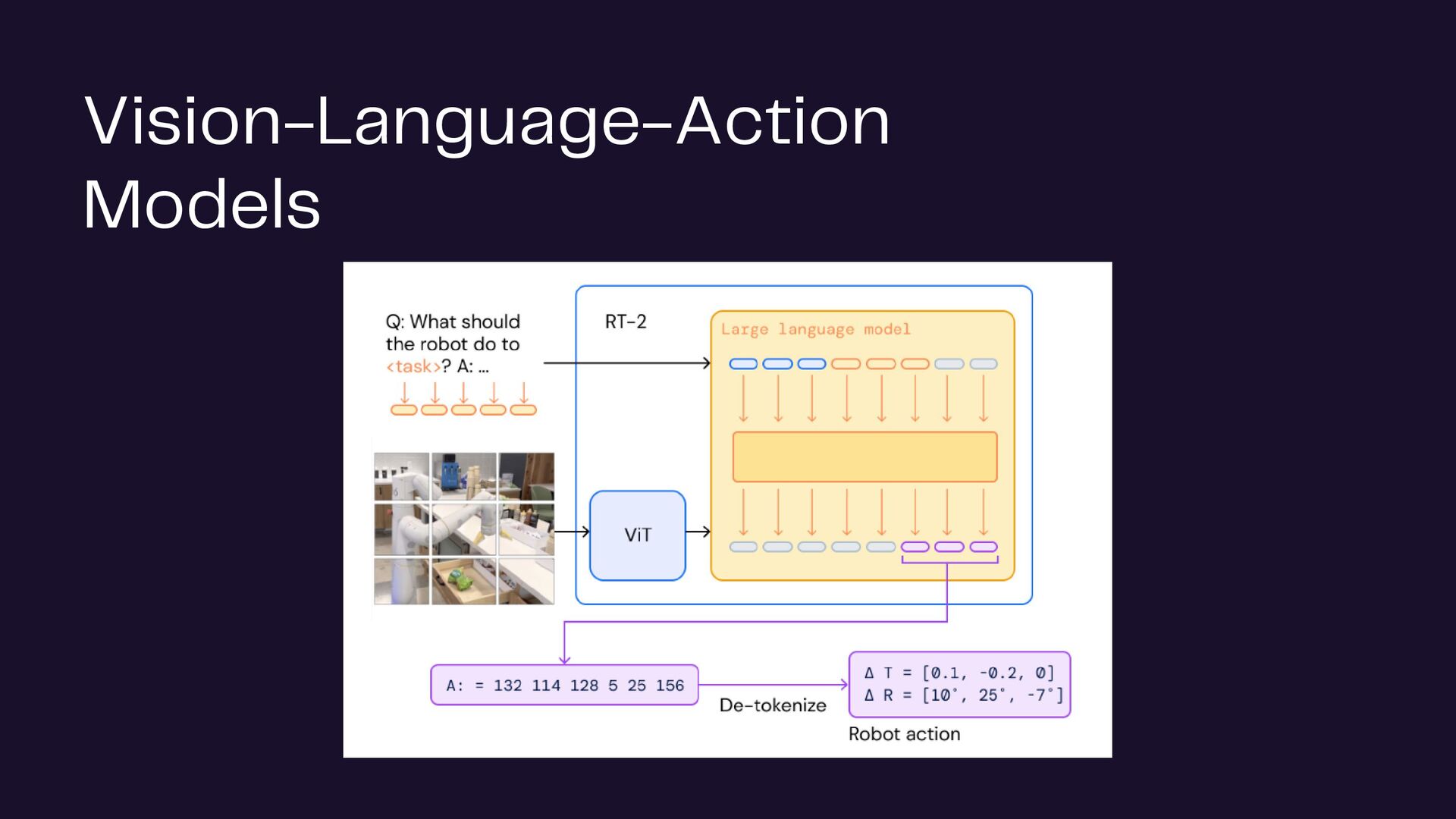
we convert our robot data to be suitable for VLM model fine-tuning, where our inputs include robot camera image and textual task description using standard VQA format: “Q: what action should the robot take to [task instruction]? A:” and our output is formatted as a string of numbers/least frequently used tokens representing a robot action.


 nnchiba
 institutdelelevage
 imai448
 tattaka
 satai
 yukako_nakano
 resolutionfoundation
 stktu
 xspa2012
 skoyamalab
 lindahogenes
 kastner
 tammyeverts
 tamaranovitovic
 seathinner
 portentint
 carmenintech
 kimpetersen
 aleyda
 lynnandtonic