Upgrade to Pro — share decks privately, control downloads, hide ads and more …

Desk Worker's Guide

Avatar for Mark Mark
April 21, 2025

Desk Worker's Guide

Desk Worker's Guide to Effective Stretching" provides essential relief strategies for office professionals suffering from the physical effects of prolonged sitting. Discover targeted stretches to combat neck tension, back pain, and tight hips, with time-efficient routines that fit seamlessly into your workday. Learn how strategic movement breaks can improve posture, boost energy, and prevent chronic pain conditions commonly associated with desk work. This comprehensive guide from Stretchlee offers practical solutions for the modern workplace to help you feel better while working smarter.

Avatar for Mark

Mark

April 21, 2025

Other Decks in How-to & DIY

Transcript

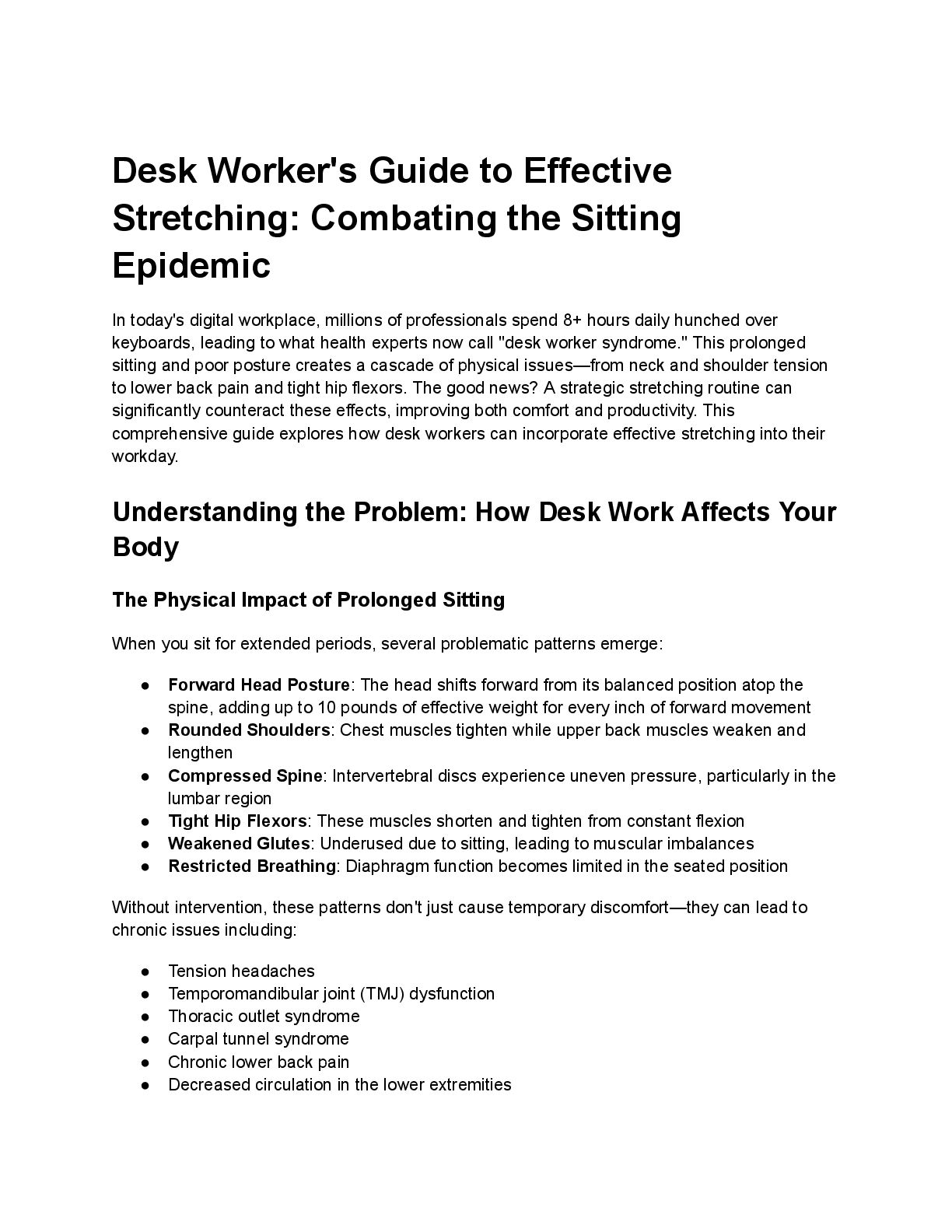
  1. Desk Worker's Guide to Effective Stretching: Combating the Sitting Epidemic

    In today's digital workplace, millions of professionals spend 8+ hours daily hunched over keyboards, leading to what health experts now call "desk worker syndrome." This prolonged sitting and poor posture creates a cascade of physical issues—from neck and shoulder tension to lower back pain and tight hip flexors. The good news? A strategic stretching routine can significantly counteract these effects, improving both comfort and productivity. This comprehensive guide explores how desk workers can incorporate effective stretching into their workday. Understanding the Problem: How Desk Work Affects Your Body The Physical Impact of Prolonged Sitting When you sit for extended periods, several problematic patterns emerge: •​ Forward Head Posture: The head shifts forward from its balanced position atop the spine, adding up to 10 pounds of effective weight for every inch of forward movement •​ Rounded Shoulders: Chest muscles tighten while upper back muscles weaken and lengthen •​ Compressed Spine: Intervertebral discs experience uneven pressure, particularly in the lumbar region •​ Tight Hip Flexors: These muscles shorten and tighten from constant flexion •​ Weakened Glutes: Underused due to sitting, leading to muscular imbalances •​ Restricted Breathing: Diaphragm function becomes limited in the seated position Without intervention, these patterns don't just cause temporary discomfort—they can lead to chronic issues including: •​ Tension headaches •​ Temporomandibular joint (TMJ) dysfunction •​ Thoracic outlet syndrome •​ Carpal tunnel syndrome •​ Chronic lower back pain •​ Decreased circulation in the lower extremities
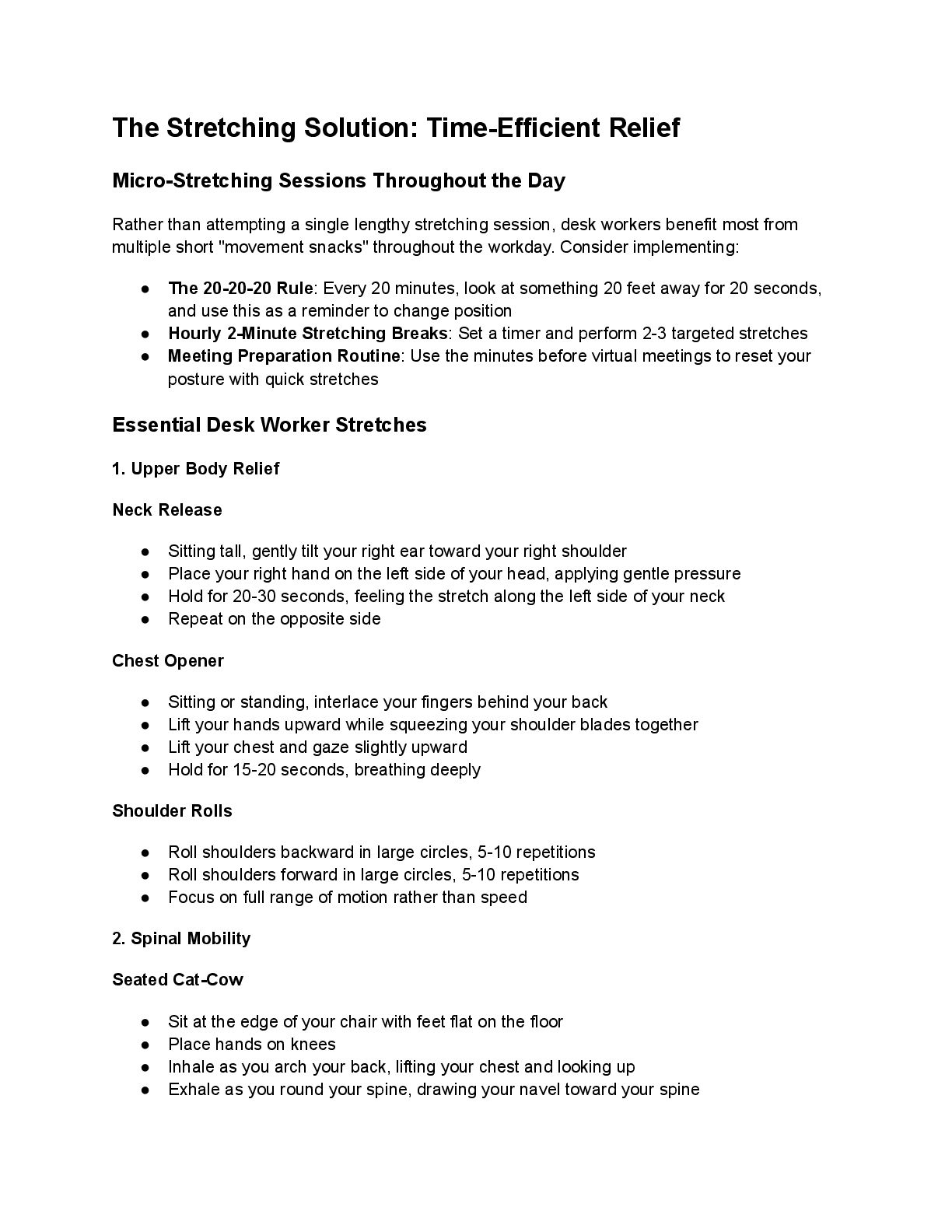
  2. The Stretching Solution: Time-Efficient Relief Micro-Stretching Sessions Throughout the Day

    Rather than attempting a single lengthy stretching session, desk workers benefit most from multiple short "movement snacks" throughout the workday. Consider implementing: •​ The 20-20-20 Rule: Every 20 minutes, look at something 20 feet away for 20 seconds, and use this as a reminder to change position •​ Hourly 2-Minute Stretching Breaks: Set a timer and perform 2-3 targeted stretches •​ Meeting Preparation Routine: Use the minutes before virtual meetings to reset your posture with quick stretches Essential Desk Worker Stretches 1. Upper Body Relief Neck Release •​ Sitting tall, gently tilt your right ear toward your right shoulder •​ Place your right hand on the left side of your head, applying gentle pressure •​ Hold for 20-30 seconds, feeling the stretch along the left side of your neck •​ Repeat on the opposite side Chest Opener •​ Sitting or standing, interlace your fingers behind your back •​ Lift your hands upward while squeezing your shoulder blades together •​ Lift your chest and gaze slightly upward •​ Hold for 15-20 seconds, breathing deeply Shoulder Rolls •​ Roll shoulders backward in large circles, 5-10 repetitions •​ Roll shoulders forward in large circles, 5-10 repetitions •​ Focus on full range of motion rather than speed 2. Spinal Mobility Seated Cat-Cow •​ Sit at the edge of your chair with feet flat on the floor •​ Place hands on knees •​ Inhale as you arch your back, lifting your chest and looking up •​ Exhale as you round your spine, drawing your navel toward your spine
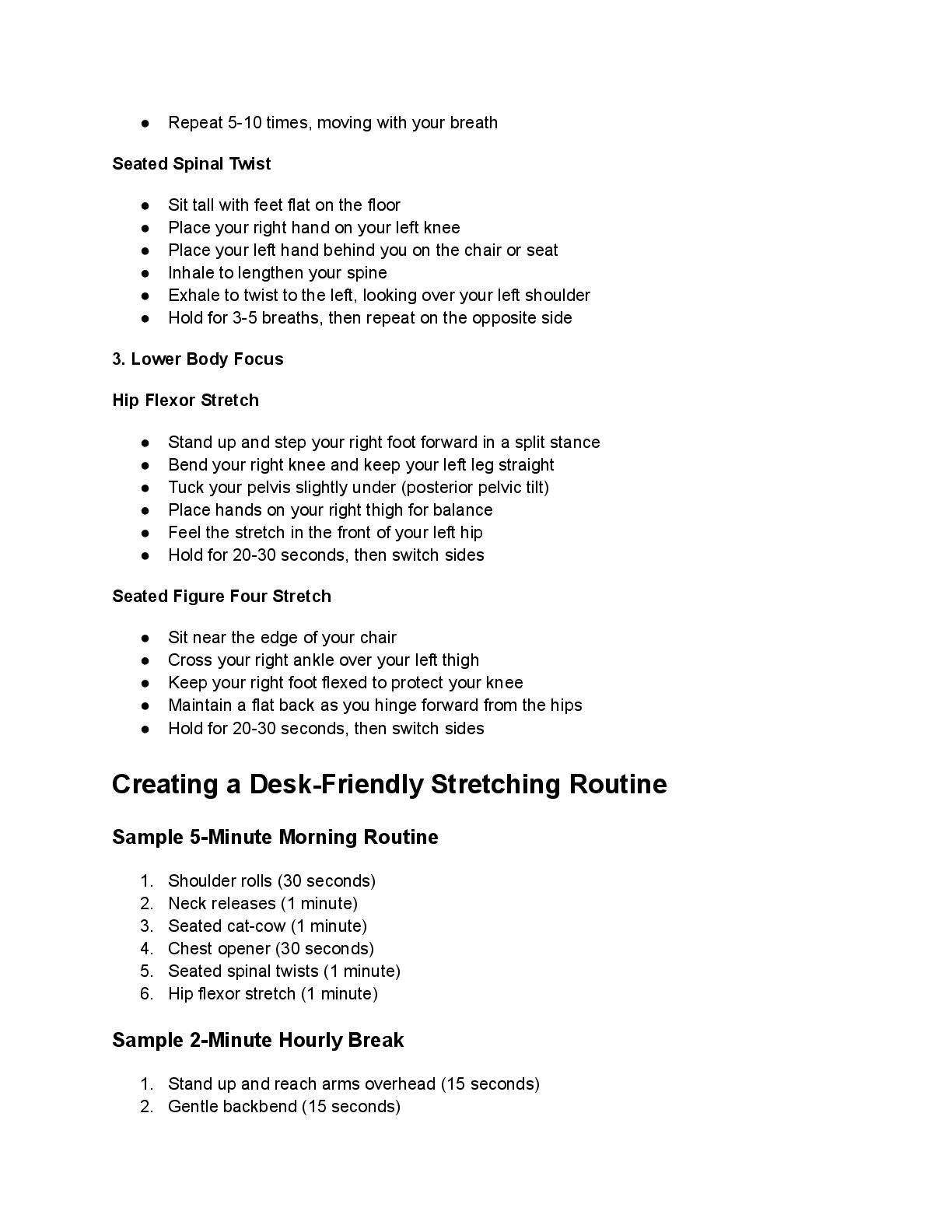
  3. •​ Repeat 5-10 times, moving with your breath Seated Spinal

    Twist •​ Sit tall with feet flat on the floor •​ Place your right hand on your left knee •​ Place your left hand behind you on the chair or seat •​ Inhale to lengthen your spine •​ Exhale to twist to the left, looking over your left shoulder •​ Hold for 3-5 breaths, then repeat on the opposite side 3. Lower Body Focus Hip Flexor Stretch •​ Stand up and step your right foot forward in a split stance •​ Bend your right knee and keep your left leg straight •​ Tuck your pelvis slightly under (posterior pelvic tilt) •​ Place hands on your right thigh for balance •​ Feel the stretch in the front of your left hip •​ Hold for 20-30 seconds, then switch sides Seated Figure Four Stretch •​ Sit near the edge of your chair •​ Cross your right ankle over your left thigh •​ Keep your right foot flexed to protect your knee •​ Maintain a flat back as you hinge forward from the hips •​ Hold for 20-30 seconds, then switch sides Creating a Desk-Friendly Stretching Routine Sample 5-Minute Morning Routine 1.​ Shoulder rolls (30 seconds) 2.​ Neck releases (1 minute) 3.​ Seated cat-cow (1 minute) 4.​ Chest opener (30 seconds) 5.​ Seated spinal twists (1 minute) 6.​ Hip flexor stretch (1 minute) Sample 2-Minute Hourly Break 1.​ Stand up and reach arms overhead (15 seconds) 2.​ Gentle backbend (15 seconds)
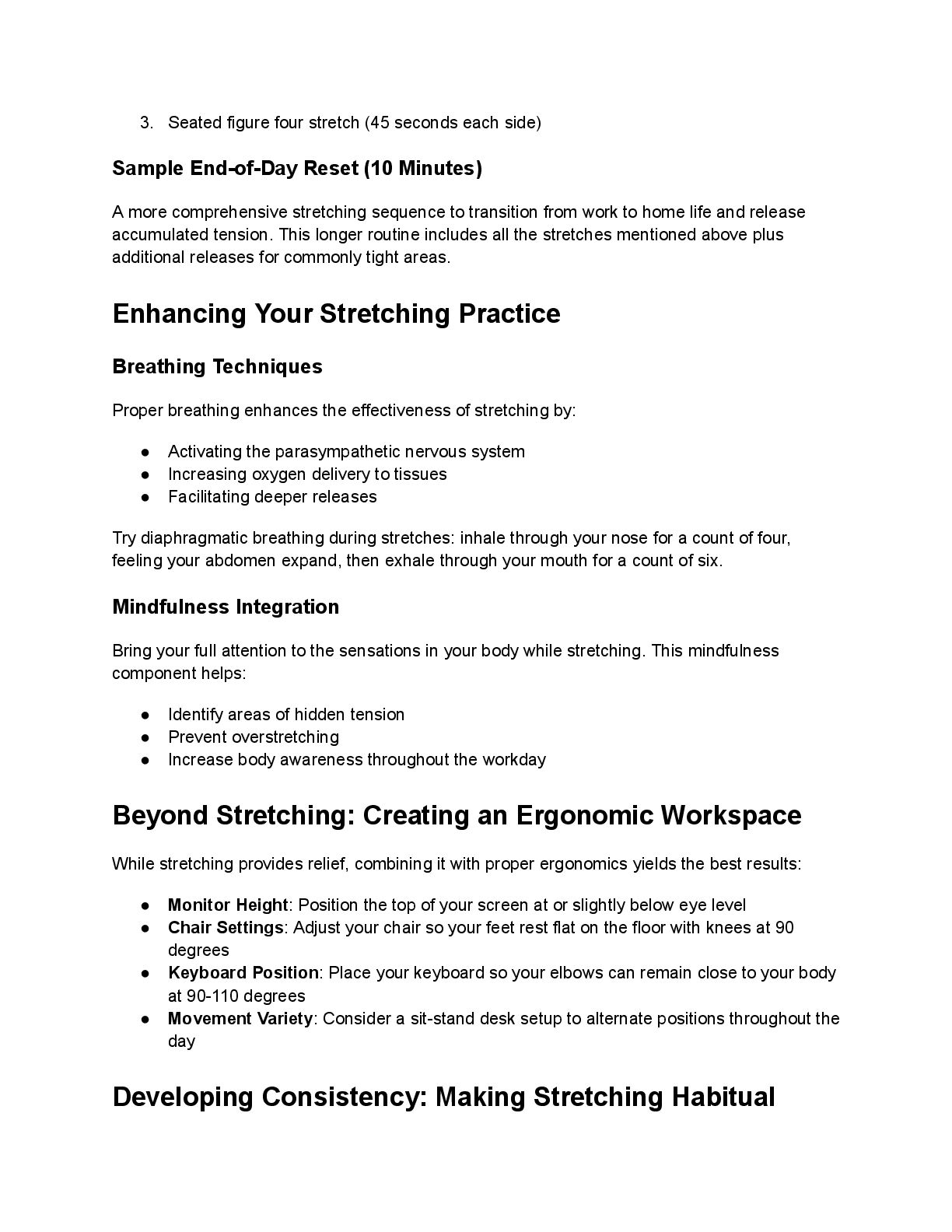
  4. 3.​ Seated figure four stretch (45 seconds each side) Sample

    End-of-Day Reset (10 Minutes) A more comprehensive stretching sequence to transition from work to home life and release accumulated tension. This longer routine includes all the stretches mentioned above plus additional releases for commonly tight areas. Enhancing Your Stretching Practice Breathing Techniques Proper breathing enhances the effectiveness of stretching by: •​ Activating the parasympathetic nervous system •​ Increasing oxygen delivery to tissues •​ Facilitating deeper releases Try diaphragmatic breathing during stretches: inhale through your nose for a count of four, feeling your abdomen expand, then exhale through your mouth for a count of six. Mindfulness Integration Bring your full attention to the sensations in your body while stretching. This mindfulness component helps: •​ Identify areas of hidden tension •​ Prevent overstretching •​ Increase body awareness throughout the workday Beyond Stretching: Creating an Ergonomic Workspace While stretching provides relief, combining it with proper ergonomics yields the best results: •​ Monitor Height: Position the top of your screen at or slightly below eye level •​ Chair Settings: Adjust your chair so your feet rest flat on the floor with knees at 90 degrees •​ Keyboard Position: Place your keyboard so your elbows can remain close to your body at 90-110 degrees •​ Movement Variety: Consider a sit-stand desk setup to alternate positions throughout the day Developing Consistency: Making Stretching Habitual
  5. The biggest challenge for desk workers isn't learning stretches—it's remembering

    to do them consistently. Try these strategies: •​ Visual Reminders: Post sticky notes on your monitor •​ Digital Prompts: Set recurring calendar reminders •​ Habit Stacking: Attach stretching to existing habits (like stretching before each cup of coffee) •​ Accountability Partners: Establish stretching breaks with colleagues When to Seek Professional Help While stretching is beneficial for most desk workers, certain conditions warrant professional attention: •​ Pain that persists despite consistent stretching •​ Numbness or tingling in extremities •​ Sharp pain during specific movements •​ Headaches that increase in frequency or intensity For personalized guidance on stretching techniques tailored to your specific needs and workplace environment, visit Stretchlee for expert advice and comprehensive stretching programs designed for office professionals. Conclusion The modern workplace poses unique challenges to physical wellbeing, but strategic stretching can significantly mitigate these effects. By incorporating brief, targeted stretching sessions throughout your workday, you can reduce discomfort, improve posture, increase energy, and enhance overall workplace wellness. Remember that consistency with simple stretches yields better results than occasional intensive sessions—make stretching a non-negotiable part of your workday routine. Your body wasn't designed for prolonged sitting, but with these stretching techniques, you can counteract the negative effects and maintain physical wellbeing despite the demands of desk work.