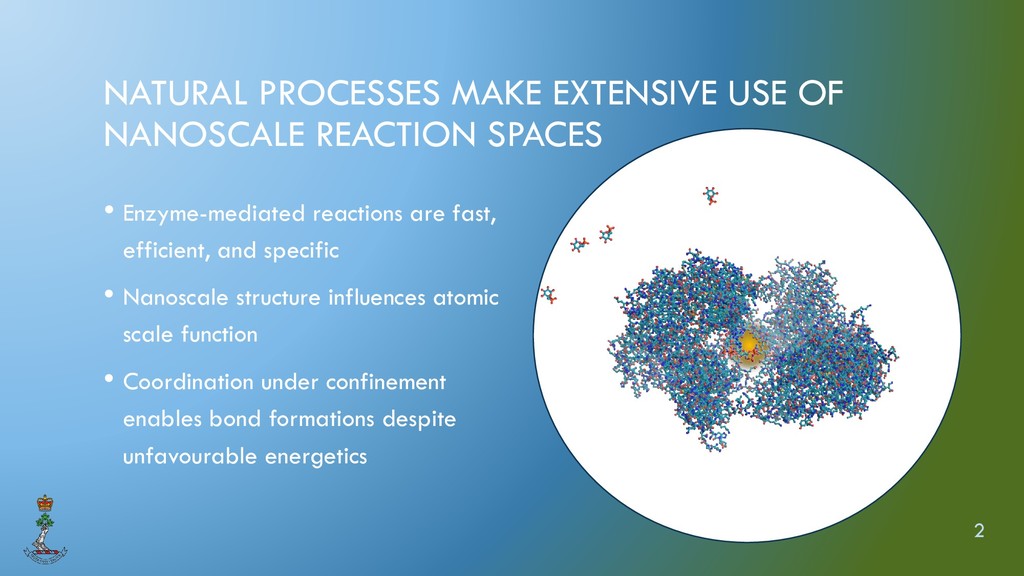
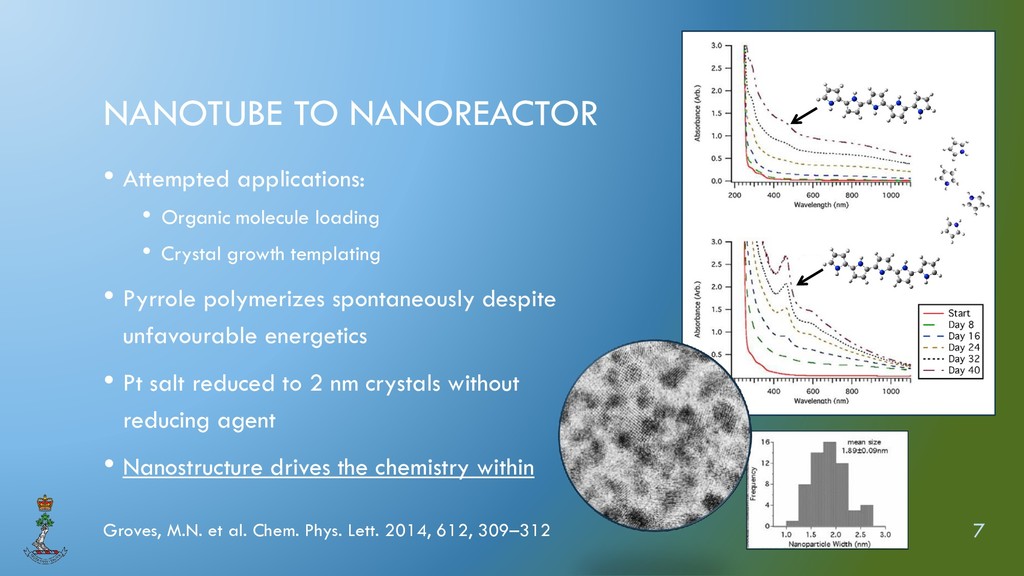
Enzyme-mediated reactions are fast, efficient, and specific • Nanoscale structure influences atomic scale function • Coordination under confinement enables bond formations despite unfavourable energetics 2
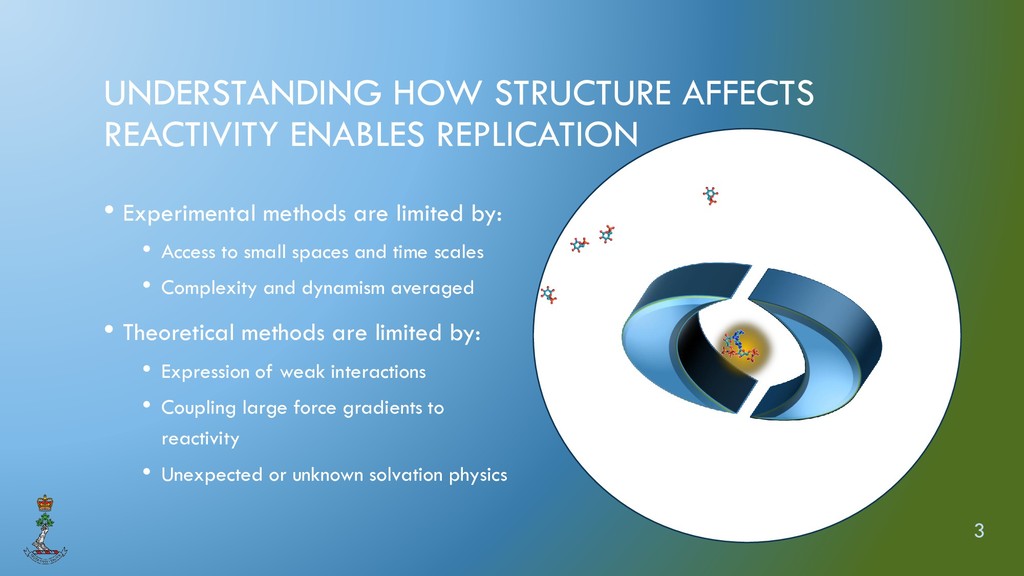
are limited by: • Access to small spaces and time scales • Complexity and dynamism averaged • Theoretical methods are limited by: • Expression of weak interactions • Coupling large force gradients to reactivity • Unexpected or unknown solvation physics 3
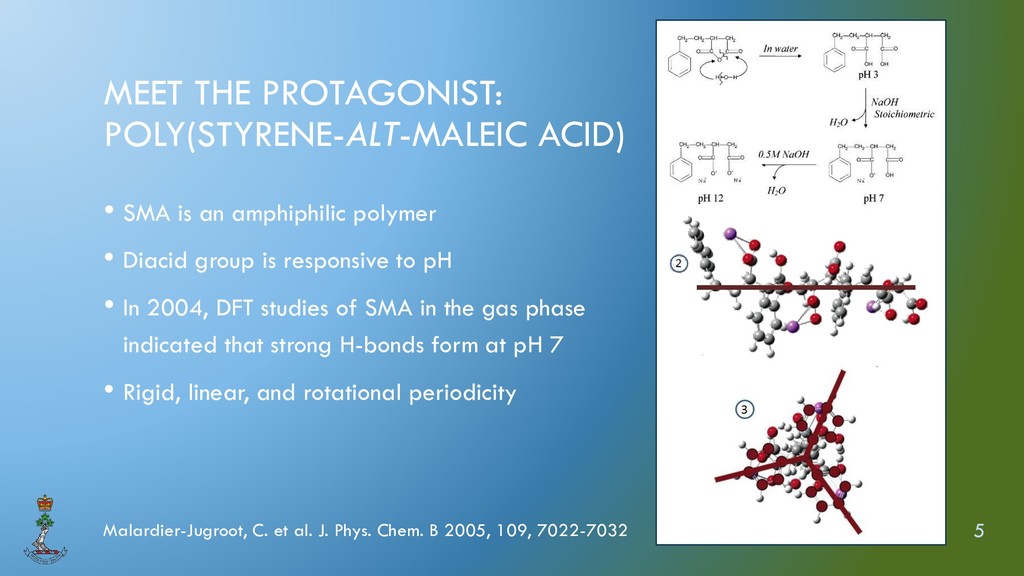
polymer • Diacid group is responsive to pH • In 2004, DFT studies of SMA in the gas phase indicated that strong H-bonds form at pH 7 • Rigid, linear, and rotational periodicity 5 Malardier-Jugroot, C. et al. J. Phys. Chem. B 2005, 109, 7022-7032
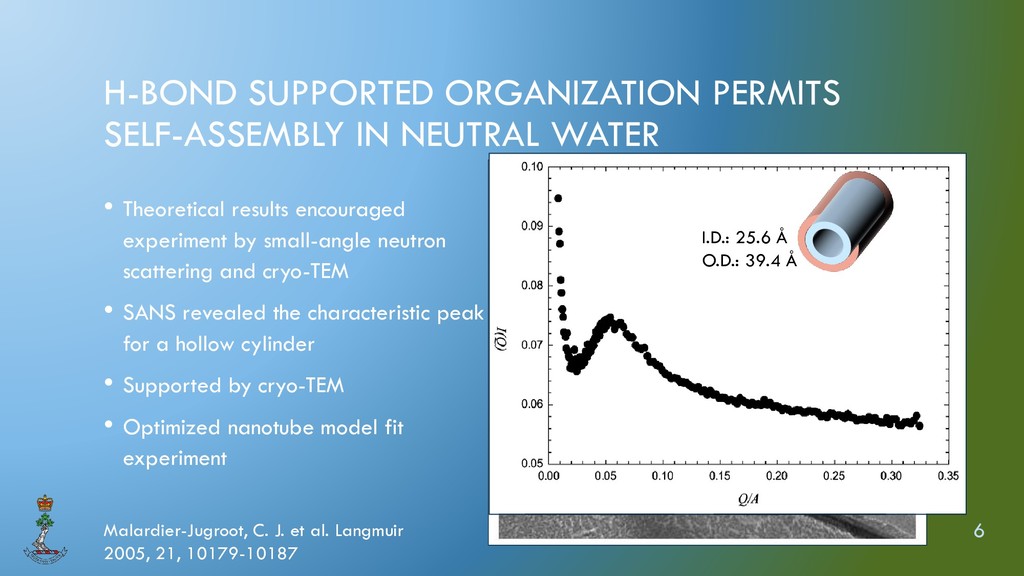
results encouraged experiment by small-angle neutron scattering and cryo-TEM • SANS revealed the characteristic peak for a hollow cylinder • Supported by cryo-TEM • Optimized nanotube model fit experiment 6 Malardier-Jugroot, C. J. et al. Langmuir 2005, 21, 10179-10187 I.D.: 25.6 Å O.D.: 39.4 Å
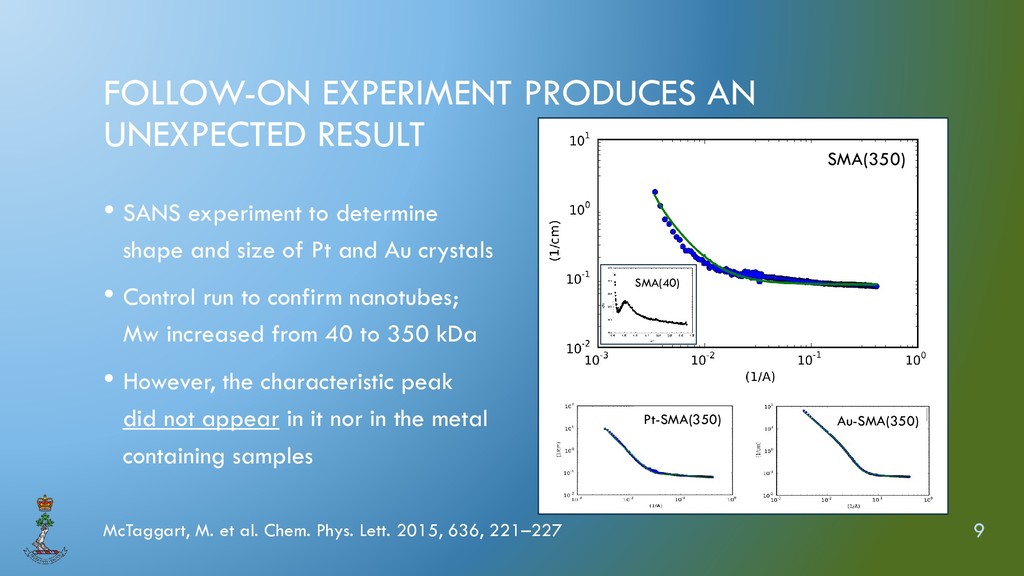
determine shape and size of Pt and Au crystals • Control run to confirm nanotubes; Mw increased from 40 to 350 kDa • However, the characteristic peak did not appear in it nor in the metal containing samples 9 McTaggart, M. et al. Chem. Phys. Lett. 2015, 636, 221–227 SMA(350) Pt-SMA(350) Au-SMA(350) SMA(40)
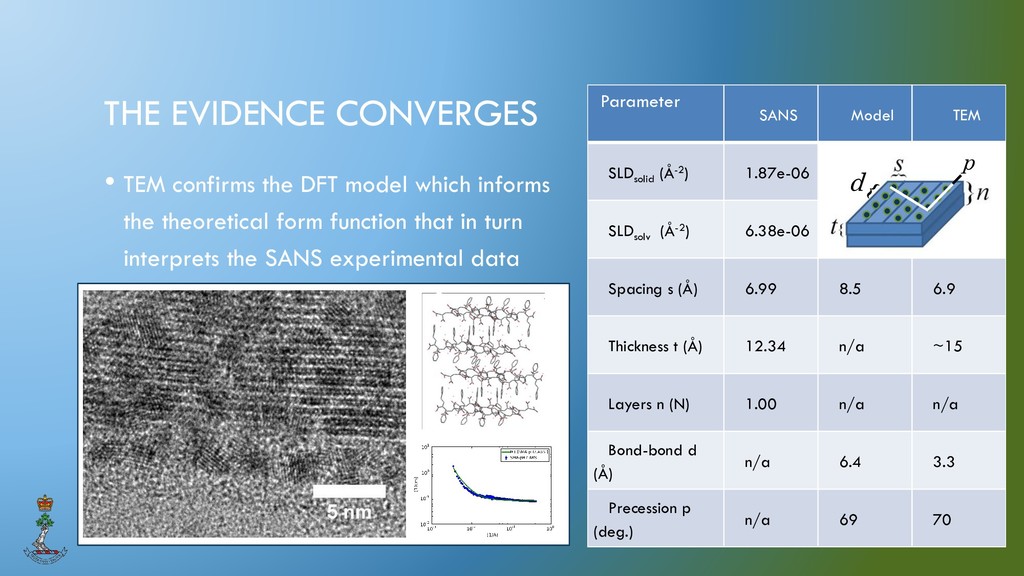
function allow inaccurate interpretation of the SANS signal • Original optimization of the SMA chain used to model an alternative assembly: • Chain to chain: 8.5 Å • Bond to bond: 6.4 Å • Bond precession: 69° 10 McTaggart, M. et al. Chem. Phys. Lett. 2015, 636, 216-220
informs the theoretical form function that in turn interprets the SANS experimental data 11 Parameter SANS Model TEM SLDsolid (Å-2) 1.87e-06 SLDsolv (Å-2) 6.38e-06 Spacing s (Å) 6.99 8.5 6.9 Thickness t (Å) 12.34 n/a ~15 Layers n (N) 1.00 n/a n/a Bond-bond d (Å) n/a 6.4 3.3 Precession p (deg.) n/a 69 70 d p
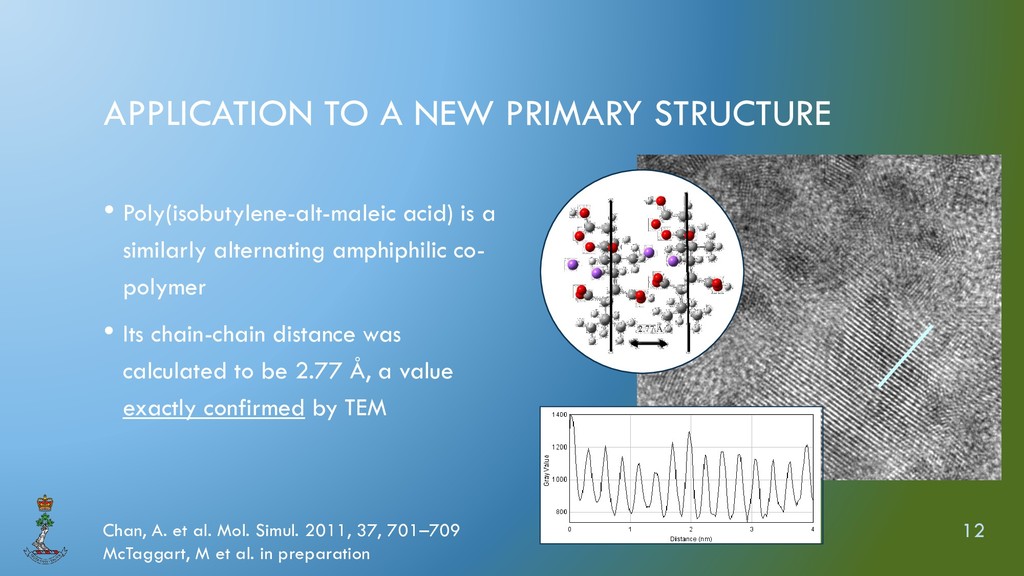
a similarly alternating amphiphilic co- polymer • Its chain-chain distance was calculated to be 2.77 Å, a value exactly confirmed by TEM 12 Chan, A. et al. Mol. Simul. 2011, 37, 701–709 McTaggart, M et al. in preparation
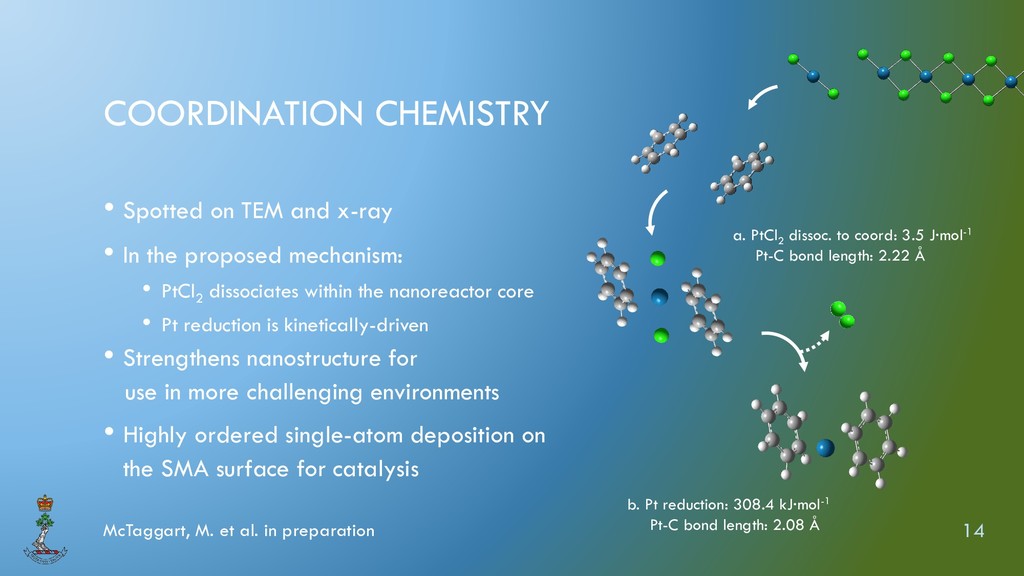
the proposed mechanism: • PtCl2 dissociates within the nanoreactor core • Pt reduction is kinetically-driven • Strengthens nanostructure for use in more challenging environments • Highly ordered single-atom deposition on the SMA surface for catalysis 14 a. PtCl2 dissoc. to coord: 3.5 J·mol-1 Pt-C bond length: 2.22 Å b. Pt reduction: 308.4 kJ·mol-1 Pt-C bond length: 2.08 Å McTaggart, M. et al. in preparation
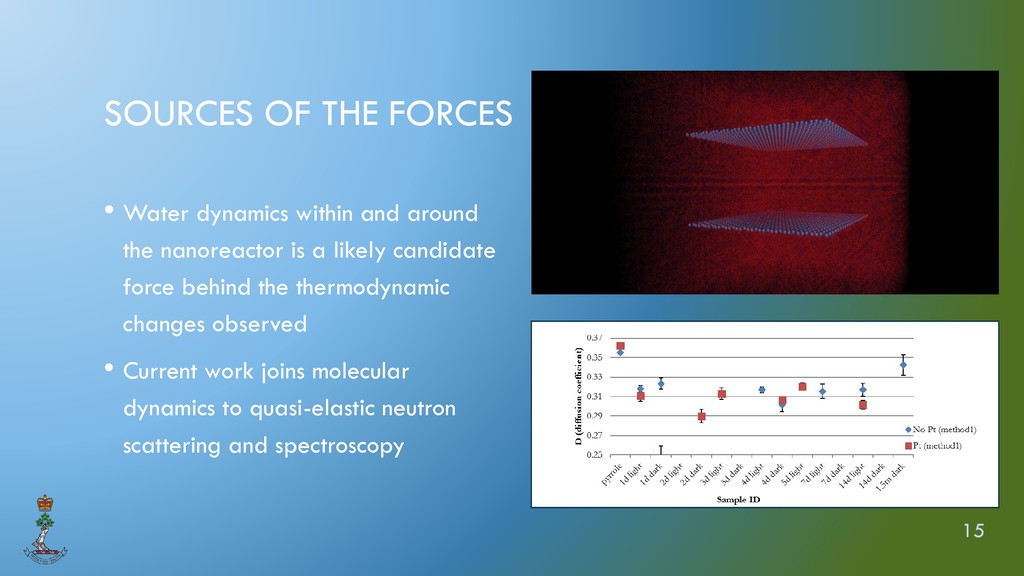
the nanoreactor is a likely candidate force behind the thermodynamic changes observed • Current work joins molecular dynamics to quasi-elastic neutron scattering and spectroscopy 15
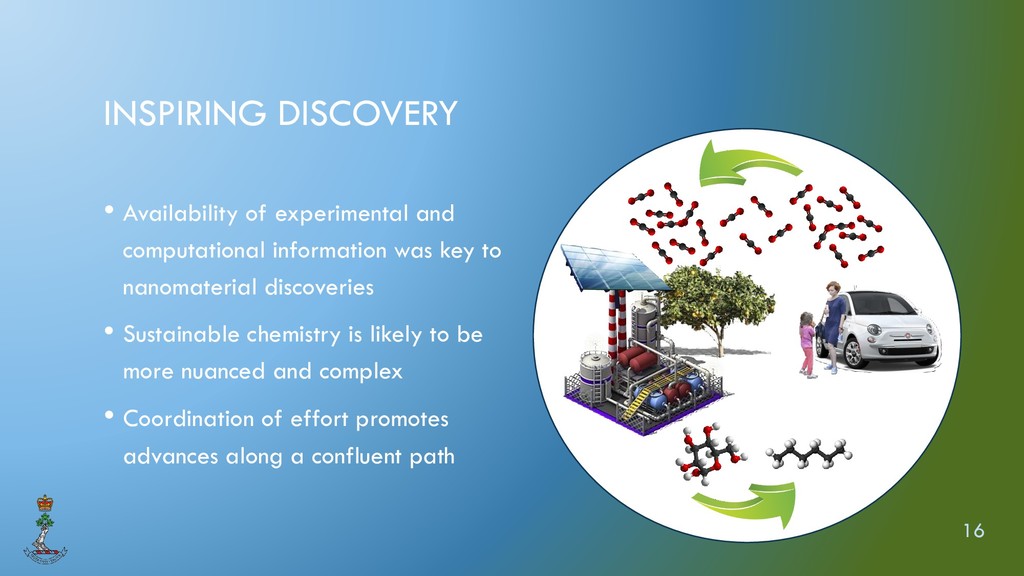
key to nanomaterial discoveries • Sustainable chemistry is likely to be more nuanced and complex • Coordination of effort promotes advances along a confluent path 16
modeling can predict or confirm structural properties of dynamic self-assembling materials in solution • Theoretical and experimental methods applied in concert can overcome the limitations of each in the investigation of complex systems 17 EPILOGUE


 mattmctaggart
 neutron63zf
 institutdelelevage
 trycycle
 signer
 yu4u
yu4u
 takusamar
 ianozsvald
 konakalab
 rmaruy
 holman
 marcoroth
 eileencodes
 sergeychernyshev
 tammyeverts
 codingconduct
 jonoalderson
 tomoyanonymous
 minecr
 tmiket
 baasie