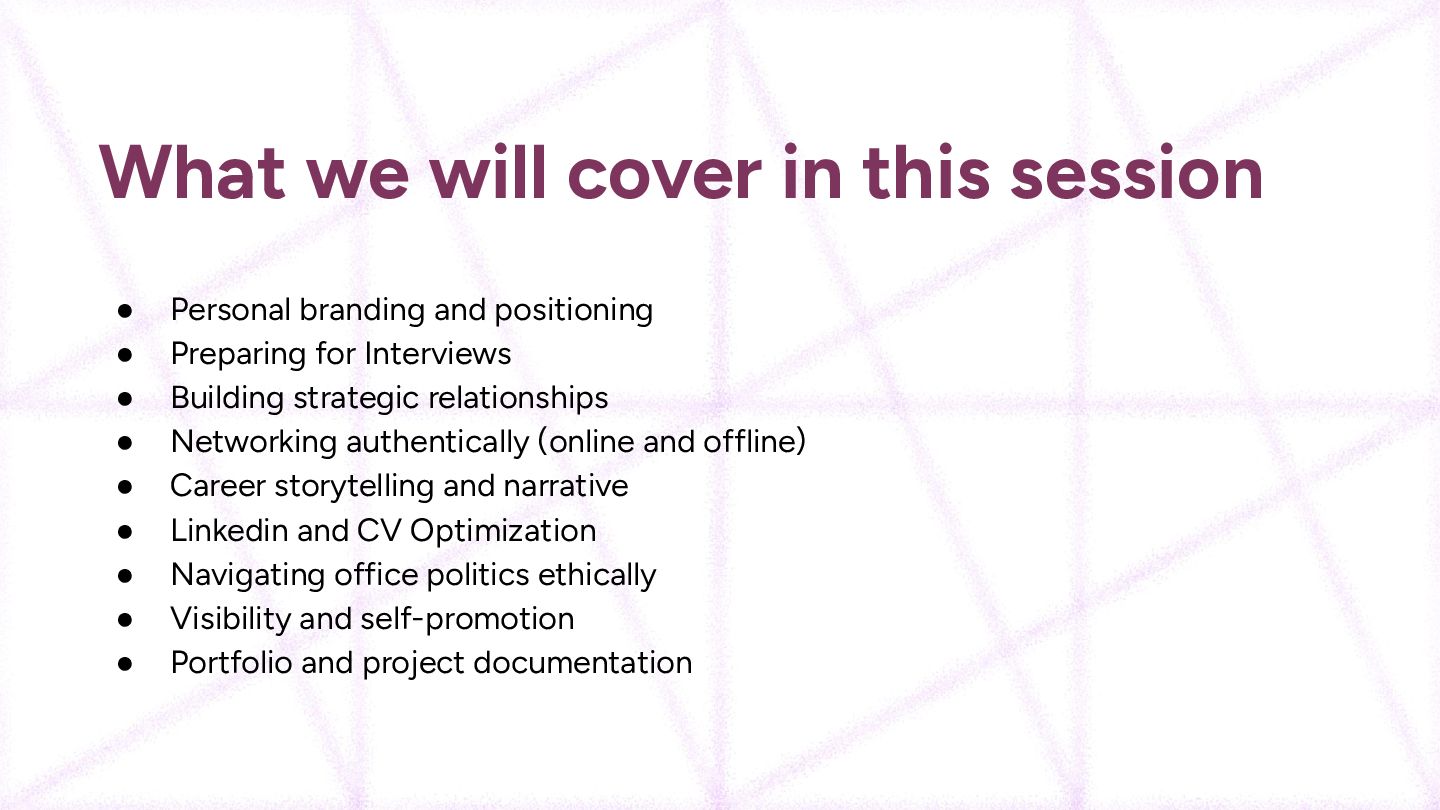
Building strategic relationships • Networking authentically (online and offline) • Career storytelling and narrative • Linkedin and CV Optimization • Navigating office politics ethically • Visibility and self-promotion • Portfolio and project documentation What we will cover in this session
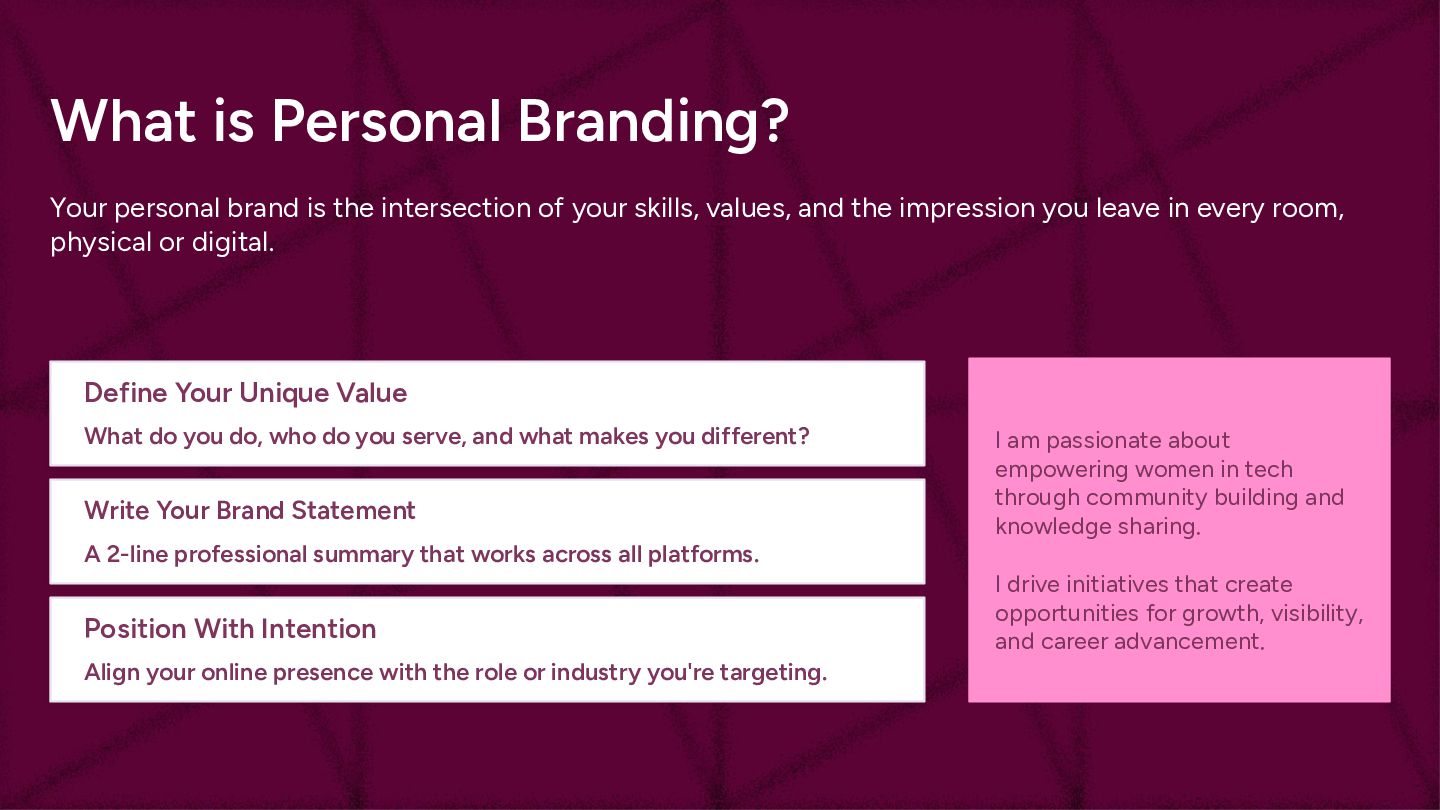
of your skills, values, and the impression you leave in every room, physical or digital. Define Your Unique Value What do you do, who do you serve, and what makes you different? Write Your Brand Statement A 2-line professional summary that works across all platforms. Position With Intention Align your online presence with the role or industry you're targeting. I am passionate about empowering women in tech through community building and knowledge sharing. I drive initiatives that create opportunities for growth, visibility, and career advancement.
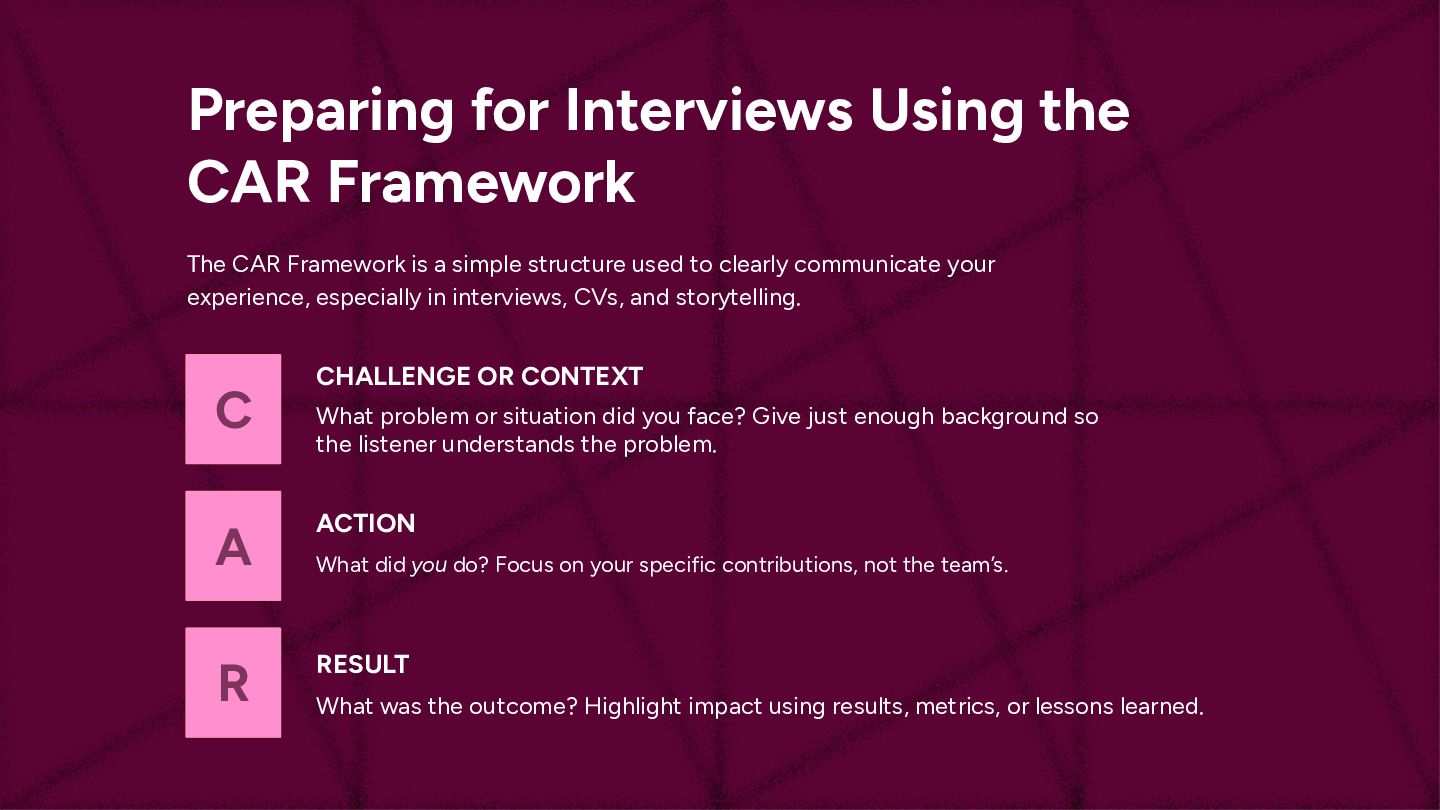
is a simple structure used to clearly communicate your experience, especially in interviews, CVs, and storytelling. C CHALLENGE OR CONTEXT What problem or situation did you face? Give just enough background so the listener understands the problem. A ACTION What did you do? Focus on your specific contributions, not the team’s. R RESULT What was the outcome? Highlight impact using results, metrics, or lessons learned.
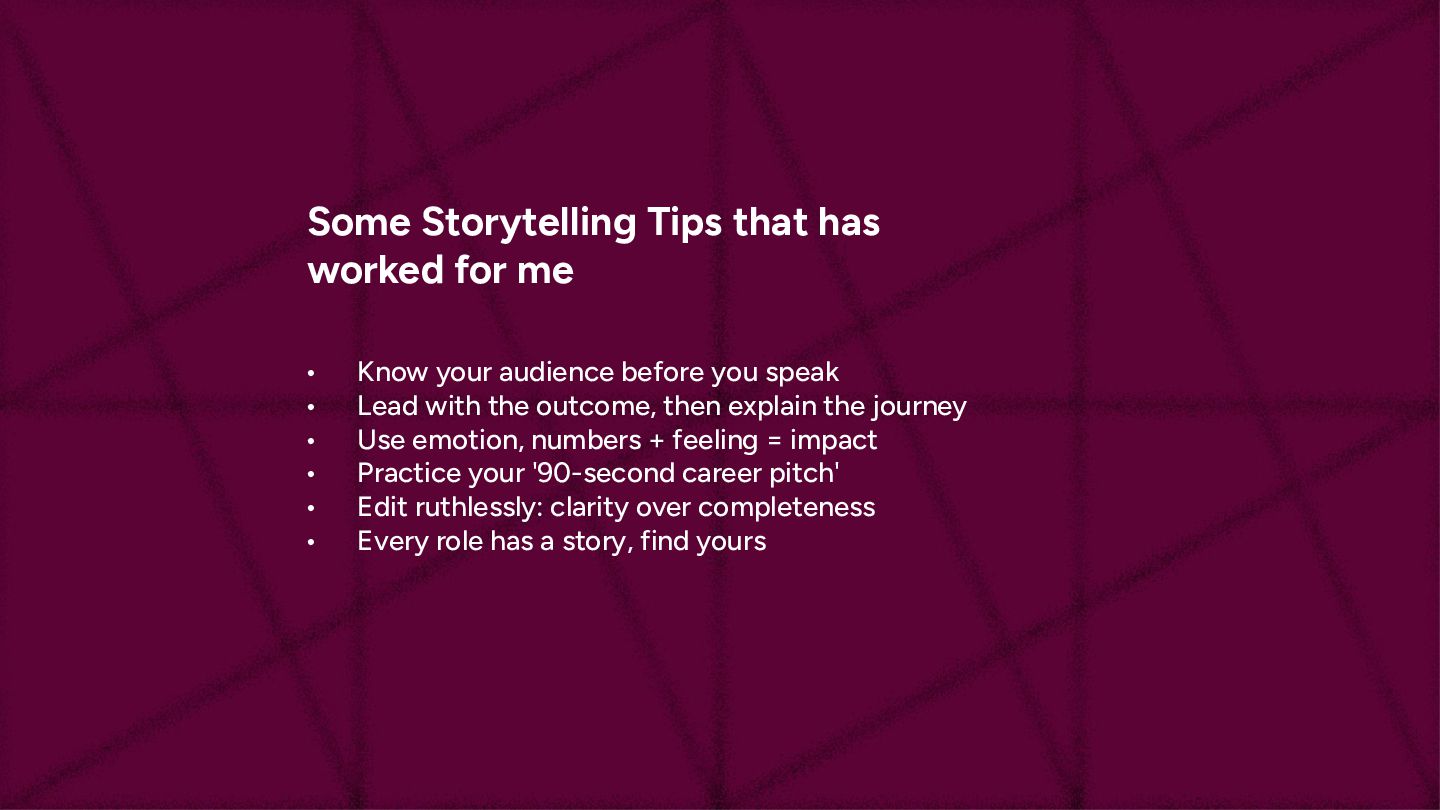
your audience before you speak • Lead with the outcome, then explain the journey • Use emotion, numbers + feeling = impact • Practice your '90-second career pitch' • Edit ruthlessly: clarity over completeness • Every role has a story, find yours
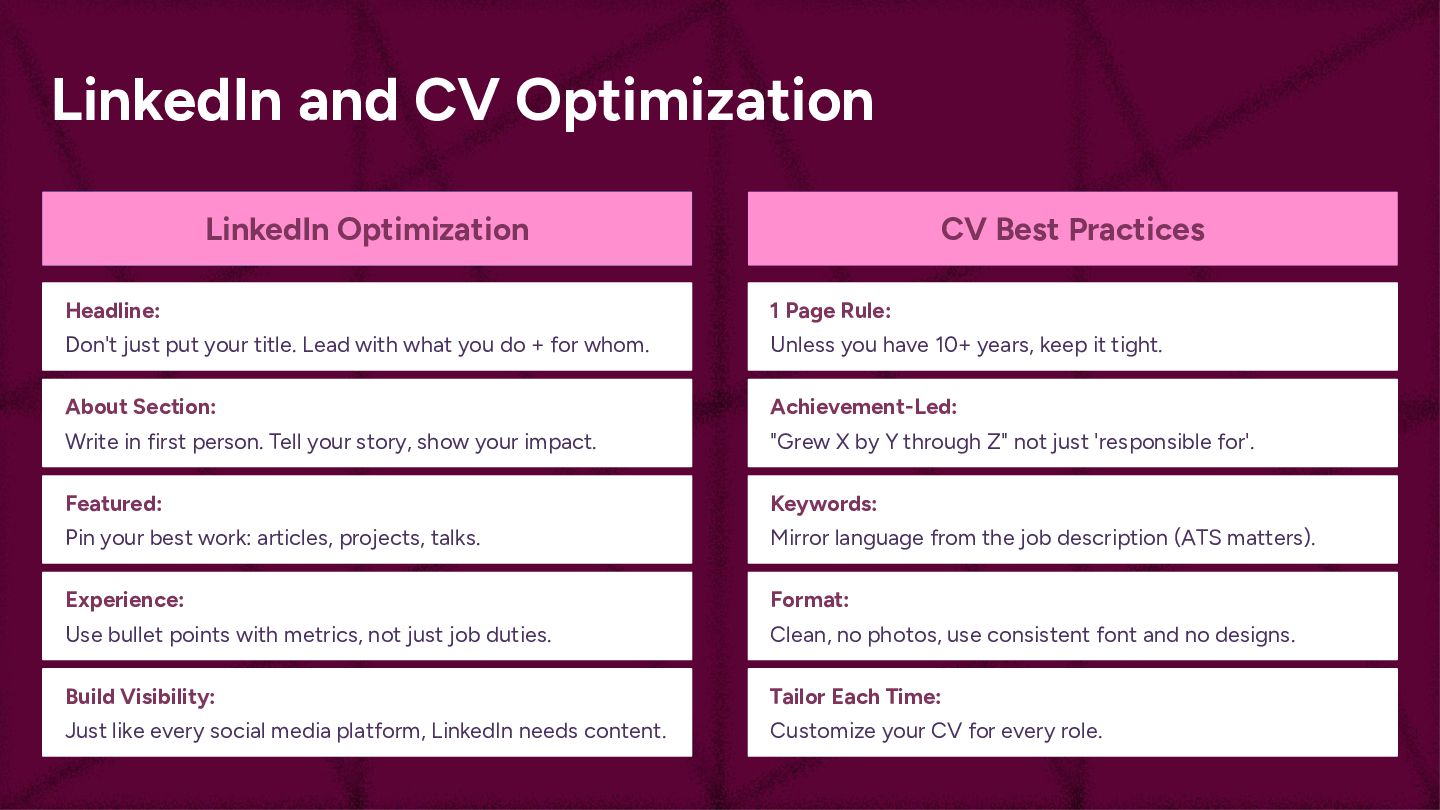
what you do + for whom. About Section: Write in first person. Tell your story, show your impact. Featured: Pin your best work: articles, projects, talks. Experience: Use bullet points with metrics, not just job duties. Build Visibility: Just like every social media platform, LinkedIn needs content. CV Best Practices 1 Page Rule: Unless you have 10+ years, keep it tight. Achievement-Led: "Grew X by Y through Z" not just 'responsible for'. Keywords: Mirror language from the job description (ATS matters). Format: Clean, no photos, use consistent font and no designs. Tailor Each Time: Customize your CV for every role. LinkedIn and CV Optimization
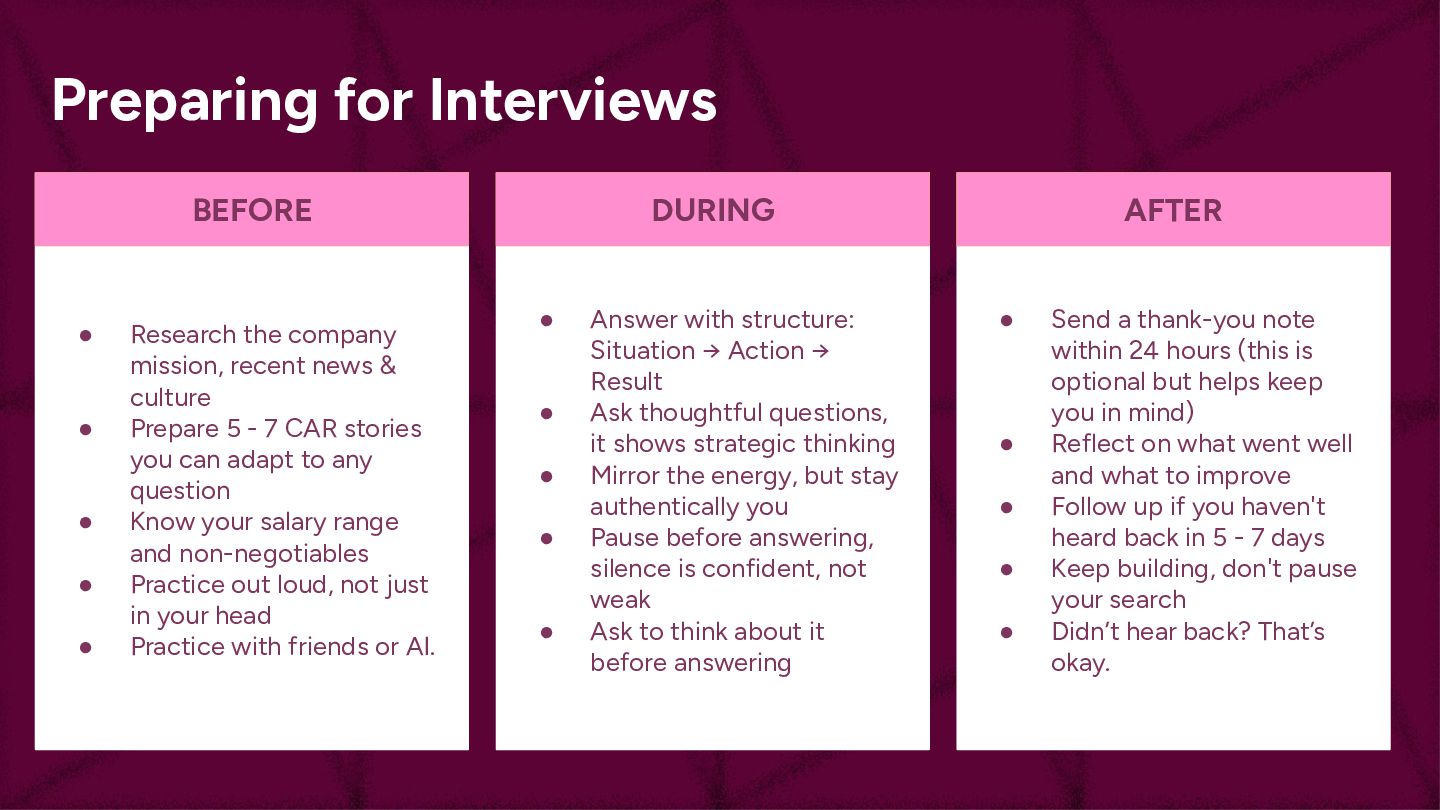
• Prepare 5 - 7 CAR stories you can adapt to any question • Know your salary range and non-negotiables • Practice out loud, not just in your head • Practice with friends or AI. DURING • Answer with structure: Situation → Action → Result • Ask thoughtful questions, it shows strategic thinking • Mirror the energy, but stay authentically you • Pause before answering, silence is confident, not weak • Ask to think about it before answering AFTER • Send a thank-you note within 24 hours (this is optional but helps keep you in mind) • Reflect on what went well and what to improve • Follow up if you haven't heard back in 5 - 7 days • Keep building, don't pause your search • Didn’t hear back? That’s okay. Preparing for Interviews
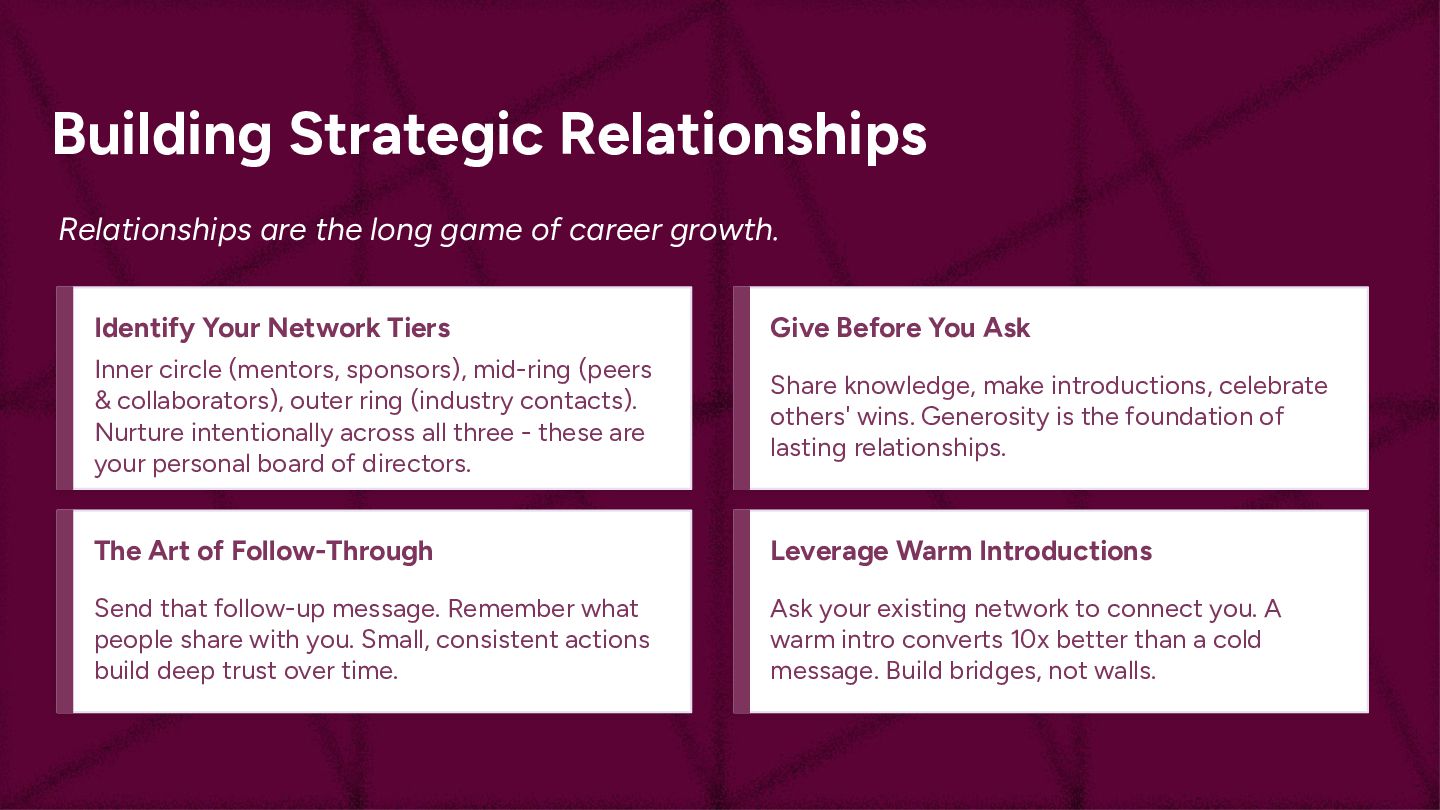
Network Tiers Inner circle (mentors, sponsors), mid-ring (peers & collaborators), outer ring (industry contacts). Nurture intentionally across all three - these are your personal board of directors. Give Before You Ask Share knowledge, make introductions, celebrate others' wins. Generosity is the foundation of lasting relationships. The Art of Follow-Through Send that follow-up message. Remember what people share with you. Small, consistent actions build deep trust over time. Leverage Warm Introductions Ask your existing network to connect you. A warm intro converts 10x better than a cold message. Build bridges, not walls. Building Strategic Relationships
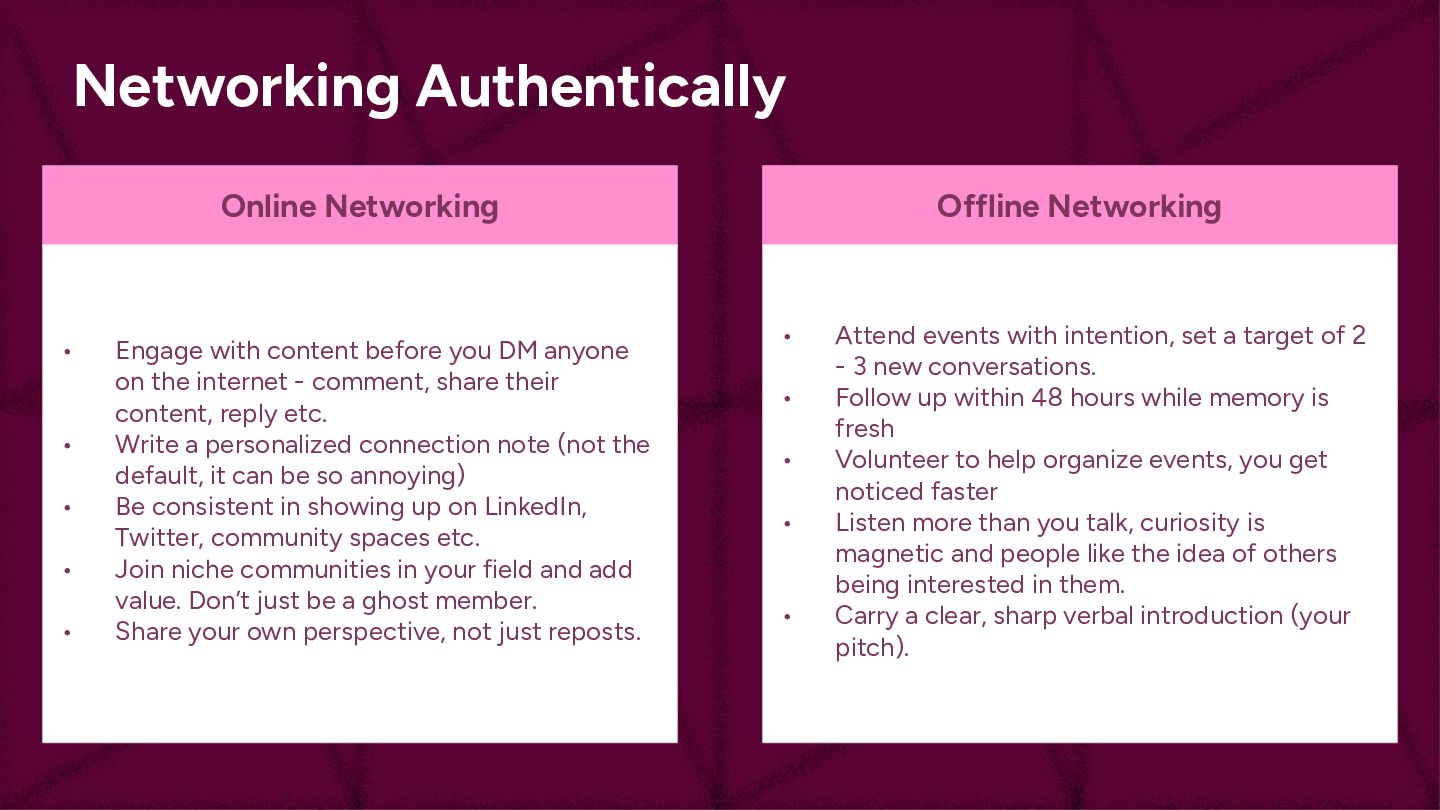
on the internet - comment, share their content, reply etc. • Write a personalized connection note (not the default, it can be so annoying) • Be consistent in showing up on LinkedIn, Twitter, community spaces etc. • Join niche communities in your field and add value. Don’t just be a ghost member. • Share your own perspective, not just reposts. Offline Networking • Attend events with intention, set a target of 2 - 3 new conversations. • Follow up within 48 hours while memory is fresh • Volunteer to help organize events, you get noticed faster • Listen more than you talk, curiosity is magnetic and people like the idea of others being interested in them. • Carry a clear, sharp verbal introduction (your pitch). Networking Authentically
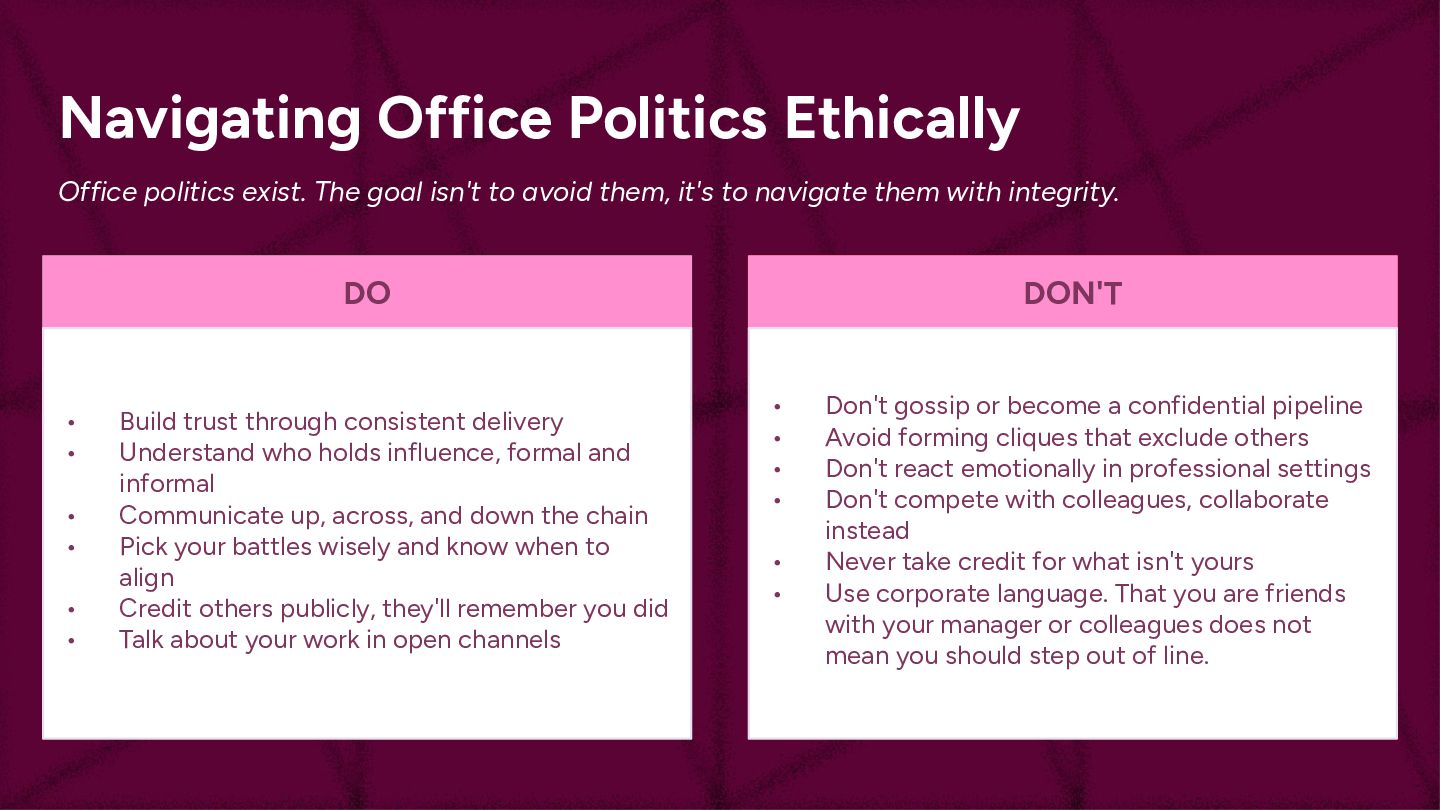
to navigate them with integrity. DO • Build trust through consistent delivery • Understand who holds influence, formal and informal • Communicate up, across, and down the chain • Pick your battles wisely and know when to align • Credit others publicly, they'll remember you did • Talk about your work in open channels DON'T • Don't gossip or become a confidential pipeline • Avoid forming cliques that exclude others • Don't react emotionally in professional settings • Don't compete with colleagues, collaborate instead • Never take credit for what isn't yours • Use corporate language. That you are friends with your manager or colleagues does not mean you should step out of line. Navigating Office Politics Ethically
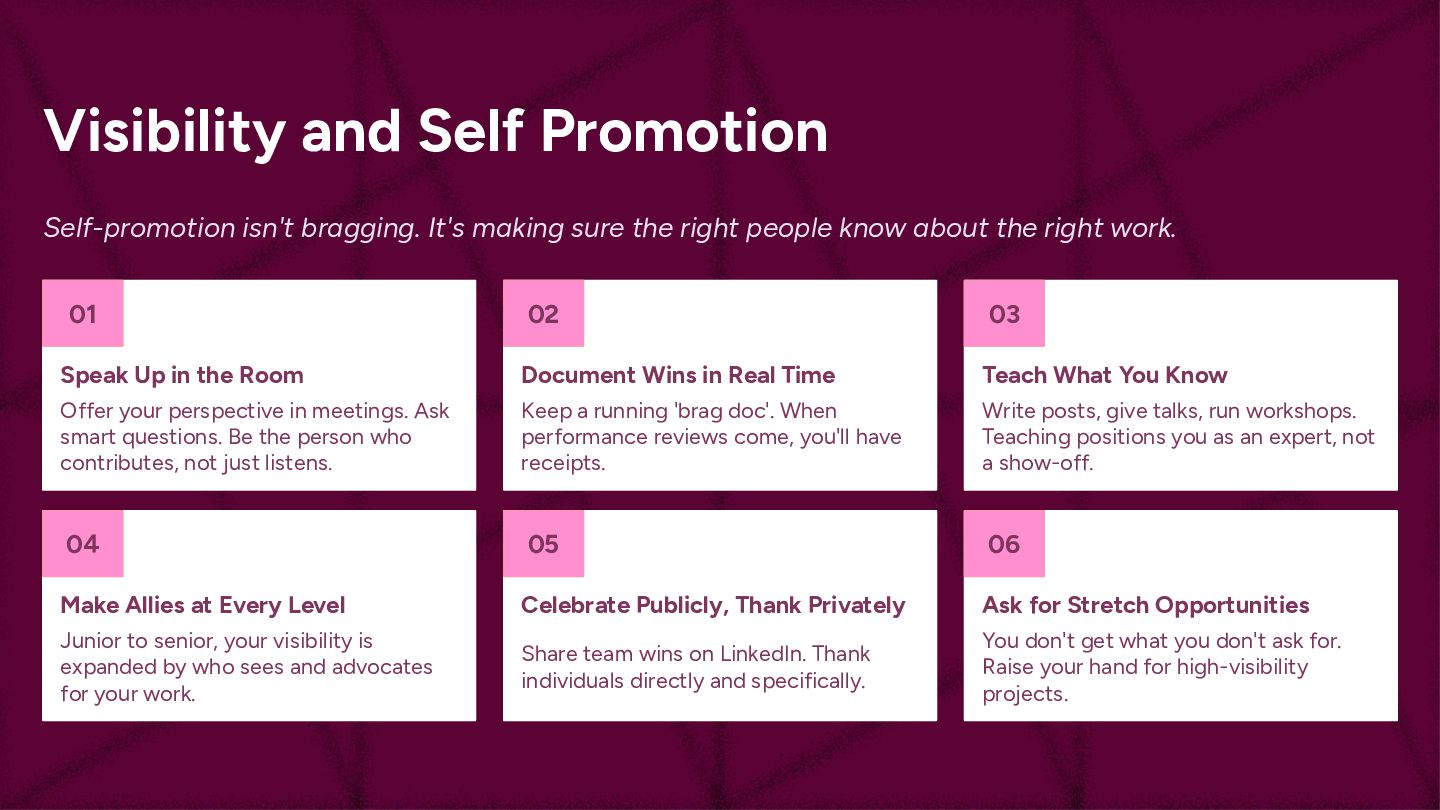
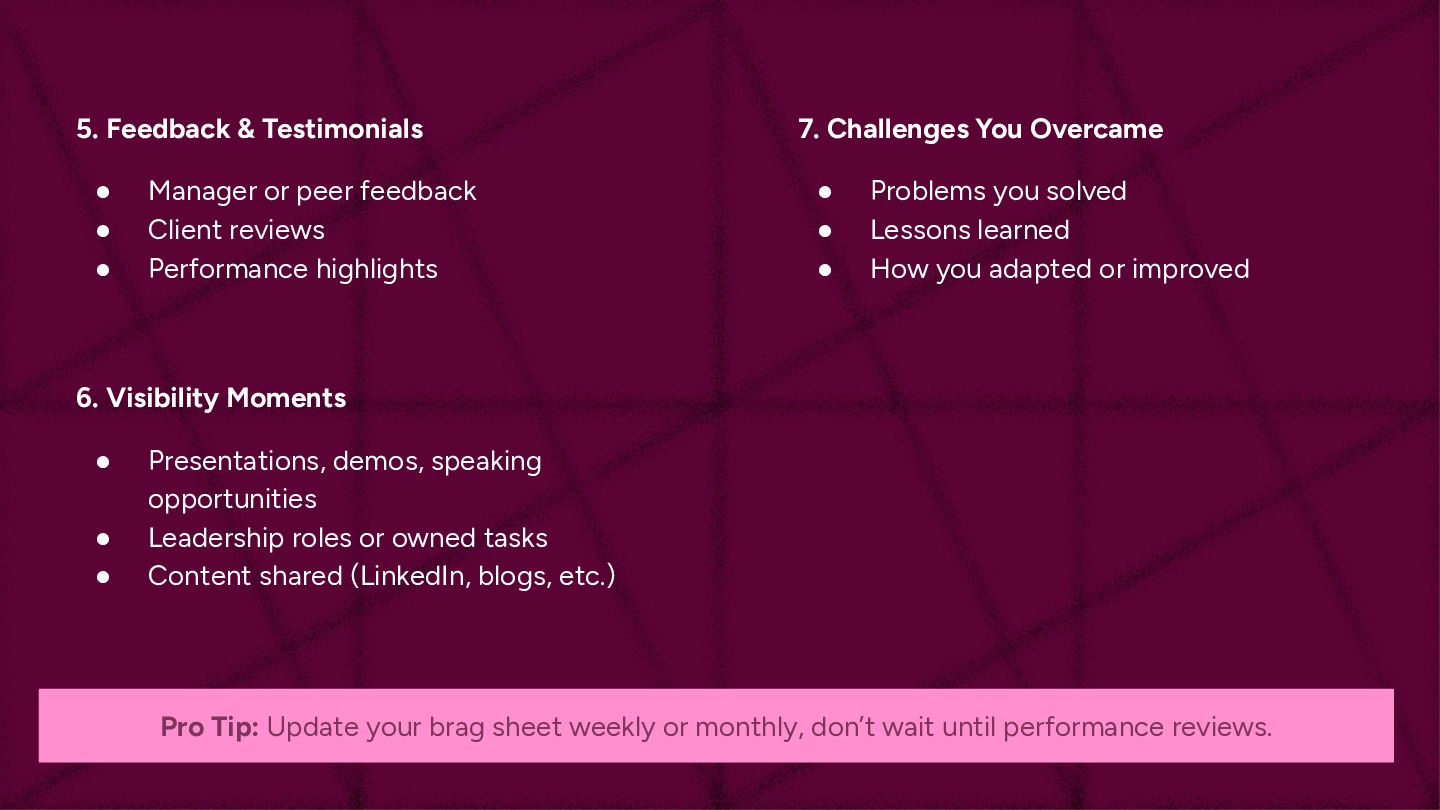
about the right work. 01 Speak Up in the Room Offer your perspective in meetings. Ask smart questions. Be the person who contributes, not just listens. 02 Document Wins in Real Time Keep a running 'brag doc'. When performance reviews come, you'll have receipts. 03 Teach What You Know Write posts, give talks, run workshops. Teaching positions you as an expert, not a show-off. 04 Make Allies at Every Level Junior to senior, your visibility is expanded by who sees and advocates for your work. 05 Celebrate Publicly, Thank Privately Share team wins on LinkedIn. Thank individuals directly and specifically. 06 Ask for Stretch Opportunities You don't get what you don't ask for. Raise your hand for high-visibility projects. Visibility and Self Promotion
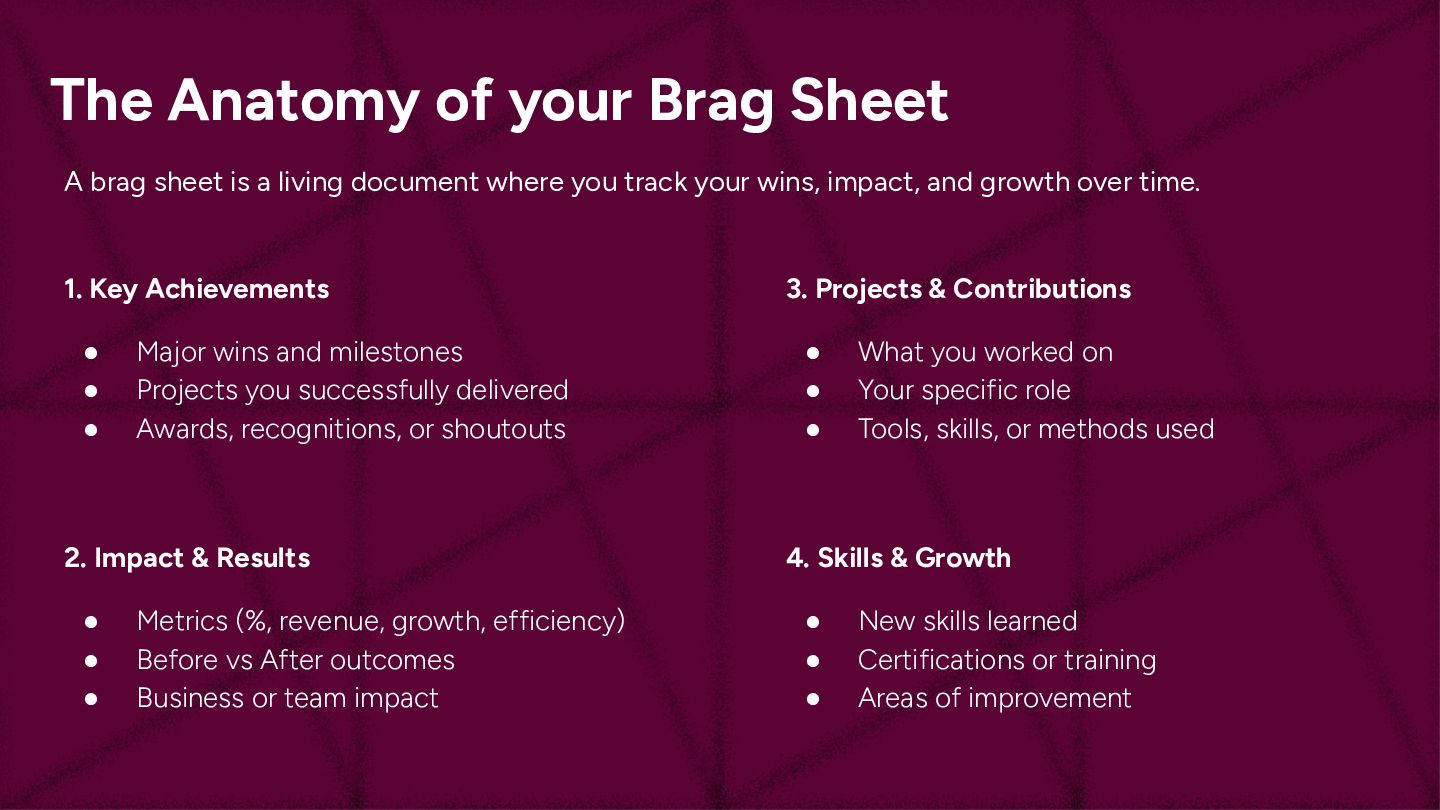
a living document where you track your wins, impact, and growth over time. 1. Key Achievements • Major wins and milestones • Projects you successfully delivered • Awards, recognitions, or shoutouts 2. Impact & Results • Metrics (%, revenue, growth, efficiency) • Before vs After outcomes • Business or team impact 3. Projects & Contributions • What you worked on • Your specific role • Tools, skills, or methods used 4. Skills & Growth • New skills learned • Certifications or training • Areas of improvement
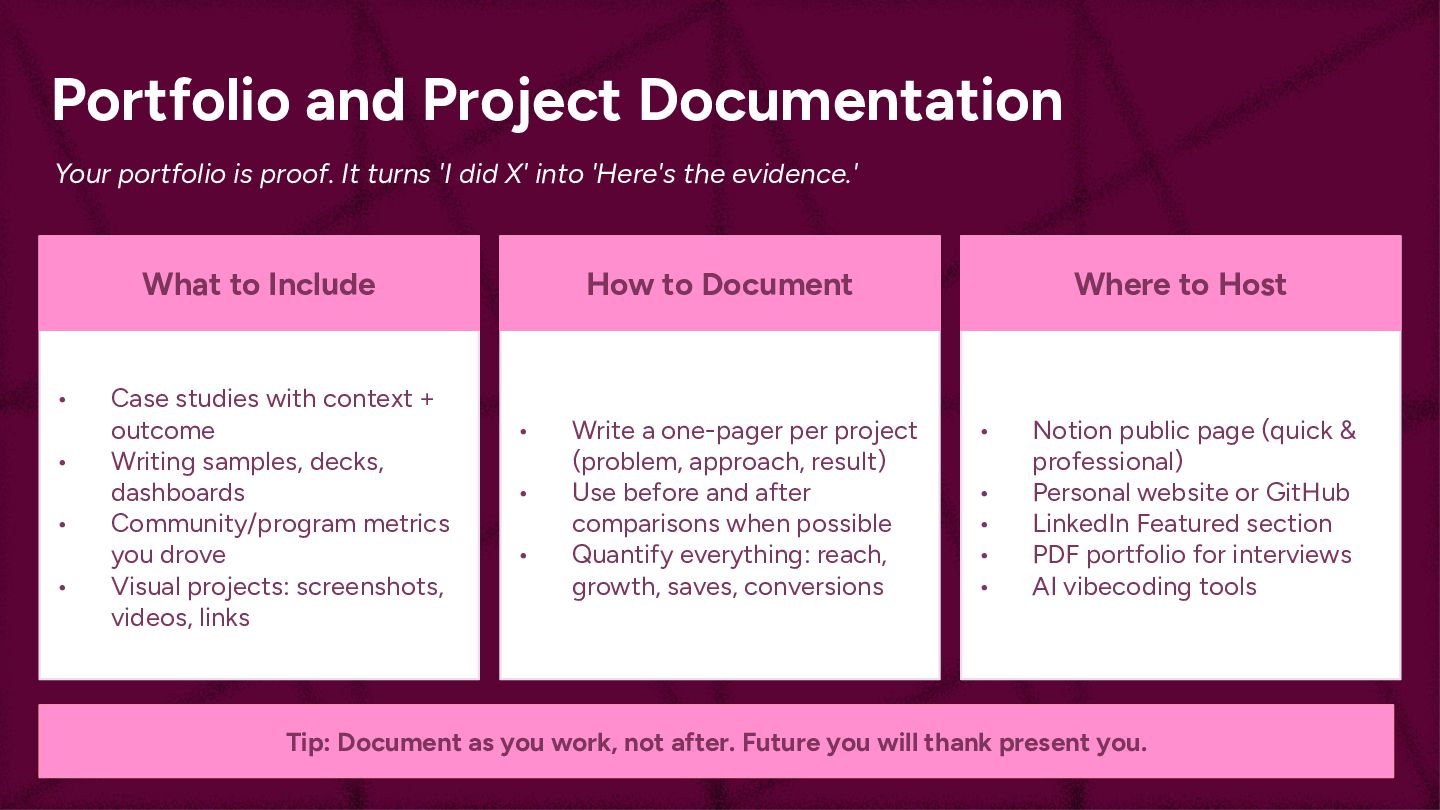
'Here's the evidence.' What to Include • Case studies with context + outcome • Writing samples, decks, dashboards • Community/program metrics you drove • Visual projects: screenshots, videos, links How to Document • Write a one-pager per project (problem, approach, result) • Use before and after comparisons when possible • Quantify everything: reach, growth, saves, conversions Where to Host • Notion public page (quick & professional) • Personal website or GitHub • LinkedIn Featured section • PDF portfolio for interviews • AI vibecoding tools Tip: Document as you work, not after. Future you will thank present you. Portfolio and Project Documentation


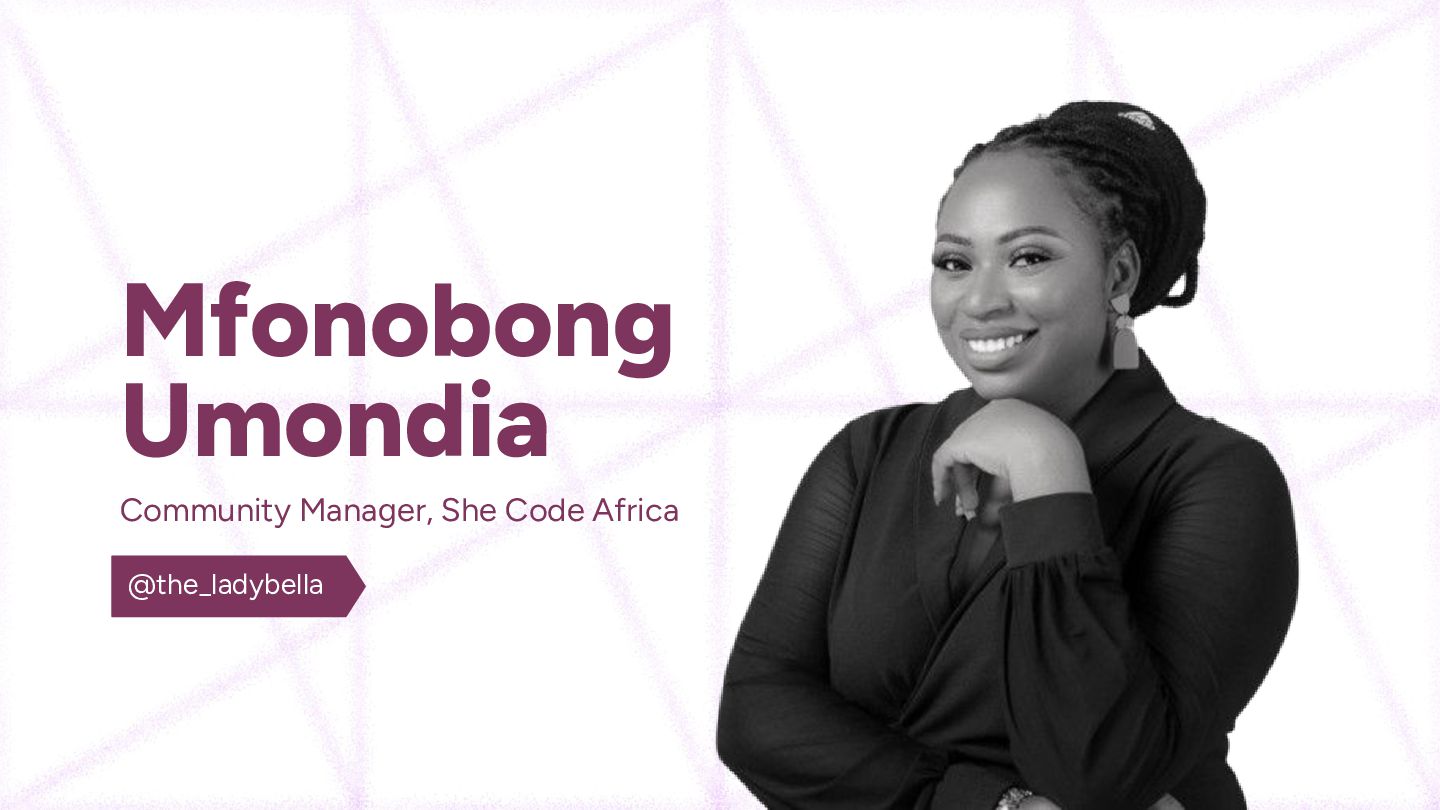
 mfonobong
 sh_fk2
 yama3133
 takuroabe
 kzkhykw1991
 kaminashi
 linedevth
 pfn
pfn
 tsukuboshi
 k1style
 snoozer05
 yuuuuuuu168
 tsukina_7mochi
 aleyda
 rmw
rmw
 csswizardry
 reverentgeek
 destraynor
 soudai
 aemeredith
 baasie
 tammielis
 hatefulcrawdad
 mlcsv
mlcsv