Upgrade to Pro — share decks privately, control downloads, hide ads and more …

CLEAR: A Framework for AI Visibility

Sponsored · SiteGround - Reliable hosting with speed, security, and support you can count on. →

CLEAR: A Framework for AI Visibility

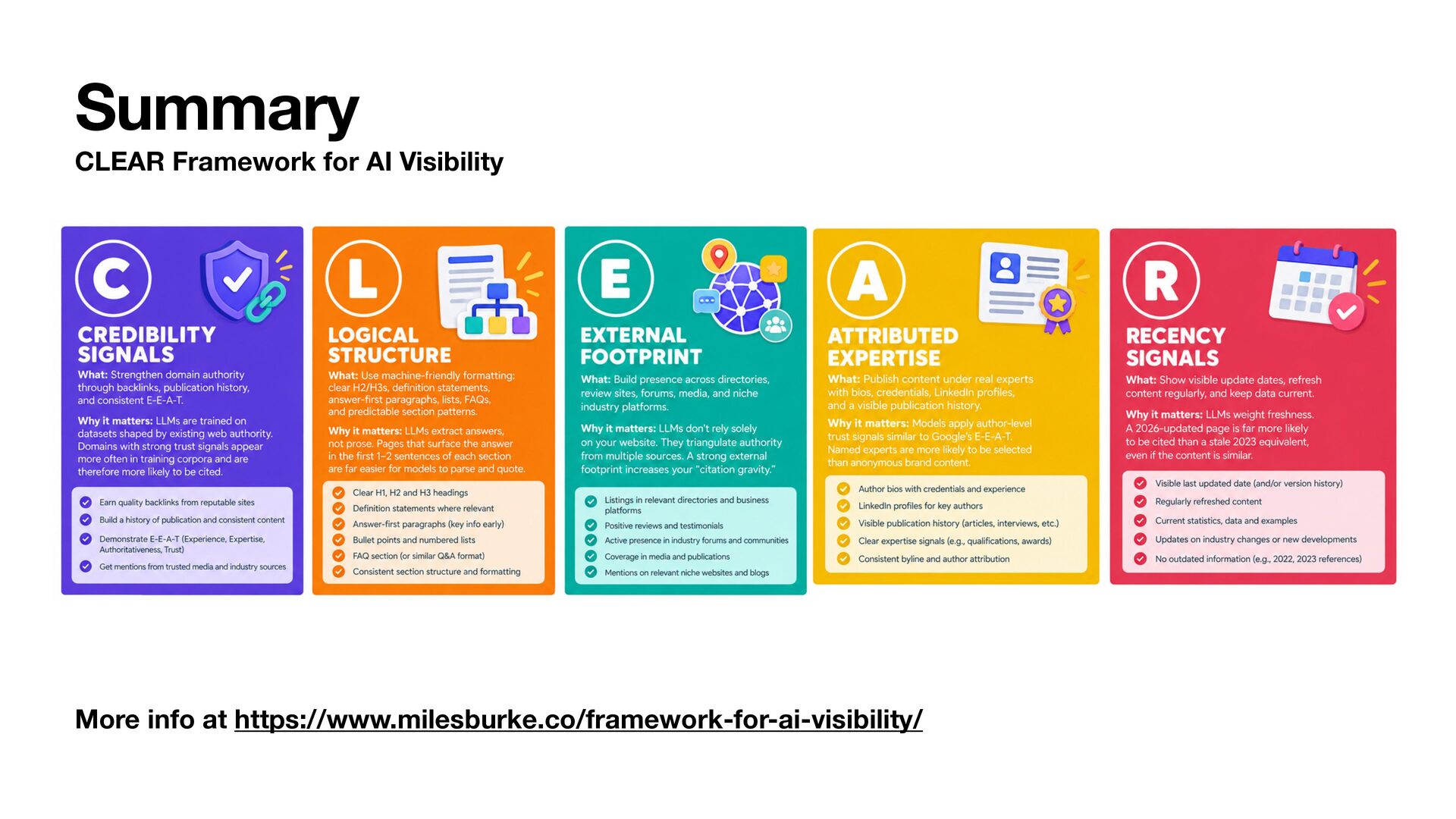
AI platforms now answer more questions than search engines — and they choose which websites to cite. If your content isn’t structured for machines, you disappear. The CLEAR Framework fixes that.

More information about how this all works at https://www.milesburke.co/framework-for-ai-visibility/

Avatar for Miles Burke

Miles Burke

September 11, 2026

Other Decks in Marketing & SEO

Transcript

  1. Credibile CLEAR Framework for AI Visibility LLMs were all trained

    on many domains which already carried authority; strong backlink pro les, consistent publishing, solid E-E-A-T signals. What to check: • Backlink strength, who’s linking to you, and are those backlinks actually relevant to your industry, or just noise? • Toxic or spammy links, worth a clean-up pass; they drag on credibility rather than adding to it. • E-E-A-T consistency, does your site read like it was written by the same trustworthy operation on every page, or does the tone lurch around depending on who wrote what? • Domain history, a visible, steady publishing timeline beats a burst of content dumped in one fi month followed by resounding silence for a year or more.
  2. Logical CLEAR Framework for AI Visibility AI doesn’t want your

    beautifully crafted 400-word introduction. They want the answer in the rst sentence or two; not buried down. What to check: • Lead every section with the direct, extractable answer, then explain afterwards. • Use a clear H2/H3 hierarchy and structured content • Add short de nition blocks for key terms, even ones you assume everyone already knows. • Turn prose into lists and tables wherever you can. fi fi fi • Build FAQ blocks, ve to ten genuinely high-intent questions per important page.
  3. External CLEAR Framework for AI Visibility LLMs don’t rely solely

    on your own website to decide whether you’re legitimate. They look at directories, reviews, media coverage, forums, and niche communities where your audience hangs out. What to check: • Get listed properly on relevant industry directories, not just the generic ones everyone ignores. • Keep review platform pro les current; outdated business hours or a dead phone number undermines credibility more than you’d think. • Chase genuine media mentions where you can, even small trade publications count. • Show up in forums and communities your actual customers use, rather than broadcasting only fi from your own blog.
  4. Attributed CLEAR Framework for AI Visibility Models apply something very

    close to Google’s E-E-A-T logic at the author level. Anonymous “Admin” bylines don’t carry weight. A named expert, with a visible bio, credentials, and pro le, does. What to check: • Use real bylines, not house accounts. • Include a proper bio; credentials, relevant experience, why this person is quali ed to write this particular piece. • Link to a genuine, active LinkedIn pro le. • Show publication history; previous articles, talks, research that demonstrates this isn’t a fi fi fi ff one-o ghost-written piece.
  5. Recency CLEAR Framework for AI Visibility LLMs weigh freshness heavily.

    A page updated in 2026 will beat a near-identical page from 2019, even when the information hasn’t changed. Old content goes stale. Keep it fresh, always. What to check: • Add “last updated” timestamps to important pages. • Set a refresh cycle, every three to six months for anything that matters commercially. • Replace outdated stats and examples rather than leaving 2022 gures sitting there looking con dent and wrong. • Avoid large clusters of stale content dragging the rest of the site down; an old, neglected fi fi corner of your site can quietly damage trust in the newer parts. Delete those old blog posts.