Introduction to Air Industry
Sponsored
·
 Your Podcast. Everywhere. Effortlessly.
Share. Educate. Inspire. Entertain. You do you. We'll handle the rest.
→
Your Podcast. Everywhere. Effortlessly.
Share. Educate. Inspire. Entertain. You do you. We'll handle the rest.
→

Share
Embed

Transcript
19 slides
-
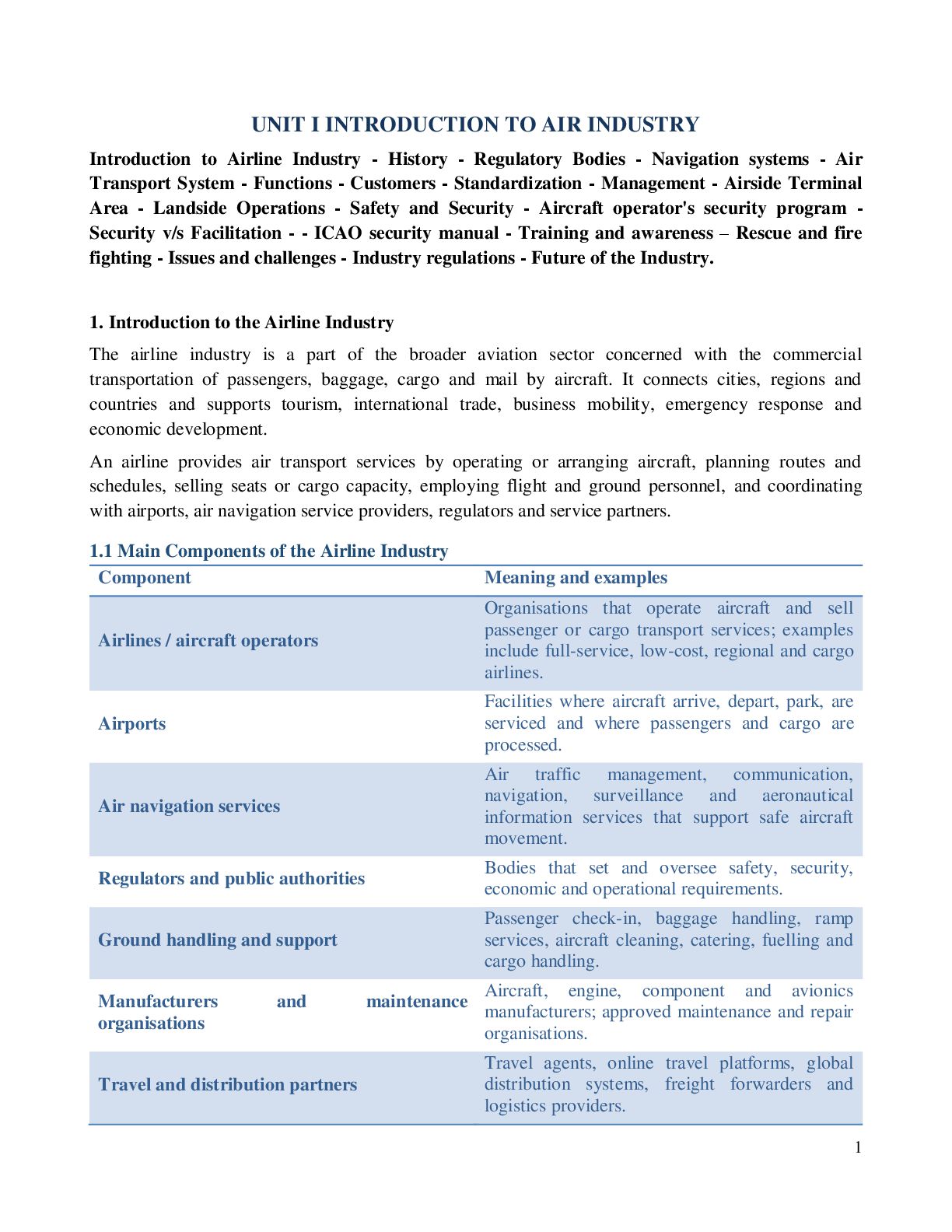
UNIT I INTRODUCTION TO AIR INDUSTRY Introduction to Airline Industry
- History - Regulatory Bodies - Navigation systems - Air Transport System - Functions - Customers - Standardization - Management - Airside Terminal Area - Landside Operations - Safety and Security - Aircraft operator's security program Security v/s Facilitation - - ICAO security manual - Training and awareness – Rescue and fire fighting - Issues and challenges - Industry regulations - Future of the Industry. 1. Introduction to the Airline Industry The airline industry is a part of the broader aviation sector concerned with the commercial transportation of passengers, baggage, cargo and mail by aircraft. It connects cities, regions and countries and supports tourism, international trade, business mobility, emergency response and economic development. An airline provides air transport services by operating or arranging aircraft, planning routes and schedules, selling seats or cargo capacity, employing flight and ground personnel, and coordinating with airports, air navigation service providers, regulators and service partners. 1.1 Main Components of the Airline Industry Component Meaning and examples Airlines / aircraft operators Organisations that operate aircraft and sell passenger or cargo transport services; examples include full-service, low-cost, regional and cargo airlines. Airports Facilities where aircraft arrive, depart, park, are serviced and where passengers and cargo are processed. Air navigation services Air traffic management, communication, navigation, surveillance and aeronautical information services that support safe aircraft movement. Regulators and public authorities Bodies that set and oversee safety, security, economic and operational requirements. Ground handling and support Passenger check-in, baggage handling, ramp services, aircraft cleaning, catering, fuelling and cargo handling. Manufacturers organisations and Travel and distribution partners maintenance Aircraft, engine, component and avionics manufacturers; approved maintenance and repair organisations. Travel agents, online travel platforms, global distribution systems, freight forwarders and logistics providers. 1 -
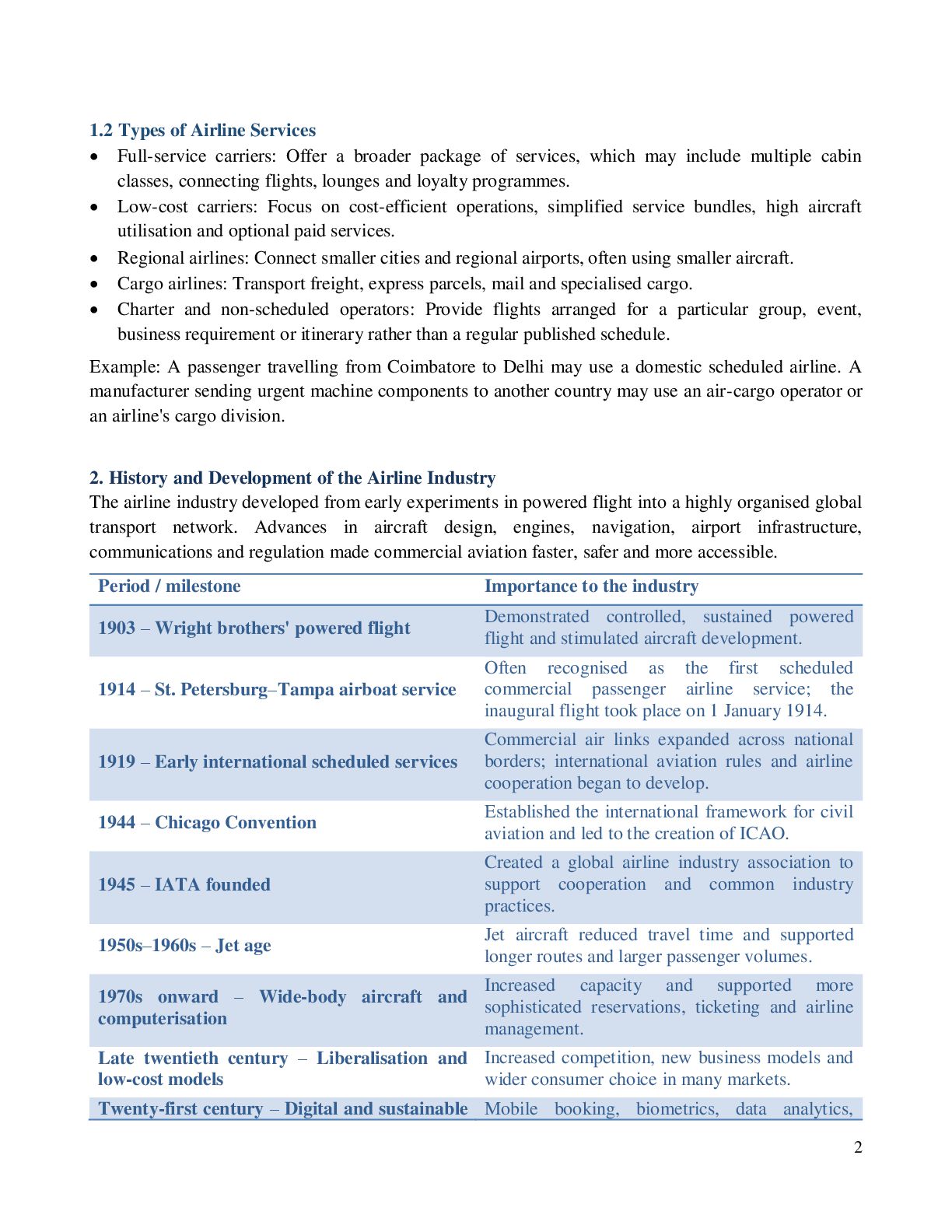
1.2 Types of Airline Services Full-service carriers: Offer a
broader package of services, which may include multiple cabin classes, connecting flights, lounges and loyalty programmes. Low-cost carriers: Focus on cost-efficient operations, simplified service bundles, high aircraft utilisation and optional paid services. Regional airlines: Connect smaller cities and regional airports, often using smaller aircraft. Cargo airlines: Transport freight, express parcels, mail and specialised cargo. Charter and non-scheduled operators: Provide flights arranged for a particular group, event, business requirement or itinerary rather than a regular published schedule. Example: A passenger travelling from Coimbatore to Delhi may use a domestic scheduled airline. A manufacturer sending urgent machine components to another country may use an air-cargo operator or an airline's cargo division. 2. History and Development of the Airline Industry The airline industry developed from early experiments in powered flight into a highly organised global transport network. Advances in aircraft design, engines, navigation, airport infrastructure, communications and regulation made commercial aviation faster, safer and more accessible. Period / milestone Importance to the industry 1903 – Wright brothers' powered flight Demonstrated controlled, sustained powered flight and stimulated aircraft development. 1914 – St. Petersburg–Tampa airboat service Often recognised as the first scheduled commercial passenger airline service; the inaugural flight took place on 1 January 1914. 1919 – Early international scheduled services Commercial air links expanded across national borders; international aviation rules and airline cooperation began to develop. 1944 – Chicago Convention Established the international framework for civil aviation and led to the creation of ICAO. 1945 – IATA founded Created a global airline industry association to support cooperation and common industry practices. 1950s–1960s – Jet age Jet aircraft reduced travel time and supported longer routes and larger passenger volumes. Increased capacity and supported more 1970s onward – Wide-body aircraft and sophisticated reservations, ticketing and airline computerisation management. Late twentieth century – Liberalisation and Increased competition, new business models and wider consumer choice in many markets. low-cost models Twenty-first century – Digital and sustainable Mobile booking, biometrics, data analytics, 2 -
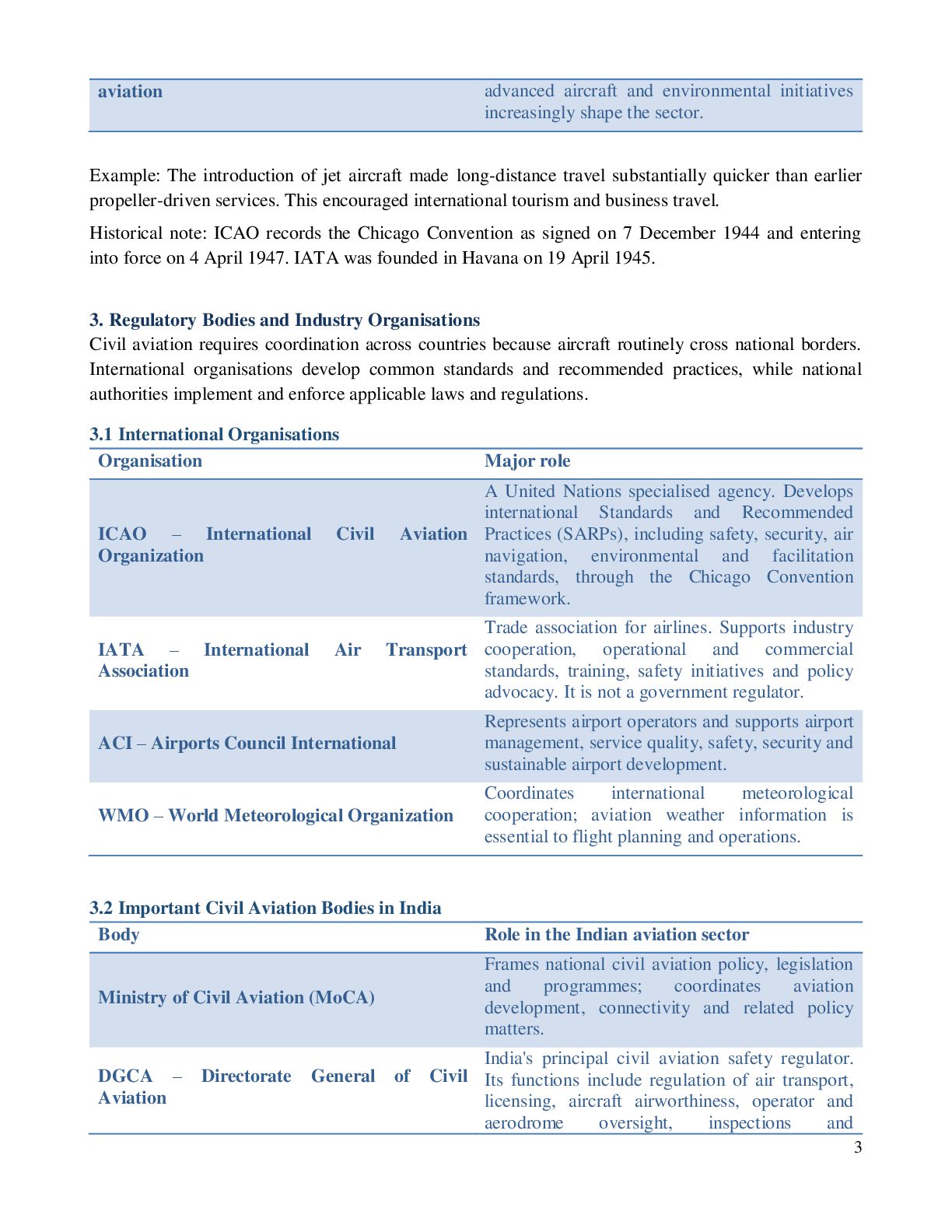
advanced aircraft and environmental initiatives increasingly shape the sector. aviation
Example: The introduction of jet aircraft made long-distance travel substantially quicker than earlier propeller-driven services. This encouraged international tourism and business travel. Historical note: ICAO records the Chicago Convention as signed on 7 December 1944 and entering into force on 4 April 1947. IATA was founded in Havana on 19 April 1945. 3. Regulatory Bodies and Industry Organisations Civil aviation requires coordination across countries because aircraft routinely cross national borders. International organisations develop common standards and recommended practices, while national authorities implement and enforce applicable laws and regulations. 3.1 International Organisations Organisation ICAO – International Organization IATA – International Association Major role A United Nations specialised agency. Develops international Standards and Recommended Aviation Practices (SARPs), including safety, security, air navigation, environmental and facilitation standards, through the Chicago Convention framework. Civil Air Trade association for airlines. Supports industry Transport cooperation, operational and commercial standards, training, safety initiatives and policy advocacy. It is not a government regulator. ACI – Airports Council International Represents airport operators and supports airport management, service quality, safety, security and sustainable airport development. WMO – World Meteorological Organization Coordinates international meteorological cooperation; aviation weather information is essential to flight planning and operations. 3.2 Important Civil Aviation Bodies in India Body Frames national civil aviation policy, legislation and programmes; coordinates aviation development, connectivity and related policy matters. Ministry of Civil Aviation (MoCA) DGCA – Aviation Directorate General Role in the Indian aviation sector of India's principal civil aviation safety regulator. Civil Its functions include regulation of air transport, licensing, aircraft airworthiness, operator and aerodrome oversight, inspections and 3 -
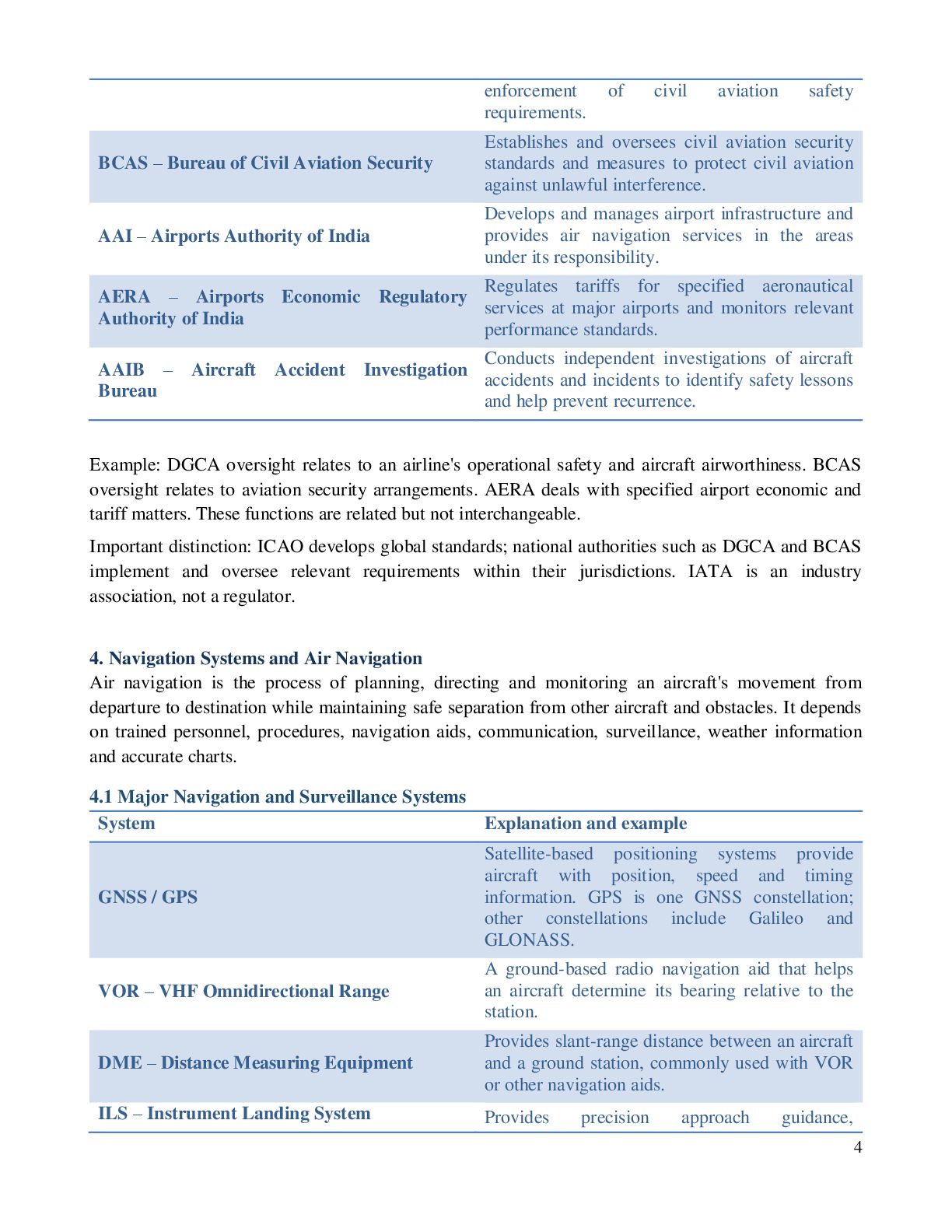
enforcement requirements. of civil aviation safety BCAS – Bureau of
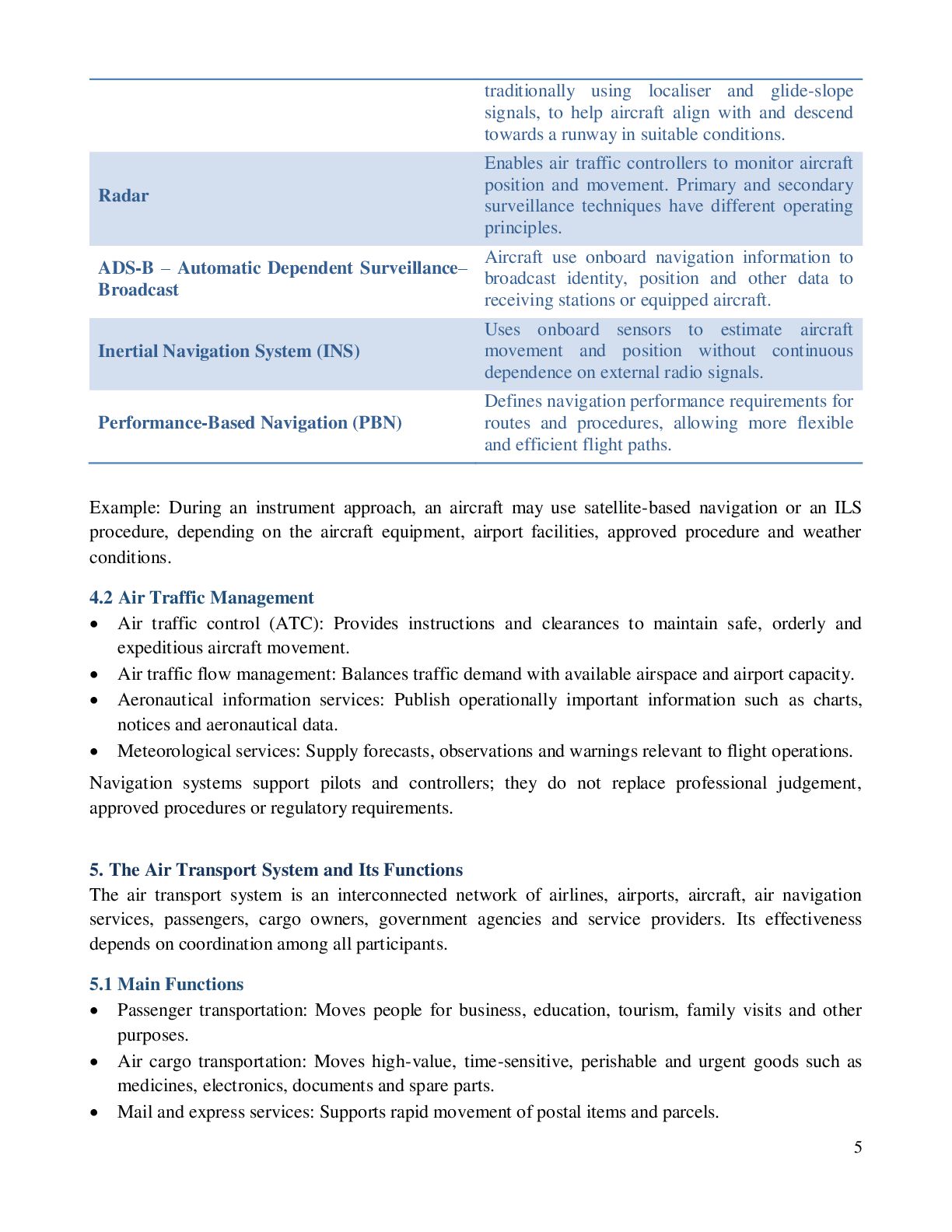
Civil Aviation Security Establishes and oversees civil aviation security standards and measures to protect civil aviation against unlawful interference. AAI – Airports Authority of India Develops and manages airport infrastructure and provides air navigation services in the areas under its responsibility. Regulates tariffs for specified aeronautical AERA – Airports Economic Regulatory services at major airports and monitors relevant Authority of India performance standards. AAIB – Bureau Aircraft Accident Investigation Conducts independent investigations of aircraft accidents and incidents to identify safety lessons and help prevent recurrence. Example: DGCA oversight relates to an airline's operational safety and aircraft airworthiness. BCAS oversight relates to aviation security arrangements. AERA deals with specified airport economic and tariff matters. These functions are related but not interchangeable. Important distinction: ICAO develops global standards; national authorities such as DGCA and BCAS implement and oversee relevant requirements within their jurisdictions. IATA is an industry association, not a regulator. 4. Navigation Systems and Air Navigation Air navigation is the process of planning, directing and monitoring an aircraft's movement from departure to destination while maintaining safe separation from other aircraft and obstacles. It depends on trained personnel, procedures, navigation aids, communication, surveillance, weather information and accurate charts. 4.1 Major Navigation and Surveillance Systems System Explanation and example GNSS / GPS Satellite-based positioning systems provide aircraft with position, speed and timing information. GPS is one GNSS constellation; other constellations include Galileo and GLONASS. VOR – VHF Omnidirectional Range A ground-based radio navigation aid that helps an aircraft determine its bearing relative to the station. DME – Distance Measuring Equipment Provides slant-range distance between an aircraft and a ground station, commonly used with VOR or other navigation aids. ILS – Instrument Landing System Provides precision approach guidance, 4 -
traditionally using localiser and glide-slope signals, to help aircraft align
with and descend towards a runway in suitable conditions. Radar Enables air traffic controllers to monitor aircraft position and movement. Primary and secondary surveillance techniques have different operating principles. Aircraft use onboard navigation information to ADS-B – Automatic Dependent Surveillance– broadcast identity, position and other data to Broadcast receiving stations or equipped aircraft. Inertial Navigation System (INS) Uses onboard sensors to estimate aircraft movement and position without continuous dependence on external radio signals. Performance-Based Navigation (PBN) Defines navigation performance requirements for routes and procedures, allowing more flexible and efficient flight paths. Example: During an instrument approach, an aircraft may use satellite-based navigation or an ILS procedure, depending on the aircraft equipment, airport facilities, approved procedure and weather conditions. 4.2 Air Traffic Management Air traffic control (ATC): Provides instructions and clearances to maintain safe, orderly and expeditious aircraft movement. Air traffic flow management: Balances traffic demand with available airspace and airport capacity. Aeronautical information services: Publish operationally important information such as charts, notices and aeronautical data. Meteorological services: Supply forecasts, observations and warnings relevant to flight operations. Navigation systems support pilots and controllers; they do not replace professional judgement, approved procedures or regulatory requirements. 5. The Air Transport System and Its Functions The air transport system is an interconnected network of airlines, airports, aircraft, air navigation services, passengers, cargo owners, government agencies and service providers. Its effectiveness depends on coordination among all participants. 5.1 Main Functions Passenger transportation: Moves people for business, education, tourism, family visits and other purposes. Air cargo transportation: Moves high-value, time-sensitive, perishable and urgent goods such as medicines, electronics, documents and spare parts. Mail and express services: Supports rapid movement of postal items and parcels. 5 -
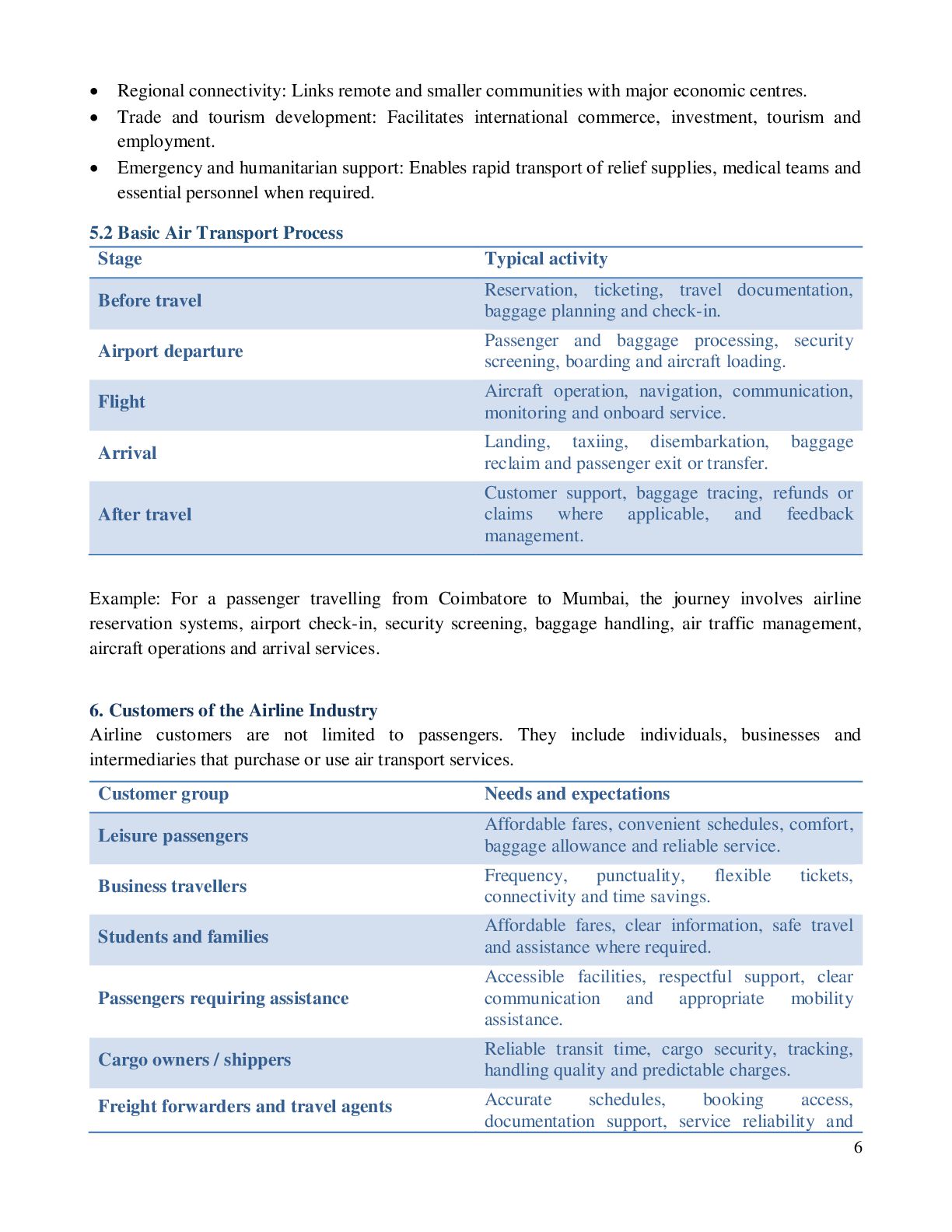
Regional connectivity: Links remote and smaller communities
with major economic centres. Trade and tourism development: Facilitates international commerce, investment, tourism and employment. Emergency and humanitarian support: Enables rapid transport of relief supplies, medical teams and essential personnel when required. 5.2 Basic Air Transport Process Stage Typical activity Before travel Reservation, ticketing, travel documentation, baggage planning and check-in. Airport departure Passenger and baggage processing, security screening, boarding and aircraft loading. Flight Aircraft operation, navigation, communication, monitoring and onboard service. Arrival Landing, taxiing, disembarkation, reclaim and passenger exit or transfer. After travel Customer support, baggage tracing, refunds or claims where applicable, and feedback management. baggage Example: For a passenger travelling from Coimbatore to Mumbai, the journey involves airline reservation systems, airport check-in, security screening, baggage handling, air traffic management, aircraft operations and arrival services. 6. Customers of the Airline Industry Airline customers are not limited to passengers. They include individuals, businesses and intermediaries that purchase or use air transport services. Customer group Needs and expectations Leisure passengers Affordable fares, convenient schedules, comfort, baggage allowance and reliable service. Business travellers Frequency, punctuality, flexible connectivity and time savings. Students and families Affordable fares, clear information, safe travel and assistance where required. Passengers requiring assistance Accessible facilities, respectful support, clear communication and appropriate mobility assistance. Cargo owners / shippers Reliable transit time, cargo security, tracking, handling quality and predictable charges. Freight forwarders and travel agents Accurate schedules, booking access, documentation support, service reliability and tickets, 6 -
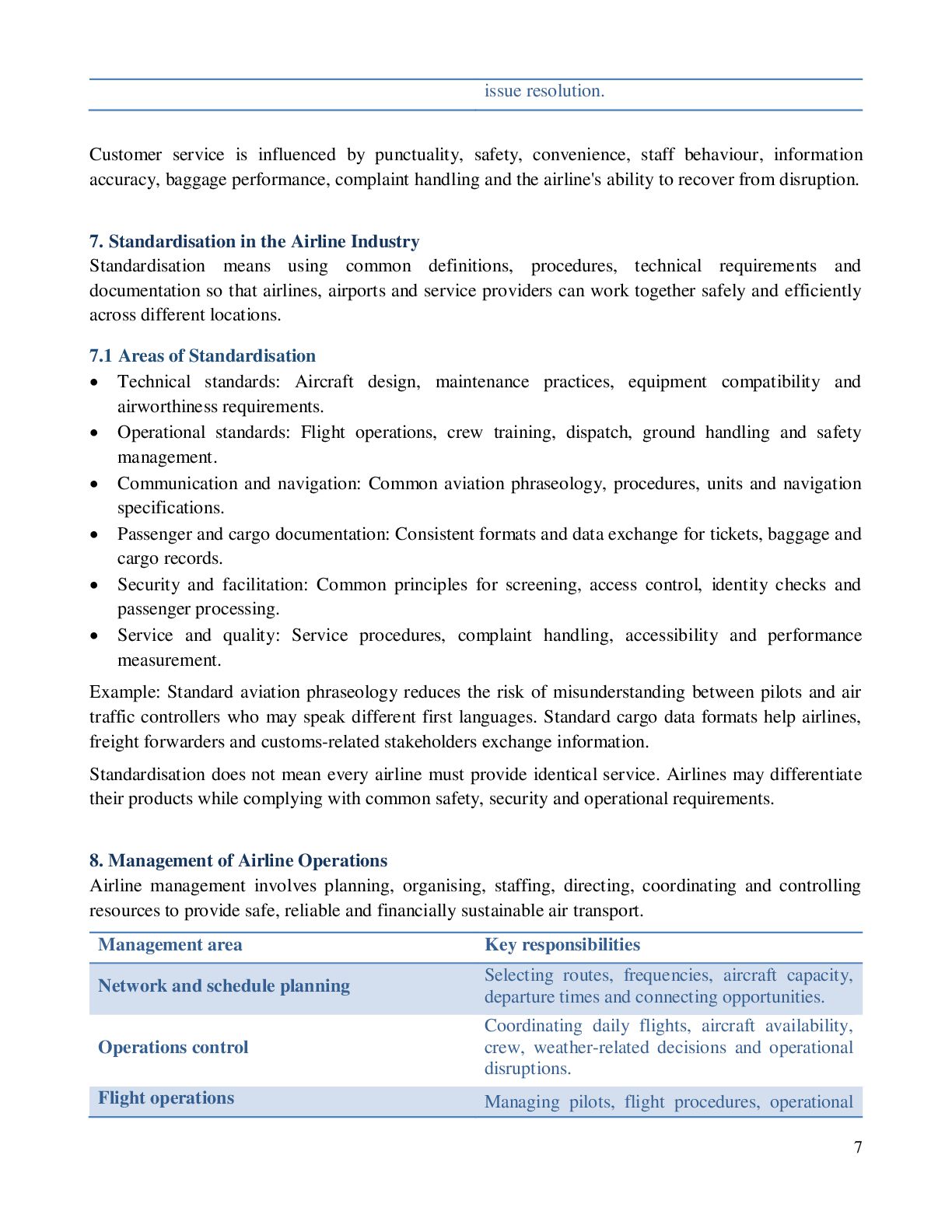
issue resolution. Customer service is influenced by punctuality, safety, convenience,
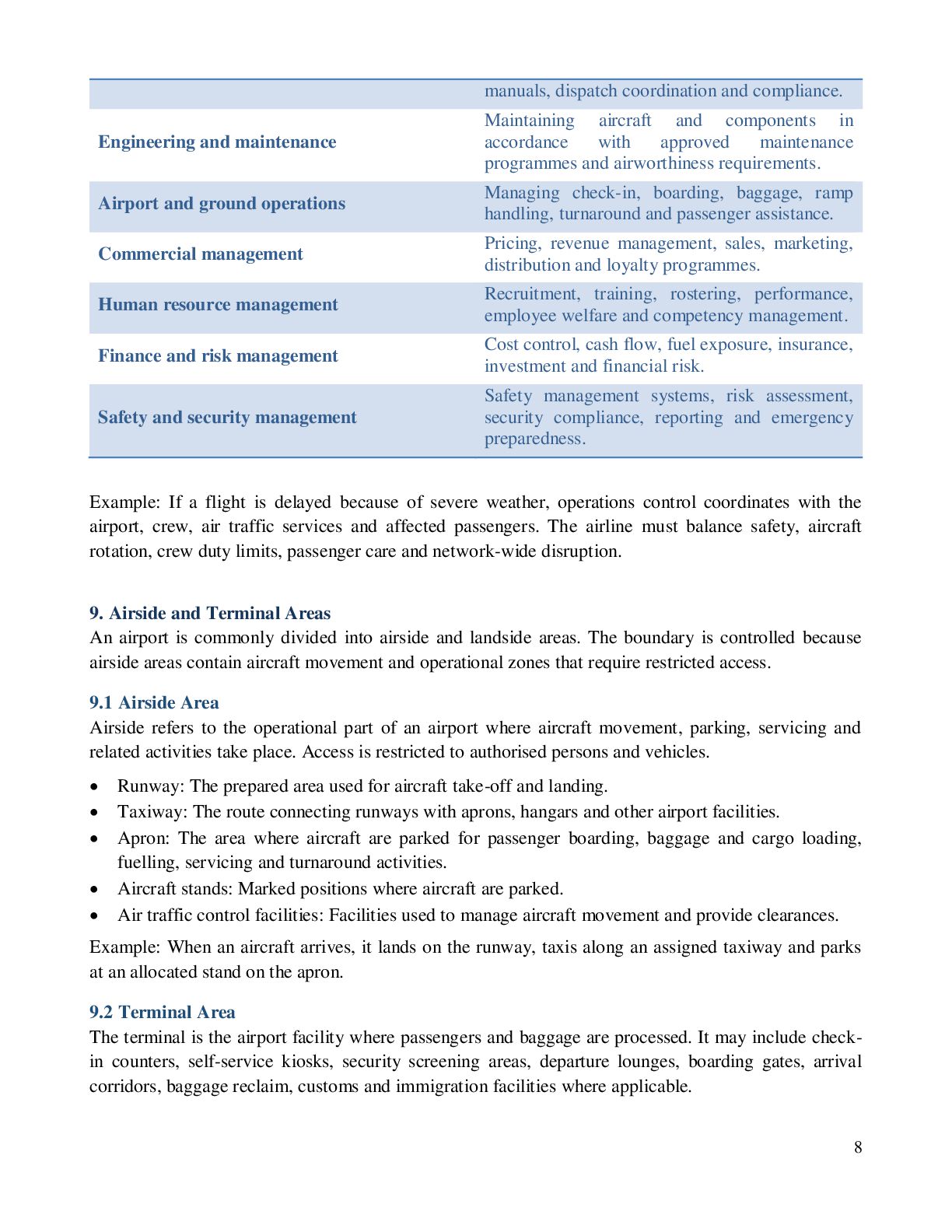
staff behaviour, information accuracy, baggage performance, complaint handling and the airline's ability to recover from disruption. 7. Standardisation in the Airline Industry Standardisation means using common definitions, procedures, technical requirements and documentation so that airlines, airports and service providers can work together safely and efficiently across different locations. 7.1 Areas of Standardisation Technical standards: Aircraft design, maintenance practices, equipment compatibility and airworthiness requirements. Operational standards: Flight operations, crew training, dispatch, ground handling and safety management. Communication and navigation: Common aviation phraseology, procedures, units and navigation specifications. Passenger and cargo documentation: Consistent formats and data exchange for tickets, baggage and cargo records. Security and facilitation: Common principles for screening, access control, identity checks and passenger processing. Service and quality: Service procedures, complaint handling, accessibility and performance measurement. Example: Standard aviation phraseology reduces the risk of misunderstanding between pilots and air traffic controllers who may speak different first languages. Standard cargo data formats help airlines, freight forwarders and customs-related stakeholders exchange information. Standardisation does not mean every airline must provide identical service. Airlines may differentiate their products while complying with common safety, security and operational requirements. 8. Management of Airline Operations Airline management involves planning, organising, staffing, directing, coordinating and controlling resources to provide safe, reliable and financially sustainable air transport. Management area Key responsibilities Network and schedule planning Selecting routes, frequencies, aircraft capacity, departure times and connecting opportunities. Operations control Coordinating daily flights, aircraft availability, crew, weather-related decisions and operational disruptions. Flight operations Managing pilots, flight procedures, operational 7 -
manuals, dispatch coordination and compliance. Engineering and maintenance Maintaining aircraft
and components in accordance with approved maintenance programmes and airworthiness requirements. Airport and ground operations Managing check-in, boarding, baggage, ramp handling, turnaround and passenger assistance. Commercial management Pricing, revenue management, sales, marketing, distribution and loyalty programmes. Human resource management Recruitment, training, rostering, performance, employee welfare and competency management. Finance and risk management Cost control, cash flow, fuel exposure, insurance, investment and financial risk. Safety and security management Safety management systems, risk assessment, security compliance, reporting and emergency preparedness. Example: If a flight is delayed because of severe weather, operations control coordinates with the airport, crew, air traffic services and affected passengers. The airline must balance safety, aircraft rotation, crew duty limits, passenger care and network-wide disruption. 9. Airside and Terminal Areas An airport is commonly divided into airside and landside areas. The boundary is controlled because airside areas contain aircraft movement and operational zones that require restricted access. 9.1 Airside Area Airside refers to the operational part of an airport where aircraft movement, parking, servicing and related activities take place. Access is restricted to authorised persons and vehicles. Runway: The prepared area used for aircraft take-off and landing. Taxiway: The route connecting runways with aprons, hangars and other airport facilities. Apron: The area where aircraft are parked for passenger boarding, baggage and cargo loading, fuelling, servicing and turnaround activities. Aircraft stands: Marked positions where aircraft are parked. Air traffic control facilities: Facilities used to manage aircraft movement and provide clearances. Example: When an aircraft arrives, it lands on the runway, taxis along an assigned taxiway and parks at an allocated stand on the apron. 9.2 Terminal Area The terminal is the airport facility where passengers and baggage are processed. It may include checkin counters, self-service kiosks, security screening areas, departure lounges, boarding gates, arrival corridors, baggage reclaim, customs and immigration facilities where applicable. 8 -
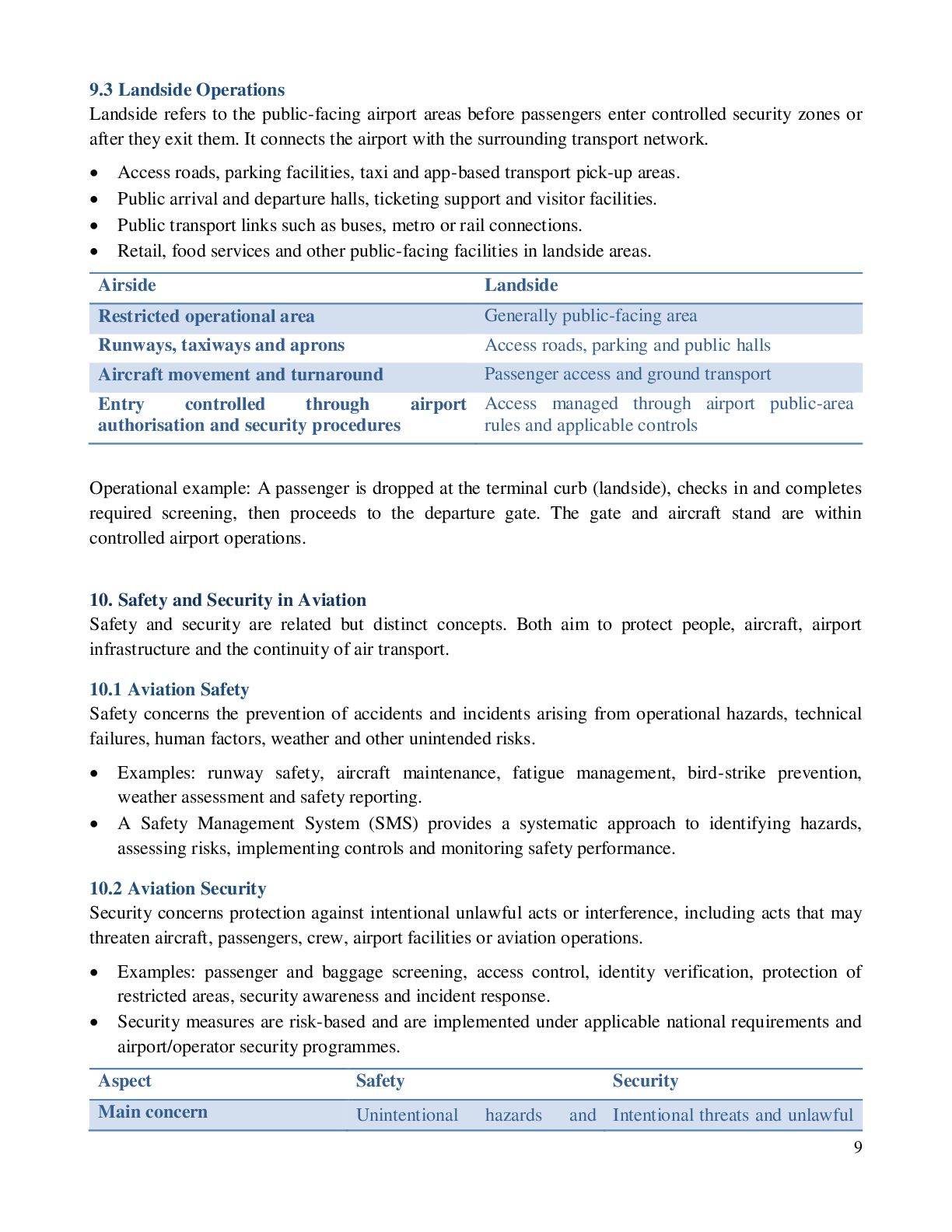
9.3 Landside Operations Landside refers to the public-facing airport areas
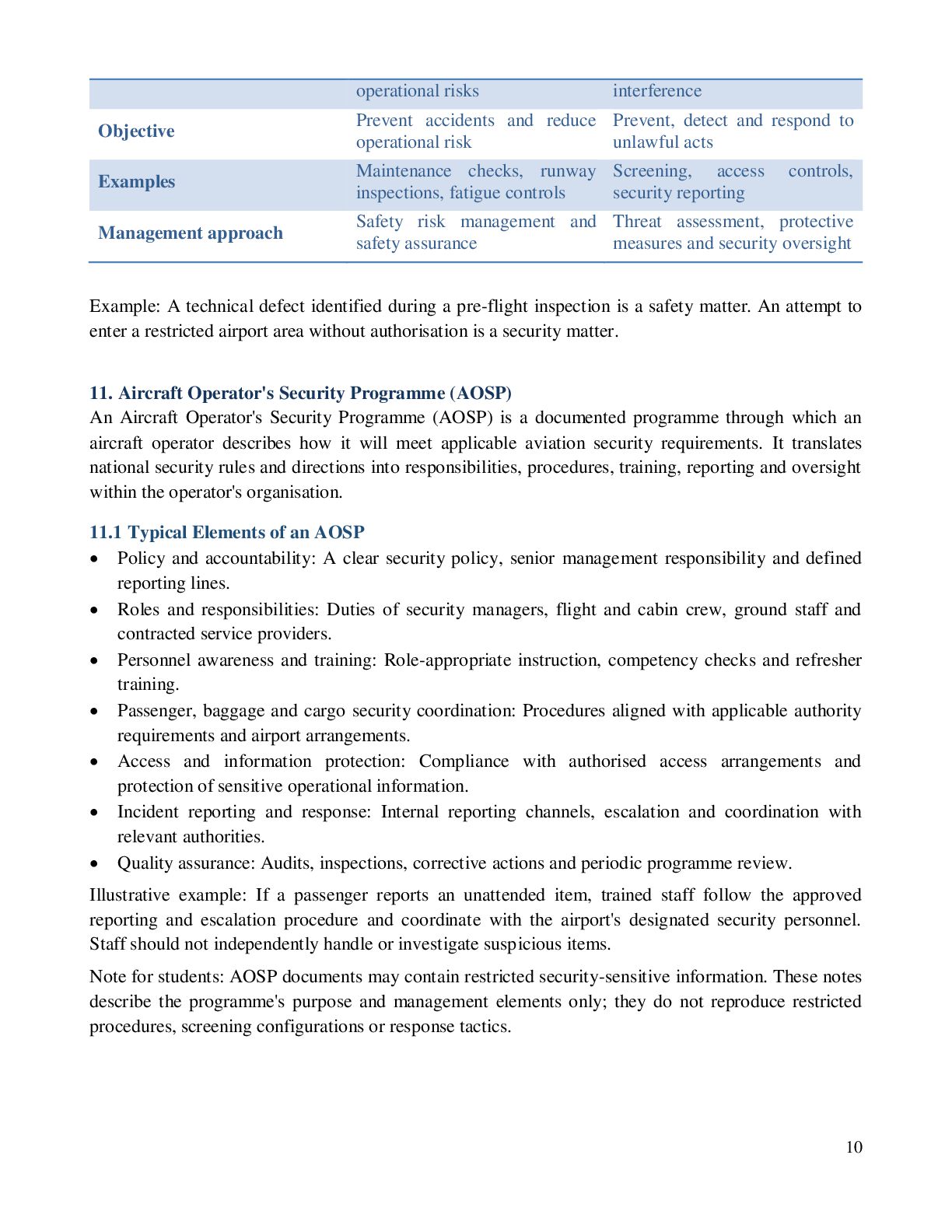
before passengers enter controlled security zones or after they exit them. It connects the airport with the surrounding transport network. Access roads, parking facilities, taxi and app-based transport pick-up areas. Public arrival and departure halls, ticketing support and visitor facilities. Public transport links such as buses, metro or rail connections. Retail, food services and other public-facing facilities in landside areas. Airside Landside Restricted operational area Generally public-facing area Runways, taxiways and aprons Access roads, parking and public halls Aircraft movement and turnaround Passenger access and ground transport Entry controlled through airport Access managed through airport public-area rules and applicable controls authorisation and security procedures Operational example: A passenger is dropped at the terminal curb (landside), checks in and completes required screening, then proceeds to the departure gate. The gate and aircraft stand are within controlled airport operations. 10. Safety and Security in Aviation Safety and security are related but distinct concepts. Both aim to protect people, aircraft, airport infrastructure and the continuity of air transport. 10.1 Aviation Safety Safety concerns the prevention of accidents and incidents arising from operational hazards, technical failures, human factors, weather and other unintended risks. Examples: runway safety, aircraft maintenance, fatigue management, bird-strike prevention, weather assessment and safety reporting. A Safety Management System (SMS) provides a systematic approach to identifying hazards, assessing risks, implementing controls and monitoring safety performance. 10.2 Aviation Security Security concerns protection against intentional unlawful acts or interference, including acts that may threaten aircraft, passengers, crew, airport facilities or aviation operations. Examples: passenger and baggage screening, access control, identity verification, protection of restricted areas, security awareness and incident response. Security measures are risk-based and are implemented under applicable national requirements and airport/operator security programmes. Aspect Safety Main concern Unintentional Security hazards and Intentional threats and unlawful 9 -
operational risks interference Objective Prevent accidents and reduce Prevent, detect
and respond to operational risk unlawful acts Examples Maintenance checks, runway Screening, access inspections, fatigue controls security reporting Management approach Safety risk management and Threat assessment, protective safety assurance measures and security oversight controls, Example: A technical defect identified during a pre-flight inspection is a safety matter. An attempt to enter a restricted airport area without authorisation is a security matter. 11. Aircraft Operator's Security Programme (AOSP) An Aircraft Operator's Security Programme (AOSP) is a documented programme through which an aircraft operator describes how it will meet applicable aviation security requirements. It translates national security rules and directions into responsibilities, procedures, training, reporting and oversight within the operator's organisation. 11.1 Typical Elements of an AOSP Policy and accountability: A clear security policy, senior management responsibility and defined reporting lines. Roles and responsibilities: Duties of security managers, flight and cabin crew, ground staff and contracted service providers. Personnel awareness and training: Role-appropriate instruction, competency checks and refresher training. Passenger, baggage and cargo security coordination: Procedures aligned with applicable authority requirements and airport arrangements. Access and information protection: Compliance with authorised access arrangements and protection of sensitive operational information. Incident reporting and response: Internal reporting channels, escalation and coordination with relevant authorities. Quality assurance: Audits, inspections, corrective actions and periodic programme review. Illustrative example: If a passenger reports an unattended item, trained staff follow the approved reporting and escalation procedure and coordinate with the airport's designated security personnel. Staff should not independently handle or investigate suspicious items. Note for students: AOSP documents may contain restricted security-sensitive information. These notes describe the programme's purpose and management elements only; they do not reproduce restricted procedures, screening configurations or response tactics. 10 -
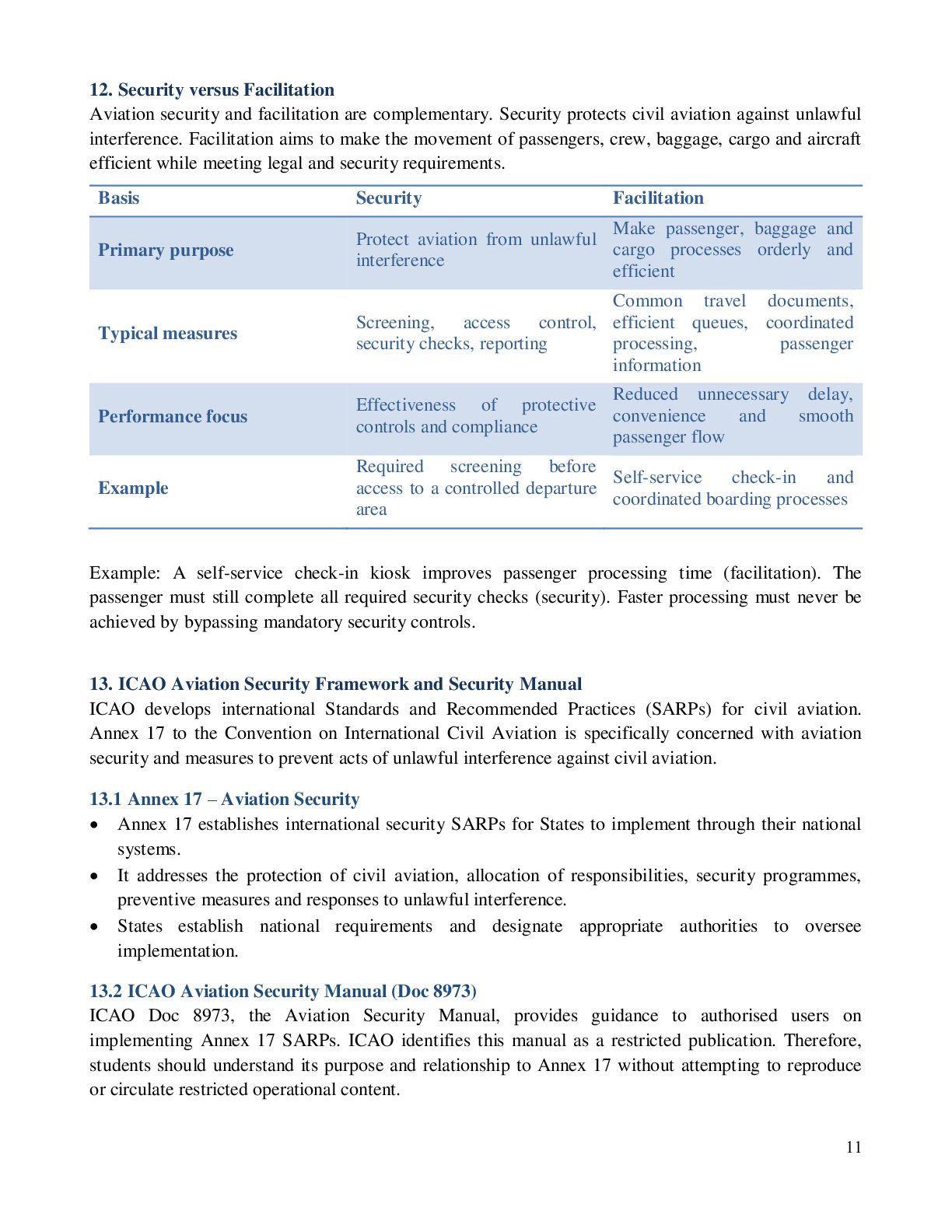
12. Security versus Facilitation Aviation security and facilitation are complementary.
Security protects civil aviation against unlawful interference. Facilitation aims to make the movement of passengers, crew, baggage, cargo and aircraft efficient while meeting legal and security requirements. Basis Security Facilitation Primary purpose Make passenger, baggage and Protect aviation from unlawful cargo processes orderly and interference efficient Typical measures Common travel documents, Screening, access control, efficient queues, coordinated security checks, reporting processing, passenger information Performance focus Reduced unnecessary delay, Effectiveness of protective convenience and smooth controls and compliance passenger flow Example Required screening before Self-service check-in and access to a controlled departure coordinated boarding processes area Example: A self-service check-in kiosk improves passenger processing time (facilitation). The passenger must still complete all required security checks (security). Faster processing must never be achieved by bypassing mandatory security controls. 13. ICAO Aviation Security Framework and Security Manual ICAO develops international Standards and Recommended Practices (SARPs) for civil aviation. Annex 17 to the Convention on International Civil Aviation is specifically concerned with aviation security and measures to prevent acts of unlawful interference against civil aviation. 13.1 Annex 17 – Aviation Security Annex 17 establishes international security SARPs for States to implement through their national systems. It addresses the protection of civil aviation, allocation of responsibilities, security programmes, preventive measures and responses to unlawful interference. States establish national requirements and designate appropriate authorities to oversee implementation. 13.2 ICAO Aviation Security Manual (Doc 8973) ICAO Doc 8973, the Aviation Security Manual, provides guidance to authorised users on implementing Annex 17 SARPs. ICAO identifies this manual as a restricted publication. Therefore, students should understand its purpose and relationship to Annex 17 without attempting to reproduce or circulate restricted operational content. 11 -
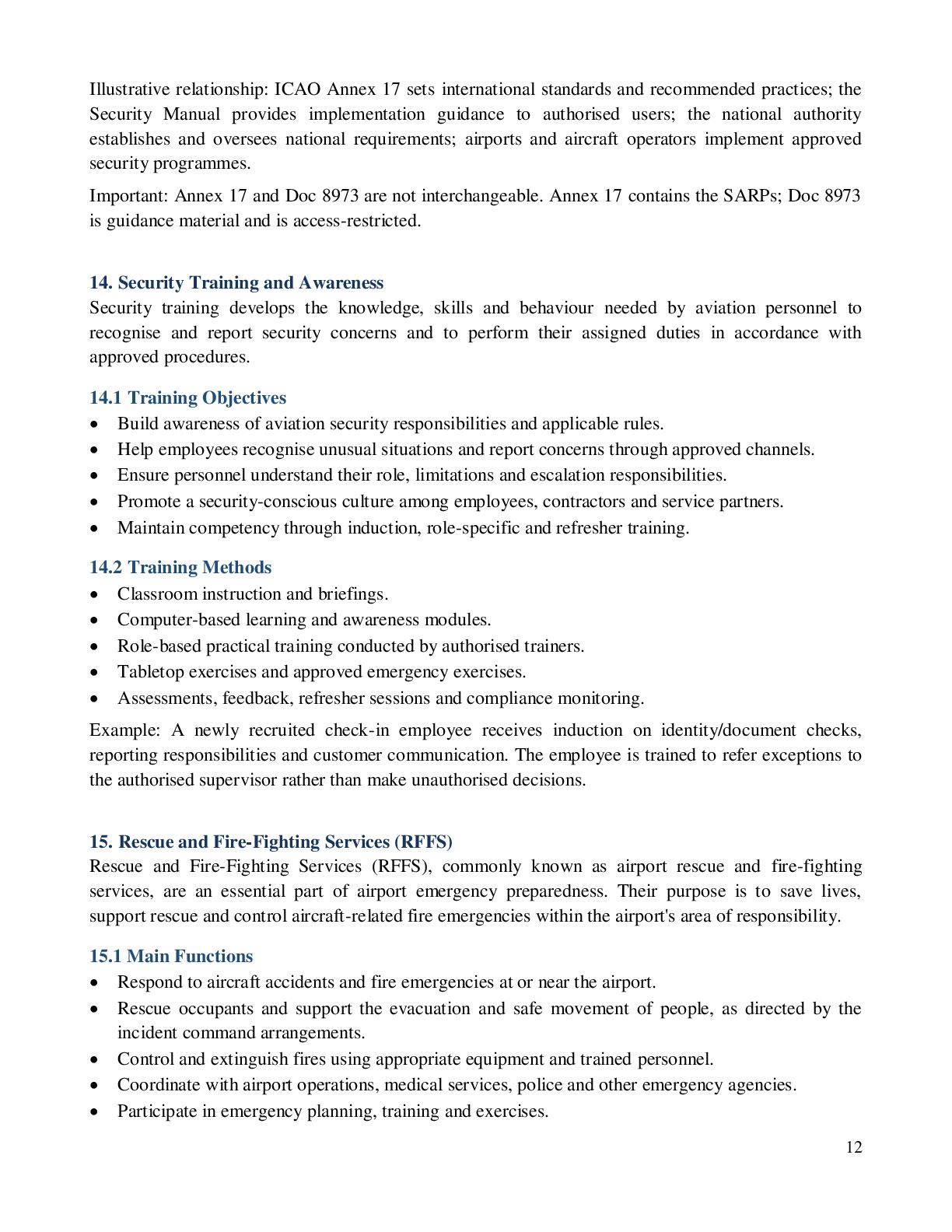
Illustrative relationship: ICAO Annex 17 sets international standards and recommended
practices; the Security Manual provides implementation guidance to authorised users; the national authority establishes and oversees national requirements; airports and aircraft operators implement approved security programmes. Important: Annex 17 and Doc 8973 are not interchangeable. Annex 17 contains the SARPs; Doc 8973 is guidance material and is access-restricted. 14. Security Training and Awareness Security training develops the knowledge, skills and behaviour needed by aviation personnel to recognise and report security concerns and to perform their assigned duties in accordance with approved procedures. 14.1 Training Objectives Build awareness of aviation security responsibilities and applicable rules. Help employees recognise unusual situations and report concerns through approved channels. Ensure personnel understand their role, limitations and escalation responsibilities. Promote a security-conscious culture among employees, contractors and service partners. Maintain competency through induction, role-specific and refresher training. 14.2 Training Methods Classroom instruction and briefings. Computer-based learning and awareness modules. Role-based practical training conducted by authorised trainers. Tabletop exercises and approved emergency exercises. Assessments, feedback, refresher sessions and compliance monitoring. Example: A newly recruited check-in employee receives induction on identity/document checks, reporting responsibilities and customer communication. The employee is trained to refer exceptions to the authorised supervisor rather than make unauthorised decisions. 15. Rescue and Fire-Fighting Services (RFFS) Rescue and Fire-Fighting Services (RFFS), commonly known as airport rescue and fire-fighting services, are an essential part of airport emergency preparedness. Their purpose is to save lives, support rescue and control aircraft-related fire emergencies within the airport's area of responsibility. 15.1 Main Functions Respond to aircraft accidents and fire emergencies at or near the airport. Rescue occupants and support the evacuation and safe movement of people, as directed by the incident command arrangements. Control and extinguish fires using appropriate equipment and trained personnel. Coordinate with airport operations, medical services, police and other emergency agencies. Participate in emergency planning, training and exercises. 12 -
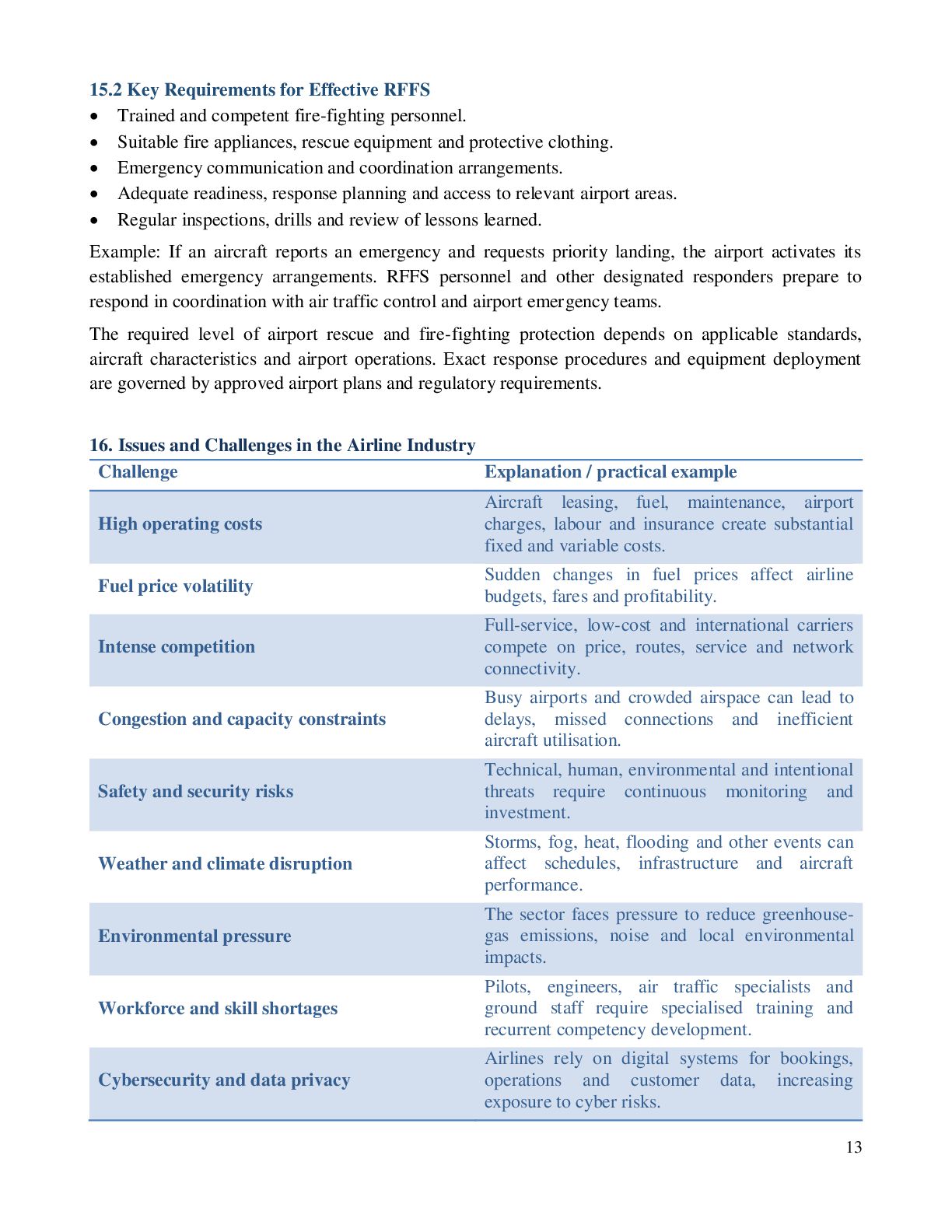
15.2 Key Requirements for Effective RFFS Trained and competent
fire-fighting personnel. Suitable fire appliances, rescue equipment and protective clothing. Emergency communication and coordination arrangements. Adequate readiness, response planning and access to relevant airport areas. Regular inspections, drills and review of lessons learned. Example: If an aircraft reports an emergency and requests priority landing, the airport activates its established emergency arrangements. RFFS personnel and other designated responders prepare to respond in coordination with air traffic control and airport emergency teams. The required level of airport rescue and fire-fighting protection depends on applicable standards, aircraft characteristics and airport operations. Exact response procedures and equipment deployment are governed by approved airport plans and regulatory requirements. 16. Issues and Challenges in the Airline Industry Challenge Explanation / practical example High operating costs Aircraft leasing, fuel, maintenance, airport charges, labour and insurance create substantial fixed and variable costs. Fuel price volatility Sudden changes in fuel prices affect airline budgets, fares and profitability. Intense competition Full-service, low-cost and international carriers compete on price, routes, service and network connectivity. Congestion and capacity constraints Busy airports and crowded airspace can lead to delays, missed connections and inefficient aircraft utilisation. Safety and security risks Technical, human, environmental and intentional threats require continuous monitoring and investment. Weather and climate disruption Storms, fog, heat, flooding and other events can affect schedules, infrastructure and aircraft performance. Environmental pressure The sector faces pressure to reduce greenhousegas emissions, noise and local environmental impacts. Workforce and skill shortages Pilots, engineers, air traffic specialists and ground staff require specialised training and recurrent competency development. Cybersecurity and data privacy Airlines rely on digital systems for bookings, operations and customer data, increasing exposure to cyber risks. 13 -
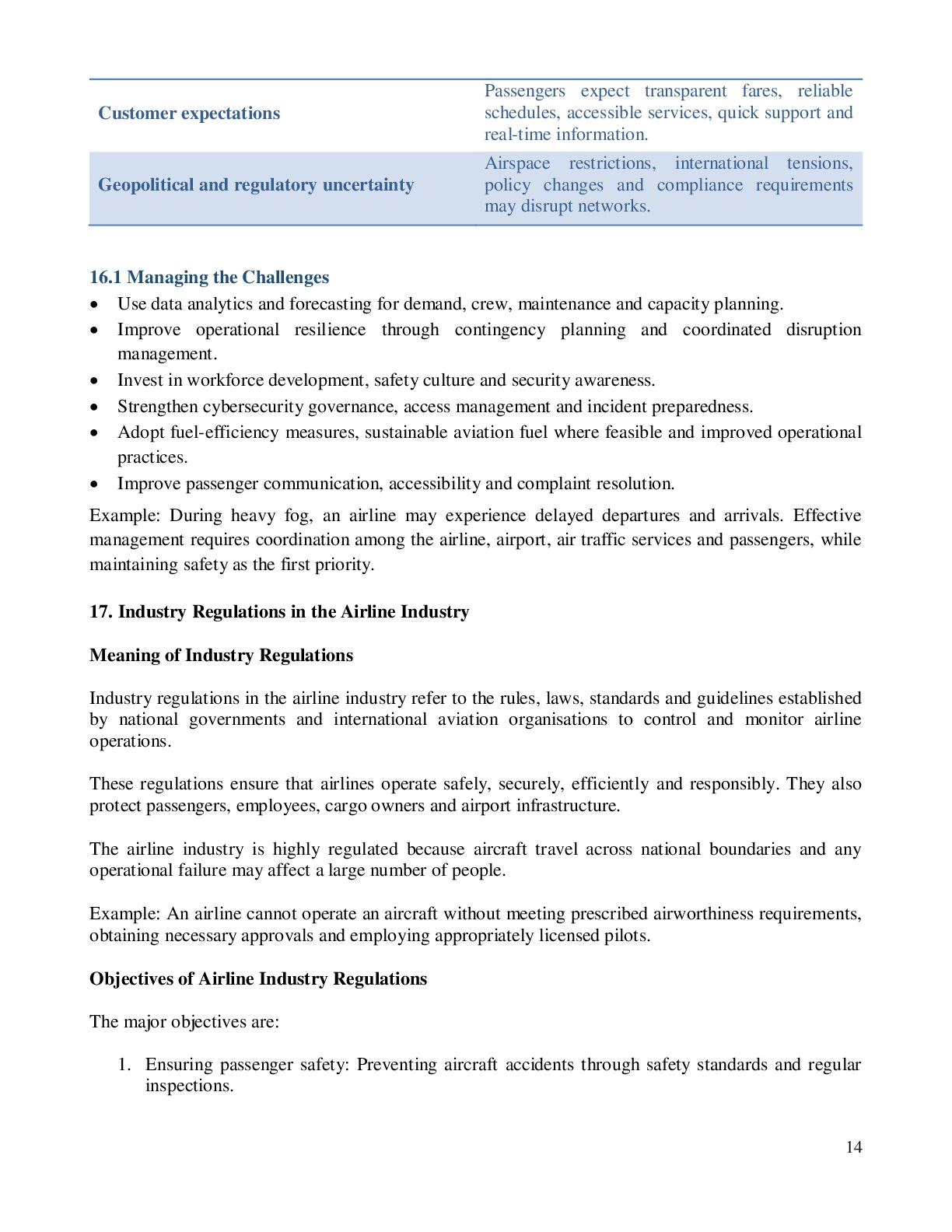
Customer expectations Passengers expect transparent fares, reliable schedules, accessible services,
quick support and real-time information. Geopolitical and regulatory uncertainty Airspace restrictions, international tensions, policy changes and compliance requirements may disrupt networks. 16.1 Managing the Challenges Use data analytics and forecasting for demand, crew, maintenance and capacity planning. Improve operational resilience through contingency planning and coordinated disruption management. Invest in workforce development, safety culture and security awareness. Strengthen cybersecurity governance, access management and incident preparedness. Adopt fuel-efficiency measures, sustainable aviation fuel where feasible and improved operational practices. Improve passenger communication, accessibility and complaint resolution. Example: During heavy fog, an airline may experience delayed departures and arrivals. Effective management requires coordination among the airline, airport, air traffic services and passengers, while maintaining safety as the first priority. 17. Industry Regulations in the Airline Industry Meaning of Industry Regulations Industry regulations in the airline industry refer to the rules, laws, standards and guidelines established by national governments and international aviation organisations to control and monitor airline operations. These regulations ensure that airlines operate safely, securely, efficiently and responsibly. They also protect passengers, employees, cargo owners and airport infrastructure. The airline industry is highly regulated because aircraft travel across national boundaries and any operational failure may affect a large number of people. Example: An airline cannot operate an aircraft without meeting prescribed airworthiness requirements, obtaining necessary approvals and employing appropriately licensed pilots. Objectives of Airline Industry Regulations The major objectives are: 1. Ensuring passenger safety: Preventing aircraft accidents through safety standards and regular inspections. 14 -
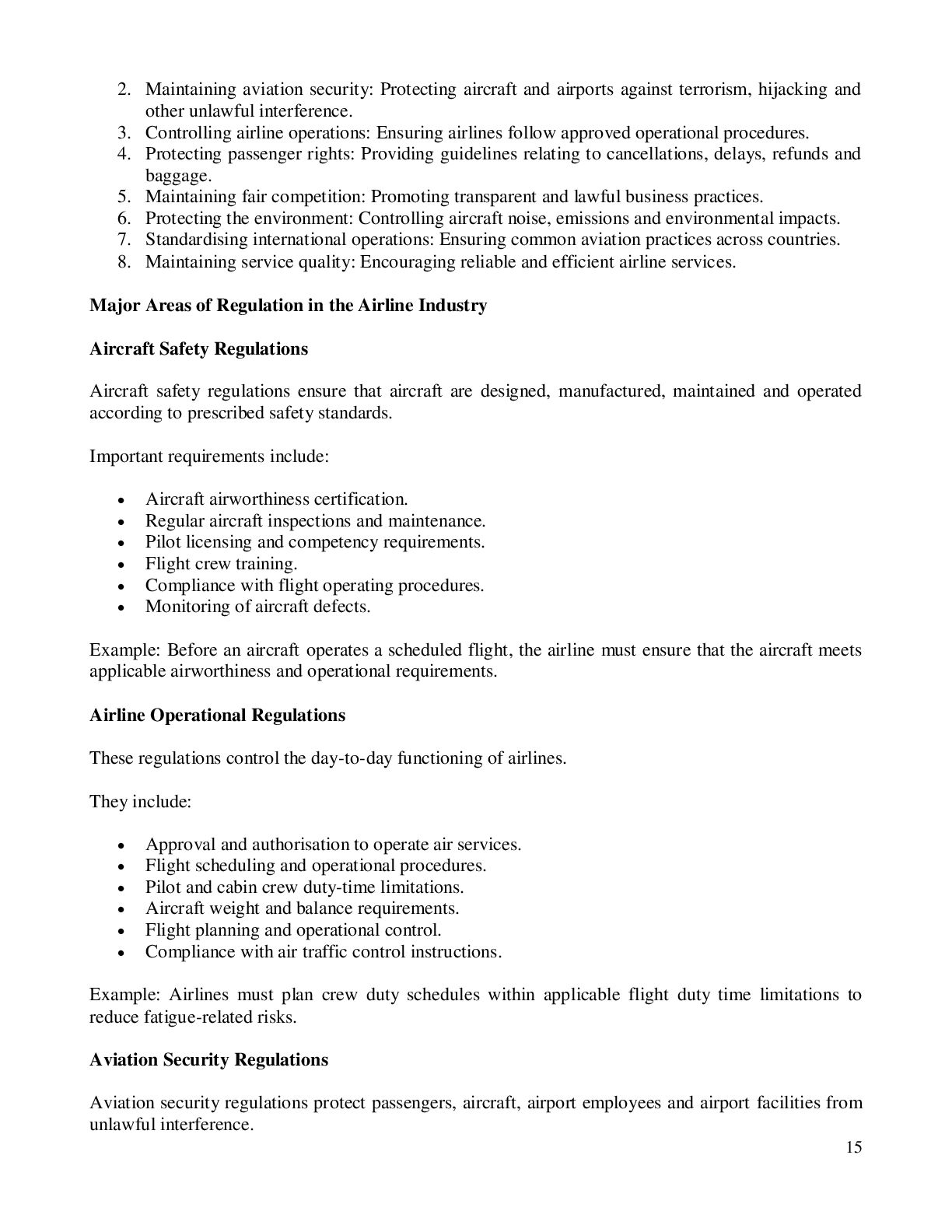
2. Maintaining aviation security: Protecting aircraft and airports against terrorism,
hijacking and other unlawful interference. 3. Controlling airline operations: Ensuring airlines follow approved operational procedures. 4. Protecting passenger rights: Providing guidelines relating to cancellations, delays, refunds and baggage. 5. Maintaining fair competition: Promoting transparent and lawful business practices. 6. Protecting the environment: Controlling aircraft noise, emissions and environmental impacts. 7. Standardising international operations: Ensuring common aviation practices across countries. 8. Maintaining service quality: Encouraging reliable and efficient airline services. Major Areas of Regulation in the Airline Industry Aircraft Safety Regulations Aircraft safety regulations ensure that aircraft are designed, manufactured, maintained and operated according to prescribed safety standards. Important requirements include: Aircraft airworthiness certification. Regular aircraft inspections and maintenance. Pilot licensing and competency requirements. Flight crew training. Compliance with flight operating procedures. Monitoring of aircraft defects. Example: Before an aircraft operates a scheduled flight, the airline must ensure that the aircraft meets applicable airworthiness and operational requirements. Airline Operational Regulations These regulations control the day-to-day functioning of airlines. They include: Approval and authorisation to operate air services. Flight scheduling and operational procedures. Pilot and cabin crew duty-time limitations. Aircraft weight and balance requirements. Flight planning and operational control. Compliance with air traffic control instructions. Example: Airlines must plan crew duty schedules within applicable flight duty time limitations to reduce fatigue-related risks. Aviation Security Regulations Aviation security regulations protect passengers, aircraft, airport employees and airport facilities from unlawful interference. 15 -
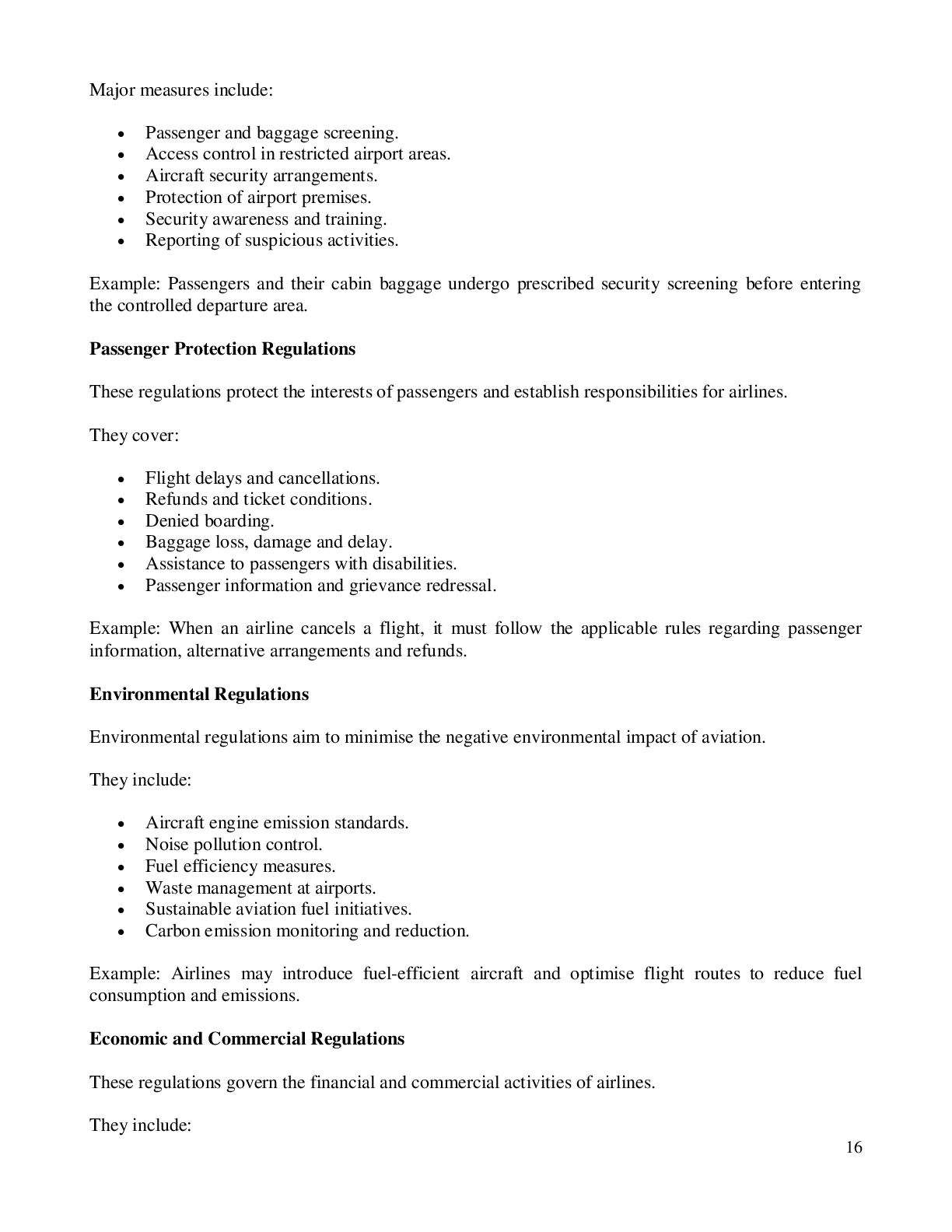
Major measures include: Passenger
and baggage screening. Access control in restricted airport areas. Aircraft security arrangements. Protection of airport premises. Security awareness and training. Reporting of suspicious activities. Example: Passengers and their cabin baggage undergo prescribed security screening before entering the controlled departure area. Passenger Protection Regulations These regulations protect the interests of passengers and establish responsibilities for airlines. They cover: Flight delays and cancellations. Refunds and ticket conditions. Denied boarding. Baggage loss, damage and delay. Assistance to passengers with disabilities. Passenger information and grievance redressal. Example: When an airline cancels a flight, it must follow the applicable rules regarding passenger information, alternative arrangements and refunds. Environmental Regulations Environmental regulations aim to minimise the negative environmental impact of aviation. They include: Aircraft engine emission standards. Noise pollution control. Fuel efficiency measures. Waste management at airports. Sustainable aviation fuel initiatives. Carbon emission monitoring and reduction. Example: Airlines may introduce fuel-efficient aircraft and optimise flight routes to reduce fuel consumption and emissions. Economic and Commercial Regulations These regulations govern the financial and commercial activities of airlines. They include: 16 -
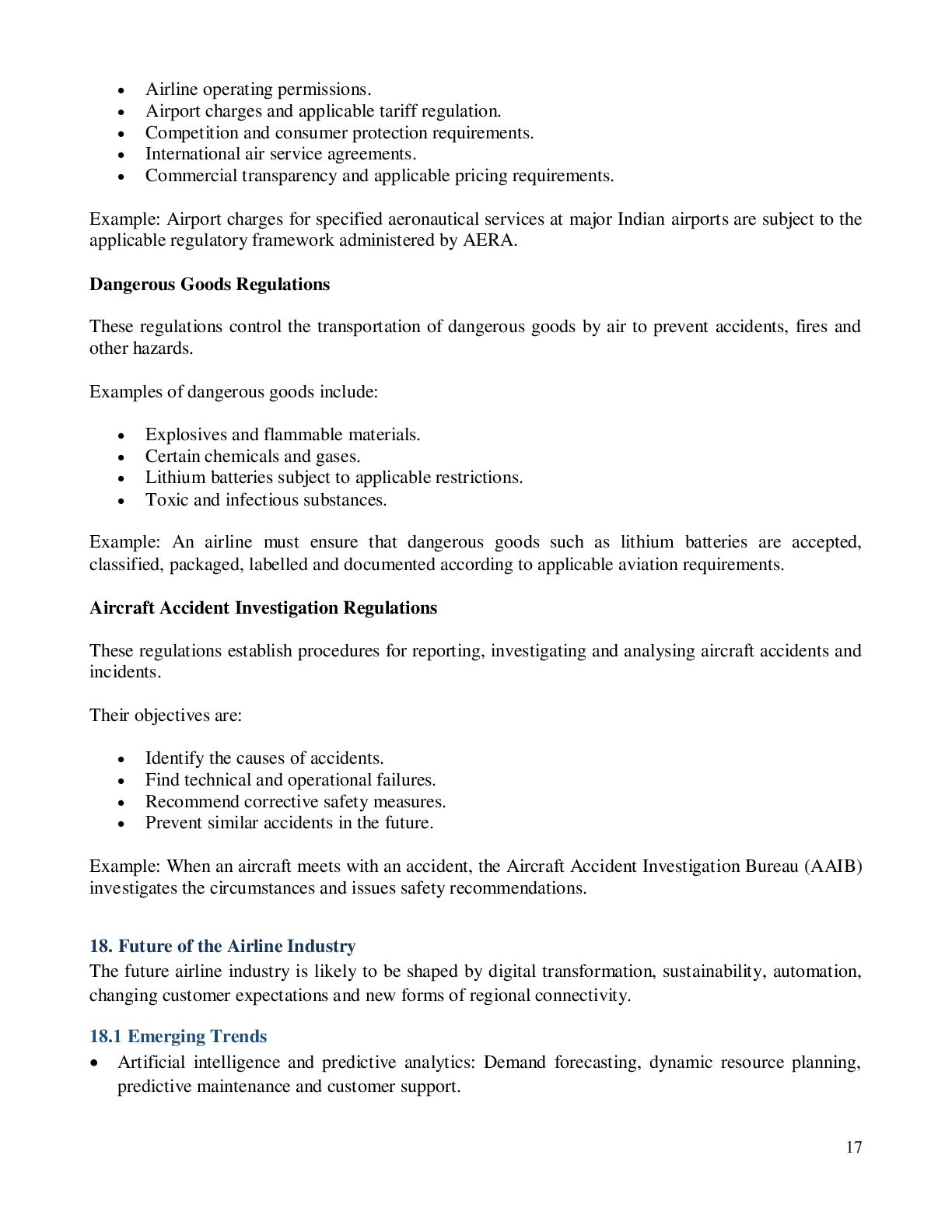
Airline operating permissions. Airport charges
and applicable tariff regulation. Competition and consumer protection requirements. International air service agreements. Commercial transparency and applicable pricing requirements. Example: Airport charges for specified aeronautical services at major Indian airports are subject to the applicable regulatory framework administered by AERA. Dangerous Goods Regulations These regulations control the transportation of dangerous goods by air to prevent accidents, fires and other hazards. Examples of dangerous goods include: Explosives and flammable materials. Certain chemicals and gases. Lithium batteries subject to applicable restrictions. Toxic and infectious substances. Example: An airline must ensure that dangerous goods such as lithium batteries are accepted, classified, packaged, labelled and documented according to applicable aviation requirements. Aircraft Accident Investigation Regulations These regulations establish procedures for reporting, investigating and analysing aircraft accidents and incidents. Their objectives are: Identify the causes of accidents. Find technical and operational failures. Recommend corrective safety measures. Prevent similar accidents in the future. Example: When an aircraft meets with an accident, the Aircraft Accident Investigation Bureau (AAIB) investigates the circumstances and issues safety recommendations. 18. Future of the Airline Industry The future airline industry is likely to be shaped by digital transformation, sustainability, automation, changing customer expectations and new forms of regional connectivity. 18.1 Emerging Trends Artificial intelligence and predictive analytics: Demand forecasting, dynamic resource planning, predictive maintenance and customer support. 17 -
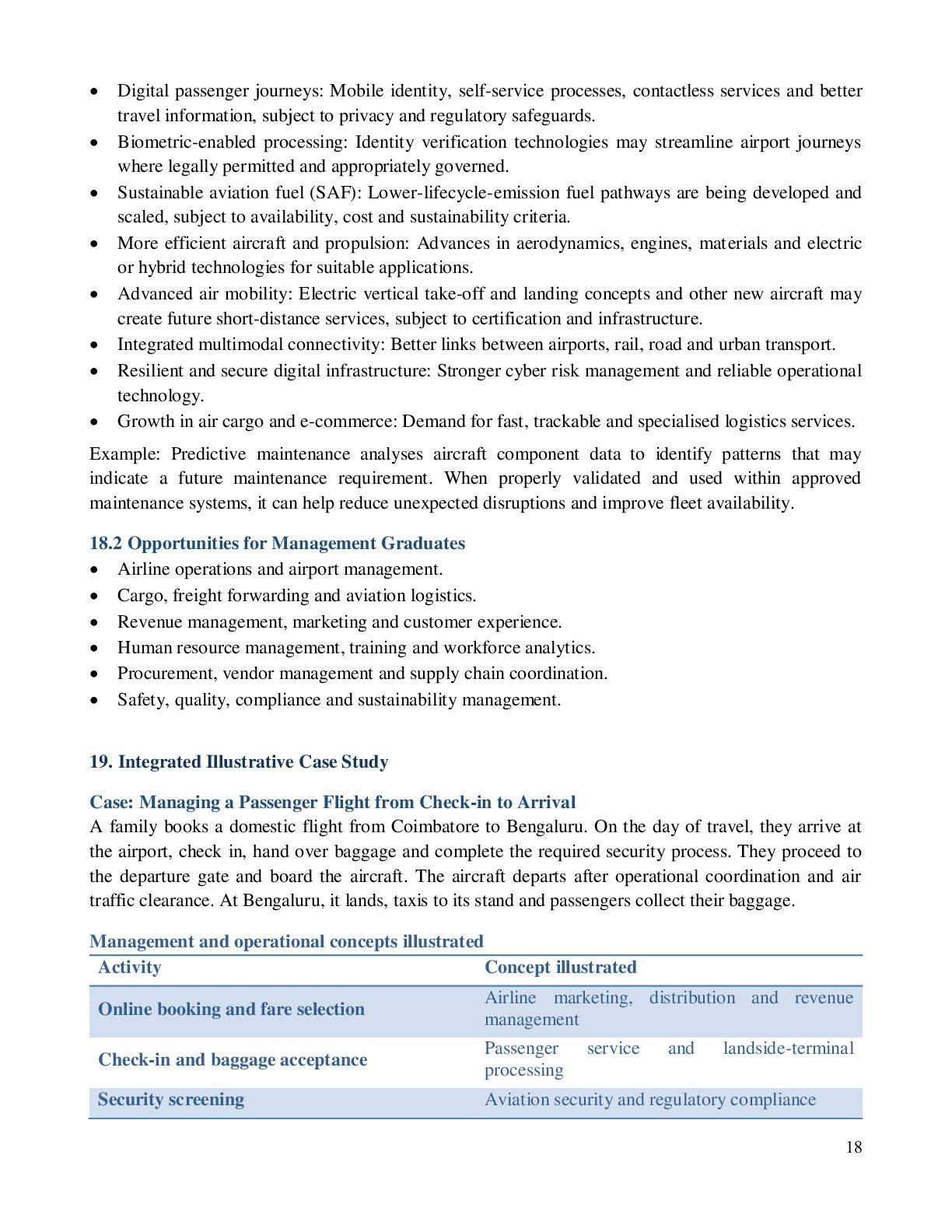
Digital passenger
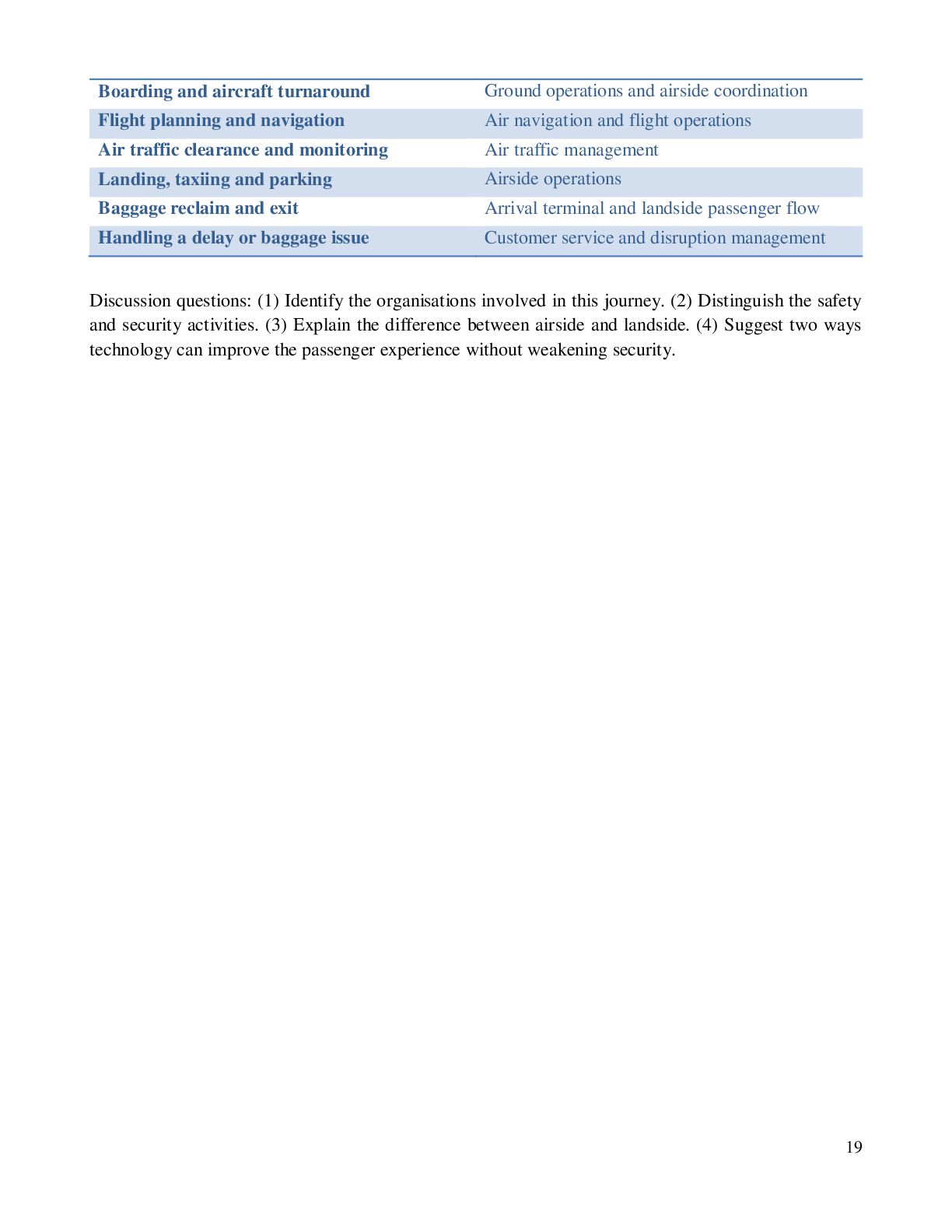
journeys: Mobile identity, self-service processes, contactless services and better travel information, subject to privacy and regulatory safeguards. Biometric-enabled processing: Identity verification technologies may streamline airport journeys where legally permitted and appropriately governed. Sustainable aviation fuel (SAF): Lower-lifecycle-emission fuel pathways are being developed and scaled, subject to availability, cost and sustainability criteria. More efficient aircraft and propulsion: Advances in aerodynamics, engines, materials and electric or hybrid technologies for suitable applications. Advanced air mobility: Electric vertical take-off and landing concepts and other new aircraft may create future short-distance services, subject to certification and infrastructure. Integrated multimodal connectivity: Better links between airports, rail, road and urban transport. Resilient and secure digital infrastructure: Stronger cyber risk management and reliable operational technology. Growth in air cargo and e-commerce: Demand for fast, trackable and specialised logistics services. Example: Predictive maintenance analyses aircraft component data to identify patterns that may indicate a future maintenance requirement. When properly validated and used within approved maintenance systems, it can help reduce unexpected disruptions and improve fleet availability. 18.2 Opportunities for Management Graduates Airline operations and airport management. Cargo, freight forwarding and aviation logistics. Revenue management, marketing and customer experience. Human resource management, training and workforce analytics. Procurement, vendor management and supply chain coordination. Safety, quality, compliance and sustainability management. 19. Integrated Illustrative Case Study Case: Managing a Passenger Flight from Check-in to Arrival A family books a domestic flight from Coimbatore to Bengaluru. On the day of travel, they arrive at the airport, check in, hand over baggage and complete the required security process. They proceed to the departure gate and board the aircraft. The aircraft departs after operational coordination and air traffic clearance. At Bengaluru, it lands, taxis to its stand and passengers collect their baggage. Management and operational concepts illustrated Activity Concept illustrated Online booking and fare selection Airline marketing, distribution and revenue management Check-in and baggage acceptance Passenger processing Security screening Aviation security and regulatory compliance service and landside-terminal 18 -
Boarding and aircraft turnaround Ground operations and airside coordination Flight
planning and navigation Air navigation and flight operations Air traffic clearance and monitoring Air traffic management Landing, taxiing and parking Airside operations Baggage reclaim and exit Arrival terminal and landside passenger flow Handling a delay or baggage issue Customer service and disruption management Discussion questions: (1) Identify the organisations involved in this journey. (2) Distinguish the safety and security activities. (3) Explain the difference between airside and landside. (4) Suggest two ways technology can improve the passenger experience without weakening security. 19
 nithi05
 ryushu
 ediel
 flatt_security
 arid2
 smartcamp
 geotra
 tmiket
 fado_dev
 c0rp_mdm
 kitchhike
 m3c
 emi0726
 codingconduct
 brad_frost
 eileencodes
 morganepeng
 katiecoart
 ks91
 aleyda
 ianozsvald
 nikkihalliwell
 pwiseman
 raygrieselhuber
 chikuwait