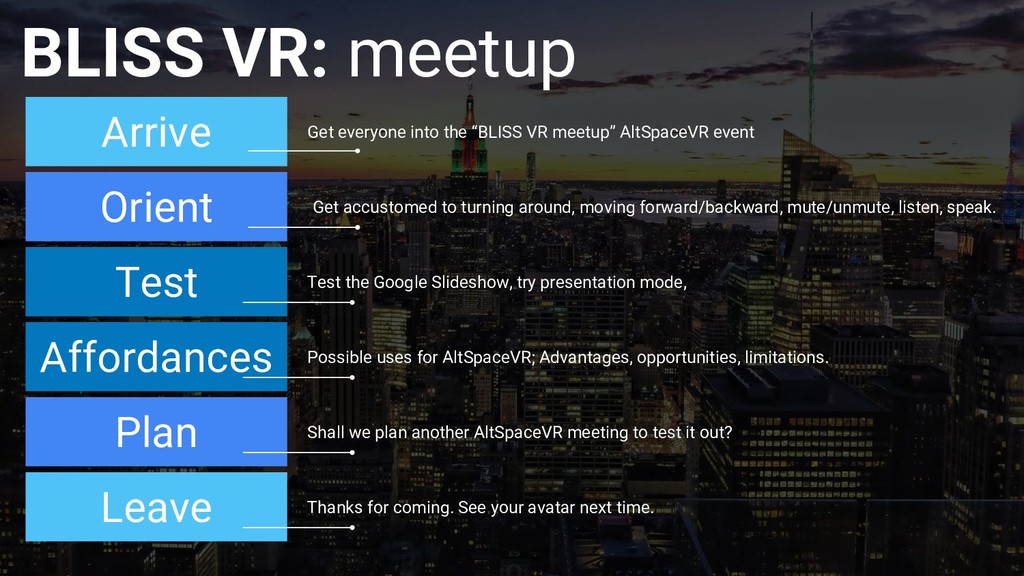
everyone into the “BLISS VR meetup” AltSpaceVR event Get accustomed to turning around, moving forward/backward, mute/unmute, listen, speak. Test the Google Slideshow, try presentation mode, Possible uses for AltSpaceVR; Advantages, opportunities, limitations. Shall we plan another AltSpaceVR meeting to test it out? Thanks for coming. See your avatar next time.
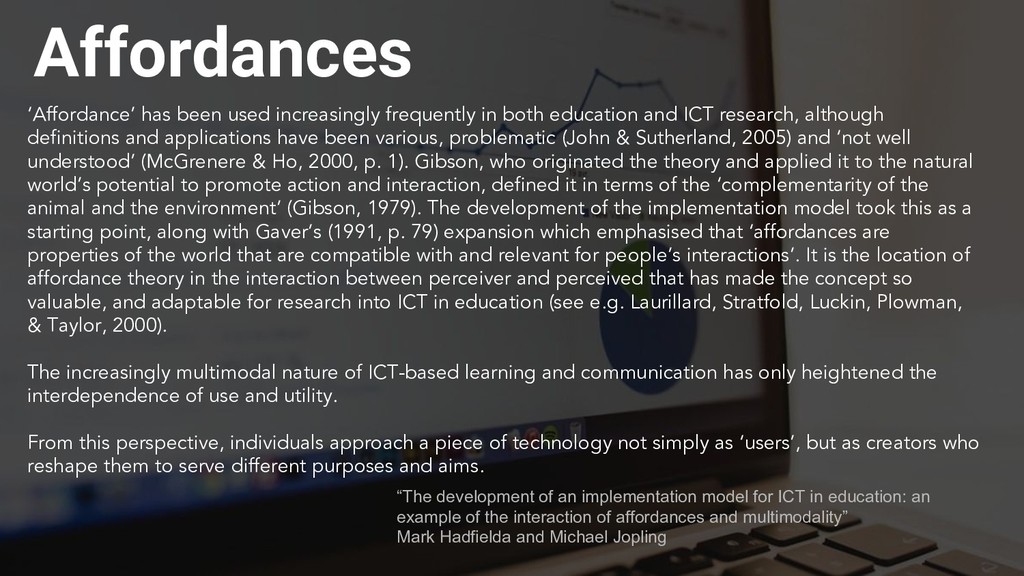
and ICT research, although definitions and applications have been various, problematic (John & Sutherland, 2005) and ‘not well understood’ (McGrenere & Ho, 2000, p. 1). Gibson, who originated the theory and applied it to the natural world’s potential to promote action and interaction, defined it in terms of the ‘complementarity of the animal and the environment’ (Gibson, 1979). The development of the implementation model took this as a starting point, along with Gaver’s (1991, p. 79) expansion which emphasised that ‘affordances are properties of the world that are compatible with and relevant for people’s interactions’. It is the location of affordance theory in the interaction between perceiver and perceived that has made the concept so valuable, and adaptable for research into ICT in education (see e.g. Laurillard, Stratfold, Luckin, Plowman, & Taylor, 2000). The increasingly multimodal nature of ICT-based learning and communication has only heightened the interdependence of use and utility. From this perspective, individuals approach a piece of technology not simply as ‘users’, but as creators who reshape them to serve different purposes and aims. “The development of an implementation model for ICT in education: an example of the interaction of affordances and multimodality” Mark Hadfielda and Michael Jopling


 yatabe
 spring_aki
 akiraasano
 ainischool
 bvr7352
 uranoken
 yoshimura_datam
 uchi8977
 pawan_pharm
 kentaroy47
 robintux
 drpoonamkc
 wjessup
 sarafernandez
 helenjbeal
 pauljervisheath
 aleyda
 ryanjones
 geshan
 jct
 marktimemedia
 mfonobong
 jacobian
 codingconduct