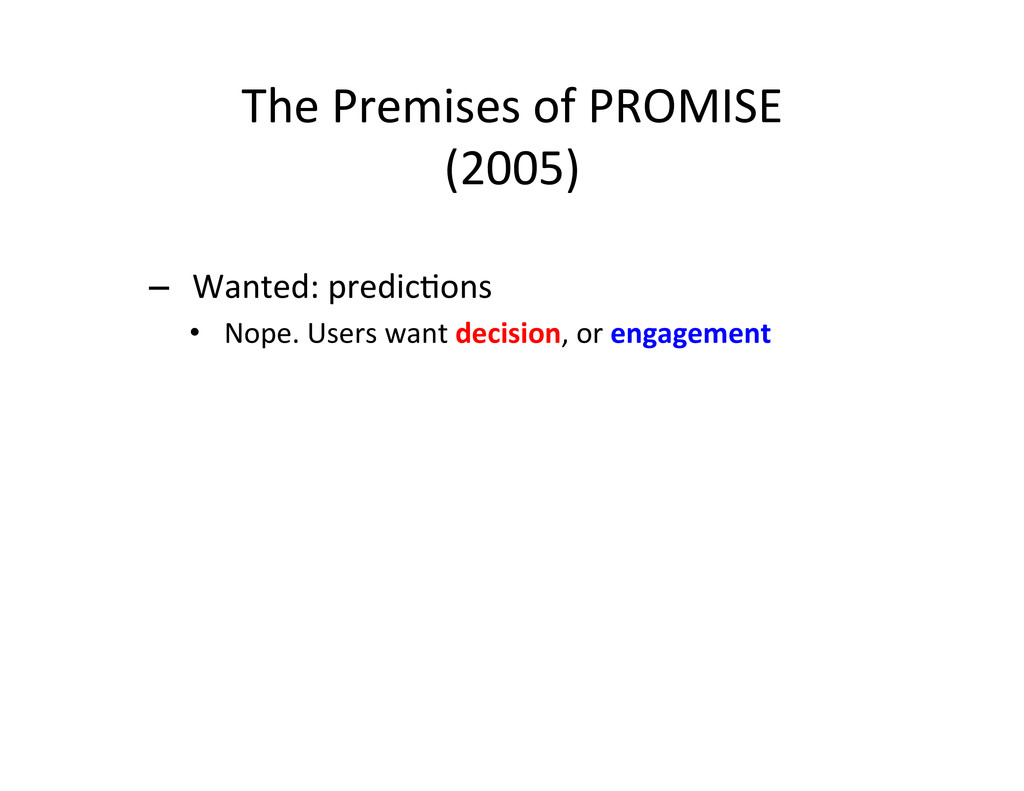
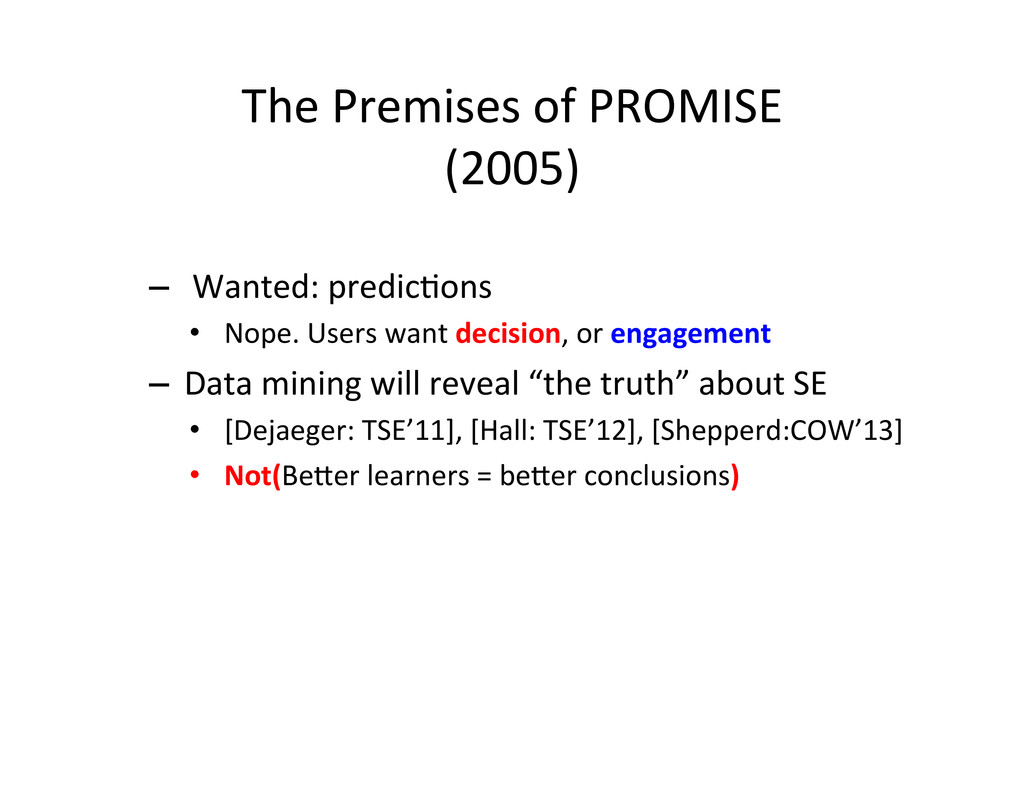
predic+ons • Nope. Users want decision, or engagement – Data mining will reveal “the truth” about SE • [Dejaeger: TSE’11], [Hall: TSE’12], [Shepperd:COW’13] • Not(BeXer learners = beXer conclusions)
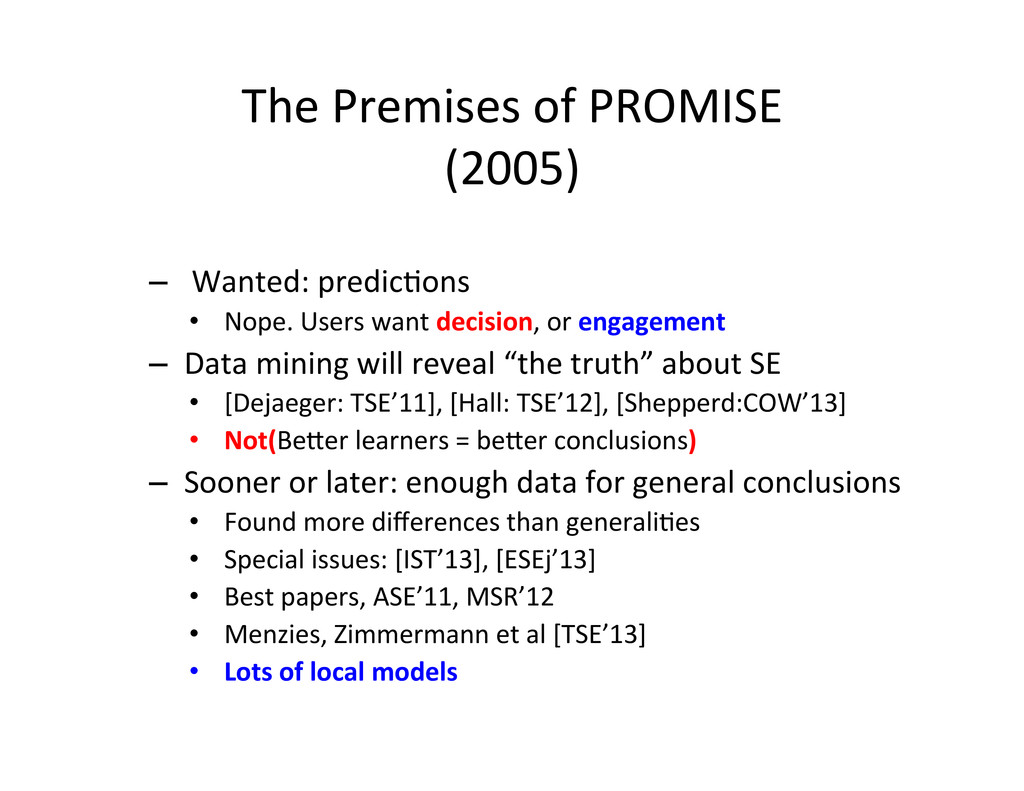
predic+ons • Nope. Users want decision, or engagement – Data mining will reveal “the truth” about SE • [Dejaeger: TSE’11], [Hall: TSE’12], [Shepperd:COW’13] • Not(BeXer learners = beXer conclusions) – Sooner or later: enough data for general conclusions • Found more differences than generali+es • Special issues: [IST’13], [ESEj’13] • Best papers, ASE’11, MSR’12 • Menzies, Zimmermann et al [TSE’13] • Lots of local models
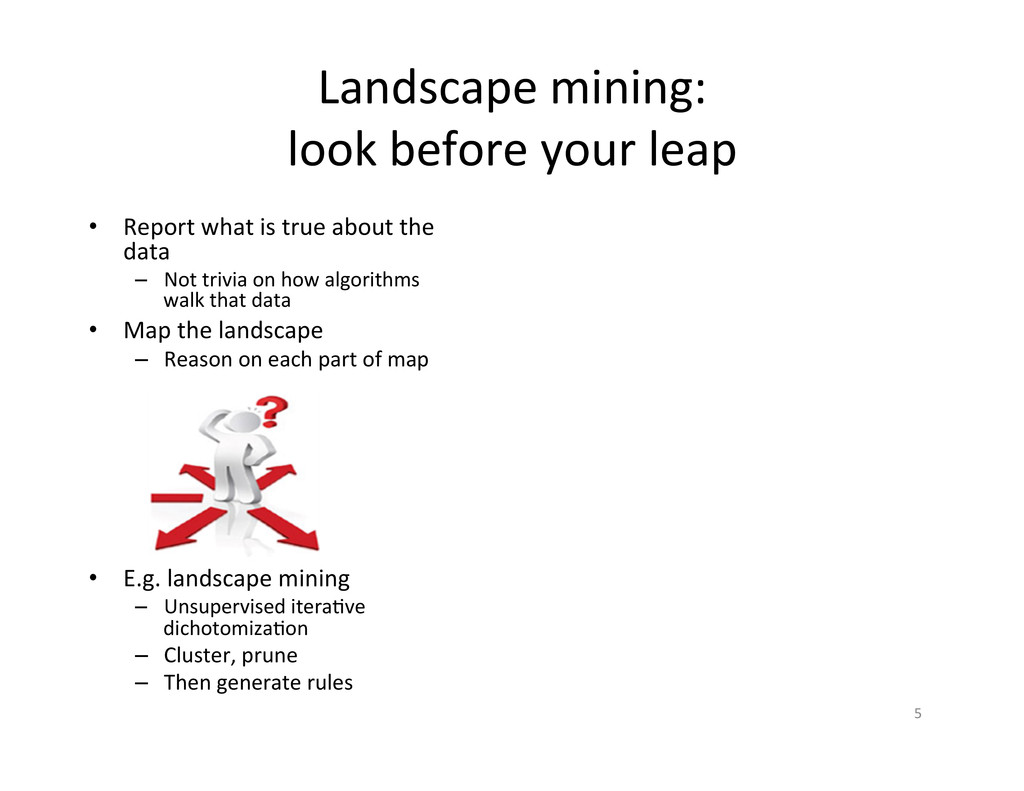
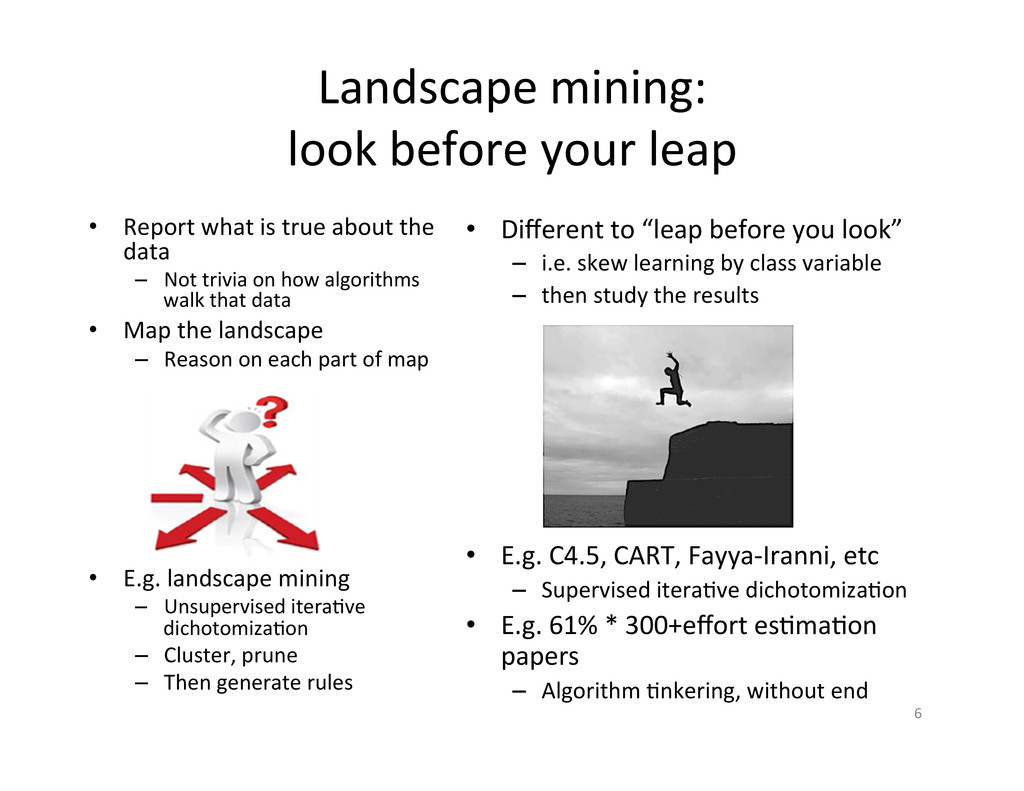
what is true about the data – Not trivia on how algorithms walk that data • Map the landscape – Reason on each part of map • E.g. landscape mining – Unsupervised itera+ve dichotomiza+on – Cluster, prune – Then generate rules 5
what is true about the data – Not trivia on how algorithms walk that data • Map the landscape – Reason on each part of map • E.g. landscape mining – Unsupervised itera+ve dichotomiza+on – Cluster, prune – Then generate rules • Different to “leap before you look” – i.e. skew learning by class variable – then study the results • E.g. C4.5, CART, Fayya-‐Iranni, etc – Supervised itera+ve dichotomiza+on • E.g. 61% * 300+effort es+ma+on papers – Algorithm +nkering, without end 6
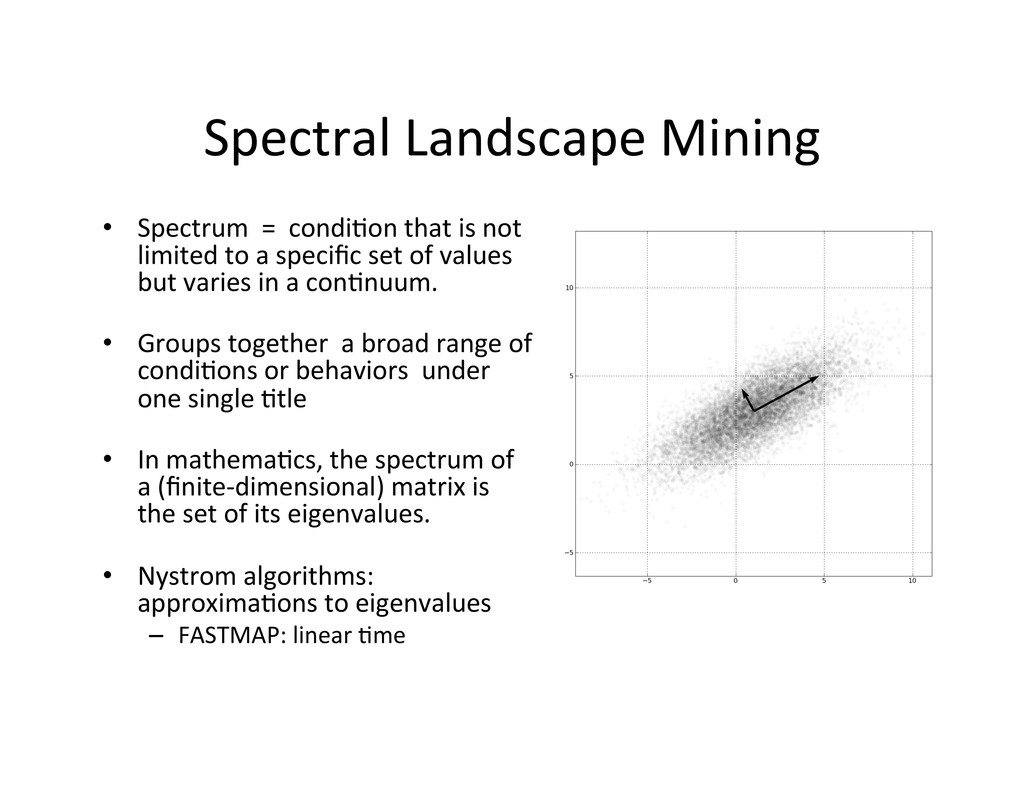
that is not limited to a specific set of values but varies in a con+nuum. • Groups together a broad range of condi+ons or behaviors under one single +tle • In mathema+cs, the spectrum of a (finite-‐dimensional) matrix is the set of its eigenvalues. • Nystrom algorithms: approxima+ons to eigenvalues – FASTMAP: linear +me
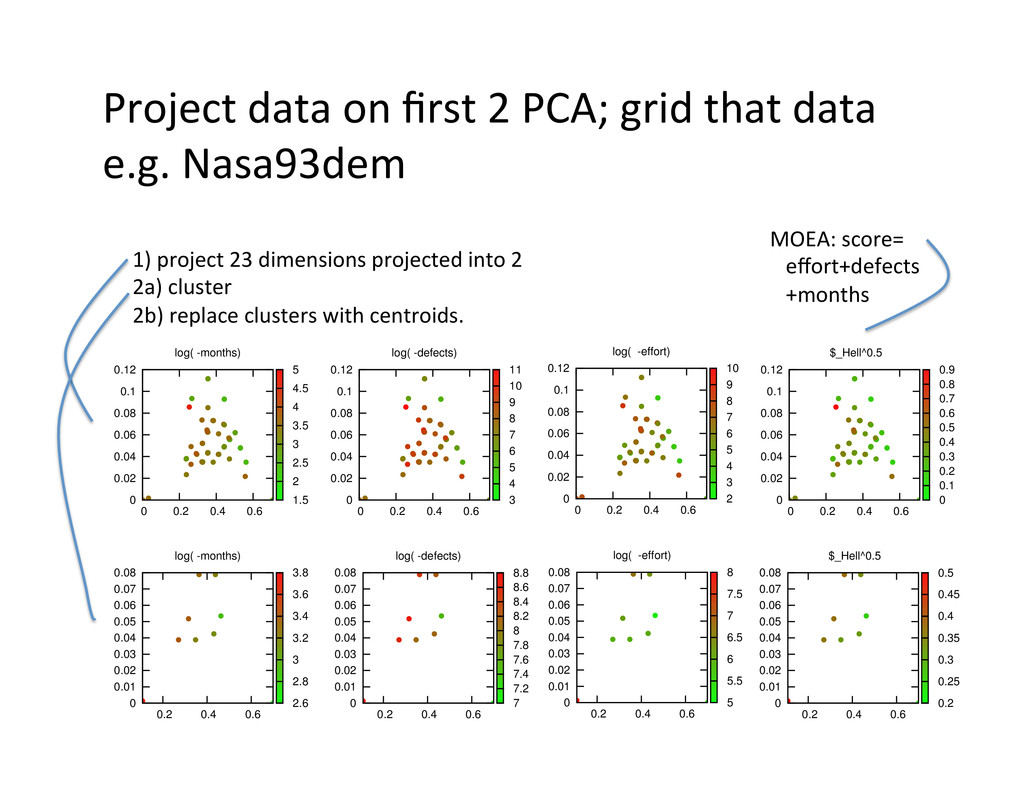
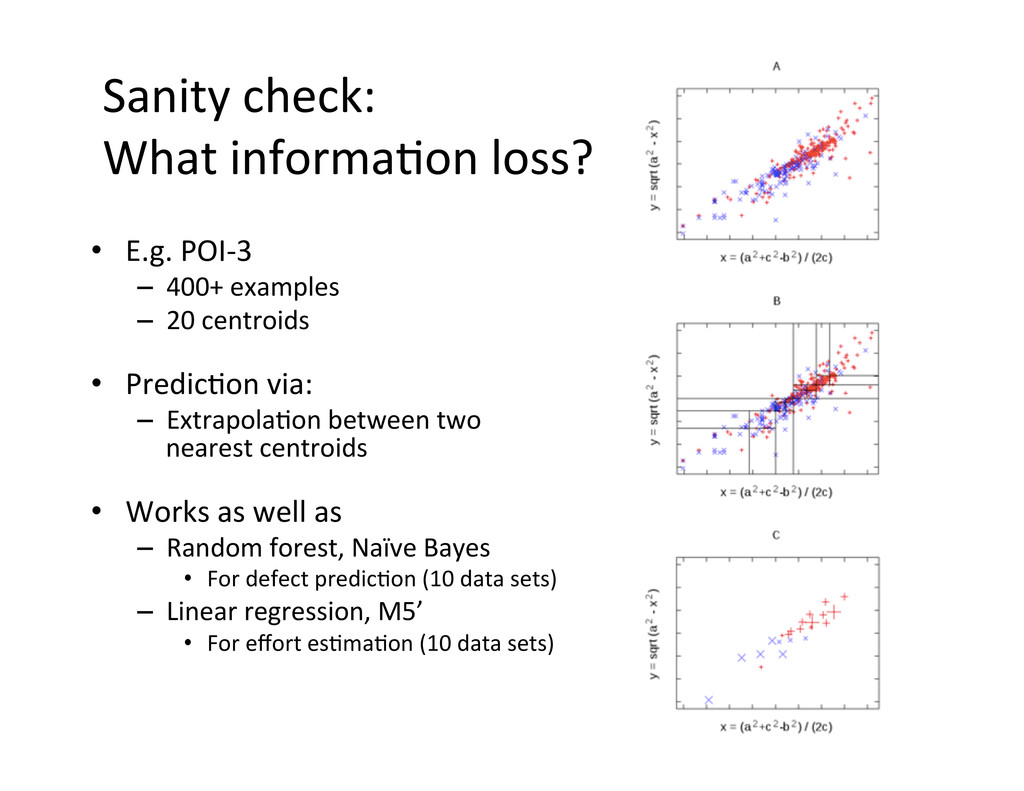
– 400+ examples – 20 centroids • Predic+on via: – Extrapola+on between two nearest centroids • Works as well as – Random forest, Naïve Bayes • For defect predic+on (10 data sets) – Linear regression, M5’ • For effort es+ma+on (10 data sets)
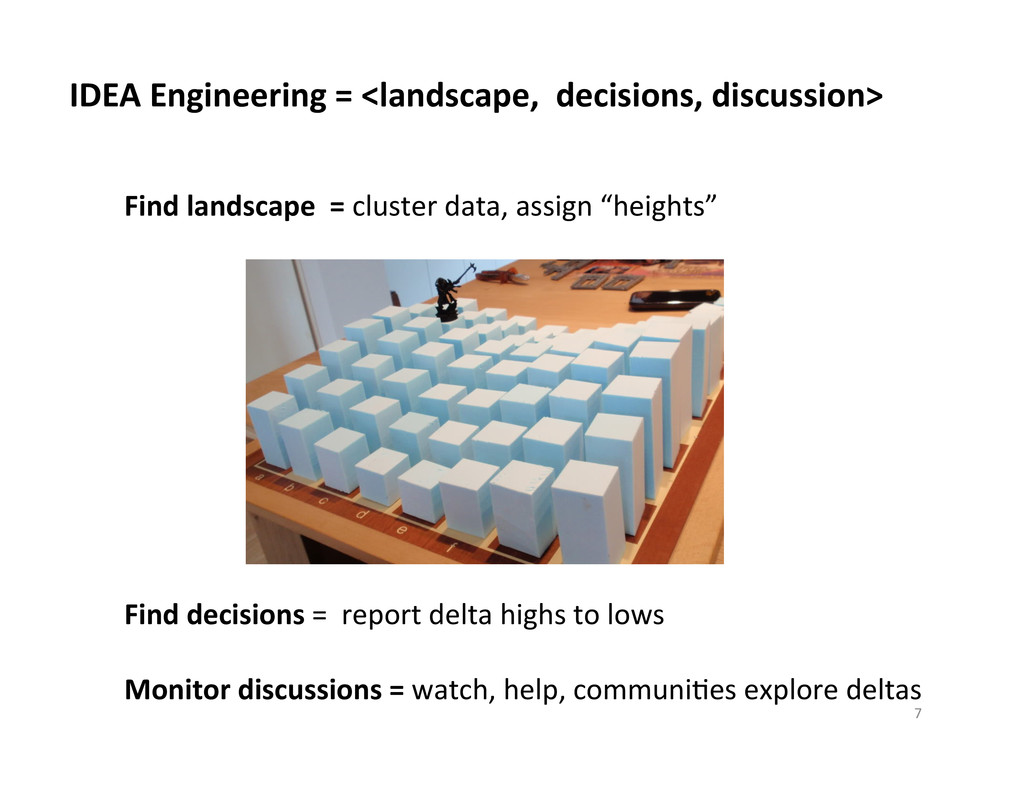
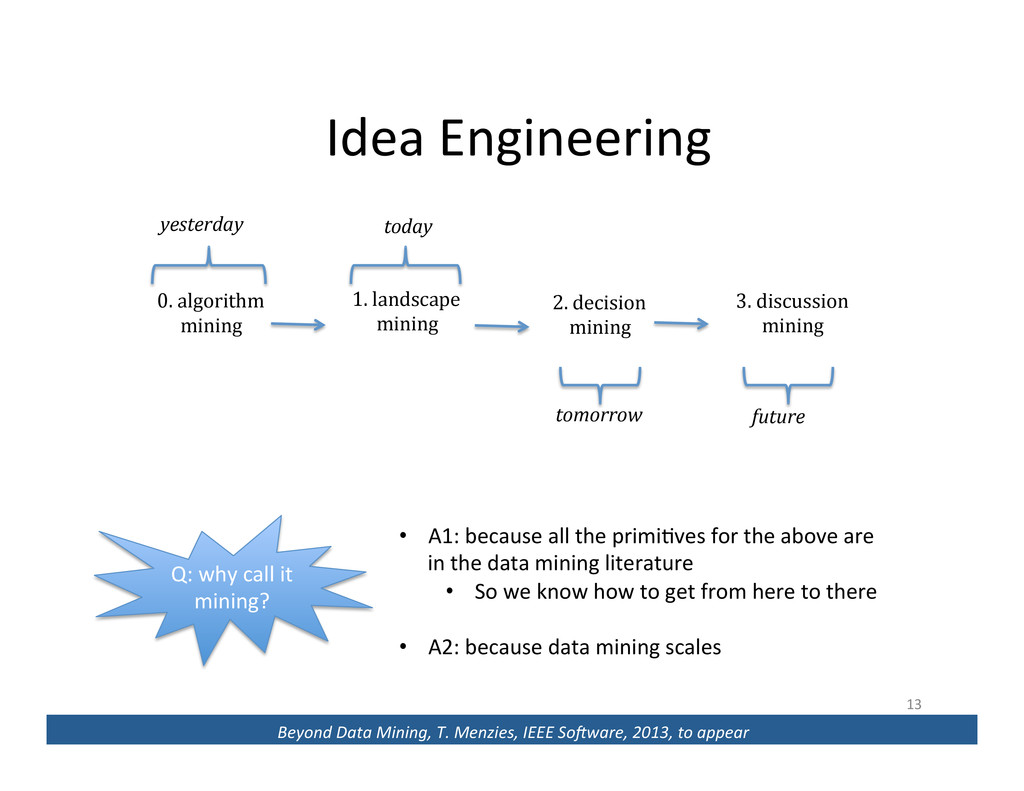
decision mining 3. discussion mining yesterday today tomorrow future Beyond Data Mining, T. Menzies, IEEE So6ware, 2013, to appear 13 Q: why call it mining? • A1: because all the primi+ves for the above are in the data mining literature • So we know how to get from here to there • A2: because data mining scales


 promise
 kento1109
 matsumooon
 upura
upura
 butchi
 institudelelevage
 rikkabotan7
 hotchpotch
 recsyslab
 eumesy
 tattaka
 yuukit
 stktu
stktu
 inesmontani
 shlominoach
 swwweet
 rabernat
 ryanjones
 dugsong
 reverentgeek
 nonsquared
 codingconduct
 yeseniaperezcruz
 honzajavorek
 szymonslowik
![Idea Engineering [email protected] PROMISE’13 Oct’13 0.](https://files.speakerdeck.com/presentations/96f2fb901fa1013114a20a360350e1fc/slide_0.jpg)