Upgrade to Pro — share decks privately, control downloads, hide ads and more …

B u y Old Facebook Accounts

B u y Old Facebook Accounts

B u y Old Facebook Accounts Professional Facebook Business Page setup with profile optimization, Meta Business Manager configuration, security setup, and fast support
https://pvasmmbiz.com/product/buy-old-facebook-accounts/

Avatar for Buy LinkedIn Accounts

Buy LinkedIn Accounts

September 16, 2026

Other Decks in Business

Transcript

  1. Buy Old Facebook Accounts? Risks, Rules, and Safer Growth Paths

    Many businesses and marketers search for ways to buy old Facebook accounts because they want to start faster. An older profile may appear to have history, activity, friends, engagement, or fewer early limitations than a newly created account. It is easy to understand the appeal. Building trust on Facebook takes time. Creating a Page, earning followers, producing useful content, and developing a reliable advertising process can feel slow—especially when a business needs visibility now. But purchasing an old Facebook account is not the same as acquiring a legitimate business asset. A Facebook profile is tied to a person’s identity, account history, security settings, messages, and relationships. Using an account that does not genuinely belong to the person operating it can create serious access, security, compliance, and reputation problems. For businesses that want durable growth, the better strategy is to build a Facebook presence around authentic people, official business assets, secure permissions, and content that gives audiences a real reason to engage. This guide explains why people look for aged Facebook accounts, the risks involved, and the safer alternatives that can help a business grow without building its marketing strategy on unstable access. Why Businesses Search for Old Facebook Accounts The desire to buy aged Facebook accounts often comes from a need for speed and perceived credibility. A brand-new profile may have little or no history. It may not have established connections, past interactions, or a recognizable identity. Some marketers believe an older account will automatically be more trusted by Facebook systems or by the people who see its activity. However, account age is only one small part of a much larger picture. Authenticity, behavior, security, content quality, relevant audience relationships, and policy compliance matter much more over the long term. The appeal of account age and activity history An old Facebook account may appear valuable because it seems to offer: •​ A longer creation history •​ Existing friends or followers •​ Previous activity and interactions
  2. •​ A profile that looks less new •​ A potential

    shortcut for joining groups or reaching audiences •​ A faster starting point for marketing efforts These perceived benefits do not necessarily translate into business results. An account’s original history may have nothing to do with the business, offer, location, or target customer that the new operator wants to reach. For example, a profile created years ago by an individual in one country, with personal friends and hobby-related activity, is unlikely to become an effective asset for a U.S.-based B2B service provider simply because it is old. Why marketers may seek a shortcut Facebook marketing requires consistent effort. A credible business presence often involves: •​ •​ •​ •​ •​ •​ •​ Creating and optimizing a Facebook Page Defining the right audience Producing useful posts, videos, and community updates Replying to comments and messages Building trust before asking for a sale Testing advertising creative responsibly Managing Page access and customer data securely Aged profiles can look like a shortcut around this work. In reality, they can introduce new friction: uncertain ownership, mismatched audiences, unexpected security issues, policy violations, and the possibility of losing access when the account is reviewed. A marketing strategy should make a business more stable—not more dependent on an account it cannot confidently verify or control. Facebook’s Focus on Authentic Identity Facebook is designed around real social and professional interactions. Meta’s policies emphasize authenticity because people need to understand who they are interacting with and whether an account accurately represents the person or organization behind it. Meta states that Facebook users must create one account using the name they use in everyday life and that the account must represent their authentic identity. Meta also prohibits people from misrepresenting themselves, using fake accounts, artificially boosting content popularity, or engaging in behavior designed to enable policy violations.transparency.meta+1 One account tied to a real person A personal Facebook profile is intended to represent a real individual, not an interchangeable business login.
  3. This distinction matters. A profile may contain private conversations, personal

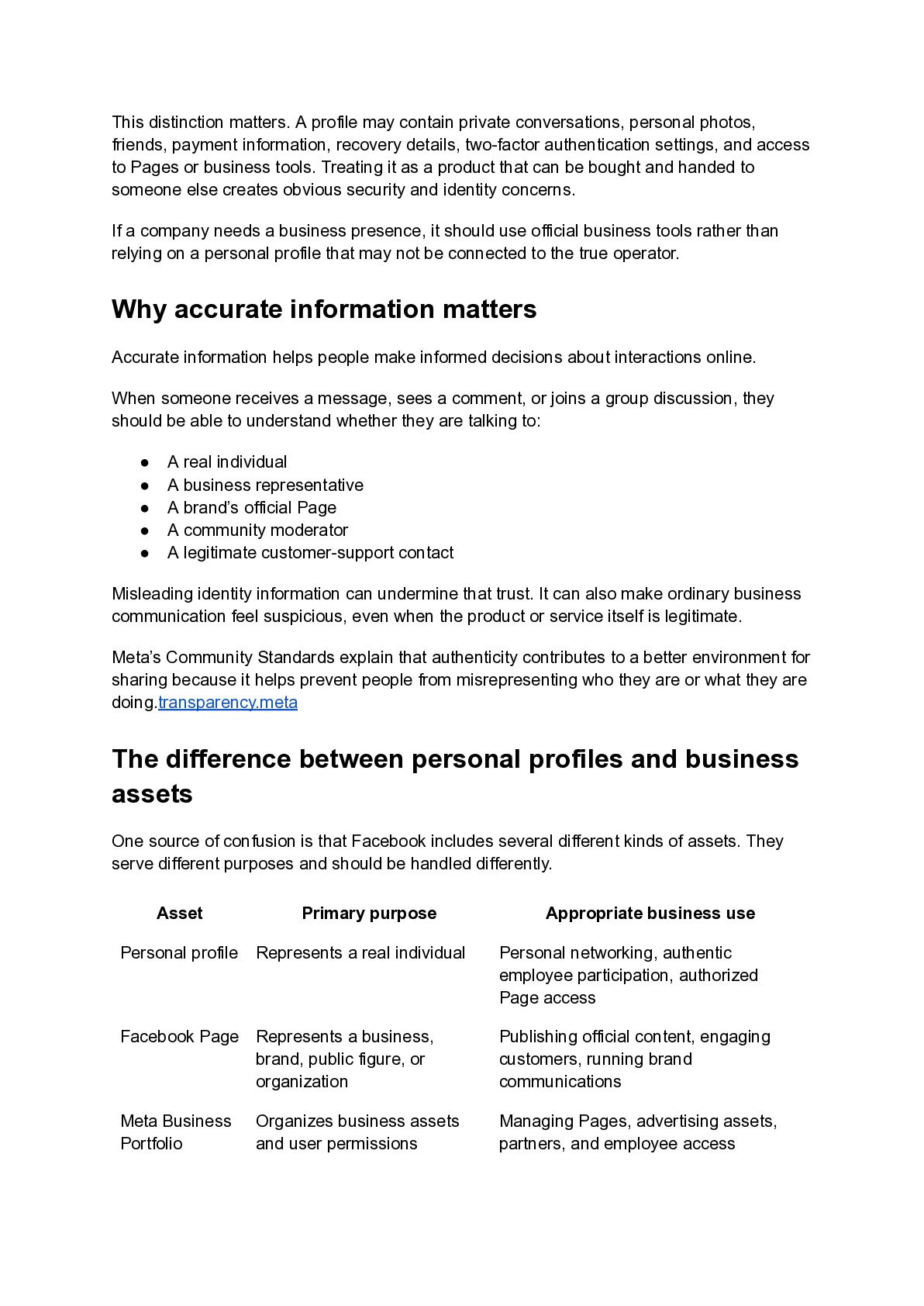
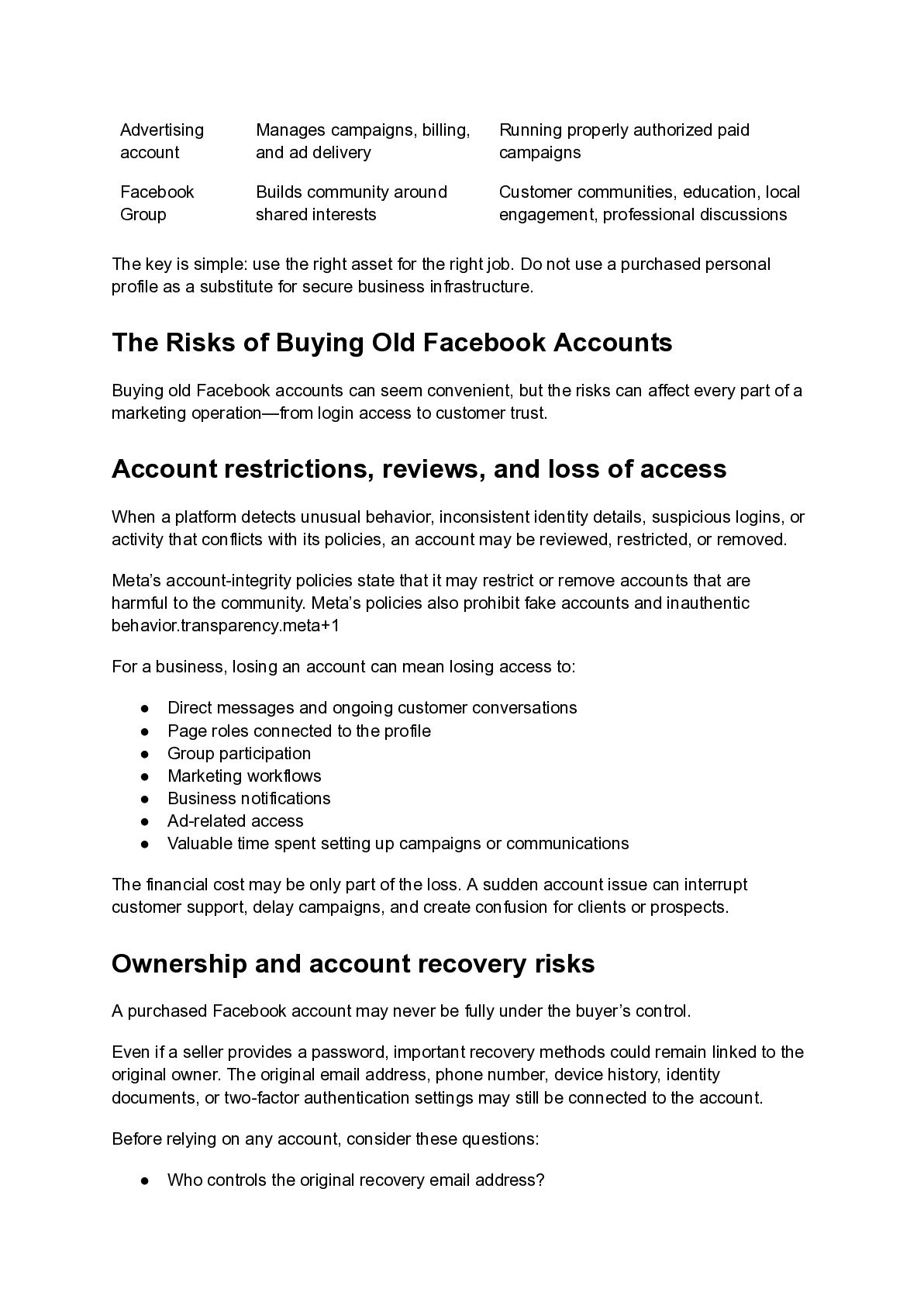
    photos, friends, payment information, recovery details, two-factor authentication settings, and access to Pages or business tools. Treating it as a product that can be bought and handed to someone else creates obvious security and identity concerns. If a company needs a business presence, it should use official business tools rather than relying on a personal profile that may not be connected to the true operator. Why accurate information matters Accurate information helps people make informed decisions about interactions online. When someone receives a message, sees a comment, or joins a group discussion, they should be able to understand whether they are talking to: •​ •​ •​ •​ •​ A real individual A business representative A brand’s official Page A community moderator A legitimate customer-support contact Misleading identity information can undermine that trust. It can also make ordinary business communication feel suspicious, even when the product or service itself is legitimate. Meta’s Community Standards explain that authenticity contributes to a better environment for sharing because it helps prevent people from misrepresenting who they are or what they are doing.transparency.meta The difference between personal profiles and business assets One source of confusion is that Facebook includes several different kinds of assets. They serve different purposes and should be handled differently. Asset Primary purpose Personal profile Represents a real individual Appropriate business use Personal networking, authentic employee participation, authorized Page access Facebook Page Represents a business, brand, public figure, or organization Publishing official content, engaging customers, running brand communications Meta Business Portfolio Managing Pages, advertising assets, partners, and employee access Organizes business assets and user permissions
  4. Advertising account Manages campaigns, billing, and ad delivery Running properly

    authorized paid campaigns Facebook Group Builds community around shared interests Customer communities, education, local engagement, professional discussions The key is simple: use the right asset for the right job. Do not use a purchased personal profile as a substitute for secure business infrastructure. The Risks of Buying Old Facebook Accounts Buying old Facebook accounts can seem convenient, but the risks can affect every part of a marketing operation—from login access to customer trust. Account restrictions, reviews, and loss of access When a platform detects unusual behavior, inconsistent identity details, suspicious logins, or activity that conflicts with its policies, an account may be reviewed, restricted, or removed. Meta’s account-integrity policies state that it may restrict or remove accounts that are harmful to the community. Meta’s policies also prohibit fake accounts and inauthentic behavior.transparency.meta+1 For a business, losing an account can mean losing access to: •​ •​ •​ •​ •​ •​ •​ Direct messages and ongoing customer conversations Page roles connected to the profile Group participation Marketing workflows Business notifications Ad-related access Valuable time spent setting up campaigns or communications The financial cost may be only part of the loss. A sudden account issue can interrupt customer support, delay campaigns, and create confusion for clients or prospects. Ownership and account recovery risks A purchased Facebook account may never be fully under the buyer’s control. Even if a seller provides a password, important recovery methods could remain linked to the original owner. The original email address, phone number, device history, identity documents, or two-factor authentication settings may still be connected to the account. Before relying on any account, consider these questions: •​ Who controls the original recovery email address?
  5. •​ •​ •​ •​ •​ •​ Which phone number receives

    security alerts? Is two-factor authentication enabled, and who holds the backup codes? Has the profile ever been reported, restricted, or compromised? Could the original owner regain access later? Did the account previously manage Pages, Groups, or advertising assets? Is there private information in the account that should not be accessed by someone else? These questions illustrate why a personal social profile should not be treated as a transferable commodity. Security, fraud, and privacy concerns The risks are not limited to platform enforcement. Account transactions can expose businesses to scams and privacy problems. A seller may retain access after sharing login details. An account may have been created with false information. It may have a history of suspicious activity. It may also contain private data belonging to the original account holder or their contacts. Using such an account could expose a business to reputational harm, data-security issues, and customer distrust. A sound social media operation should reduce uncertainty. Purchased profiles tend to create more of it. Audience mismatch and poor marketing results A Facebook account’s friend list, past posts, and activity history are not automatically valuable to a new business. Suppose a local fitness studio acquires an older account whose past activity centered on gaming communities, personal family posts, and unrelated international contacts. That account’s historical audience has no clear reason to engage with local fitness offers. If the profile suddenly starts promoting a business, the change may look out of place. This is why marketers should not confuse reach with relevance. A smaller community of people who genuinely care about a topic, location, or business category can create more meaningful results than a larger but disconnected audience. Brand trust and reputational damage Trust is especially important on Facebook because people often use the platform to connect with friends, family, local businesses, community groups, and customer-service channels.
  6. If people believe they are communicating with one person but

    discover that the account belongs to someone else, the brand can lose credibility. This can result in ignored messages, negative comments, reports, or word-of-mouth damage. The best marketing systems make customers feel informed and respected. Identity ambiguity does the opposite. Old Facebook Accounts vs. Legitimate Business Assets Businesses do not need to rely on purchased personal profiles to build a serious Facebook presence. Meta provides business-focused assets that allow teams to work collaboratively and manage brand communications appropriately. Personal profiles A personal profile should remain tied to the real person who owns and uses it. It can be useful when a founder, employee, or subject-matter expert participates genuinely in a relevant community. For example, a company founder may share lessons from building a product, answer questions in a professional group, or comment on industry discussions from their own real profile. That kind of participation can be effective because it is transparent and human. Facebook Pages A Facebook Page is usually the correct home for official brand communication. Use a Page to: •​ •​ •​ •​ •​ •​ Share company news and educational content Respond to customer comments and messages Publish promotions and product updates Display business details, contact information, and operating hours Build a recognizable content library Run official community engagement campaigns A Page allows a business to create a consistent identity that does not depend on one employee’s personal profile. For businesses exploring Facebook account-related services, review the available information at PVASMMBIZ’s old Facebook accounts page. Before taking action, ensure that your business follows Meta’s authenticity standards, uses accurate identity information, and protects account access through legitimate business tools.
  7. Meta Business Portfolio access Meta Business Portfolio, sometimes referred to

    as business management tools, helps businesses organize assets and control who can access them. Instead of sharing one password across a team, assign the right people the right level of access. This makes it easier to manage employees, agencies, contractors, and partners without compromising personal accounts. A well-organized access system should include: •​ •​ •​ •​ •​ Clear owners for every Page and advertising asset Role-based permissions for team members Immediate removal of access when a contractor or employee leaves Regular review of administrators and partner connections Documented approval processes for campaign changes and billing actions Advertising accounts and authorized team roles Paid Facebook advertising can be powerful when built on a legitimate business foundation. However, advertising operations require accurate billing, secure account ownership, properly configured assets, and policy-compliant creative. Rather than searching for old profiles to gain advertising access, focus on building an advertising setup your company actually controls. That includes: •​ •​ •​ •​ •​ •​ Creating campaigns through your own business infrastructure Using accurate billing information Verifying business details when requested Following Meta advertising policies Keeping landing pages transparent and functional Avoiding deceptive claims, misleading offers, or prohibited targeting practices This approach may feel less immediate, but it produces a more reliable system for testing ads, learning from results, and scaling campaigns responsibly. Safer Ways to Build a Facebook Marketing Presence Sustainable Facebook growth usually comes from a combination of clarity, consistency, useful content, and responsible access management. Build an authentic business foundation Start with the basics:
  8. •​ •​ •​ •​ •​ •​ •​ Create a complete

    Facebook Page under your real business name Use accurate contact information, website details, and business descriptions Add a recognizable logo and cover image Connect the Page to the correct business tools Give access only to authorized people Maintain clear ownership of every business asset Set up appropriate security protections for administrators This foundation makes your business easier to trust and easier to manage. Create content people want to engage with Facebook content should answer real questions, solve small problems, entertain appropriately, or give people a useful reason to pay attention. Strong content examples include: •​ •​ •​ •​ •​ •​ •​ •​ A short product demonstration A before-and-after look at a process Answers to common customer questions Staff expertise or behind-the-scenes insights Customer education posts Community announcements Helpful checklists and seasonal tips Short videos that explain a topic clearly Google’s Search Essentials emphasizes helpful, reliable, people-first content rather than content created primarily to manipulate rankings. That principle applies to social media, too: build posts around what the audience needs, not only what the brand wants to promote.developers.google Use organic community-building methods Organic growth may take time, but it creates better audience alignment. Try the following: •​ •​ •​ •​ •​ •​ •​ Reply to every legitimate comment and message promptly Ask audience questions that invite useful discussion Participate transparently in relevant local or industry communities Feature customer stories with permission Share practical tips related to your expertise Collaborate with complementary businesses or creators Encourage employees to participate authentically rather than copy-and-paste promotional scripts The goal is not to chase every possible follower. It is to earn attention from the people most likely to value your business.
  9. Set up responsible advertising operations Advertising works best when it

    supports a clear customer journey. Before launching campaigns, confirm that you have: •​ •​ •​ •​ •​ •​ •​ A specific offer and audience A relevant landing page or message destination Clear pricing or next steps where appropriate Honest creative and accurate claims A method for responding to inquiries quickly A realistic budget for testing A process for measuring leads, sales, and customer quality Avoid treating ads as a magic switch for instant growth. Good campaigns improve through testing, audience understanding, creative iteration, and follow-up discipline. Use professional access management Never make a business dependent on one person’s password. Instead: •​ •​ •​ •​ •​ •​ •​ Assign Page and business roles individually Remove former staff and vendors promptly Require strong, unique passwords Enable multi-factor authentication where available Keep a secure record of asset ownership Review permissions at least quarterly Separate personal activity from official business operations This reduces the chance that a staff change, agency transition, or security issue will interrupt the entire marketing operation. A Practical Facebook Account Safety Checklist Use this checklist to keep your Facebook presence secure and credible: •​ •​ •​ •​ •​ •​ •​ •​ •​ Keep personal Facebook profiles connected to their real owners Do not buy, sell, share, or repurpose personal accounts Use a Facebook Page for official business communication Use Meta business tools to manage Pages, advertising, and team roles Give employees and agencies individual permissions instead of sharing logins Use strong passwords and multi-factor authentication Review administrator, partner, and agency access regularly Remove access as soon as a person leaves a role Keep business contact, billing, and identity information accurate
  10. •​ Create content that is useful, honest, and relevant to

    the intended audience •​ Avoid fake engagement, misleading identity practices, and suspicious automation •​ Maintain a documented process for account ownership and access recovery FAQ: Buying Old Facebook Accounts Is it safe to buy old Facebook accounts? Buying old Facebook accounts is not a reliable long-term business strategy. Facebook requires users to represent their authentic identity, and Meta prohibits fake accounts and inauthentic behavior. Purchased profiles can also involve access, recovery, privacy, and security risks.transparency.meta+1 Can a Facebook account be transferred to someone else? A personal Facebook account is designed to represent the person using it, not to function as a transferable business asset. If a business needs continuity, use a Facebook Page and role-based business access rather than trying to transfer an individual’s profile. Why do marketers look for aged Facebook accounts? Marketers may believe older accounts offer more credibility, account history, existing connections, or easier access to marketing features. However, age does not replace authentic identity, secure ownership, relevant audience relationships, or policy-compliant activity. What is the best alternative to buying an old Facebook account? The best alternative is to create a properly managed Facebook Page, set up your official business tools, build content around your target audience, and use authentic employees or representatives for community participation. This creates a presence your business can manage and protect over time. Can an agency manage a company’s Facebook Page? Yes. An agency can manage content, advertising, reporting, moderation, and strategy when it is granted the appropriate role-based access. The business should keep ownership of its Page, business portfolio, billing methods, and primary administrative access.
  11. Will an old Facebook account automatically improve ad performance? No.

    Ad performance depends on factors such as the offer, creative quality, targeting, landing-page experience, conversion tracking, budget, and customer follow-up. An old personal profile does not automatically create better campaigns or more qualified leads. How can a new Facebook Page gain followers without fake engagement? Start by inviting relevant existing customers and contacts, sharing valuable content, encouraging real interaction, collaborating with related local or industry accounts, responding quickly to messages, and using carefully targeted paid promotions where appropriate. Focus on attracting people who are likely to care about the business, not just increasing a follower count. Conclusion: Build a Facebook Presence You Can Trust
  12. The interest in buying old Facebook accounts usually comes from

    a desire to gain momentum faster. But an account with uncertain ownership, questionable identity history, or unclear security controls is not a dependable marketing asset. A stronger path is to build your Facebook presence through official business tools, authentic profiles, useful content, secure permissions, and audience-first communication. This gives you more control, protects your reputation, and creates a brand presence that can grow without relying on risky shortcuts. Build for real people. Be transparent about who is behind the account. Make every post, message, and campaign useful to the audience you want to serve. That is how Facebook marketing becomes an asset rather than a liability.