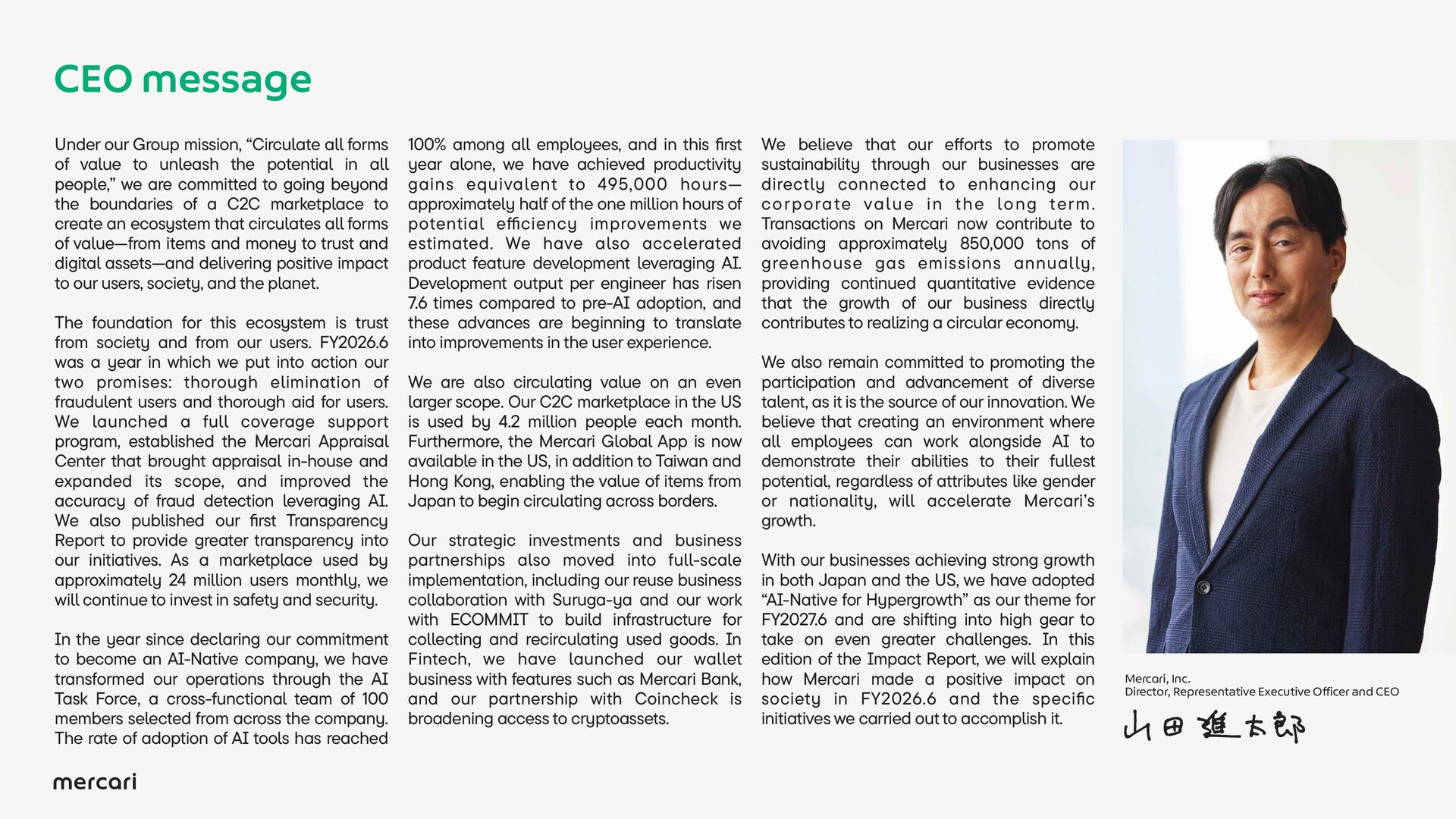
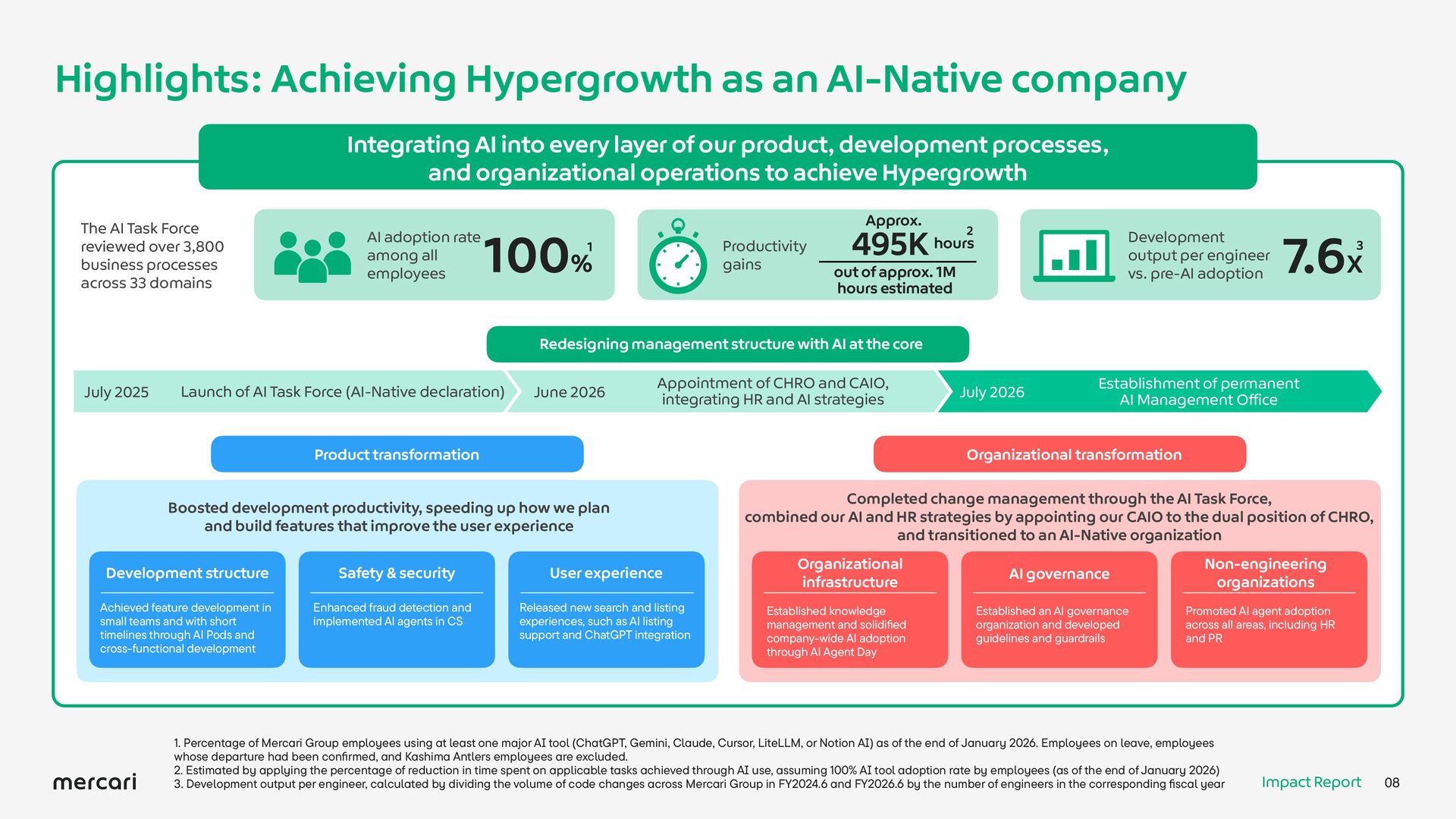
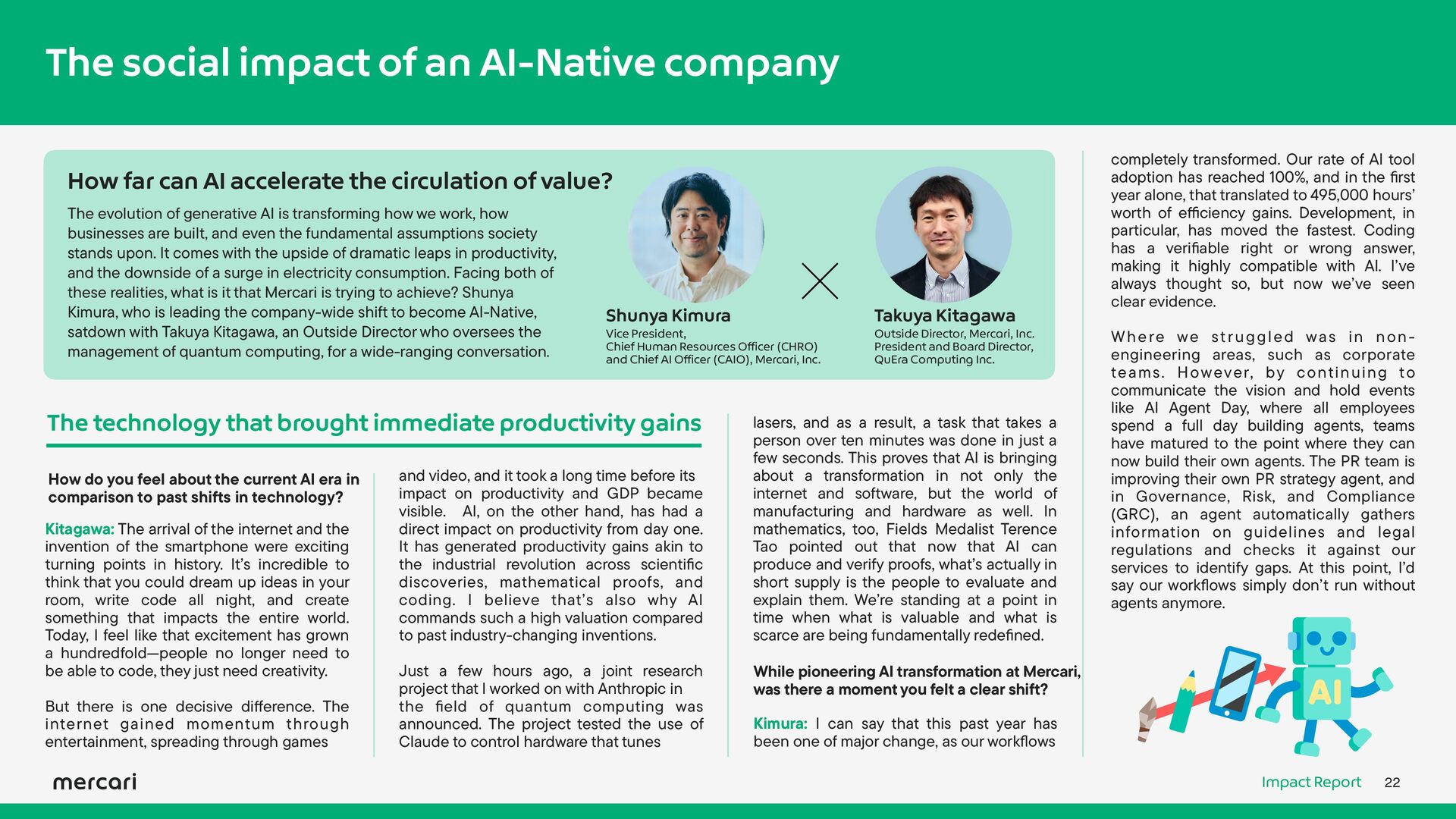
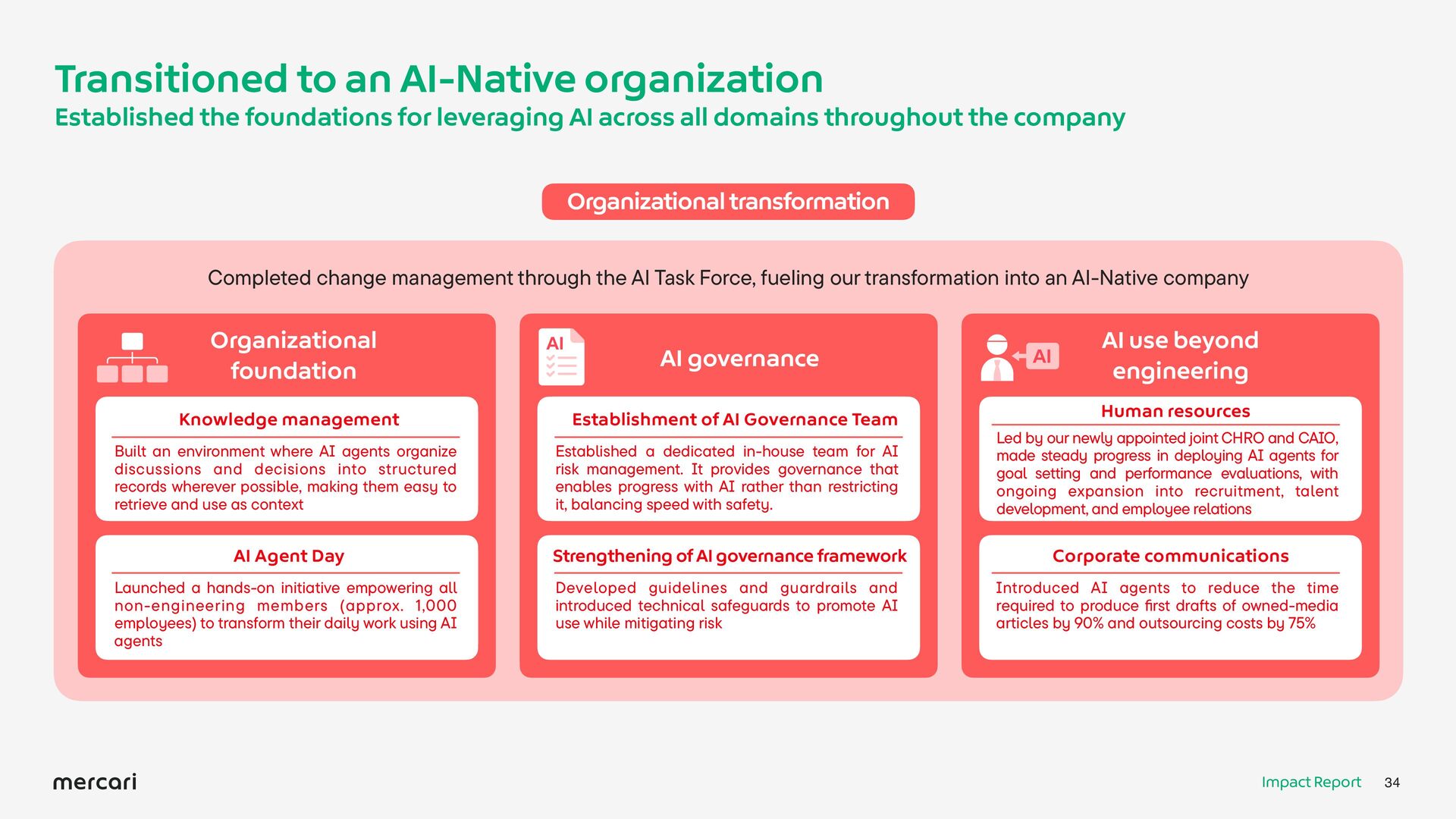
AI accelerate the circulation of value? The evolution of generative AI is transforming how we work, how businesses are built, and even the fundamental assumptions society stands upon. It comes with the upside of dramatic leaps in productivity, and the downside of a surge in electricity consumption. Facing both of these realities, what is it that Mercari is trying to achieve? Shunya Kimura, who is leading the company-wide shift to become AI-Native, satdown with Takuya Kitagawa, an Outside Director who oversees the management of quantum computing, for a wide-ranging conversation. Shunya Kimura Takuya Kitagawa Vice President, Chief Human Resources Officer (CHRO) and Chief AI Officer (CAIO), Mercari, Inc. Outside Director, Mercari, Inc. President and Board Director, QuEra Computing Inc. The technology that brought immediate productivity gains How do you feel about the current AI era in comparison to past shifts in technology? Kitagawa: The arrival of the internet and the invention of the smartphone were exciting turning points in history. It’s incredible to think that you could dream up ideas in your room, write code all night, and create something that impacts the entire world. Today, I feel like that excitement has grown a hundredfold—people no longer need to be able to code, they just need creativity. But there is one decisive difference. The internet gained momentum through entertainment, spreading through games and video, and it took a long time before its impact on productivity and GDP became visible. AI, on the other hand, has had a direct impact on productivity from day one. It has generated productivity gains akin to the industrial revolution across scientific discoveries, mathematical proofs, and coding. I believe that’s also why AI commands such a high valuation compared to past industry-changing inventions. Just a few hours ago, a joint research project that I worked on with Anthropic in the field of quantum computing was announced. The project tested the use of Claude to control hardware that tunes lasers, and as a result, a task that takes a person over ten minutes was done in just a few seconds. This proves that AI is bringing about a transformation in not only the internet and software, but the world of manufacturing and hardware as well. In mathematics, too, Fields Medalist Terence Tao pointed out that now that AI can produce and verify proofs, what’s actually in short supply is the people to evaluate and explain them. We’re standing at a point in time when what is valuable and what is scarce are being fundamentally redefined. While pioneering AI transformation at Mercari, was there a moment you felt a clear shift? completely transformed. Our rate of AI tool adoption has reached 100%, and in the first year alone, that translated to 495,000 hours’ worth of efficiency gains. Development, in particular, has moved the fastest. Coding has a verifiable right or wrong answer, making it highly compatible with AI. I’ve always thought so, but now we’ve seen clear evidence. Where we struggled was in nonengineering areas, such as corporate te a m s . H o w eve r, by c o nt i n u i n g to communicate the vision and hold events like AI Agent Day, where all employees spend a full day building agents, teams have matured to the point where they can now build their own agents. The PR team is improving their own PR strategy agent, and in Governance, Risk, and Compliance (GRC), an agent automatically gathers information on guidelines and legal regulations and checks it against our services to identify gaps. At this point, I’d say our workflows simply don’t run without agents anymore. AI Kimura: I can say that this past year has been one of major change, as our workflows Impact Report 22


 mercari_inc
 mj6237
 flux
flux
 gw_recruit
 ideininc
 nakasonejusetsu
 superstudio
 daiksy
.jpg) ikuodanaka
ikuodanaka
 kgmotors
 orroyalties
 ashisuto_career
 nakahara
 caitiem20
 stephaniewalter
 sferik
 jonrohan
 letsgokoyo
 ryanjones
 aki_iinuma
 techseoconnect
 mza
mza
 codingconduct
 smashingmag
 portentint