Upgrade to Pro
— share decks privately, control downloads, hide ads and more …
Speaker Deck
Sign up for free
Menu
Search
Features
All features
Private URLs
Password Protection
Custom URLS
Scheduled publishing
Remove Branding
Restrict embedding
Deck Collections
Notes
Features
All features
Private URLs
Password Protection
Custom URLS
Scheduled publishing
Remove Branding
Restrict embedding
Deck Collections
Notes
Explore
Featured decks
Featured speakers
Programming
Technology
Storyboards
Explore
Featured decks
Featured speakers
Programming
Technology
Storyboards
Pricing
Search
Sign in
Sign up for free
EMNLP論文紹介 The Myth of Double-Blind Review Revis...
Search
Reo
January 20, 2020
Technology
190
0
Share
Embed
Copy iframe code
Copy JS code
Copy link
Start on current slide
EMNLP論文紹介 The Myth of Double-Blind Review Revisited: ACL vs. EMNLP
EMNLP論文紹介
2020/01/20
Reo
January 20, 2020
More Decks by Reo
See All by Reo
論文紹介 Taking Notes on the Fly Helps Language Pre-Trainig
reo11
0
63
論文紹介 Reformer: The Efficient Transformer
reo11
0
270
論文読み会 How Large Are Lions? Inducing Distributions over Quantitative Attributes
reo11
1
290
ACL読み会 Give Me More Feedback II: Annotating Thesis Strength and Related Attributes in Student Essays
reo11
0
210
NAACL読み会 Attention is not Explanation
reo11
0
220
Other Decks in Technology
See All in Technology
NDIでApple Vision Proにリアルタイム映像送信
jyouryuusui
0
130
WasmをRustにする
sansantech
PRO
0
280
『SAR衛星データ解析入門』の ご紹介とその応用
syuchimu
0
120
TinyGoでオブザーバビリティ?OpenTelemetryはTinyGoで使えるのか / Is OpenTelemetry available in TinyGo environment?
ymotongpoo
2
140
Rustuna: Rustによる高速なOptuna実装
pfn
PRO
0
200
Tofu-Controller lightning talk @ Containerday 2026
gionn
0
120
実践! SRE × AI - ABEMA における AIOps -
tetsuya28
8
3.1k
Benchmarking Disaggregated Serving on vLLM + Dynamo with a Real Coding-Agent Workload
nttcom
1
200
Kiro Crewで「みのるん式」仕事術やってみた
minorun365
PRO
3
690
Running Kotlin + Quarkus with Lambda
nealle
1
4k
価値について
gree_tech
PRO
0
100
Post AI時代のリファクタリング実践記 / Refactoring in the post AI era
kaminashi
1
290
Featured
See All Featured
DBのスキルで生き残る技術 - AI時代におけるテーブル設計の勘所
soudai
PRO
68
58k
Highjacked: Video Game Concept Design
rkendrick25
PRO
1
480
Jess Joyce - The Pitfalls of Following Frameworks
techseoconnect
PRO
1
450
CSS Pre-Processors: Stylus, Less & Sass
bermonpainter
360
31k
Conquering PDFs: document understanding beyond plain text
inesmontani
PRO
4
3.2k
How to Ace a Technical Interview
jacobian
280
24k
Java REST API Framework Comparison - PWX 2021
mraible
34
9.8k
How to Build an AI Search Optimization Roadmap - Criteria and Steps to Take #SEOIRL
aleyda
1
2.2k
The Language of Interfaces
destraynor
162
27k
Raft: Consensus for Rubyists
vanstee
142
7.8k
XXLCSS - How to scale CSS and keep your sanity
sugarenia
250
1.3M
How To Stay Up To Date on Web Technology
chriscoyier
790
250k
Transcript
The Myth of Double-Blind Review Revisited: ACL vs. EMNLP Cornelia
Caragea, Ana Sabina Uban, and Liviu P. Dinu EMNLP 2019 紹介者: 平尾 礼央(TMU, B4, 小町研究室) 20 January, 2020 @EMNLP読み会
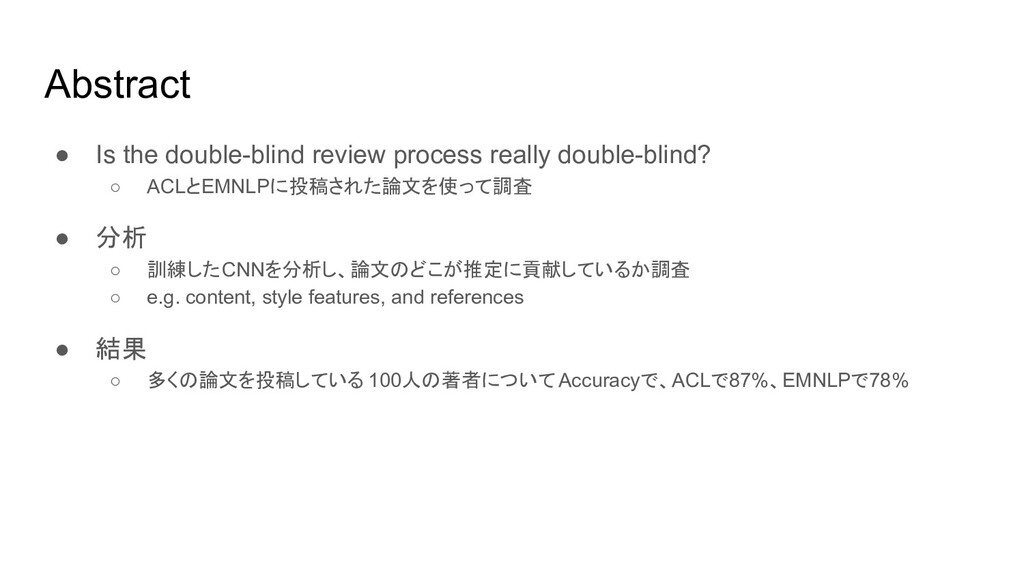
Abstract • Is the double-blind review process really double-blind? ◦
ACLとEMNLPに投稿された論文を使って調査 • 分析 ◦ 訓練したCNNを分析し、論文のどこが推定に貢献しているか調査 ◦ e.g. content, style features, and references • 結果 ◦ 多くの論文を投稿している 100人の著者についてAccuracyで、ACLで87%、EMNLPで78%
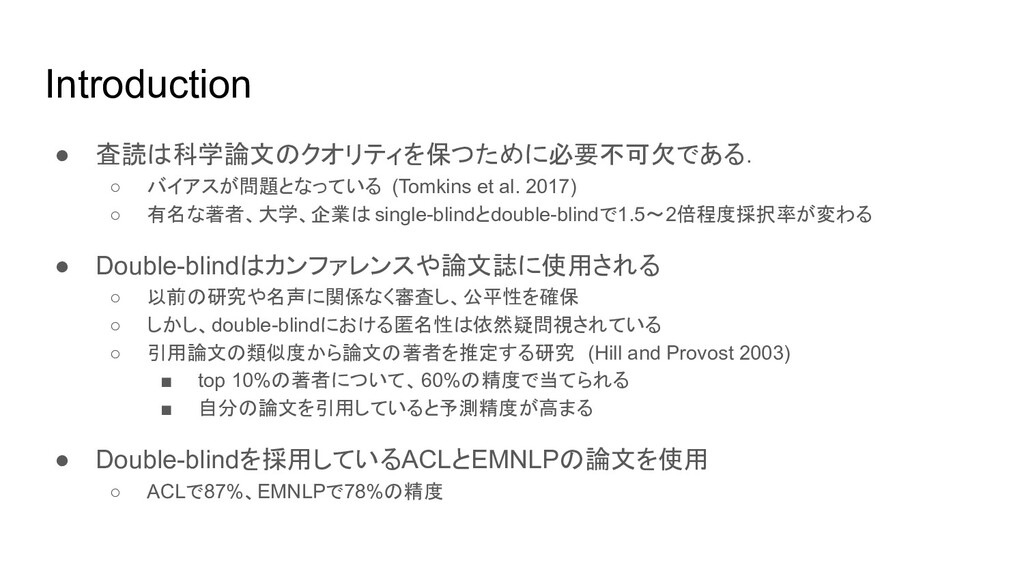
Introduction • 査読は科学論文のクオリティを保つために必要不可欠である. ◦ バイアスが問題となっている (Tomkins et al. 2017) ◦
有名な著者、大学、企業は single-blindとdouble-blindで1.5〜2倍程度採択率が変わる • Double-blindはカンファレンスや論文誌に使用される ◦ 以前の研究や名声に関係なく審査し、公平性を確保 ◦ しかし、double-blindにおける匿名性は依然疑問視されている ◦ 引用論文の類似度から論文の著者を推定する研究 (Hill and Provost 2003) ▪ top 10%の著者について、60%の精度で当てられる ▪ 自分の論文を引用していると予測精度が高まる • Double-blindを採用しているACLとEMNLPの論文を使用 ◦ ACLで87%、EMNLPで78%の精度
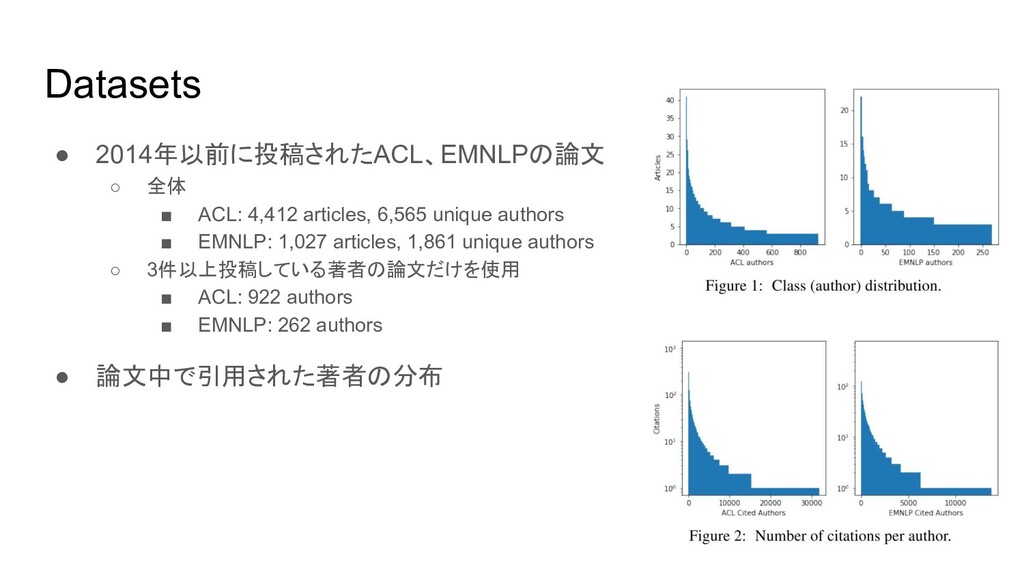
Datasets • 2014年以前に投稿されたACL、EMNLPの論文 ◦ 全体 ▪ ACL: 4,412 articles, 6,565
unique authors ▪ EMNLP: 1,027 articles, 1,861 unique authors ◦ 3件以上投稿している著者の論文だけを使用 ▪ ACL: 922 authors ▪ EMNLP: 262 authors • 論文中で引用された著者の分布
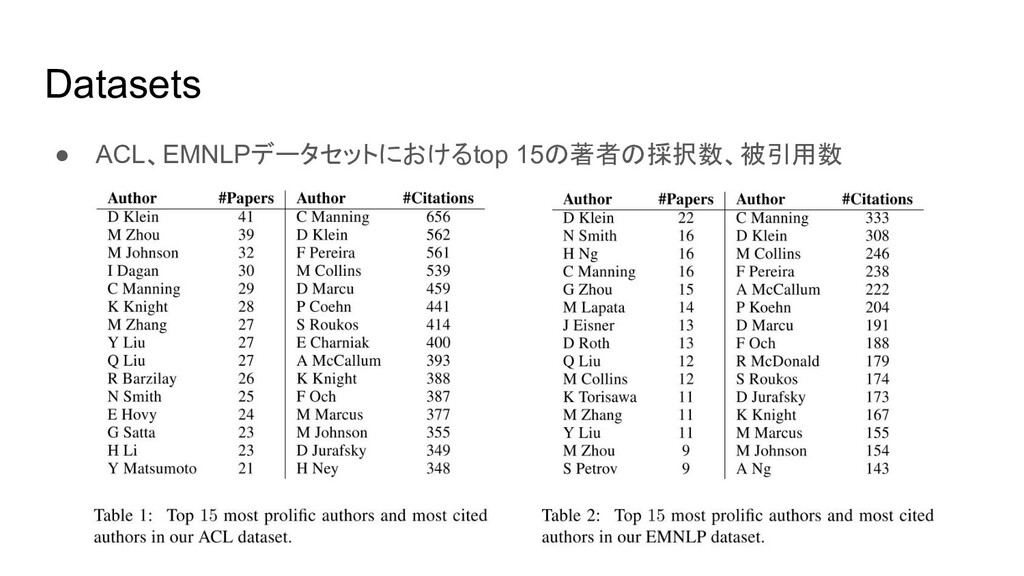
Datasets • ACL、EMNLPデータセットにおけるtop 15の著者の採択数、被引用数
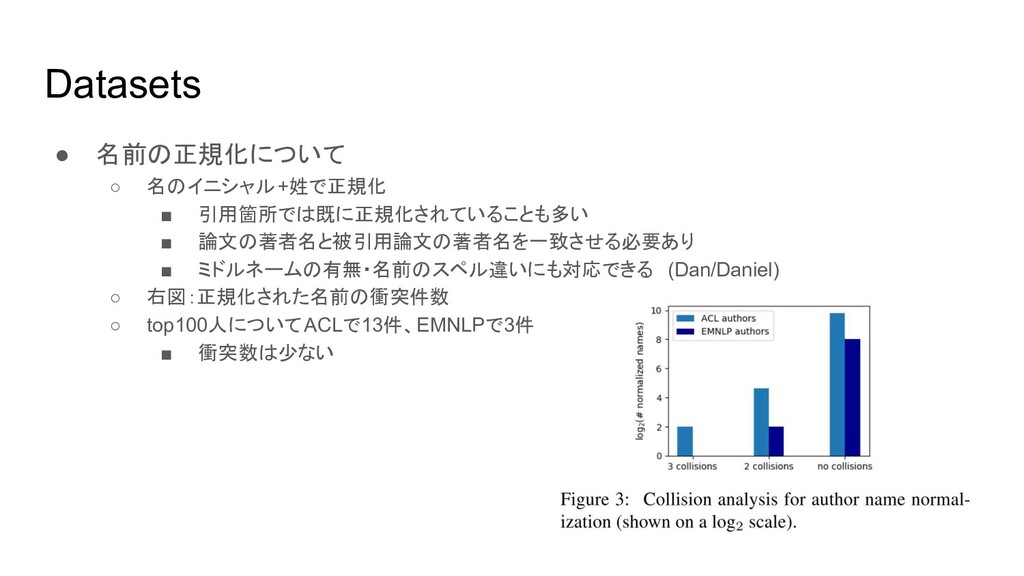
Datasets • 名前の正規化について ◦ 名のイニシャル+姓で正規化 ▪ 引用箇所では既に正規化されていることも多い ▪ 論文の著者名と被引用論文の著者名を一致させる必要あり ▪
ミドルネームの有無・名前のスペル違いにも対応できる (Dan/Daniel) ◦ 右図:正規化された名前の衝突件数 ◦ top100人についてACLで13件、EMNLPで3件 ▪ 衝突数は少ない
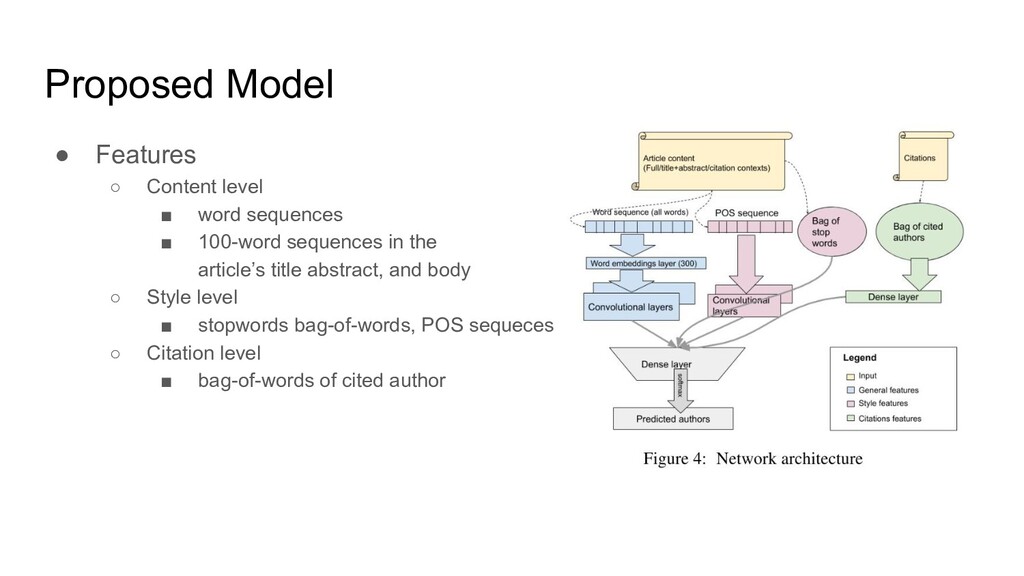
Proposed Model • Features ◦ Content level ▪ word sequences
▪ 100-word sequences in the article’s title abstract, and body ◦ Style level ▪ stopwords bag-of-words, POS sequeces ◦ Citation level ▪ bag-of-words of cited author
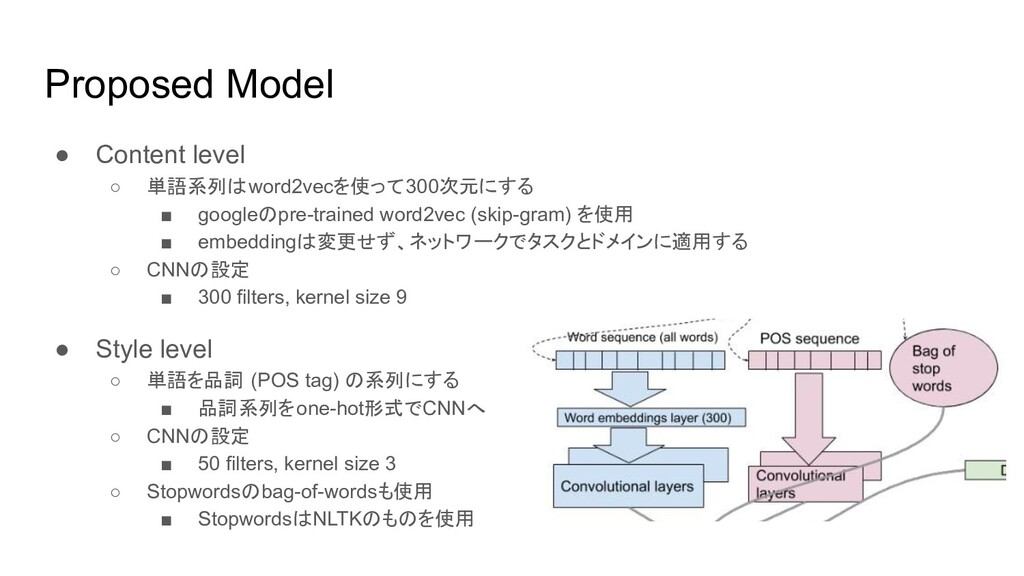
Proposed Model • Content level ◦ 単語系列はword2vecを使って300次元にする ▪ googleのpre-trained word2vec
(skip-gram) を使用 ▪ embeddingは変更せず、ネットワークでタスクとドメインに適用する ◦ CNNの設定 ▪ 300 filters, kernel size 9 • Style level ◦ 単語を品詞 (POS tag) の系列にする ▪ 品詞系列をone-hot形式でCNNへ ◦ CNNの設定 ▪ 50 filters, kernel size 3 ◦ Stopwordsのbag-of-wordsも使用 ▪ StopwordsはNLTKのものを使用
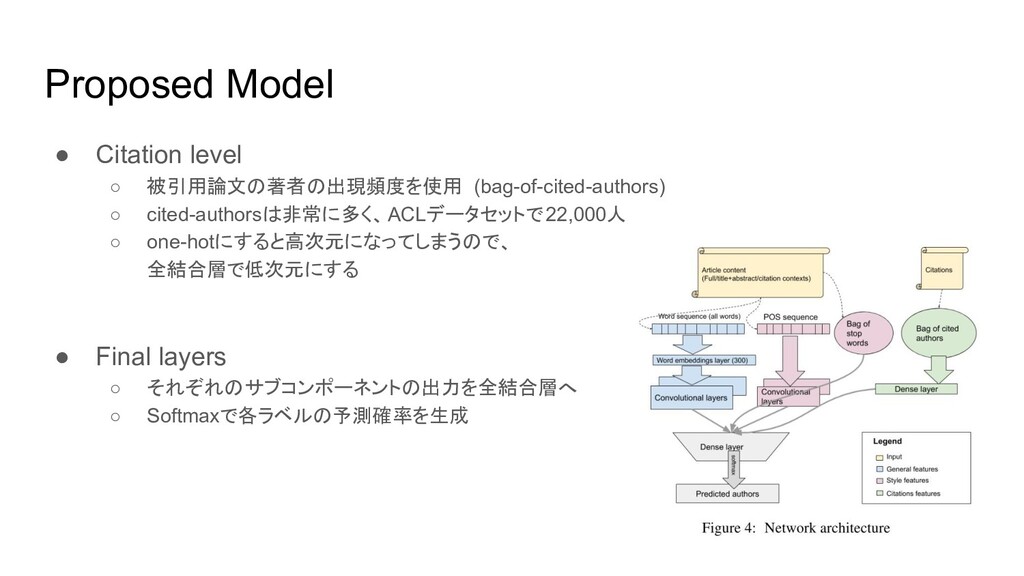
Proposed Model • Citation level ◦ 被引用論文の著者の出現頻度を使用 (bag-of-cited-authors) ◦ cited-authorsは非常に多く、ACLデータセットで22,000人
◦ one-hotにすると高次元になってしまうので、 全結合層で低次元にする • Final layers ◦ それぞれのサブコンポーネントの出力を全結合層へ ◦ Softmaxで各ラベルの予測確率を生成
Preprocessing and Feature Extraction • 論文のPDFからGrobidを使って文章を抽出 ◦ 引用箇所、Referenceを削除し、contentとcitation featureを独立にする ◦
正規化、トークン化 ◦ ACLデータセットにおける vocabは全論文で頻出の50,000語 (Hitschler et al., 2017) ◦ EMNLPデータセットでは、最小の頻度を 5回とした約23,000語 • 符号化 ◦ vocab外の単語は”unk”トークンにする ◦ 系列長が短い場合、ゼロパディング ◦ 引用箇所の周辺の文字系列 (100 words) を使用し、引用に関する単語を素性とする • 品詞タグ付け ◦ Stanford POS tagger https://github.com/kermitt2/grobid
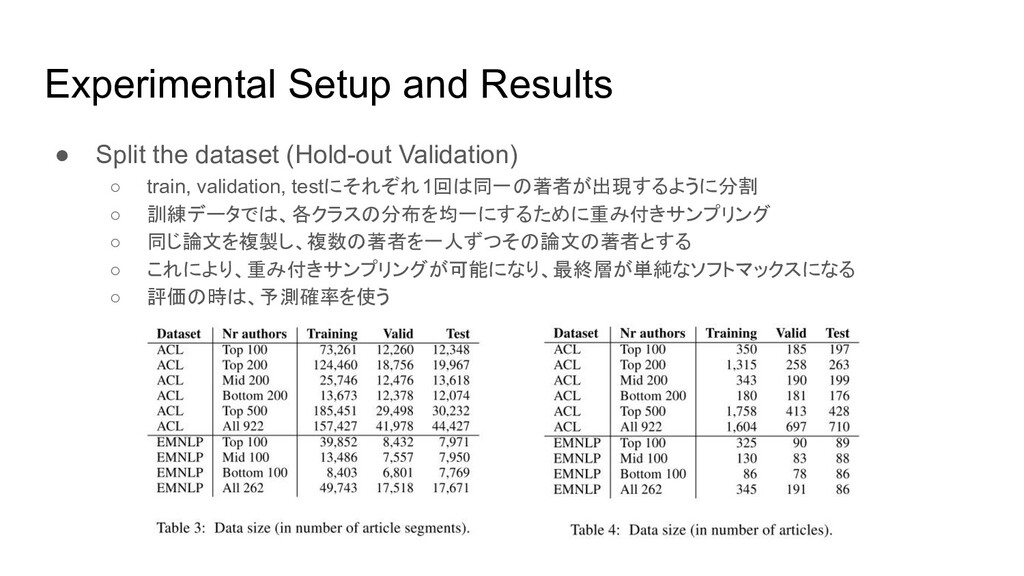
Experimental Setup and Results • Split the dataset (Hold-out Validation)
◦ train, validation, testにそれぞれ1回は同一の著者が出現するように分割 ◦ 訓練データでは、各クラスの分布を均一にするために重み付きサンプリング ◦ 同じ論文を複製し、複数の著者を一人ずつその論文の著者とする ◦ これにより、重み付きサンプリングが可能になり、最終層が単純なソフトマックスになる ◦ 評価の時は、予測確率を使う
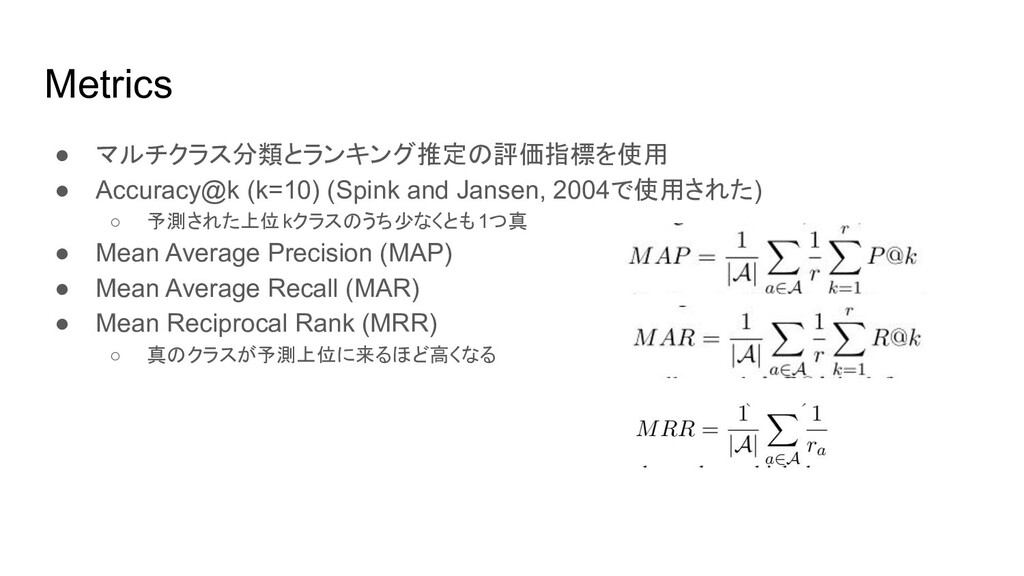
Metrics • マルチクラス分類とランキング推定の評価指標を使用 • Accuracy@k (k=10) (Spink and Jansen, 2004で使用された)
◦ 予測された上位kクラスのうち少なくとも 1つ真 • Mean Average Precision (MAP) • Mean Average Recall (MAR) • Mean Reciprocal Rank (MRR) ◦ 真のクラスが予測上位に来るほど高くなる
Experiment Settings 1. 採択頻度上位100, 200の著者のデータだけを使う ◦ 採択数が今回の最低数 (3) の場合は訓練データに 1件しか入らないため
◦ 予測対象が絞られるのでスコアが高くなることが予想される 2. 素性の重要度を分析するため、特定の素性以外を除外する ◦ content level, style level, citation levelの3つで実験 3. 著者推定において重要な部分の分析 ◦ 本文 ◦ タイトルとアブスト ◦ 論文の引用コンテキスト 重要な部分の分析にはtop100のdatasetを使用
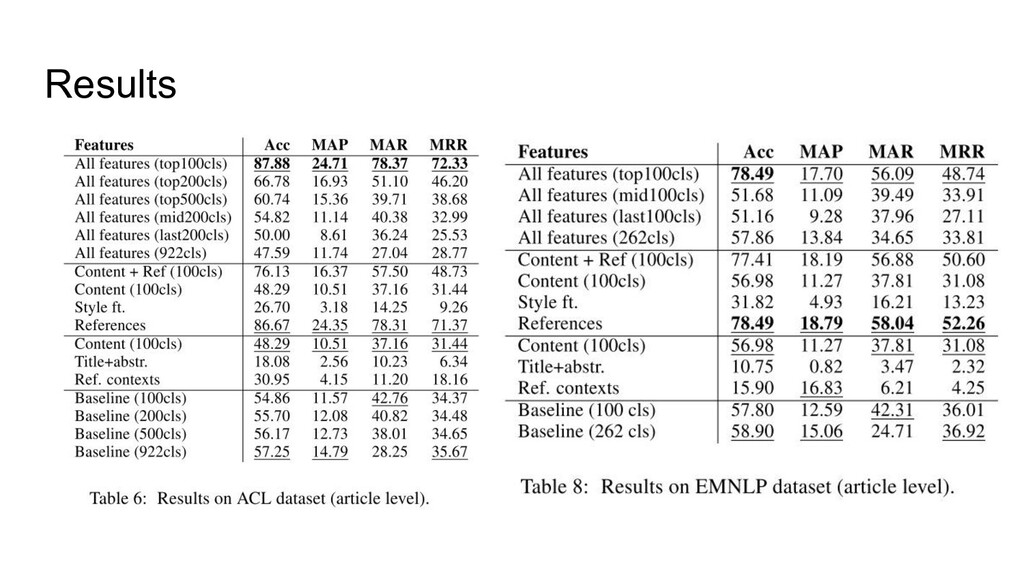
Results
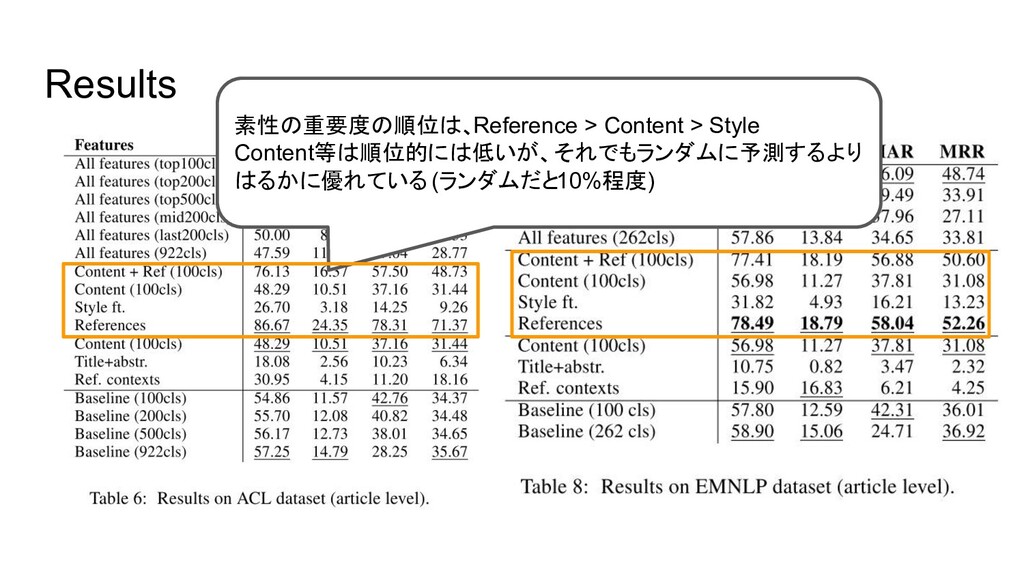
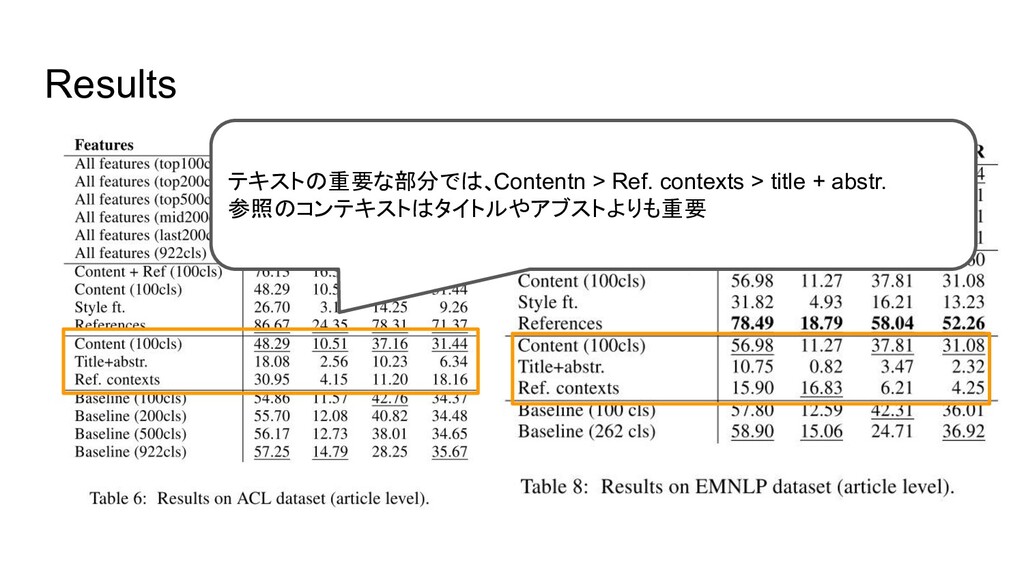
Results 著者の予測においてReferencesの情報は重要 • 被引用論文の著者の情報だけを利用した Baselineでも54.86%, 57.80% • Referencesのみを使用したNNモデルでも高いスコア
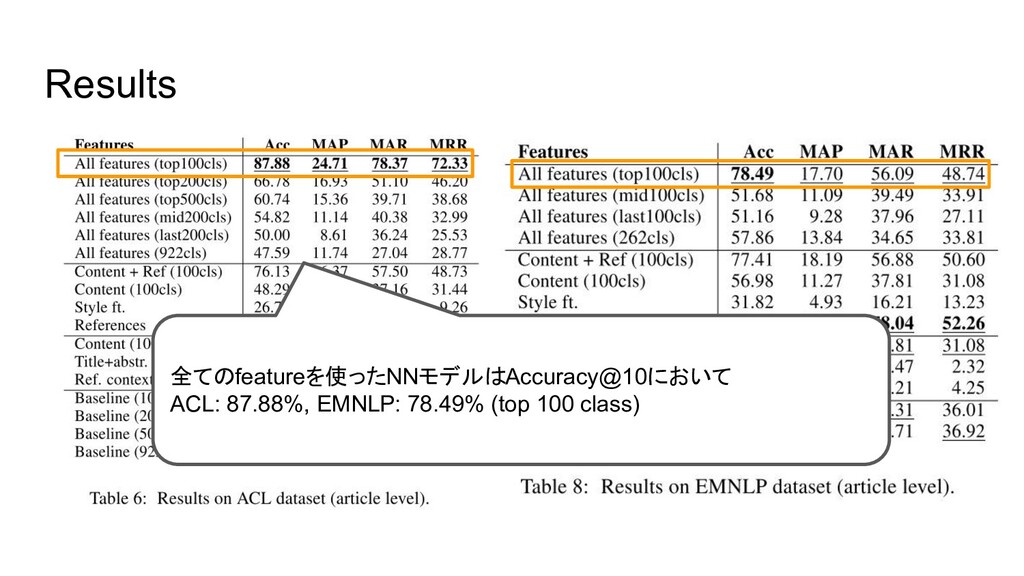
Results 全てのfeatureを使ったNNモデルはAccuracy@10において ACL: 87.88%, EMNLP: 78.49% (top 100 class)
Results 素性の重要度の順位は、Reference > Content > Style Content等は順位的には低いが、それでもランダムに予測するより はるかに優れている (ランダムだと10%程度)
Results テキストの重要な部分では、Contentn > Ref. contexts > title + abstr. 参照のコンテキストはタイトルやアブストよりも重要
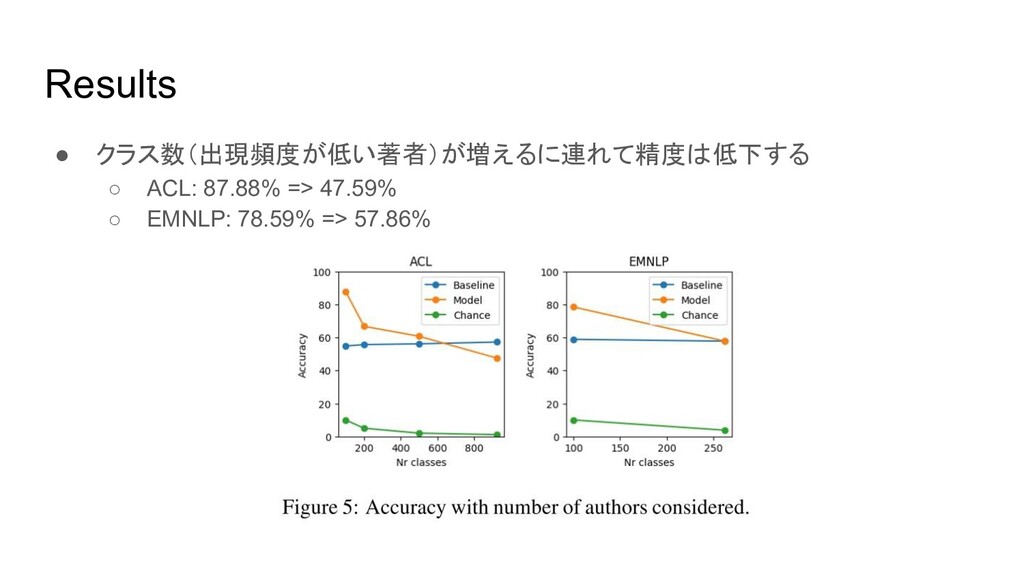
Results • クラス数(出現頻度が低い著者)が増えるに連れて精度は低下する ◦ ACL: 87.88% => 47.59% ◦ EMNLP:
78.59% => 57.86%
Error Analysis • ACL test setの各著者の誤分類率を計算 ◦ 誤分類率 = 正確に予測した数
/ 全論文数 • 論文数で昇順にランク付けした時、著者のランクと誤分類率の相関が0.35であり、 採択数が多いほど正確に分類される傾向がある • 引用論文が似ている、キーワードが同じ場合間違えやすい
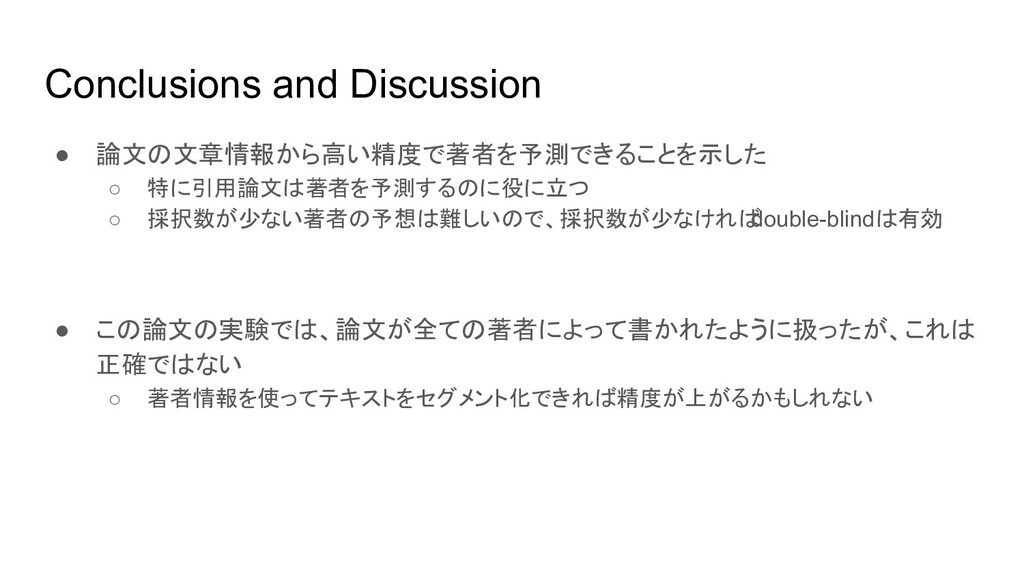
Conclusions and Discussion • 論文の文章情報から高い精度で著者を予測できることを示した ◦ 特に引用論文は著者を予測するのに役に立つ ◦ 採択数が少ない著者の予想は難しいので、採択数が少なければ double-blindは有効
• この論文の実験では、論文が全ての著者によって書かれたように扱ったが、これは 正確ではない ◦ 著者情報を使ってテキストをセグメント化できれば精度が上がるかもしれない


 reo11
reo11
 jyouryuusui
 sansantech
 syuchimu
 ymotongpoo
 pfn
pfn
 gionn
gionn
 tetsuya28
 nttcom
 minorun365
 nealle
 gree_tech
 kaminashi
 soudai
 rkendrick25
 techseoconnect
 bermonpainter
 inesmontani
 jacobian
 mraible
 aleyda
 destraynor
 vanstee
 sugarenia
 chriscoyier