$30 off During Our Annual Pro Sale. View Details »

Jakarta Agentic AI Specification - Status and F...

Avatar for Reza Rahman Reza Rahman
December 12, 2025

Jakarta Agentic AI Specification - Status and Future

This talk outlines the current status and roadmap of the Jakarta Agentic AI specification.

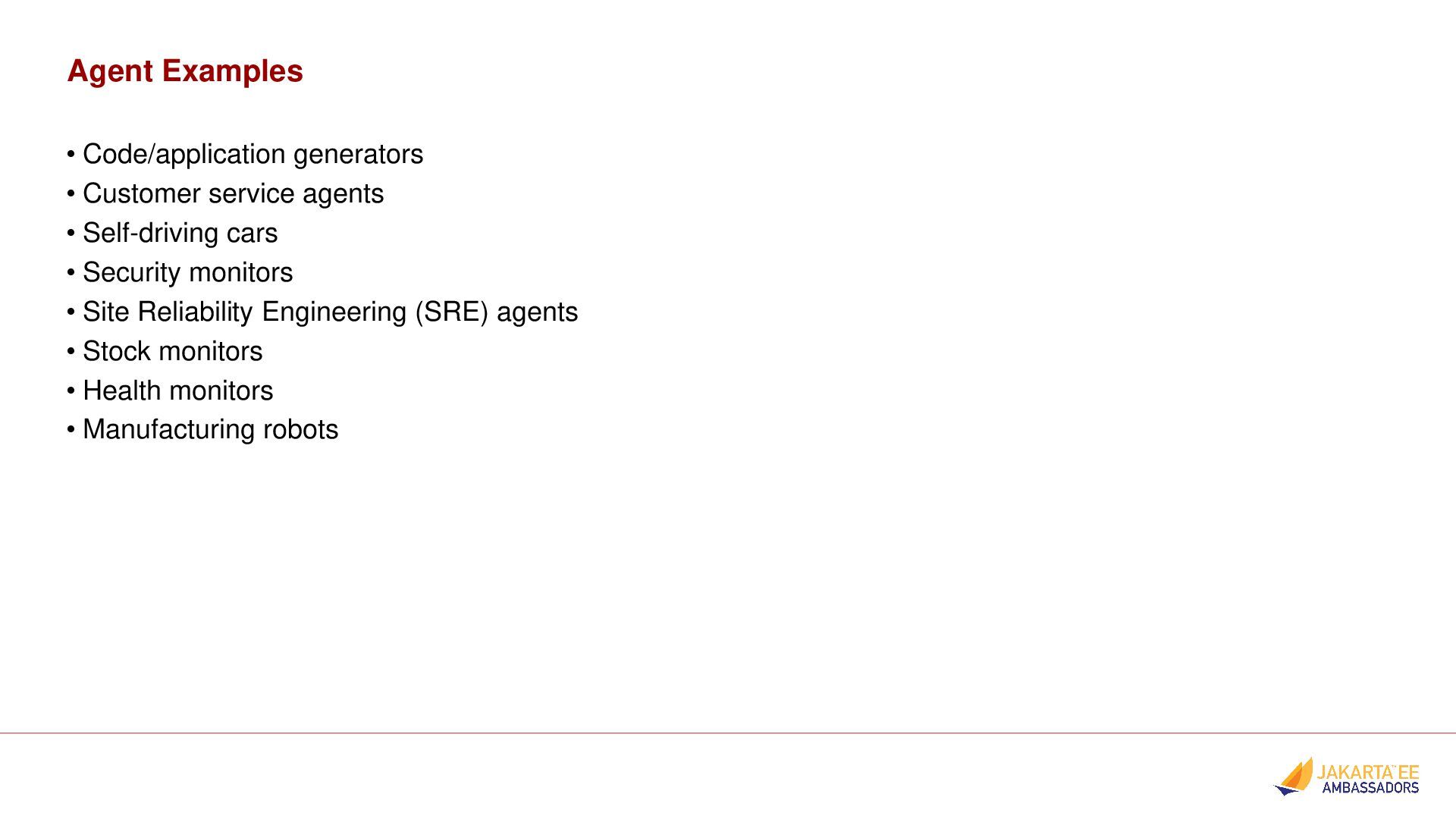
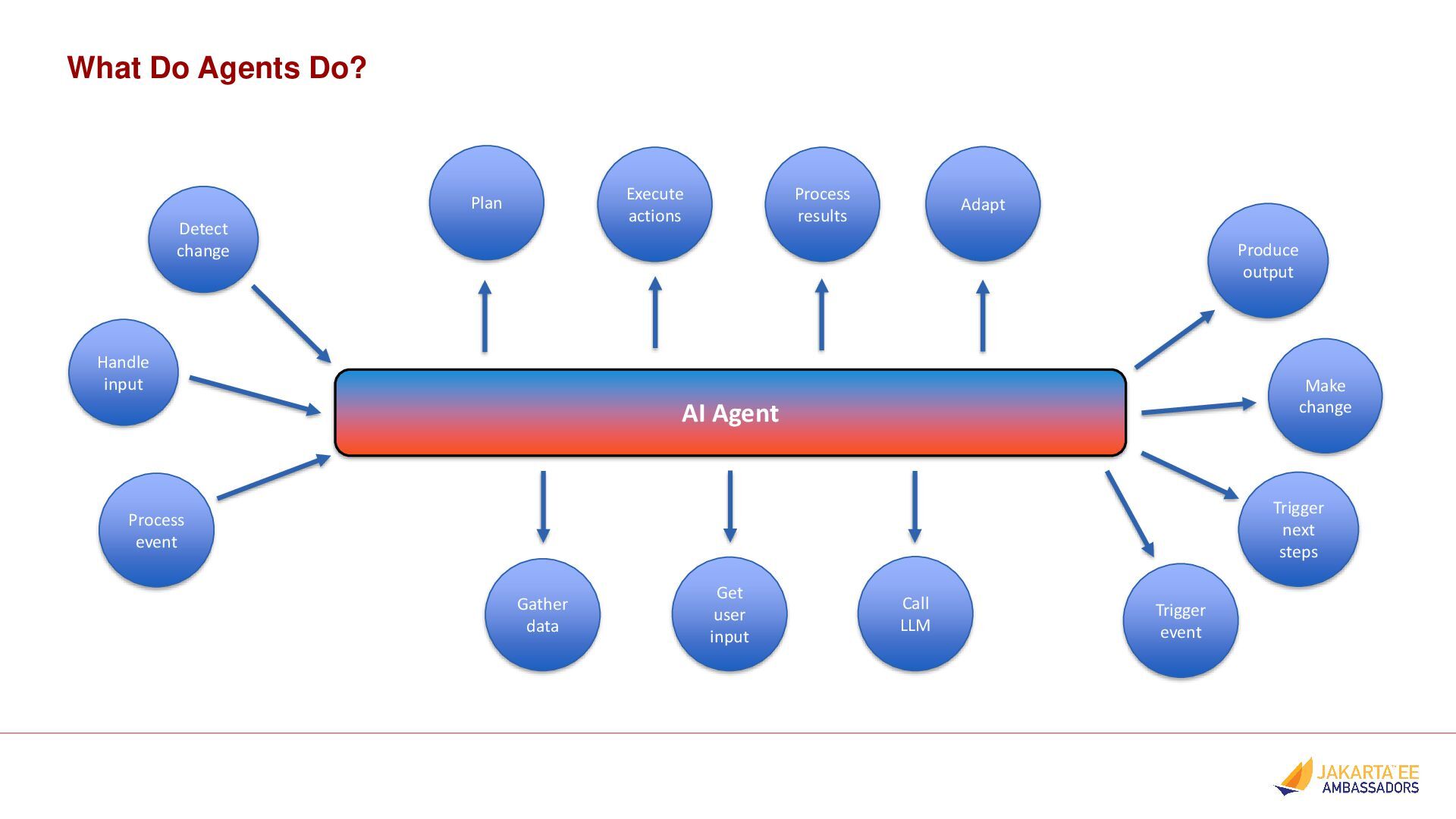
AI agents are one of the most prominent developments in enterprise and cloud native computing in decades. They promise to fundamentally accelerate innovation, automation, and productivity by leveraging AI in virtually every industry. Agents operate by leveraging Neural Networks, Machine Learning (ML), Natural Language Processing (NLP), Large Language Models (LLMs), and many other AI technologies to aim to perform specific tasks autonomously with little or no human intervention. They detect events, gather data, generate self-correcting plans, execute actions, process results, and evolve subsequent decisions. Examples include self-driving cars, security monitors, Site Reliability Engineering (SRE) agents, stock monitors, code/application generators, health monitors, customer service agents, manufacturing robots, and many others.

The Agentic AI specification aims to provide a set of APIs that make it easy, consistent, and reliable to build, deploy, and run AI agents on Jakarta EE runtimes. The technology aims to do for developing AI agents what Servlet did for HTTP processing, Jakarta REST did for RESTful web services, or perhaps most appropriately, Jakarta Batch did for batch processing. It defines common usage patterns/life cycles for AI agents, provides a very minimal LLM facade, allows defining dynamic agent workflows that can change at runtime, integrates with other key Jakarta EE APIs such as CDI, Validation, JSON Binding, Persistence, Messaging, and much, much more.

Avatar for Reza Rahman

Reza Rahman

December 12, 2025
Tweet

More Decks by Reza Rahman

Other Decks in Technology

Transcript

  1. Jakarta Agentic AI - Status and Future Reza Rahman Jakarta

    EE Ambassador, Author, Blogger, Speaker @reza_rahman, [email protected]
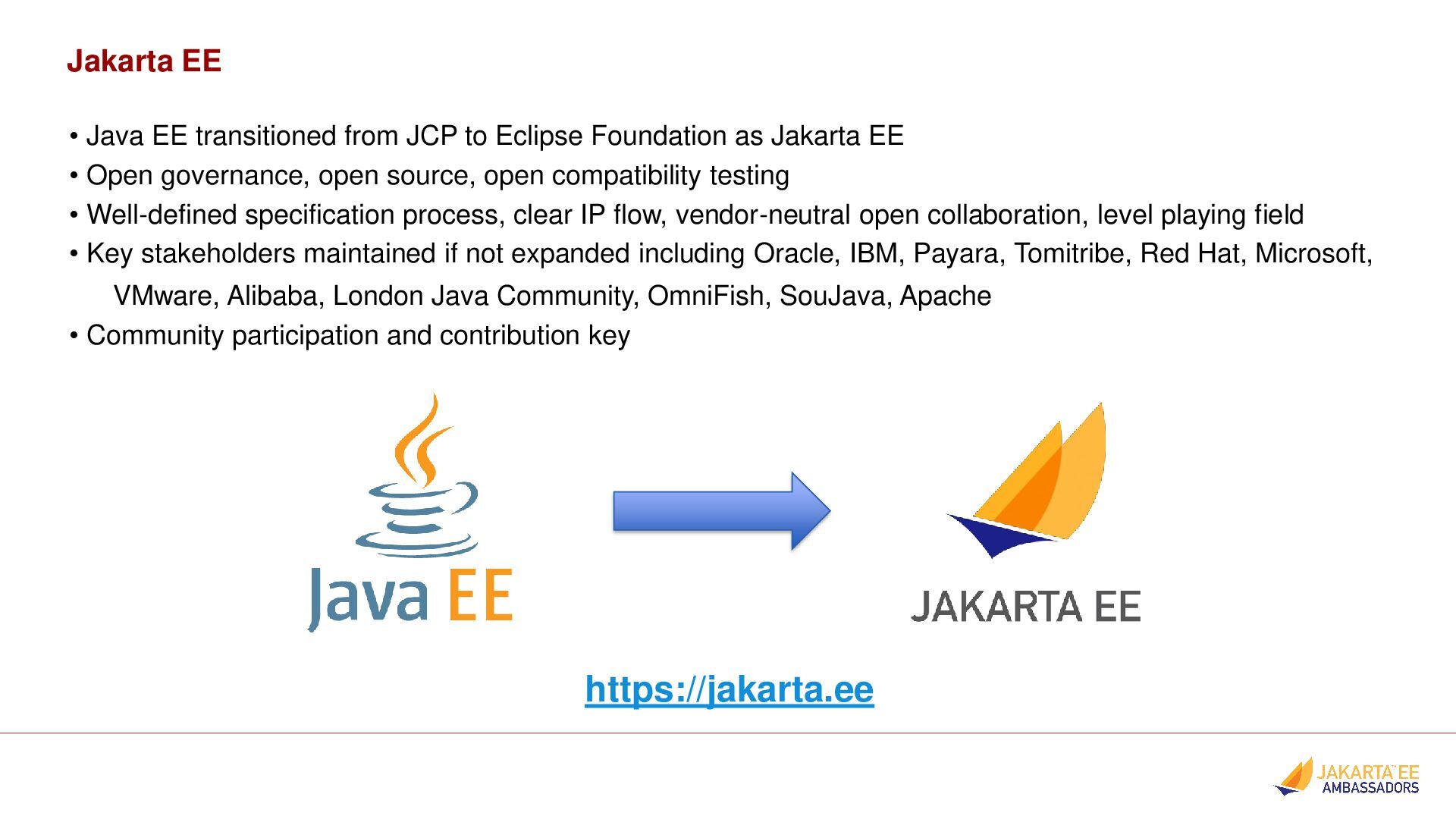
  2. Jakarta EE • Java EE transitioned from JCP to Eclipse

    Foundation as Jakarta EE • Open governance, open source, open compatibility testing • Well-defined specification process, clear IP flow, vendor-neutral open collaboration, level playing field • Key stakeholders maintained if not expanded including Oracle, IBM, Payara, Tomitribe, Red Hat, Microsoft, VMware, Alibaba, London Java Community, OmniFish, SouJava, Apache • Community participation and contribution key https://jakarta.ee
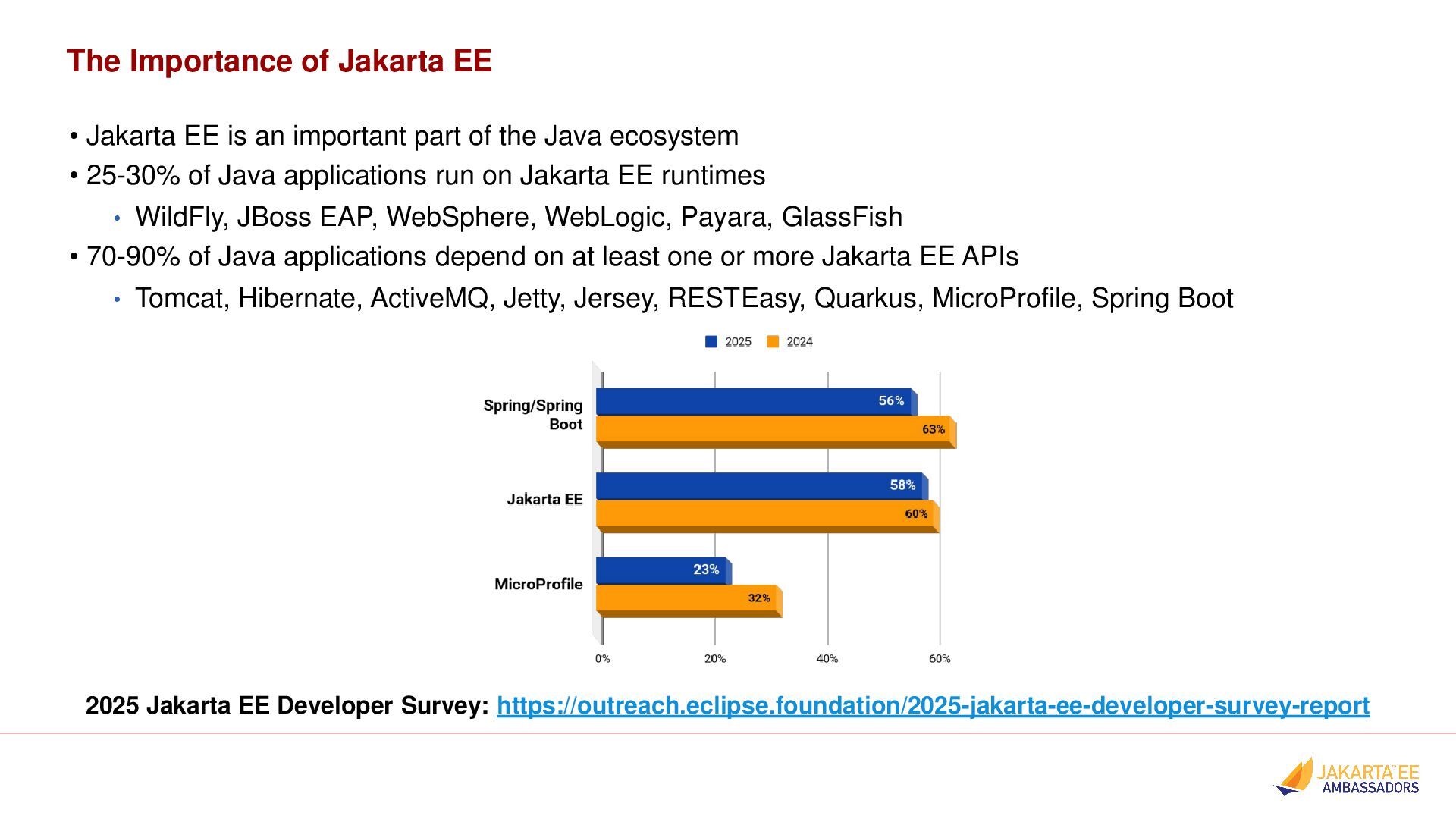
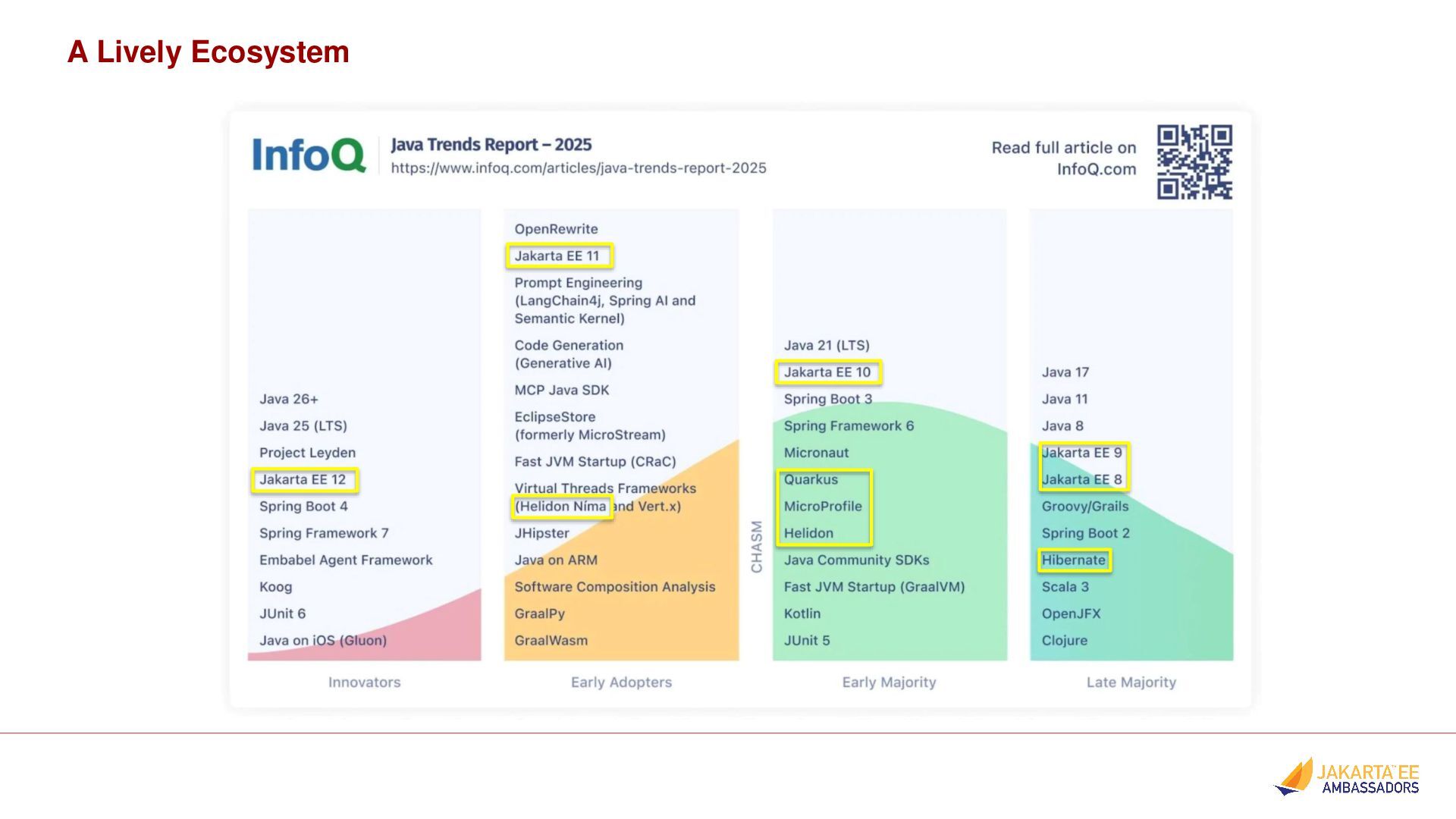
  3. The Importance of Jakarta EE • Jakarta EE is an

    important part of the Java ecosystem • 25-30% of Java applications run on Jakarta EE runtimes • WildFly, JBoss EAP, WebSphere, WebLogic, Payara, GlassFish • 70-90% of Java applications depend on at least one or more Jakarta EE APIs • Tomcat, Hibernate, ActiveMQ, Jetty, Jersey, RESTEasy, Quarkus, MicroProfile, Spring Boot 2025 Jakarta EE Developer Survey: https://outreach.eclipse.foundation/2025-jakarta-ee-developer-survey-report
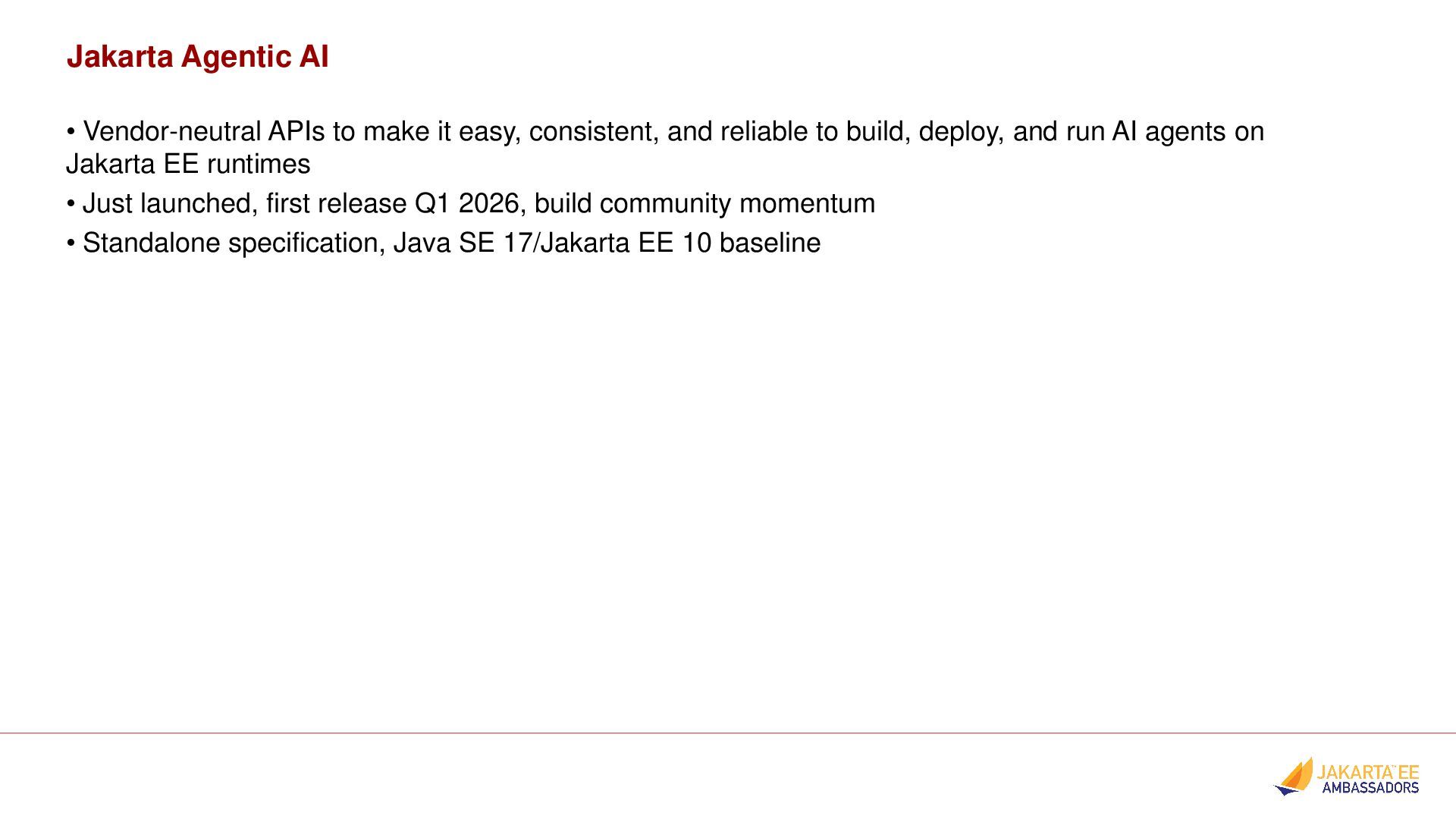
  4. • Vendor-neutral APIs to make it easy, consistent, and reliable

    to build, deploy, and run AI agents on Jakarta EE runtimes • Just launched, first release Q1 2026, build community momentum • Standalone specification, Java SE 17/Jakarta EE 10 baseline Jakarta Agentic AI
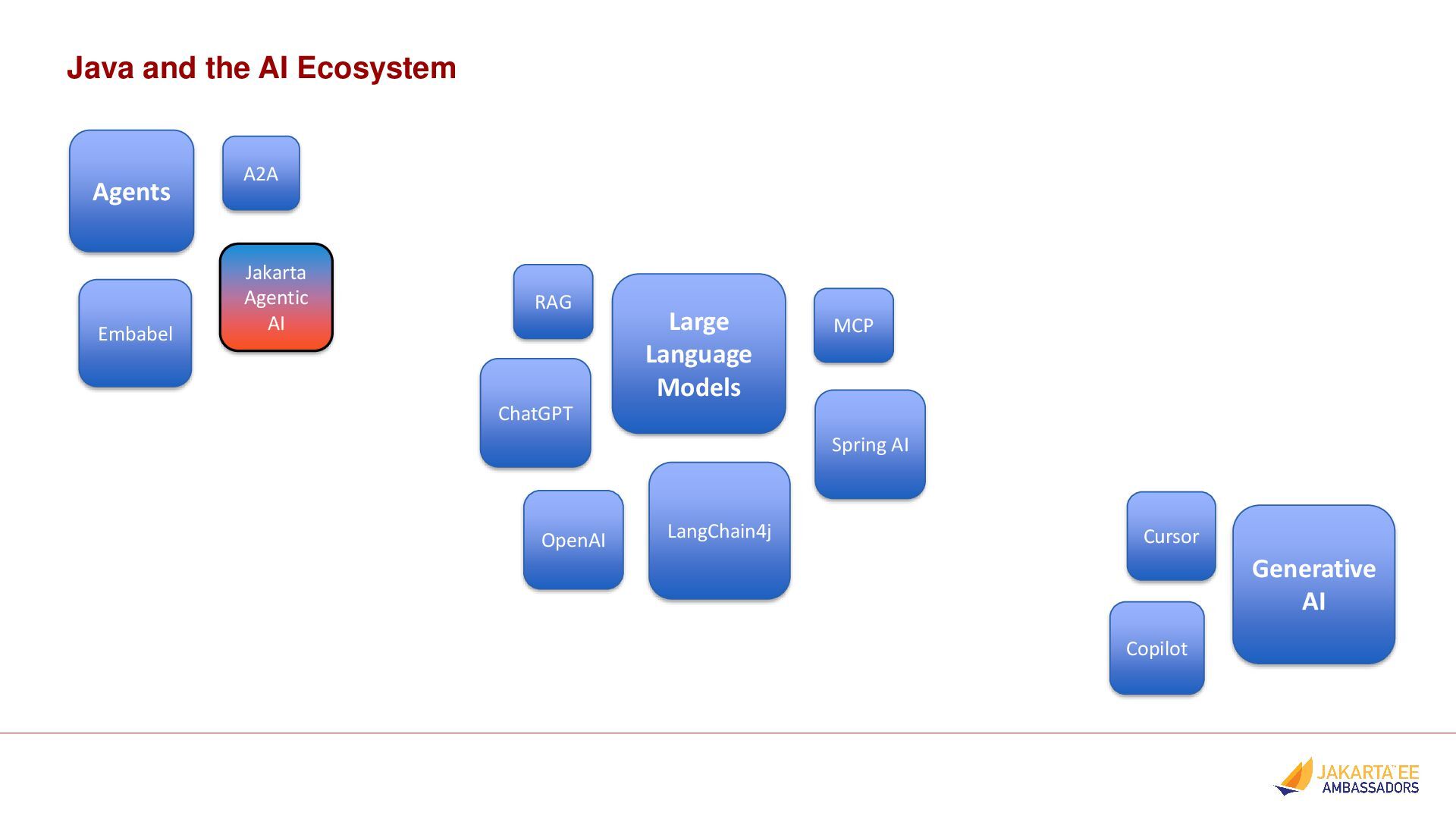
  5. Java and the AI Ecosystem Large Language Models Agents A2A

    MCP Embabel Jakarta Agentic AI Generative AI Copilot Spring AI LangChain4j ChatGPT OpenAI RAG Gemini Claude Cursor Ollama Windsurf
  6. • Code/application generators • Customer service agents • Self-driving cars

    • Security monitors • Site Reliability Engineering (SRE) agents • Stock monitors • Health monitors • Manufacturing robots • Travel planner Agent Examples
  7. What Do Agents Do? AI Agent Detect change Handle input

    Process event Produce output Make change Trigger next steps Trigger event Call LLM Get user input Gather data Execute actions Plan Process results Adapt
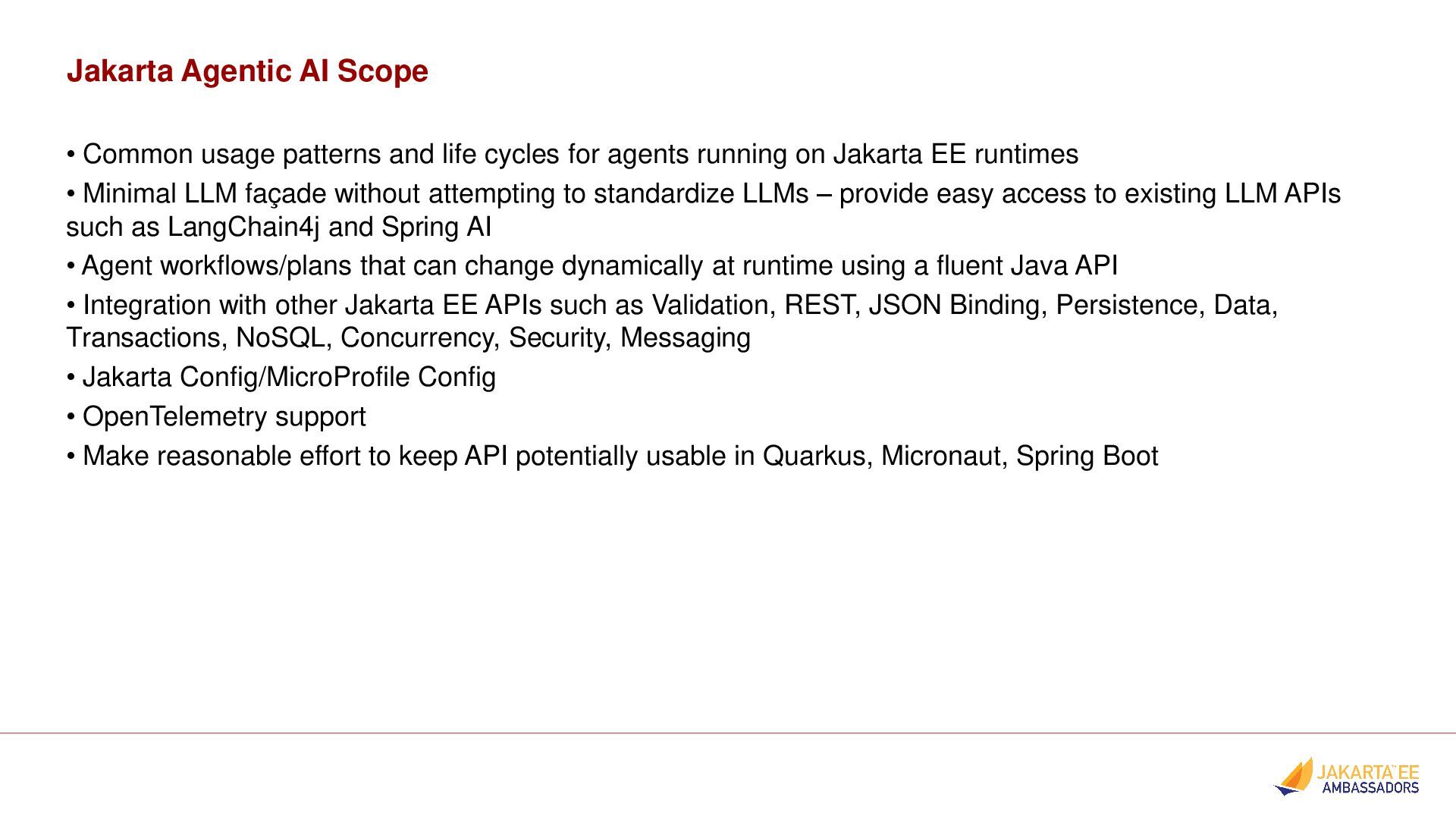
  8. • Common usage patterns and life cycles for agents running

    on Jakarta EE runtimes • Minimal LLM façade without attempting to standardize LLMs – provide easy access to existing LLM APIs such as LangChain4j and Spring AI • Agent workflows/plans that can change dynamically at runtime using a fluent Java API • Integration with other Jakarta EE APIs such as Validation, REST, JSON Binding, Persistence, Data, Transactions, NoSQL, Concurrency, Security, Messaging • Jakarta Config/MicroProfile Config • OpenTelemetry support • Make reasonable effort to keep API potentially usable in Quarkus, Micronaut, Spring Boot Jakarta Agentic AI Scope
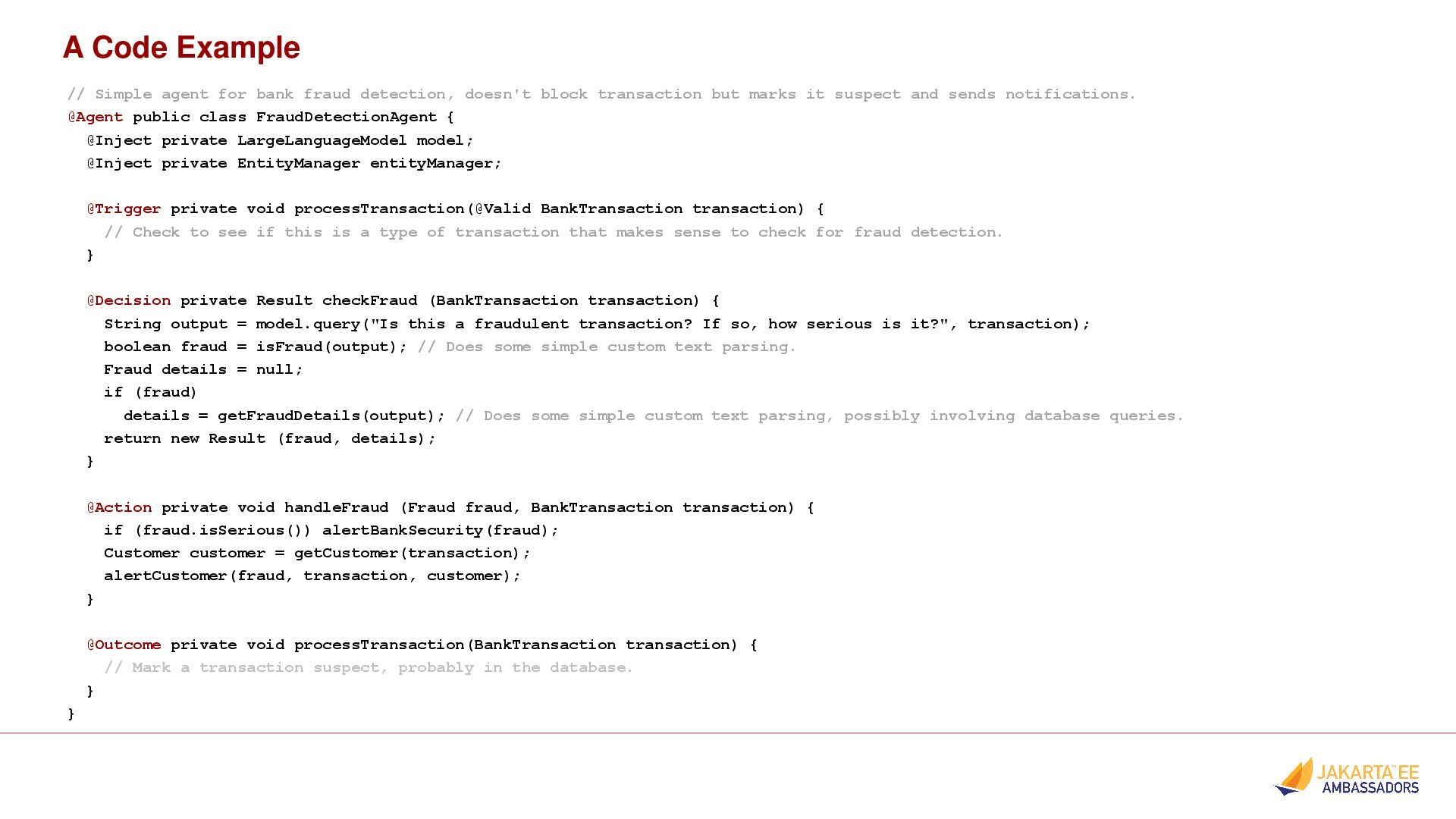
  9. A Code Example // Simple agent for bank fraud detection,

    doesn't block transaction but marks it suspect and sends notifications. @Agent public class FraudDetectionAgent { @Inject private LargeLanguageModel model; @Inject private EntityManager entityManager; @Trigger private void processTransaction(@Valid BankTransaction transaction) { // Check to see if this is a type of transaction that makes sense to check for fraud detection. } @Decision private Result checkFraud (BankTransaction transaction) { String output = model.query("Is this a fraudulent transaction? If so, how serious is it?", transaction); boolean fraud = isFraud(output); // Does some simple custom text parsing. Fraud details = null; if (fraud) details = getFraudDetails(output); // Does some simple custom text parsing, possibly involving database queries. return new Result (fraud, details); } @Action private void handleFraud (Fraud fraud, BankTransaction transaction) { if (fraud.isSerious()) alertBankSecurity(fraud); Customer customer = getCustomer(transaction); alertCustomer(fraud, transaction, customer); } @Outcome private void processTransaction(BankTransaction transaction) { // Mark a transaction suspect, probably in the database. } }
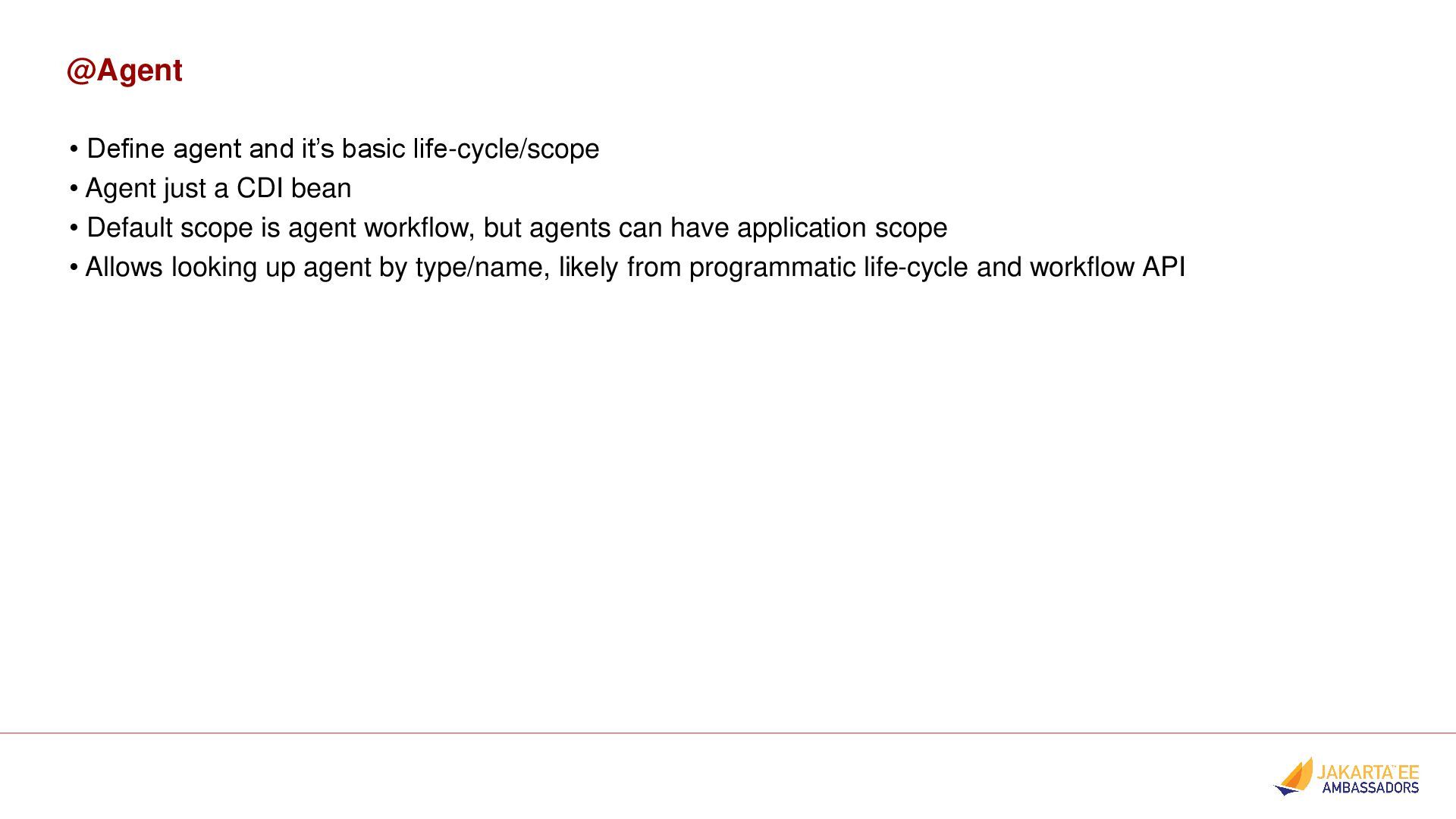
  10. @Agent • Define agent and it’s basic life-cycle/scope • Agent

    just a CDI bean • Default scope is agent workflow, but agents can have application scope • Allows looking up agent by type/name, likely from programmatic life-cycle and workflow API
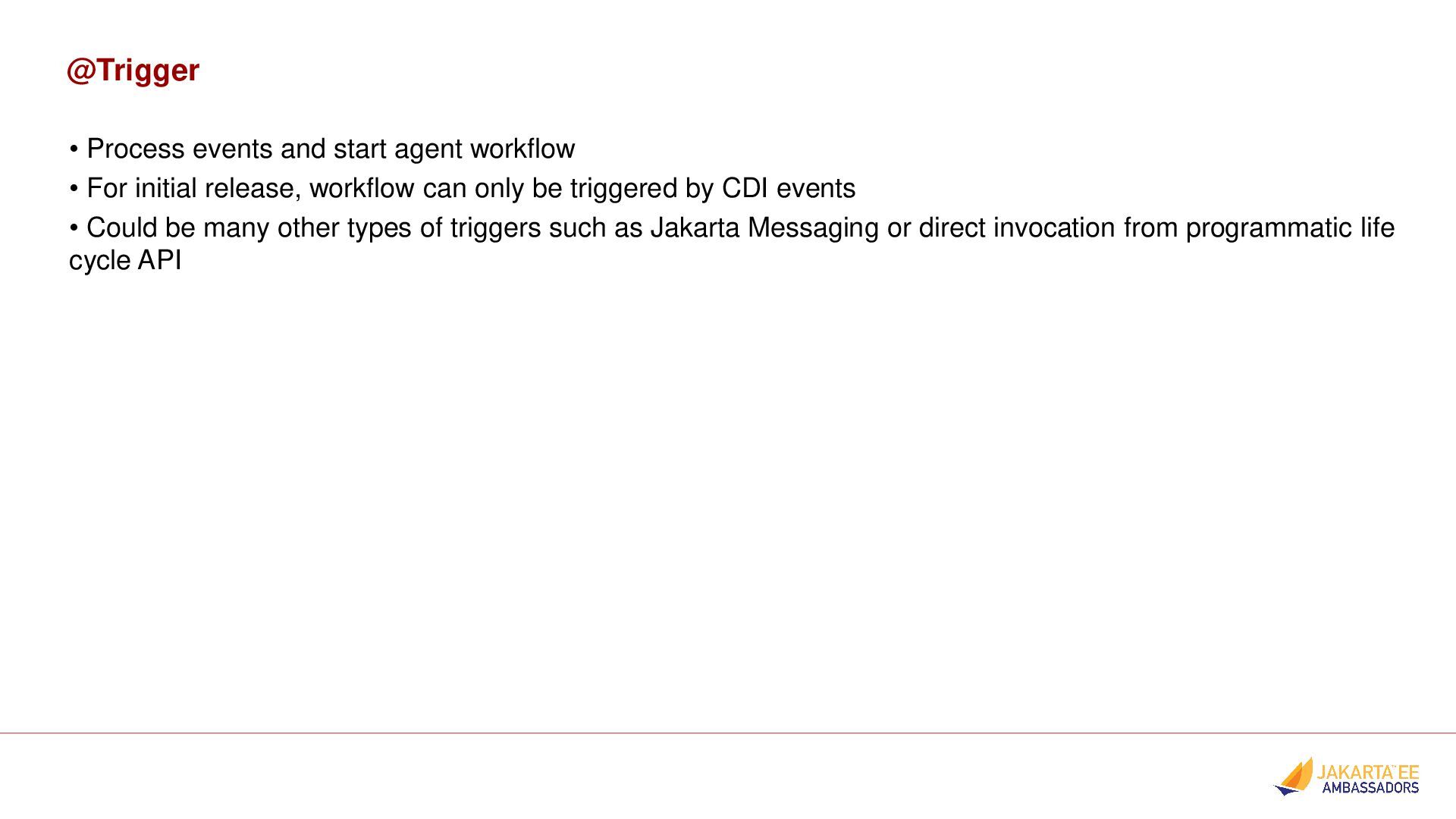
  11. @Trigger • Process events and start agent workflow • For

    initial release, workflow can only be triggered by CDI events • Could be many other types of triggers such as Jakarta Messaging or direct invocation from programmatic life cycle API
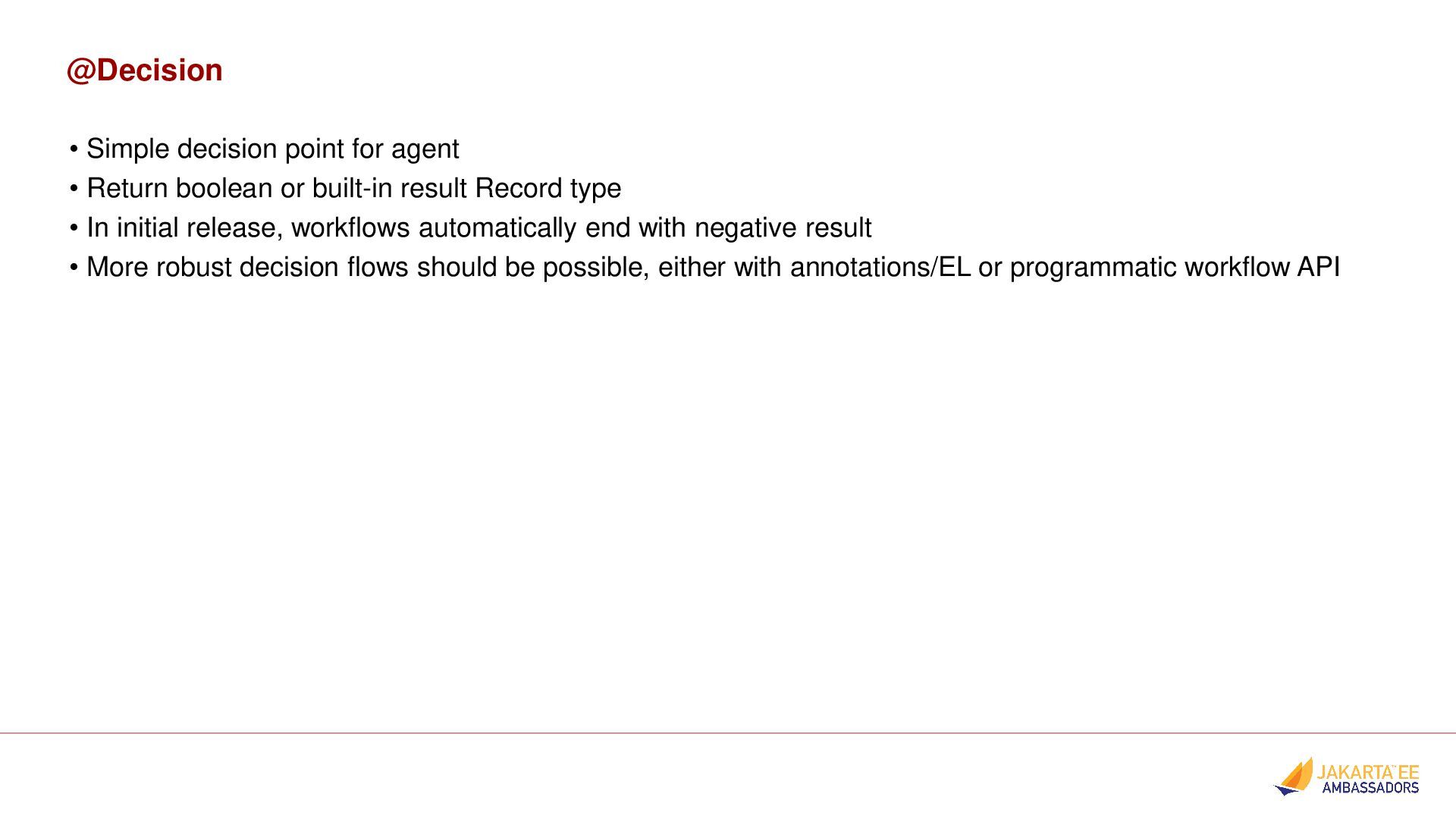
  12. @Decision • Simple decision point for agent • Return boolean

    or built-in result Record type • In initial release, workflows automatically end with negative result • More robust decision flows should be possible, either with annotations/EL or programmatic workflow API
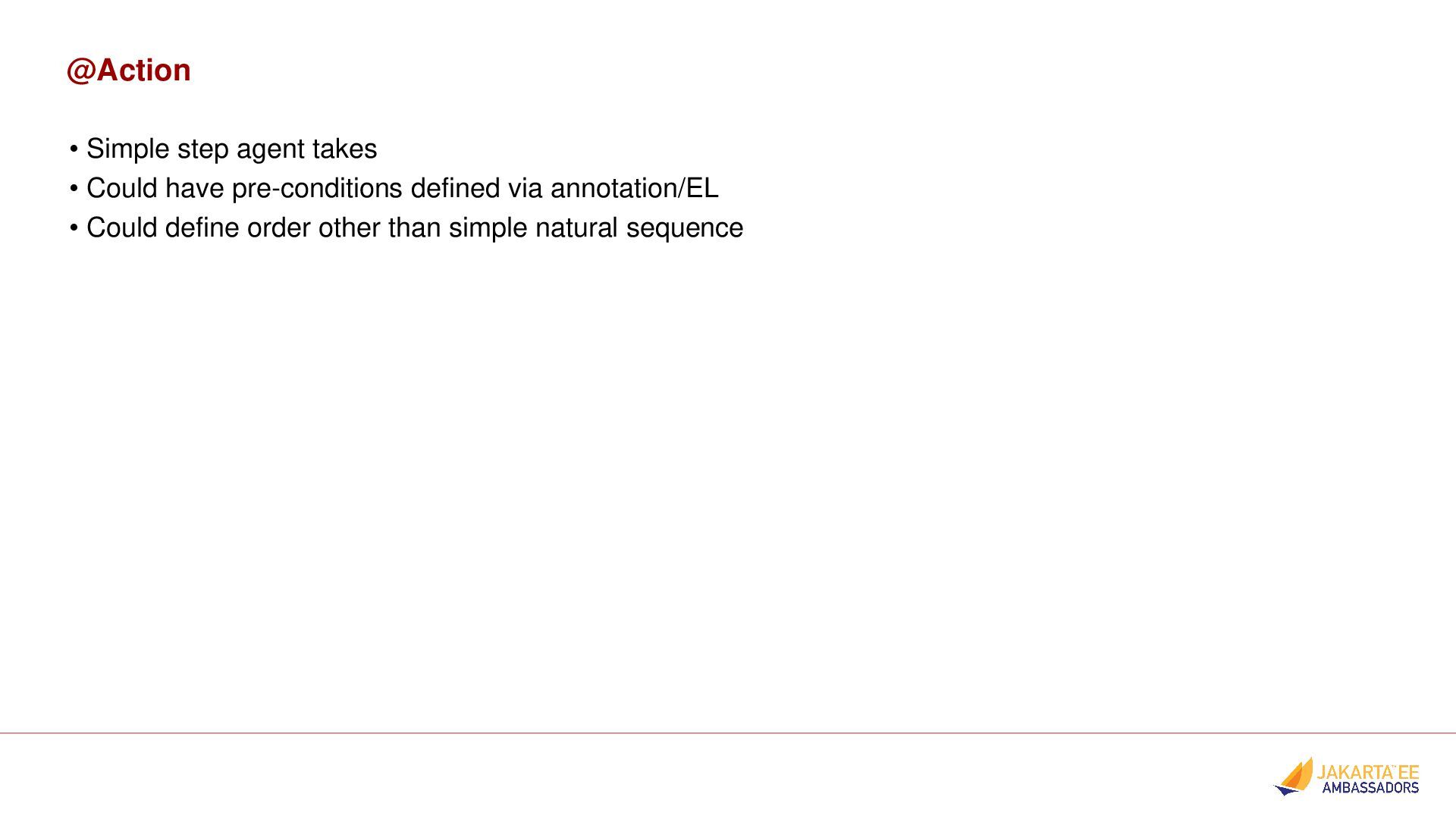
  13. @Action • Simple step agent takes • Could have pre-conditions

    defined via annotation/EL • Could define order other than simple natural sequence
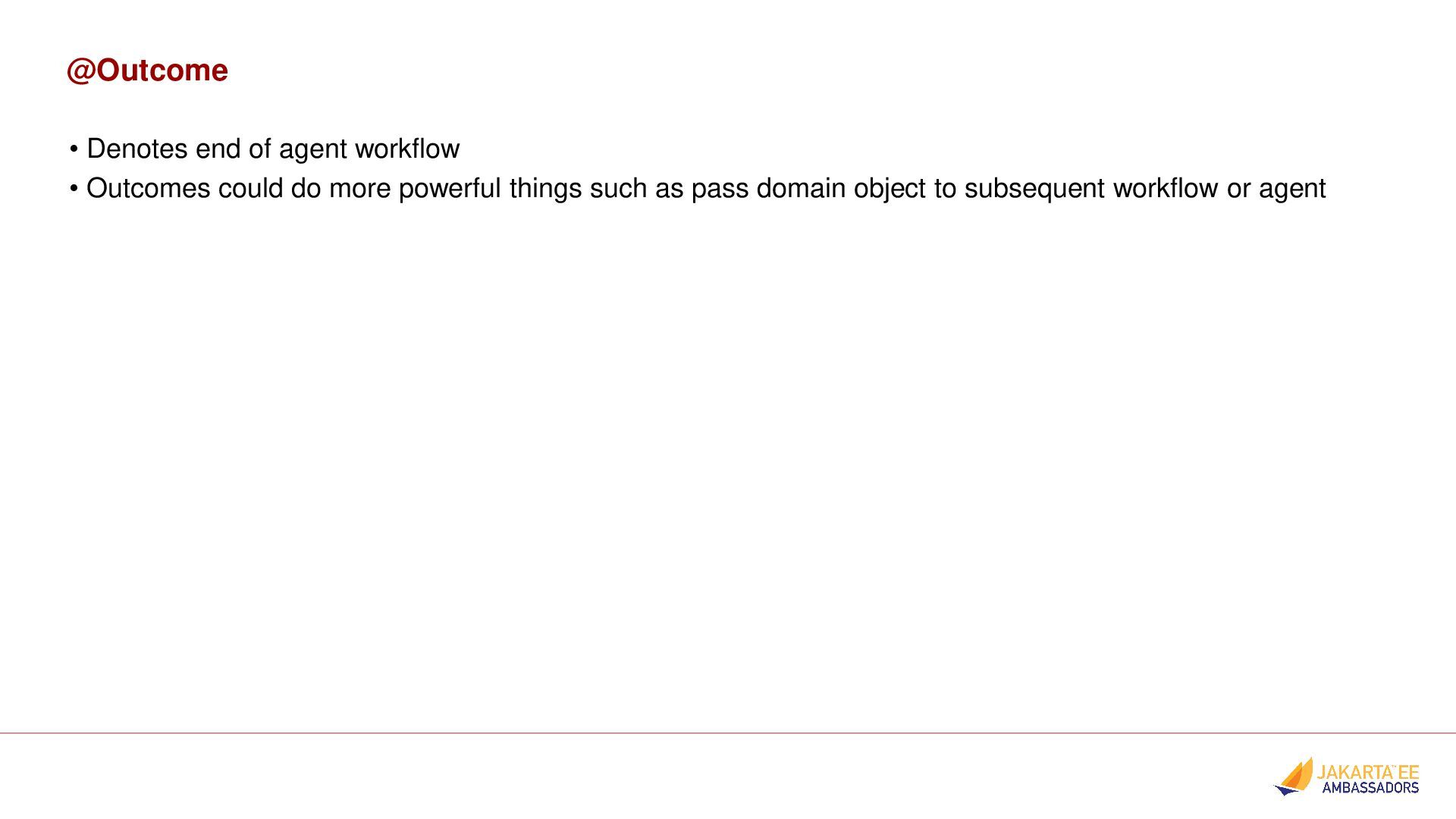
  14. @Outcome • Denotes end of agent workflow • Outcomes could

    do more powerful things such as pass domain object to subsequent workflow or agent
  15. Simple LLM Facade • Targeted towards simplest and most common

    cases • Allows easy access to underlying LLM API similar to how Jakarta Persistence does unwrapping • Key value propositions is automatic type conversion in Java, both for parameters and return types • JSON and string are supported initially for conversion • If no type is specified, it's all strings for simplicity • Closely follows Jakarta Persistence query API paradigms
  16. • 1.0 release intentionally minimal - seek early momentum, awareness,

    participation, adoption • After 1.0 iterate quickly based on evolving industry knowledge on Agentic AI as well as user feedback • Workflow/plan API • Programmatic life cycle management • Advanced features – retry, circuit breaker, ordering, conditional loops, so on After Initial Release