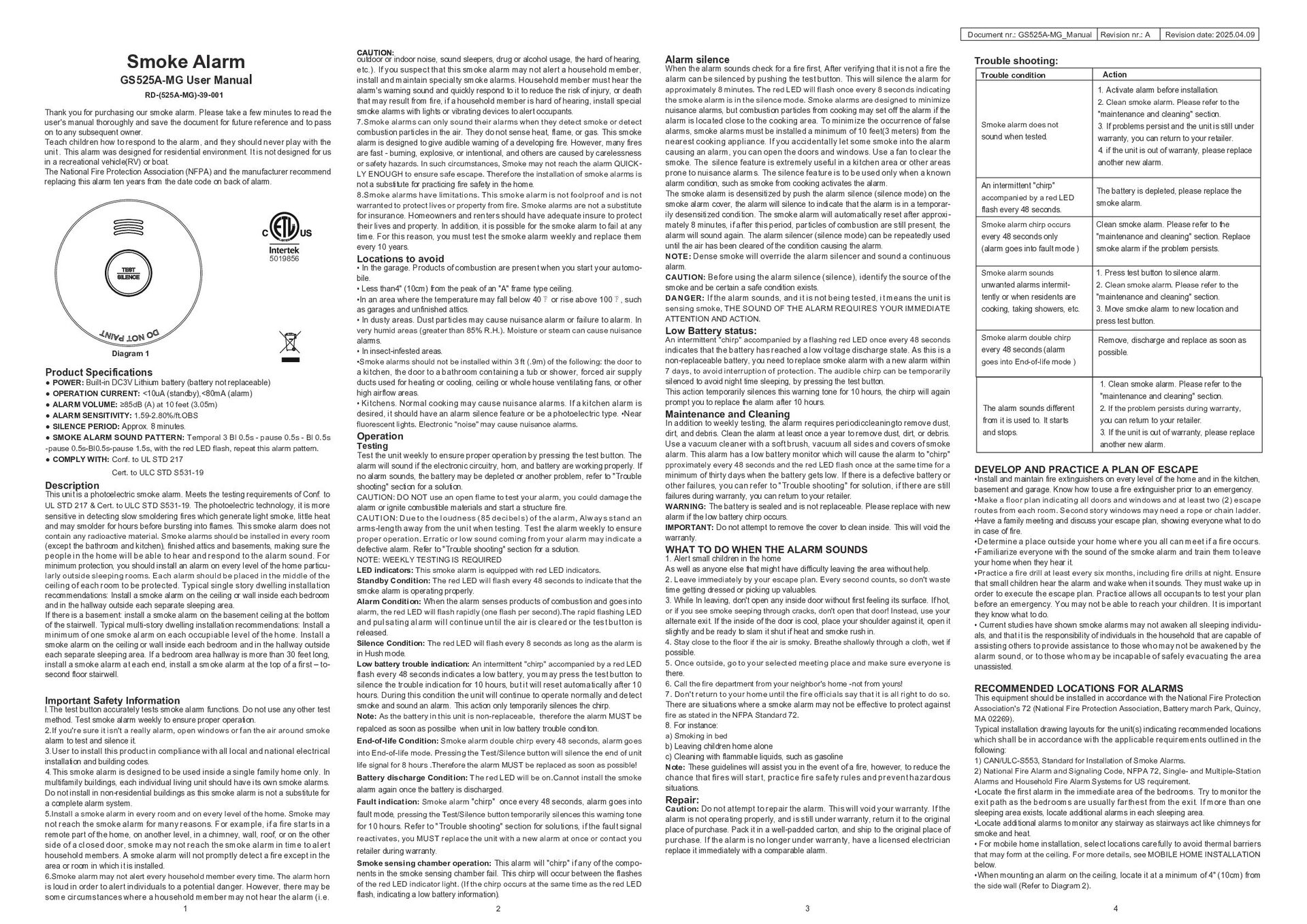
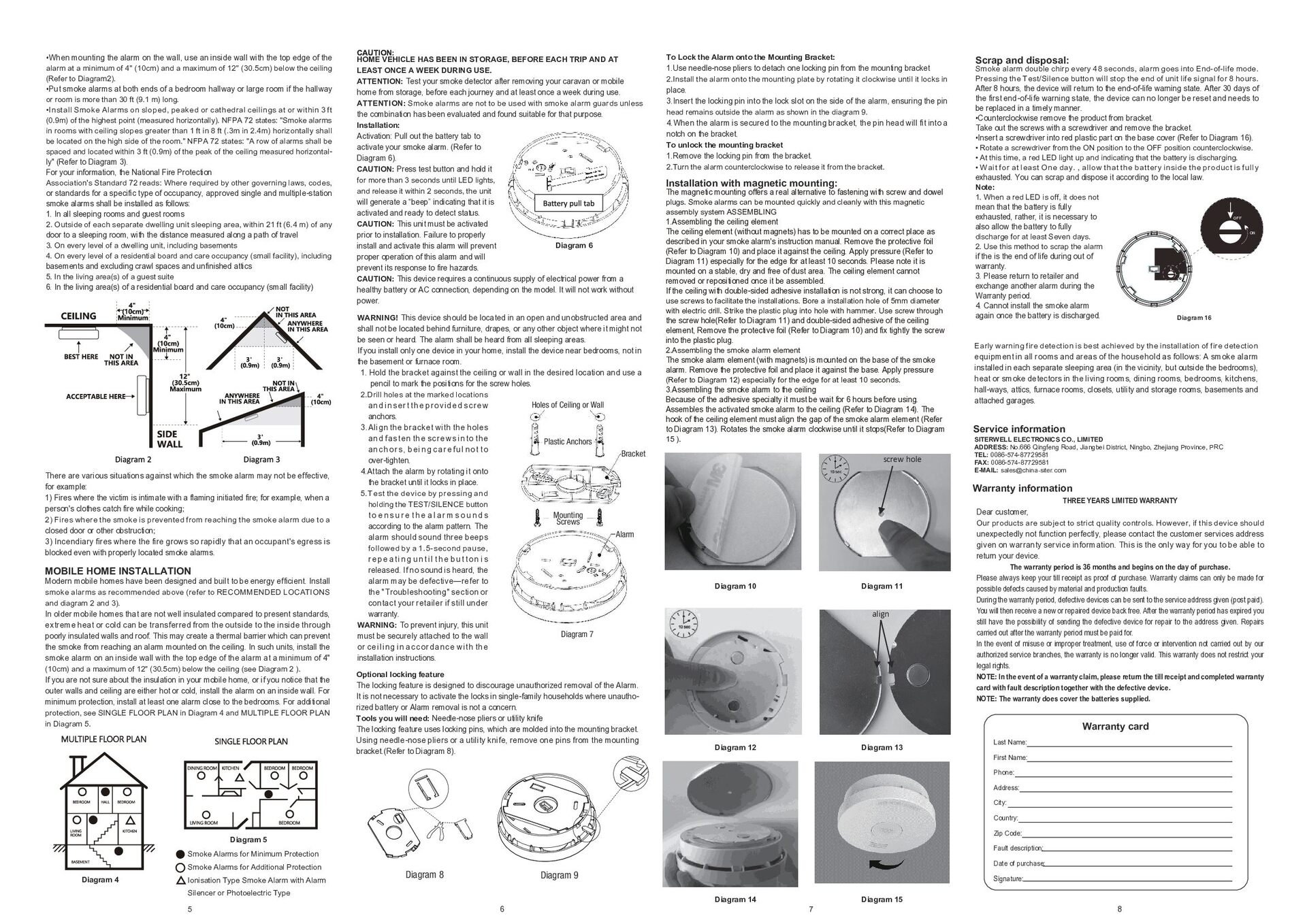
you for purchasing our smoke alarm. Please take a few minutes to read the user's manual thoroughly and save the document for future reference and to pass on to any subsequent owner. Teach children how to respond to the alarm, and they should never play with the unit . This alarm was designed for residential environment. lt is not designed for us in a recreational vehicle(RV) or boat. The National Fire Protection Association (NFPA) and the manufacturer recommend replacing this alarm ten years from the date code on back of alarm. 5019856 Diagram 1 Product Specifications • POWER: Built-in DC3V Lithium battery (battery not replaceable) • OPERATION CURRENT: <10uA (standby),<80mA (alarm) • ALARM VOLUME: ≥85dB (A) at 10 feet (3.05m) • ALARM SENSITIVITY: 1.59-2.80%/ft.OBS • SILENCE PERIOD: Approx. 8 minutes. • SMOKE ALARM SOUND PATTERN: Temporal 3 Bl 0.5s - pause 0.5s - Bl 0.5s -pause 0.5s-Bl0.5s-pause 1.5s, with the red LED flash, repeat this alarm pattern. • COMPLY WITH: Conf. to UL STD 217 Cert. to ULC STD S531-19 Description This unit is a photoelectric smoke alarm. Meets the testing requirements of Conf. to UL STD 217 & Cert. to ULC STD S531-19. The photoelectric technology, it is more sensitive in detecting slow smoldering fires which generate light smoke, little heat and may smolder for hours before bursting into flames. This smoke alarm does not contain any radioactive material. Smoke alarms should be installed in every room (except the bathroom and kitchen), finished attics and basements, making sure the people in the home will be able to hear and respond to the alarm sound. For minimum protection, you should install an alarm on every level of the home particularly outside sleeping rooms. Each alarm should be placed in the middle of the ceiling of each room to be protected. Typical single story dwelling installation recommendations: Install a smoke alarm on the ceiling or wall inside each bedroom and in the hallway outside each separate sleeping area. If there is a basement: install a smoke alarm on the basement ceiling at the bottom of the stairwell. Typical multi-story dwelling installation recommendations: Install a minimum of one smoke alarm on each occupiable level of the home. Install a smoke alarm on the ceiling or wall inside each bedroom and in the hallway outside each separate sleeping area. If a bedroom area hallway is more than 30 feet long, install a smoke alarm at each end, install a smoke alarm at the top of a first – tosecond floor stairwell. Important Safety Information l.The test button accurately tests smoke alarm functions. Do not use any other test method. Test smoke alarm weekly to ensure proper operation. 2.If you're sure it isn't a really alarm, open windows or fan the air around smoke alarm to test and silence it. 3.User to install this product in compliance with all local and national electrical installation and building codes. 4.This smoke alarm is designed to be used inside a single family home only. In multifamily buildings, each individual living unit should have its own smoke alarms. Do not install in non-residential buildings as this smoke alarm is not a substitute for a complete alarm system. 5.Install a smoke alarm in every room and on every level of the home. Smoke may not reach the smoke alarm for many reasons. For example, if a fire starts in a remote part of the home, on another level, in a chimney, wall, roof, or on the other side of a closed door, smoke may not reach the smoke alarm in time to alert household members. A smoke alarm will not promptly detect a fire except in the area or room in which it is installed. 6.Smoke alarm may not alert every household member every time. The alarm horn is loud in order to alert individuals to a potential danger. However, there may be some circumstances where a household member may not hear the alarm (i.e. 1 CAUTION: outdoor or indoor noise, sound sleepers, drug or alcohol usage, the hard of hearing, etc.). If you suspect that this smoke alarm may not alert a household member, install and maintain specialty smoke alarms. Household member must hear the alarm's warning sound and quickly respond to it to reduce the risk of injury, or death that may result from fire, if a household member is hard of hearing, install special smoke alarms with lights or vibrating devices to alert occupants. 7.Smoke alarms can only sound their alarms when they detect smoke or detect combustion particles in the air. They do not sense heat, flame, or gas. This smoke alarm is designed to give audible warning of a developing fire. However, many fires are fast - burning, explosive, or intentional, and others are caused by carelessness or safety hazards. In such circumstances, Smoke may not reach the alarm QUICKLY ENOUGH to ensure safe escape. Therefore the installation of smoke alarms is not a substitute for practicing fire safety in the home. 8.Smoke alarms have limitations. This smoke alarm is not foolproof and is not warranted to protect lives or property from fire. Smoke alarms are not a substitute for insurance. Homeowners and renters should have adequate insure to protect their lives and property. In addition, it is possible for the smoke alarm to fail at any time. For this reason, you must test the smoke alarm weekly and replace them every 10 years. Locations to avoid • In the garage. Products of combustion are present when you start your automobile. • Less than4" (10cm) from the peak of an "A" frame type ceiling. •In an area where the temperature may fall below 40℉ or rise above 100℉, such as garages and unfinished attics. • In dusty areas. Dust particles may cause nuisance alarm or failure to alarm. In very humid areas (greater than 85% R.H.). Moisture or steam can cause nuisance alarms. • In insect-infested areas. •Smoke alarms should not be installed within 3 ft (.9m) of the following: the door to a kitchen, the door to a bathroom containing a tub or shower, forced air supply ducts used for heating or cooling, ceiling or whole house ventilating fans, or other high airflow areas. • Kitchens. Normal cooking may cause nuisance alarms. If a kitchen alarm is desired, it should have an alarm silence feature or be a photoelectric type. •Near fluorescent lights. Electronic "noise" may cause nuisance alarms. Operation Testing Test the unit weekly to ensure proper operation by pressing the test button. The alarm will sound if the electronic circuitry, horn, and battery are working properly. If no alarm sounds, the battery may be depleted or another problem, refer to "Trouble shooting" section for a solution. CAUTION: DO NOT use an open flame to test your alarm, you could damage the alarm or ignite combustible materials and start a structure fire. CAUTION: Due to the loudness (85 decibels) of the alarm, Always stand an arms-length away from the unit when testing. Test the alarm weekly to ensure proper operation. Erratic or low sound coming from your alarm may indicate a defective alarm. Refer to "Trouble shooting" section for a solution. NOTE: WEEKLY TESTING IS REQUIRED LED indicators: This smoke alarm is equipped with red LED indicators. Standby Condition: The red LED will flash every 48 seconds to indicate that the smoke alarm is operating properly. Alarm Condition: When the alarm senses products of combustion and goes into alarm, the red LED will flash rapidly (one flash per second).The rapid flashing LED and pulsating alarm will continue until the air is cleared or the test button is released. Silence Condition: The red LED will flash every 8 seconds as long as the alarm is in Hush mode. Low battery trouble indication: An intermittent "chirp" accompanied by a red LED flash every 48 seconds indicates a low battery, you may press the test button to silence the trouble indication for 10 hours, but it will reset automatically after 10 hours. During this condition the unit will continue to operate normally and detect smoke and sound an alarm. This action only temporarily silences the chirp. Note: As the battery in this unit is non-replaceable, therefore the alarm MUST be repalced as soon as possilbe when unit in low battery trouble conditon. End-of-life Condition: Smoke alarm double chirp every 48 seconds, alarm goes into End-of-life mode. Pressing the Test/Silence button will silence the end of unit life signal for 8 hours .Therefore the alarm MUST be replaced as soon as possible! Battery discharge Condition: The red LED will be on.Cannot install the smoke alarm again once the battery is discharged. Fault indication: Smoke alarm "chirp" once every 48 seconds, alarm goes into fault mode, pressing the Test/Silence button temporarily silences this warning tone for 10 hours. Refer to "Trouble shooting" section for solutions, if the fault signal reactivates, you MUST replace the unit with a new alarm at once or contact you retailer during warranty. Alarm silence When the alarm sounds check for a fire first, After verifying that it is not a fire the alarm can be silenced by pushing the test button. This will silence the alarm for approximately 8 minutes. The red LED will flash once every 8 seconds indicating the smoke alarm is in the silence mode. Smoke alarms are designed to minimize nuisance alarms, but combustion particles from cooking may set off the alarm if the alarm is located close to the cooking area. To minimize the occurrence of false alarms, smoke alarms must be installed a minimum of 10 feet(3 meters) from the nearest cooking appliance. If you accidentally let some smoke into the alarm causing an alarm, you can open the doors and windows. Use a fan to clear the smoke. The silence feature is extremely useful in a kitchen area or other areas prone to nuisance alarms. The silence feature is to be used only when a known alarm condition, such as smoke from cooking activates the alarm. The smoke alarm is desensitized by push the alarm silence (silence mode) on the smoke alarm cover, the alarm will silence to indicate that the alarm is in a temporarily desensitized condition. The smoke alarm will automatically reset after approximately 8 minutes, if after this period, particles of combustion are still present, the alarm will sound again. The alarm silencer (silence mode) can be repeatedly used until the air has been cleared of the condition causing the alarm. NOTE: Dense smoke will override the alarm silencer and sound a continuous alarm. CAUTION: Before using the alarm silence (silence), identify the source of the smoke and be certain a safe condition exists. DANGER: If the alarm sounds, and it is not being tested, it means the unit is sensing smoke, THE SOUND OF THE ALARM REQUIRES YOUR IMMEDIATE ATTENTION AND ACTION. Low Battery status: Revision date: 2025.04.09 Trouble shooting: Trouble condition Action 1. Activate alarm before installation. 2. Clean smoke alarm. Please refer to the Smoke alarm does not sound when tested. "maintenance and cleaning" section. 3. If problems persist and the unit is still under warranty, you can return to your retailer. 4. if the unit is out of warranty, please replace another new alarm. An intermittent "chirp" accompanied by a red LED flash every 48 seconds. The battery is depleted, please replace the smoke alarm. Smoke alarm chirp occurs Clean smoke alarm. Please refer to the every 48 seconds only "maintenance and cleaning" section. Replace (alarm goes into fault mode ) smoke alarm if the problem persists. Smoke alarm sounds 1. Press test button to silence alarm. unwanted alarms intermit- 2. Clean smoke alarm. Please refer to the tently or when residents are "maintenance and cleaning" section. cooking, taking showers, etc. 3. Move smoke alarm to new location and press test button. An intermittent "chirp" accompanied by a flashing red LED once every 48 seconds indicates that the battery has reached a low voltage discharge state. As this is a non-replaceable battery, you need to replace smoke alarm with a new alarm within 7 days, to avoid interruption of protection. The audible chirp can be temporarily silenced to avoid night time sleeping, by pressing the test button. This action temporarily silences this warning tone for 10 hours, the chirp will again prompt you to replace the alarm after 10 hours. Smoke alarm double chirp The alarm sounds different 2. If the problem persists during warranty, In addition to weekly testing, the alarm requires periodiccleaningto remove dust, dirt, and debris. Clean the alarm at least once a year to remove dust, dirt, or debris. Use a vacuum cleaner with a soft brush, vacuum all sides and covers of smoke alarm. This alarm has a low battery monitor which will cause the alarm to "chirp" pproximately every 48 seconds and the red LED flash once at the same time for a minimum of thirty days when the battery gets low. If there is a defective battery or other failures, you can refer to "Trouble shooting" for solution, if there are still failures during warranty, you can return to your retailer. WARNING: The battery is sealed and is not replaceable. Please replace with new alarm if the low battery chirp occurs. IMPORTANT: Do not attempt to remove the cover to clean inside. This will void the warranty. from it is used to. It starts you can return to your retailer. and stops. 3. If the unit is out of warranty, please replace Maintenance and Cleaning WHAT TO DO WHEN THE ALARM SOUNDS 1. Alert small children in the home As well as anyone else that might have difficulty leaving the area without help. 2. Leave immediately by your escape plan. Every second counts, so don't waste time getting dressed or picking up valuables. 3. While In leaving, don't open any inside door without first feeling its surface. If hot, or if you see smoke seeping through cracks, don't open that door! Instead, use your alternate exit. If the inside of the door is cool, place your shoulder against it, open it slightly and be ready to slam it shut if heat and smoke rush in. 4. Stay close to the floor if the air is smoky. Breathe shallowly through a cloth, wet if possible. 5. Once outside, go to your selected meeting place and make sure everyone is there. 6. Call the fire department from your neighbor's home -not from yours! 7. Don't return to your home until the fire officials say that it is all right to do so. There are situations where a smoke alarm may not be effective to protect against fire as stated in the NFPA Standard 72. 8. For instance: a) Smoking in bed b) Leaving children home alone c) Cleaning with flammable liquids, such as gasoline Note: These guidelines will assist you in the event of a fire, however, to reduce the chance that fires will start, practice fire safety rules and prevent hazardous situations. Repair: Caution: Do not attempt to repair the alarm. This will void your warranty. If the alarm is not operating properly, and is still under warranty, return it to the original place of purchase. Pack it in a well-padded carton, and ship to the original place of purchase. If the alarm is no longer under warranty, have a licensed electrician replace it immediately with a comparable alarm. Smoke sensing chamber operation: This alarm will "chirp" if any of the components in the smoke sensing chamber fail. This chirp will occur between the flashes of the red LED indicator light. (If the chirp occurs at the same time as the red LED flash, indicating a low battery information). 2 Revision nr.: A 3 every 48 seconds (alarm goes into End-of-life mode ) Remove, discharge and replace as soon as possible. 1. Clean smoke alarm. Please refer to the "maintenance and cleaning" section. another new alarm. DEVELOP AND PRACTICE A PLAN OF ESCAPE •Install and maintain fire extinguishers on every level of the home and in the kitchen, basement and garage. Know how to use a fire extinguisher prior to an emergency. •Make a floor plan indicating all doors and windows and at least two (2) escape routes from each room. Second story windows may need a rope or chain ladder. •Have a family meeting and discuss your escape plan, showing everyone what to do in case of fire. •Determine a place outside your home where you all can meet if a fire occurs. •Familiarize everyone with the sound of the smoke alarm and train them to leave your home when they hear it. •Practice a fire drill at least every six months, including fire drills at night. Ensure that small children hear the alarm and wake when it sounds. They must wake up in order to execute the escape plan. Practice allows all occupants to test your plan before an emergency. You may not be able to reach your children. It is important they know what to do. • Current studies have shown smoke alarms may not awaken all sleeping individuals, and that it is the responsibility of individuals in the household that are capable of assisting others to provide assistance to those who may not be awakened by the alarm sound, or to those who may be incapable of safely evacuating the area unassisted. RECOMMENDED LOCATIONS FOR ALARMS This equipment should be installed in accordance with the National Fire Protection Association's 72 (National Fire Protection Association, Battery march Park, Quincy, MA 02269). Typical installation drawing layouts for the unit(s) indicating recommended locations which shall be in accordance with the applicable requirements outlined in the following: 1) CAN/ULC-S553, Standard for Installation of Smoke Alarms. 2) National Fire Alarm and Signaling Code, NFPA 72, Single- and Multiple-Station Alarms and Household Fire Alarm Systems for US requirement. •Locate the first alarm in the immediate area of the bedrooms. Try to monitor the exit path as the bedrooms are usually farthest from the exit. If more than one sleeping area exists, locate additional alarms in each sleeping area. •Locate additional alarms to monitor any stairway as stairways act like chimneys for smoke and heat. • For mobile home installation, select locations carefully to avoid thermal barriers that may form at the ceiling. For more details, see MOBILE HOME INSTALLATION below. •When mounting an alarm on the ceiling, locate it at a minimum of 4" (10cm) from the side wall (Refer to Diagram 2). 4


 ikuodanaka
 kotomin_m
 mzryuka
 akkiesoft
 awsjcpm
 coco_se
 rooty19
 n0bisuke2
 cheebow
 aokiplayer
 stuffmc
 3n
 kimpetersen
 keithpitt
 livdayseo
 marketingsoph
 rkendrick25
 codingconduct
 samanthasiow
 konakalab
 skipperchong
 tammyeverts