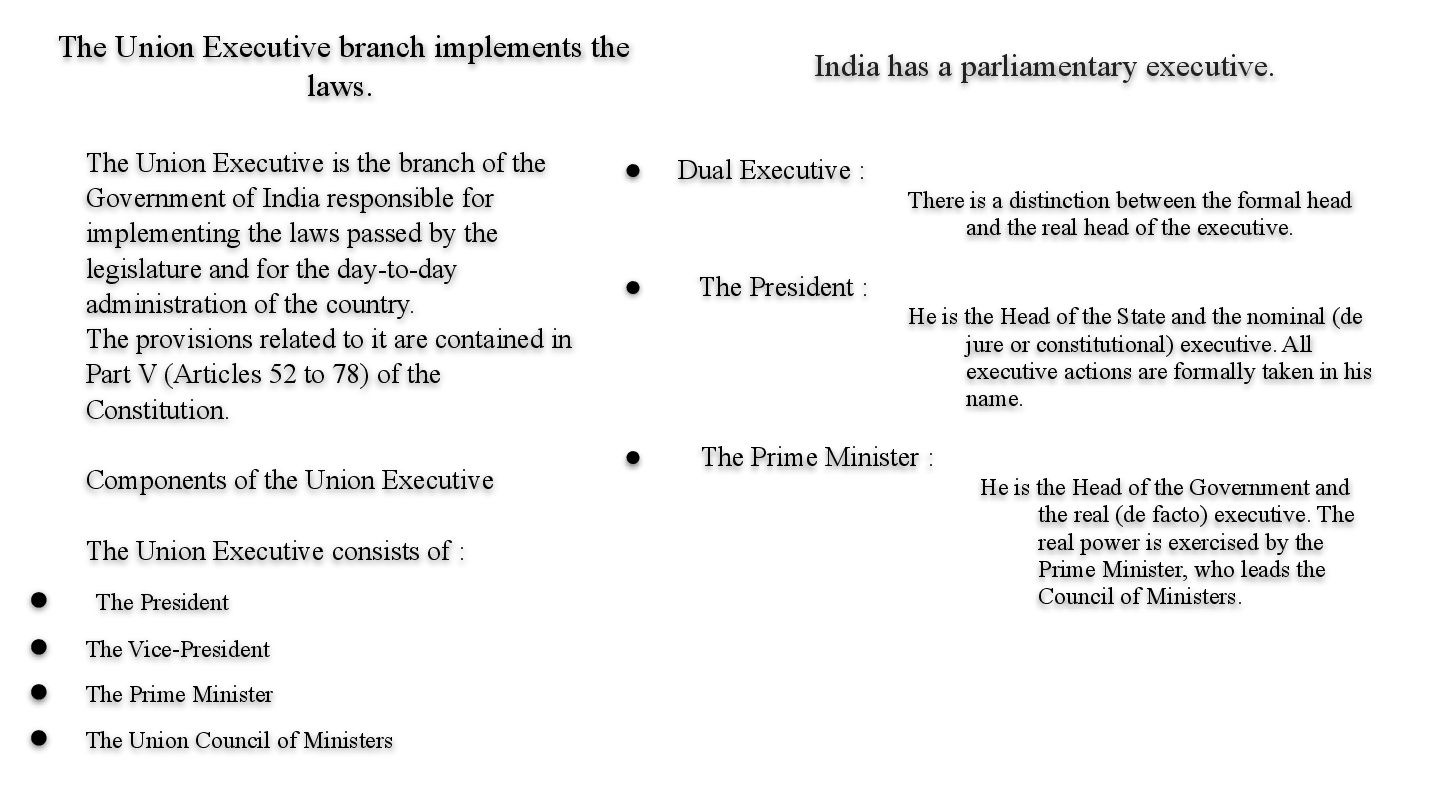
is the branch of the Government of India responsible for implementing the laws passed by the legislature and for the day-to-day administration of the country. The provisions related to it are contained in Part V (Articles 52 to 78) of the Constitution. Components of the Union Executive The Union Executive consists of : • The President • The Vice-President • The Prime Minister • The Union Council of Ministers India has a parliamentary executive. • Dual Executive : There is a distinction between the formal head and the real head of the executive. • The President : He is the Head of the State and the nominal (de jure or constitutional) executive. All executive actions are formally taken in his name. • The Prime Minister : He is the Head of the Government and the real (de facto) executive. The real power is exercised by the Prime Minister, who leads the Council of Ministers.
According to Article 74, there is a Council of Ministers, headed by the Prime Minister, to "aid and advise" the President. ◦ This advice is binding on the President, which ensures that the real power stays with the elected government. • Collective Responsibility : ◦ This is the bedrock principle of the parliamentary system. As per Article 75(3), the Council of Ministers is collectively responsible to the Lok Sabha. ◦ This means the government remains in power only as long as it enjoys the confidence of the majority in the House of the People. President of India. The President is the head of the Union Executive and the highest constitutional office in the country. President is the nominal or constitutional head.
of the Indian State. He is the first citizen of India and serves as a symbol of the nation's unity, integrity, and solidarity. In India's parliamentary system of government, the President is the nominal, de jure, or constitutional head. This is similar to the role of the King or Queen in England. While all executive powers of the Union are formally vested in the President, the real executive authority is exercised by the Prime Minister and the Union Council of Ministers, who must aid and advise the President. • President : Acts as the symbol of the nation, the formal head of all branches of government, and a stabilizing force. • Vice-President : Functions as the Chairman of the Rajya Sabha and steps in as Acting President when the President's office is vacant. • Prime Minister : The lynchpin of the system, who leads the government, directs policy, and advises the President. • Council of Ministers : The collective body that formulates policies and runs the administration. In essence, the Union Executive is a parliamentary executive where the President is the formal head of state, but the real power is wielded by the Prime Minister and the Council of Ministers, who are responsible to the Lok Sabha.
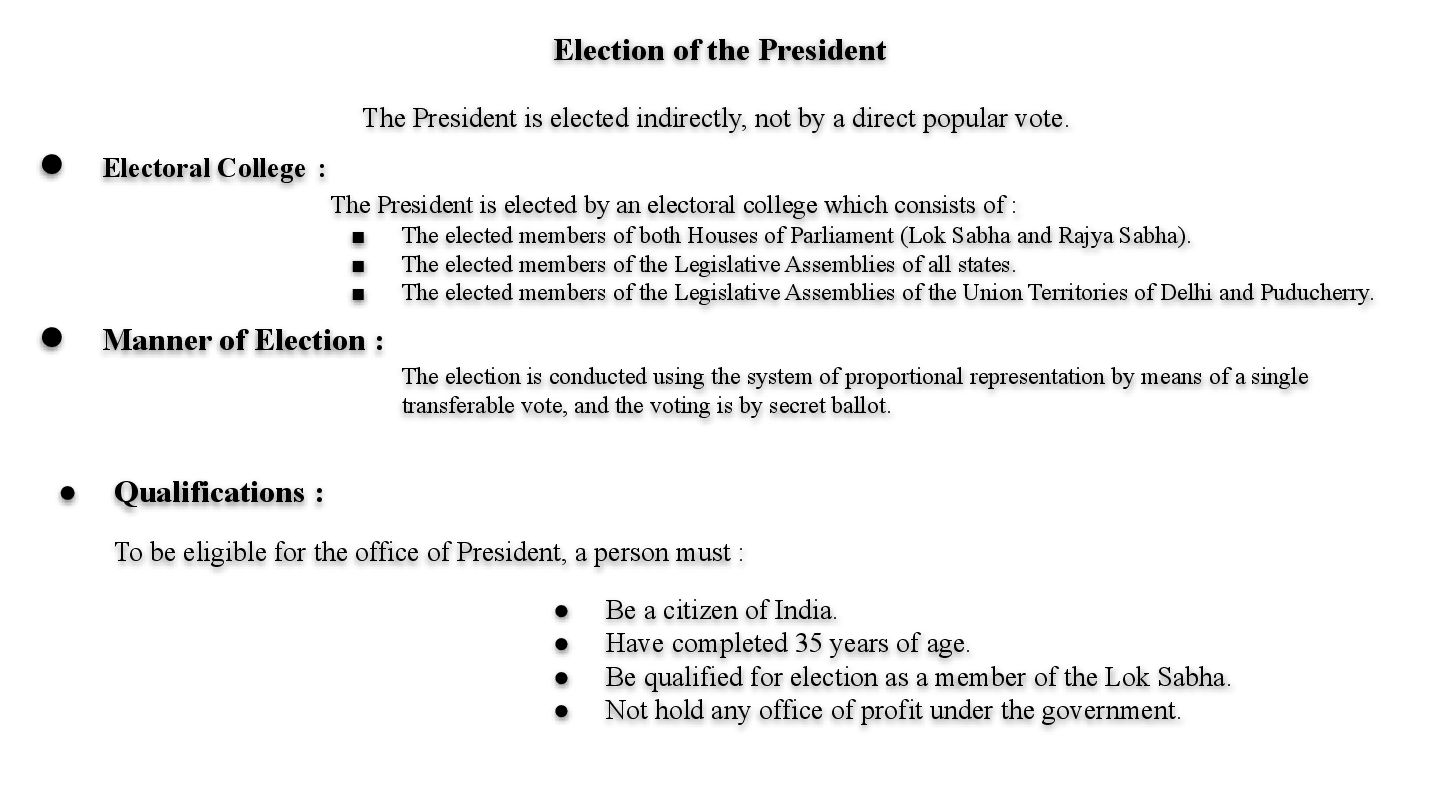
by a direct popular vote. • Electoral College : The President is elected by an electoral college which consists of : ▪ The elected members of both Houses of Parliament (Lok Sabha and Rajya Sabha). ▪ The elected members of the Legislative Assemblies of all states. ▪ The elected members of the Legislative Assemblies of the Union Territories of Delhi and Puducherry. • Manner of Election : The election is conducted using the system of proportional representation by means of a single transferable vote, and the voting is by secret ballot. • Qualifications : To be eligible for the office of President, a person must : • Be a citizen of India. • Have completed 35 years of age. • Be qualified for election as a member of the Lok Sabha. • Not hold any office of profit under the government.
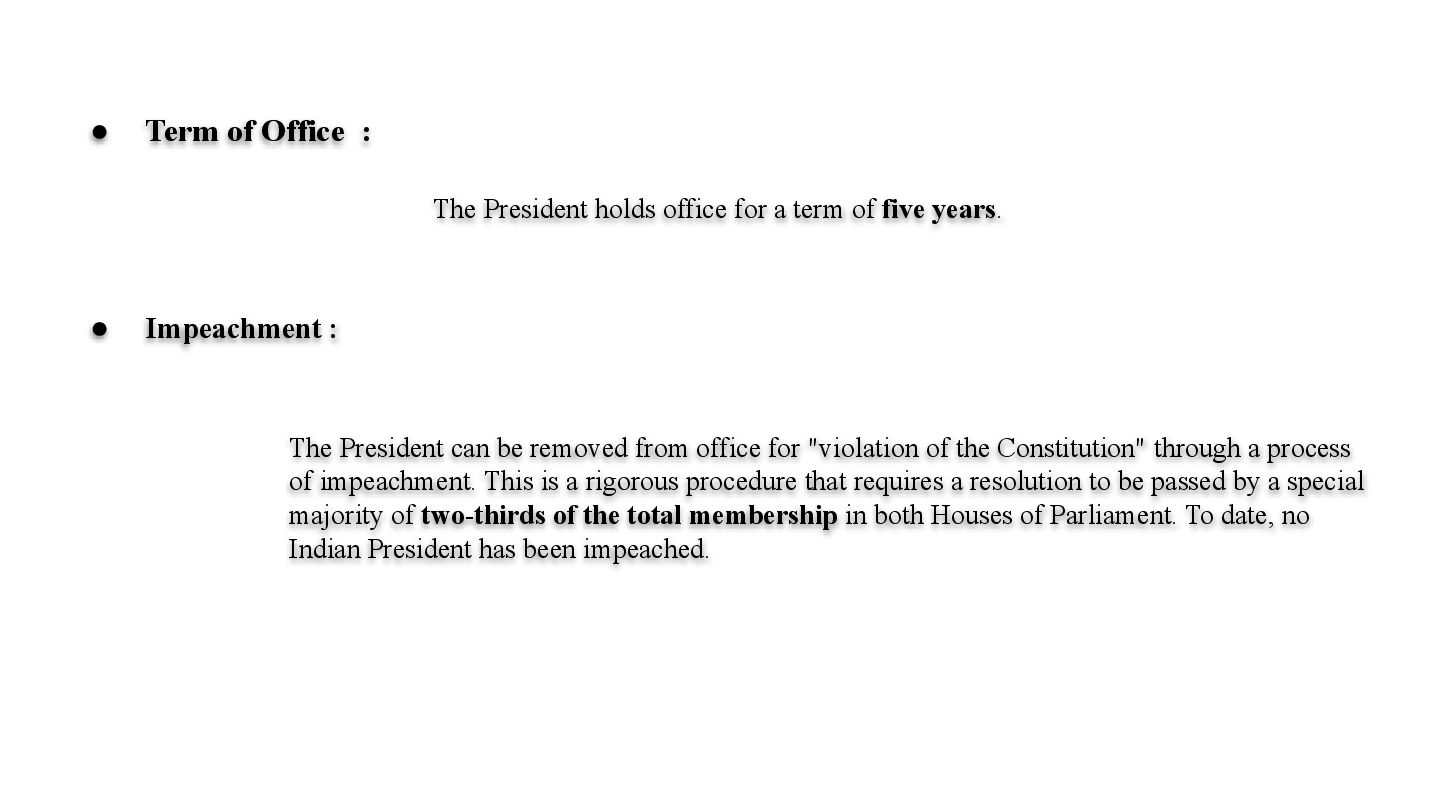
a term of five years. • Impeachment : The President can be removed from office for "violation of the Constitution" through a process of impeachment. This is a rigorous procedure that requires a resolution to be passed by a special majority of two-thirds of the total membership in both Houses of Parliament. To date, no Indian President has been impeached.
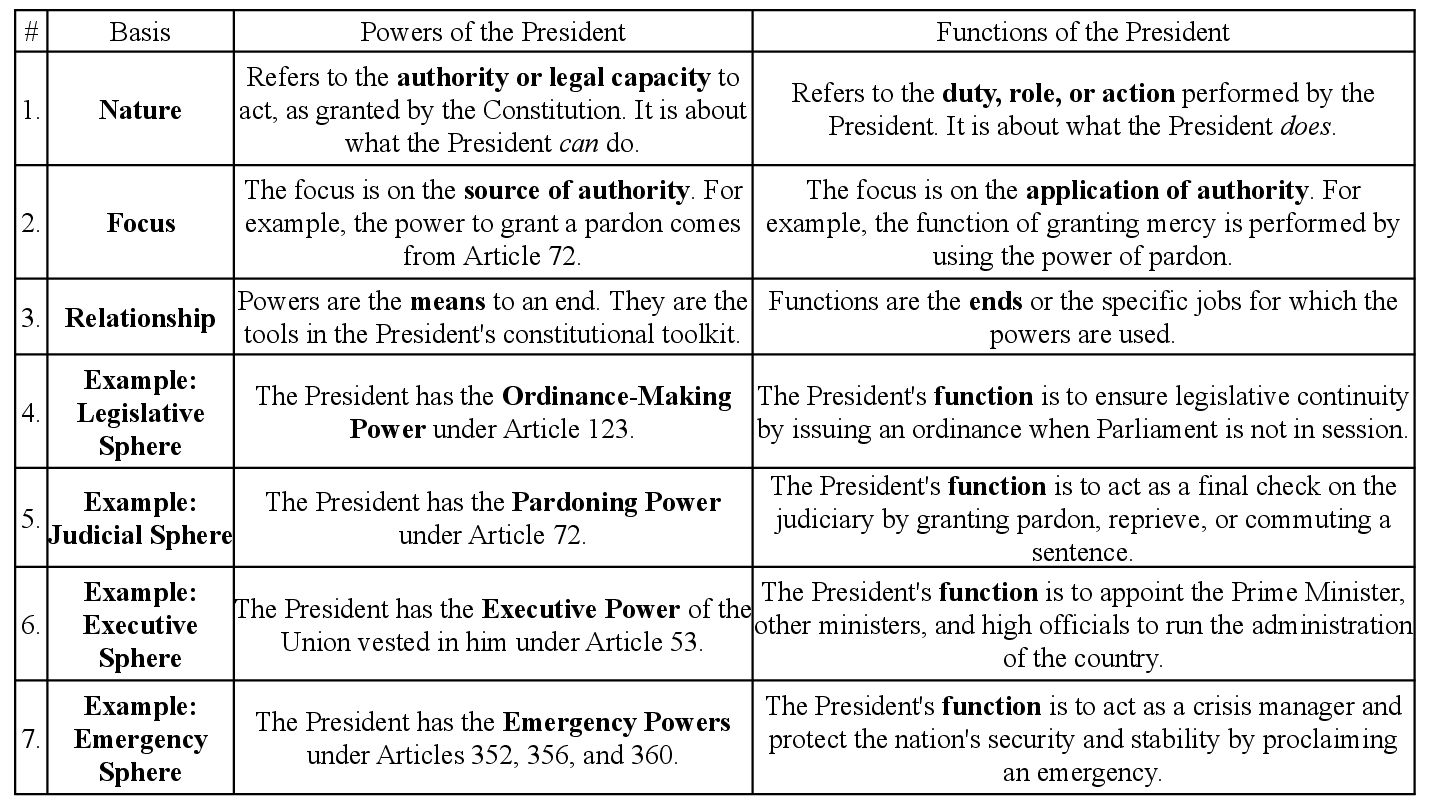
1. Nature Refers to the authority or legal capacity to act, as granted by the Constitution. It is about what the President can do. Refers to the duty, role, or action performed by the President. It is about what the President does. 2. Focus The focus is on the source of authority. For example, the power to grant a pardon comes from Article 72. The focus is on the application of authority. For example, the function of granting mercy is performed by using the power of pardon. 3. Relationship Powers are the means to an end. They are the tools in the President's constitutional toolkit. Functions are the ends or the specific jobs for which the powers are used. 4. Example: Legislative Sphere The President has the Ordinance-Making Power under Article 123. The President's function is to ensure legislative continuity by issuing an ordinance when Parliament is not in session. 5. Example: Judicial Sphere The President has the Pardoning Power under Article 72. The President's function is to act as a final check on the judiciary by granting pardon, reprieve, or commuting a sentence. 6. Example: Executive Sphere The President has the Executive Power of the Union vested in him under Article 53. The President's function is to appoint the Prime Minister, other ministers, and high officials to run the administration of the country. 7. Example: Emergency Sphere The President has the Emergency Powers under Articles 352, 356, and 360. The President's function is to act as a crisis manager and protect the nation's security and stability by proclaiming an emergency.
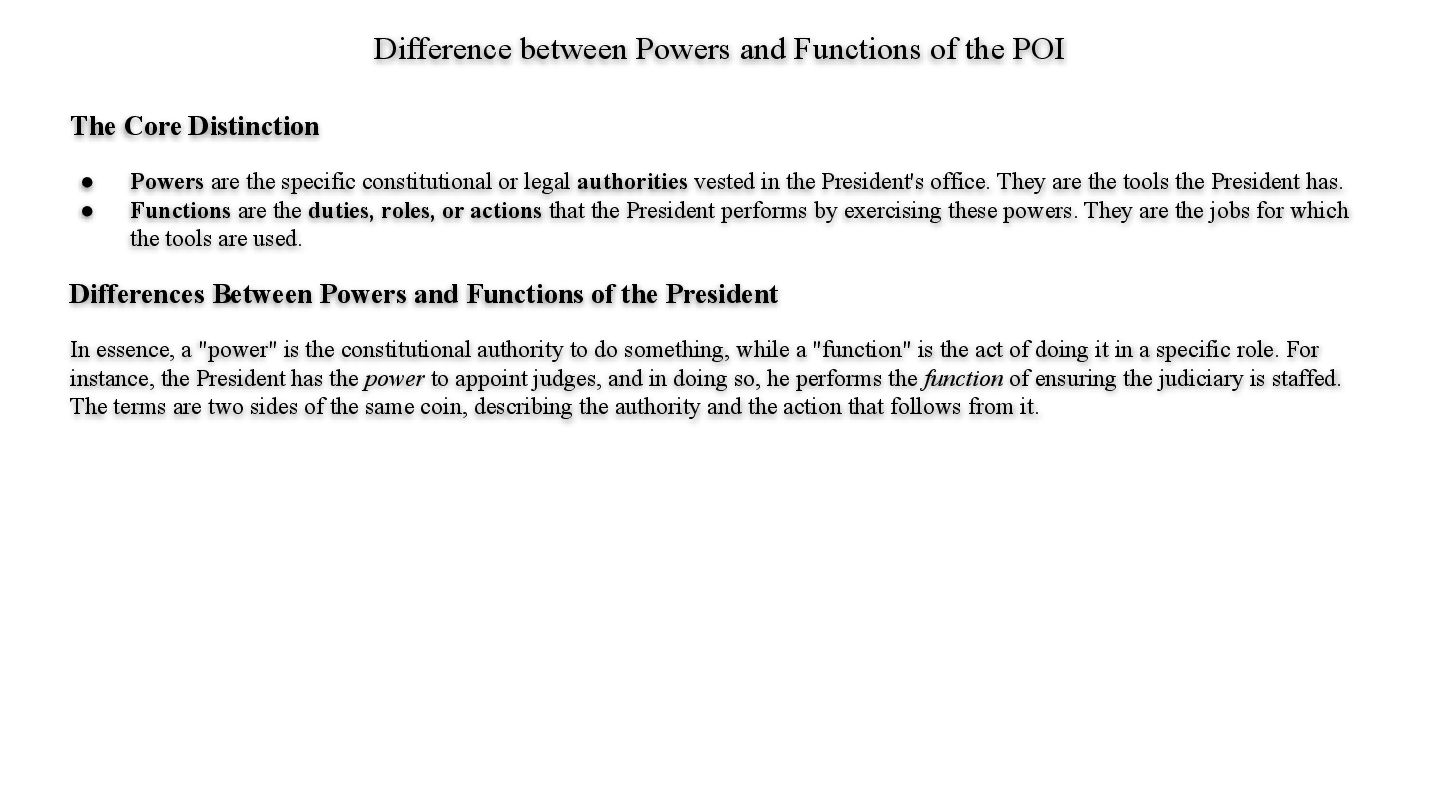
Distinction • Powers are the specific constitutional or legal authorities vested in the President's office. They are the tools the President has. • Functions are the duties, roles, or actions that the President performs by exercising these powers. They are the jobs for which the tools are used. Differences Between Powers and Functions of the President In essence, a "power" is the constitutional authority to do something, while a "function" is the act of doing it in a specific role. For instance, the President has the power to appoint judges, and in doing so, he performs the function of ensuring the judiciary is staffed. The terms are two sides of the same coin, describing the authority and the action that follows from it.
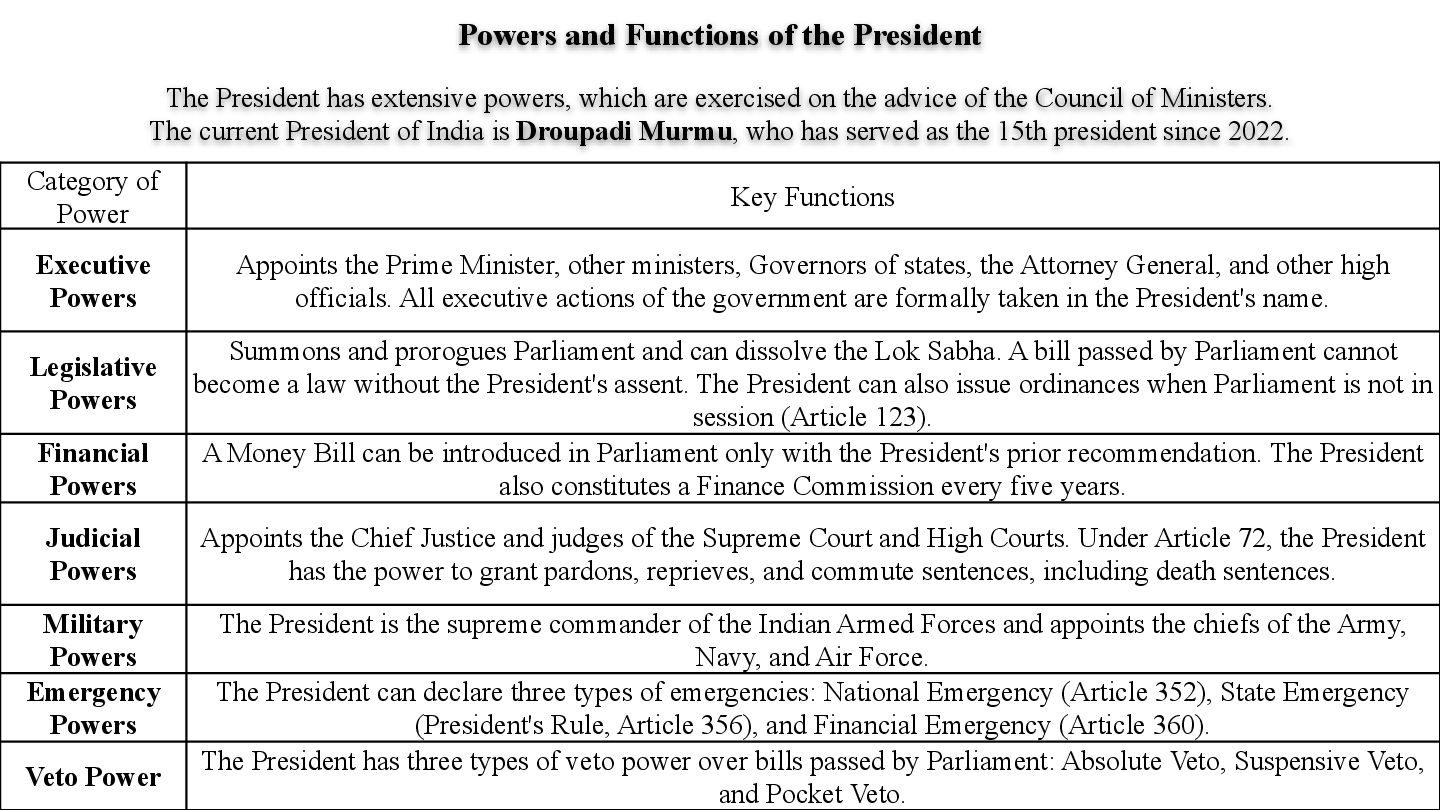
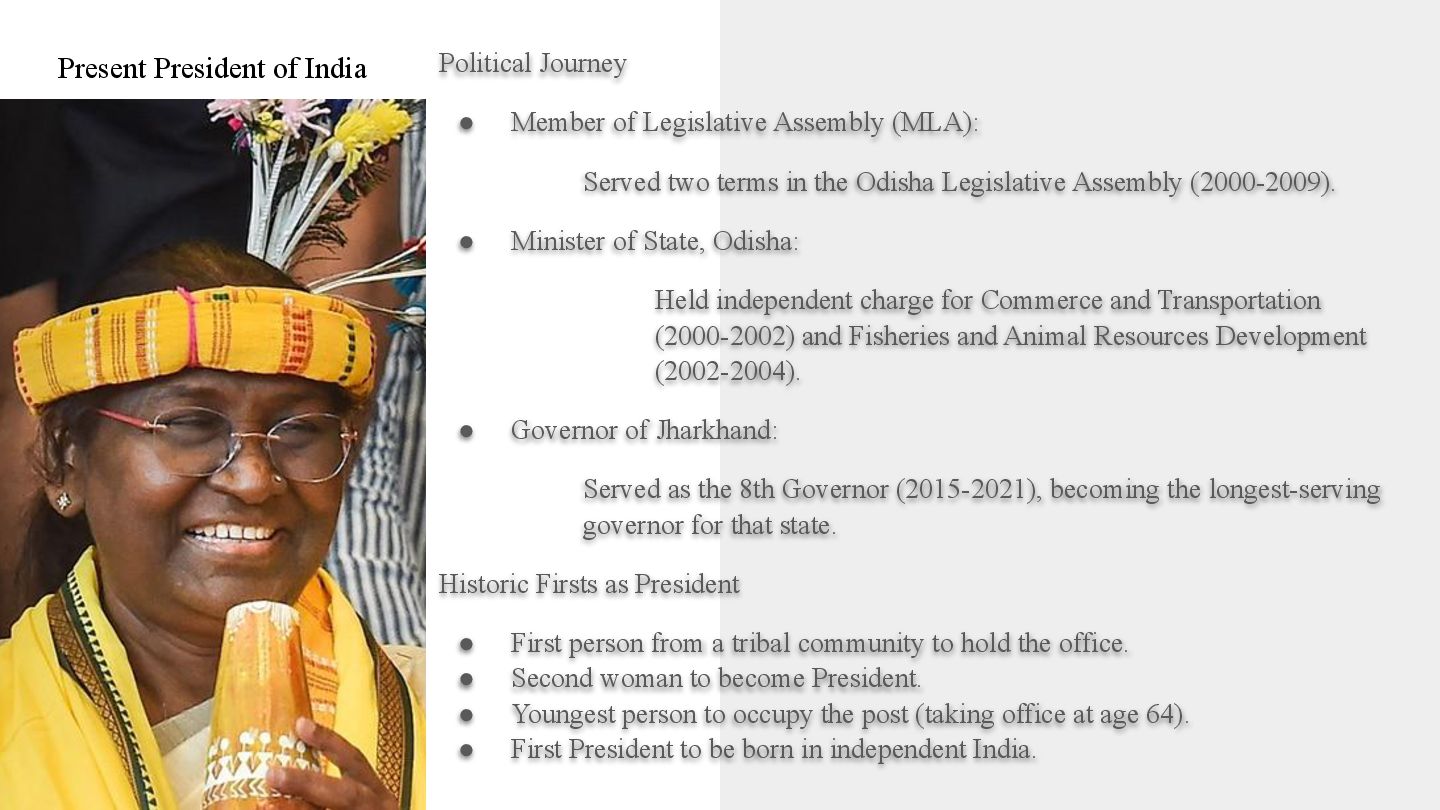
powers, which are exercised on the advice of the Council of Ministers. The current President of India is Droupadi Murmu, who has served as the 15th president since 2022. Category of Power Key Functions Executive Powers Appoints the Prime Minister, other ministers, Governors of states, the Attorney General, and other high officials. All executive actions of the government are formally taken in the President's name. Legislative Powers Summons and prorogues Parliament and can dissolve the Lok Sabha. A bill passed by Parliament cannot become a law without the President's assent. The President can also issue ordinances when Parliament is not in session (Article 123). Financial Powers A Money Bill can be introduced in Parliament only with the President's prior recommendation. The President also constitutes a Finance Commission every five years. Judicial Powers Appoints the Chief Justice and judges of the Supreme Court and High Courts. Under Article 72, the President has the power to grant pardons, reprieves, and commute sentences, including death sentences. Military Powers The President is the supreme commander of the Indian Armed Forces and appoints the chiefs of the Army, Navy, and Air Force. Emergency Powers The President can declare three types of emergencies: National Emergency (Article 352), State Emergency (President's Rule, Article 356), and Financial Emergency (Article 360). Veto Power The President has three types of veto power over bills passed by Parliament: Absolute Veto, Suspensive Veto, and Pocket Veto.
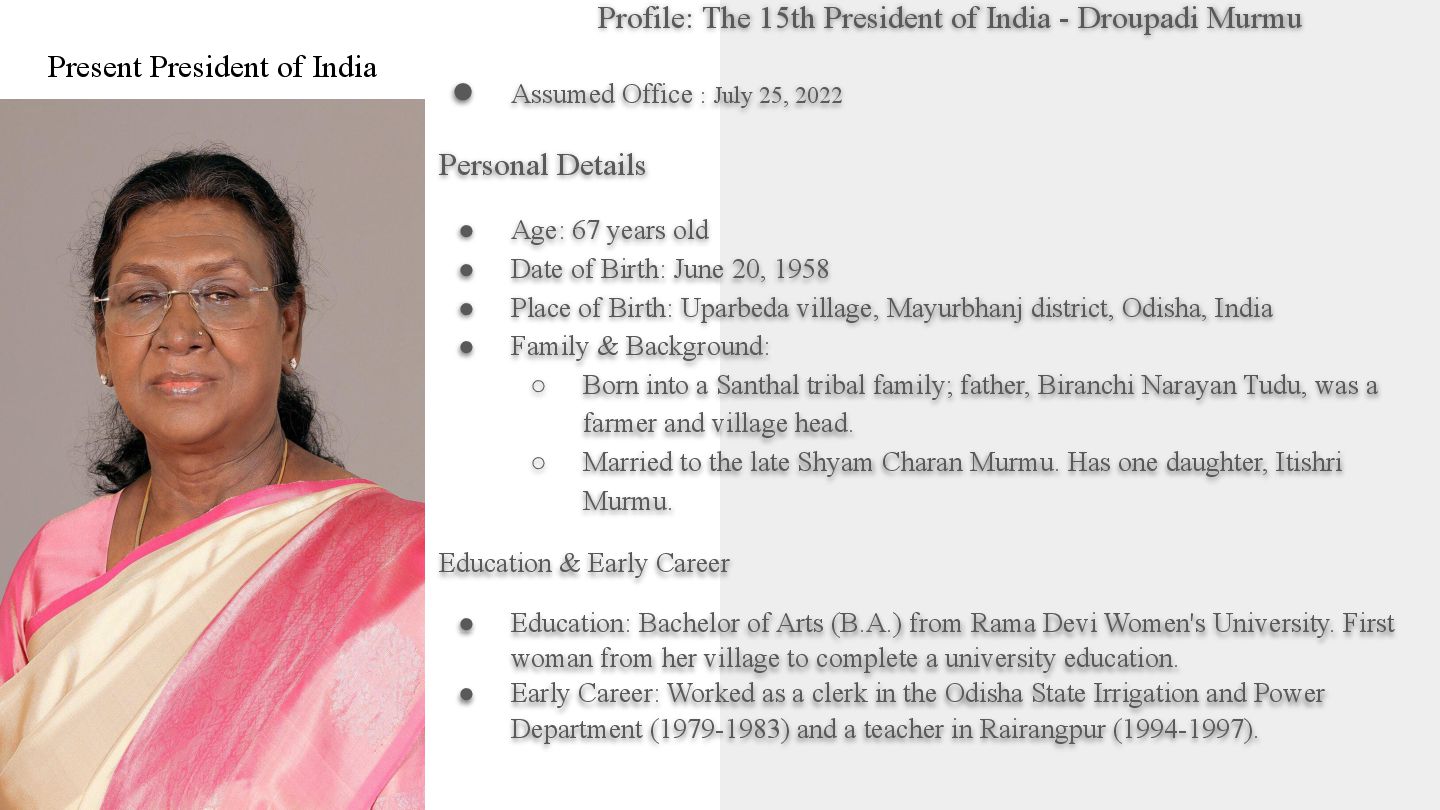
- Droupadi Murmu • Assumed Office : July 25, 2022 Personal Details • Age: 67 years old • Date of Birth: June 20, 1958 • Place of Birth: Uparbeda village, Mayurbhanj district, Odisha, India • Family & Background: ◦ Born into a Santhal tribal family; father, Biranchi Narayan Tudu, was a farmer and village head. ◦ Married to the late Shyam Charan Murmu. Has one daughter, Itishri Murmu. Education & Early Career • Education: Bachelor of Arts (B.A.) from Rama Devi Women's University. First woman from her village to complete a university education. • Early Career: Worked as a clerk in the Odisha State Irrigation and Power Department (1979-1983) and a teacher in Rairangpur (1994-1997).
terms in the Odisha Legislative Assembly (2000-2009). • Minister of State, Odisha: Held independent charge for Commerce and Transportation (2000-2002) and Fisheries and Animal Resources Development (2002-2004). • Governor of Jharkhand: Served as the 8th Governor (2015-2021), becoming the longest-serving governor for that state. Historic Firsts as President • First person from a tribal community to hold the office. • Second woman to become President. • Youngest person to occupy the post (taking office at age 64). • First President to be born in independent India. Present President of India


 skpk
 hiola
 pawan_pharm
 moriyuya
 terazawa
 dragon2
 signer
 uchi8977
 soudai
 ssmedikasda
 mutomasa
 konakalab
 baasie
 uxyall
 danielanewman
 honnibal
 philnash
 ryanjones
 marketingsoph
 chriscoyier
 codingconduct
 ammeep