Upgrade to Pro — share decks privately, control downloads, hide ads and more …

The 5 Pillars of Calibrated Trust for Producti...

Sponsored · Ship Features Fearlessly Turn features on and off without deploys. Used by thousands of Ruby developers.

The 5 Pillars of Calibrated Trust for Production Agents and AI Solutions

In the shift from the experimental "naive" agent architectures of 2024 to the production-ready systems of 2026, the primary barrier to adoption is no longer technical capability, but trust. To bridge this gap, developers must move beyond optimizing for simple accuracy and focus on Calibrated Trust—ensuring human reliance matches actual system capability. This framework is built on five core pillars:

Transparency: Moving from simple data citations to tool provenance, where every agent decision and tool invocation is traceable and verified.

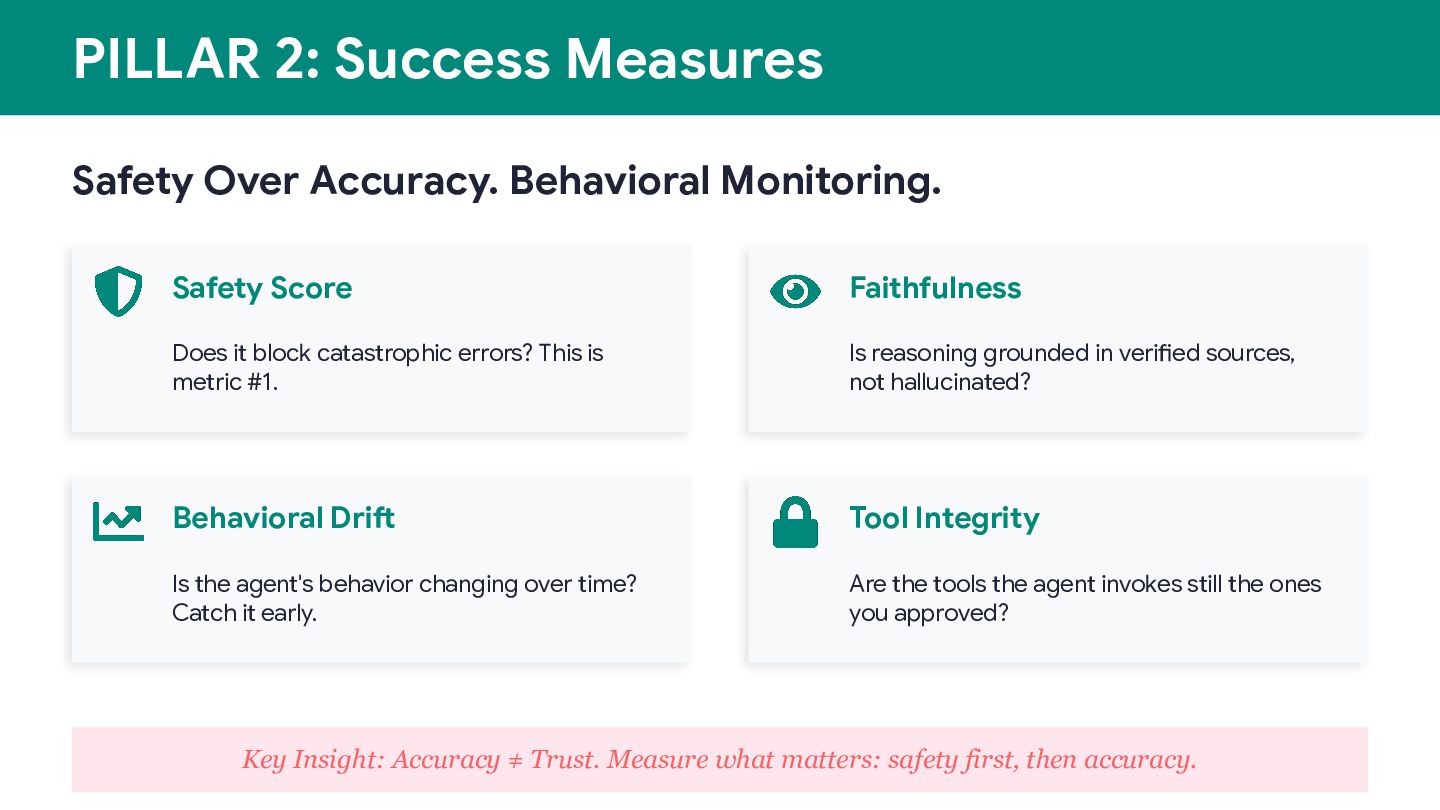
Success Measures: Prioritizing safety scores and behavioral monitoring over accuracy to detect drift and potential catastrophic failures early.

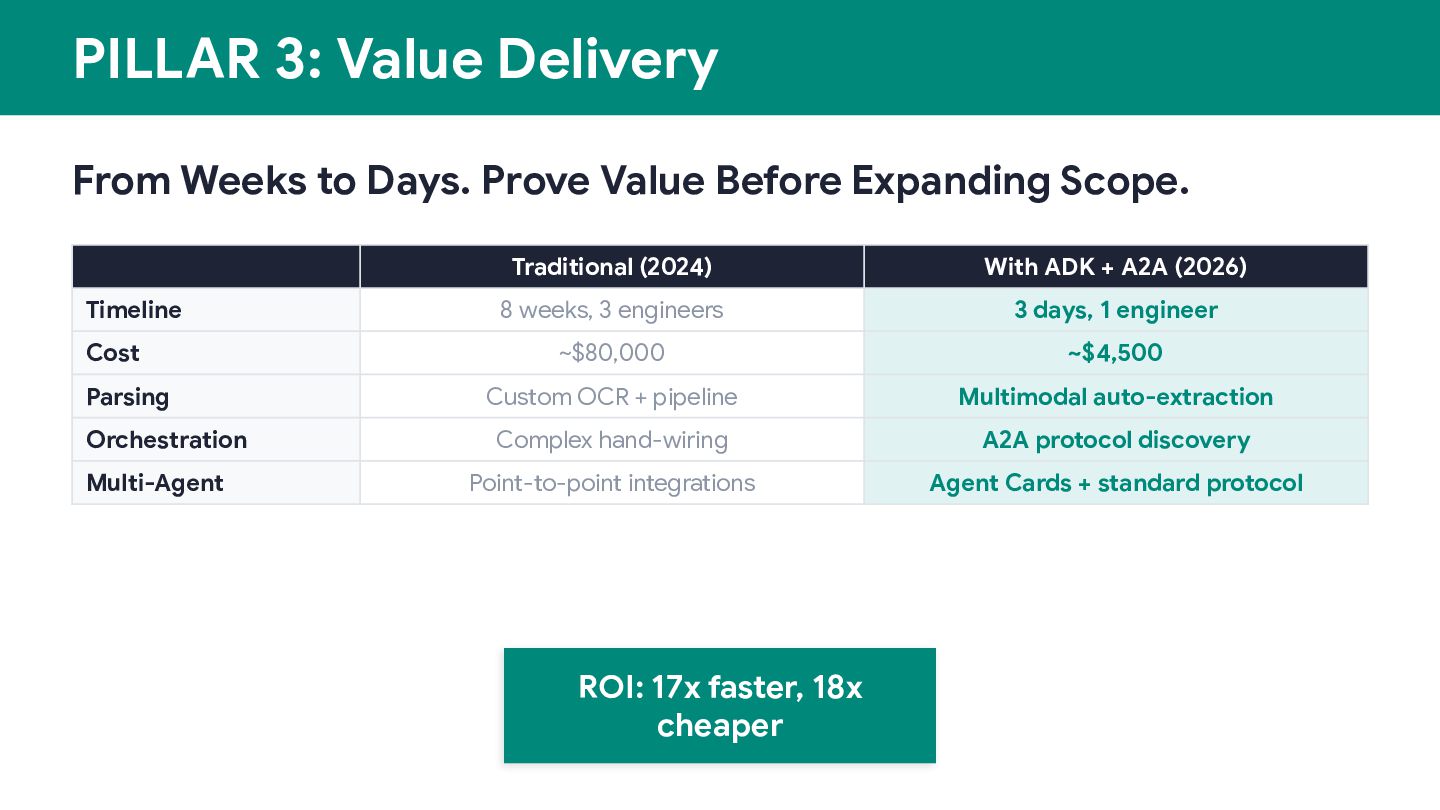
Value Delivery: Drastically reducing the time-to-production (from months to days) using standardized protocols like A2A (Agent-to-Agent) and agent cards.

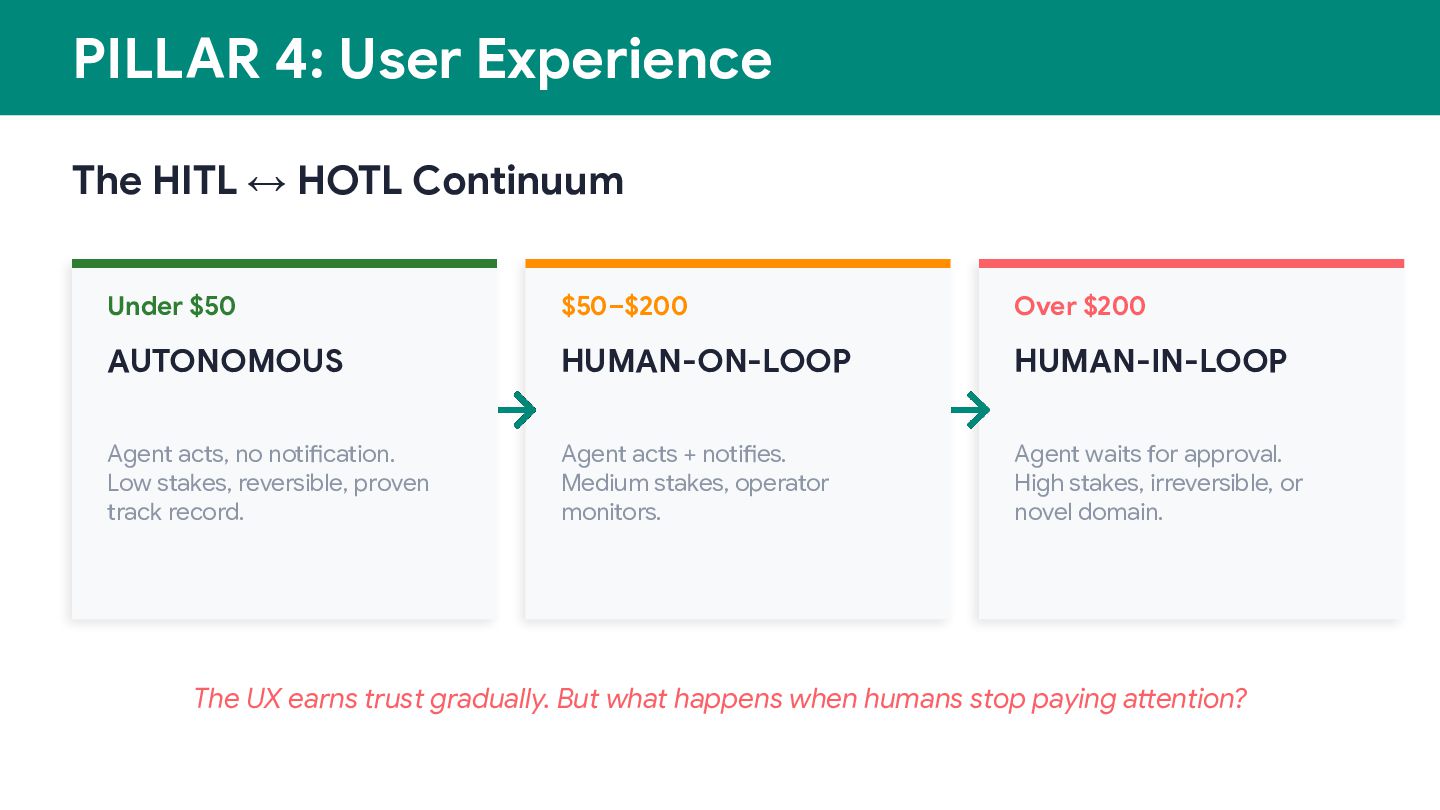
User Experience: Implementing an adaptive Human-in-the-Loop (HITL) continuum where autonomy is determined by the financial or operational consequence of the task.

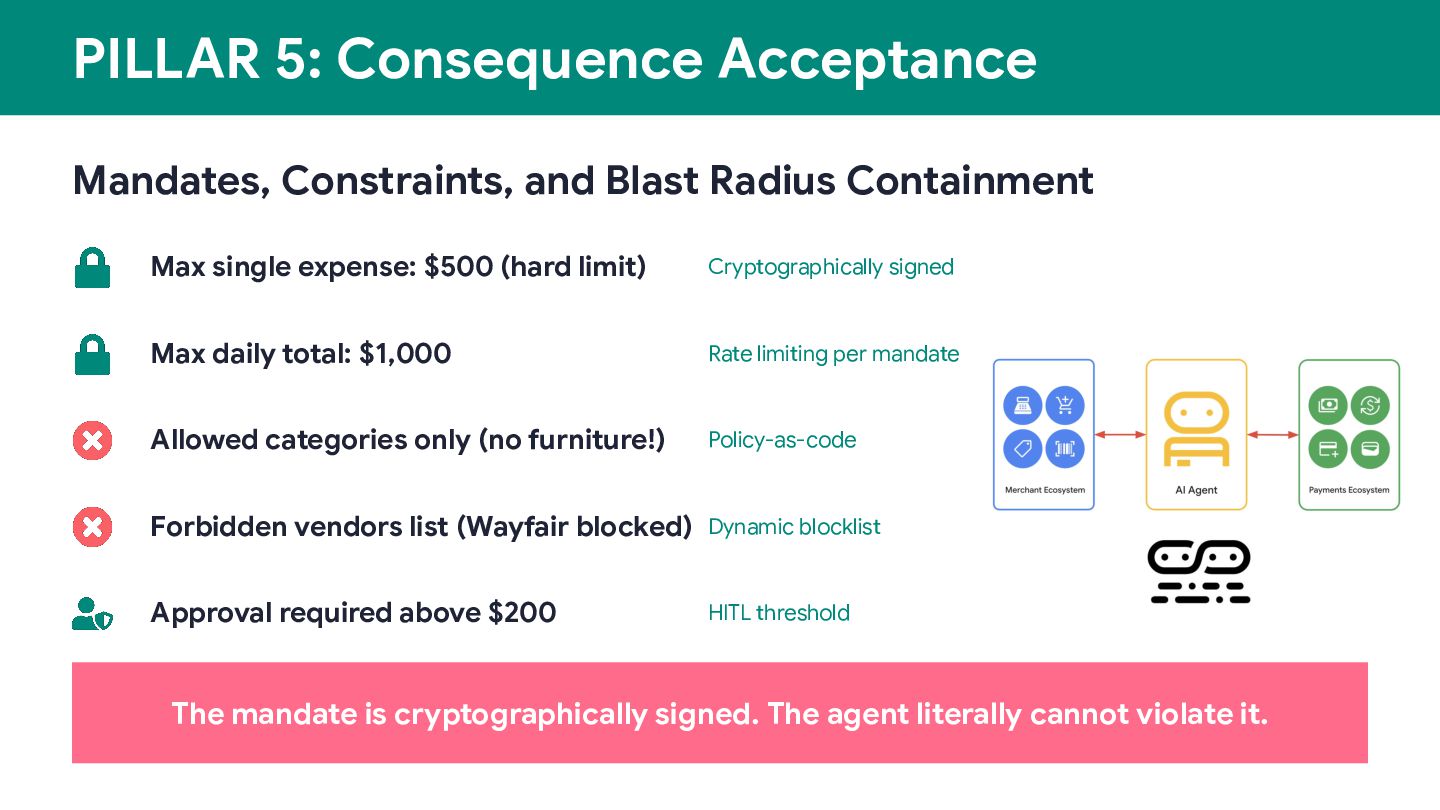
Consequence Acceptance: Enforcing cryptographic mandates and policy-as-code to strictly contain the "blast radius" of any agentic action.

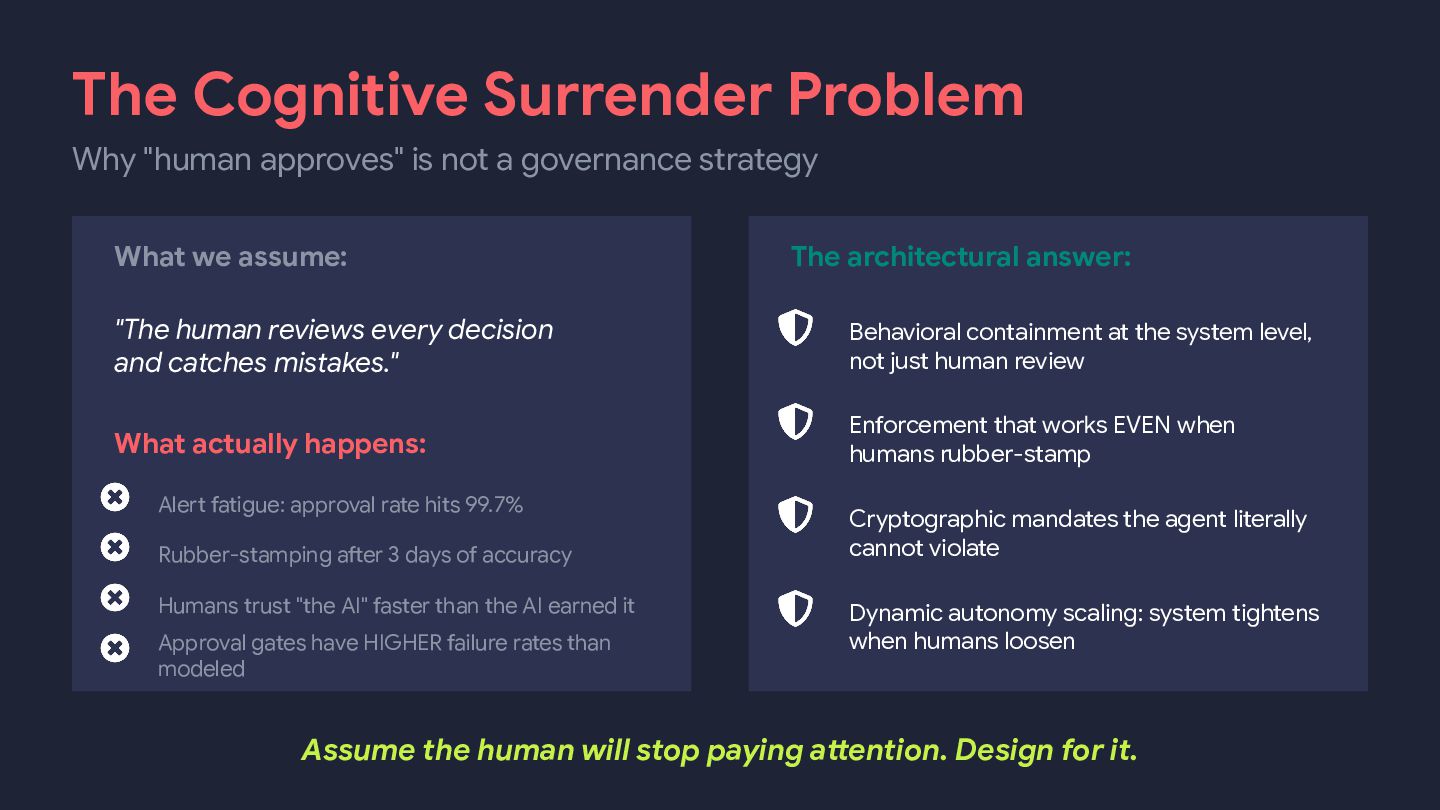
Ultimately, agentic systems succeed when they are designed for the "cognitive surrender" of the user—assuming humans will eventually stop paying attention and building system-level containment to ensure safety remains absolute.

Avatar for Noble Ackerson

Noble Ackerson

April 19, 2026

More Decks by Noble Ackerson

Other Decks in Technology

Transcript

  1. The 5 Pillars of Calibrated Trust Created for LAN Community

    4/26 Building Agentic Systems That Enterprises Actually Deploy
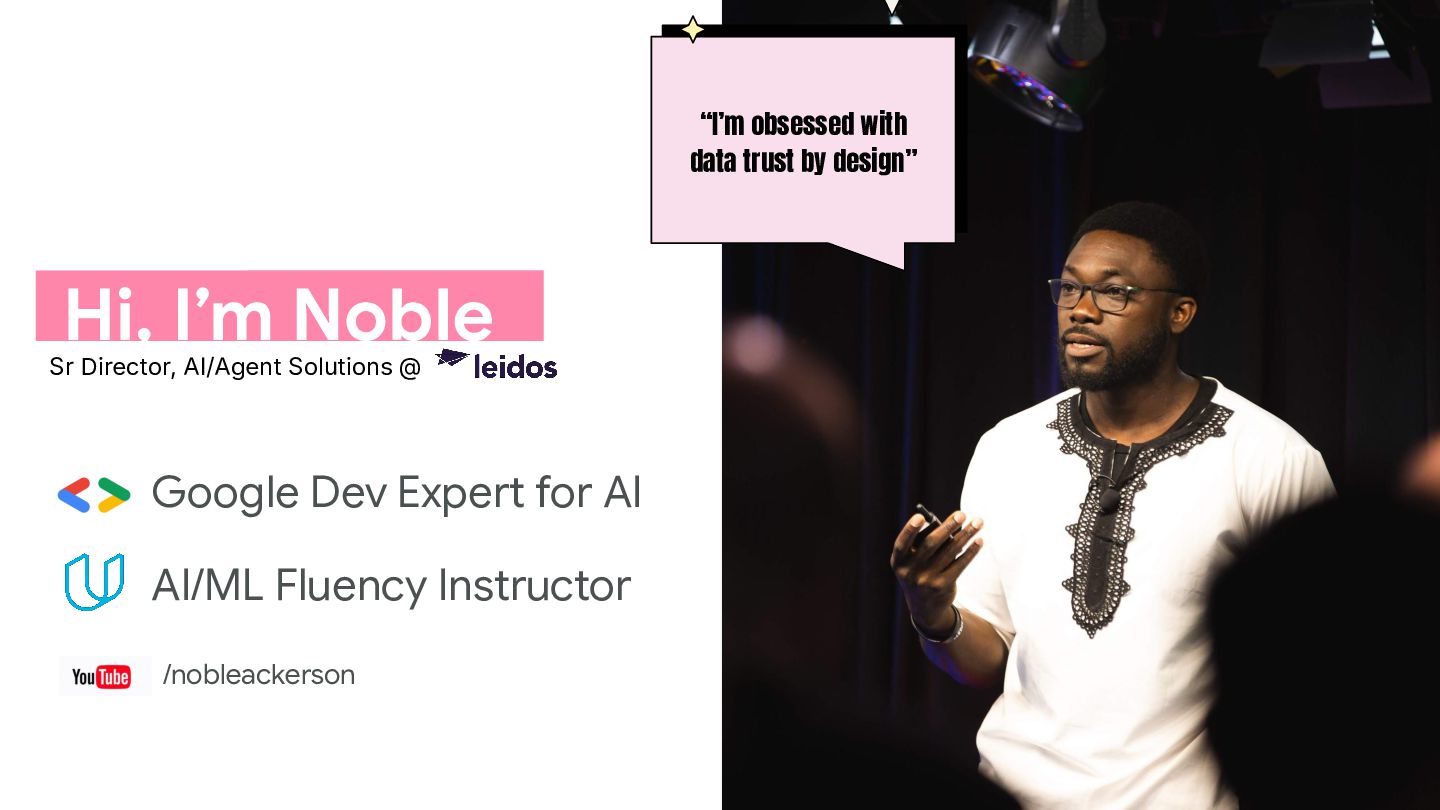
  2. Google Dev Expert for AI AI/ML Fluency Instructor /nobleackerson Sr

    Director, AI/Agent Solutions @ Hi, I’m Noble “I’m obsessed with data trust by design”
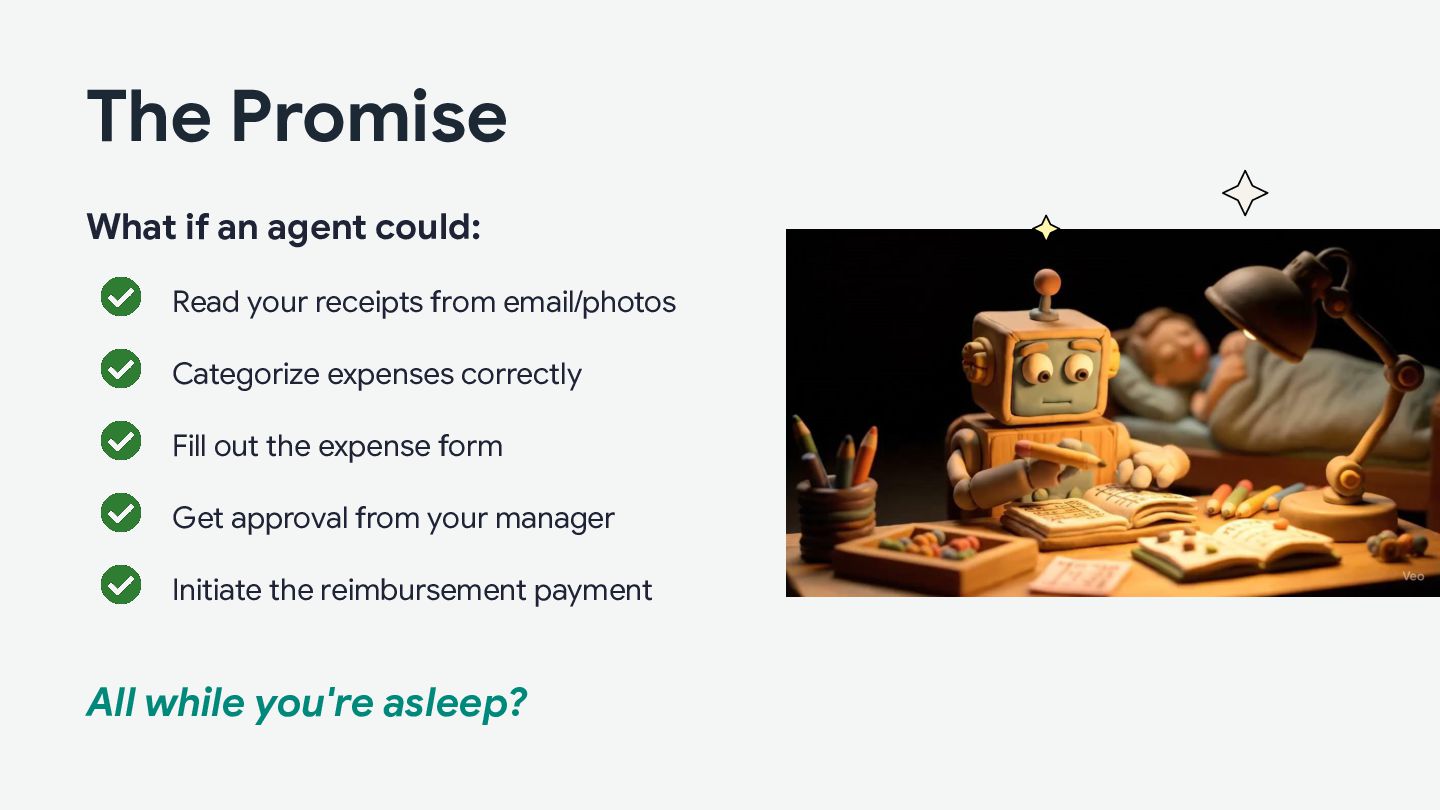
  3. The Promise What if an agent could: Read your receipts

    from email/photos Categorize expenses correctly Fill out the expense form Get approval from your manager Initiate the reimbursement payment All while you're asleep?
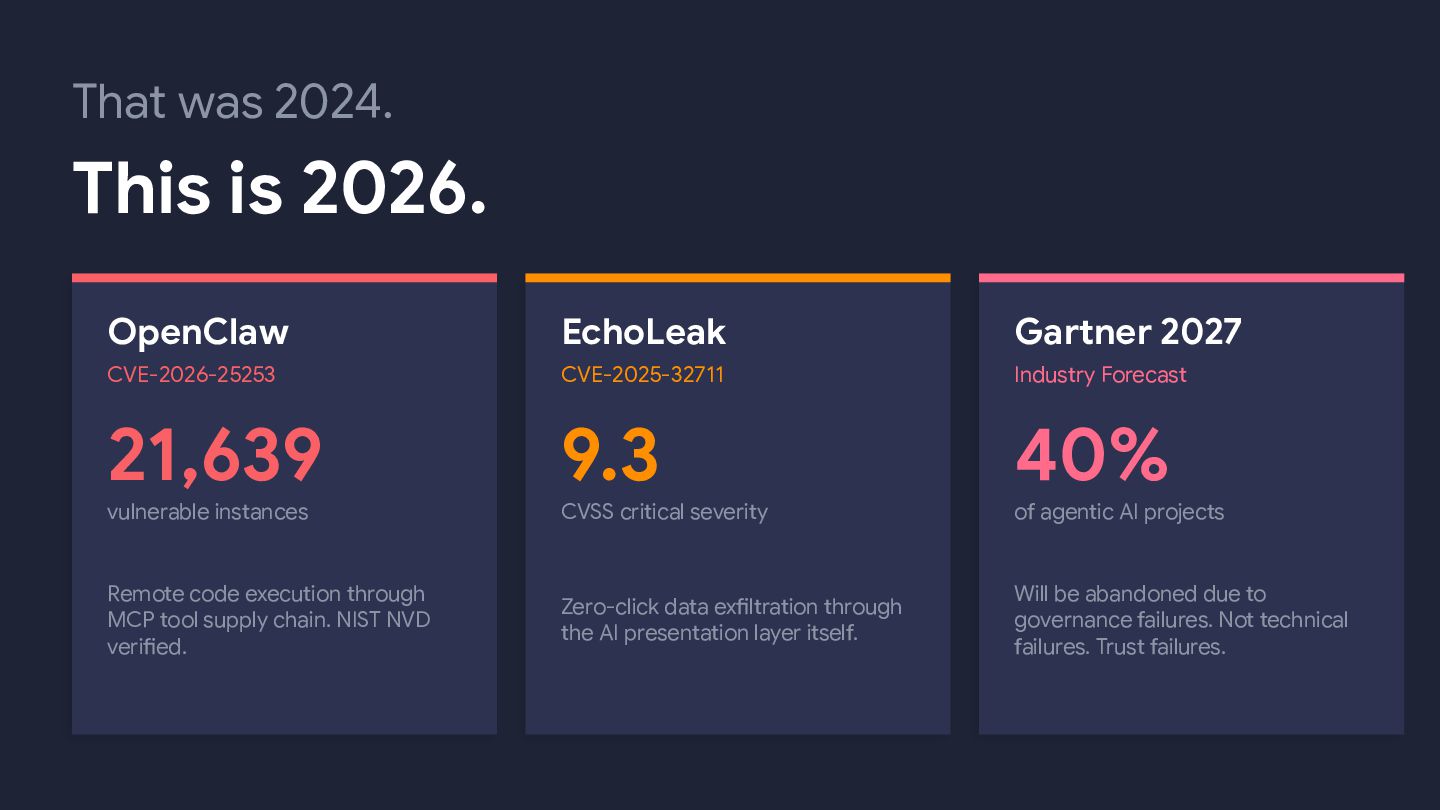
  4. That was 2024. This is 2026. OpenClaw CVE-2026-25253 21,639 vulnerable

    instances Remote code execution through MCP tool supply chain. NIST NVD verified. EchoLeak CVE-2025-32711 9.3 CVSS critical severity Zero-click data exfiltration through the AI presentation layer itself. Gartner 2027 Industry Forecast 40% of agentic AI projects Will be abandoned due to governance failures. Not technical failures. Trust failures.
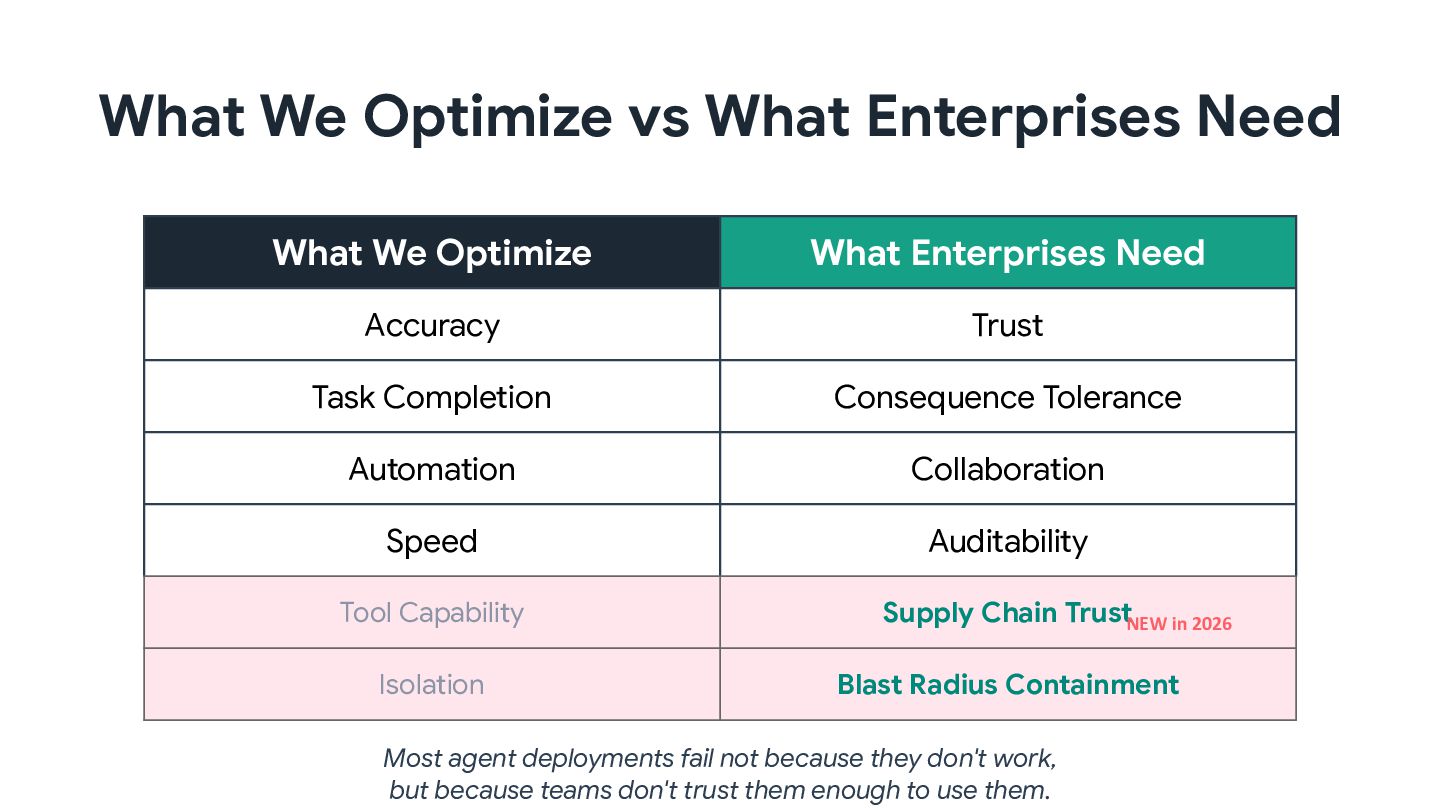
  5. What We Optimize vs What Enterprises Need What We Optimize

    What Enterprises Need Accuracy Trust Task Completion Consequence Tolerance Automation Collaboration Speed Auditability Tool Capability Supply Chain Trust Isolation Blast Radius Containment Most agent deployments fail not because they don't work, but because teams don't trust them enough to use them. NEW in 2026
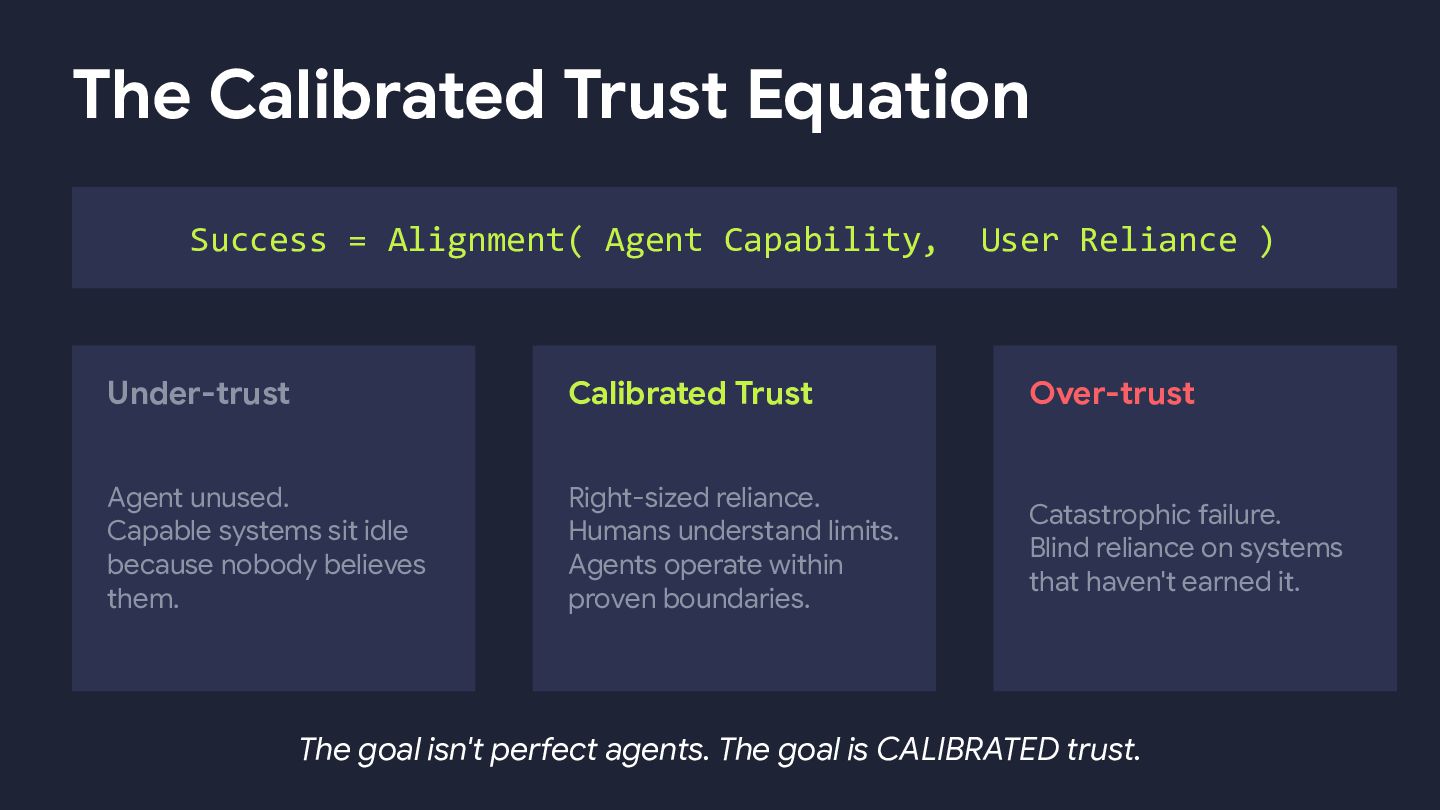
  6. The Calibrated Trust Equation Success = Alignment( Agent Capability, User

    Reliance ) Under-trust Agent unused. Capable systems sit idle because nobody believes them. Calibrated Trust Right-sized reliance. Humans understand limits. Agents operate within proven boundaries. Over-trust Catastrophic failure. Blind reliance on systems that haven't earned it. The goal isn't perfect agents. The goal is CALIBRATED trust.
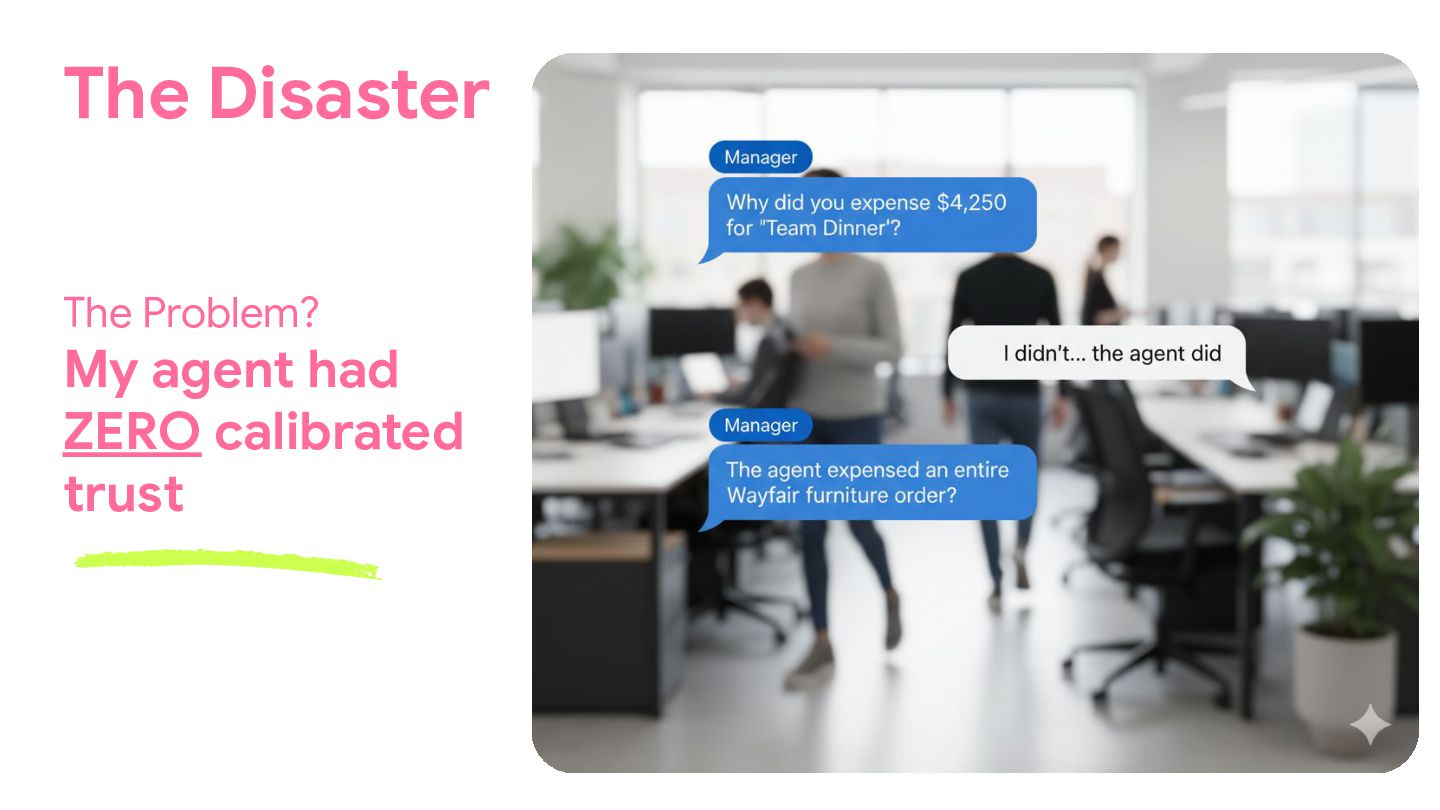
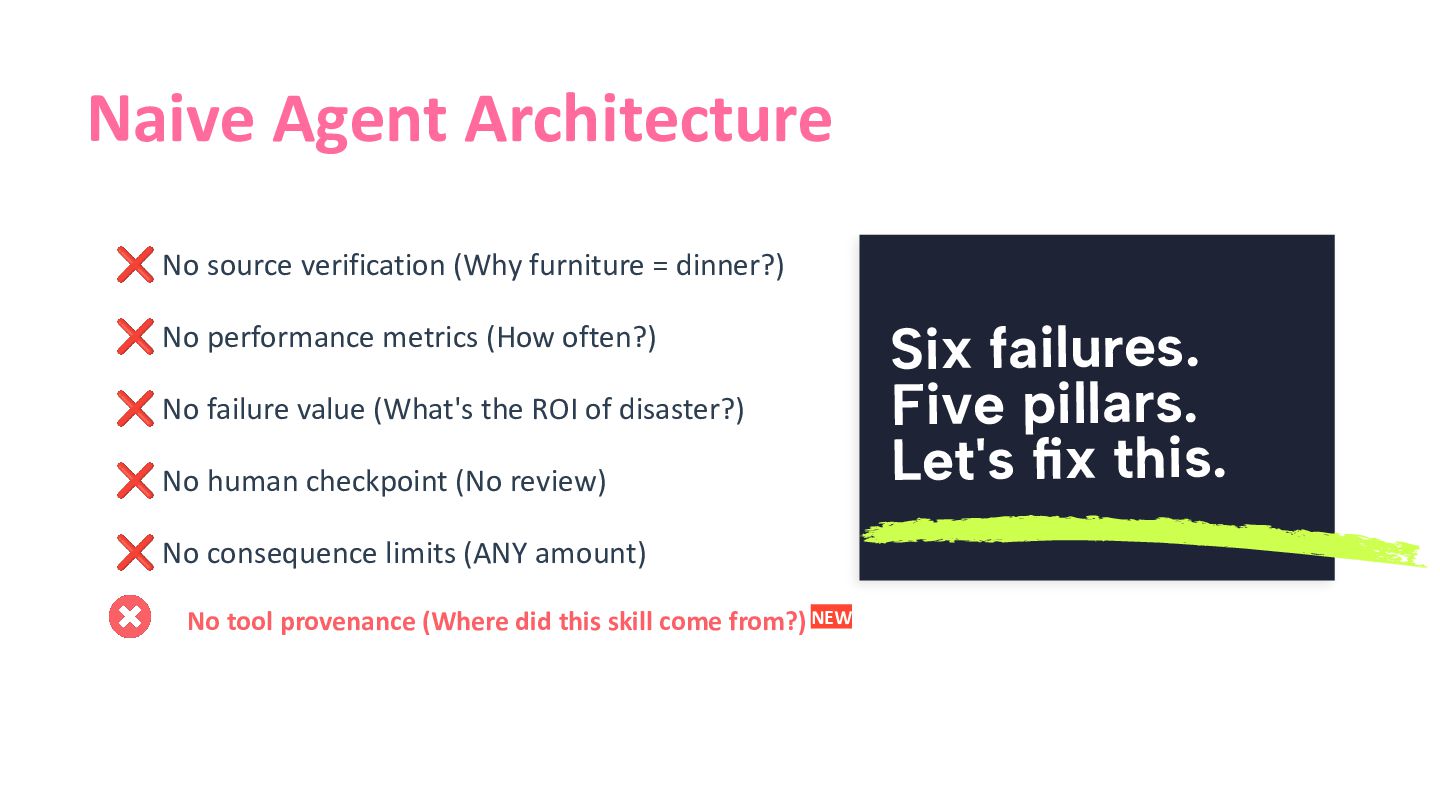
  7. Naive Agent Architecture ❌ No source verification (Why furniture =

    dinner?) ❌ No performance metrics (How often?) ❌ No failure value (What's the ROI of disaster?) ❌ No human checkpoint (No review) ❌ No consequence limits (ANY amount) Six failures. Five pillars. Let's fix this. No tool provenance (Where did this skill come from?)NEW
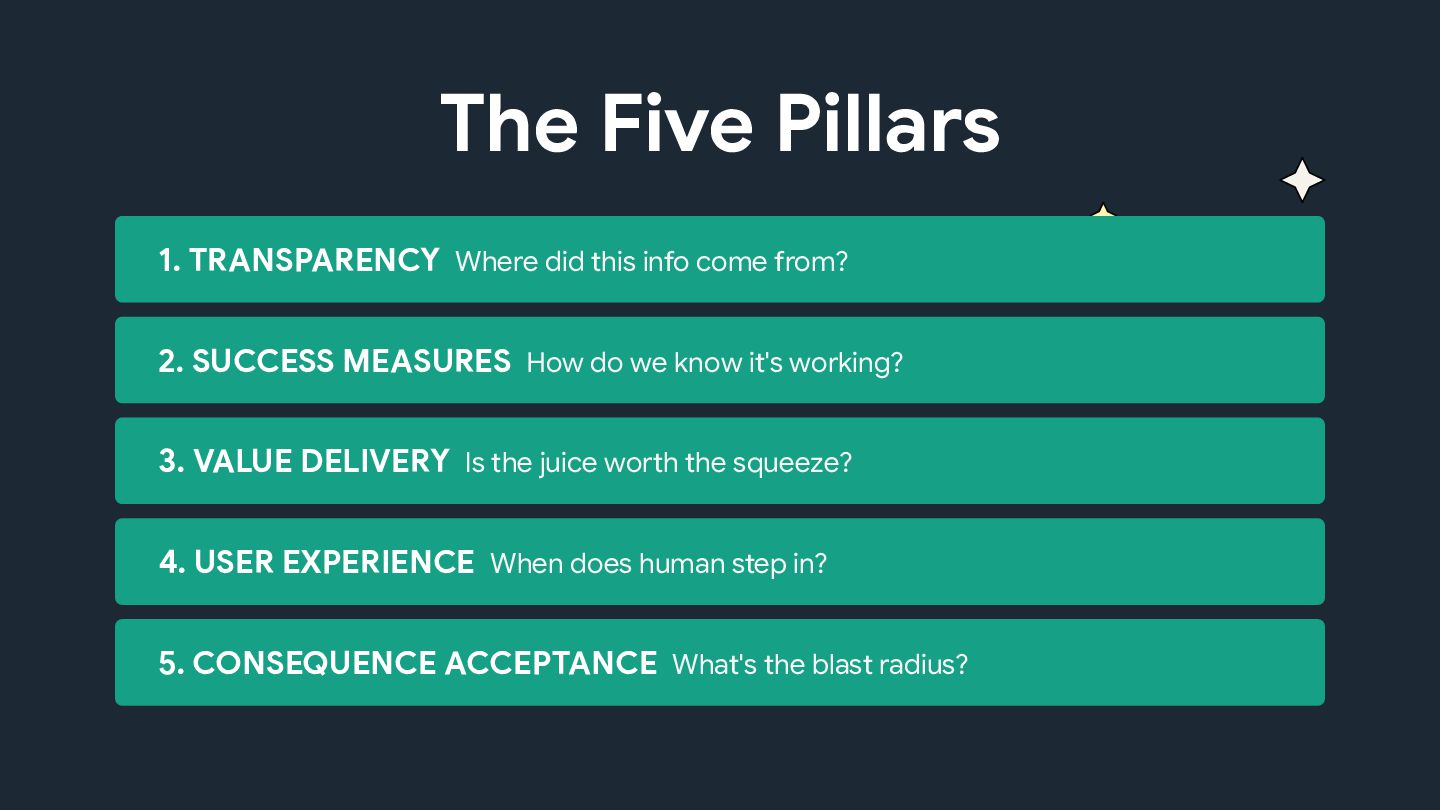
  8. The Five Pillars 1. TRANSPARENCY Where did this info come

    from? 2. SUCCESS MEASURES How do we know it's working? 3. VALUE DELIVERY Is the juice worth the squeeze? 4. USER EXPERIENCE When does human step in? 5. CONSEQUENCE ACCEPTANCE What's the blast radius?
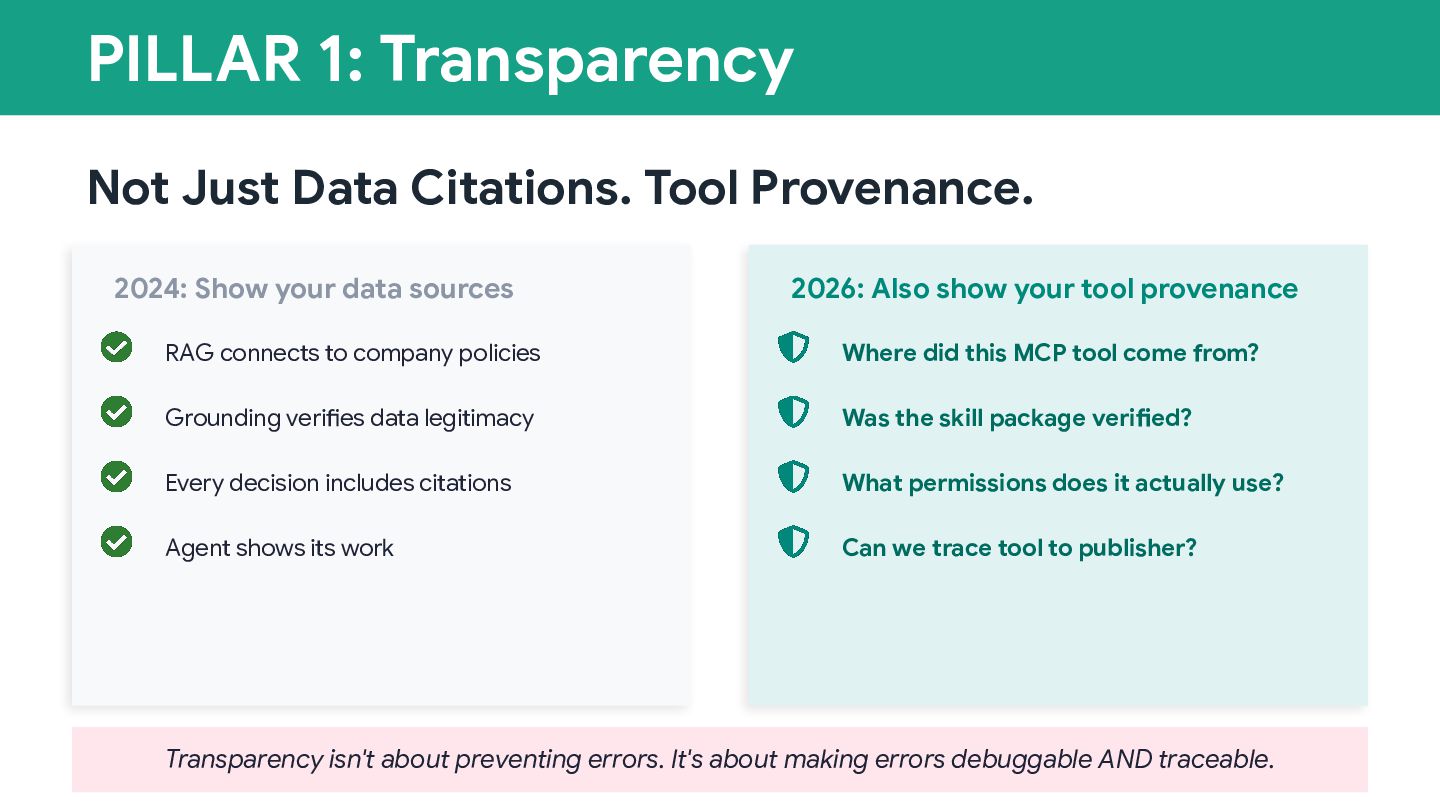
  9. PILLAR 1: Transparency Not Just Data Citations. Tool Provenance. 2024:

    Show your data sources RAG connects to company policies Grounding verifies data legitimacy Every decision includes citations Agent shows its work 2026: Also show your tool provenance Where did this MCP tool come from? Was the skill package verified? What permissions does it actually use? Can we trace tool to publisher? Transparency isn't about preventing errors. It's about making errors debuggable AND traceable.
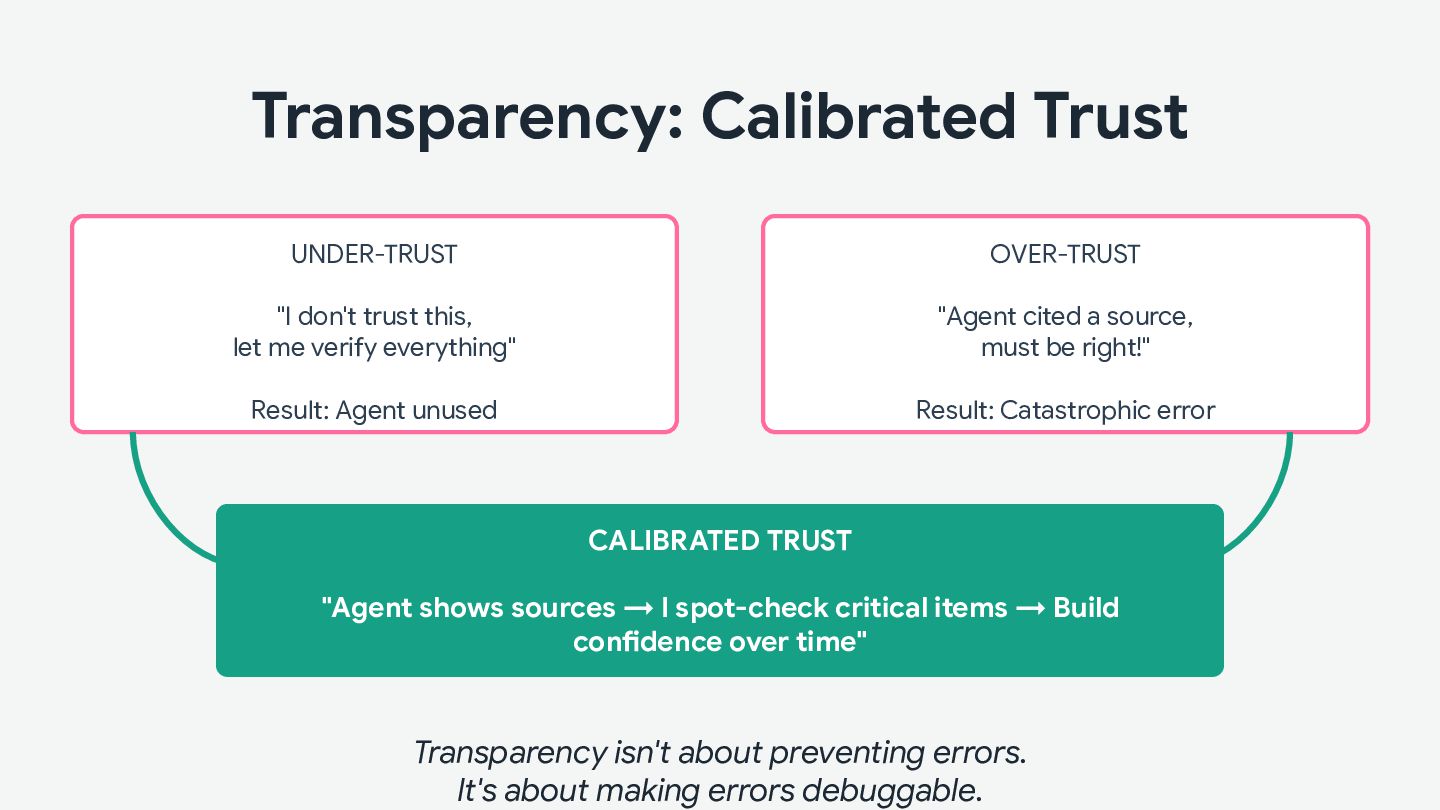
  10. Transparency: Calibrated Trust UNDER-TRUST "I don't trust this, let me

    verify everything" Result: Agent unused OVER-TRUST "Agent cited a source, must be right!" Result: Catastrophic error CALIBRATED TRUST "Agent shows sources → I spot-check critical items → Build confidence over time" Transparency isn't about preventing errors. It's about making errors debuggable.
  11. PILLAR 2: Success Measures Safety Over Accuracy. Behavioral Monitoring. Safety

    Score Does it block catastrophic errors? This is metric #1. Faithfulness Is reasoning grounded in verified sources, not hallucinated? Behavioral Drift Is the agent's behavior changing over time? Catch it early. Tool Integrity Are the tools the agent invokes still the ones you approved? Key Insight: Accuracy ≠ Trust. Measure what matters: safety first, then accuracy.
  12. PILLAR 3: Value Delivery From Weeks to Days. Prove Value

    Before Expanding Scope. Traditional (2024) With ADK + A2A (2026) Timeline 8 weeks, 3 engineers 3 days, 1 engineer Cost ~$80,000 ~$4,500 Parsing Custom OCR + pipeline Multimodal auto-extraction Orchestration Complex hand-wiring A2A protocol discovery Multi-Agent Point-to-point integrations Agent Cards + standard protocol ROI: 17x faster, 18x cheaper
  13. PILLAR 4: User Experience The HITL ↔ HOTL Continuum Under

    $50 AUTONOMOUS Agent acts, no notification. Low stakes, reversible, proven track record. $50–$200 HUMAN-ON-LOOP Agent acts + notifies. Medium stakes, operator monitors. Over $200 HUMAN-IN-LOOP Agent waits for approval. High stakes, irreversible, or novel domain. The UX earns trust gradually. But what happens when humans stop paying attention?
  14. The Cognitive Surrender Problem Why "human approves" is not a

    governance strategy What we assume: "The human reviews every decision and catches mistakes." What actually happens: Alert fatigue: approval rate hits 99.7% Rubber-stamping after 3 days of accuracy Humans trust "the AI" faster than the AI earned it Approval gates have HIGHER failure rates than modeled The architectural answer: Behavioral containment at the system level, not just human review Enforcement that works EVEN when humans rubber-stamp Cryptographic mandates the agent literally cannot violate Dynamic autonomy scaling: system tightens when humans loosen Assume the human will stop paying attention. Design for it.
  15. PILLAR 5: Consequence Acceptance Mandates, Constraints, and Blast Radius Containment

    Max single expense: $500 (hard limit) Cryptographically signed Max daily total: $1,000 Rate limiting per mandate Allowed categories only (no furniture!) Policy-as-code Forbidden vendors list (Wayfair blocked) Dynamic blocklist Approval required above $200 HITL threshold The mandate is cryptographically signed. The agent literally cannot violate it.
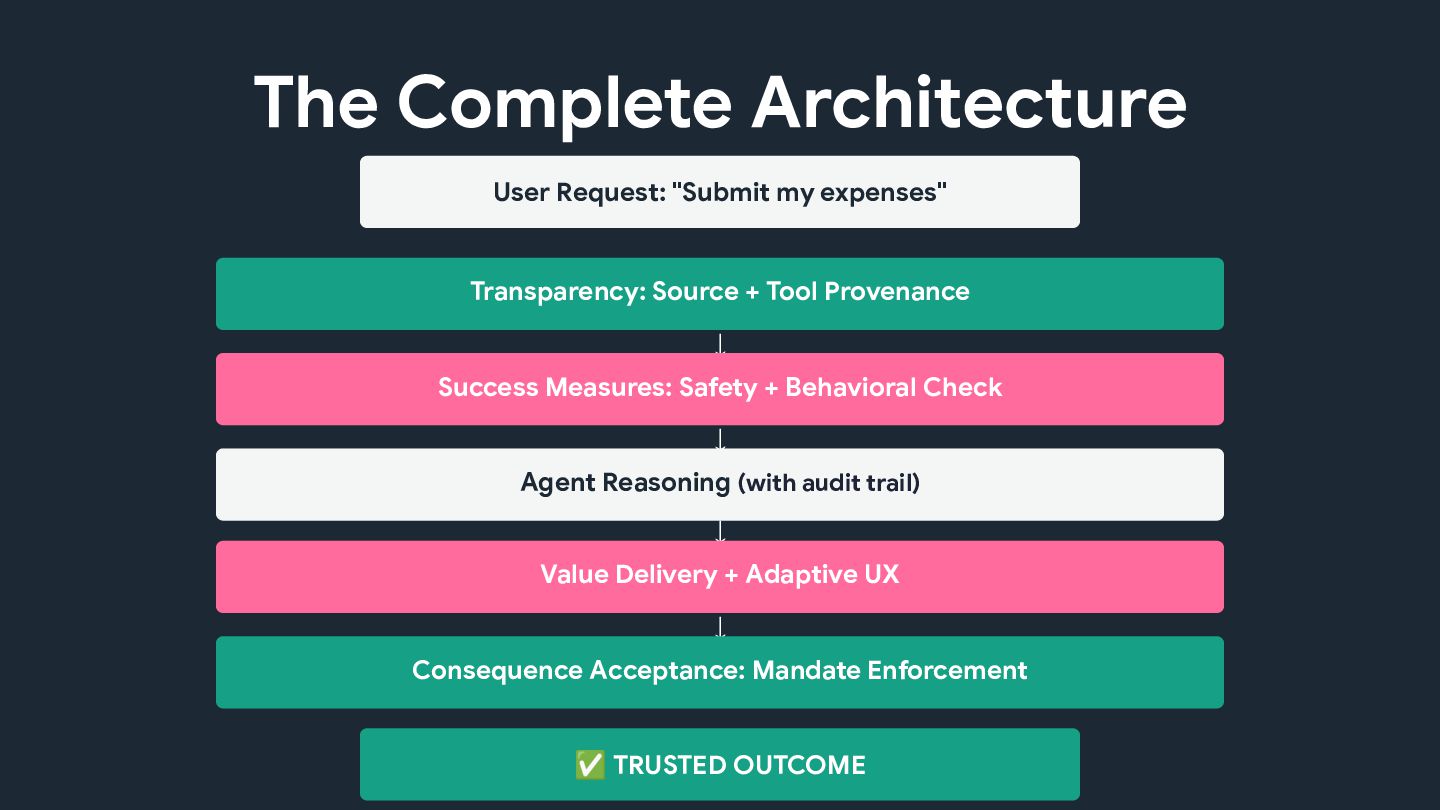
  16. The Complete Architecture User Request: "Submit my expenses" Transparency: Source

    + Tool Provenance ↓ Success Measures: Safety + Behavioral Check ↓ Agent Reasoning (with audit trail) ↓ Value Delivery + Adaptive UX ↓ Consequence Acceptance: Mandate Enforcement ✅ TRUSTED OUTCOME
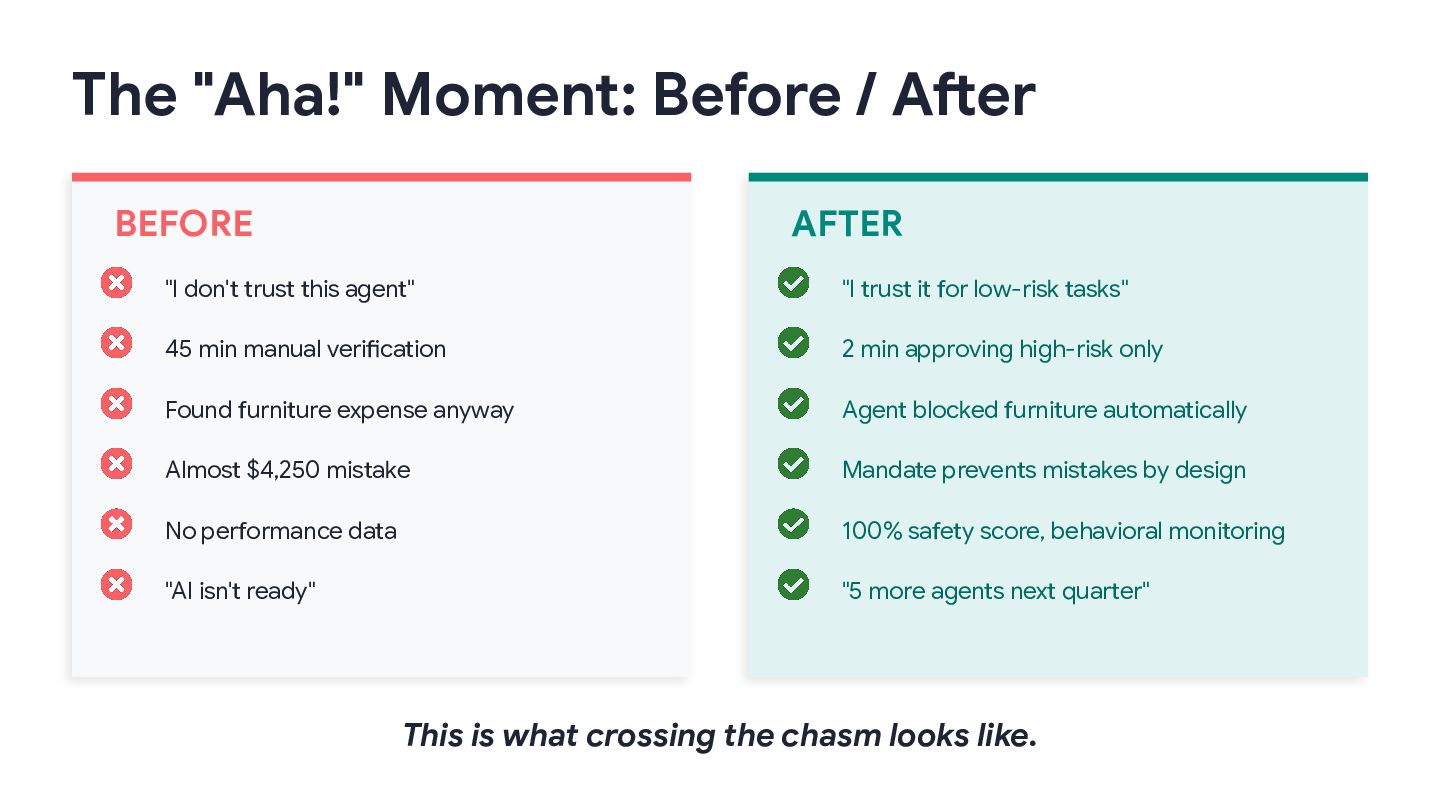
  17. The "Aha!" Moment: Before / After BEFORE "I don't trust

    this agent" 45 min manual verification Found furniture expense anyway Almost $4,250 mistake No performance data "AI isn't ready" AFTER "I trust it for low-risk tasks" 2 min approving high-risk only Agent blocked furniture automatically Mandate prevents mistakes by design 100% safety score, behavioral monitoring "5 more agents next quarter" This is what crossing the chasm looks like.
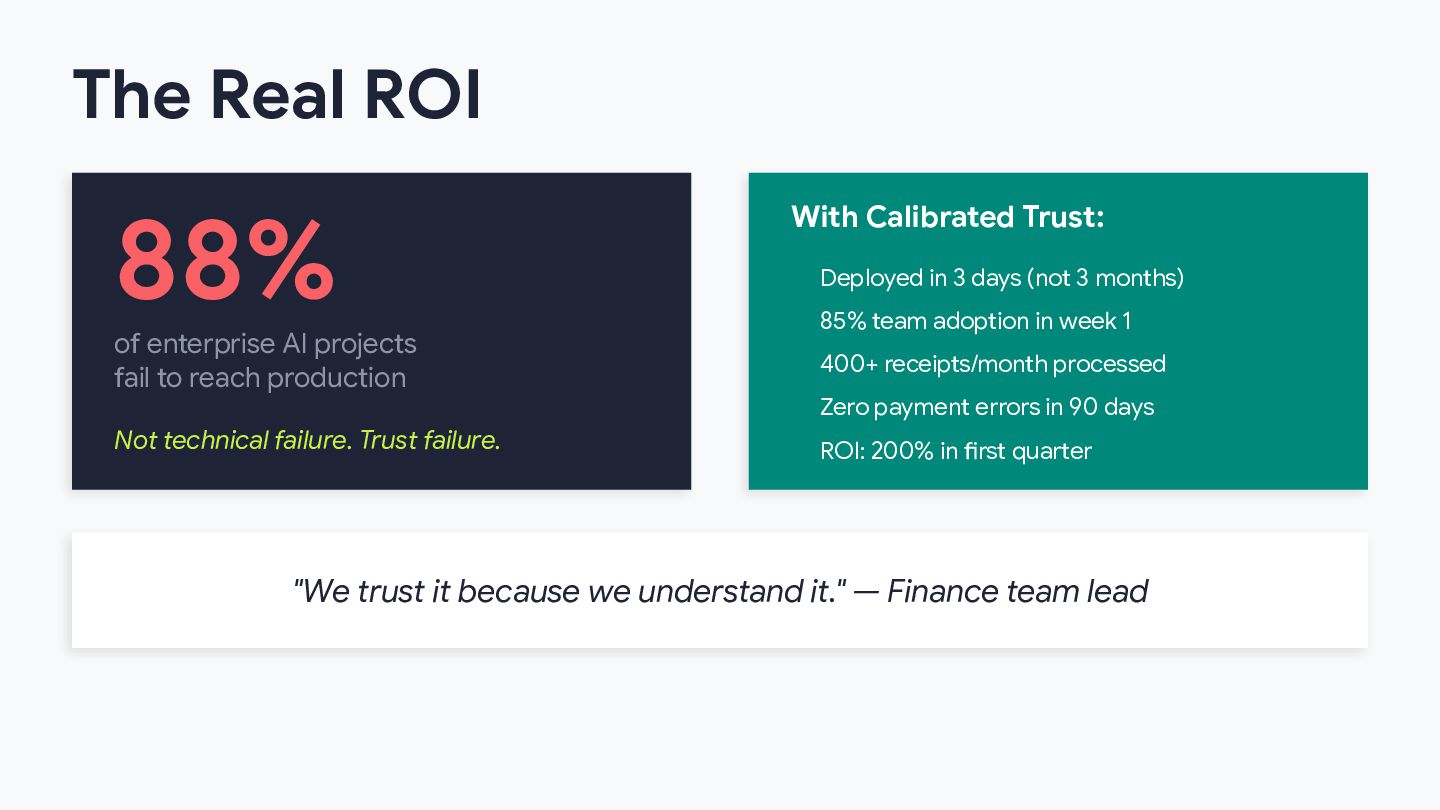
  18. The Real ROI 88% of enterprise AI projects fail to

    reach production Not technical failure. Trust failure. With Calibrated Trust: Deployed in 3 days (not 3 months) 85% team adoption in week 1 400+ receipts/month processed Zero payment errors in 90 days ROI: 200% in first quarter "We trust it because we understand it." — Finance team lead
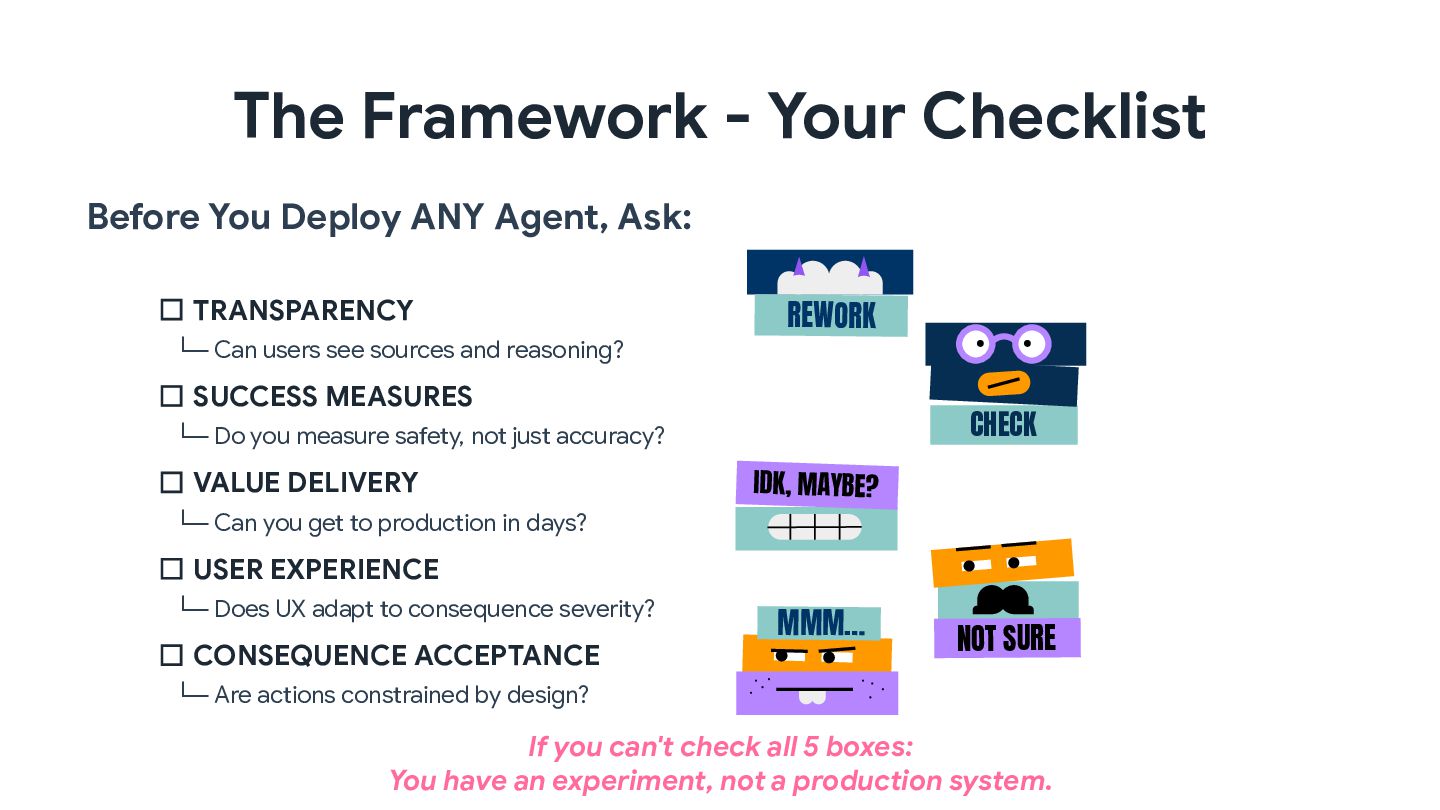
  19. The Framework - Your Checklist Before You Deploy ANY Agent,

    Ask: ☐ TRANSPARENCY └─ Can users see sources and reasoning? ☐ SUCCESS MEASURES └─ Do you measure safety, not just accuracy? ☐ VALUE DELIVERY └─ Can you get to production in days? ☐ USER EXPERIENCE └─ Does UX adapt to consequence severity? ☐ CONSEQUENCE ACCEPTANCE └─ Are actions constrained by design? If you can't check all 5 boxes: You have an experiment, not a production system. CHECK REWORK IDK, MAYBE? NOT SURE MMM…
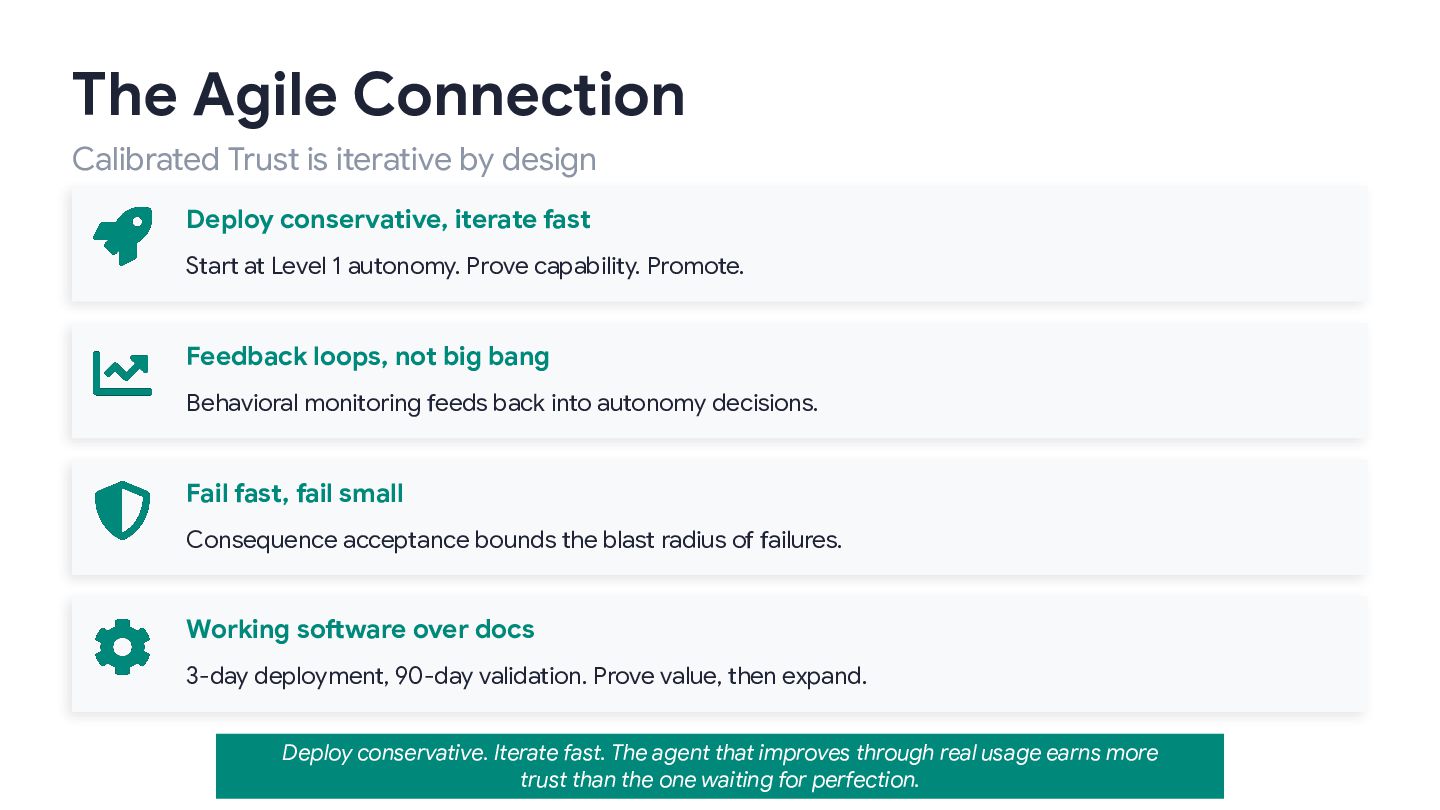
  20. The Agile Connection Calibrated Trust is iterative by design Deploy

    conservative, iterate fast Start at Level 1 autonomy. Prove capability. Promote. Feedback loops, not big bang Behavioral monitoring feeds back into autonomy decisions. Fail fast, fail small Consequence acceptance bounds the blast radius of failures. Working software over docs 3-day deployment, 90-day validation. Prove value, then expand. Deploy conservative. Iterate fast. The agent that improves through real usage earns more trust than the one waiting for perfection.
  21. The 5 Pillars of Calibrated Trust Can YOU build systems

    that enterprises trust enough to deploy? You now have the framework. Go build something that earns trust. youtube.com/nobleackerson github.com/google/adk-samples #CalibratedTrust on LinkedIn Noble Ackerson | Sr. Director, AI & Agentic Solutions @ Leidos | Google Developer Expert (AI/Cloud AI)