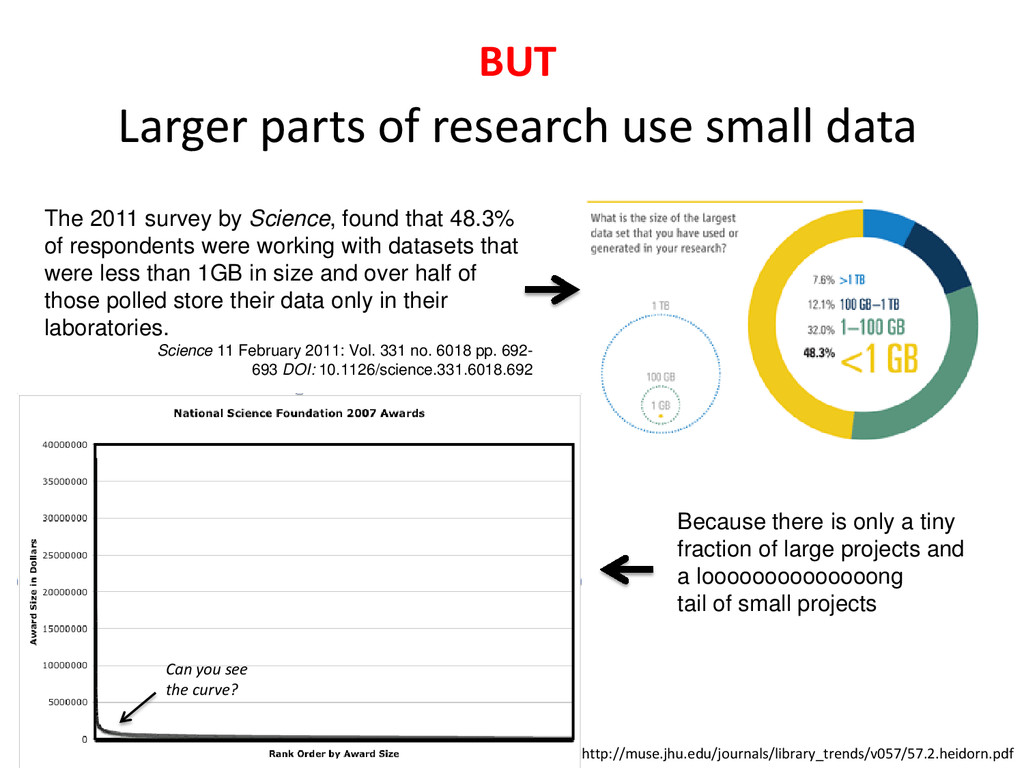
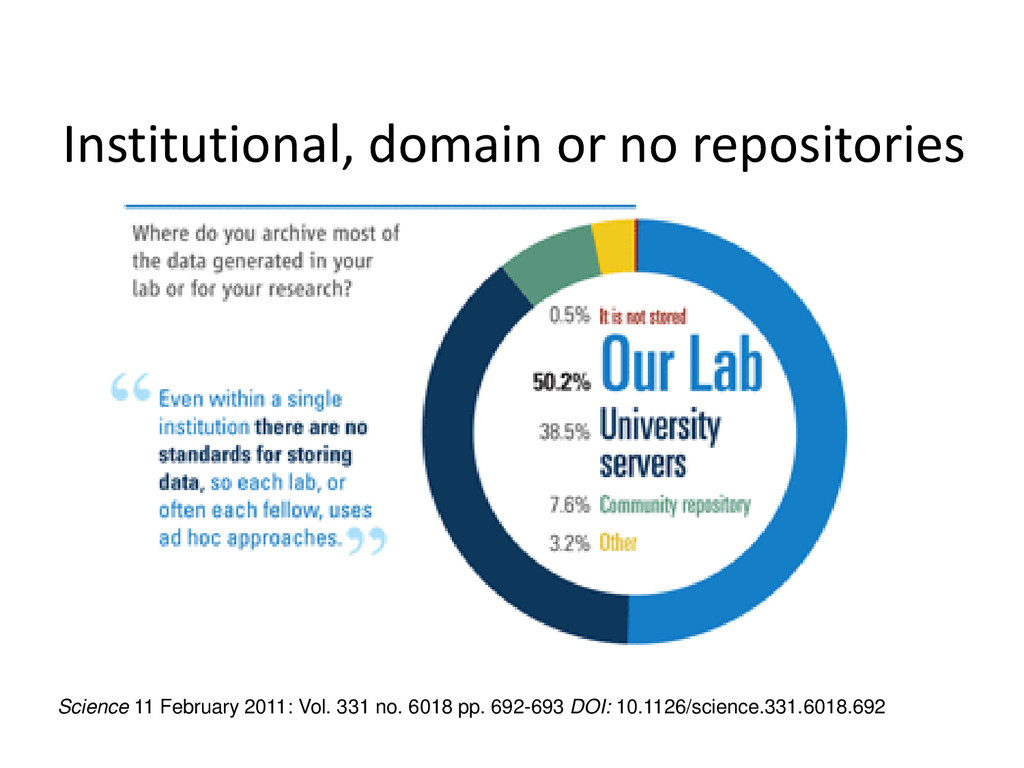
by Science, found that 48.3% of respondents were working with datasets that were less than 1GB in size and over half of those polled store their data only in their laboratories. Science 11 February 2011: Vol. 331 no. 6018 pp. 692- 693 DOI: 10.1126/science.331.6018.692 BUT http://muse.jhu.edu/journals/library_trends/v057/57.2.heidorn.pdf Because there is only a tiny fraction of large projects and a loooooooooooooong tail of small projects Can you see the curve?
Arizona) in Library Trends 57/2, Fall 2008 http://muse.jhu.edu/journals/library_trends/v057/57.2.heidorn.pdf • … While great care is frequently devoted to the collection, preservation and reuse of data on very large projects, relatively little attention is given to the data that is being generated by the majority of scientists. • … There may only be a few scientists worldwide that would want to see a particular boutique data set but there are many thousands of these data sets. • … The long tail is a breeding ground for new ideas and never before attempted science. • … The challenge for science policy is to develop institutions and practices such as institutional repositories, which make this data useful for society.
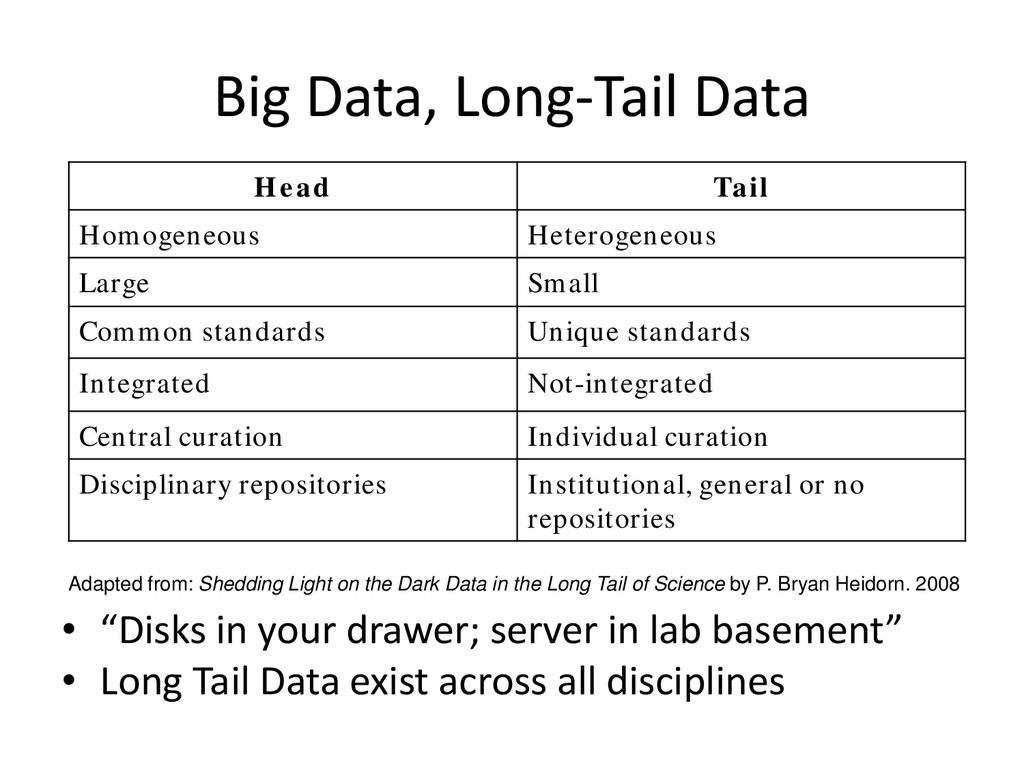
in lab basement” • Long Tail Data exist across all disciplines Head Tail Homogeneous Heterogeneous Large Small Common standards Unique standards Integrated Not-integrated Central curation Individual curation Disciplinary repositories Institutional, general or no repositories Adapted from: Shedding Light on the Dark Data in the Long Tail of Science by P. Bryan Heidorn. 2008
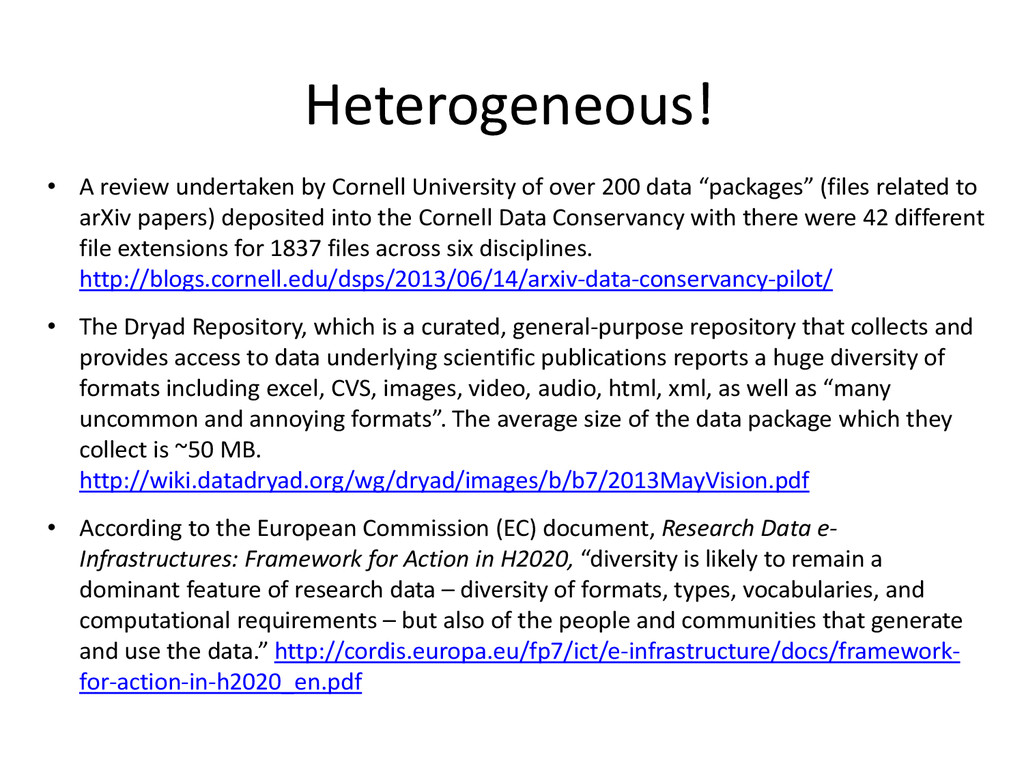
200 data “packages” (files related to arXiv papers) deposited into the Cornell Data Conservancy with there were 42 different file extensions for 1837 files across six disciplines. http://blogs.cornell.edu/dsps/2013/06/14/arxiv-data-conservancy-pilot/ • The Dryad Repository, which is a curated, general-purpose repository that collects and provides access to data underlying scientific publications reports a huge diversity of formats including excel, CVS, images, video, audio, html, xml, as well as “many uncommon and annoying formats”. The average size of the data package which they collect is ~50 MB. http://wiki.datadryad.org/wg/dryad/images/b/b7/2013MayVision.pdf • According to the European Commission (EC) document, Research Data e- Infrastructures: Framework for Action in H2020, “diversity is likely to remain a dominant feature of research data – diversity of formats, types, vocabularies, and computational requirements – but also of the people and communities that generate and use the data.” http://cordis.europa.eu/fp7/ict/e-infrastructure/docs/framework- for-action-in-h2020_en.pdf
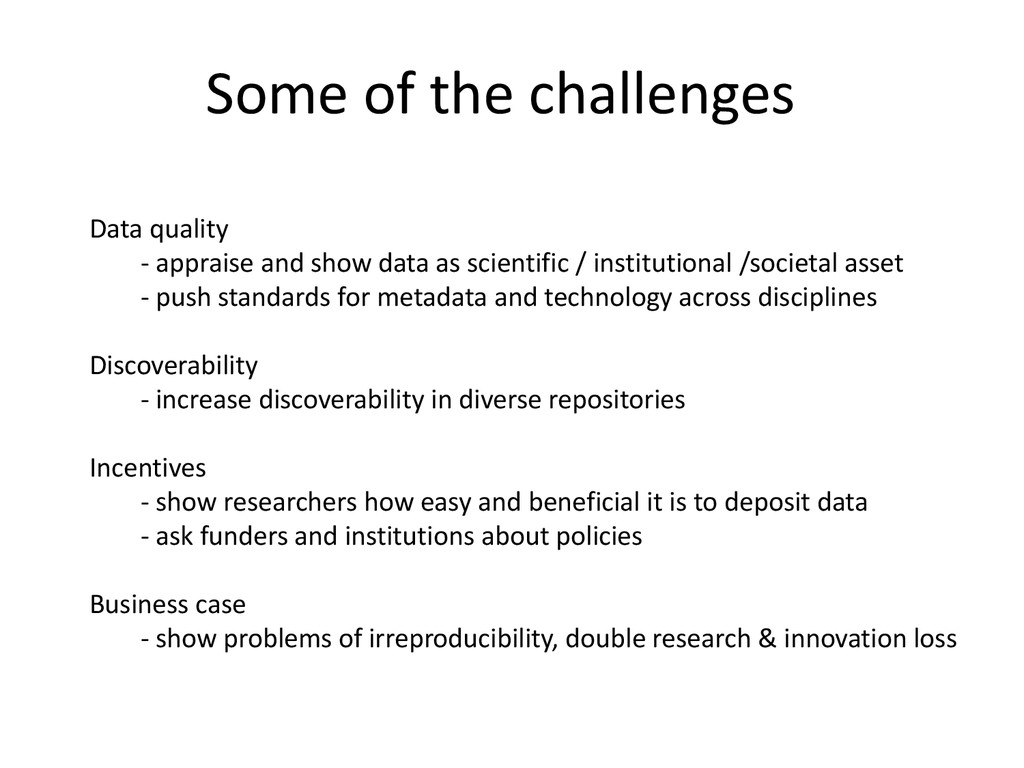
data as scientific / institutional /societal asset - push standards for metadata and technology across disciplines Discoverability - increase discoverability in diverse repositories Incentives - show researchers how easy and beneficial it is to deposit data - ask funders and institutions about policies Business case - show problems of irreproducibility, double research & innovation loss
• Over 90 members from around the world Objectives • To better understand the long tail • To address challenges involved in managing diverse datasets • To share and develop practices for managing diverse data • To work towards greater interoperability across repositories Long Tail of Research Data Interest Group “Thanks for the slides, Kathleen!” Kathleen Sheerer, COAR Executive Director and Co- Chair of the RDA IG
for improving discoverability of datasets All information is available on the interest group’s website Future activities • evidence to incentivize researchers to deposit • make it easier for researchers to deposit their data • sharing practices about discovery • interoperability across repositories (WG!) • preservation planning Long Tail of Research Data Interest Group
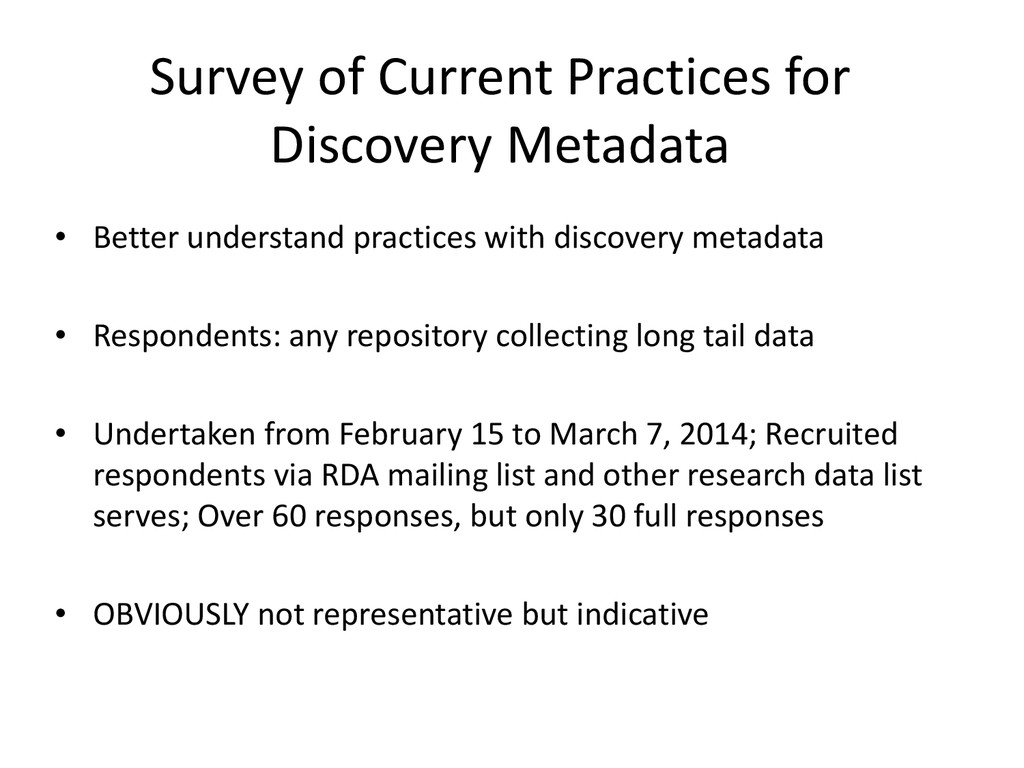
practices with discovery metadata • Respondents: any repository collecting long tail data • Undertaken from February 15 to March 7, 2014; Recruited respondents via RDA mailing list and other research data list serves; Over 60 responses, but only 30 full responses • OBVIOUSLY not representative but indicative
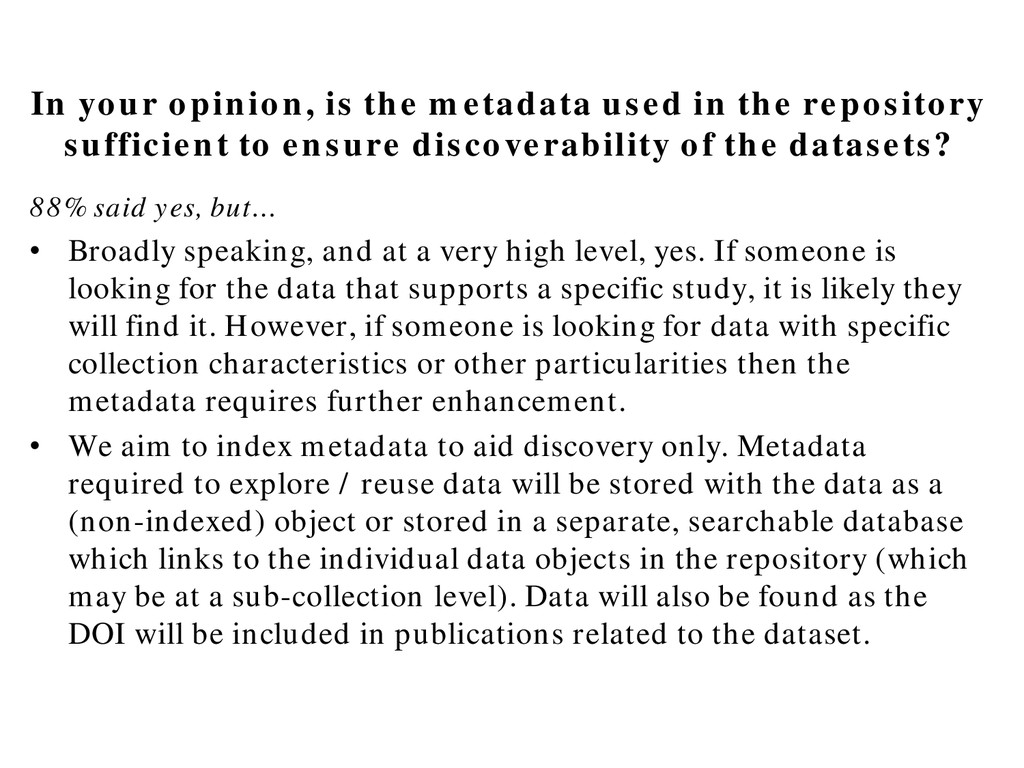
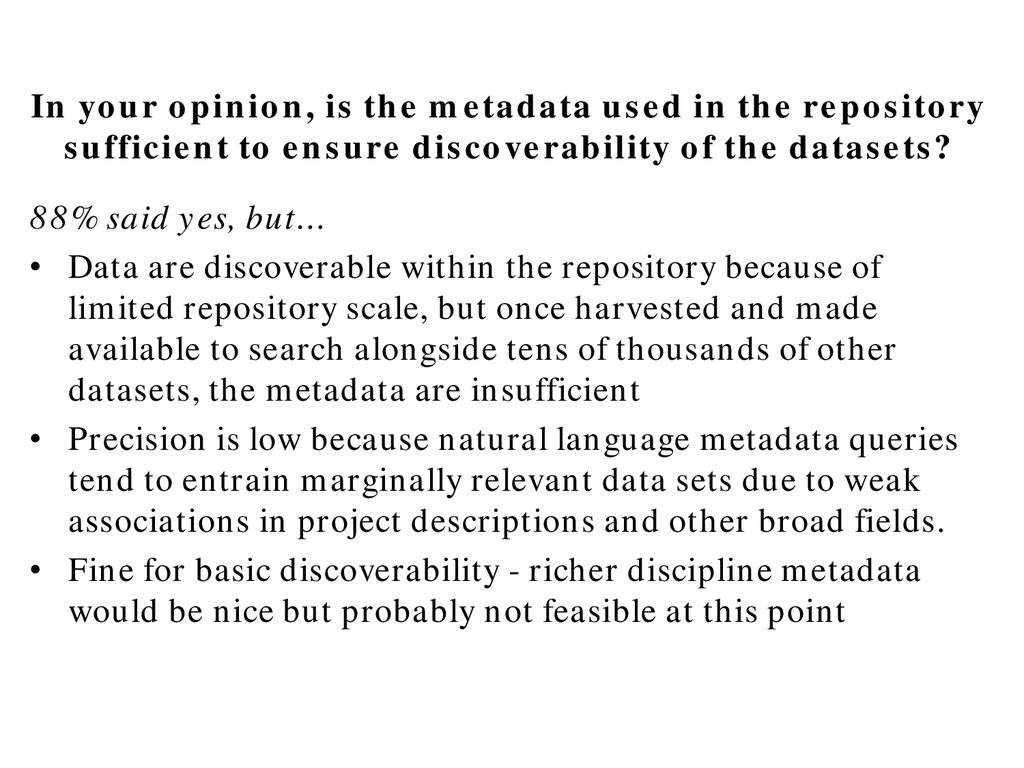
sufficient to ensure discoverability of the datasets? 88% said yes, but… • Broadly speaking, and at a very high level, yes. If someone is looking for the data that supports a specific study, it is likely they will find it. However, if someone is looking for data with specific collection characteristics or other particularities then the metadata requires further enhancement. • We aim to index metadata to aid discovery only. Metadata required to explore / reuse data will be stored with the data as a (non-indexed) object or stored in a separate, searchable database which links to the individual data objects in the repository (which may be at a sub-collection level). Data will also be found as the DOI will be included in publications related to the dataset.
sufficient to ensure discoverability of the datasets? 88% said yes, but… • Data are discoverable within the repository because of limited repository scale, but once harvested and made available to search alongside tens of thousands of other datasets, the metadata are insufficient • Precision is low because natural language metadata queries tend to entrain marginally relevant data sets due to weak associations in project descriptions and other broad fields. • Fine for basic discoverability - richer discipline metadata would be nice but probably not feasible at this point
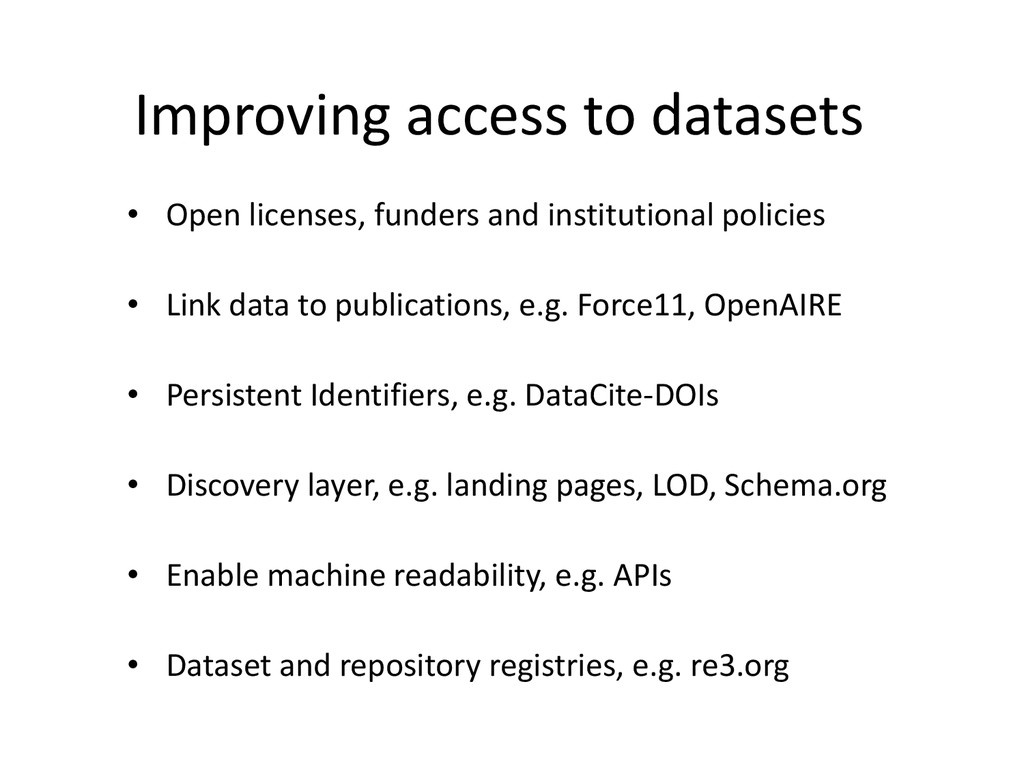
policies • Link data to publications, e.g. Force11, OpenAIRE • Persistent Identifiers, e.g. DataCite-DOIs • Discovery layer, e.g. landing pages, LOD, Schema.org • Enable machine readability, e.g. APIs • Dataset and repository registries, e.g. re3.org
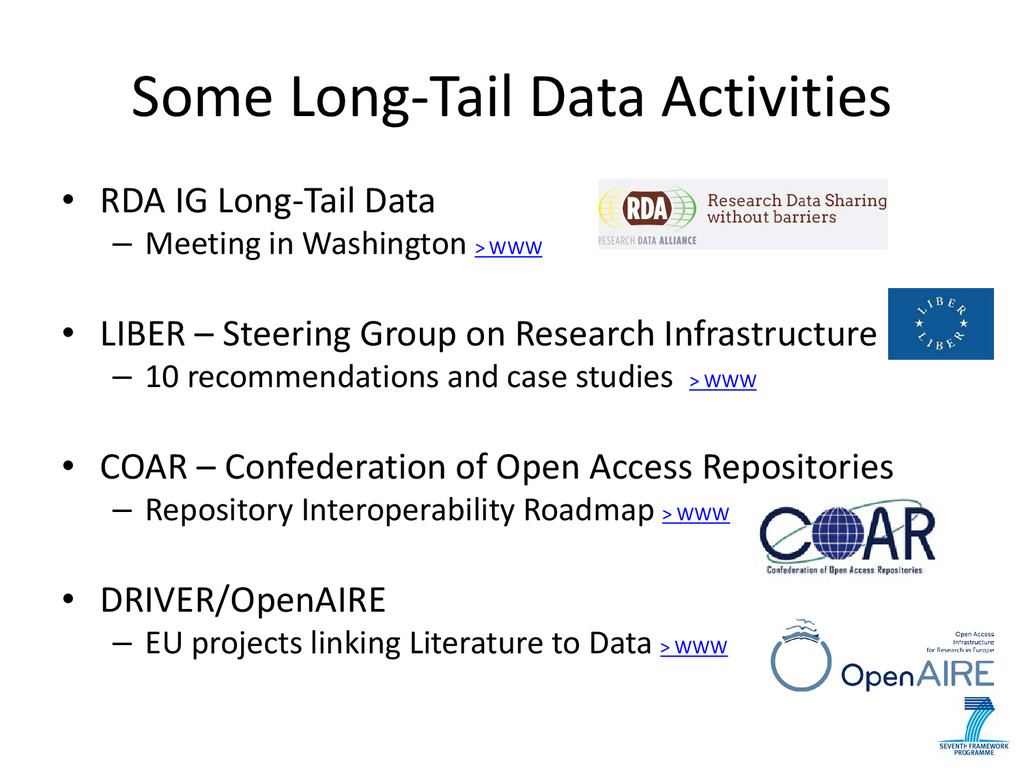
Meeting in Washington > WWW • LIBER – Steering Group on Research Infrastructure – 10 recommendations and case studies > WWW • COAR – Confederation of Open Access Repositories – Repository Interoperability Roadmap > WWW • DRIVER/OpenAIRE – EU projects linking Literature to Data > WWW


 subugoe
 sishi
sishi
 corochann
 sazimai
 s_mizuki_nlp
 ept
ept
 ldcn
ldcn
 dk999
dk999
 institutdelelevage
 pomcho555
 beale
beale
 rfujii
 kentaitakura
 brad_frost
 marktimemedia
 reverentgeek
 nwiizo
 bluesmoon
 uxyall
 marketingsoph
 tammyeverts
 eileencodes
 joshbly
 retrage
 cassininazir