Upgrade to Pro — share decks privately, control downloads, hide ads and more …

Revisiting the links-species scaling relationsh...

Revisiting the links-species scaling relationship in food webs

Presentation of this preprint at McGill University - https://www.biorxiv.org/content/10.1101/2020.02.13.947531v1

Avatar for Timothée Poisot

Timothée Poisot

February 25, 2020
Tweet

More Decks by Timothée Poisot

Other Decks in Research

Transcript

  1. cb How many links in a food web? An exercise

    in fixing something that was not broken Timothée Poisot Université de Montréal February 25, 2020
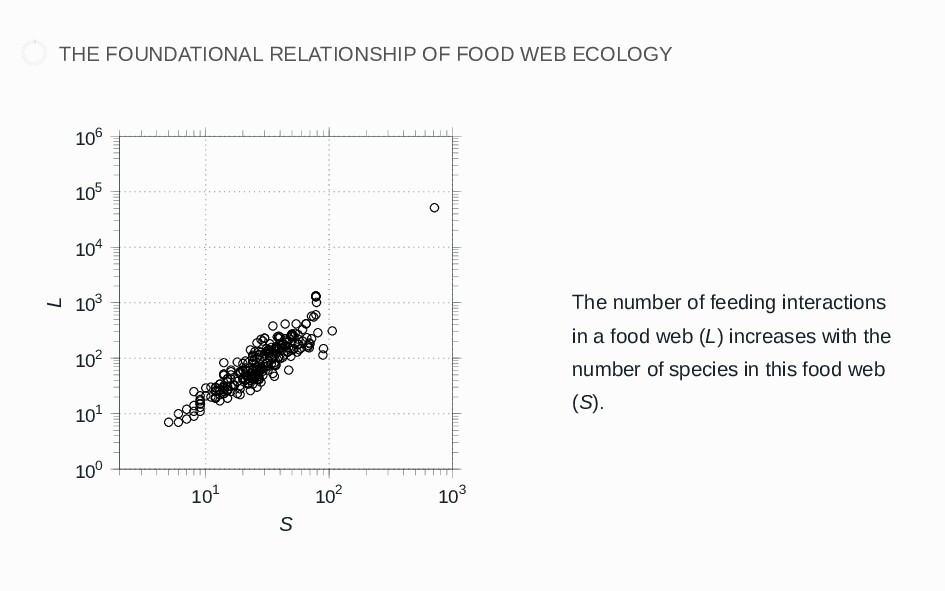
  2. THE FOUNDATIONAL RELATIONSHIP OF FOOD WEB ECOLOGY 101 102 103

    100 101 102 103 104 105 106 S L The number of feeding interactions in a food web (L) increases with the number of species in this food web (S).
  3. THANKS TO… Francis Banville ([email protected]) Andrew MacDonald ([email protected]) Revisiting the

    links­species scaling relationship in food webs Read the preprint: 10.1101/2020.02.13.947531 Get the data: 10.17605/OSF.IO/YGPZ2
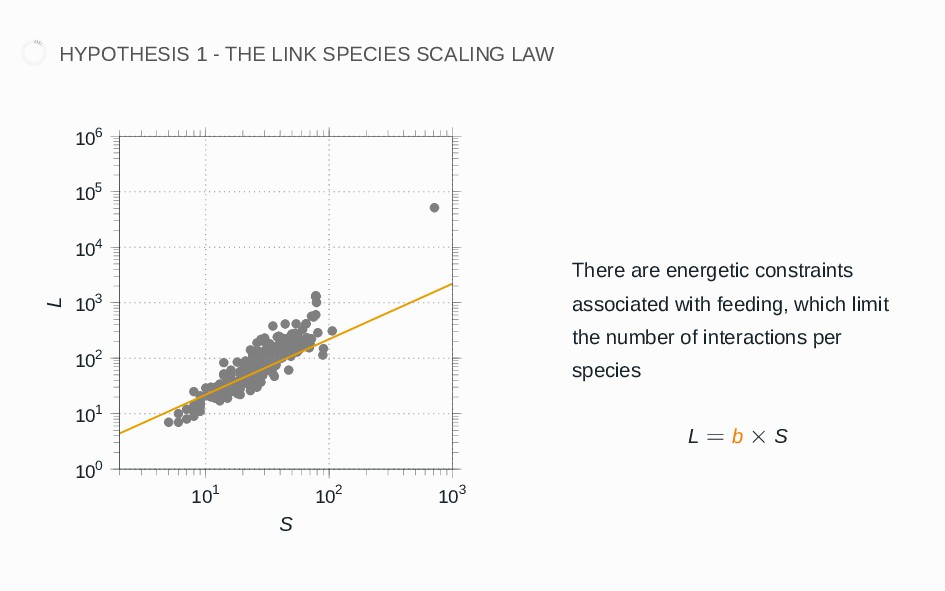
  4. HYPOTHESIS 1 ­ THE LINK SPECIES SCALING LAW 101 102

    103 100 101 102 103 104 105 106 S L There are energetic constraints associated with feeding, which limit the number of interactions per species L = b × S
  5. HYPOTHESIS 1 ­ THE LINK SPECIES SCALING LAW 101 102

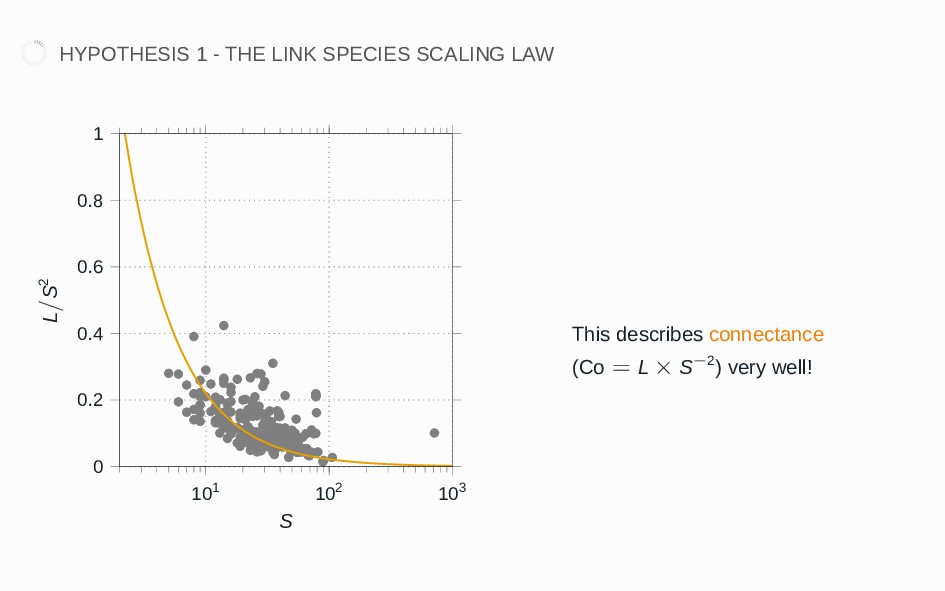
    103 0 0.2 0.4 0.6 0.8 1 S L/S2 This describes connectance (Co = L × S−2) very well!
  6. HYPOTHESIS 1 ­ THE LINK SPECIES SCALING LAW 101 102

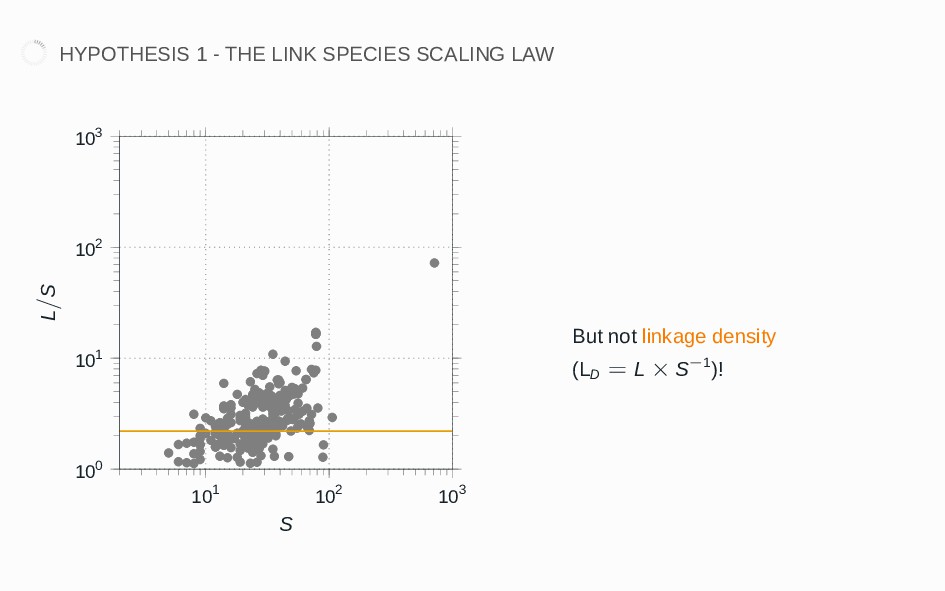
    103 100 101 102 103 S L/S But not linkage density (LD = L × S−1)!
  7. HYPOTHESIS 2 ­ CONSTANT CONNECTANCE 101 102 103 100 101

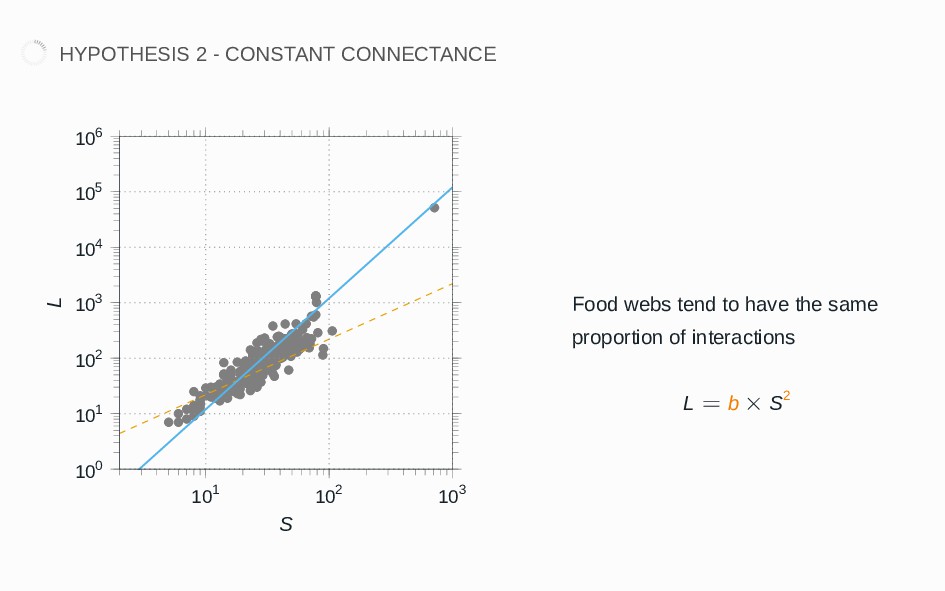
    102 103 104 105 106 S L Food webs tend to have the same proportion of interactions L = b × S2
  8. HYPOTHESIS 2 ­ CONSTANT CONNECTANCE 101 102 103 0 0.2

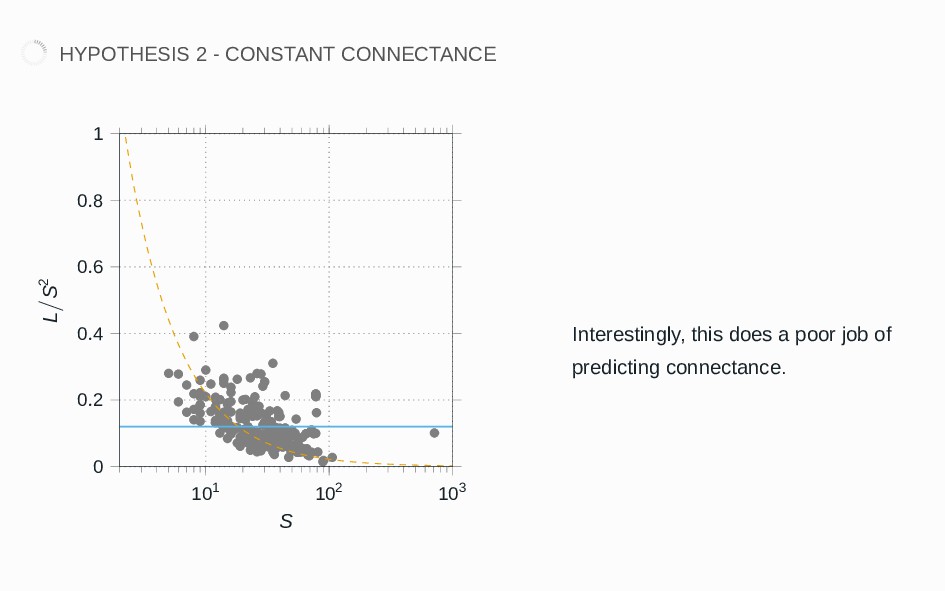
    0.4 0.6 0.8 1 S L/S2 Interestingly, this does a poor job of predicting connectance.
  9. HYPOTHESIS 2 ­ CONSTANT CONNECTANCE 101 102 103 100 101

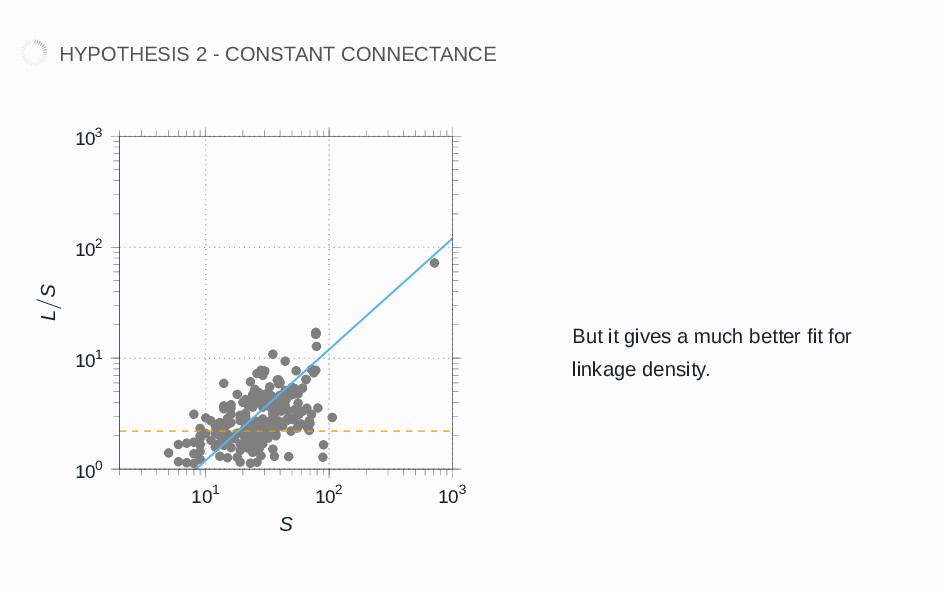
    102 103 S L/S But it gives a much better fit for linkage density.
  10. HYPOTHESIS 3 ­ POWER LAW 101 102 103 100 101

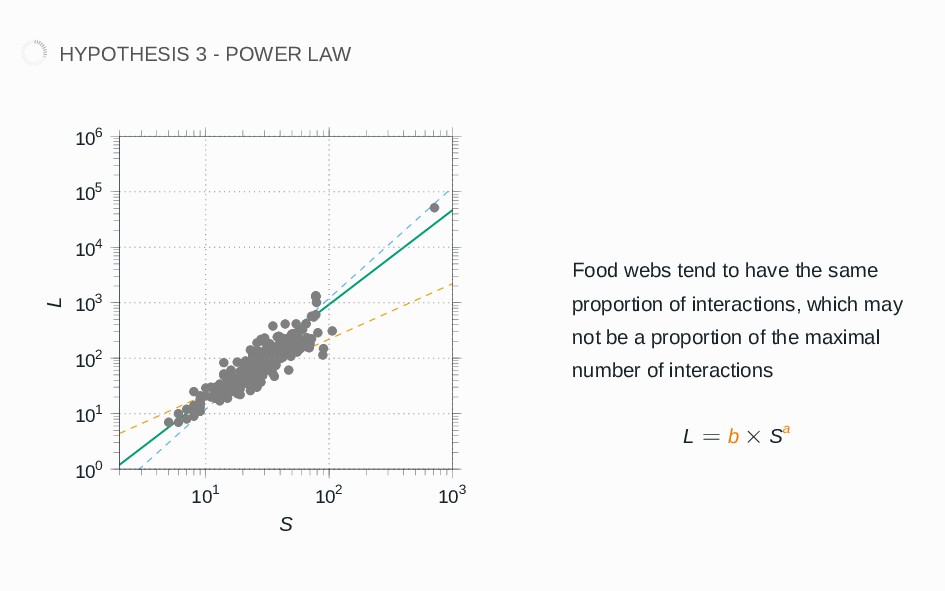
    102 103 104 105 106 S L Food webs tend to have the same proportion of interactions, which may not be a proportion of the maximal number of interactions L = b × Sa
  11. HYPOTHESIS 3 ­ POWER LAW 101 102 103 0 0.2

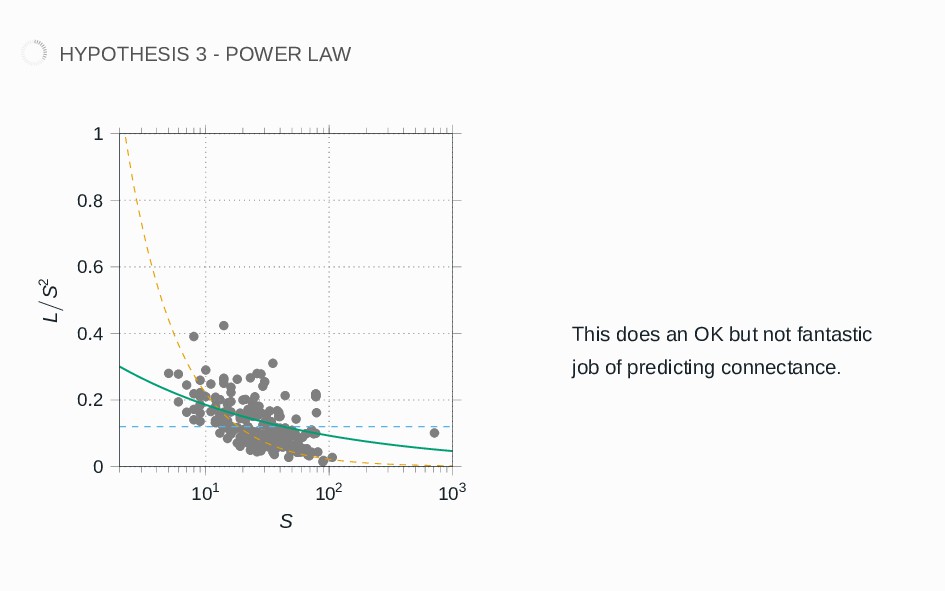
    0.4 0.6 0.8 1 S L/S2 This does an OK but not fantastic job of predicting connectance.
  12. HYPOTHESIS 3 ­ POWER LAW 101 102 103 100 101

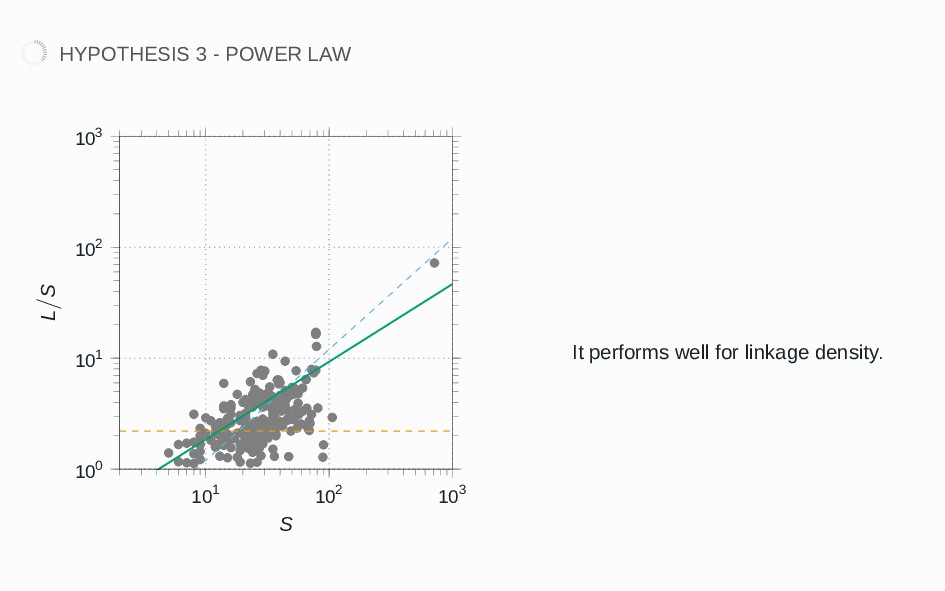
    102 103 S L/S It performs well for linkage density.
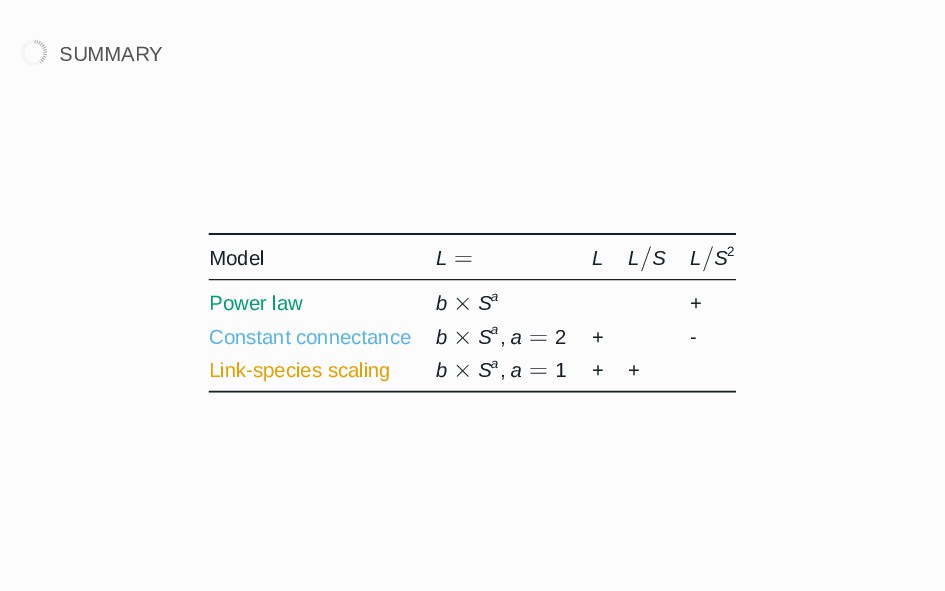
  13. SUMMARY Model L = L L/S L/S2 Power law b

    × Sa + Constant connectance b × Sa, a = 2 + ­ Link­species scaling b × Sa, a = 1 + +
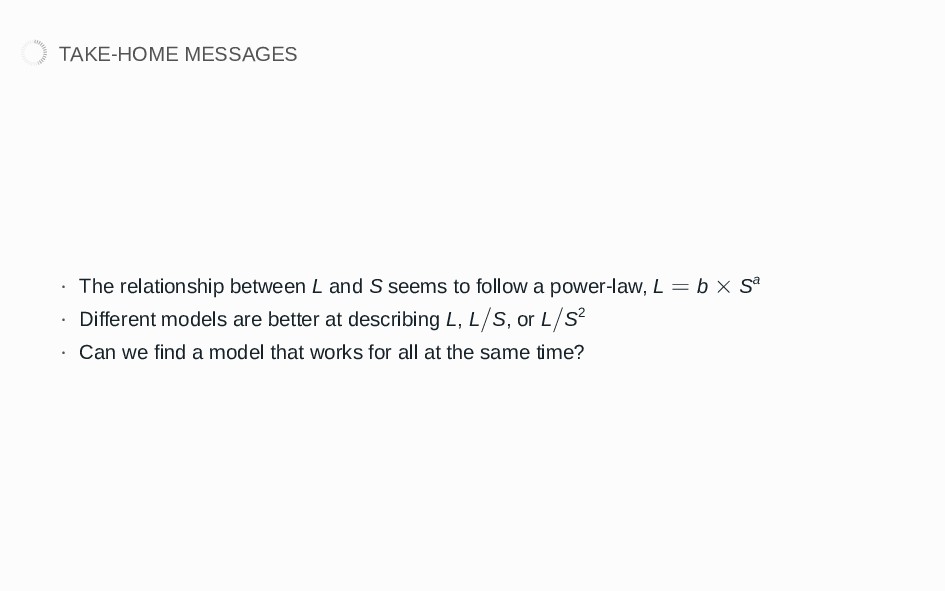
  14. TAKE­HOME MESSAGES · The relationship between L and S seems

    to follow a power­law, L = b × Sa · Different models are better at describing L, L/S, or L/S2 · Can we find a model that works for all at the same time?
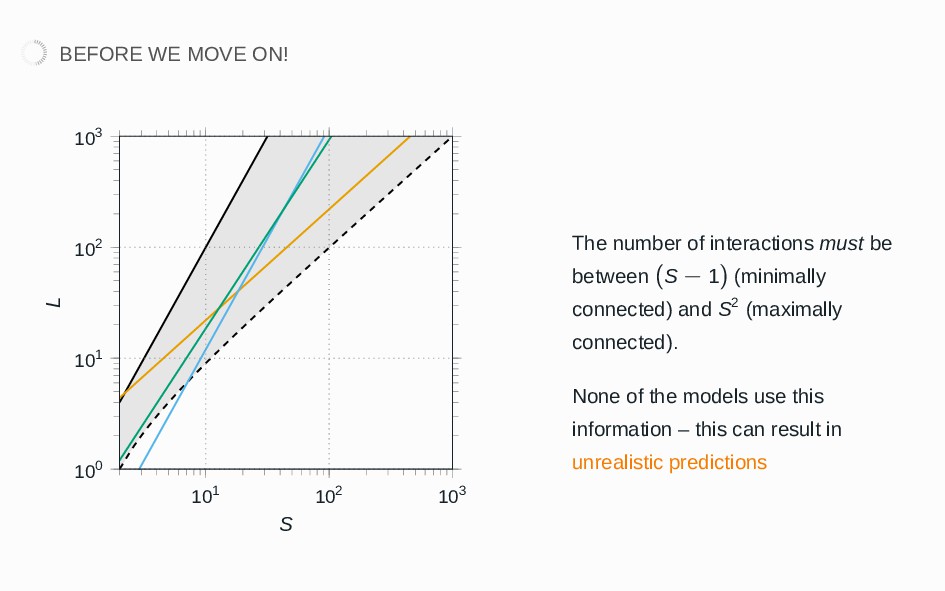
  15. BEFORE WE MOVE ON! 101 102 103 100 101 102

    103 S L The number of interactions must be between (S − 1) (minimally connected) and S2 (maximally connected). None of the models use this information – this can result in unrealistic predictions
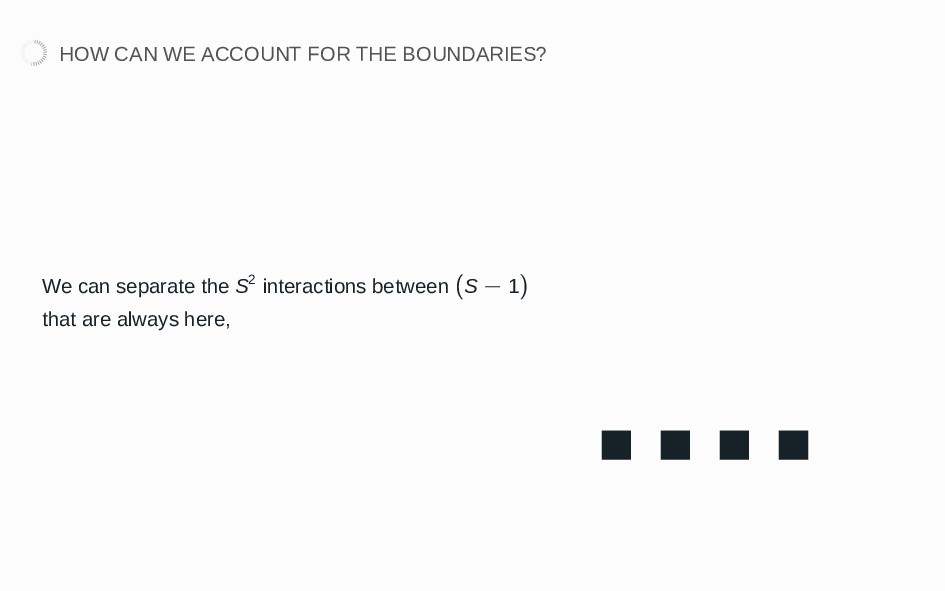
  16. HOW CAN WE ACCOUNT FOR THE BOUNDARIES? We can separate

    the S2 interactions between (S − 1) that are always here,
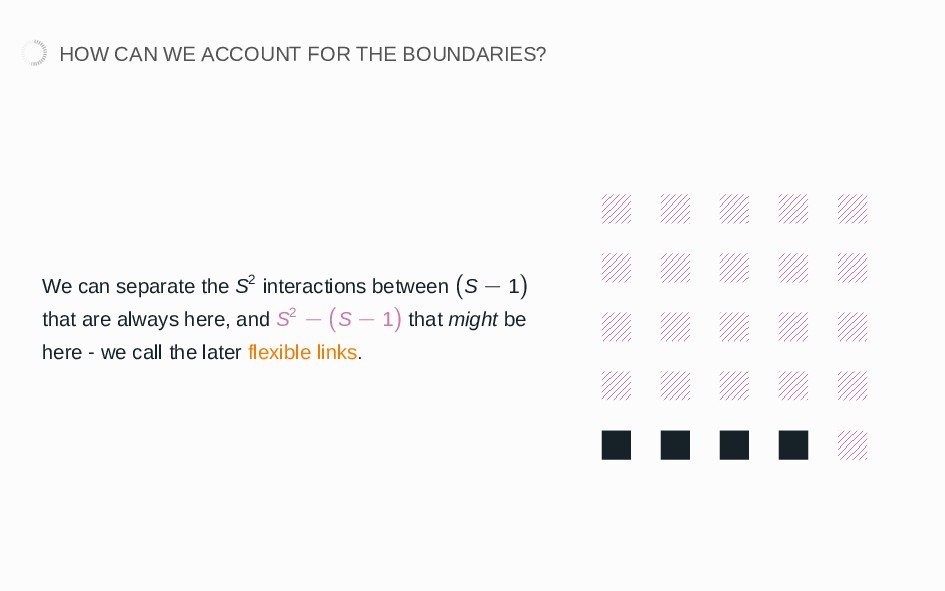
  17. HOW CAN WE ACCOUNT FOR THE BOUNDARIES? We can separate

    the S2 interactions between (S − 1) that are always here, and S2 − (S − 1) that might be here ­ we call the later flexible links.
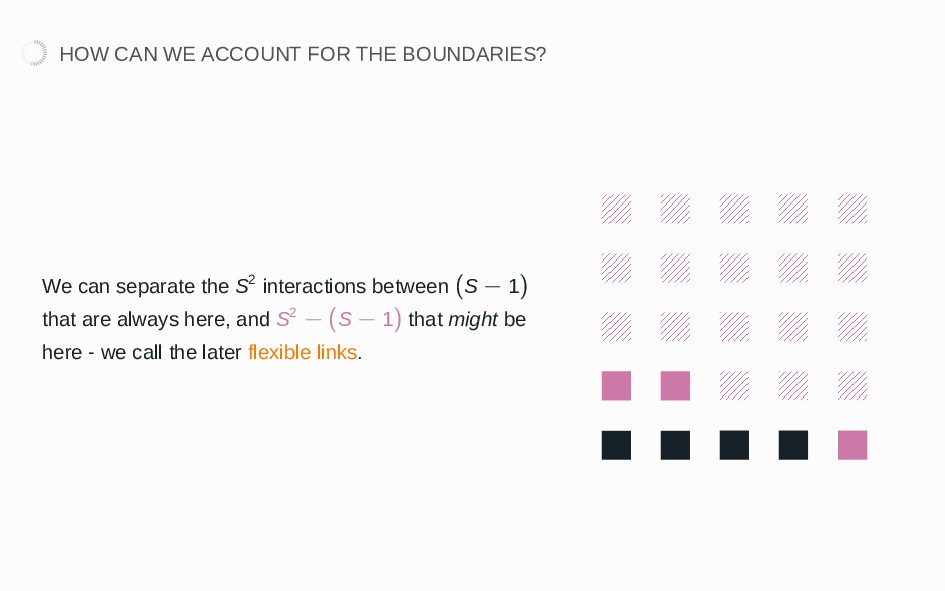
  18. HOW CAN WE ACCOUNT FOR THE BOUNDARIES? We can separate

    the S2 interactions between (S − 1) that are always here, and S2 − (S − 1) that might be here ­ we call the later flexible links.
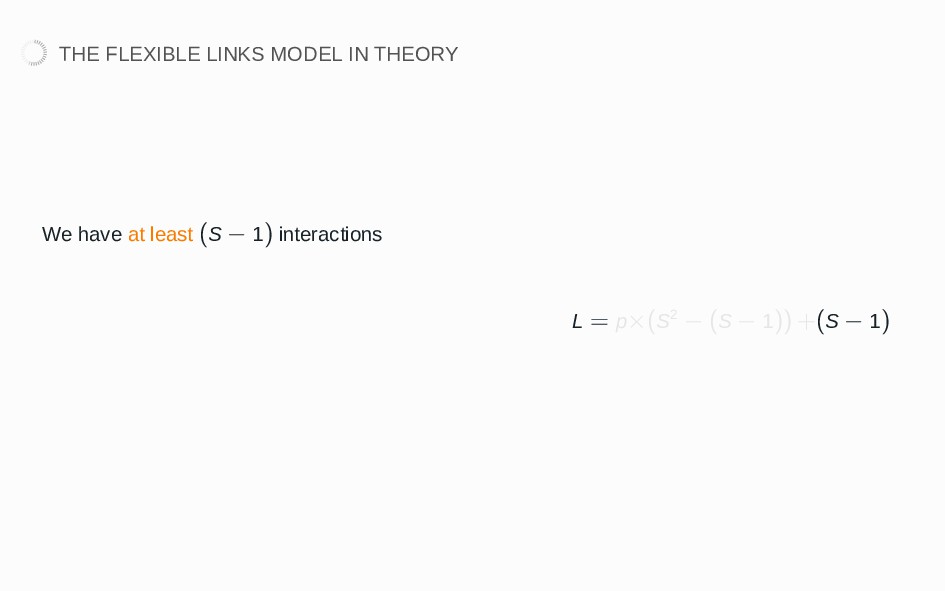
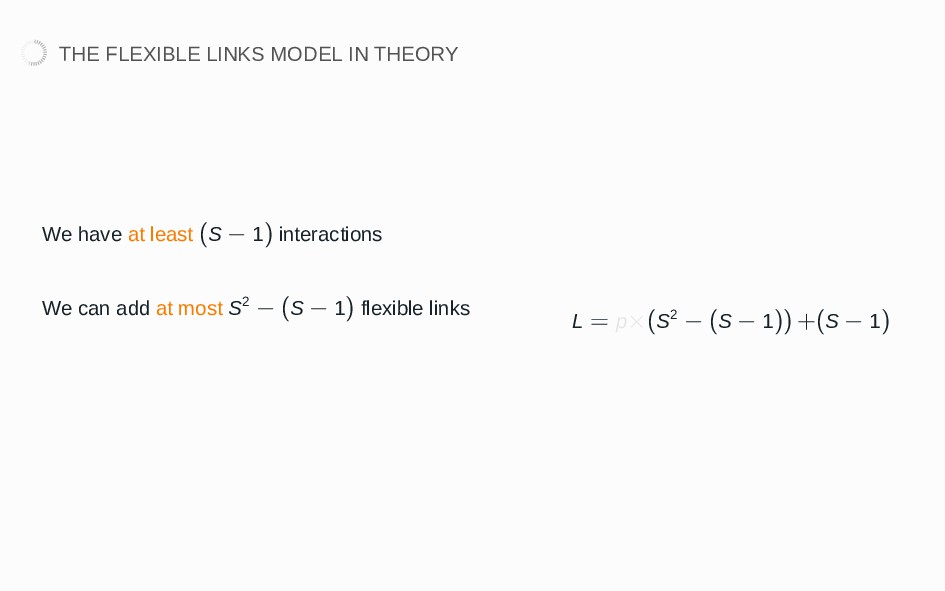
  19. THE FLEXIBLE LINKS MODEL IN THEORY We have at least

    (S − 1) interactions L = p×(S2 − (S − 1)) +(S − 1)
  20. THE FLEXIBLE LINKS MODEL IN THEORY We have at least

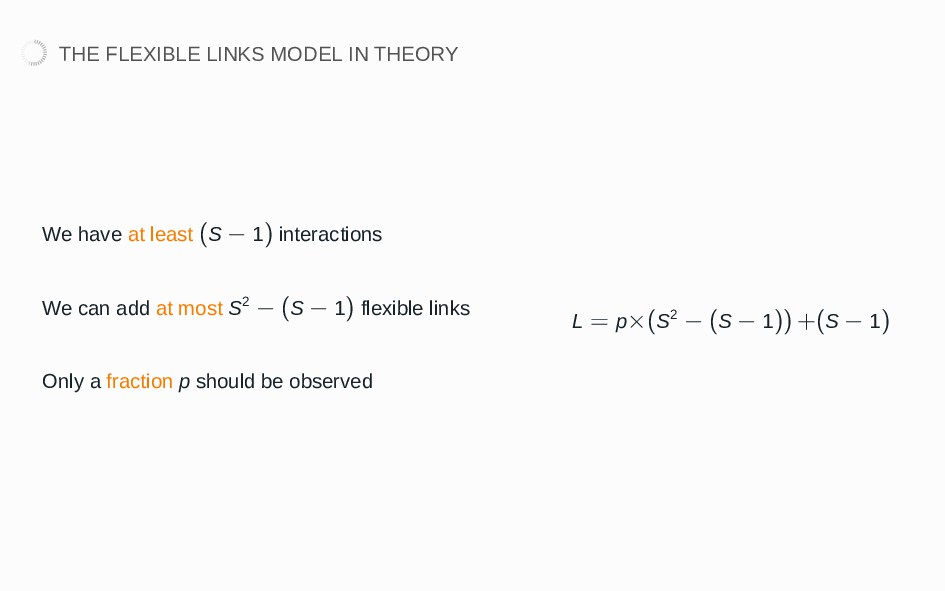
    (S − 1) interactions We can add at most S2 − (S − 1) flexible links L = p×(S2 − (S − 1)) +(S − 1)
  21. THE FLEXIBLE LINKS MODEL IN THEORY We have at least

    (S − 1) interactions We can add at most S2 − (S − 1) flexible links Only a fraction p should be observed L = p×(S2 − (S − 1)) +(S − 1)
  22. THE FLEXIBLE LINKS MODEL IN PRACTICE [L|S, μ, φ] =

    ( S2 − (S − 1) L − (S − 1) ) B (L − (S − 1) + μφ, S2 − L + (1 − μ)φ) B(μφ, (1 − μ)φ)
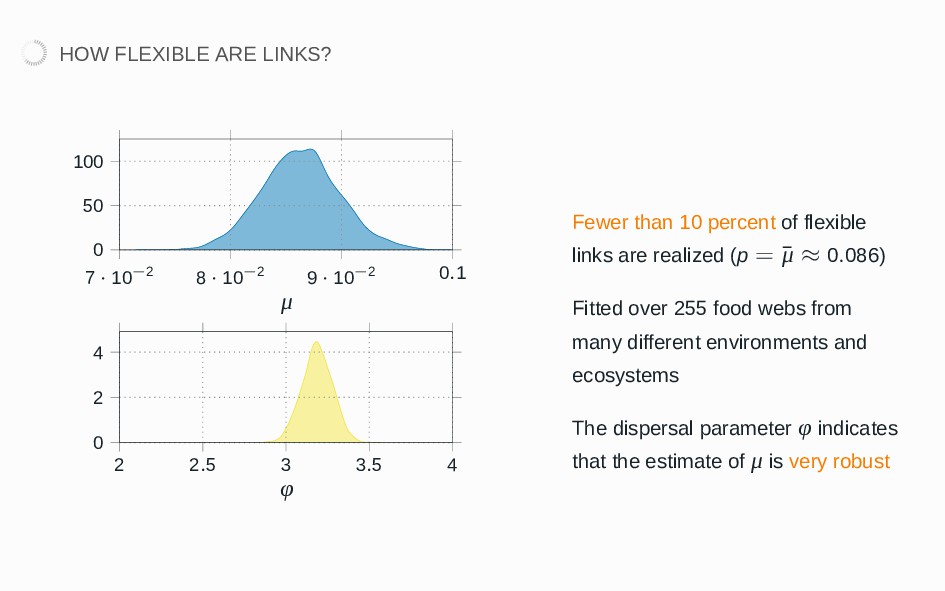
  23. HOW FLEXIBLE ARE LINKS? 7 · 10−2 8 · 10−2

    9 · 10−2 0.1 0 50 100 μ 2 2.5 3 3.5 4 0 2 4 φ Fewer than 10 percent of flexible links are realized (p = ¯ μ ≈ 0.086) Fitted over 255 food webs from many different environments and ecosystems The dispersal parameter φ indicates that the estimate of μ is very robust
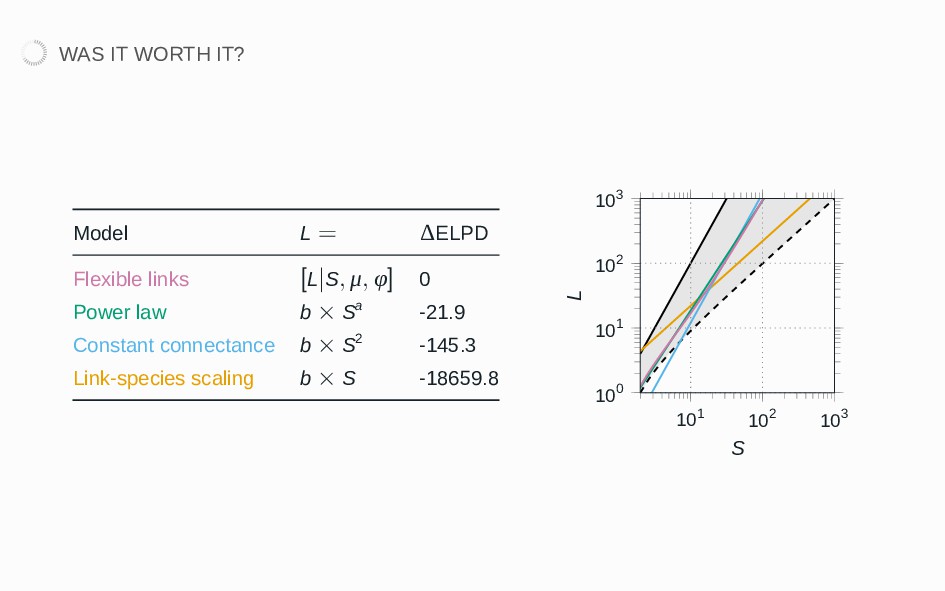
  24. WAS IT WORTH IT? Model L = ΔELPD Flexible links

    [L|S, μ, φ] 0 Power law b × Sa ­21.9 Constant connectance b × S2 ­145.3 Link­species scaling b × S ­18659.8 101 102 103 100 101 102 103 S L
  25. YES IT WAS! 101 102 0 0.1 0.2 0.3 0.4

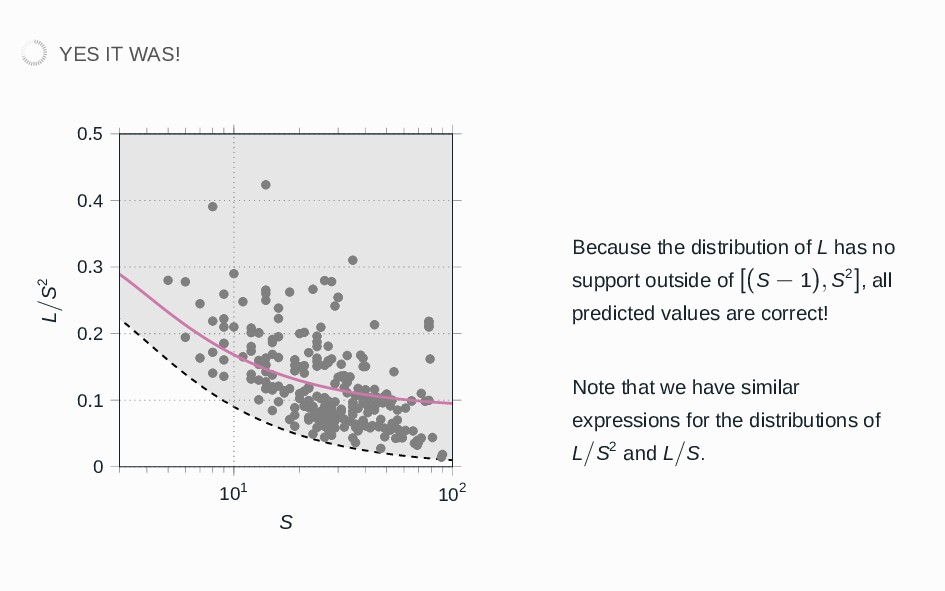
    0.5 S L/S2 Because the distribution of L has no support outside of [(S − 1), S2], all predicted values are correct! Note that we have similar expressions for the distributions of L/S2 and L/S.
  26. YES IT WAS! 101 102 0 0.1 0.2 0.3 0.4

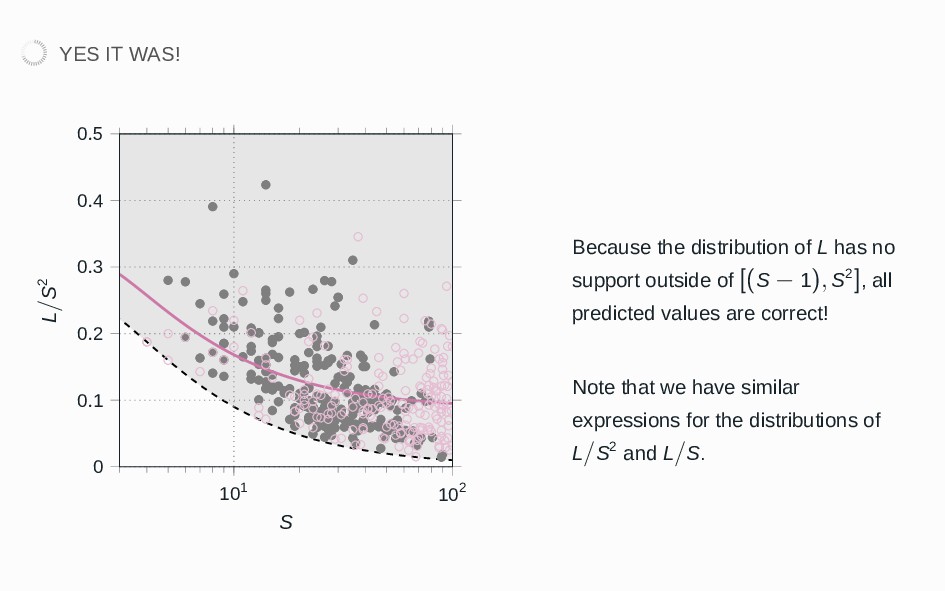
    0.5 S L/S2 Because the distribution of L has no support outside of [(S − 1), S2], all predicted values are correct! Note that we have similar expressions for the distributions of L/S2 and L/S.
  27. TAKE­HOME MESSAGES · We can model the number of links

    by looking at the proportion of flexible links · This has better fit than the previous models · This also always return predictions within the boundaries
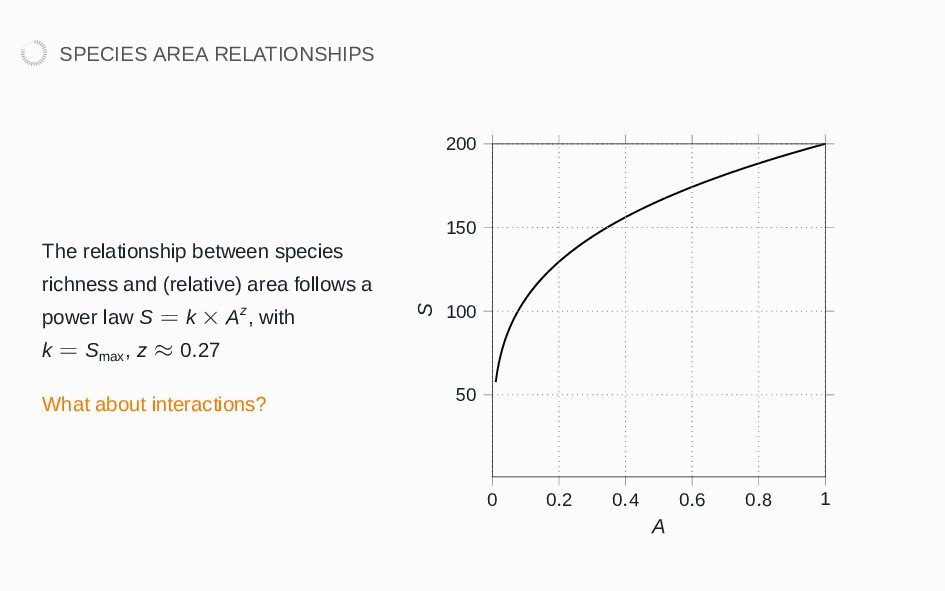
  28. SPECIES AREA RELATIONSHIPS The relationship between species richness and (relative)

    area follows a power law S = k × Az, with k = Smax , z ≈ 0.27 What about interactions? 0 0.2 0.4 0.6 0.8 1 50 100 150 200 A S
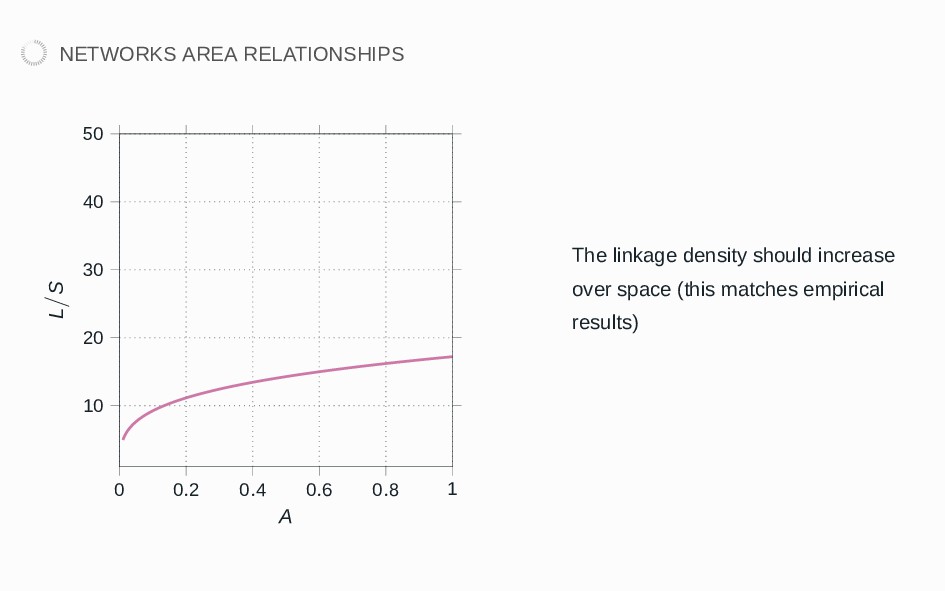
  29. NETWORKS AREA RELATIONSHIPS 0 0.2 0.4 0.6 0.8 1 10

    20 30 40 50 A L/S The linkage density should increase over space (this matches empirical results)
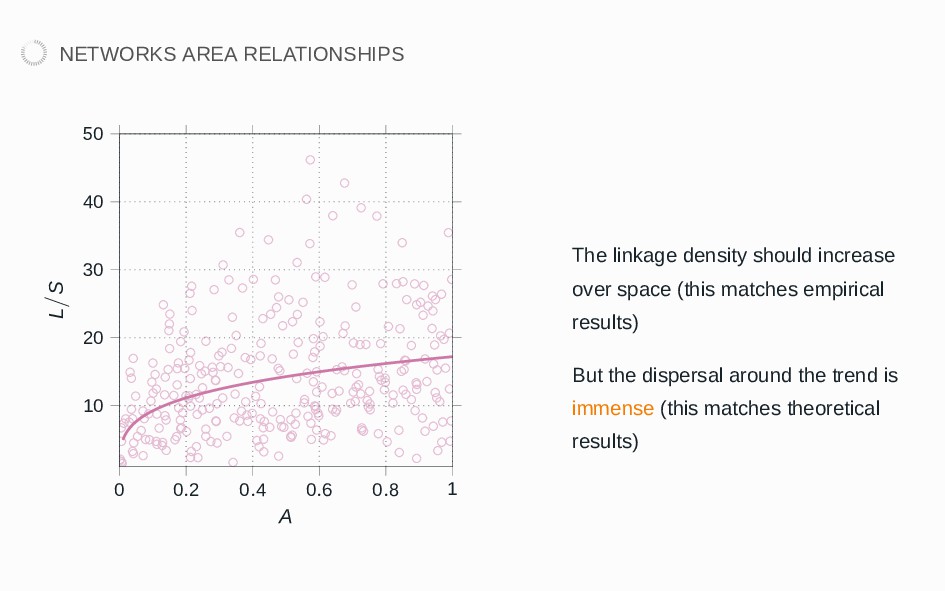
  30. NETWORKS AREA RELATIONSHIPS 0 0.2 0.4 0.6 0.8 1 10

    20 30 40 50 A L/S The linkage density should increase over space (this matches empirical results) But the dispersal around the trend is immense (this matches theoretical results)
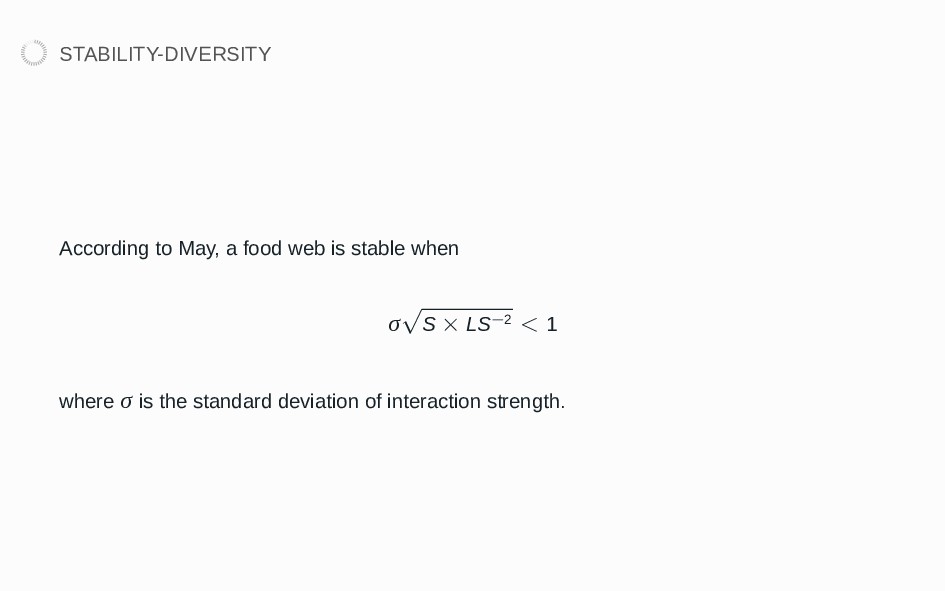
  31. STABILITY­DIVERSITY According to May, a food web is stable when

    σ √ S × LS−2 < 1 where σ is the standard deviation of interaction strength.
  32. STABILITY­DIVERSITY The maximal standard deviation of interaction strength is σ⋆

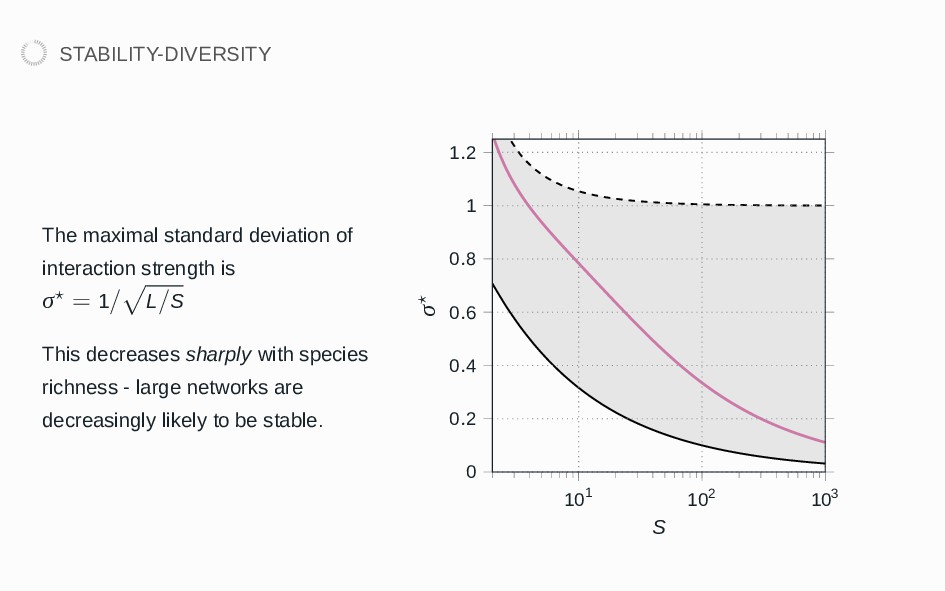
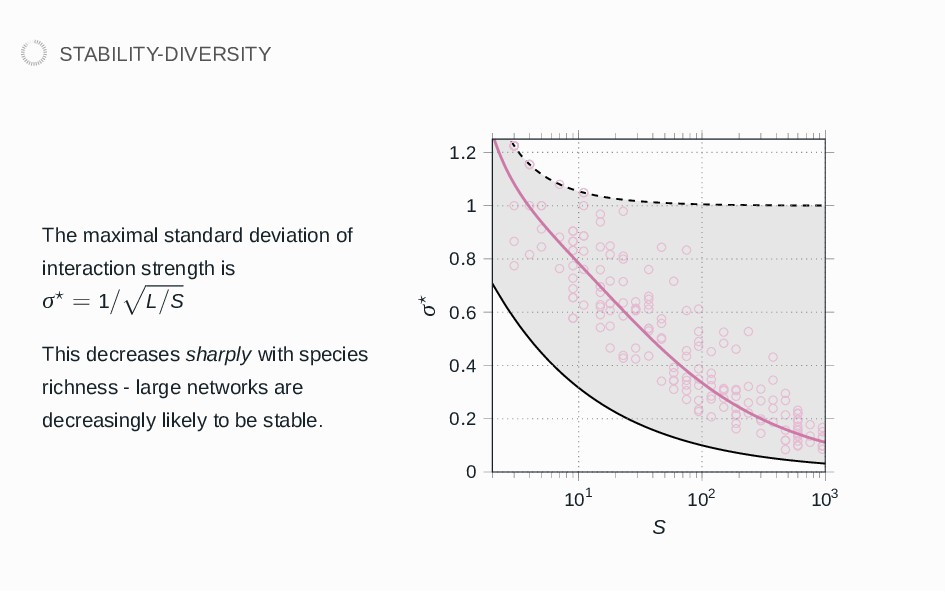
    = 1/ √ L/S This decreases sharply with species richness ­ large networks are decreasingly likely to be stable. 101 102 103 0 0.2 0.4 0.6 0.8 1 1.2 S σ⋆
  33. STABILITY­DIVERSITY The maximal standard deviation of interaction strength is σ⋆

    = 1/ √ L/S This decreases sharply with species richness ­ large networks are decreasingly likely to be stable. 101 102 103 0 0.2 0.4 0.6 0.8 1 1.2 S σ⋆
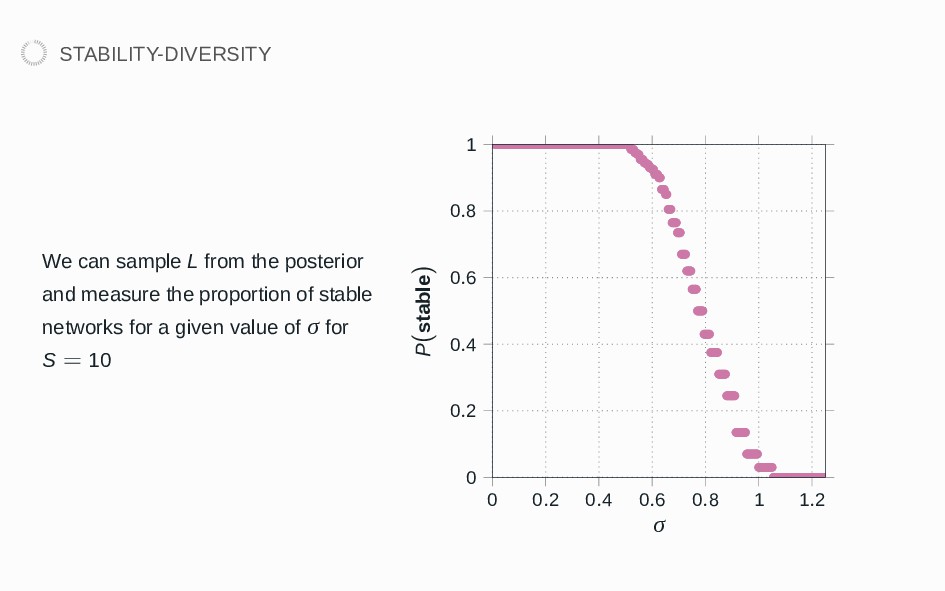
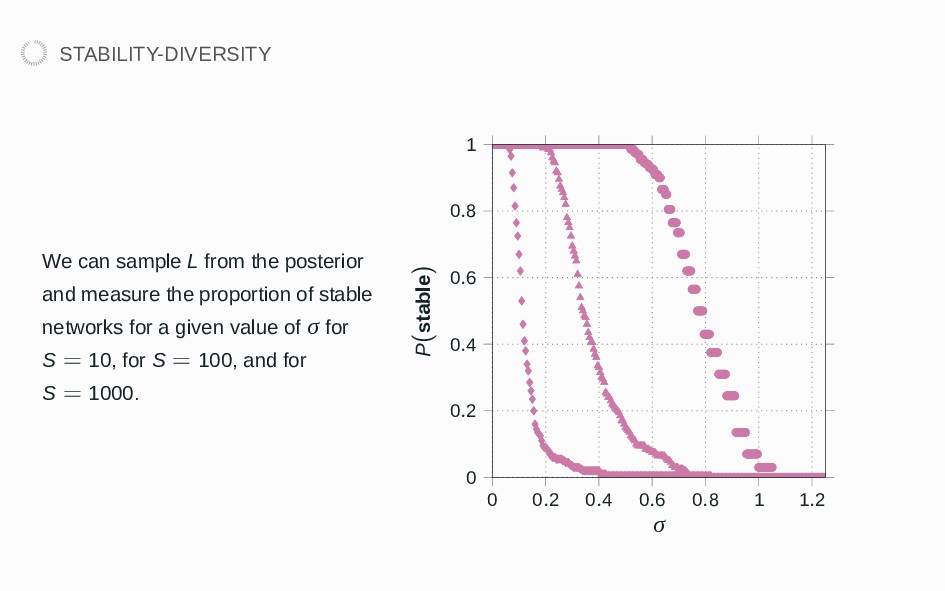
  34. STABILITY­DIVERSITY We can sample L from the posterior and measure

    the proportion of stable networks for a given value of σ for S = 10 0 0.2 0.4 0.6 0.8 1 1.2 0 0.2 0.4 0.6 0.8 1 σ P(stable)
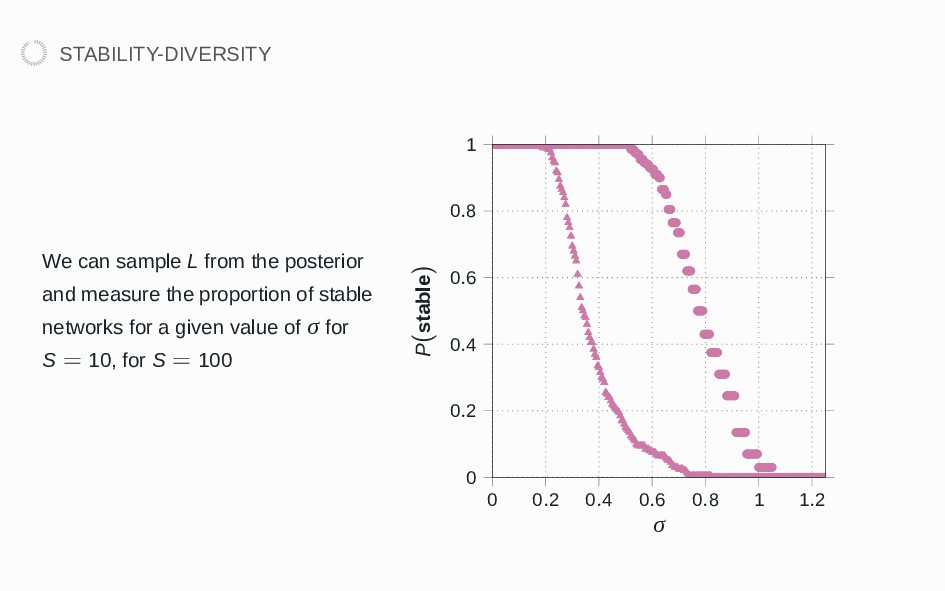
  35. STABILITY­DIVERSITY We can sample L from the posterior and measure

    the proportion of stable networks for a given value of σ for S = 10, for S = 100 0 0.2 0.4 0.6 0.8 1 1.2 0 0.2 0.4 0.6 0.8 1 σ P(stable)
  36. STABILITY­DIVERSITY We can sample L from the posterior and measure

    the proportion of stable networks for a given value of σ for S = 10, for S = 100, and for S = 1000. 0 0.2 0.4 0.6 0.8 1 1.2 0 0.2 0.4 0.6 0.8 1 σ P(stable)
  37. TAKE­HOME MESSAGES · The flexible links model reaches the same

    results as previous studies · It also removes the guesswork when deciding on food web connectance for several applications