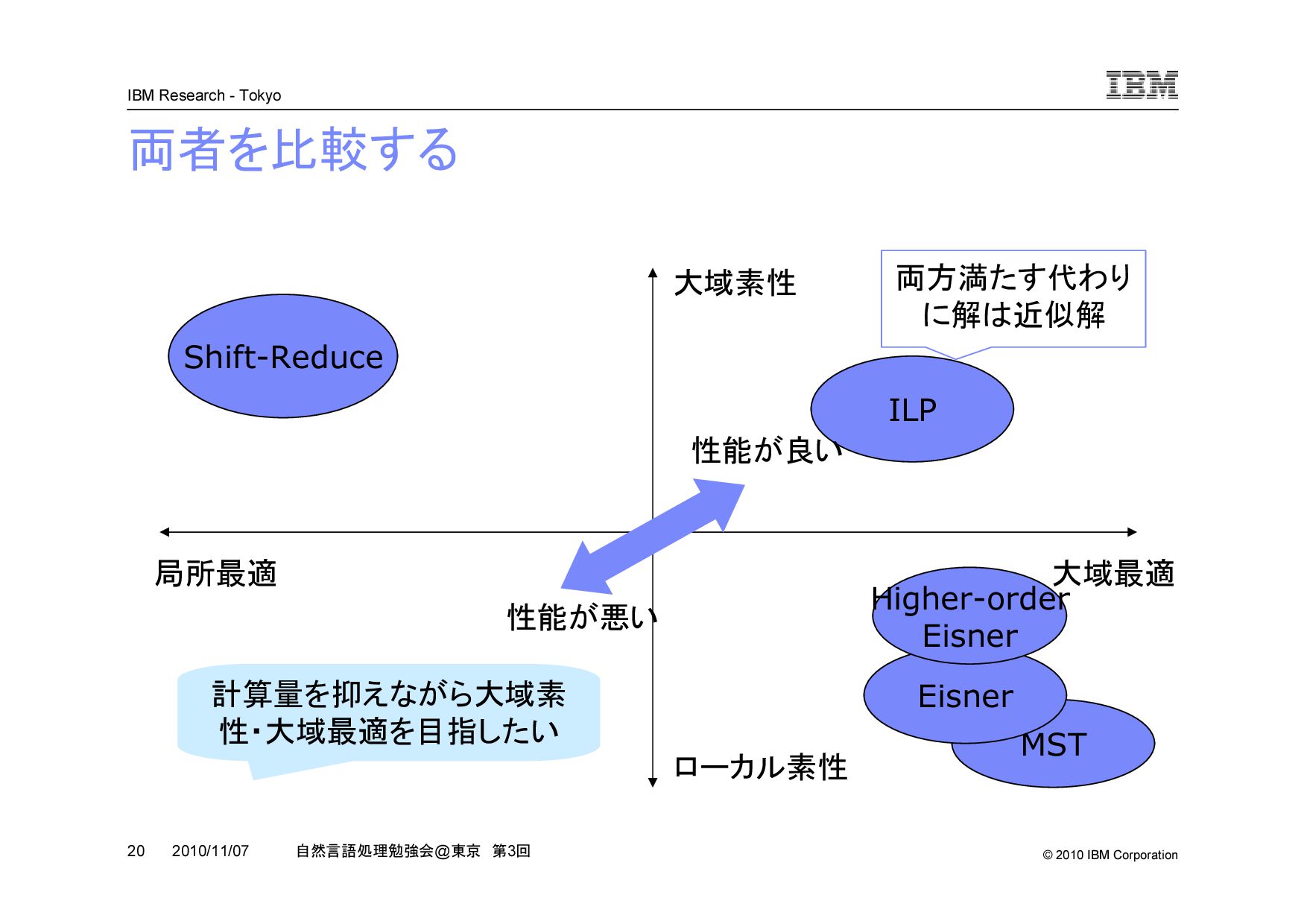
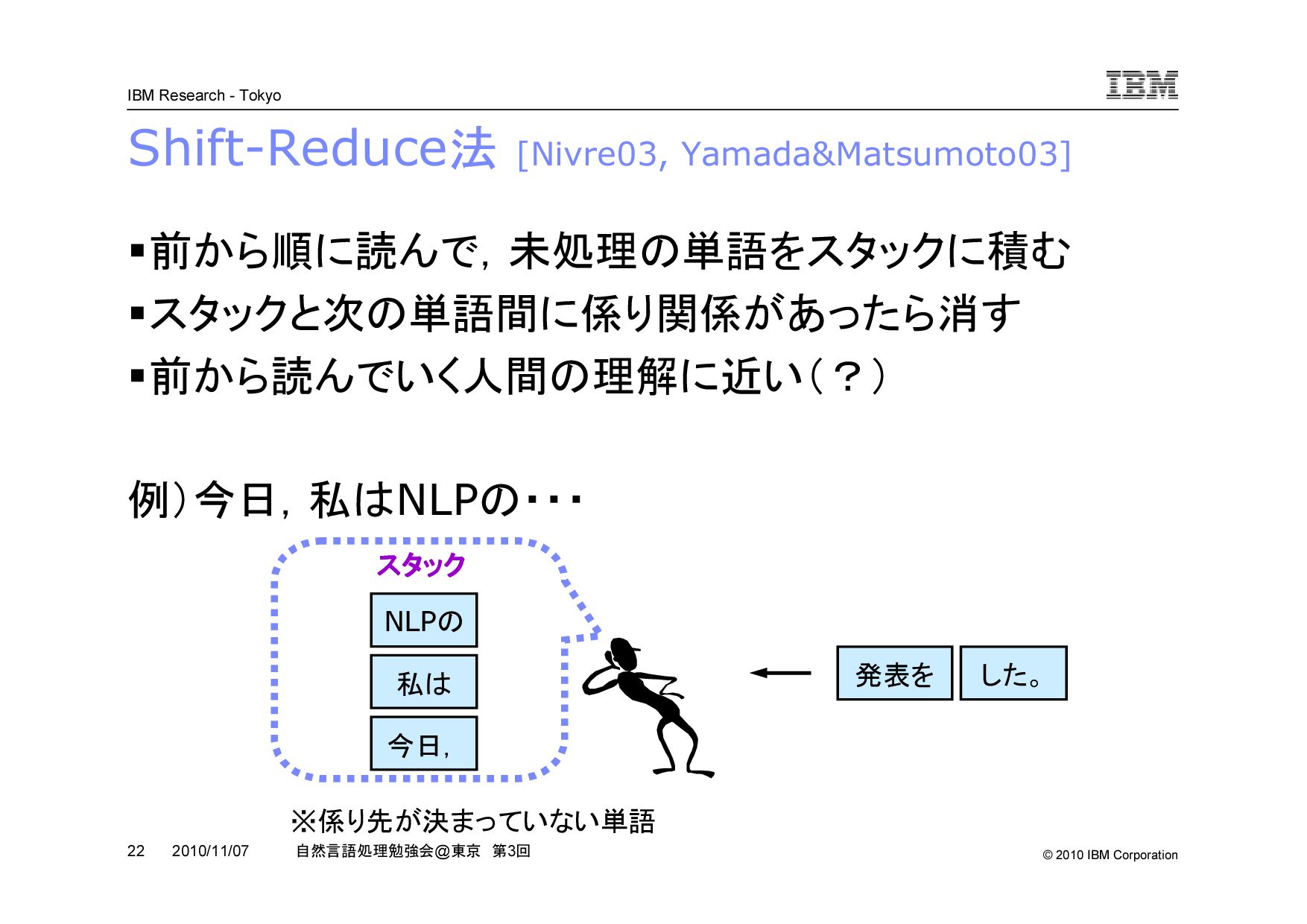
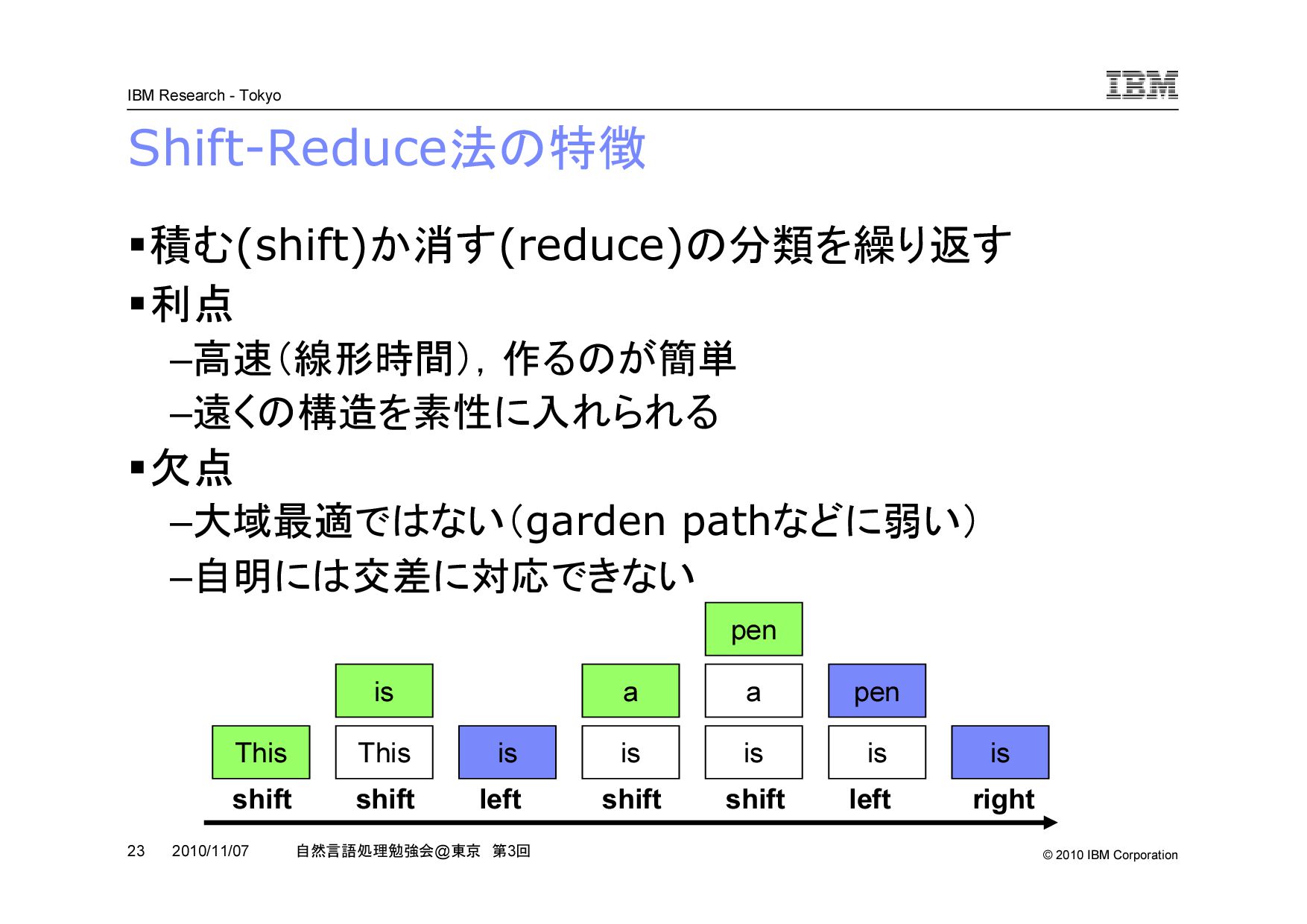
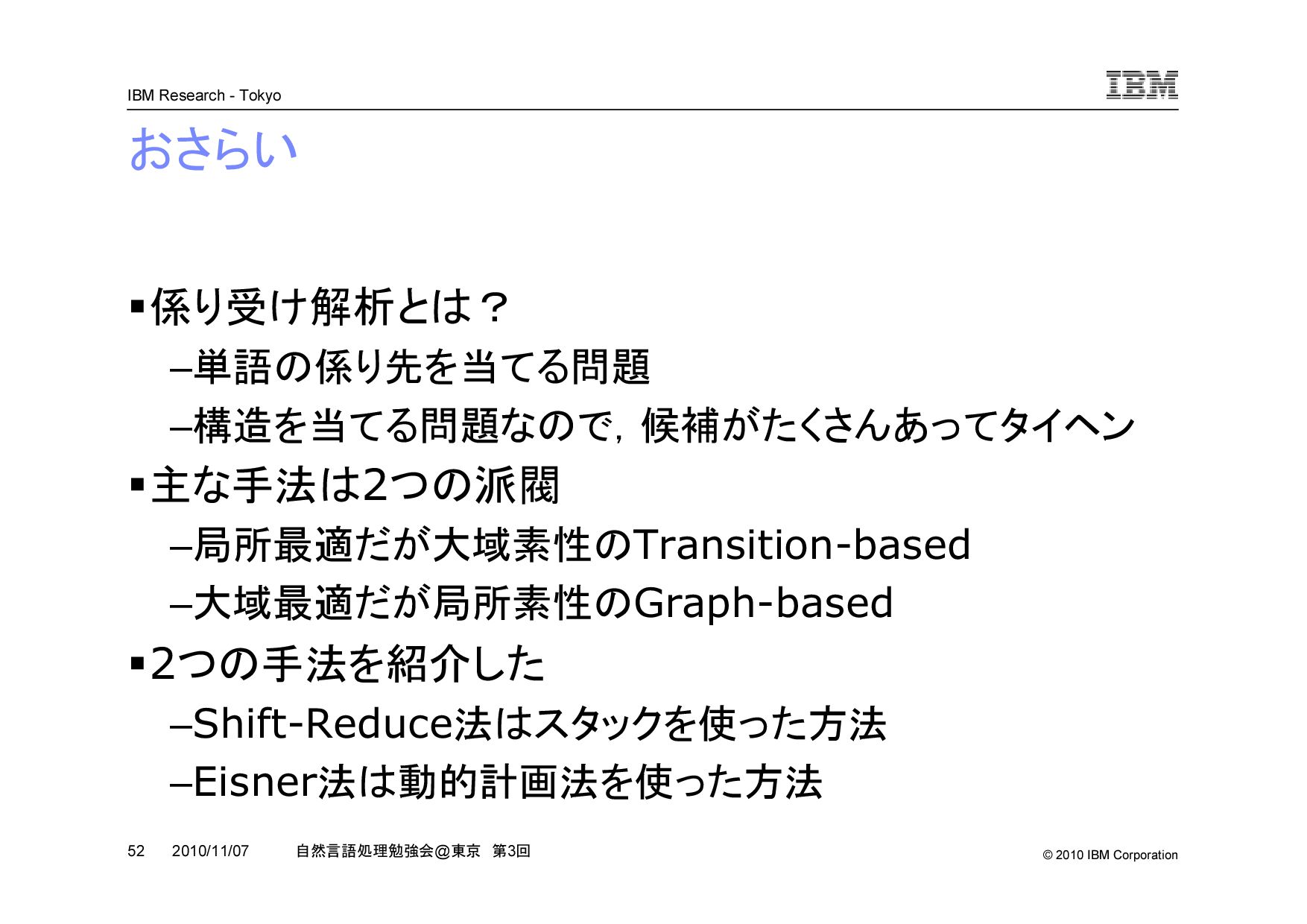
@ 東京 第 3 回 2010/11/07 Shift-Reduce 法の特徴 積む (shift) か消す (reduce) の分類を繰り返す 利点 –高速(線形時間),作るのが簡単 –遠くの構造を素性に入れられる 欠点 –大域最適ではない( garden path などに弱い) –自明には交差に対応できない This This is is is a is a is pen is pen shift shift left shift shift left right
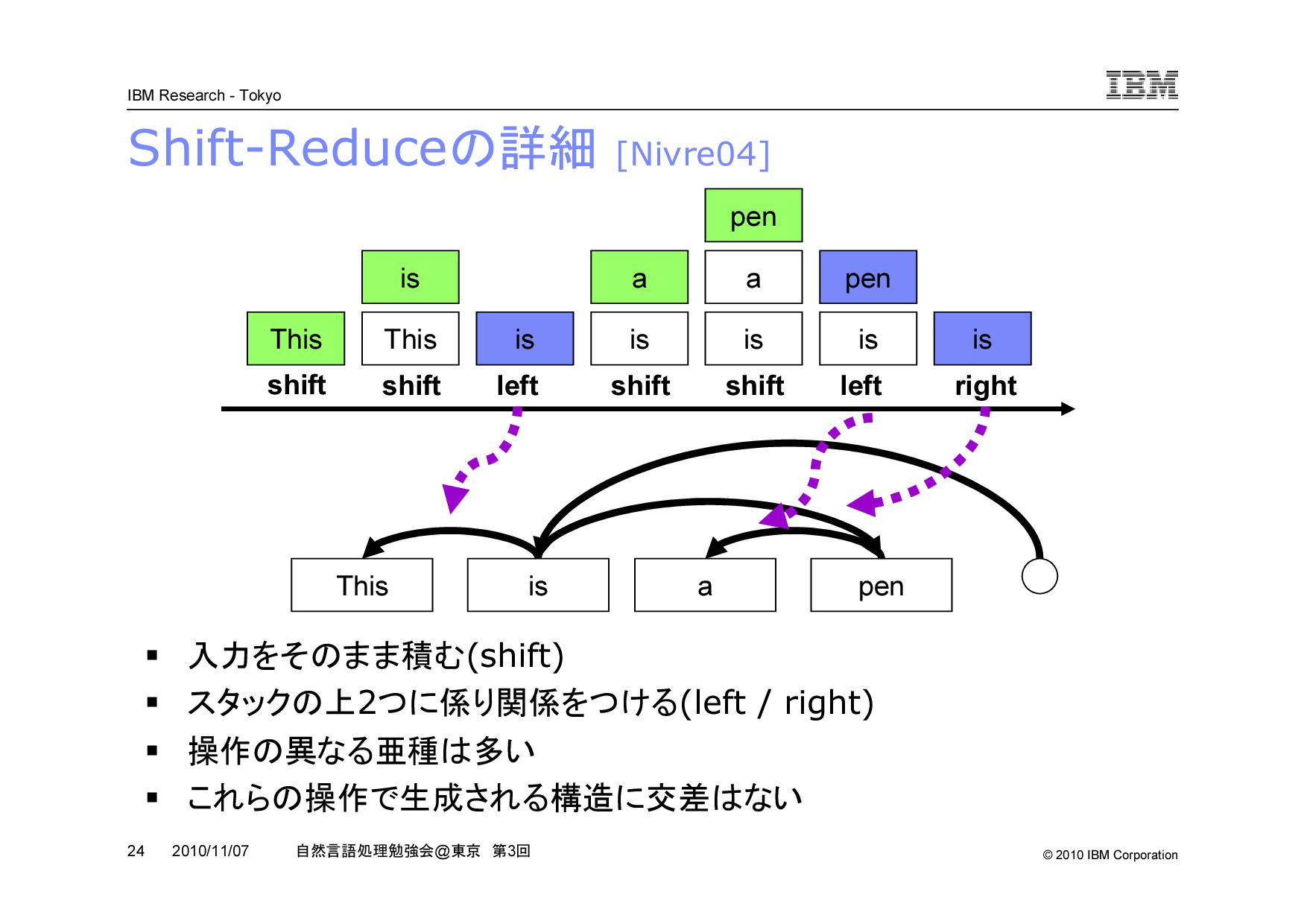
@ 東京 第 3 回 2010/11/07 Shift-Reduce の詳細 [Nivre04] 入力をそのまま積む (shift) スタックの上 2 つに係り関係をつける (left / right) 操作の異なる亜種は多い これらの操作で生成される構造に交差はない This is a pen This This is is is a is a is pen is pen shift shift left shift shift left right
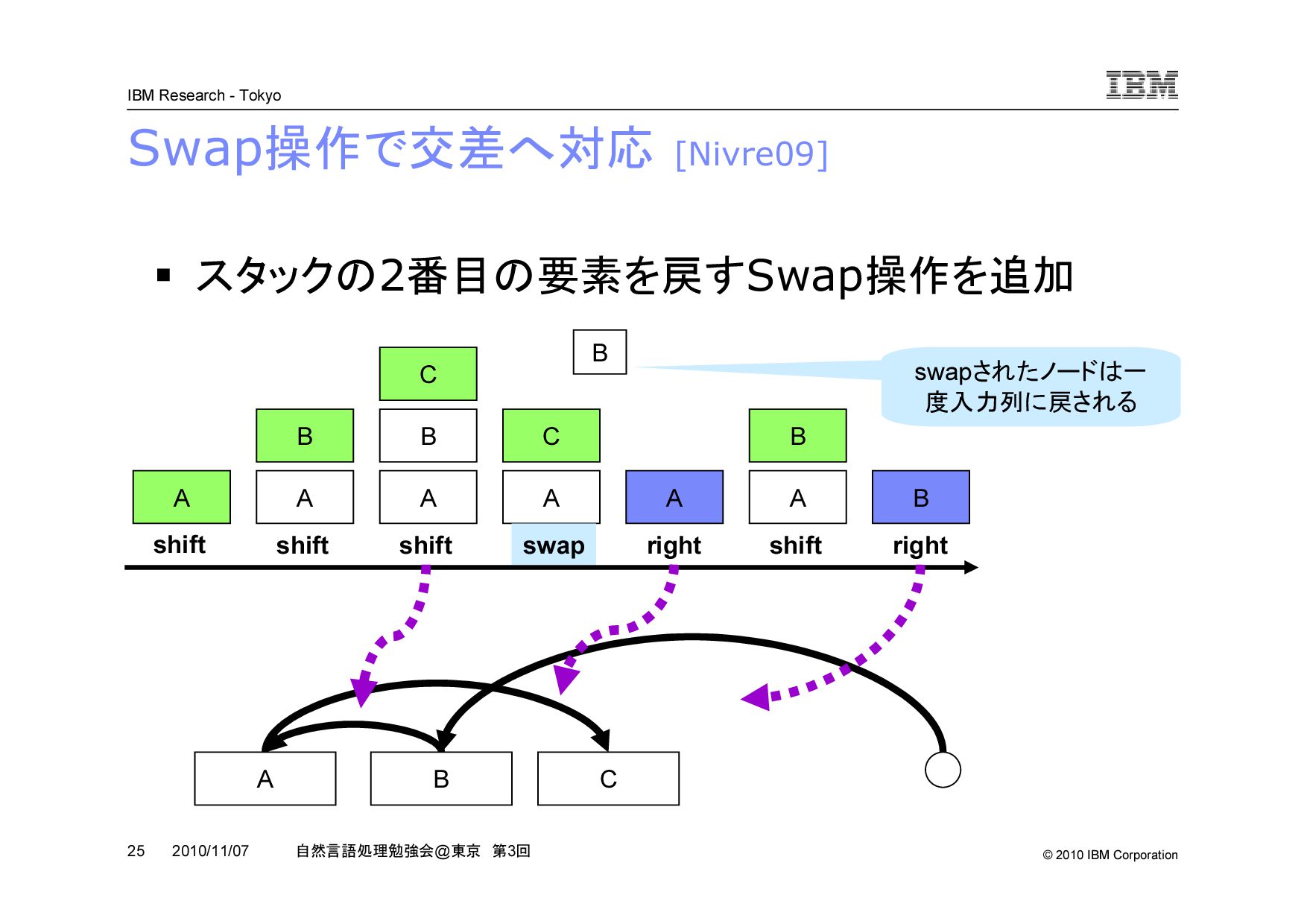
@ 東京 第 3 回 2010/11/07 Swap 操作で交差へ対応 [Nivre09] スタックの 2 番目の要素を戻す Swap 操作を追加 A B C A A B A C A A B B shift shift shift swap right shift right A C B B swap されたノードは一 度入力列に戻される
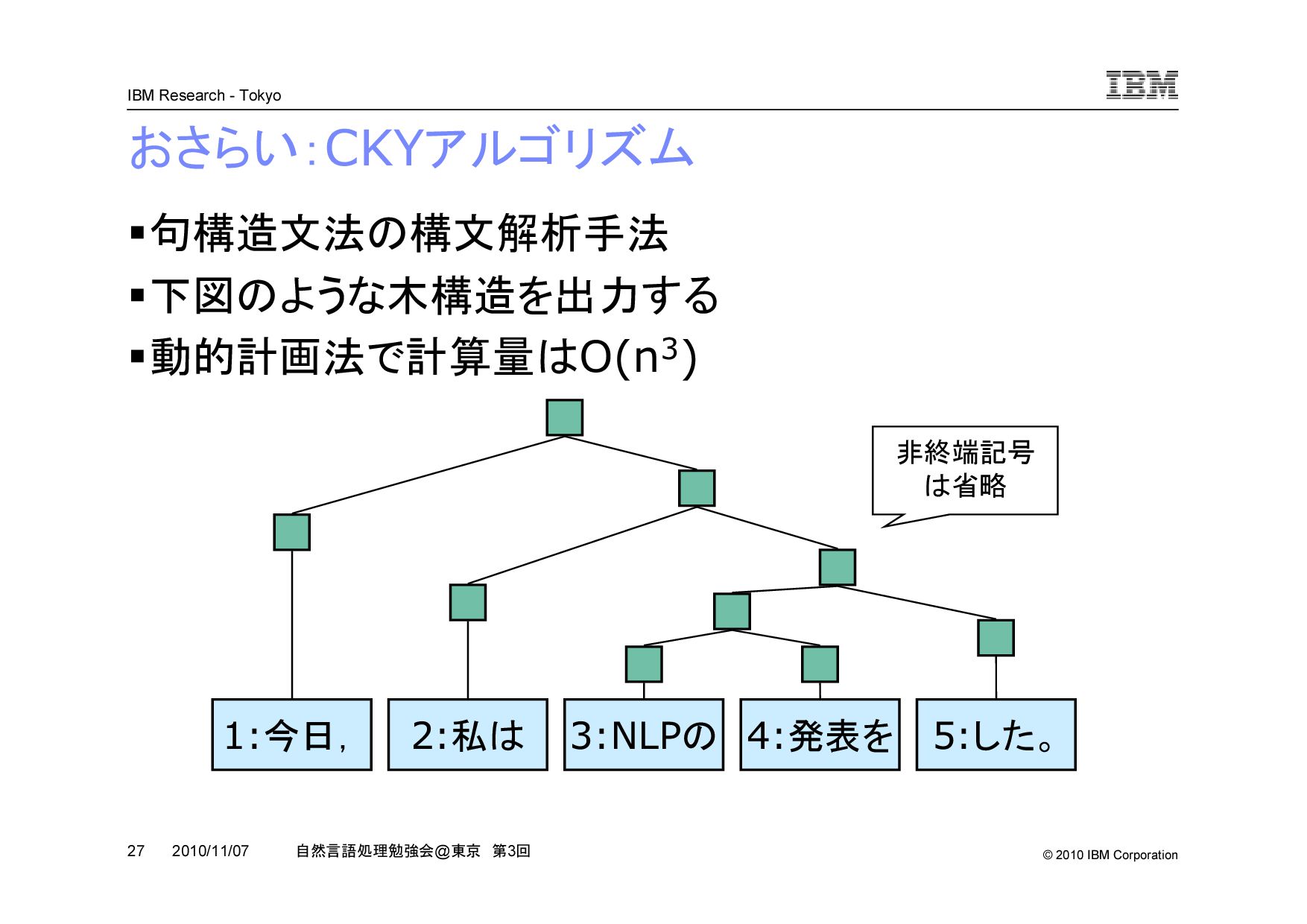
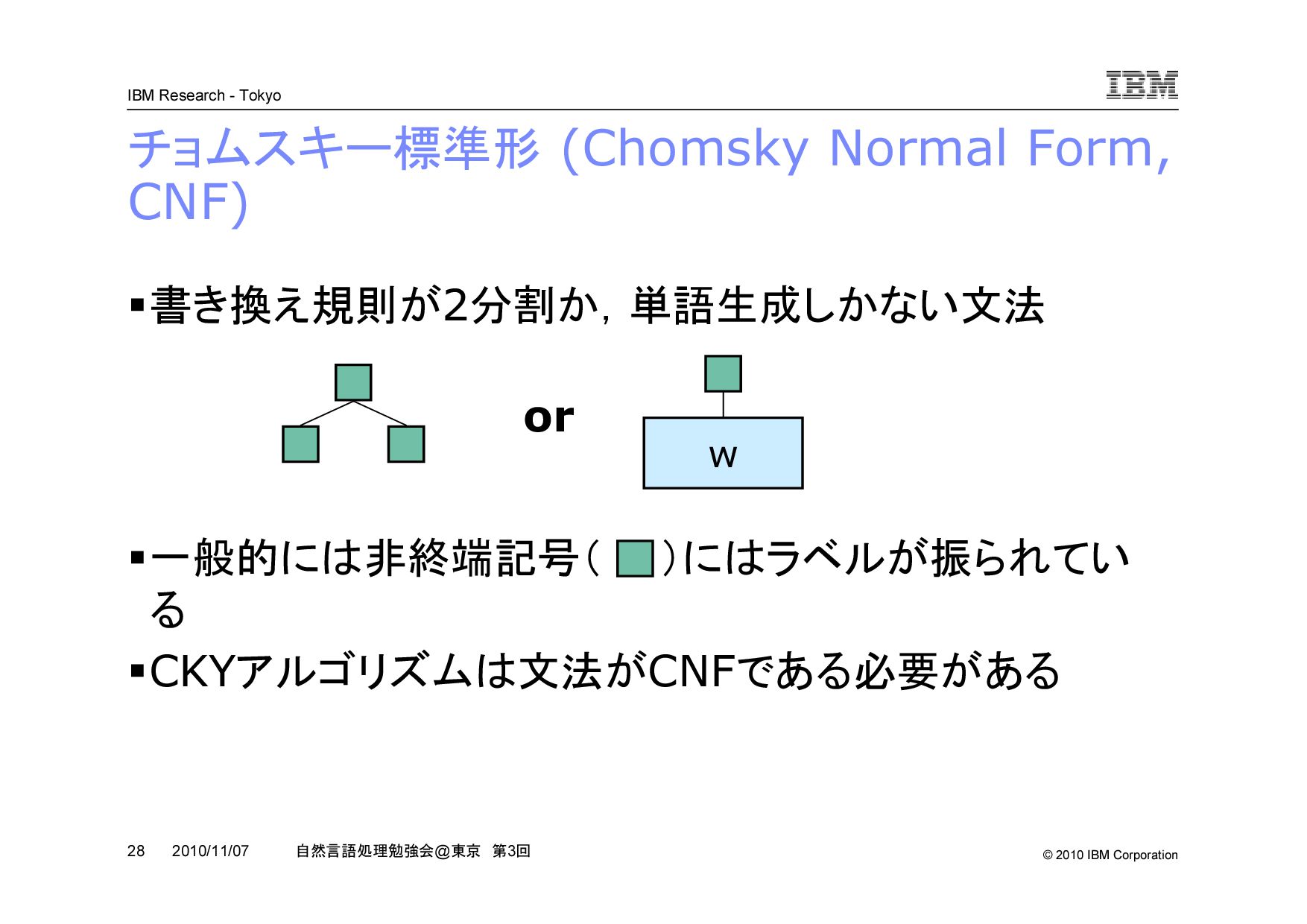
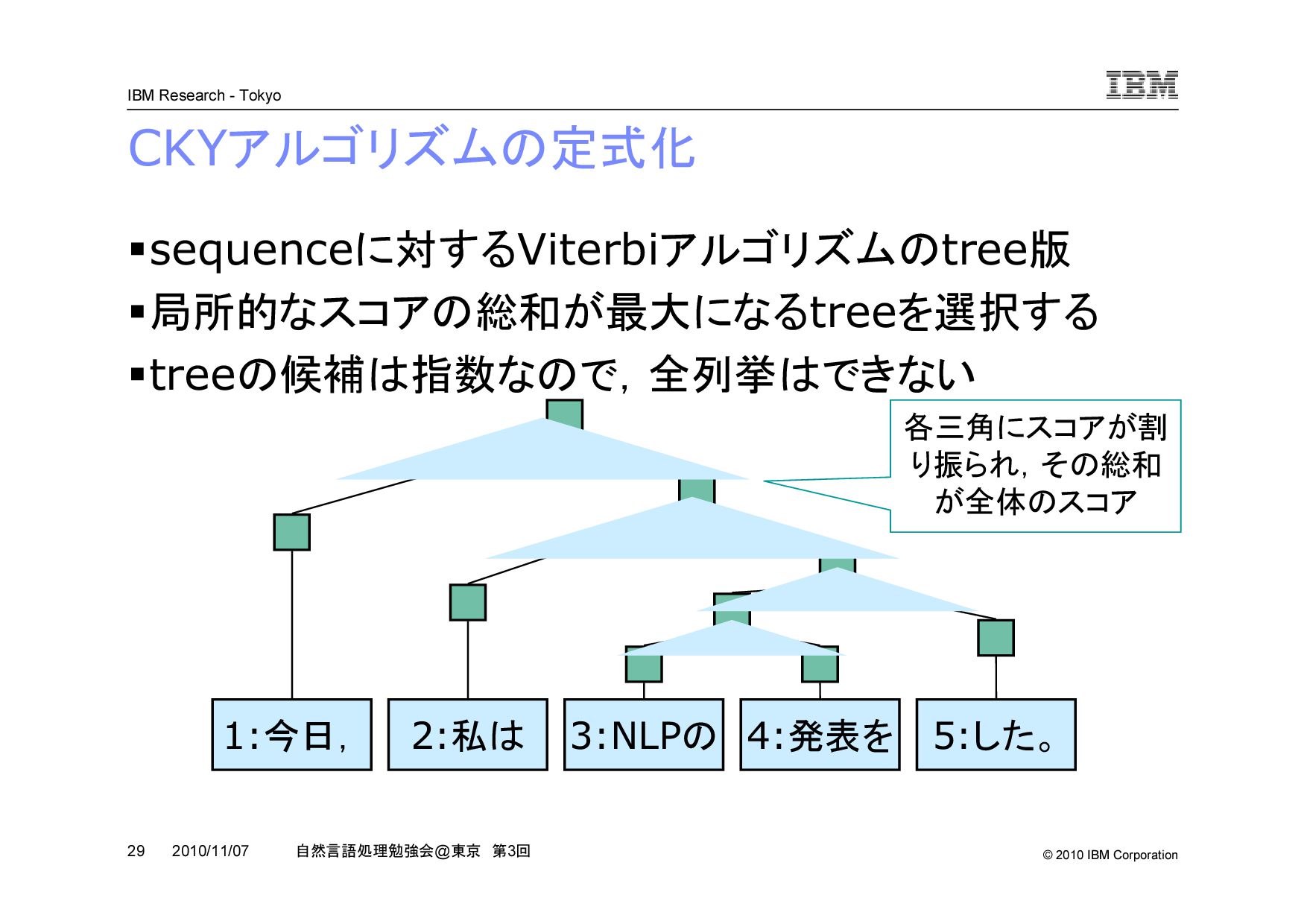
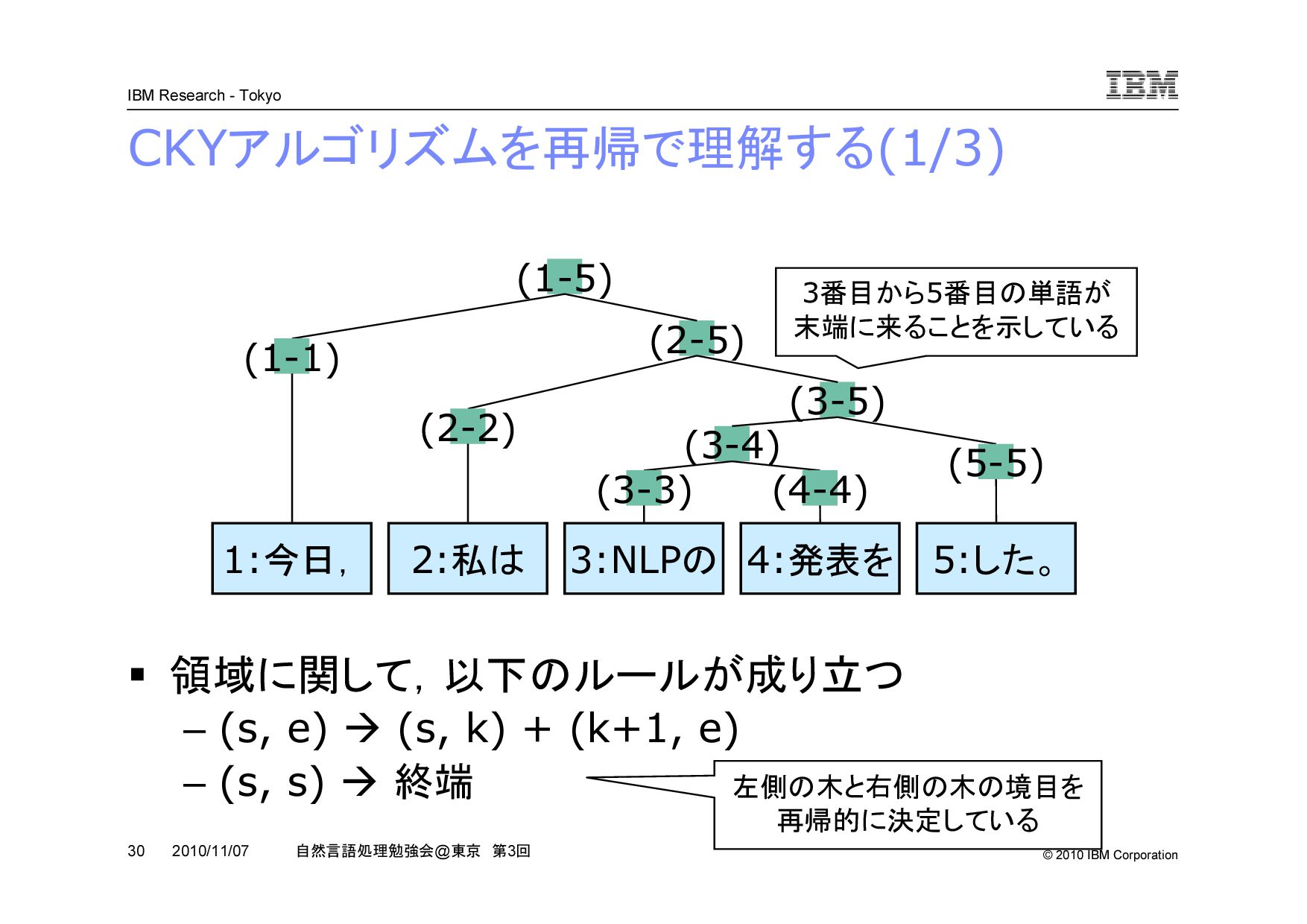
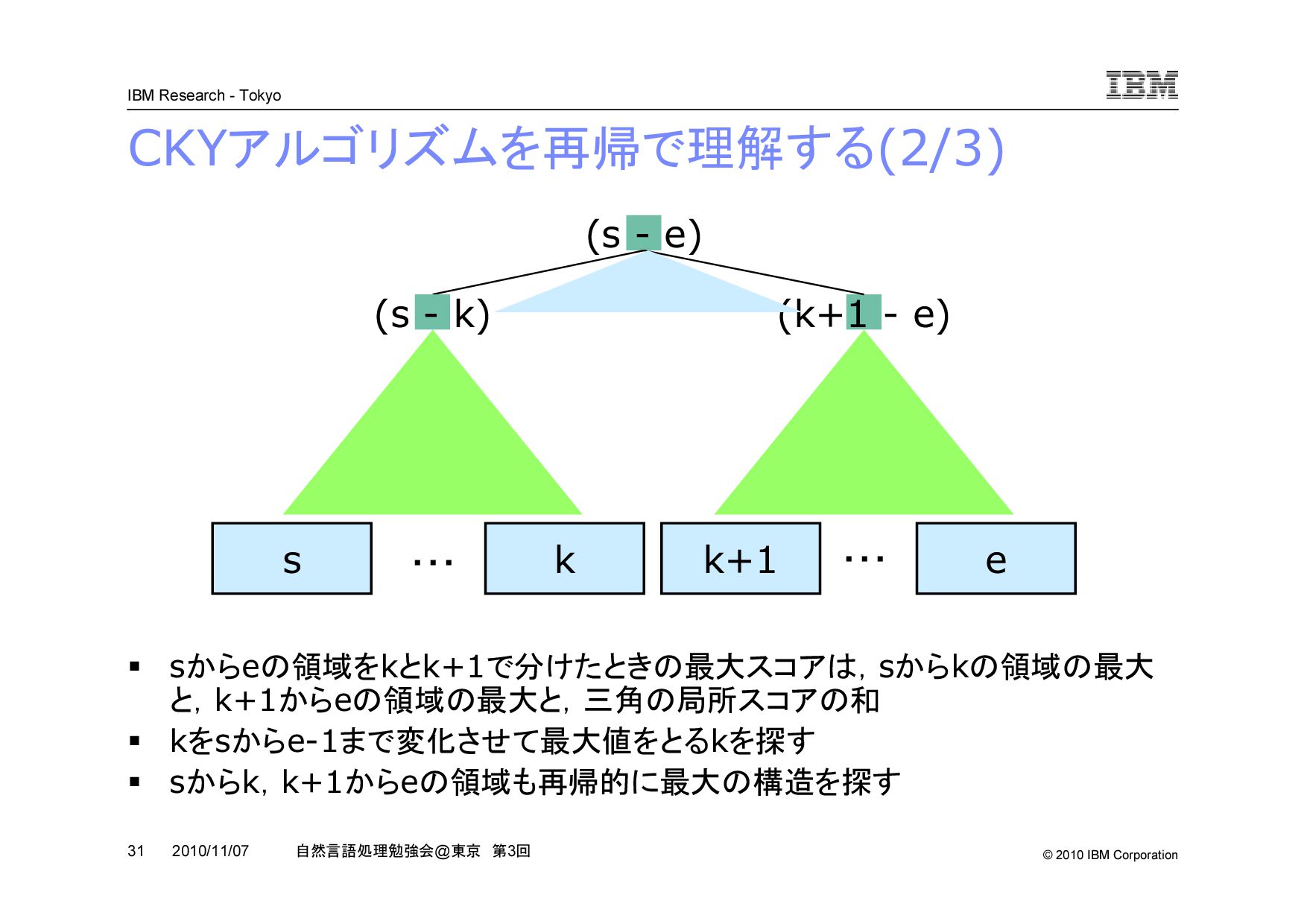
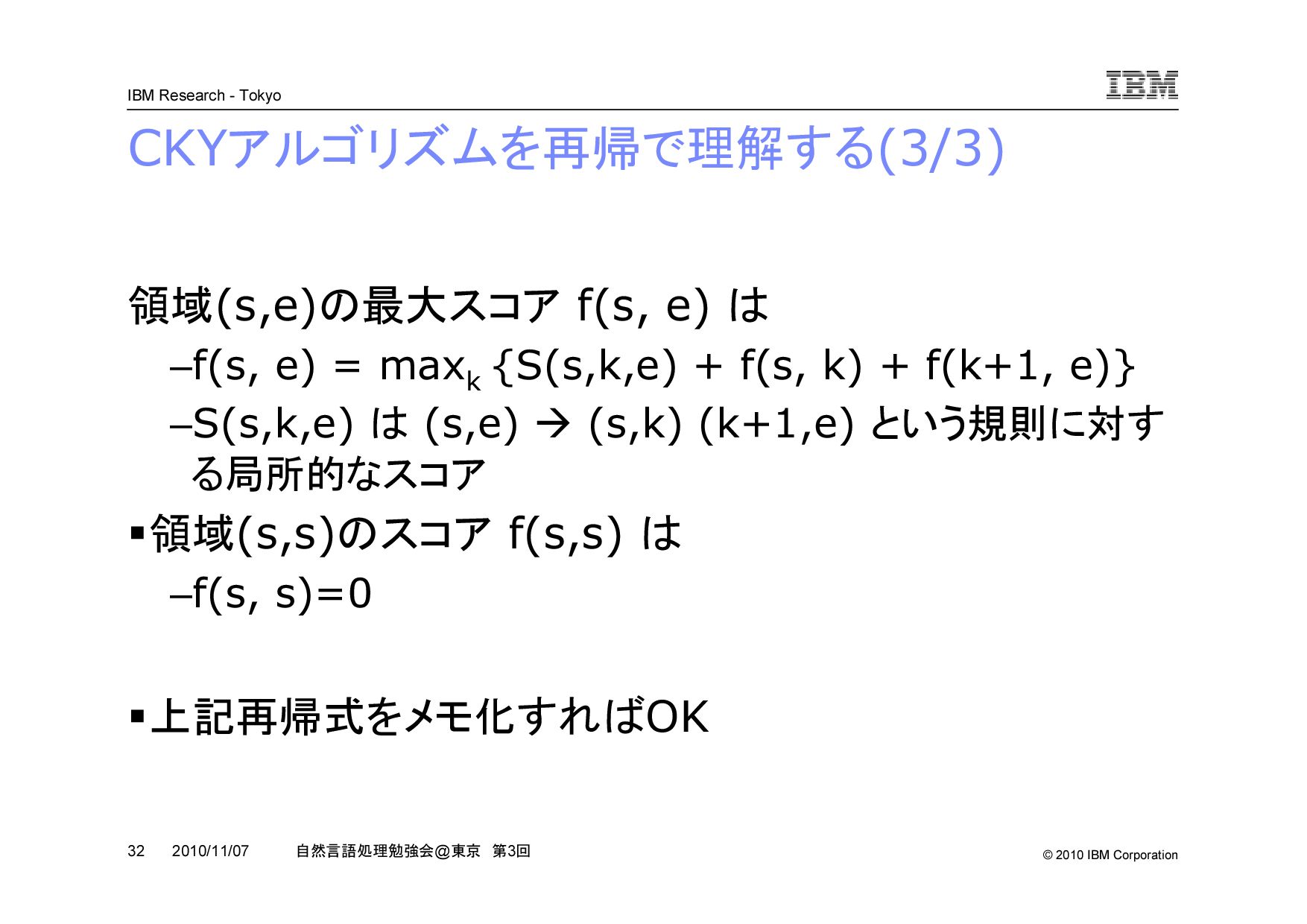
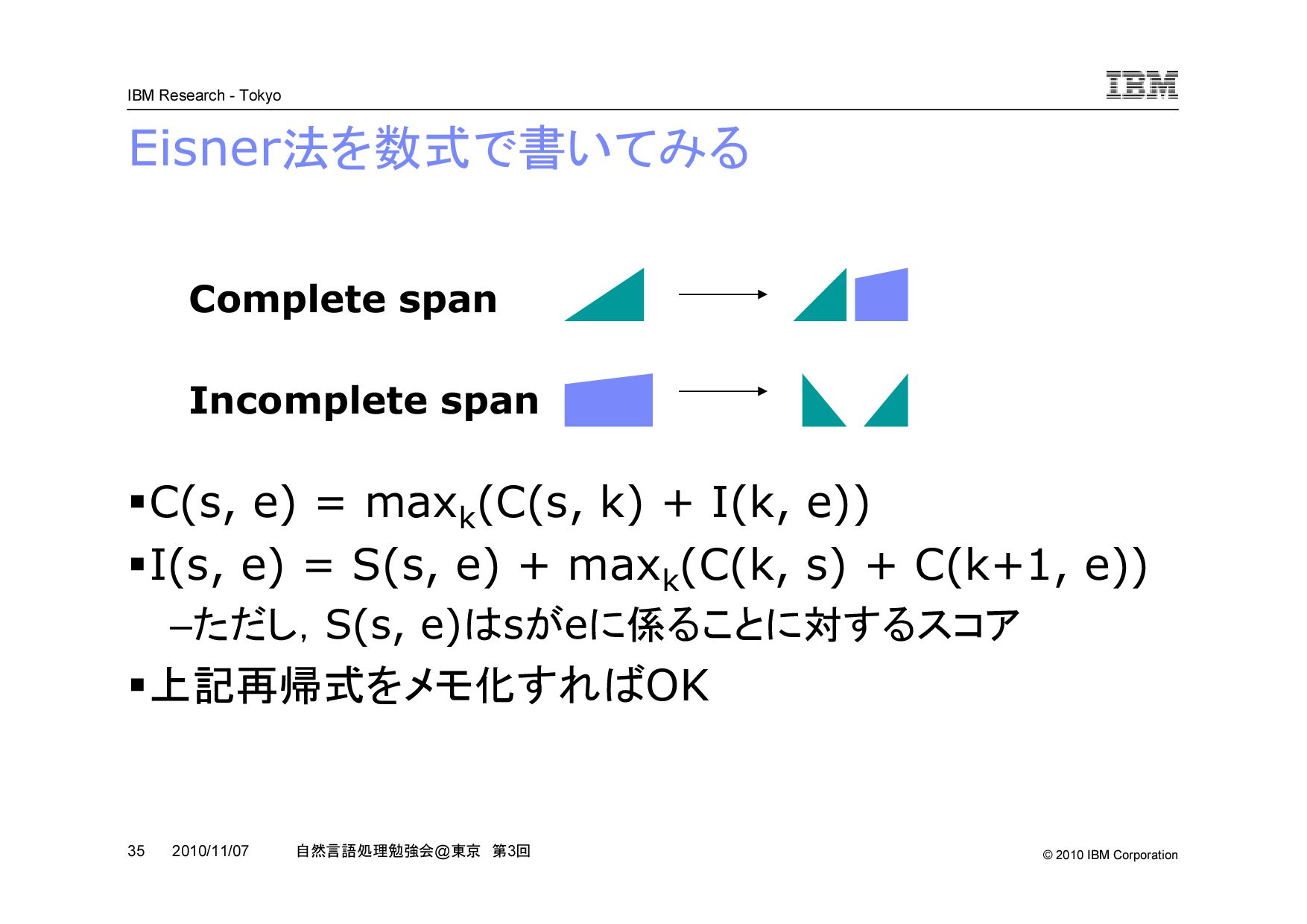
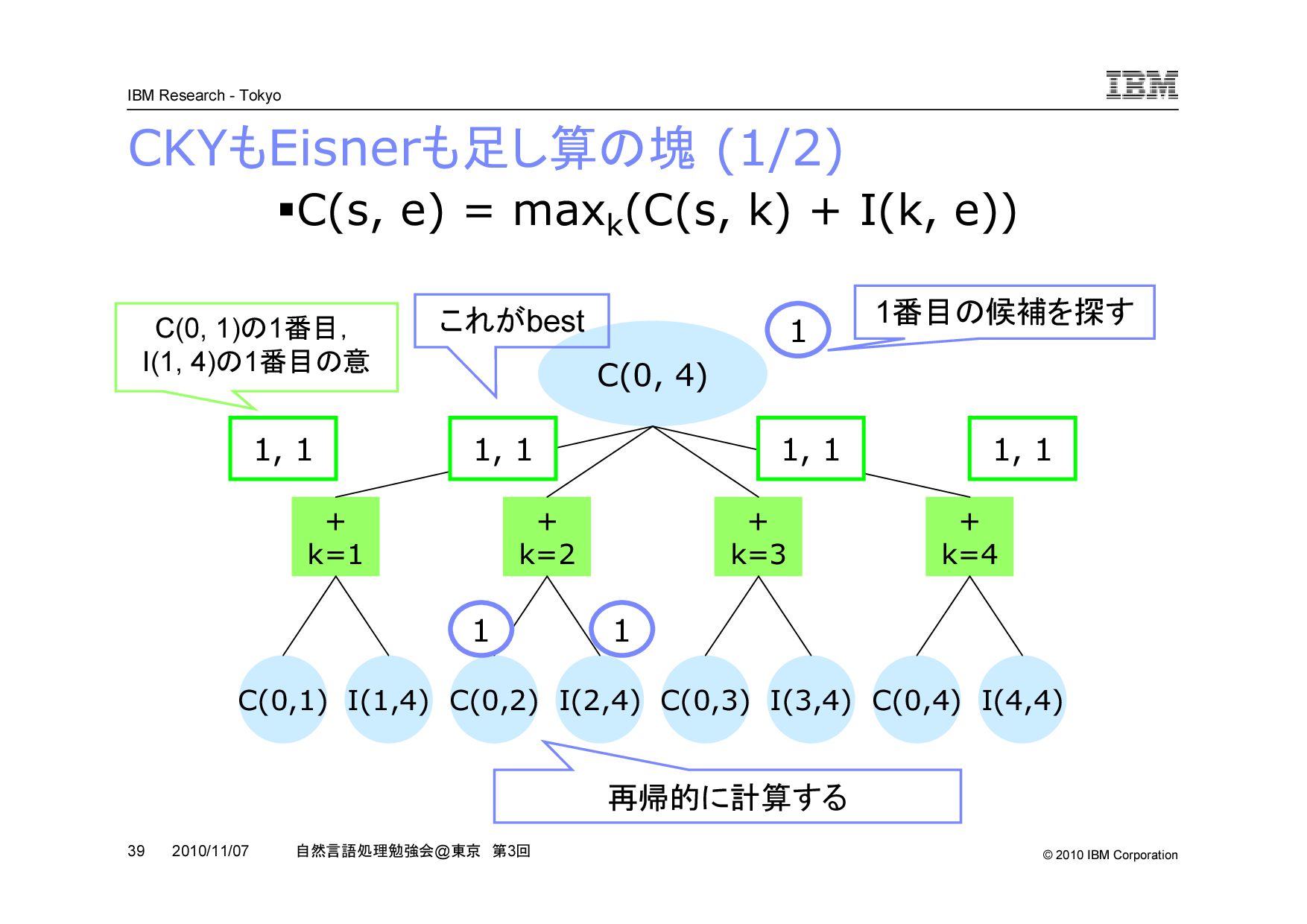
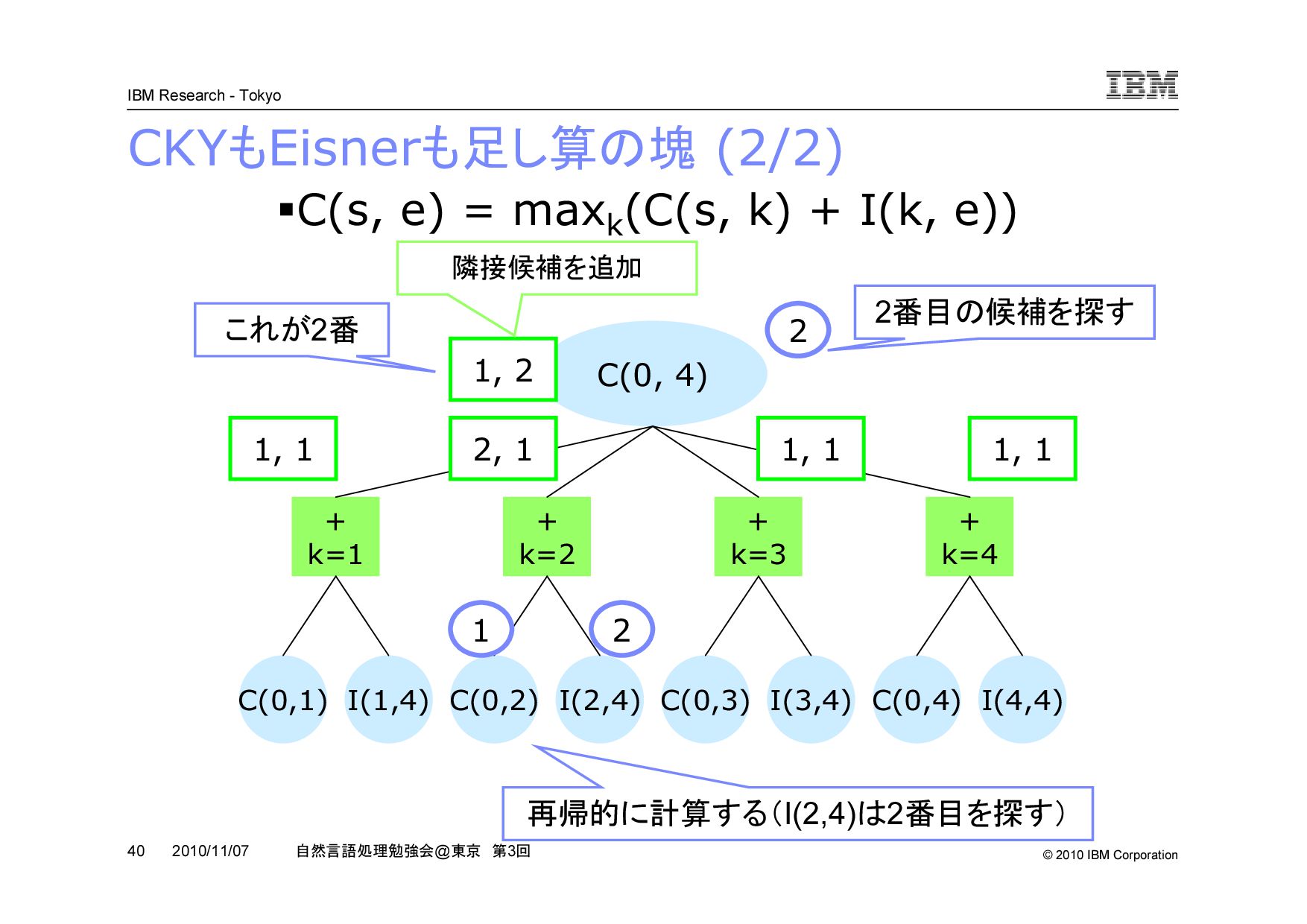
@ 東京 第 3 回 2010/11/07 CKY アルゴリズムを再帰で理解する (2/3) s k k+1 e (k+1 - e) (s - e) (s - k) s から e の領域を k と k+1 で分けたときの最大スコアは, s から k の領域の最大 と, k+1 から e の領域の最大と,三角の局所スコアの和 k を s から e-1 まで変化させて最大値をとる k を探す s から k , k+1 から e の領域も再帰的に最大の構造を探す ・・・ ・・・
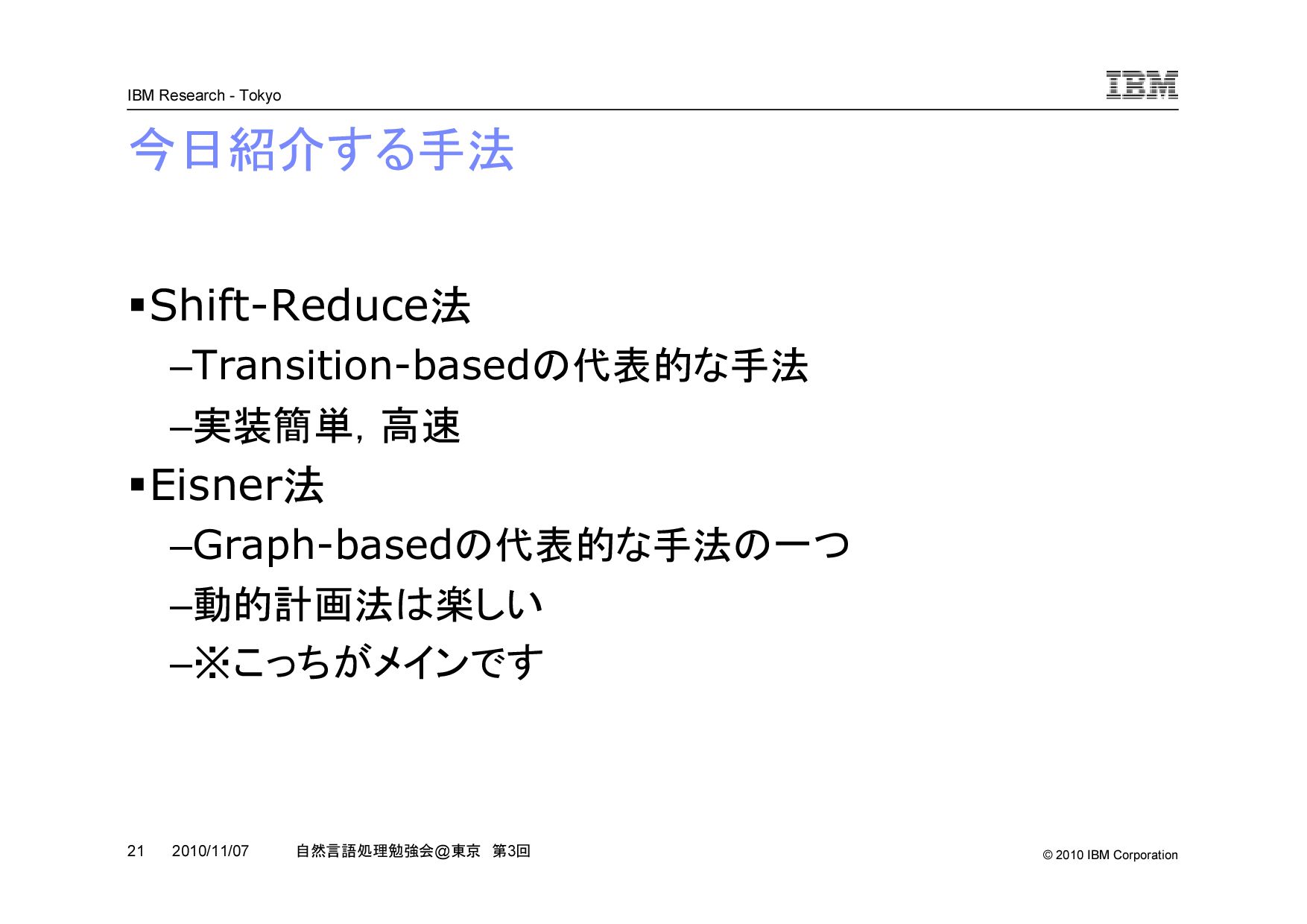
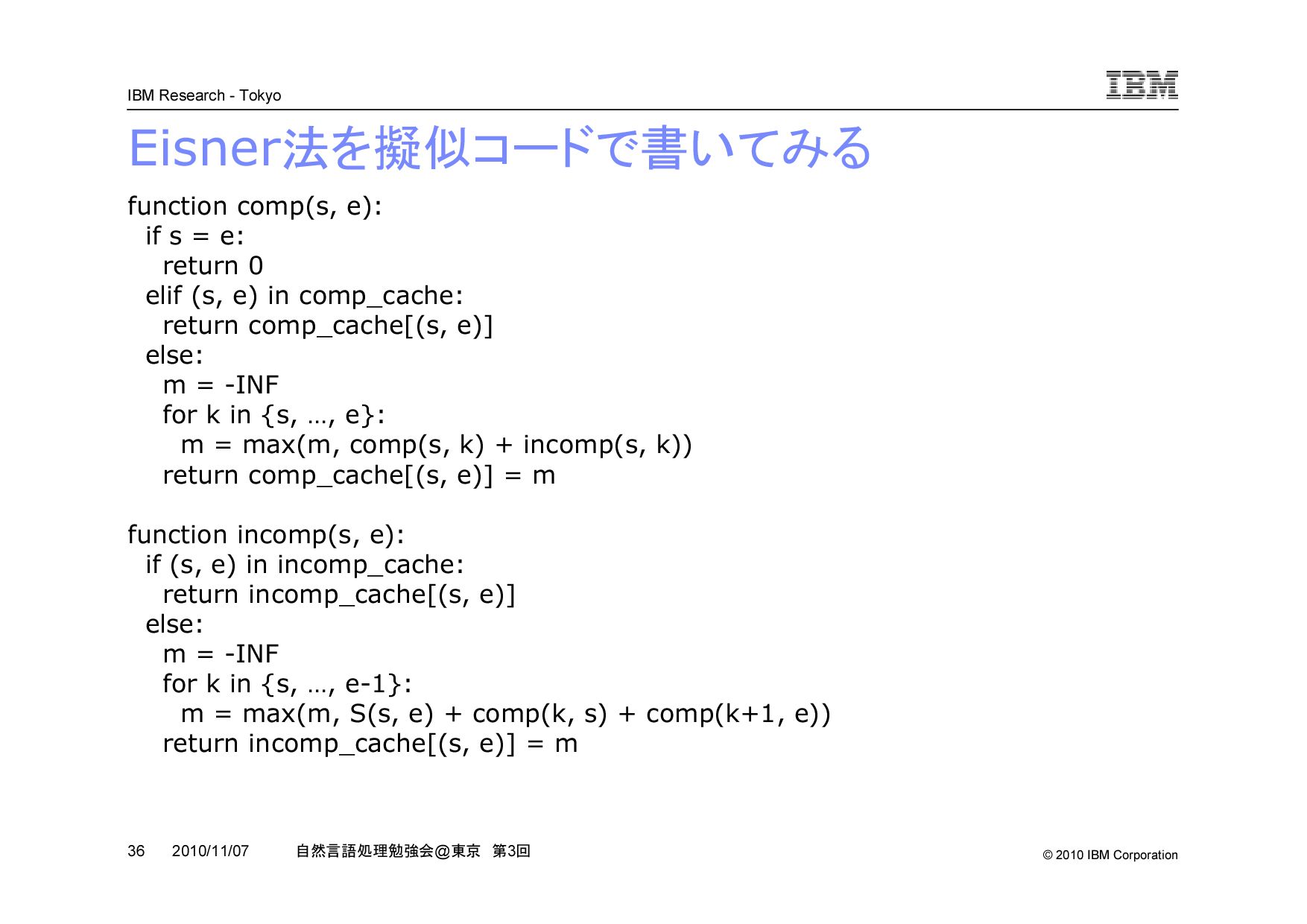
@ 東京 第 3 回 2010/11/07 Eisner 法を擬似コードで書いてみる function comp(s, e): if s = e: return 0 elif (s, e) in comp_cache: return comp_cache[(s, e)] else: m = -INF for k in {s, …, e}: m = max(m, comp(s, k) + incomp(s, k)) return comp_cache[(s, e)] = m function incomp(s, e): if (s, e) in incomp_cache: return incomp_cache[(s, e)] else: m = -INF for k in {s, …, e-1}: m = max(m, S(s, e) + comp(k, s) + comp(k+1, e)) return incomp_cache[(s, e)] = m
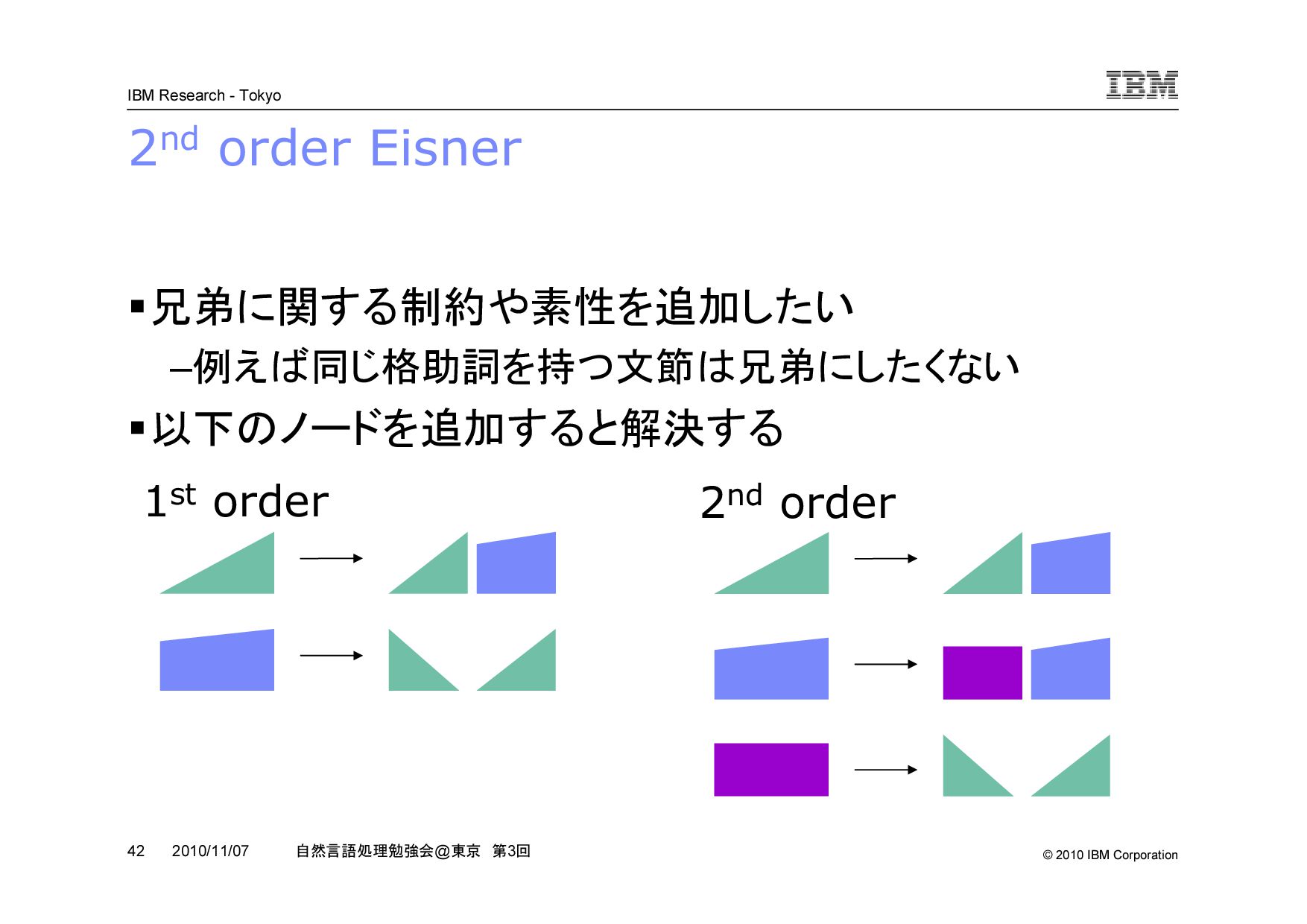
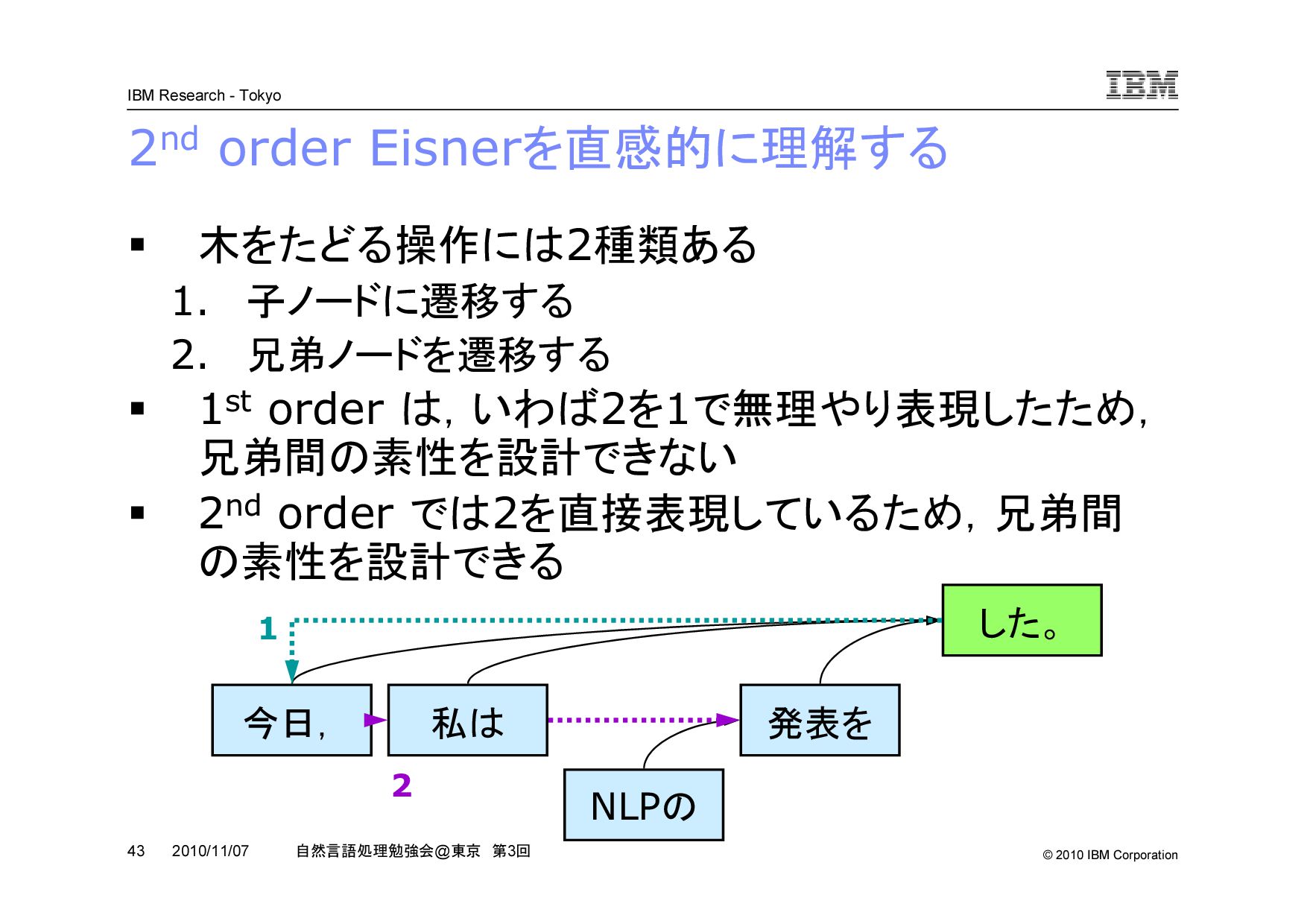
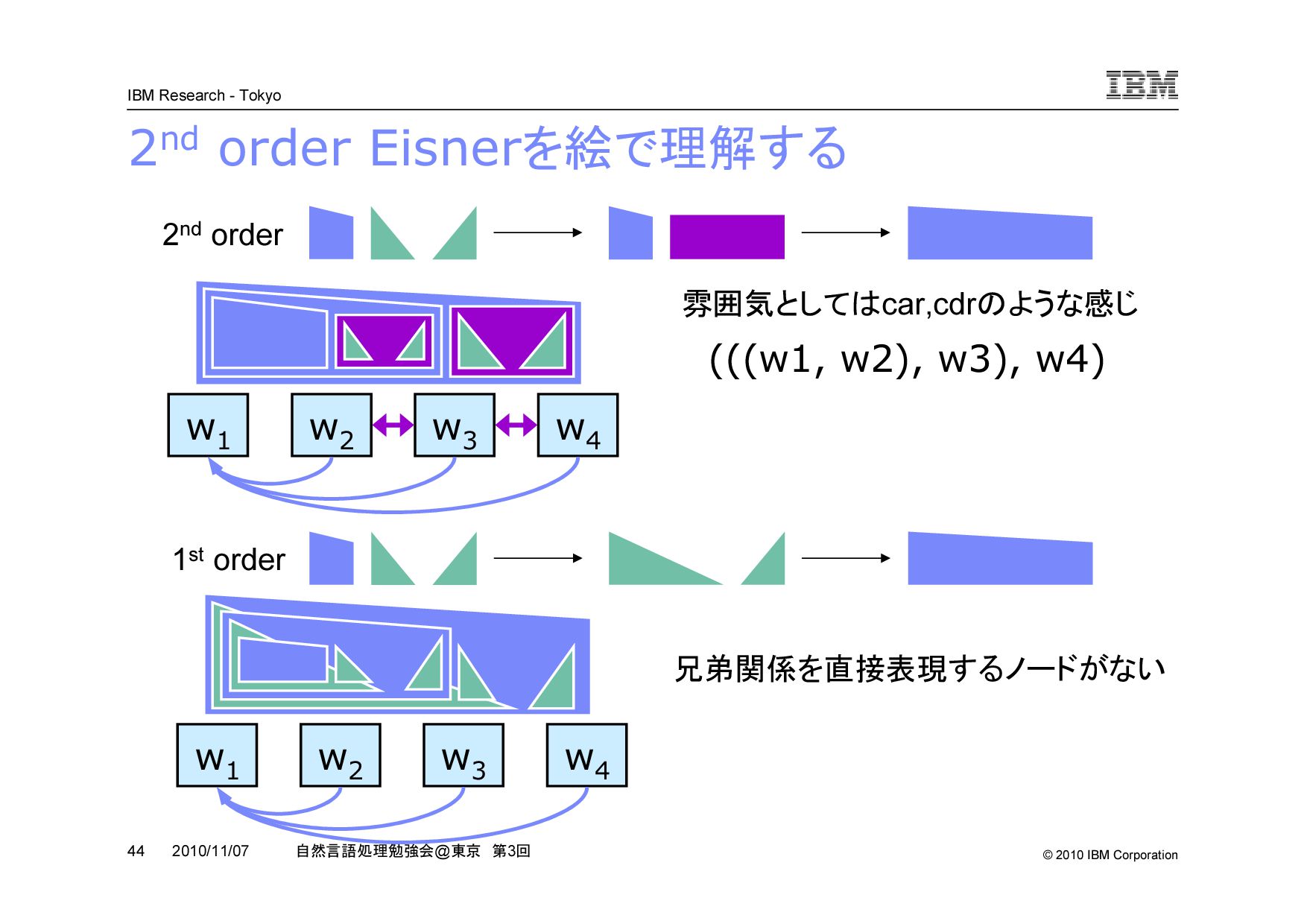
@ 東京 第 3 回 2010/11/07 2nd order Eisner を絵で理解する 1st order 2nd order (((w1, w2), w3), w4) 雰囲気としては car,cdr のような感じ w 1 w 2 w 3 w 4 w 1 w 2 w 3 w 4 兄弟関係を直接表現するノードがない
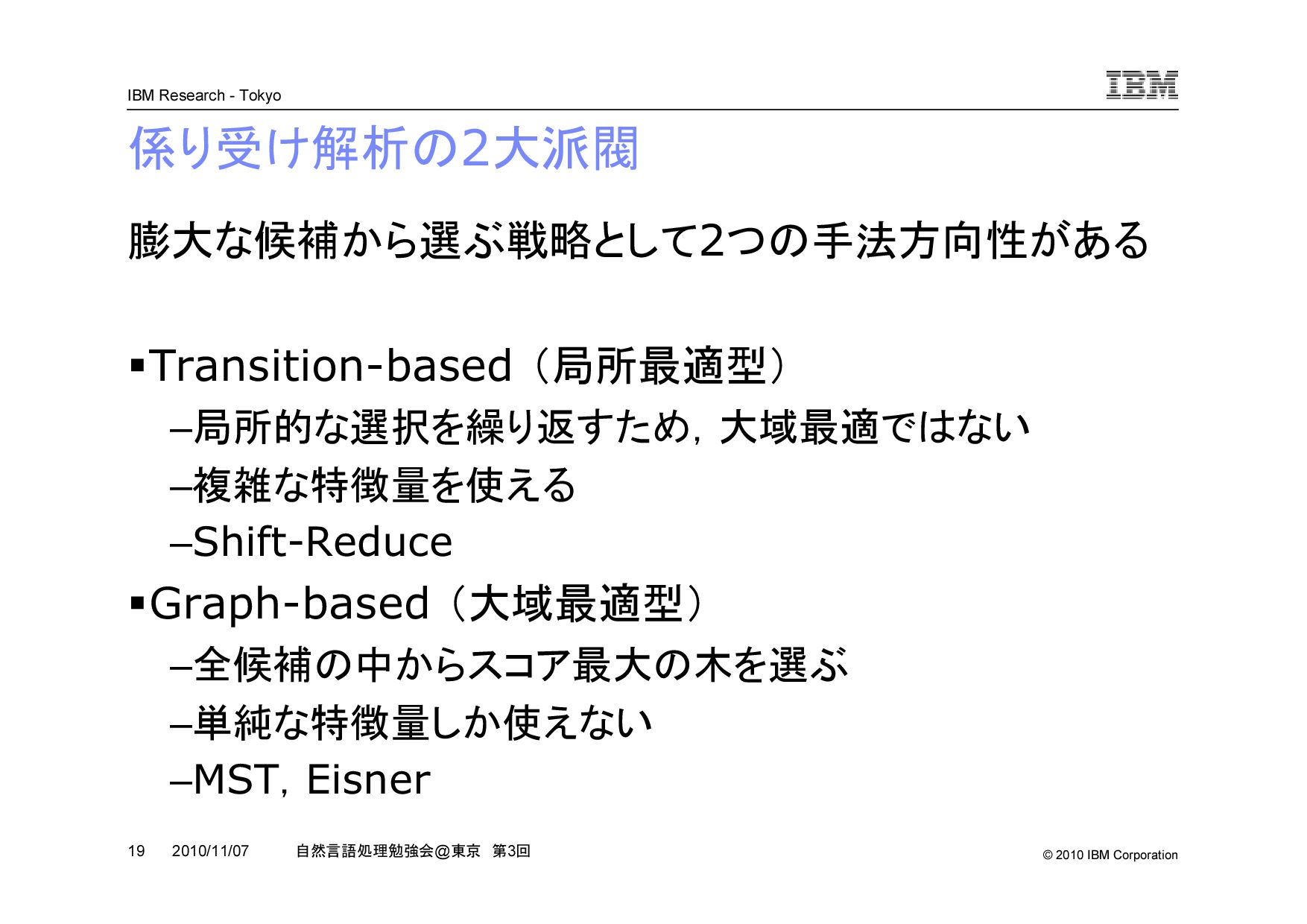
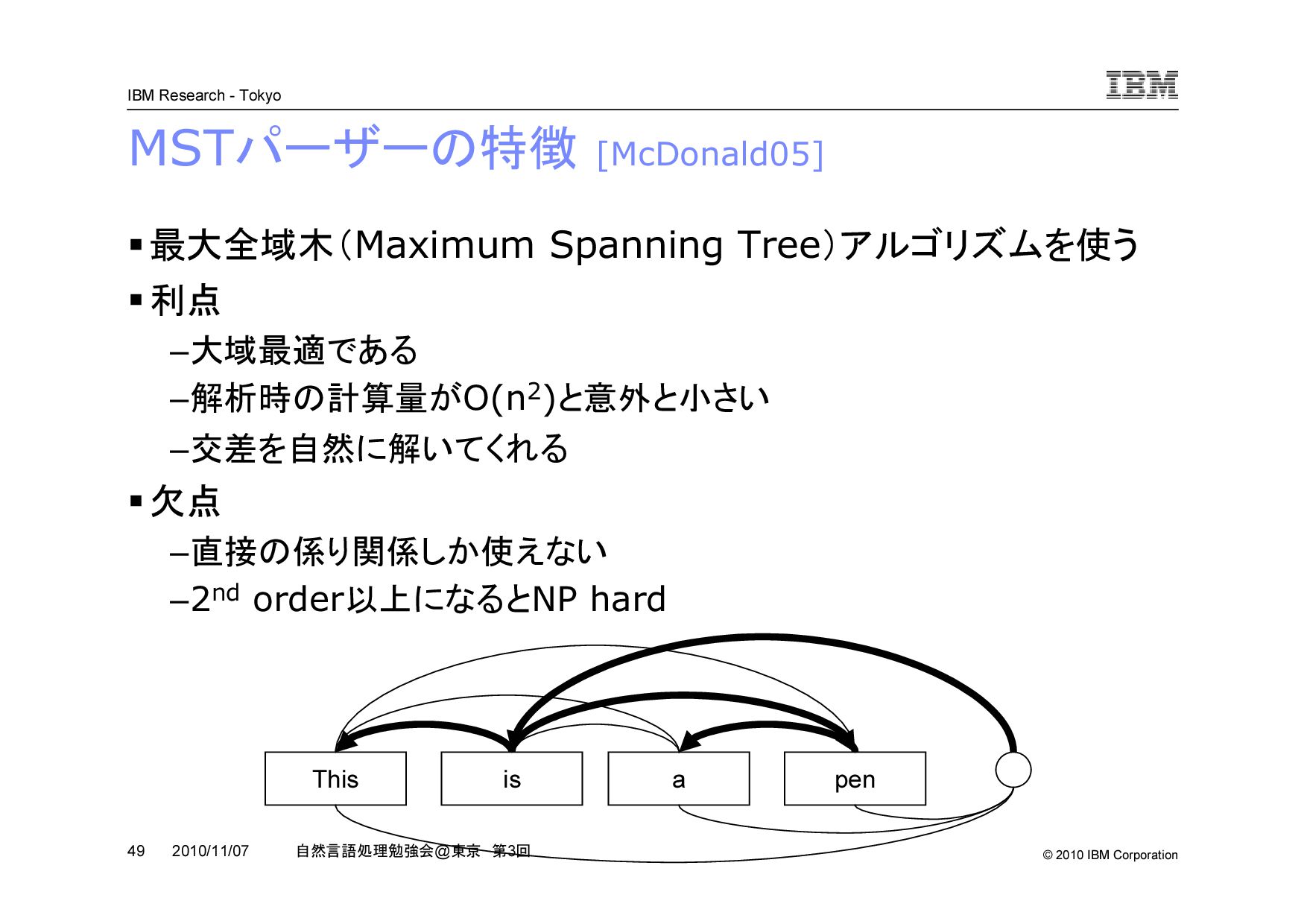
@ 東京 第 3 回 2010/11/07 MST パーザーの特徴 [McDonald05] 最大全域木( Maximum Spanning Tree )アルゴリズムを使う 利点 –大域最適である –解析時の計算量が O(n2) と意外と小さい –交差を自然に解いてくれる 欠点 –直接の係り関係しか使えない –2nd order 以上になると NP hard This is a pen
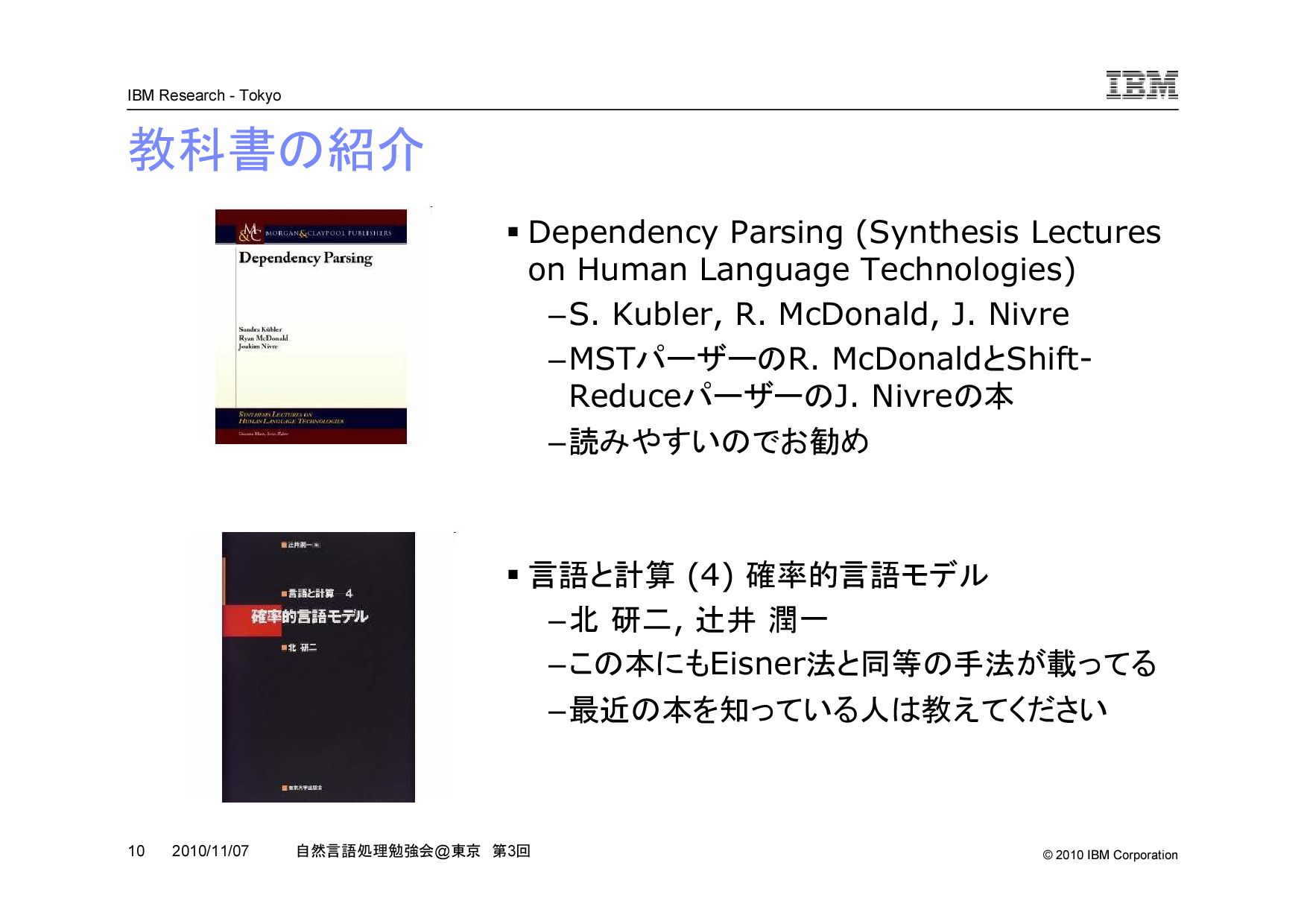
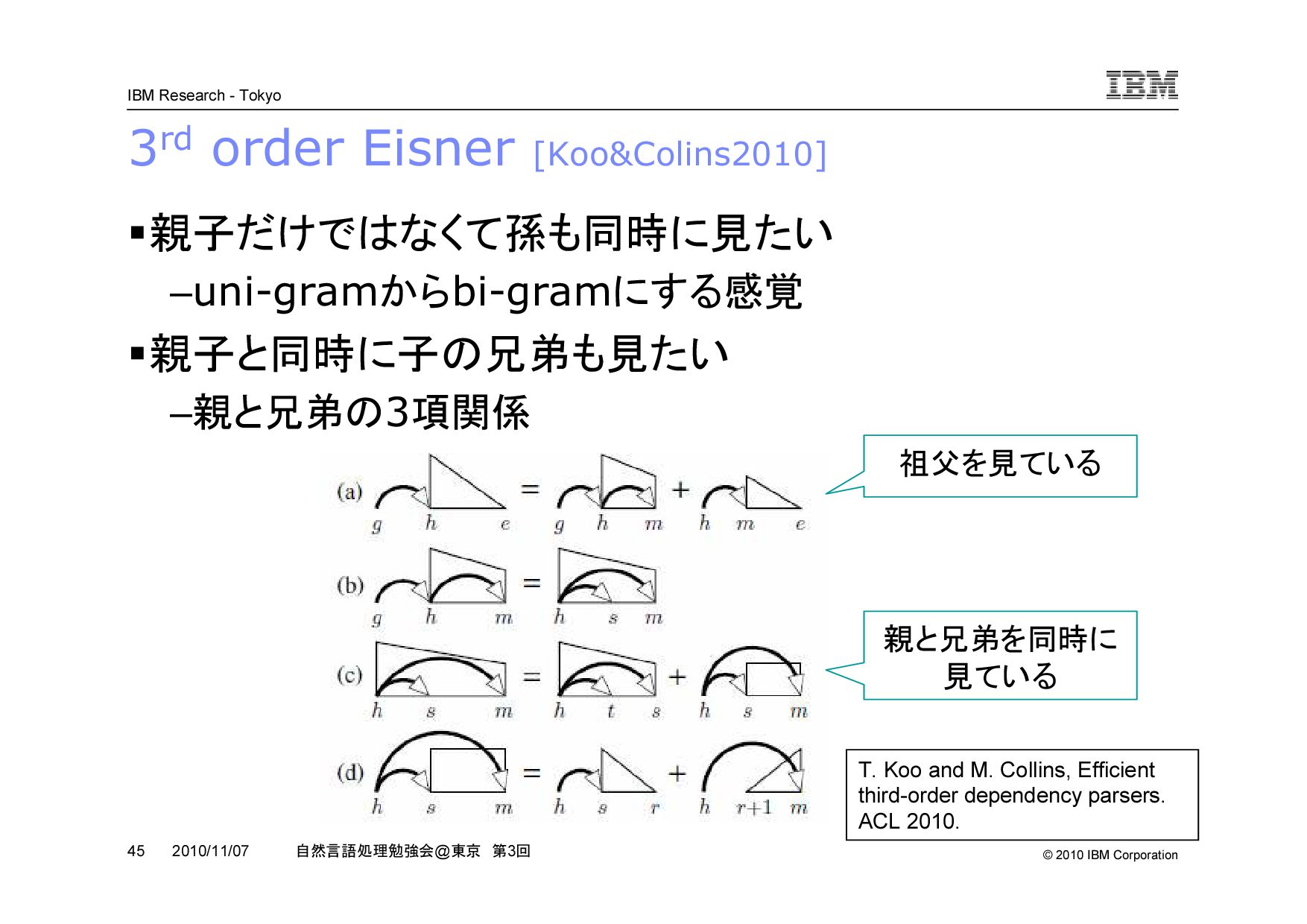
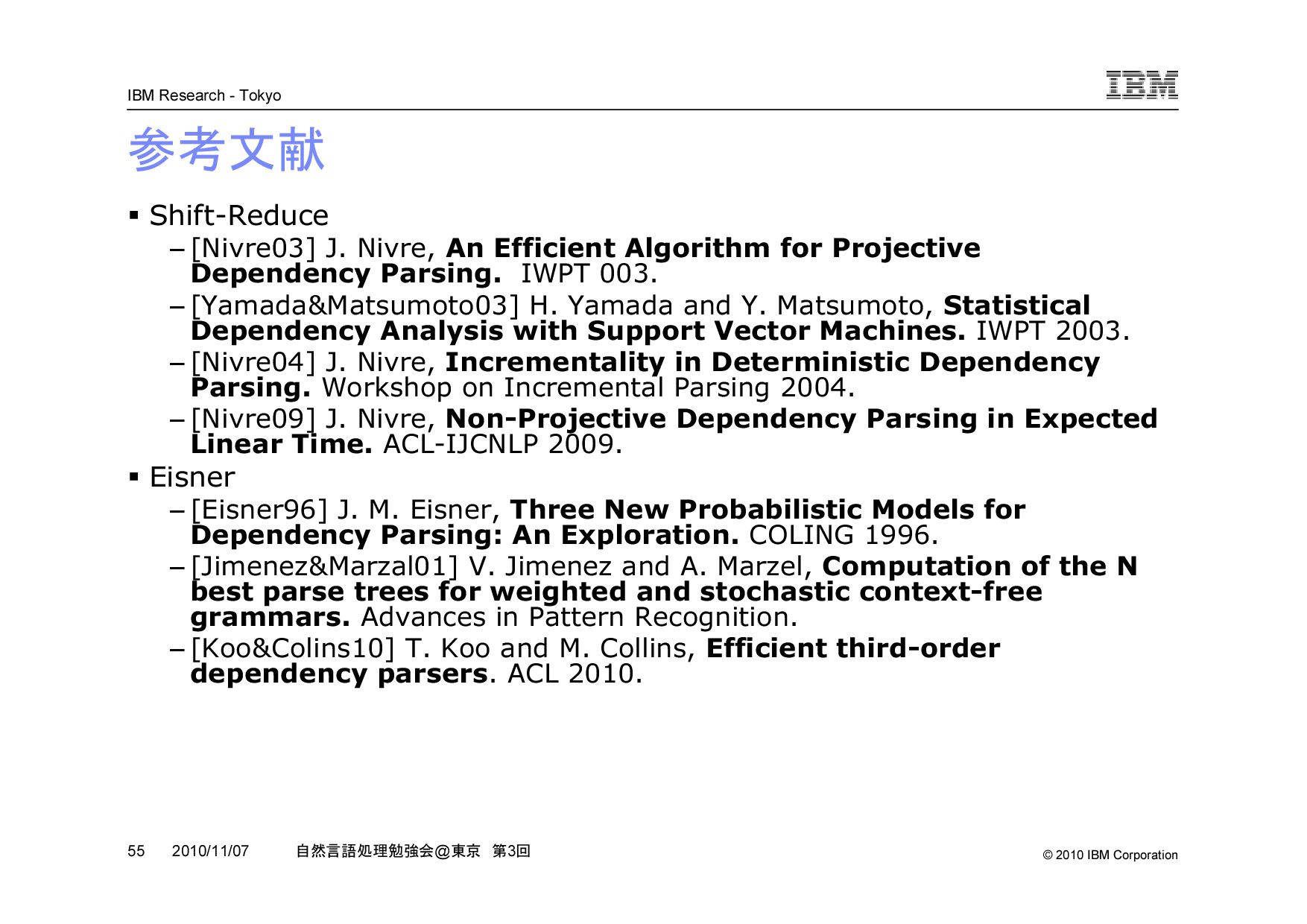
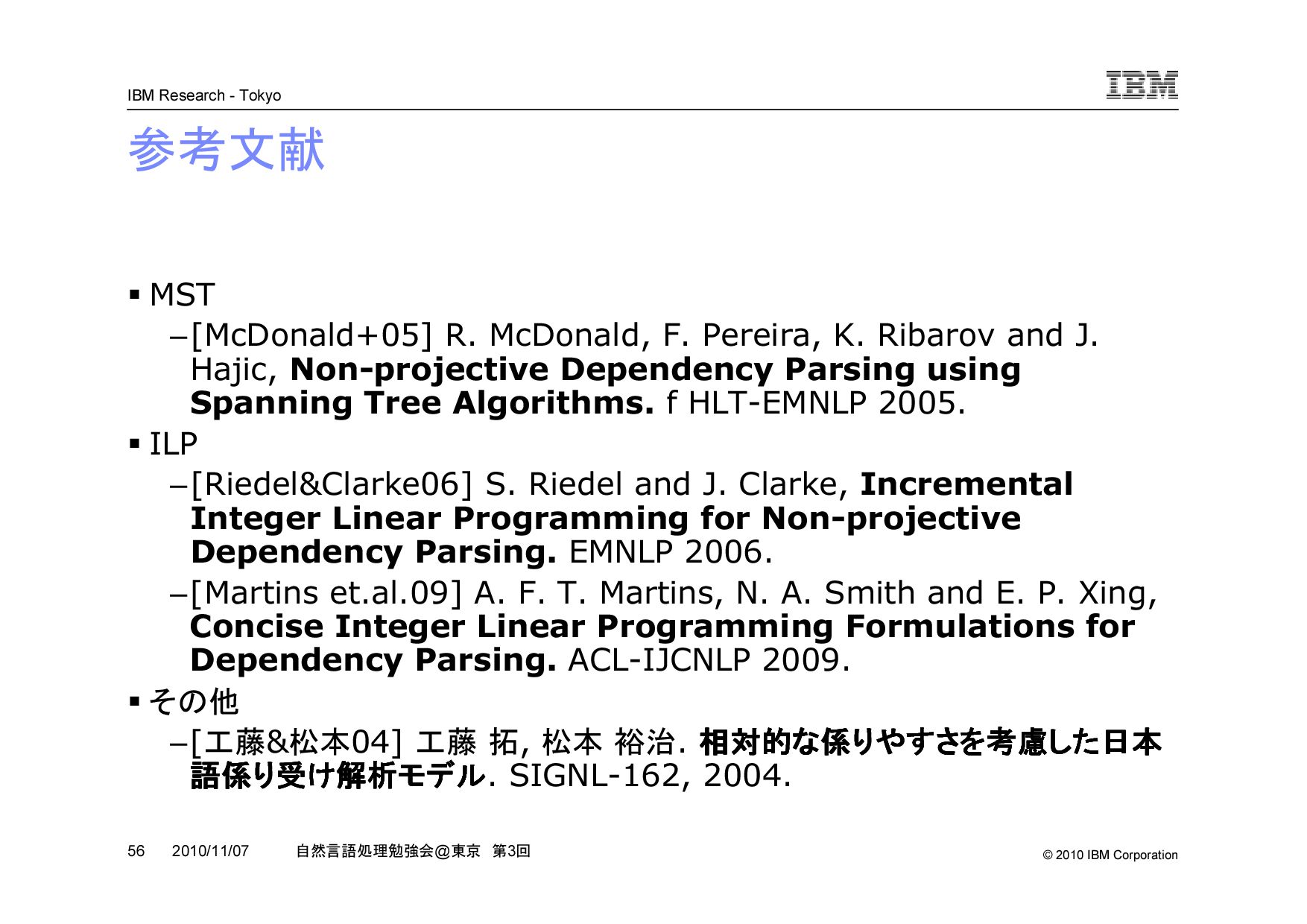
@ 東京 第 3 回 2010/11/07 参考文献 Shift-Reduce – [Nivre03] J. Nivre, An Efficient Algorithm for Projective Dependency Parsing. IWPT 003. – [Yamada&Matsumoto03] H. Yamada and Y. Matsumoto, Statistical Dependency Analysis with Support Vector Machines. IWPT 2003. – [Nivre04] J. Nivre, Incrementality in Deterministic Dependency Parsing. Workshop on Incremental Parsing 2004. – [Nivre09] J. Nivre, Non-Projective Dependency Parsing in Expected Linear Time. ACL-IJCNLP 2009. Eisner – [Eisner96] J. M. Eisner, Three New Probabilistic Models for Dependency Parsing: An Exploration. COLING 1996. – [Jimenez&Marzal01] V. Jimenez and A. Marzel, Computation of the N best parse trees for weighted and stochastic context-free grammars. Advances in Pattern Recognition. – [Koo&Colins10] T. Koo and M. Collins, Efficient third-order dependency parsers. ACL 2010.


 unnonouno
 sansantech
 tomokusaba
 husengs7
 makocchi
 keeg
keeg
 furuton
 recruitengineers
 carta_engineering
 munakata
 glaforge
 yut0naga1_fa
 pauli
pauli
 iamctodd
 carmenintech
 mza
mza
 tessaabrams
 addyosmani
 chriscoyier
 aleyda
 cassininazir
 ivargrimstad
 soudai
 kneath
 tammyeverts