State of SaaS Onboarding if you want to: Learn best practices & trends in SaaS at a glance! See what your competitors are doing Back your decisions up with industry data & get internal buy-in from your execs! 03
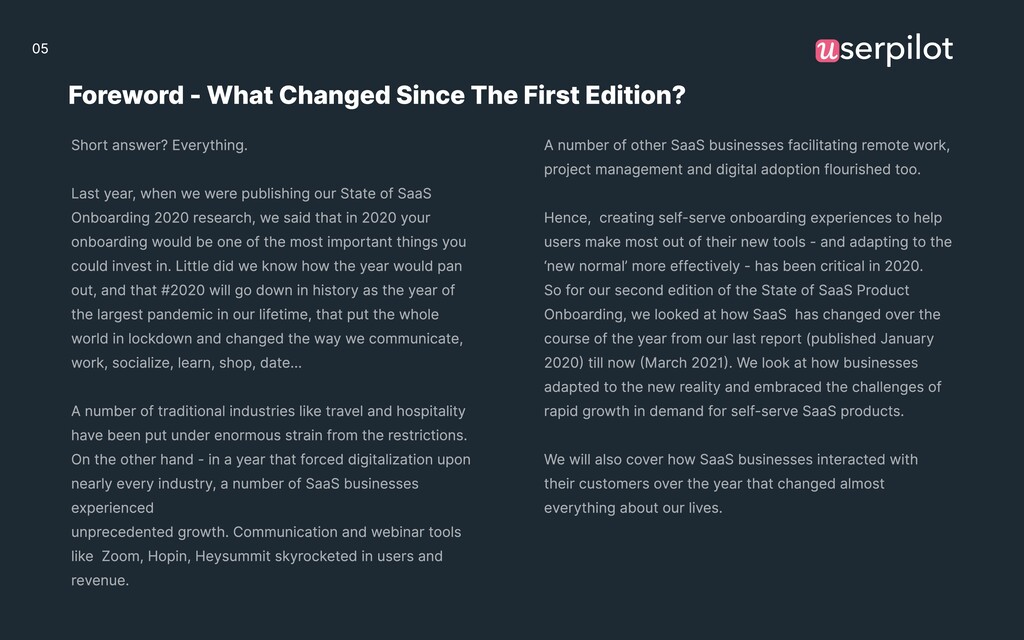
State of SaaS Onboarding 2020 research, we said that in 2020 your onboarding would be one of the most important things you could invest in. Little did we know how the year would pan out, and that #2020 will go down in history as the year of the largest pandemic in our lifetime, that put the whole world in lockdown and changed the way we communicate, work, socialize, learn, shop, date... A number of traditional industries like travel and hospitality have been put under enormous strain from the restrictions. On the other hand - in a year that forced digitalization upon nearly every industry, a number of SaaS businesses experienced unprecedented growth. Communication and webinar tools like Zoom, Hopin, Heysummit skyrocketed in users and revenue. A number of other SaaS businesses facilitating remote work, project management and digital adoption flourished too. Hence, creating self-serve onboarding experiences to help users make most out of their new tools - and adapting to the ‘new normal’ more effectively - has been critical in 2020. So for our second edition of the State of SaaS Product Onboarding, we looked at how SaaS has changed over the course of the year from our last report (published January 2020) till now (March 2021). We look at how businesses adapted to the new reality and embraced the challenges of rapid growth in demand for self-serve SaaS products. We will also cover how SaaS businesses interacted with their customers over the year that changed almost everything about our lives. Foreword - What Changed Since The First Edition? 05
many SaaS businesses thrived in the work-from-home world. Was it partly owing to their stellar onboarding strategy, which helped them offset support costs and activate more users with self-serve guides? Let’s see if this transformative time has also translated into more interactive and relevant in-app experiences that help users achieve their product goals. Foreword - What Changed Since The First Edition? 06
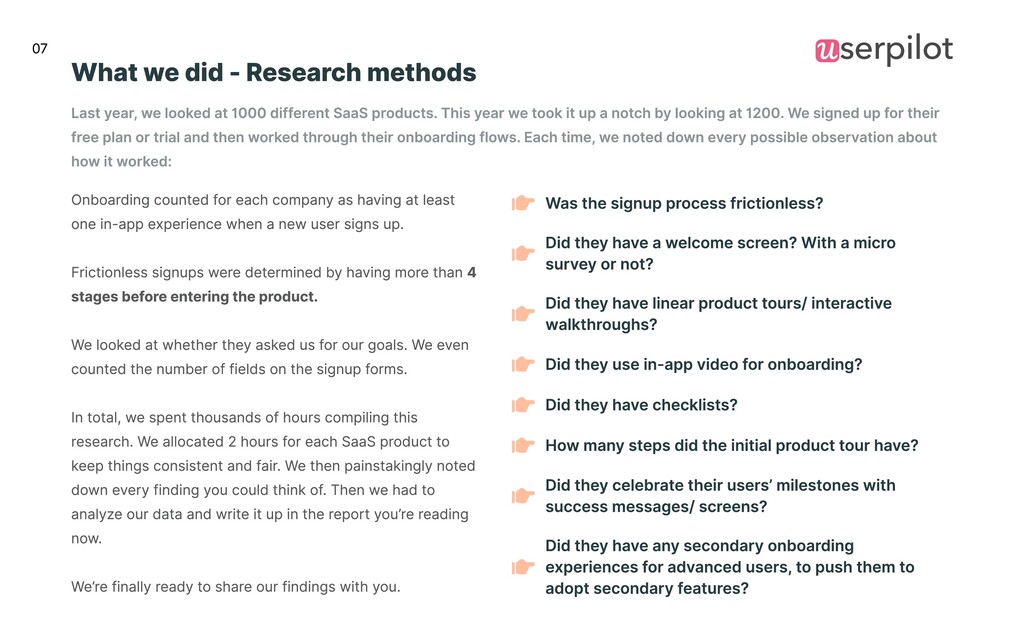
at 1000 different SaaS products. This year we took it up a notch by looking at 1200. We signed up for their free plan or trial and then worked through their onboarding flows. Each time, we noted down every possible observation about how it worked: Onboarding counted for each company as having at least one in-app experience when a new user signs up. Frictionless signups were determined by having more than 4 stages before entering the product. We looked at whether they asked us for our goals. We even counted the number of fields on the signup forms. In total, we spent thousands of hours compiling this research. We allocated 2 hours for each SaaS product to keep things consistent and fair. We then painstakingly noted down every finding you could think of. Then we had to analyze our data and write it up in the report you’re reading now. We’re finally ready to share our findings with you. Was the signup process frictionless? Did they have a welcome screen? With a micro survey or not? Did they have linear product tours/ interactive walkthroughs? Did they use in-app video for onboarding? Did they have checklists? How many steps did the initial product tour have? Did they celebrate their users’ milestones with success messages/ screens? Did they have any secondary onboarding experiences for advanced users, to push them to adopt secondary features? 07
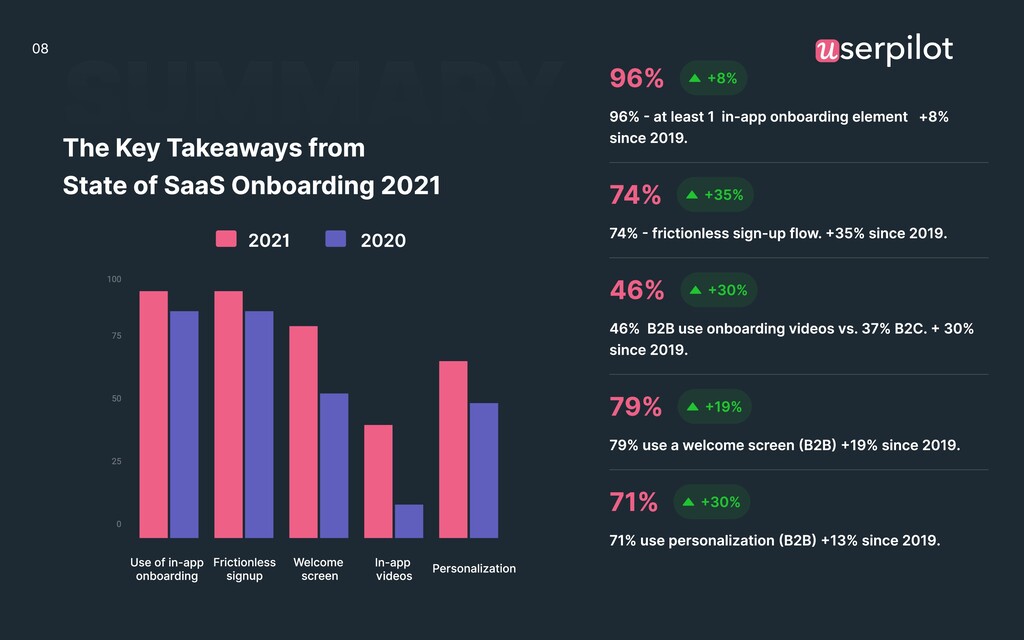
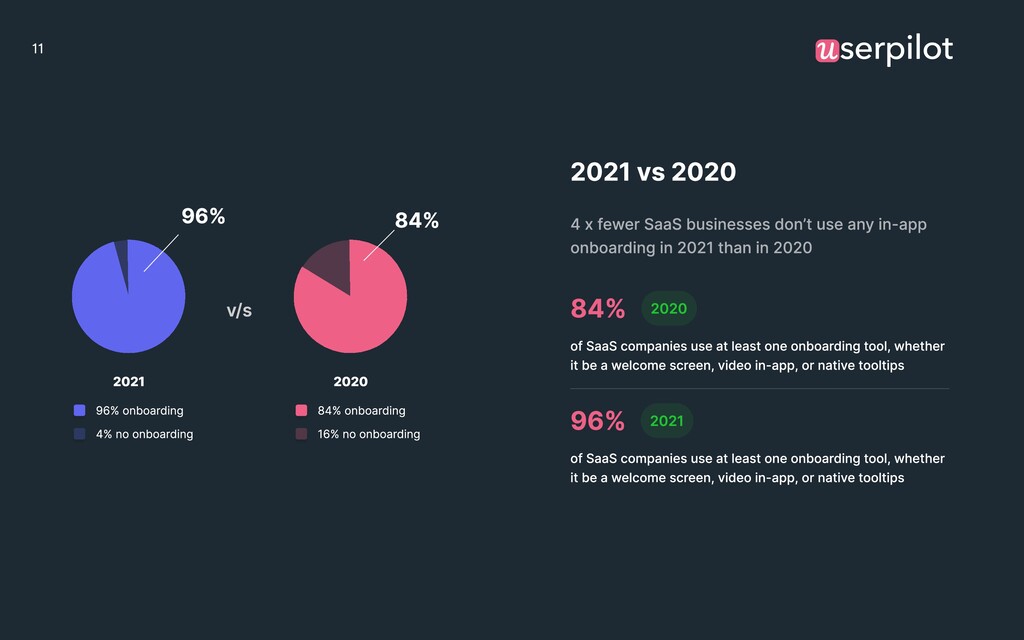
16% no onboarding 96% 84% 2021 vs 2020 4 x fewer SaaS businesses don’t use any in-app onboarding in 2021 than in 2020 84% 2020 of SaaS companies use at least one onboarding tool, whether it be a welcome screen, video in-app, or native tooltips 96% 2021 of SaaS companies use at least one onboarding tool, whether it be a welcome screen, video in-app, or native tooltips 11
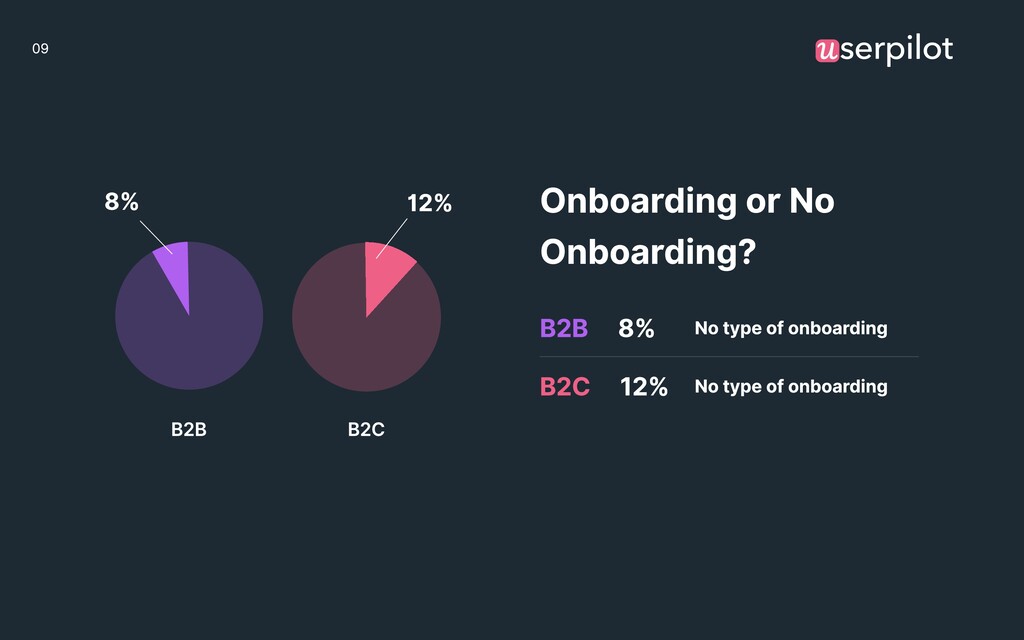
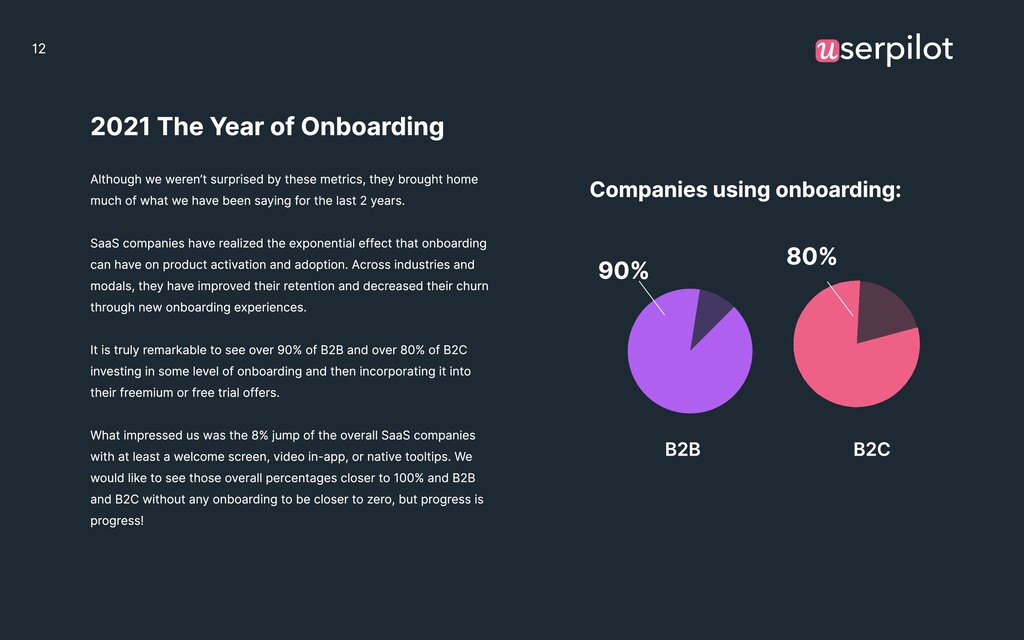
these metrics, they brought home much of what we have been saying for the last 2 years. SaaS companies have realized the exponential effect that onboarding can have on product activation and adoption. Across industries and modals, they have improved their retention and decreased their churn through new onboarding experiences. It is truly remarkable to see over 90% of B2B and over 80% of B2C investing in some level of onboarding and then incorporating it into their freemium or free trial offers. What impressed us was the 8% jump of the overall SaaS companies with at least a welcome screen, video in-app, or native tooltips. We would like to see those overall percentages closer to 100% and B2B and B2C without any onboarding to be closer to zero, but progress is progress! Companies using onboarding: 90% 80% B2B B2C 12
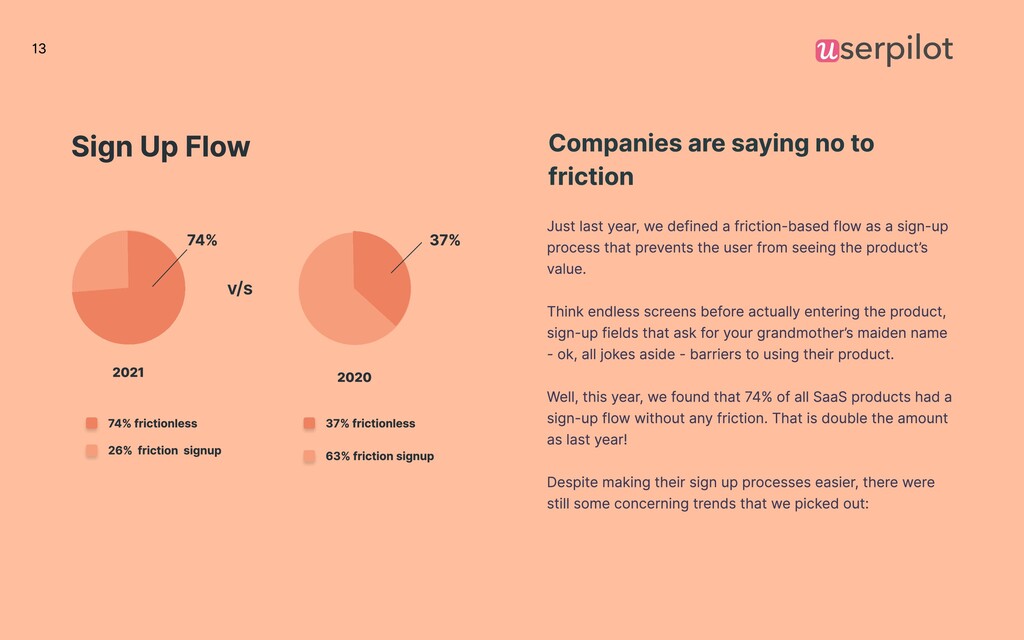
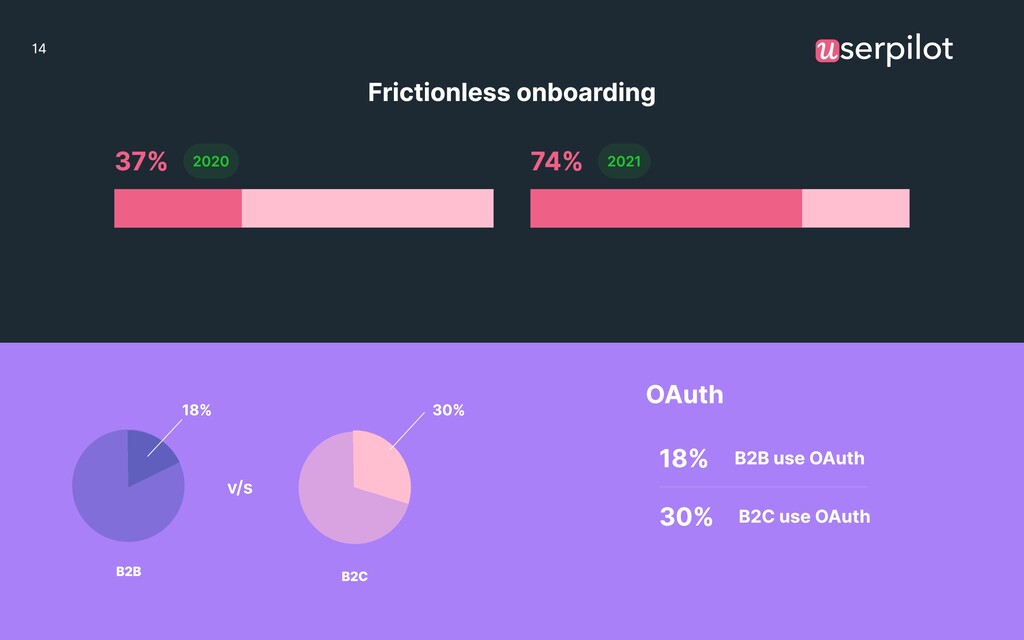
63% friction signup 74% 37% v/s 2021 2020 Just last year, we defined a friction-based flow as a sign-up process that prevents the user from seeing the product’s value. Think endless screens before actually entering the product, sign-up fields that ask for your grandmother’s maiden name - ok, all jokes aside - barriers to using their product. Well, this year, we found that 74% of all SaaS products had a sign-up flow without any friction. That is double the amount as last year! Despite making their sign up processes easier, there were still some concerning trends that we picked out: Companies are saying no to friction 13
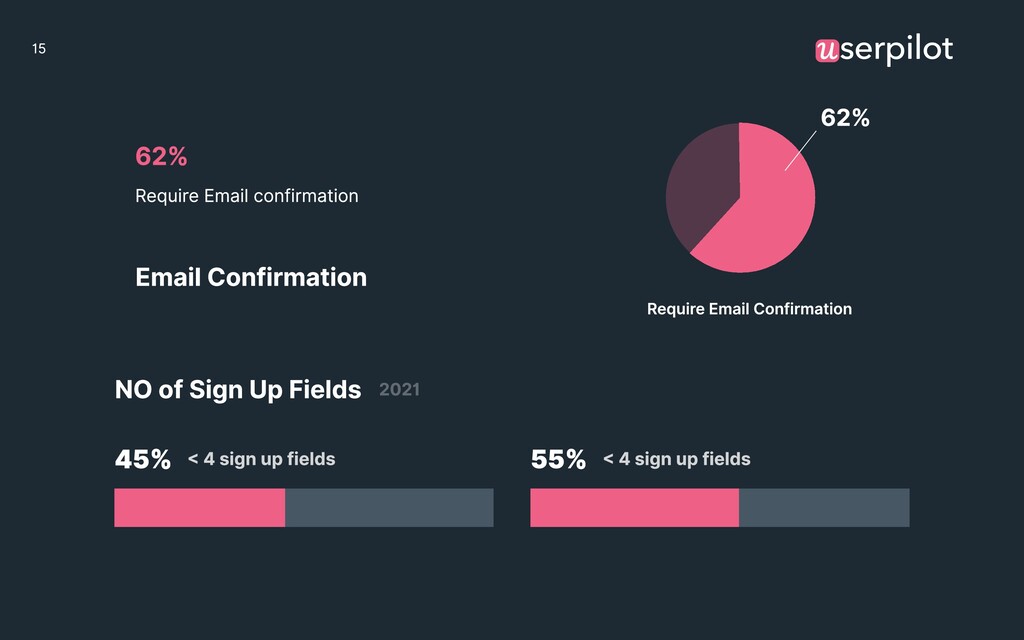
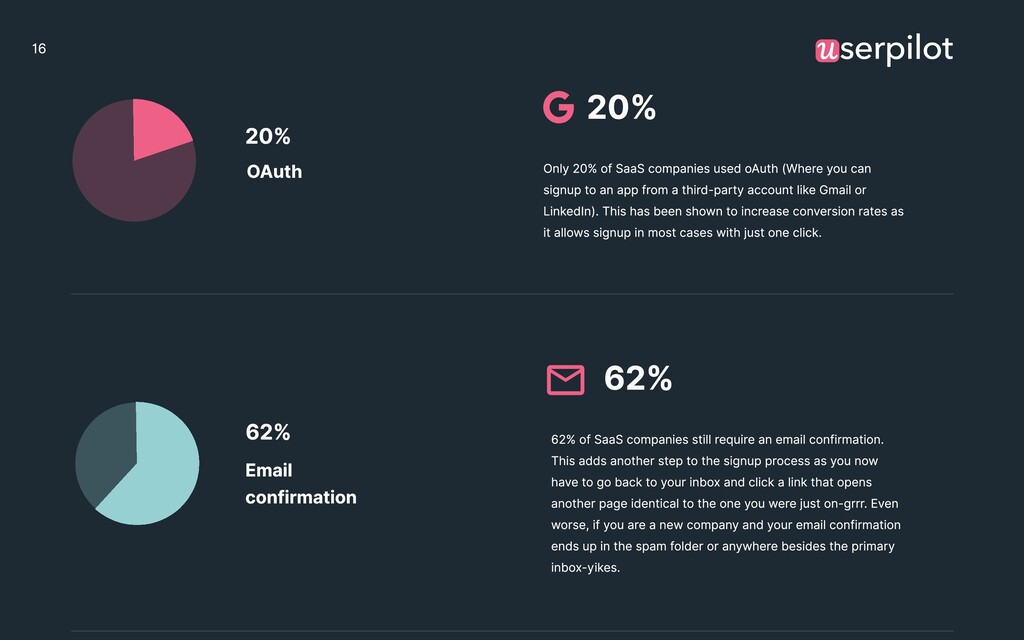
companies used oAuth (Where you can signup to an app from a third-party account like Gmail or LinkedIn). This has been shown to increase conversion rates as it allows signup in most cases with just one click. 62% 62% of SaaS companies still require an email confirmation. This adds another step to the signup process as you now have to go back to your inbox and click a link that opens another page identical to the one you were just on-grrr. Even worse, if you are a new company and your email confirmation ends up in the spam folder or anywhere besides the primary inbox-yikes. 16
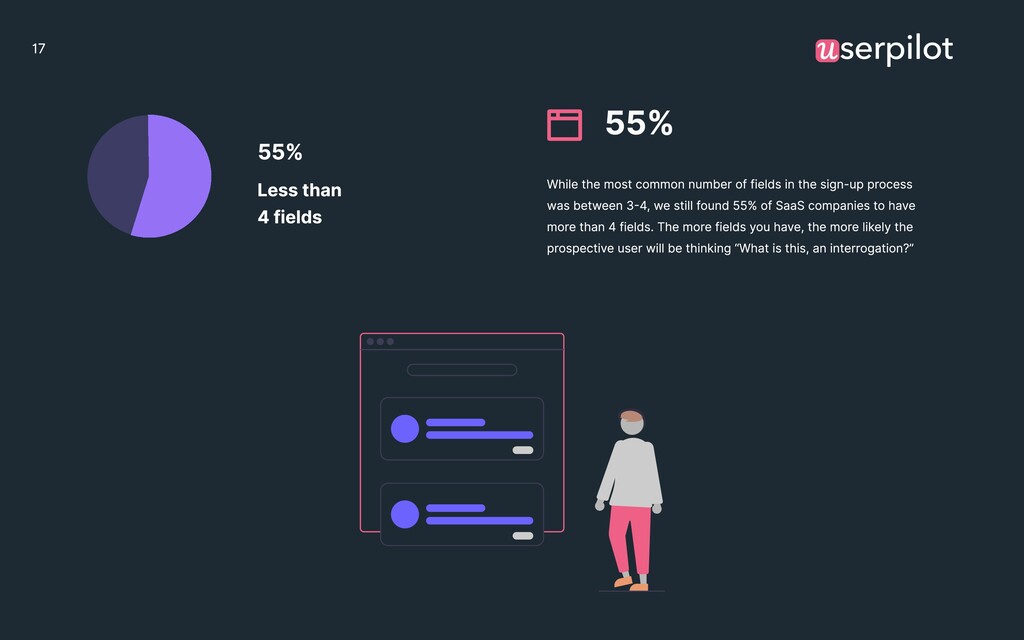
number of fields in the sign-up process was between 3-4, we still found 55% of SaaS companies to have more than 4 fields. The more fields you have, the more likely the prospective user will be thinking “What is this, an interrogation?” 17
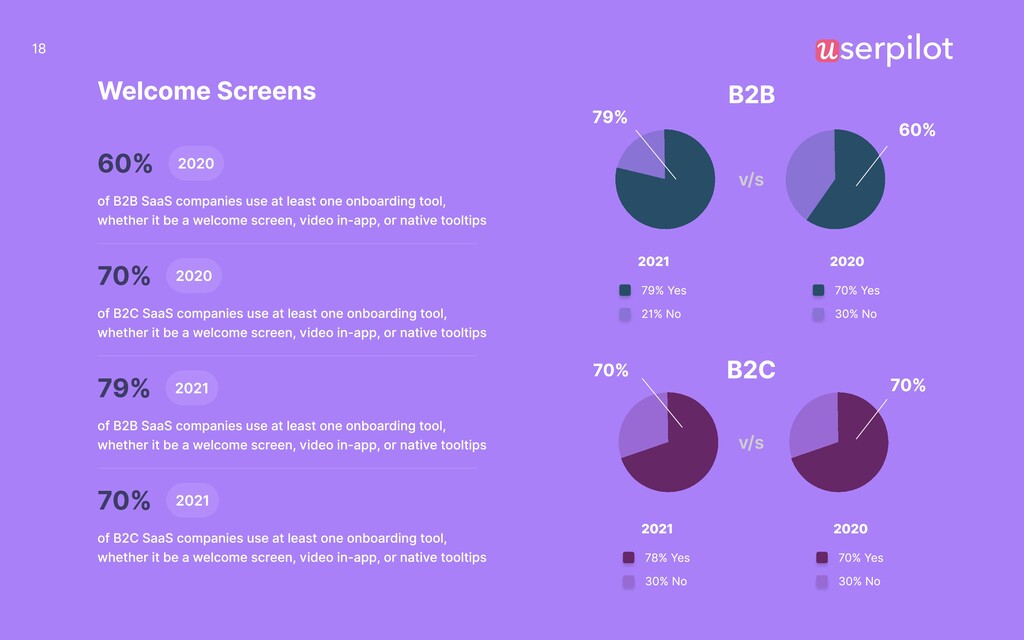
onboarding tool, whether it be a welcome screen, video in-app, or native tooltips 70% 2020 of B2C SaaS companies use at least one onboarding tool, whether it be a welcome screen, video in-app, or native tooltips 79% 2021 of B2B SaaS companies use at least one onboarding tool, whether it be a welcome screen, video in-app, or native tooltips 70% 2021 of B2C SaaS companies use at least one onboarding tool, whether it be a welcome screen, video in-app, or native tooltips B2B v/s 2021 2020 79% Yes 70% Yes 21% No 30% No B2C v/s 2021 2020 78% Yes 70% Yes 30% No 30% No 60% 70% 79% 70% Welcome Screens 18
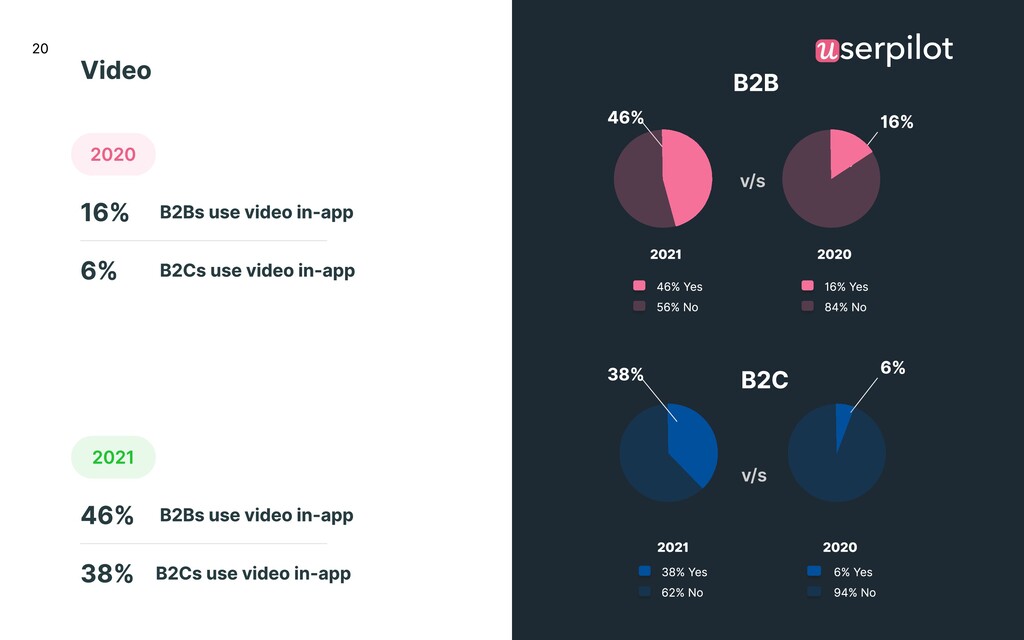
84% No 16% 46% B2C v/s 2021 2020 38% Yes 62% No 6% Yes 94% No 6% 38% Video 2020 2021 16% 46% B2Bs use video in-app B2Bs use video in-app 6% 38% B2Cs use video in-app B2Cs use video in-app 20
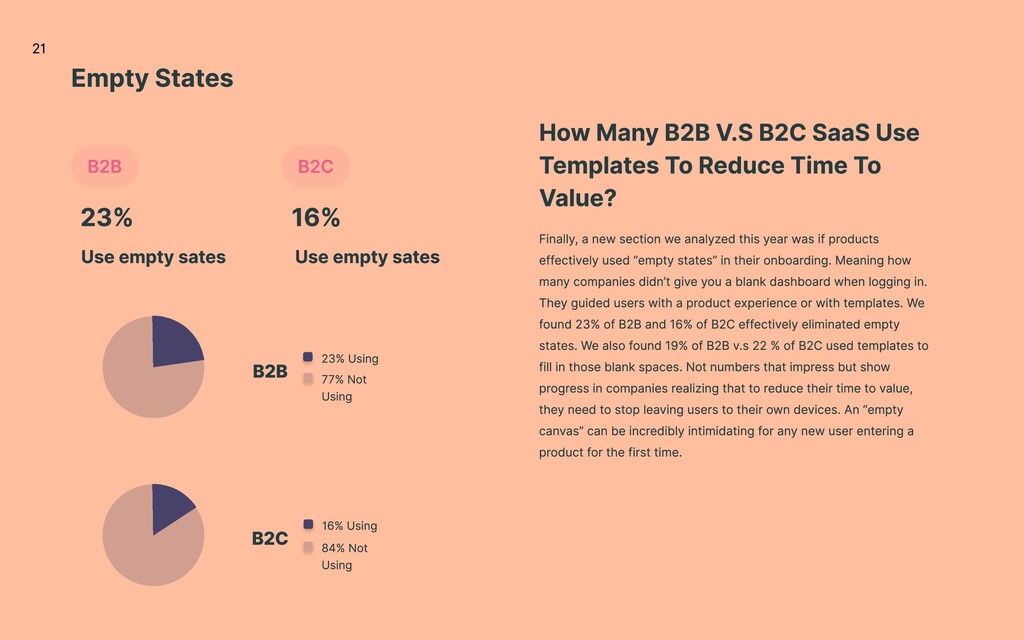
Using 84% Not Using B2B B2C 23% Use empty sates 16% Use empty sates How many B2B v.s B2C SaaS use templates to reduce time to value? Finally, a new section we analyzed this year was if products effectively used “empty states” in their onboarding. Meaning how many companies didn’t give you a blank dashboard when logging in. They guided users with a product experience or with templates. We found 23% of B2B and 16% of B2C effectively eliminated empty states. We also found 19% of B2B v.s 22 % of B2C used templates to fill in those blank spaces. Not numbers that impress but show progress in companies realizing that to reduce their time to value, they need to stop leaving users to their own devices. An “empty canvas” can be incredibly intimidating for any new user entering a product for the first time. 21
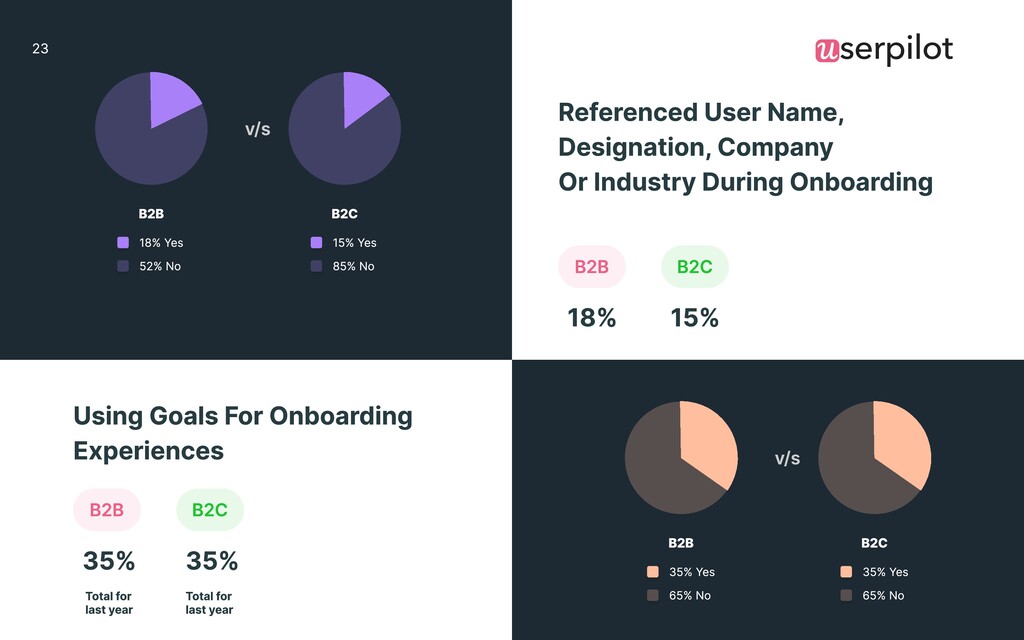
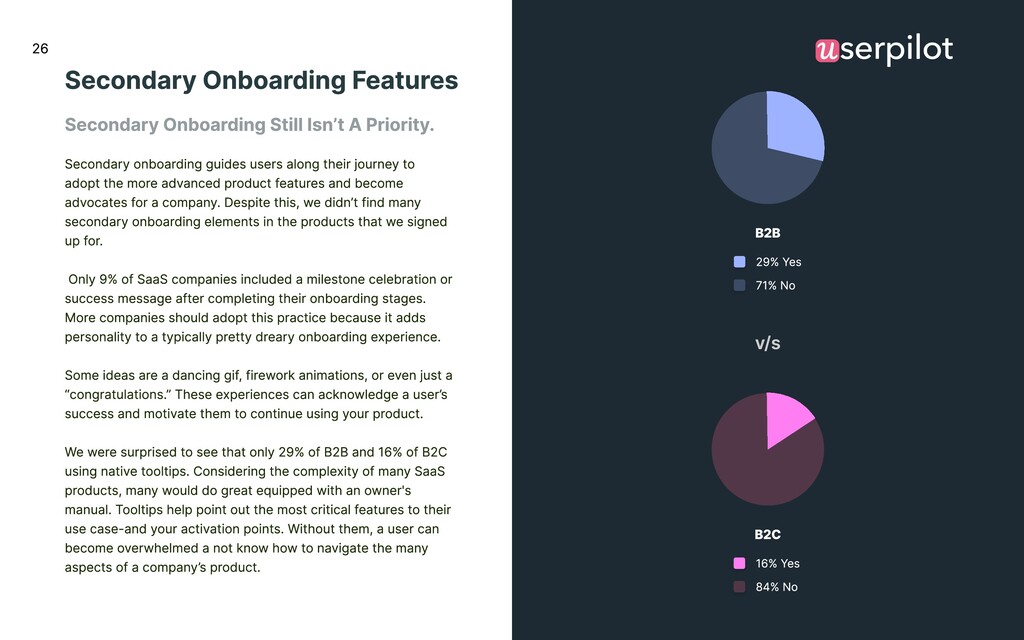
No referenced user name, designation, company or industry during onboarding B2B B2C 18% 15% v/s B2B B2C 35% Yes 35% Yes 65% No 65% No Using Goals For Onboarding Experiences B2B B2C 35% 35% Total for last year Total for last year 23
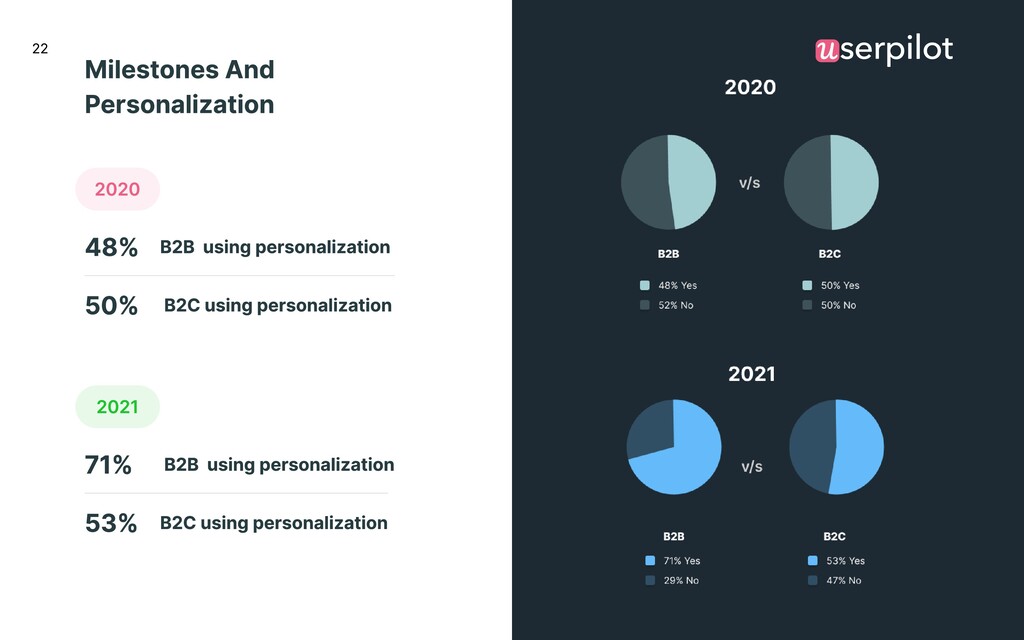
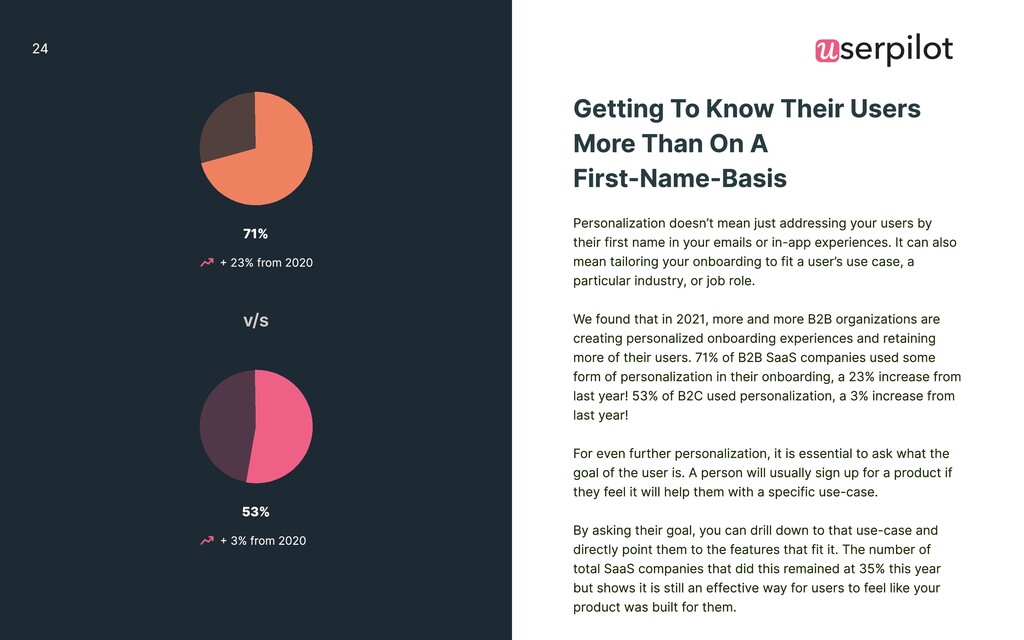
53% Getting to know their users more than on a first-name-basis Personalization doesn’t mean just addressing your users by their first name in your emails or in-app experiences. It can also mean tailoring your onboarding to fit a user’s use case, a particular industry, or job role. We found that in 2021, more and more B2B organizations are creating personalized onboarding experiences and retaining more of their users. 71% of B2B SaaS companies used some form of personalization in their onboarding, a 23% increase from last year! 53% of B2C used personalization, a 3% increase from last year! For even further personalization, it is essential to ask what the goal of the user is. A person will usually sign up for a product if they feel it will help them with a specific use-case. By asking their goal, you can drill down to that use-case and directly point them to the features that fit it. The number of total SaaS companies that did this remained at 35% this year but shows it is still an effective way for users to feel like your product was built for them. 24
of the B2C collected our data and then didn’t even personalize the experience. If you find yourself signing up for a product and going through multiple steps only to be greeted with a generic onboarding, such as a boring product tour showing you everything instead of what you need - this is definitely a red flag. Probably not worth the trouble to learn a new product if the company doesn’t go out of their way to provide a good customer experience. 25
B2C Secondary onboarding features Secondary onboarding still isn’t a priority. Secondary onboarding guides users along their journey to adopt the more advanced product features and become advocates for a company. Despite this, we didn’t find many secondary onboarding elements in the products that we signed up for. Only 9% of SaaS companies included a milestone celebration or success message after completing their onboarding stages. More companies should adopt this practice because it adds personality to a typically pretty dreary onboarding experience. Some ideas are a dancing gif, firework animations, or even just a “congratulations.” These experiences can acknowledge a user’s success and motivate them to continue using your product. We were surprised to see that only 29% of B2B and 16% of B2C using native tooltips. Considering the complexity of many SaaS products, many would do great equipped with an owner's manual. Tooltips help point out the most critical features to their use case-and your activation points. Without them, a user can become overwhelmed a not know how to navigate the many aspects of a company’s product. 26
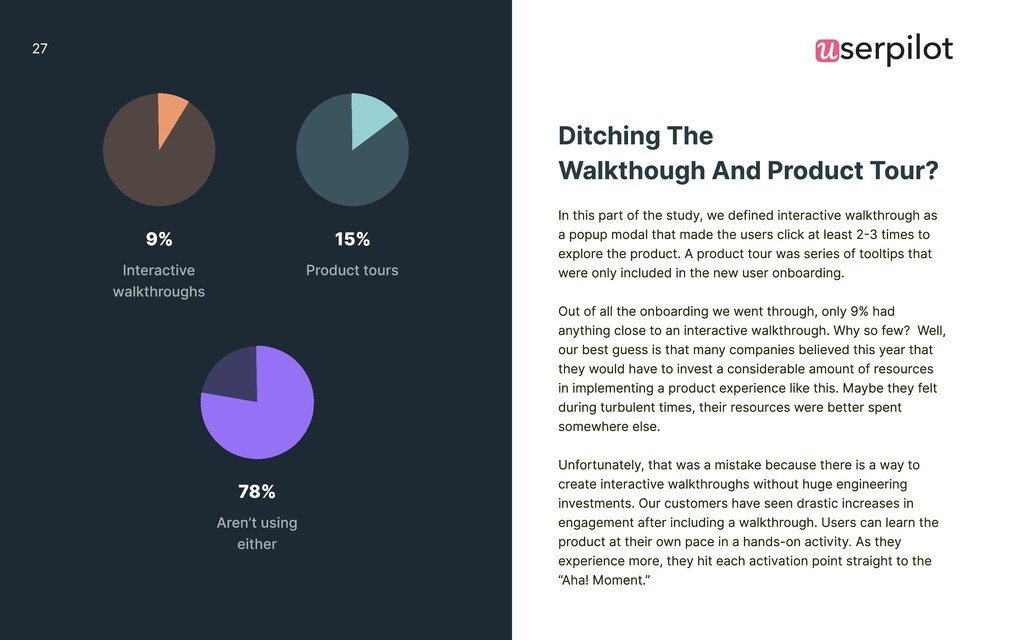
Ditching the walkthough and product tour? In this part of the study, we defined interactive walkthrough as a popup modal that made the users click at least 2-3 times to explore the product. A product tour was series of tooltips that were only included in the new user onboarding. Out of all the onboarding we went through, only 9% had anything close to an interactive walkthrough. Why so few? Well, our best guess is that many companies believed this year that they would have to invest a considerable amount of resources in implementing a product experience like this. Maybe they felt during turbulent times, their resources were better spent somewhere else. Unfortunately, that was a mistake because there is a way to create interactive walkthroughs without huge engineering investments. Our customers have seen drastic increases in engagement after including a walkthrough. Users can learn the product at their own pace in a hands-on activity. As they experience more, they hit each activation point straight to the “Aha! Moment.” 27
product tour in their onboarding. Although these experiences can help show a user around, they often can be quite dull and overload the user with information. If you decide to include one, make sure it is quick and focuses only on one feature aspect. The other 78% of companies that didn’t have either tried to substitute with different onboarding experiences, but we felt many could have used a walkthrough. 28
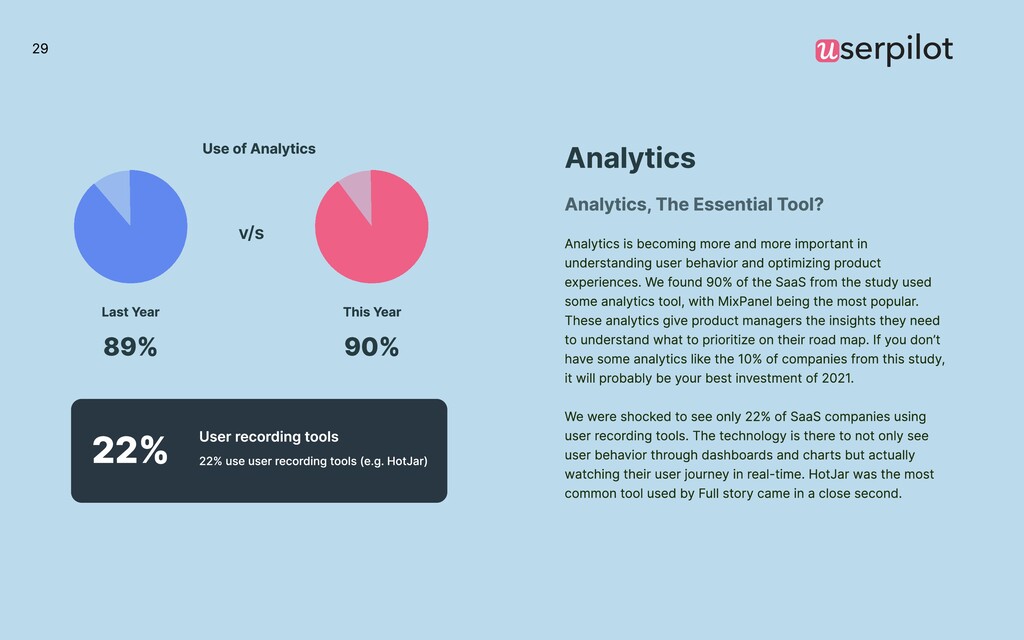
user behavior and optimizing product experiences. We found 90% of the SaaS from the study used some analytics tool, with MixPanel being the most popular. These analytics give product managers the insights they need to understand what to prioritize on their road map. If you don’t have some analytics like the 10% of companies from this study, it will probably be your best investment of 2021. We were shocked to see only 22% of SaaS companies using user recording tools. The technology is there to not only see user behavior through dashboards and charts but actually watching their user journey in real-time. HotJar was the most common tool used by Full story came in a close second. Use of Analytics User recording tools 22% use user recording tools (e.g. HotJar) v/s Last Year This Year 89% 22% 90% Analytics, the essential tool? Analytics, the essential tool? 29
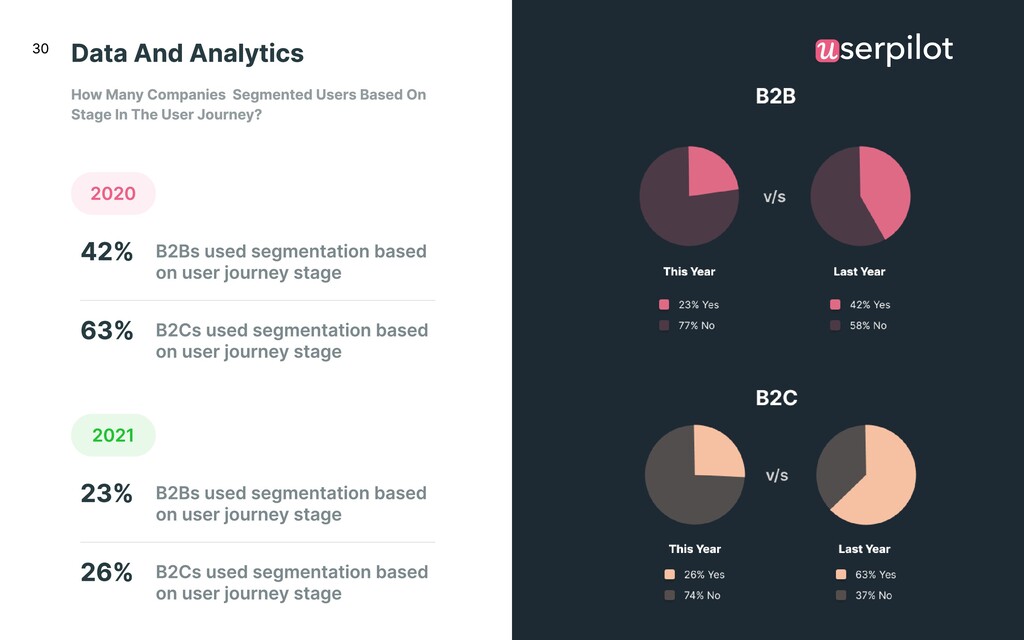
user journey stage 63% B2Cs used segmentation based on user journey stage 2021 23% B2Bs used segmentation based on user journey stage 26% B2Cs used segmentation based on user journey stage How many Companies segmented Users Based on Stage in the User Journey? 30
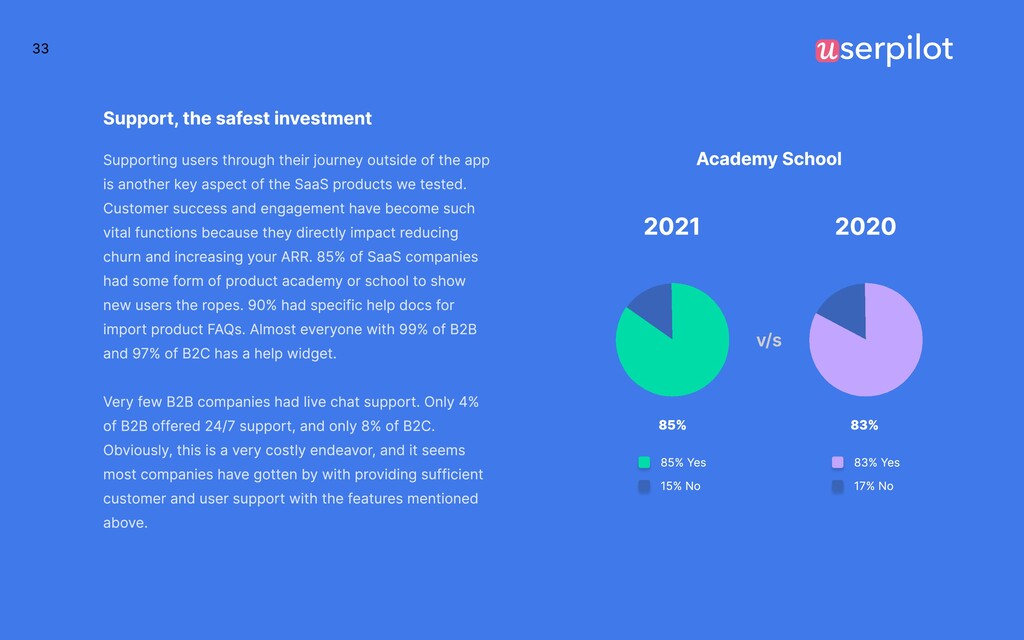
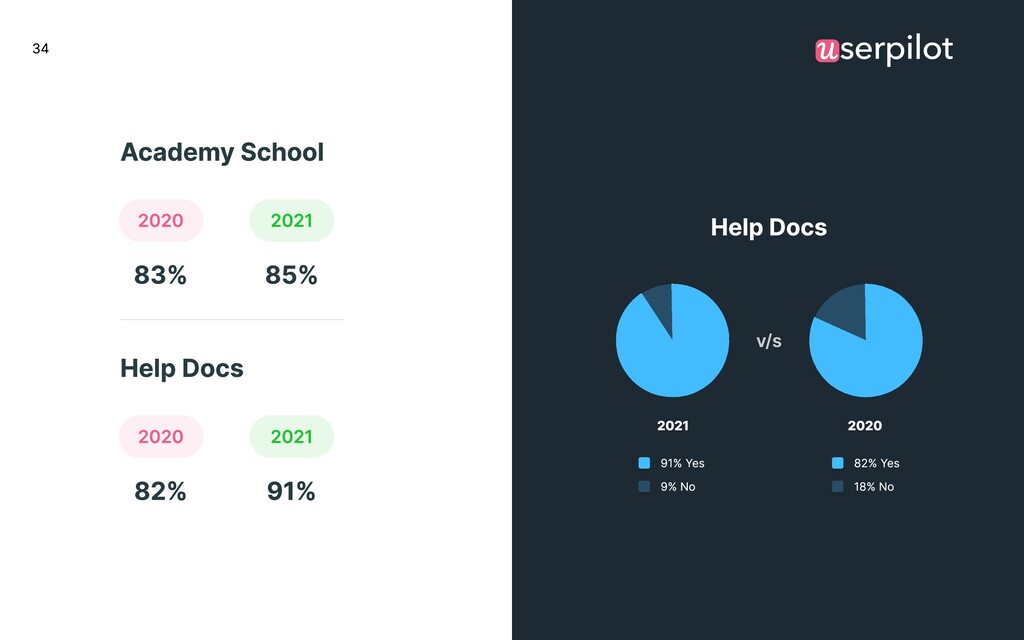
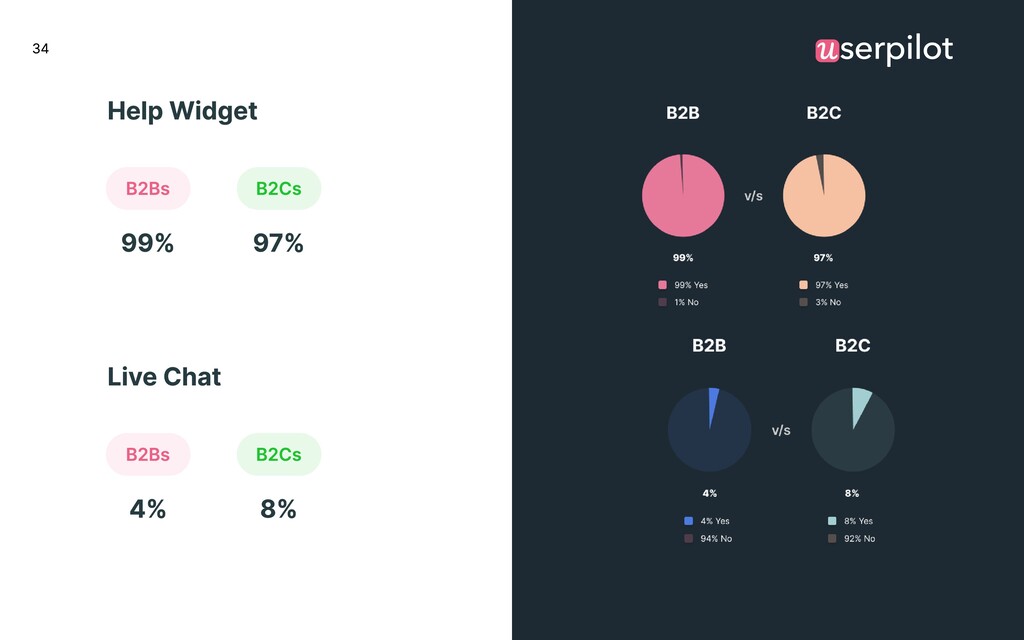
No 83% Yes 17% No Support, the safest investment Supporting users through their journey outside of the app is another key aspect of the SaaS products we tested. Customer success and engagement have become such vital functions because they directly impact reducing churn and increasing your ARR. 85% of SaaS companies had some form of product academy or school to show new users the ropes. 90% had specific help docs for import product FAQs. Almost everyone with 99% of B2B and 97% of B2C has a help widget. Very few B2B companies had live chat support. Only 4% of B2B offered 24/7 support, and only 8% of B2C. Obviously, this is a very costly endeavor, and it seems most companies have gotten by with providing sufficient customer and user support with the features mentioned above. 33
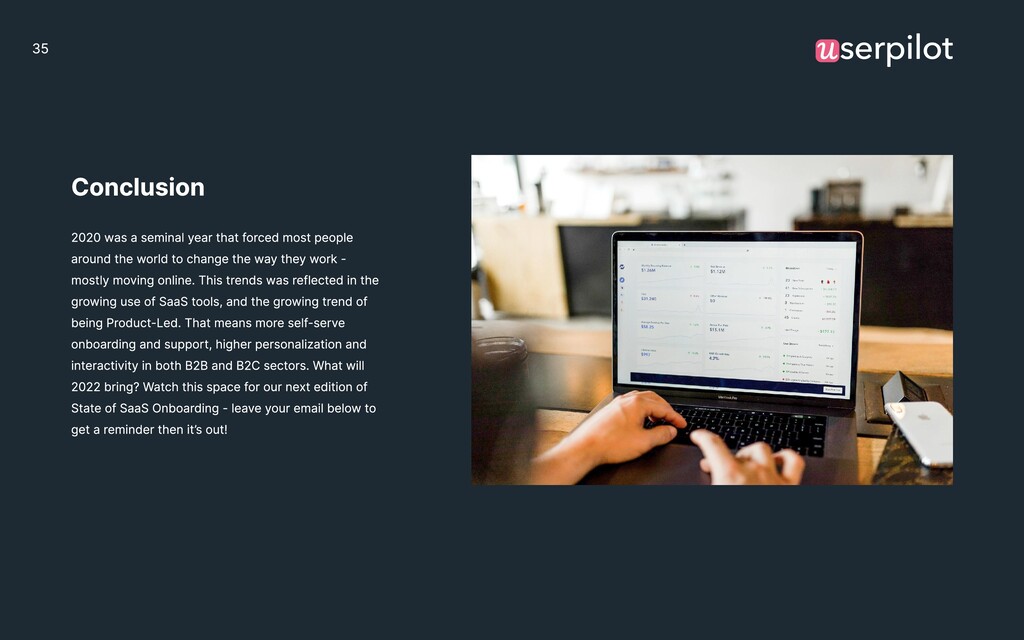
around the world to change the way they work - mostly moving online. This trends was reflected in the growing use of SaaS tools, and the growing trend of being Product-Led. That means more self-serve onboarding and support, higher personalization and interactivity in both B2B and B2C sectors. What will 2022 bring? Watch this space for our next edition of State of SaaS Onboarding - leave your email below to get a reminder then it’s out! 35


 canvasedge
 tamosan01
 ggfs
ggfs
 so_kotani
 advalistar
 gatechnologies
 xinghr
 kgmotors
 kazuma777777
 neuroenergia
 loglass2019
.jpg) ikuodanaka
ikuodanaka
 rkaga
rkaga
 kastner
 speakerdeck
 geshan
 frankvandijk
 soudai
 skipperchong
 katarinadahlin
 denniskardys
.png) helenjbeal
helenjbeal
 uxyall
 aleyda