
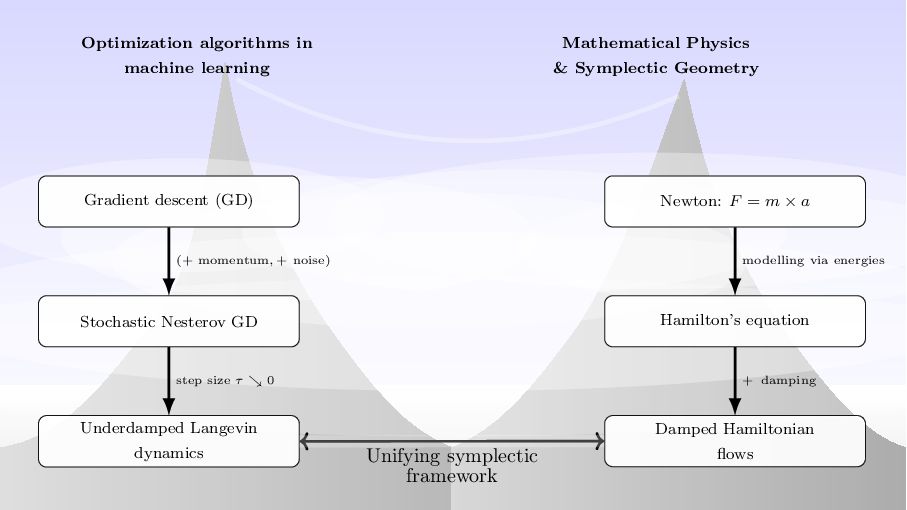
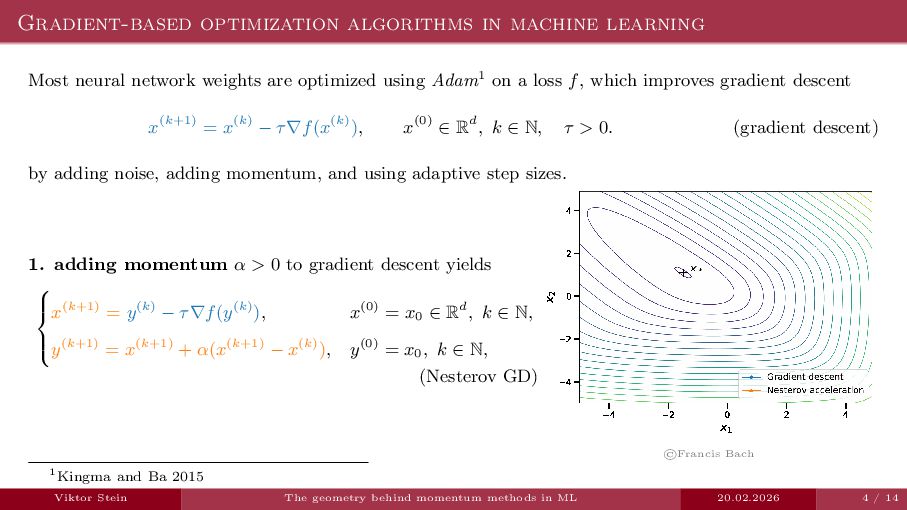
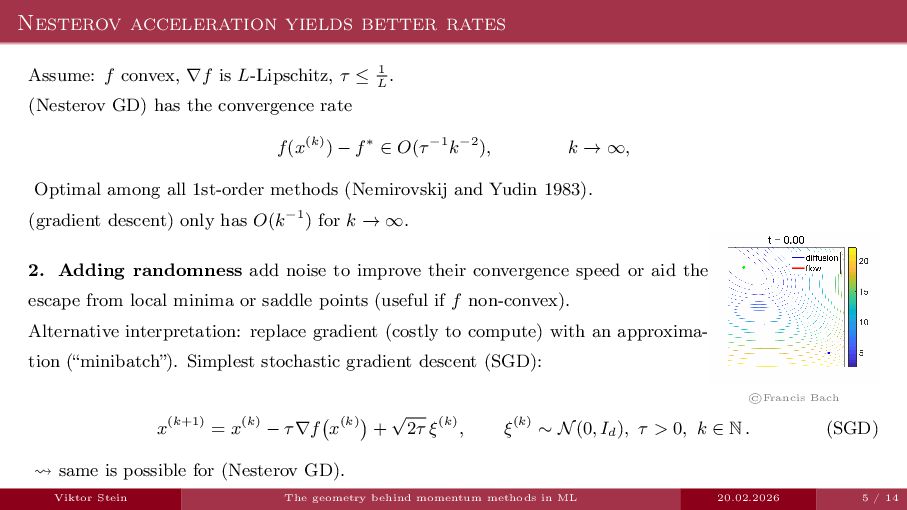
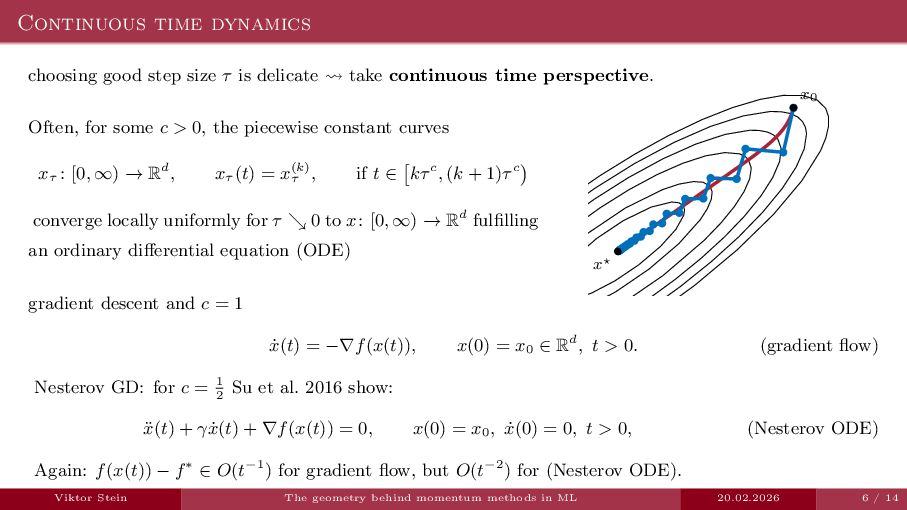
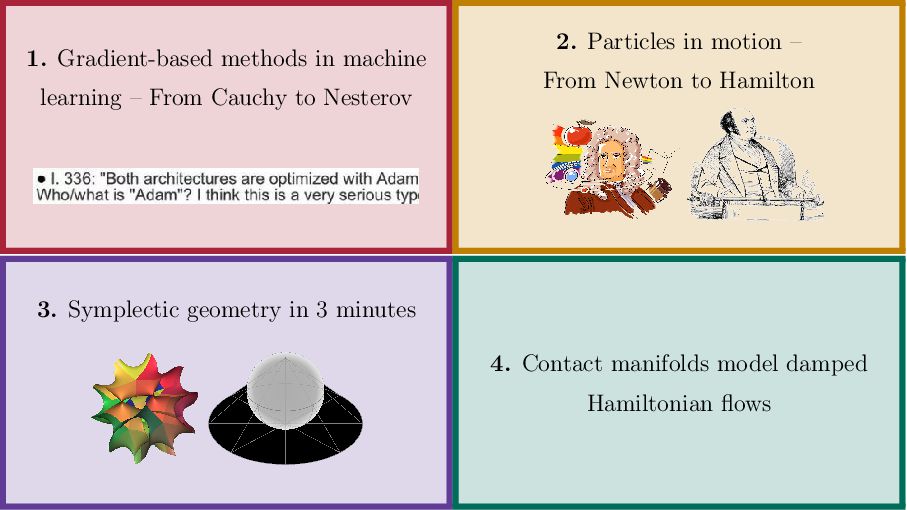
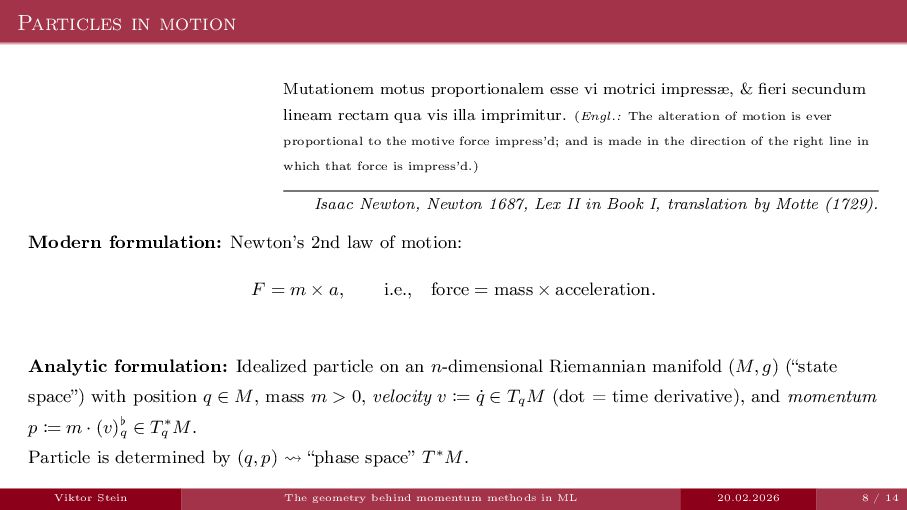
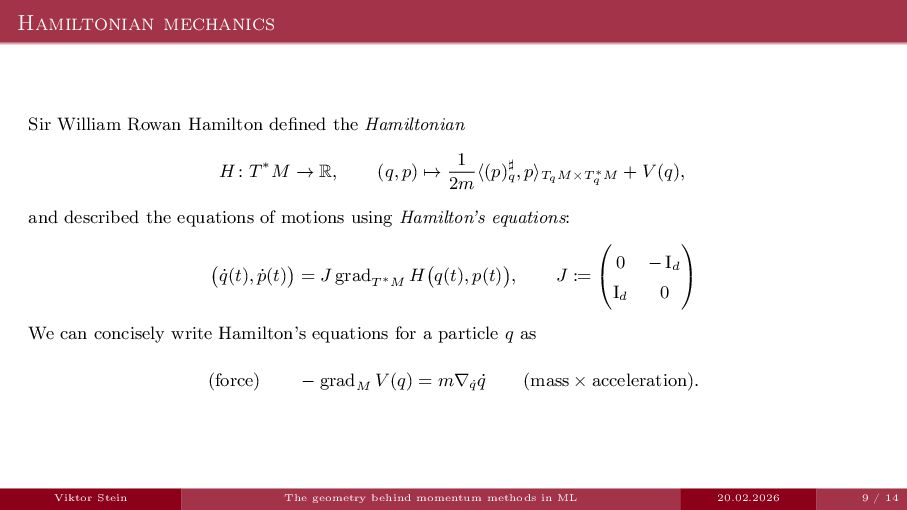
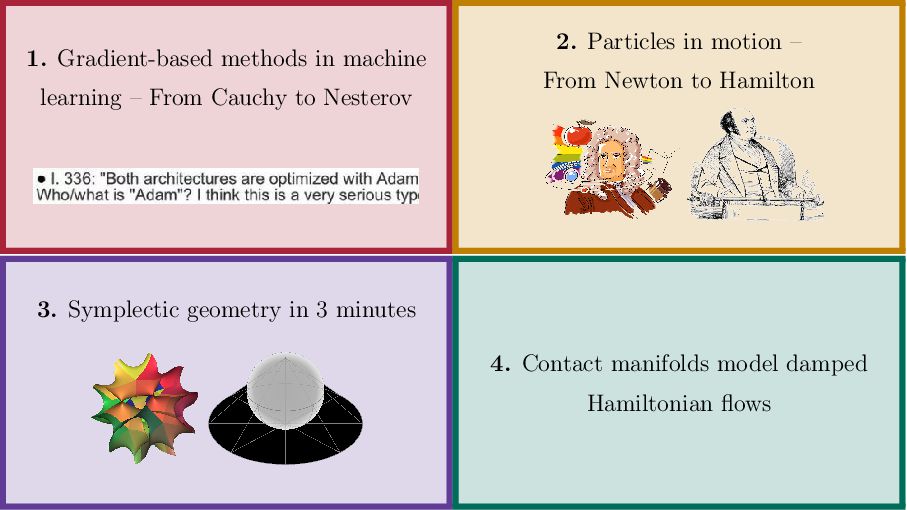
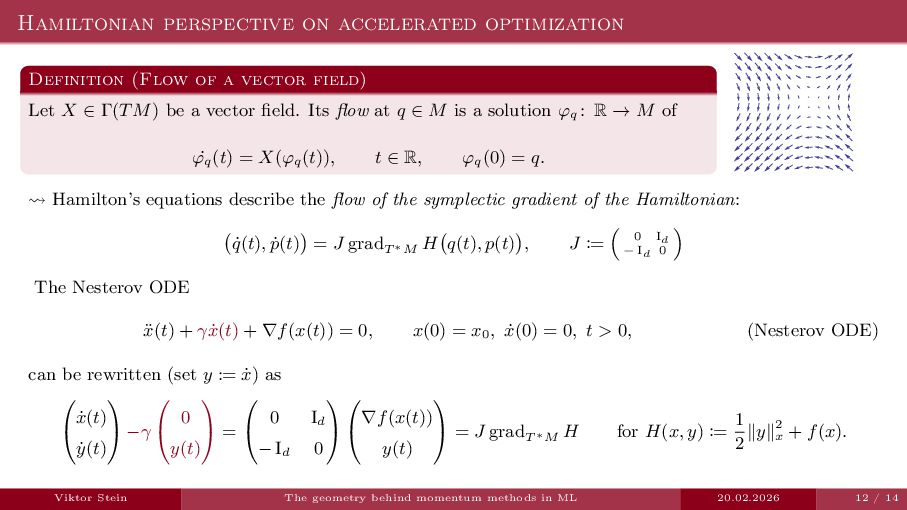
Gradient-based optimization algorithms are indispensable for most modern machine learning applications, since they are used to train convolutional neural networks (CNNs) for image classification or transformers for natural language processing. Often, the weights are optimized using the Adam algorithm, a momentum-based modification of gradient descent. In the vanishing step-size limit, these momentum-based algorithms can be described as second-order damped dynamics with a time-dependent Hamiltonian interpretation.
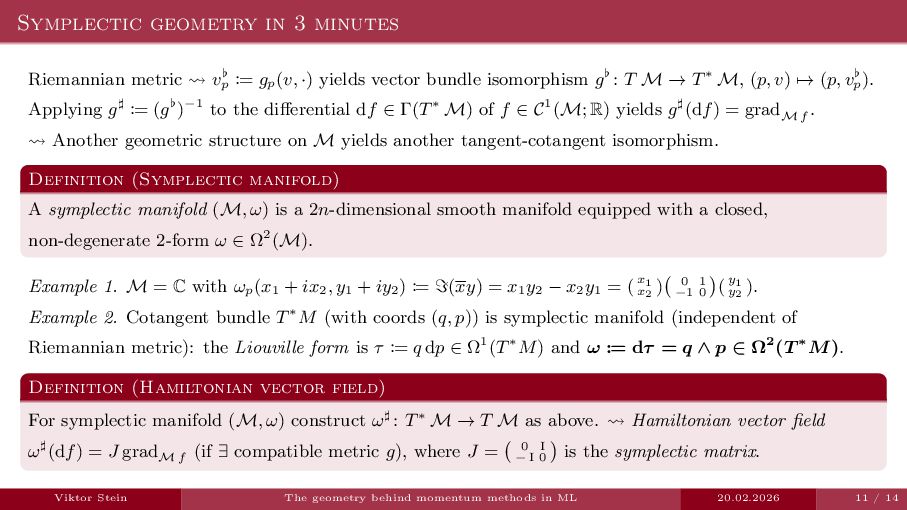
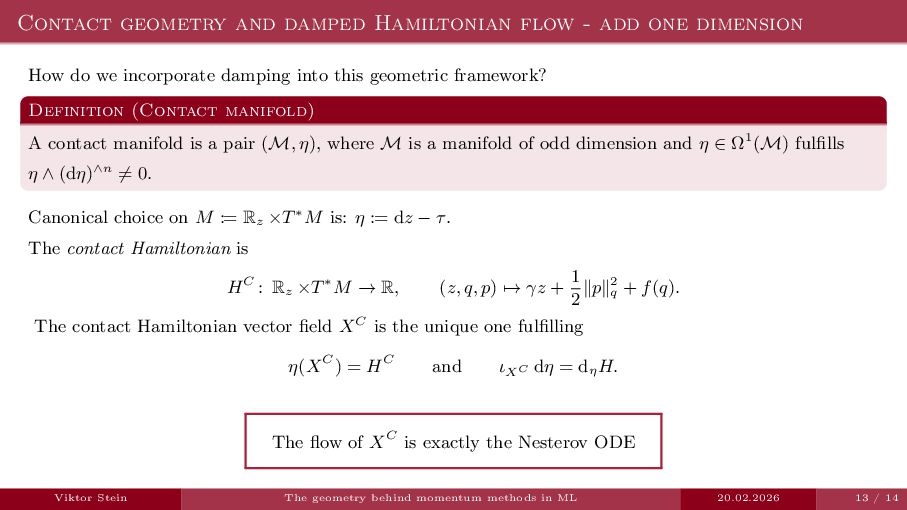
In this talk, I will gently introduce the contact geometry behind time-dependent Hamiltonian systems and show how viewing momentum-based methods in machine learning through this geometric lens can help elucidate their properties.


 viktorajstein
 monochromegane
 hf149
hf149
 sokikatayama
 shunk031
.png) satai
satai
 ayaniwa
 institutdelelevage
 kohlerjohannes
 mikimhk
 reokashiwa
 nnchiba
 fkske
fkske
 aleyda
 mclloyd
 trallard
 sonatard
 jonrohan
 addyosmani
 kimpetersen
 tammielis
 helmedeiros
 pwiseman
 nikkihalliwell
 akademiya2063

![Bibliography [1] D. Kingma and J. Ba, “Adam: A method](https://files.speakerdeck.com/presentations/cbe74067065e418aa57713272523f911/slide_14.jpg)