computer is kept by the child, and they can access it on their own • There should be no consequence to anyone but the child if it breaks • Something is better than nothing, but nothing beats a real machine
an end • Let that sink in • Find out the child’s interests and let that set the goal • Be ready to pivot with changing interest • But do stress the need to finish
One Day / Weekend Camp • Student / Teacher Ratio • True Outreach? Ask about scholarship participation • Short events can be a great start, but education takes time • I’ve yet to find an effective method that scales – 1:1
You may need to help the child engage (school, home) • Some children need to move, or play music – let them! • Different methods for different children (Common Core or even New Math may be the answer!) • Understand your own background and do not assume it’s the same for the child
An area I personally am passionate about • A large set of skills to work on (Art, Code, Music, Writing, Math, Physics, Psychology) • Tools for all skill and experience levels • Allow a great deal of self expression • Can be run on the mobile devices children already have to share with friends and family
Free from MIT • Scratch Like Scripting • Deploy directly to and debug on any Android device • Good place to start with young children and children interested in making games for their phone • I’ve used successfully it with very cheap ($50) devices! ai2.appinventor.mit.edu
web and mobile paid add ons • Basic scripting via wizards • Advanced scripting via custom language • Good for children to advanced for Scratch but not ready for Unity yoyogames.com/studio
and mobile (some costs, web free) • Built for 2D games • Scripting via wizards • Advanced scripting with Javascript • Good starting platform for making games and for more art focused children Scirra.com/construct2
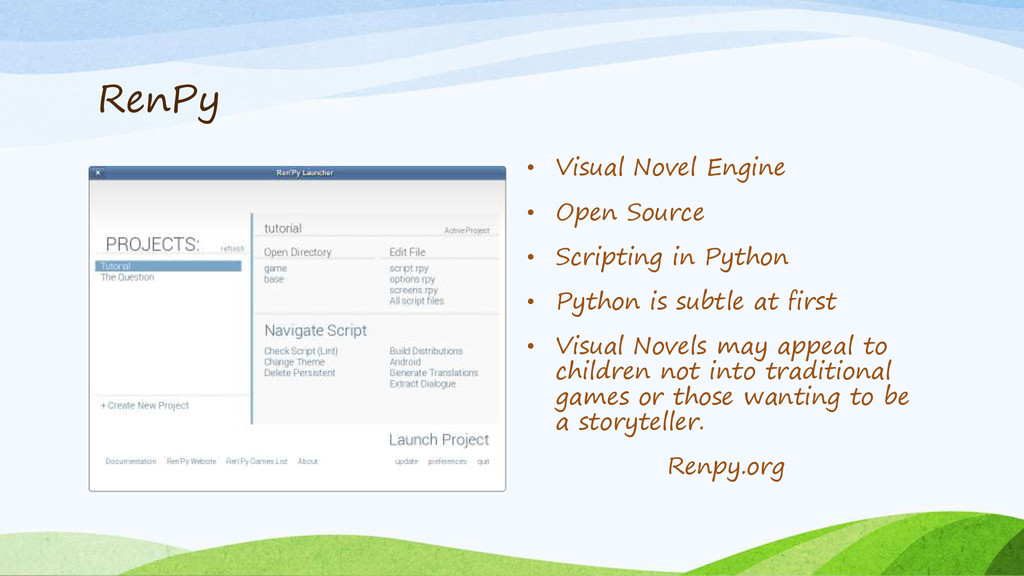
in Python • Python is subtle at first • Visual Novels may appeal to children not into traditional games or those wanting to be a storyteller. Renpy.org


 vinull
 juanmartin2026
 radlovacki1976
 auctria
 ainischool
 cbtlibrary
 kentaroy47
 2720japanoke
 kaityo256
 akiraasano
 spring_aki
 hiola
 skipperchong
 csswizardry
 eileencodes
 lemiorhan
 lara
 kimpetersen
 marktimemedia
 ammeep
 jacobtomlinson
 kneath
 badams
 twada