Upgrade to Pro — share decks privately, control downloads, hide ads and more …

Creating summative scores from instructionally ...

Sponsored · Your Podcast. Everywhere. Effortlessly. Share. Educate. Inspire. Entertain. You do you. We'll handle the rest.

Creating summative scores from instructionally embedded results

As states begin implementing through-year assessment models, assessment providers must consider how to create a comprehensive summative result from multiple discrete testing occasions. In this talk we describe a process for evaluating a wide range of summative scoring models (e.g., item response theory, diagnostic classification, and innovative hybrid models) based on our work in the Pathways for Instructionally Embedded Assessment (PIE), a Competitive Grant for State Assessment project with the Missouri Department of Elementary and Secondary Education. This process involves not just a psychometric evaluation of summative models but also careful consideration of whether the scores support assessment claims made in a theory of action and can be used to generate indicators in a state accountability model (e.g., growth models). We then illustrate how summative scores are produced using diagnostic classification models for the Dynamic Learning Maps Alternate Assessment System, a through-year assessment that has been operational since 2015 and fully meets federal peer review requirements. We discuss the specific assessment claims and how the data collected throughout the year is used to provide both real-time instructional feedback and summative results, including an overall performance level for use in accountability systems.

Avatar for Jake Thompson

Jake Thompson

April 03, 2026

More Decks by Jake Thompson

Other Decks in Education

Transcript

  1. The UNIVERSITY of KANSAS The UNIVERSITY of KANSAS Accessible Teaching,

    Learning, and Assessment Systems (ATLAS) Creating Summative Scores from Instructionally Embedded Results W. Jake Thompson and Brooke Nash
  2. The UNIVERSITY of KANSAS The UNIVERSITY of KANSAS What are

    instructionally embedded assessments? • One possible through-year assessment design • Short, frequent assessments embedded into teachers’ planned instructional units • Teachers flexibly choose which standards to assess and when, according to local curriculum and pacing guides • No full blueprint end-of-year assessment • Results provided at a grain-size to support instructional decision-making
  3. The UNIVERSITY of KANSAS The UNIVERSITY of KANSAS Theory-of-action driven

    psychometrics • Item response theory is often treated as the default psychometric model • We may define a theory of action for how scores should be used, but then reverse engineer how to get that information (or an approximation) from our IRT model • Rather than starting from the psychometric model, we advocate starting from the intended uses and building the model that meets the assessment's needs
  4. The UNIVERSITY of KANSAS The UNIVERSITY of KANSAS Psychometrics in

    a through-year assessment • Through-year assessments have unique designs with different intended uses and traditional summative assessments • If we are measuring something different, we shouldn't expect our results to look the same • Need psychometric models that meet the needs of a through- year assessment • Two example use cases: • Dynamic Learning Maps • Pathways for Instructionally Embedded Assessment
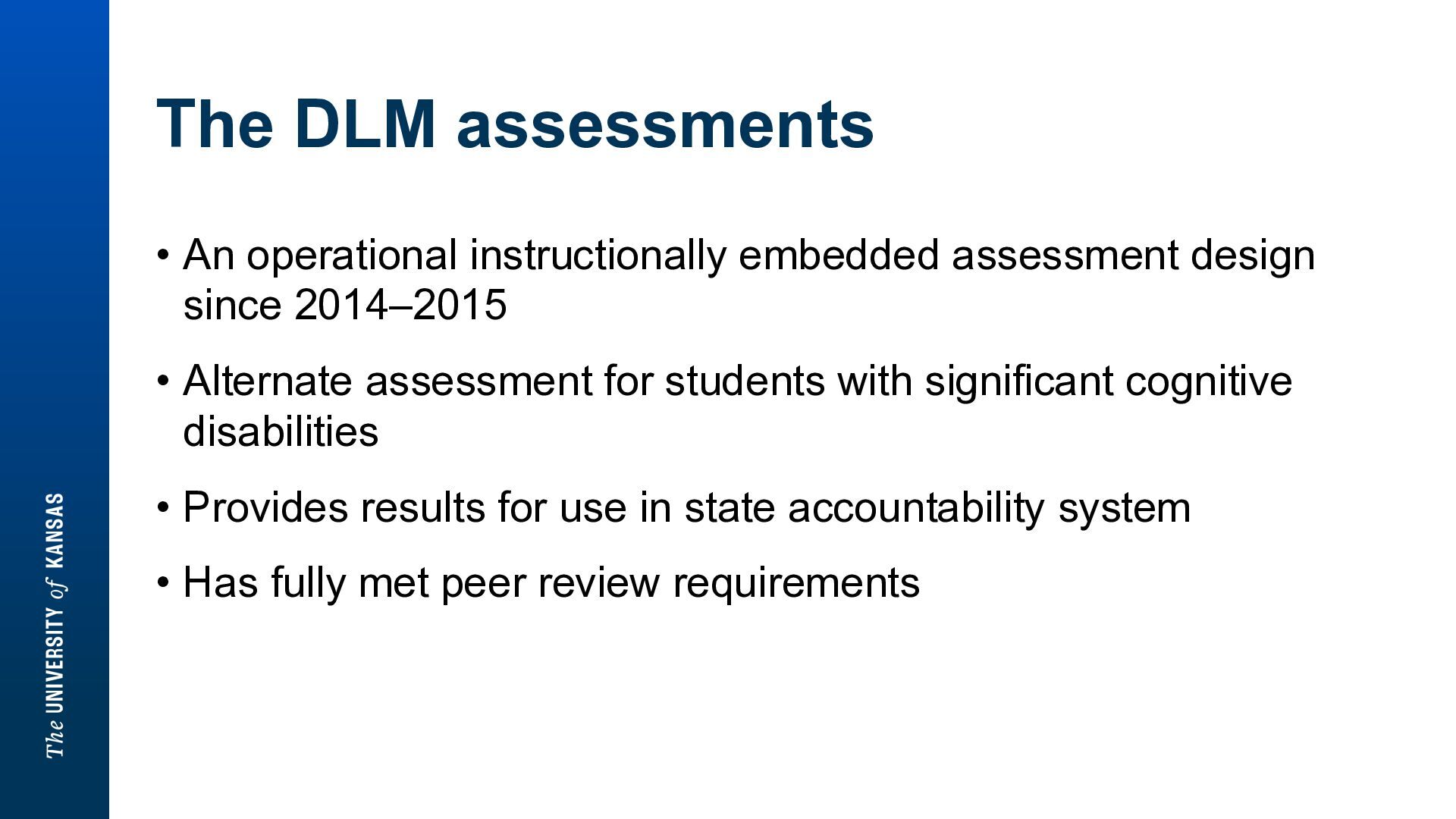
  5. The UNIVERSITY of KANSAS The UNIVERSITY of KANSAS The DLM

    assessments • An operational instructionally embedded assessment design since 2014–2015 • Alternate assessment for students with significant cognitive disabilities • Provides results for use in state accountability system • Has fully met peer review requirements
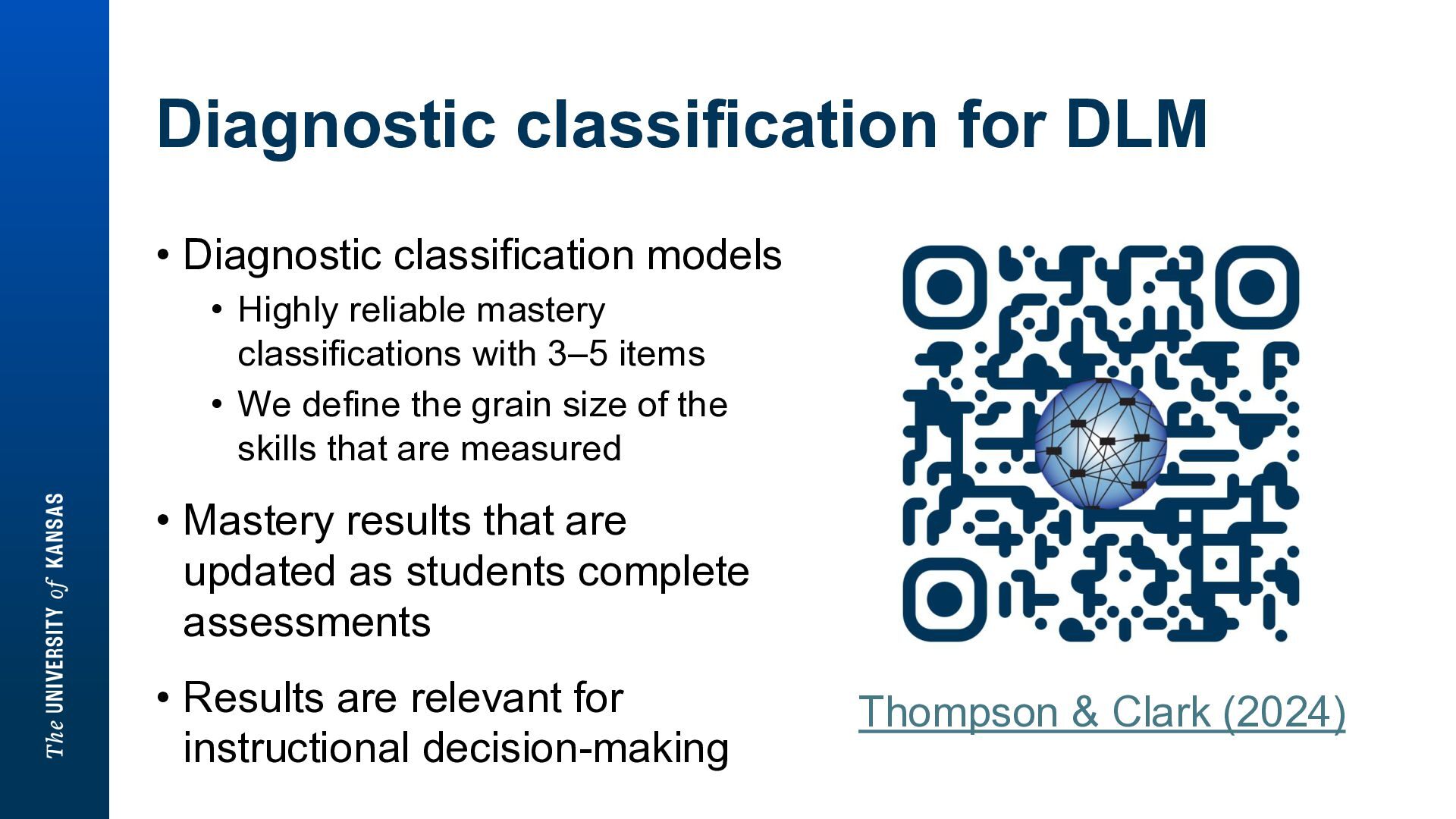
  6. The UNIVERSITY of KANSAS The UNIVERSITY of KANSAS Diagnostic classification

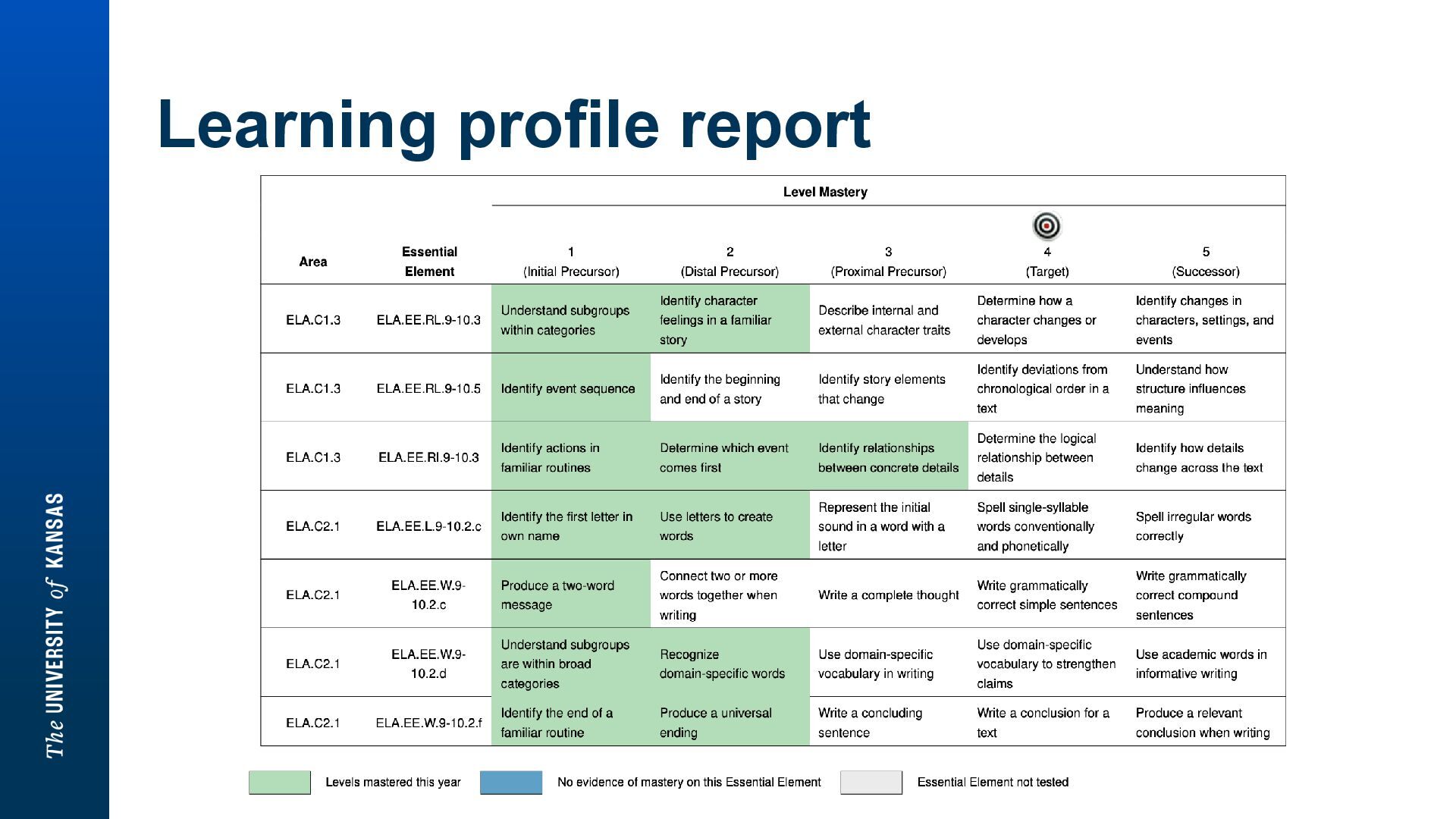
    for DLM • Diagnostic classification models • Highly reliable mastery classifications with 3–5 items • We define the grain size of the skills that are measured • Mastery results that are updated as students complete assessments • Results are relevant for instructional decision-making Thompson & Clark (2024)
  7. The UNIVERSITY of KANSAS The UNIVERSITY of KANSAS From profiles

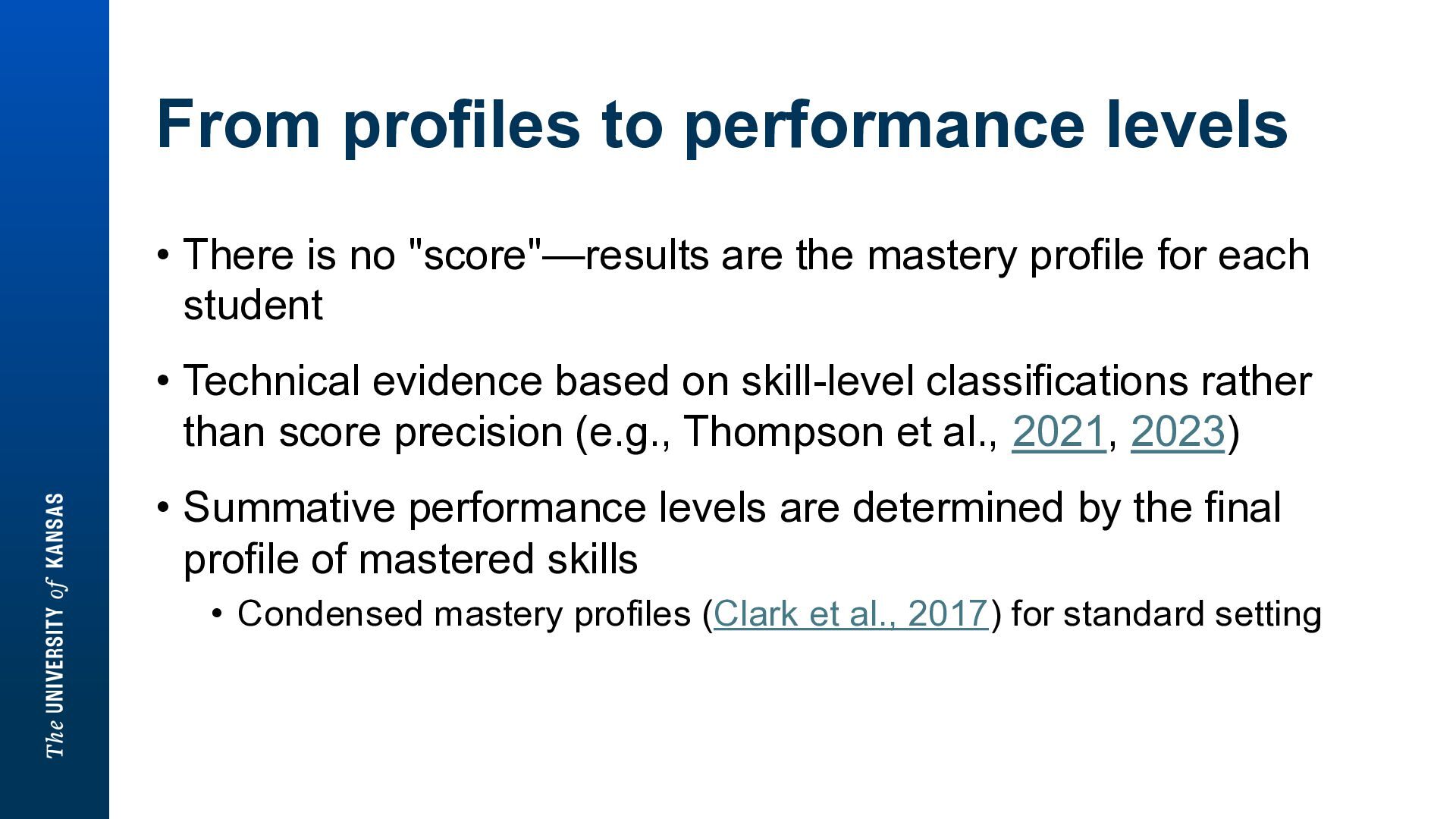
    to performance levels • There is no "score"—results are the mastery profile for each student • Technical evidence based on skill-level classifications rather than score precision (e.g., Thompson et al., 2021, 2023) • Summative performance levels are determined by the final profile of mastered skills • Condensed mastery profiles (Clark et al., 2017) for standard setting
  8. The UNIVERSITY of KANSAS The UNIVERSITY of KANSAS The PIE

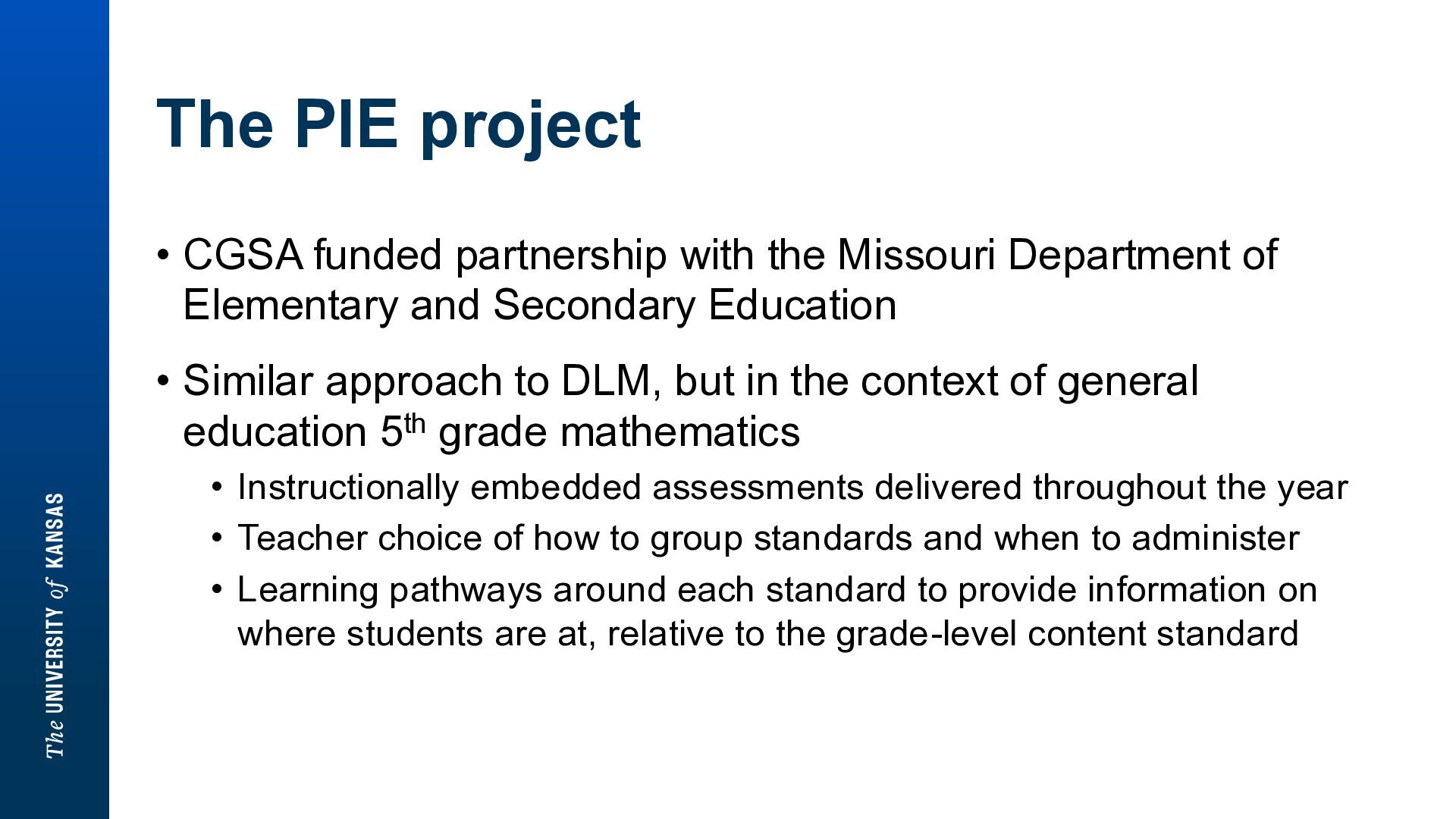
    project • CGSA funded partnership with the Missouri Department of Elementary and Secondary Education • Similar approach to DLM, but in the context of general education 5th grade mathematics • Instructionally embedded assessments delivered throughout the year • Teacher choice of how to group standards and when to administer • Learning pathways around each standard to provide information on where students are at, relative to the grade-level content standard
  9. The UNIVERSITY of KANSAS The UNIVERSITY of KANSAS Summative reporting

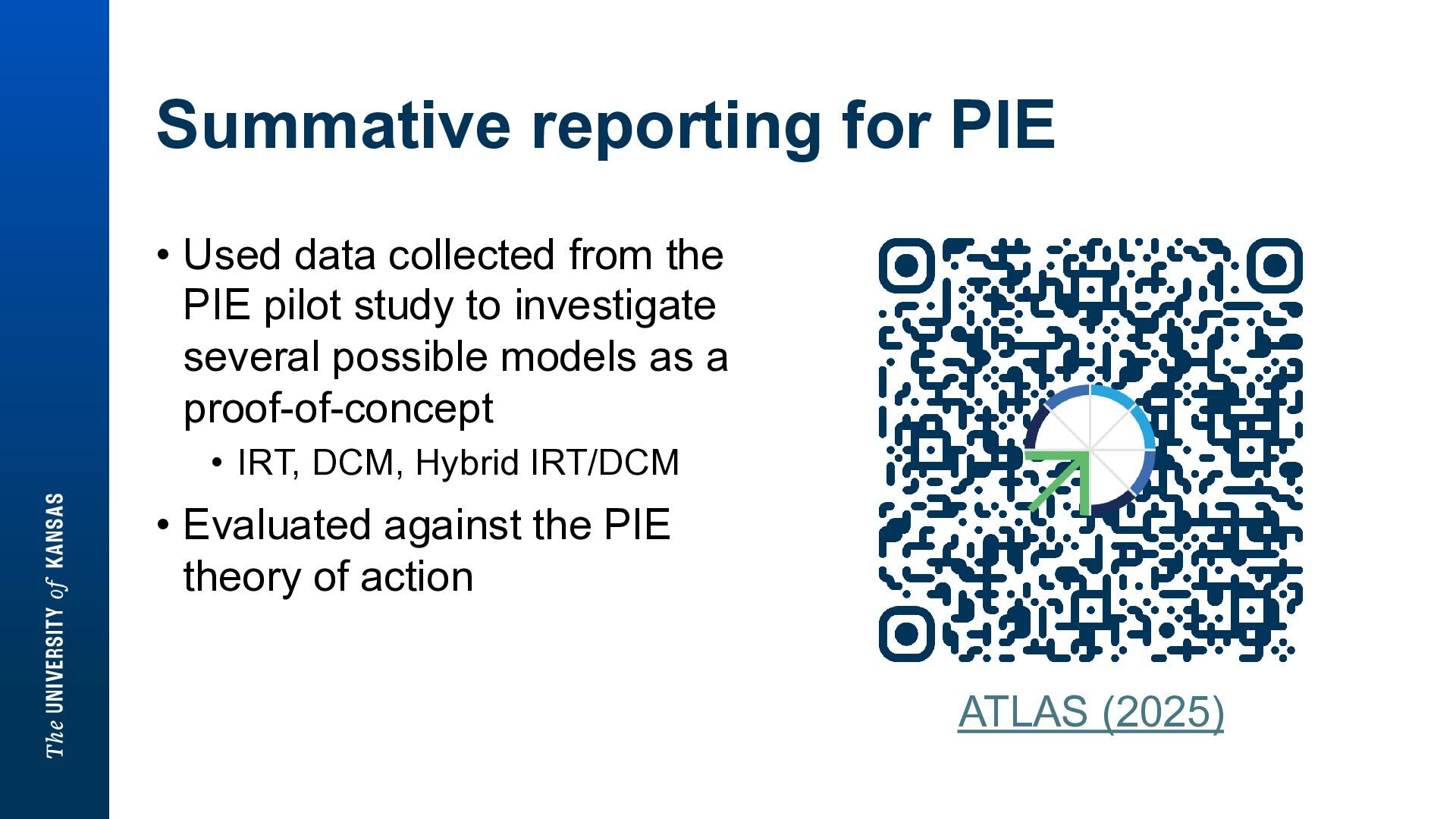
    for PIE • Used data collected from the PIE pilot study to investigate several possible models as a proof-of-concept • IRT, DCM, Hybrid IRT/DCM • Evaluated against the PIE theory of action ATLAS (2025)
  10. The UNIVERSITY of KANSAS The UNIVERSITY of KANSAS Scale scores

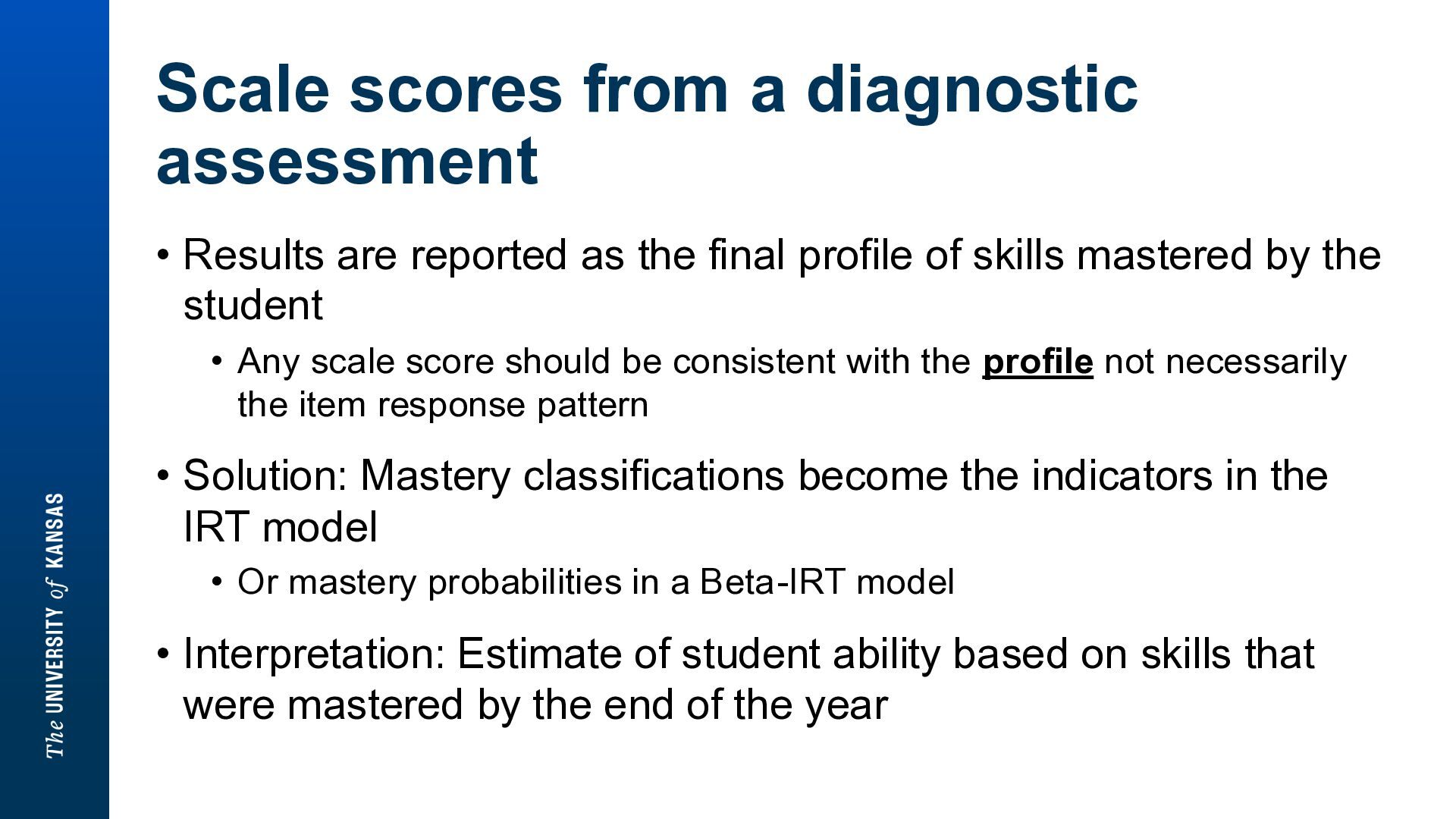
    from a diagnostic assessment • Results are reported as the final profile of skills mastered by the student • Any scale score should be consistent with the profile not necessarily the item response pattern • Solution: Mastery classifications become the indicators in the IRT model • Or mastery probabilities in a Beta-IRT model • Interpretation: Estimate of student ability based on skills that were mastered by the end of the year
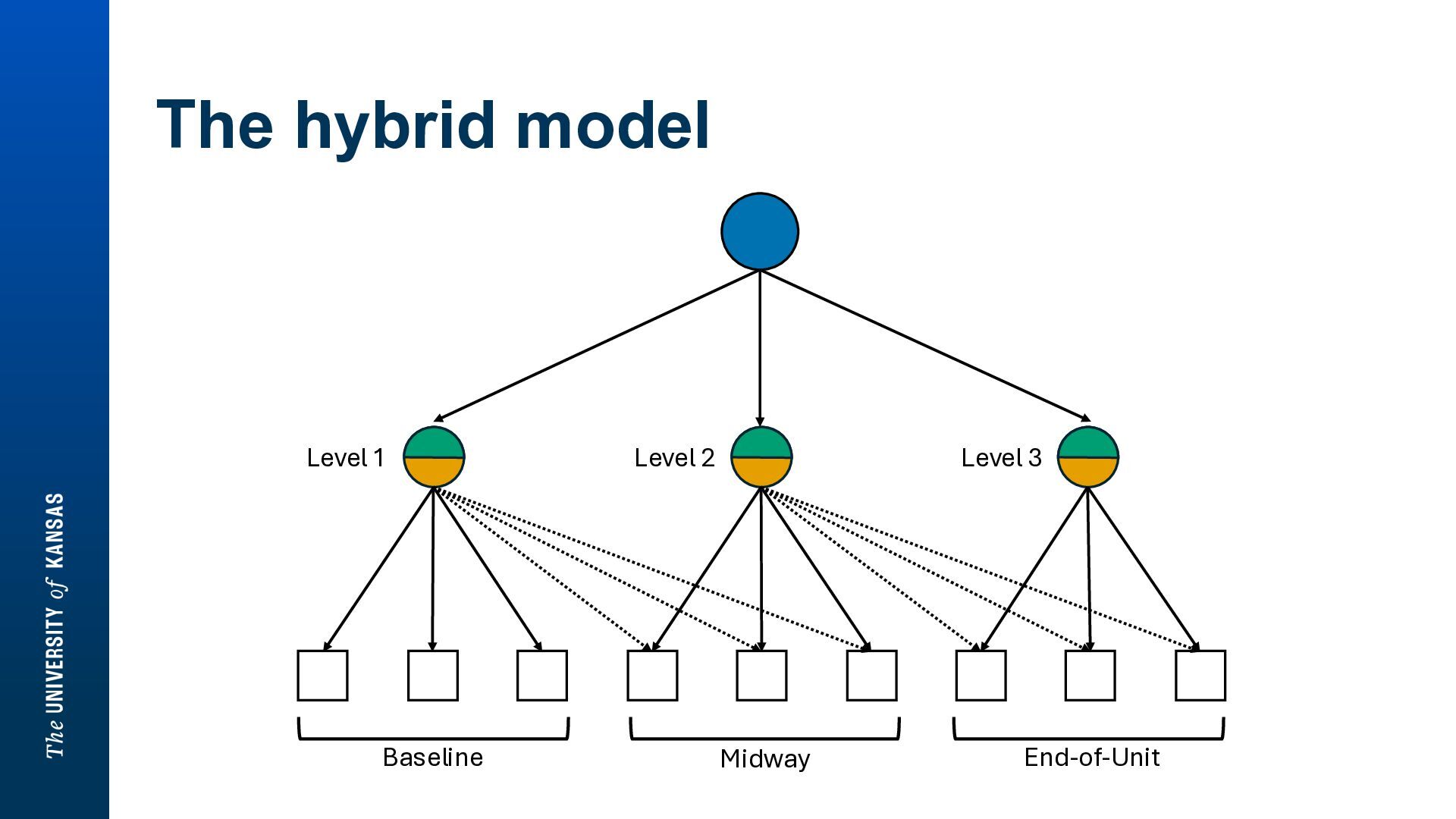
  11. The UNIVERSITY of KANSAS The UNIVERSITY of KANSAS Baseline Midway

    End-of-Unit Level 1 Level 2 Level 3 The hybrid model
  12. The UNIVERSITY of KANSAS The UNIVERSITY of KANSAS Benefits of

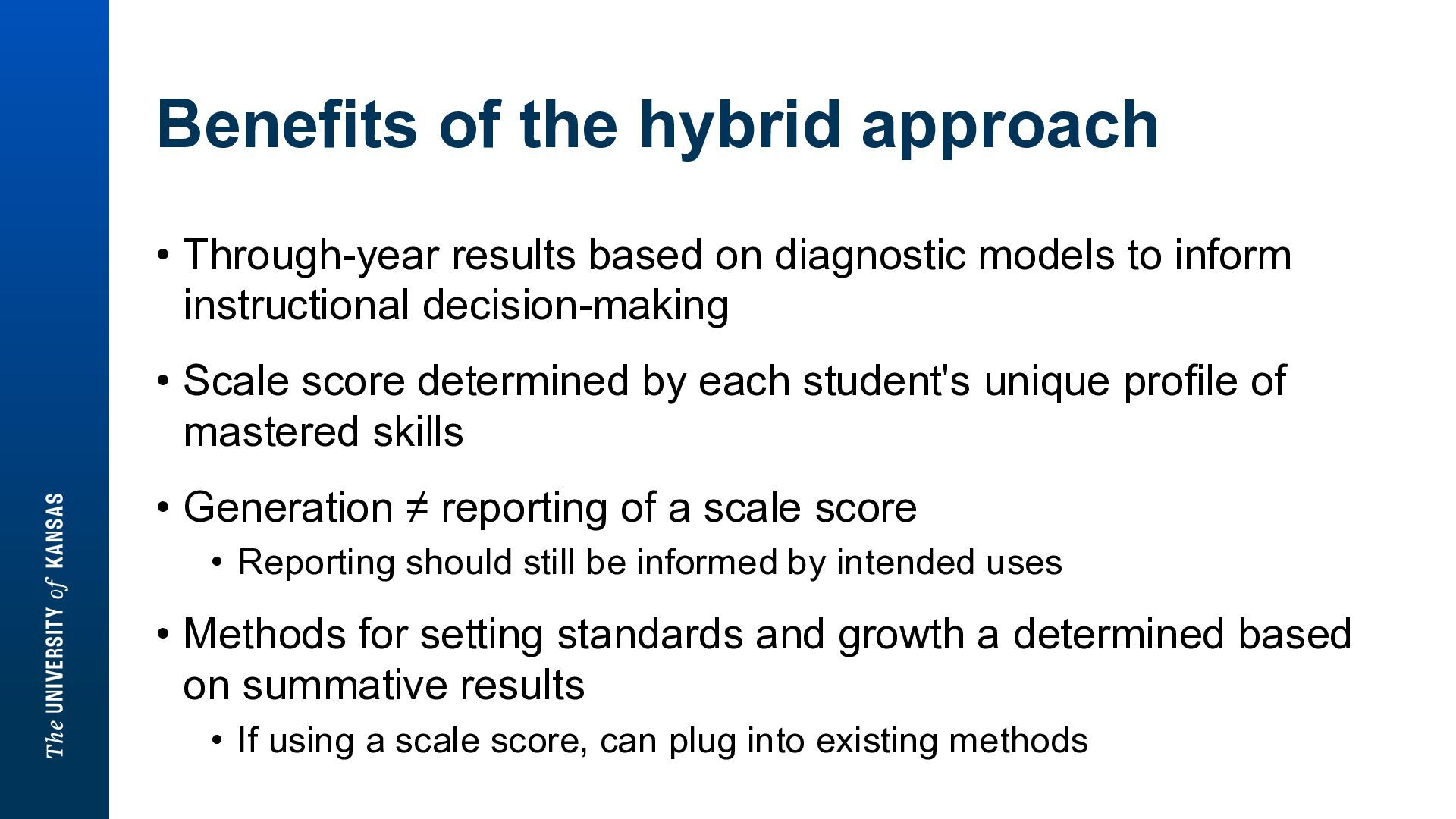
    the hybrid approach • Through-year results based on diagnostic models to inform instructional decision-making • Scale score determined by each student's unique profile of mastered skills • Generation ≠ reporting of a scale score • Reporting should still be informed by intended uses • Methods for setting standards and growth a determined based on summative results • If using a scale score, can plug into existing methods
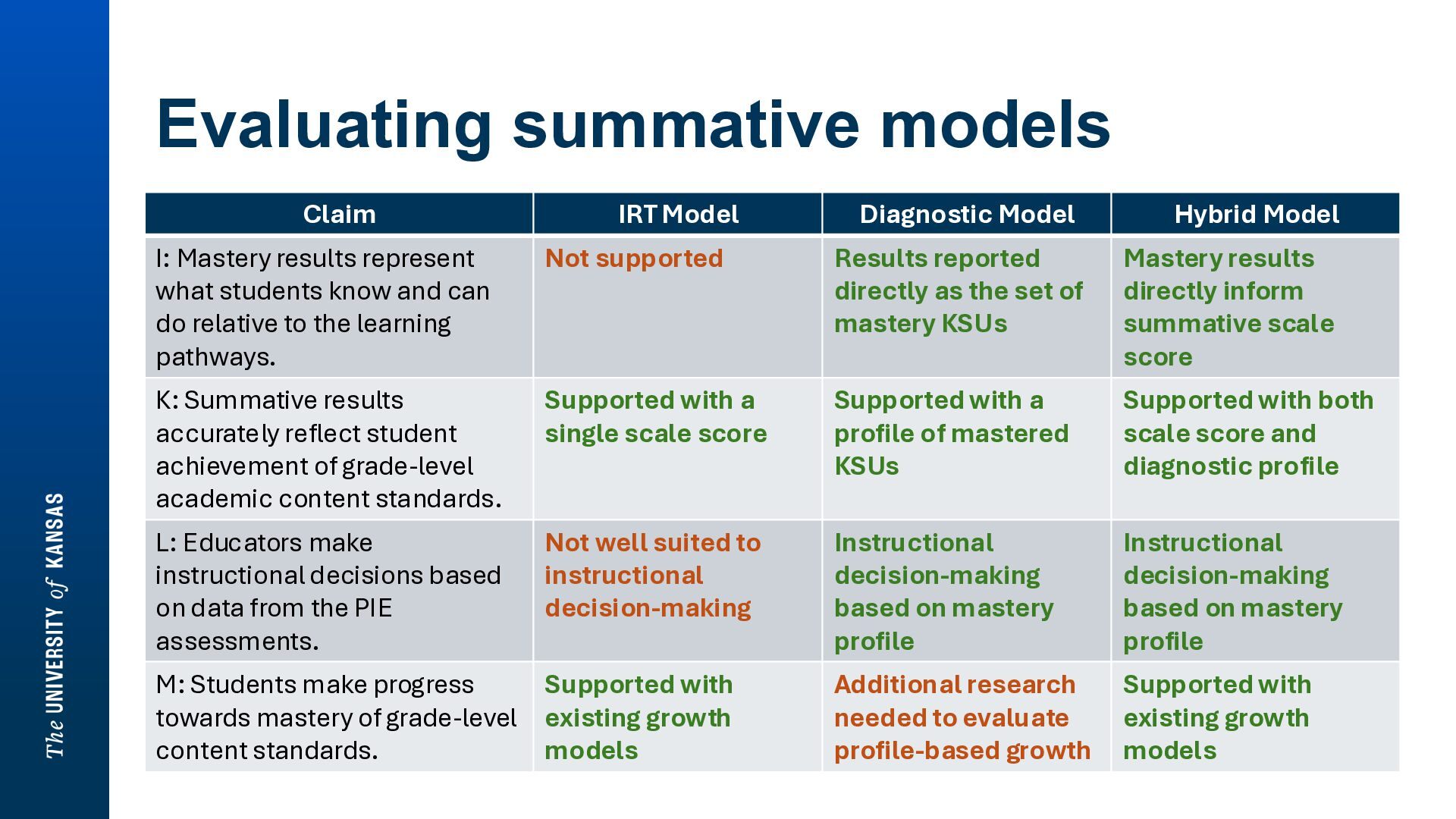
  13. The UNIVERSITY of KANSAS The UNIVERSITY of KANSAS Evaluating summative

    models Claim IRT Model Diagnostic Model Hybrid Model I: Mastery results represent what students know and can do relative to the learning pathways. Not supported Results reported directly as the set of mastery KSUs Mastery results directly inform summative scale score K: Summative results accurately reflect student achievement of grade-level academic content standards. Supported with a single scale score Supported with a profile of mastered KSUs Supported with both scale score and diagnostic profile L: Educators make instructional decisions based on data from the PIE assessments. Not well suited to instructional decision-making Instructional decision-making based on mastery profile Instructional decision-making based on mastery profile M: Students make progress towards mastery of grade-level content standards. Supported with existing growth models Additional research needed to evaluate profile-based growth Supported with existing growth models
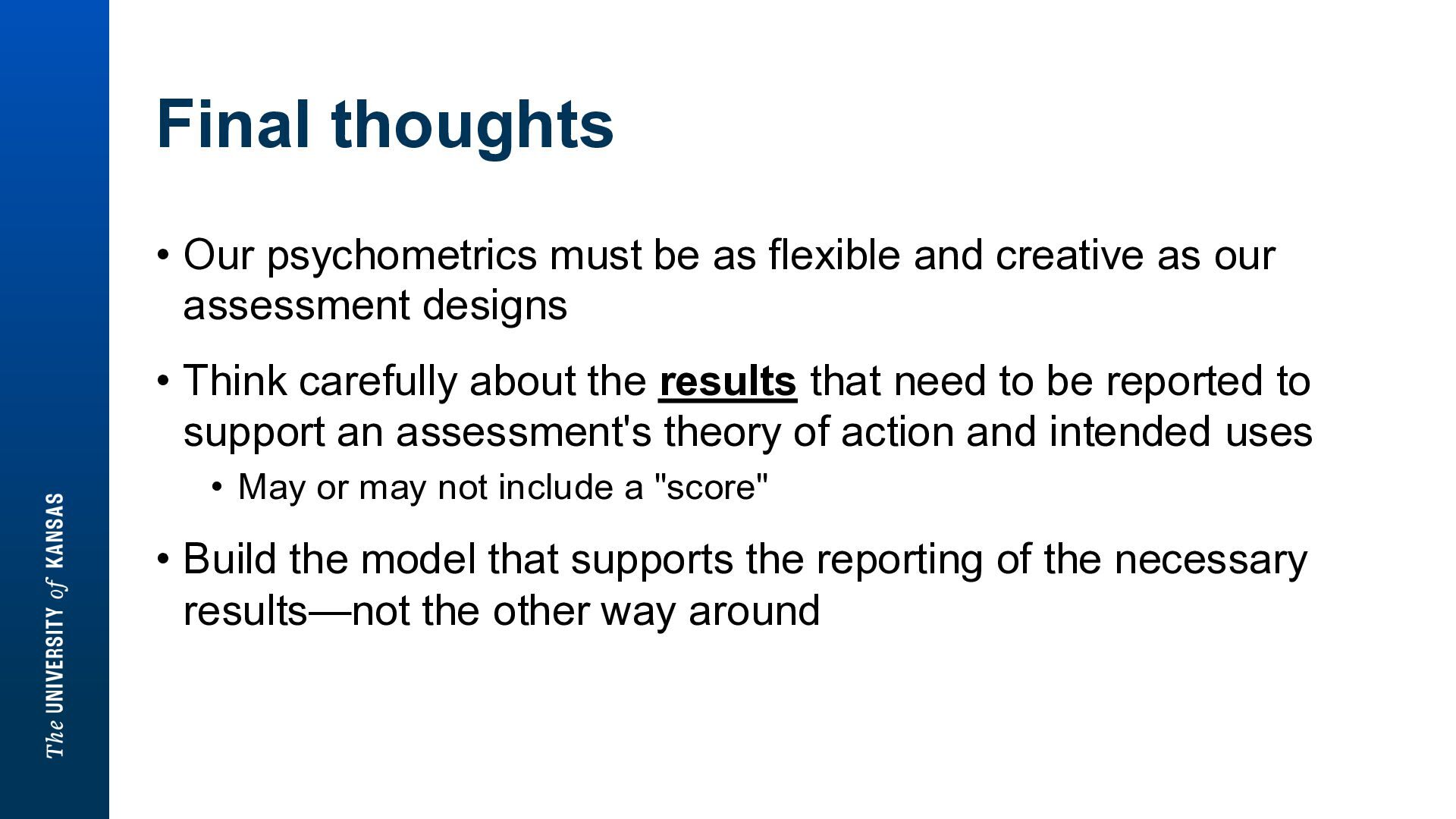
  14. The UNIVERSITY of KANSAS The UNIVERSITY of KANSAS Final thoughts

    • Our psychometrics must be as flexible and creative as our assessment designs • Think carefully about the results that need to be reported to support an assessment's theory of action and intended uses • May or may not include a "score" • Build the model that supports the reporting of the necessary results—not the other way around
  15. The UNIVERSITY of KANSAS The UNIVERSITY of KANSAS wjakethompson.com [email protected]

    0000-0001-7339-0300 in/wjakethompson @wjakethompson @wjakethompson.com @[email protected] @wjakethompson Thank you! Slides