Upgrade to Pro
— share decks privately, control downloads, hide ads and more …
Speaker Deck
Sign up for free
Menu
Search
Features
All features
Private URLs
Password Protection
Custom URLS
Scheduled publishing
Remove Branding
Restrict embedding
Deck Collections
Notes
Features
All features
Private URLs
Password Protection
Custom URLS
Scheduled publishing
Remove Branding
Restrict embedding
Deck Collections
Notes
Explore
Featured decks
Featured speakers
Programming
Technology
Storyboards
Explore
Featured decks
Featured speakers
Programming
Technology
Storyboards
Pricing
Search
Sign in
Sign up for free
コンテナ起動への道
Search
Sponsored
·
SiteGround - Reliable hosting with speed, security, and support you can count on.
→
xorphitus
August 16, 2016
Programming
170
0
Share
Embed
Copy iframe code
Copy JS code
Copy link
Start on current slide
コンテナ起動への道
コンテナの要素技術を使ってみました。
xorphitus
August 16, 2016
More Decks by xorphitus
See All by xorphitus
オリジナリティのあるGitLabを標準に近づける
xorphitus
1
800
マイクロサービスを作ろう
xorphitus
0
150
型システムを学ぼうとした結果
xorphitus
0
82
M-x doctor
xorphitus
0
180
型で数を表そう
xorphitus
0
110
AOT と direct linking
xorphitus
0
92
CFS入門
xorphitus
0
91
HyperLogLog
xorphitus
0
130
immutable database
xorphitus
0
330
Other Decks in Programming
See All in Programming
パーソナライズPodcastを作った話
repunit11
0
130
contenteditable と日本語入力に向き合う
colorful12
0
190
AI時代のコードレビューは人に向けるな、仕組みに向けろ
texmeijin
5
3.6k
AI が書く Go コードの品質を劇的に向上させる Linter: “declscope”
mpyw
0
490
AWSに止められる覚悟してますか?
morizo_1984
2
530
SREの越境 / SRE Collaboration
y0hgi
2
300
設計次第でAIコードの読む量は減らせる / designing-for-code-reading
minodriven
34
16k
Atomic Design, Enforced: Scaling Mobile Design Systems (next.app devCon / droidCon Berlin 2026)
steliosf
PRO
0
160
技術的負債を組織課題として解く-増えすぎたマイクロサービスとの戦い-
reimaru
1
3k
Agents on Rails - Rails at Scale 2026
irinanazarova
0
530
すこし踏み込む CancellationToken
htkym
2
1.7k
更なる可用性を求めて、5年間運用したKotlinのアプリケーションをGoでリプレイスする話
ken_tunc
0
550
Featured
See All Featured
Leveraging Curiosity to Care for An Aging Population
cassininazir
1
530
The Straight Up "How To Draw Better" Workshop
denniskardys
239
140k
Save Time (by Creating Custom Rails Generators)
garrettdimon
PRO
33
5.2k
Sharpening the Axe: The Primacy of Toolmaking
bcantrill
46
3k
[Rails World 2023 - Day 1 Closing Keynote] - The Magic of Rails
eileencodes
38
3.1k
Conquering PDFs: document understanding beyond plain text
inesmontani
PRO
4
3.2k
Evolving SEO for Evolving Search Engines
ryanjones
0
320
Max Prin - Stacking Signals: How International SEO Comes Together (And Falls Apart)
techseoconnect
PRO
0
480
ピンチをチャンスに:未来をつくるプロダクトロードマップ #pmconf2020
aki_iinuma
128
56k
Un-Boring Meetings
codingconduct
0
450
Exploring anti-patterns in Rails
aemeredith
4
530
The Anti-SEO Checklist Checklist. Pubcon Cyber Week
ryanjones
0
260
Transcript
コンテナ起動への道 @xorhitus (2016-08)
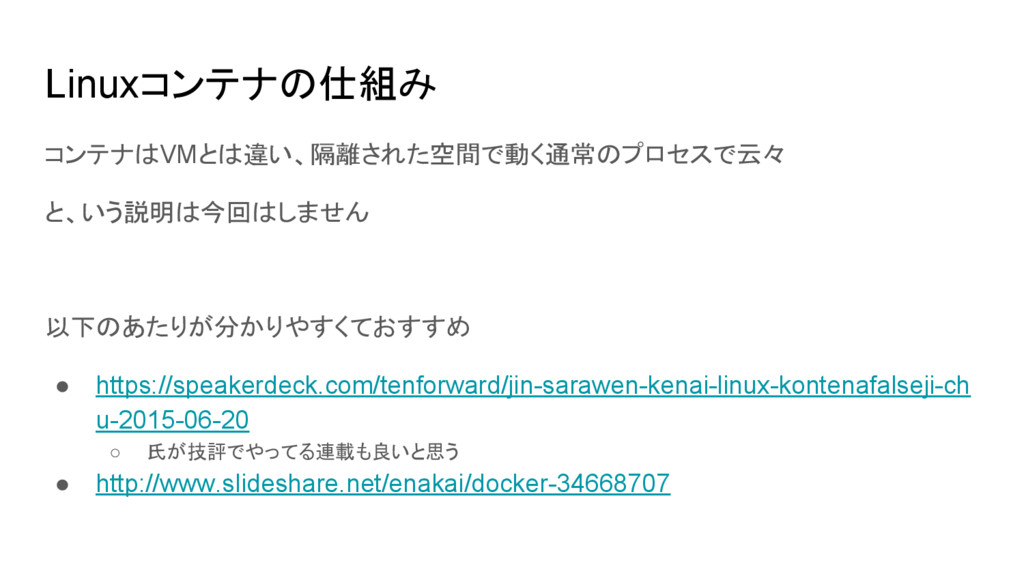
Linuxコンテナの仕組み コンテナはVMとは違い、隔離された空間で動く通常のプロセスで云々 と、いう説明は今回はしません 以下のあたりが分かりやすくておすすめ • https://speakerdeck.com/tenforward/jin-sarawen-kenai-linux-kontenafalseji-ch u-2015-06-20 ◦ 氏が技評でやってる連載も良いと思う •
http://www.slideshare.net/enakai/docker-34668707
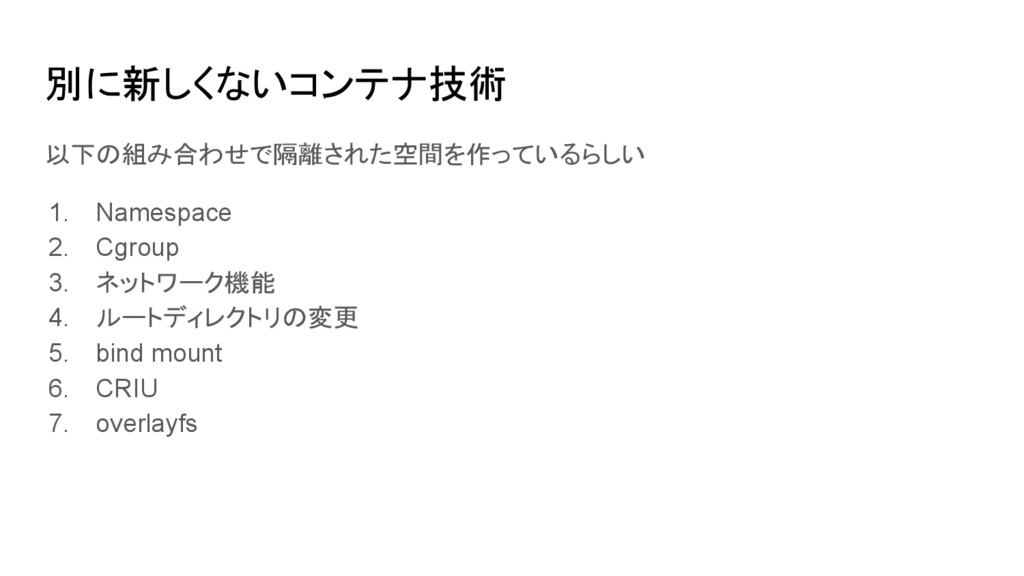
別に新しくないコンテナ技術 以下の組み合わせで隔離された空間を作っているらしい 1. Namespace 2. Cgroup 3. ネットワーク機能 4. ルートディレクトリの変更
5. bind mount 6. CRIU 7. overlayfs
よし、流行ってるし コンテナを立ち上げてみよう
$ docker run
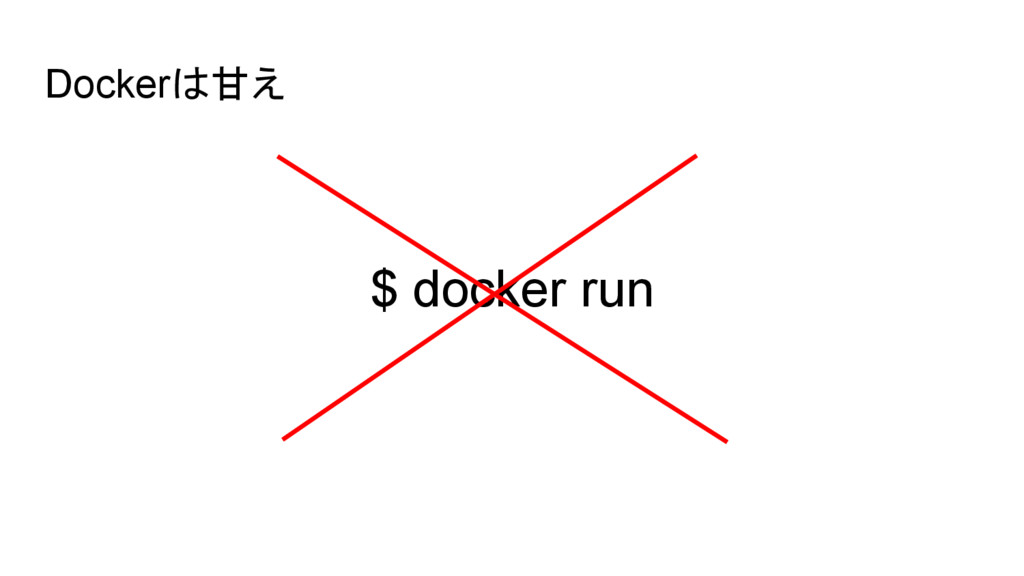
Dockerは甘え $ docker run
まずはNamespaceから
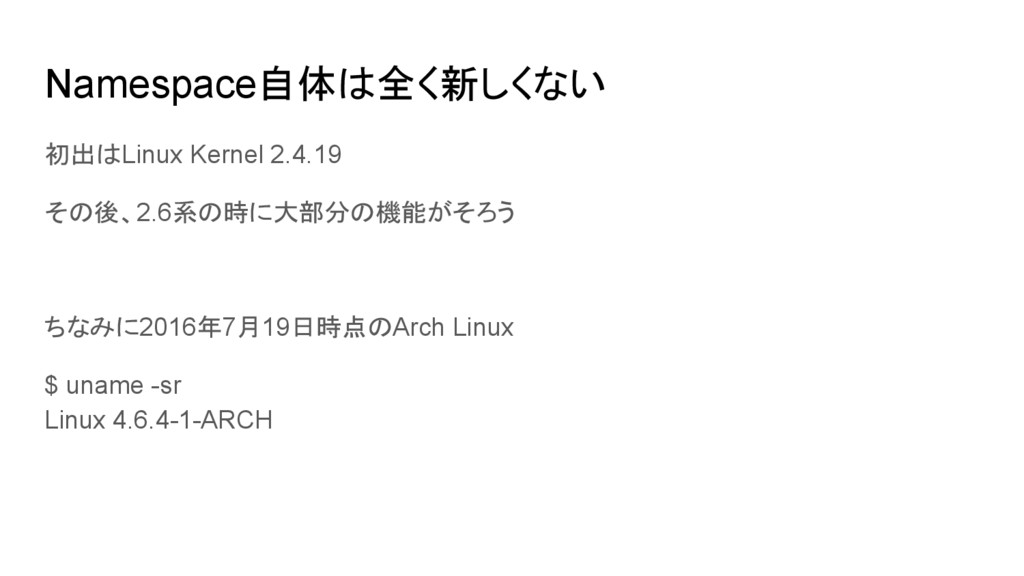
Namespace自体は全く新しくない 初出はLinux Kernel 2.4.19 その後、2.6系の時に大部分の機能がそろう ちなみに2016年7月19日時点のArch Linux $ uname -sr
Linux 4.6.4-1-ARCH
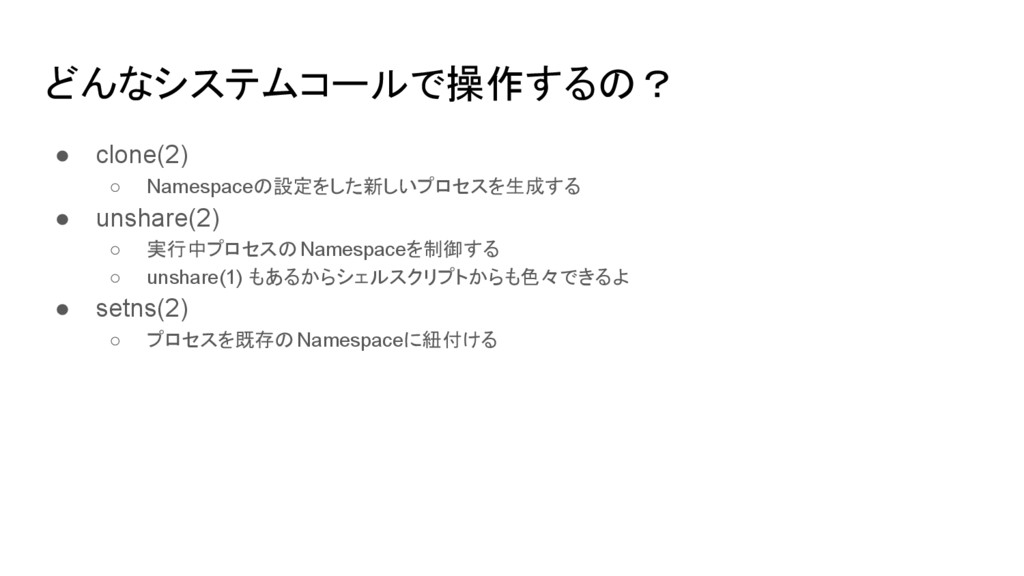
どんなシステムコールで操作するの? • clone(2) ◦ Namespaceの設定をした新しいプロセスを生成する • unshare(2) ◦ 実行中プロセスのNamespaceを制御する ◦
unshare(1) もあるからシェルスクリプトからも色々できるよ • setns(2) ◦ プロセスを既存のNamespaceに紐付ける
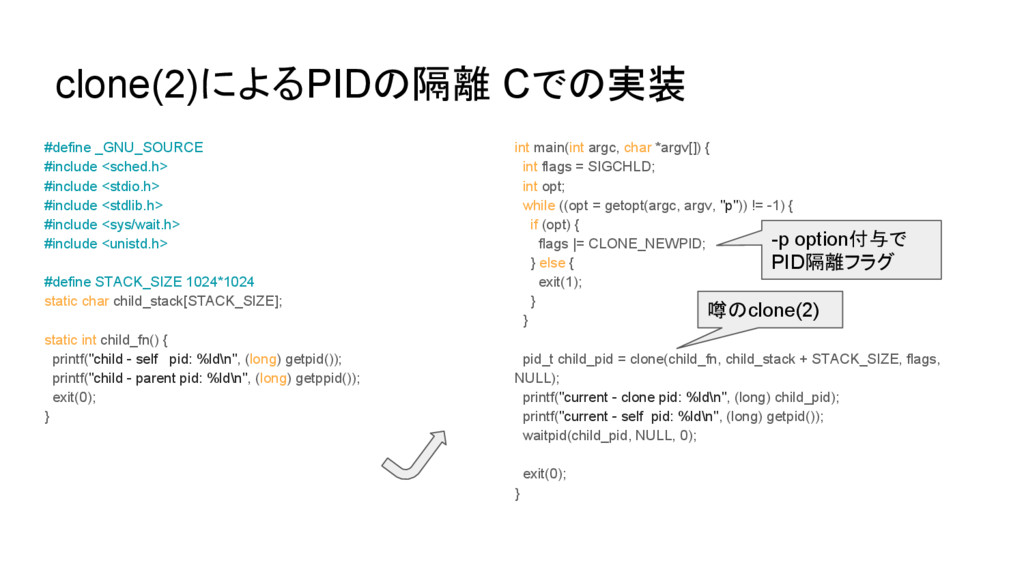
clone(2)によるPIDの隔離 Cでの実装 #define _GNU_SOURCE #include <sched.h> #include <stdio.h> #include <stdlib.h>
#include <sys/wait.h> #include <unistd.h> #define STACK_SIZE 1024*1024 static char child_stack[STACK_SIZE]; static int child_fn() { printf("child - self pid: %ld\n", (long) getpid()); printf("child - parent pid: %ld\n", (long) getppid()); exit(0); } int main(int argc, char *argv[]) { int flags = SIGCHLD; int opt; while ((opt = getopt(argc, argv, "p")) != -1) { if (opt) { flags |= CLONE_NEWPID; } else { exit(1); } } pid_t child_pid = clone(child_fn, child_stack + STACK_SIZE, flags, NULL); printf("current - clone pid: %ld\n", (long) child_pid); printf("current - self pid: %ld\n", (long) getpid()); waitpid(child_pid, NULL, 0); exit(0); } -p option付与で PID隔離フラグ 噂のclone(2)
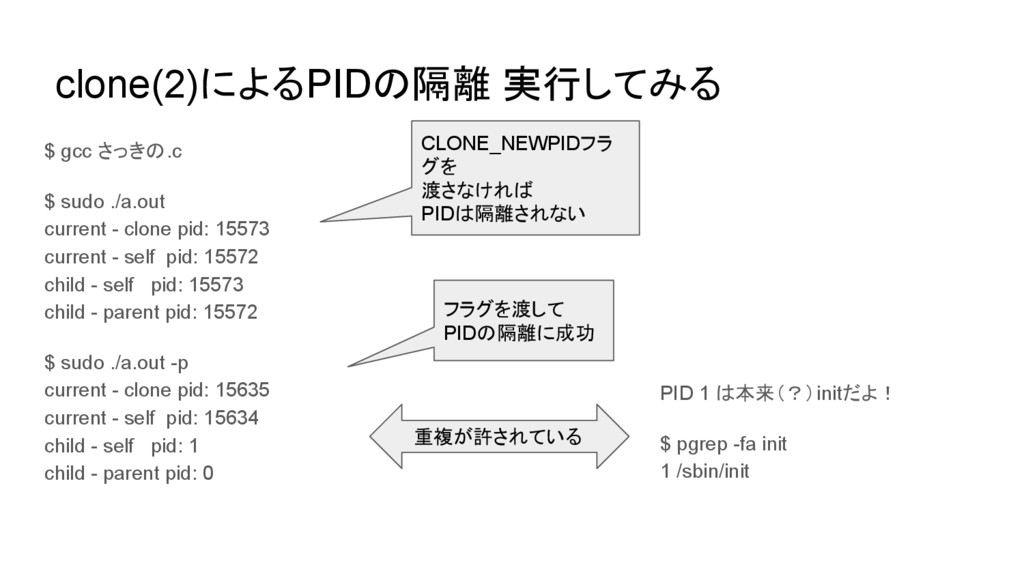
clone(2)によるPIDの隔離 実行してみる $ gcc さっきの.c $ sudo ./a.out current -
clone pid: 15573 current - self pid: 15572 child - self pid: 15573 child - parent pid: 15572 $ sudo ./a.out -p current - clone pid: 15635 current - self pid: 15634 child - self pid: 1 child - parent pid: 0 CLONE_NEWPIDフラ グを 渡さなければ PIDは隔離されない フラグを渡して PIDの隔離に成功 PID 1 は本来(?)initだよ! $ pgrep -fa init 1 /sbin/init 重複が許されている
Namespaceの情報ってどこにあるの? /proc/[pid]/ns にある 先ほどのプログラムを少し変更して、上記のパスを見てみる static int child_fn() { printf("child -
self pid: %ld\n", (long) getpid()); printf("child - parent pid: %ld\n", (long) getppid()); // この sleep を追記 (せっかくなのでC99スタイル) // ここで止まっている間に /proc/[pid]/ns を ls する作戦 (プログラム中で ls 呼べばいいとか言わないこと) sleep(100); exit(0); }
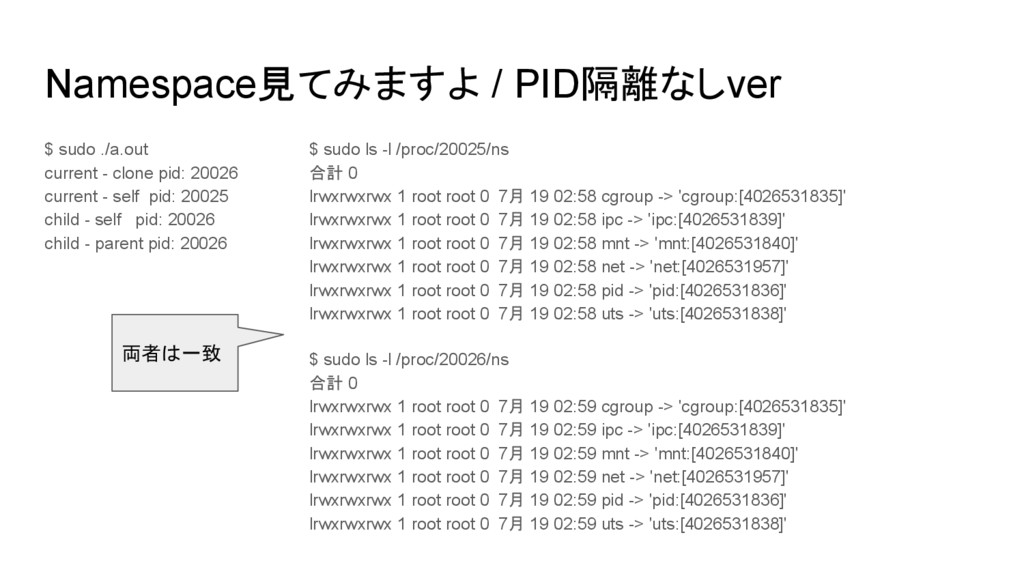
Namespace見てみますよ / PID隔離なしver $ sudo ./a.out current - clone pid:
20026 current - self pid: 20025 child - self pid: 20026 child - parent pid: 20026 $ sudo ls -l /proc/20025/ns 合計 0 lrwxrwxrwx 1 root root 0 7月 19 02:58 cgroup -> 'cgroup:[4026531835]' lrwxrwxrwx 1 root root 0 7月 19 02:58 ipc -> 'ipc:[4026531839]' lrwxrwxrwx 1 root root 0 7月 19 02:58 mnt -> 'mnt:[4026531840]' lrwxrwxrwx 1 root root 0 7月 19 02:58 net -> 'net:[4026531957]' lrwxrwxrwx 1 root root 0 7月 19 02:58 pid -> 'pid:[4026531836]' lrwxrwxrwx 1 root root 0 7月 19 02:58 uts -> 'uts:[4026531838]' $ sudo ls -l /proc/20026/ns 合計 0 lrwxrwxrwx 1 root root 0 7月 19 02:59 cgroup -> 'cgroup:[4026531835]' lrwxrwxrwx 1 root root 0 7月 19 02:59 ipc -> 'ipc:[4026531839]' lrwxrwxrwx 1 root root 0 7月 19 02:59 mnt -> 'mnt:[4026531840]' lrwxrwxrwx 1 root root 0 7月 19 02:59 net -> 'net:[4026531957]' lrwxrwxrwx 1 root root 0 7月 19 02:59 pid -> 'pid:[4026531836]' lrwxrwxrwx 1 root root 0 7月 19 02:59 uts -> 'uts:[4026531838]' 両者は一致
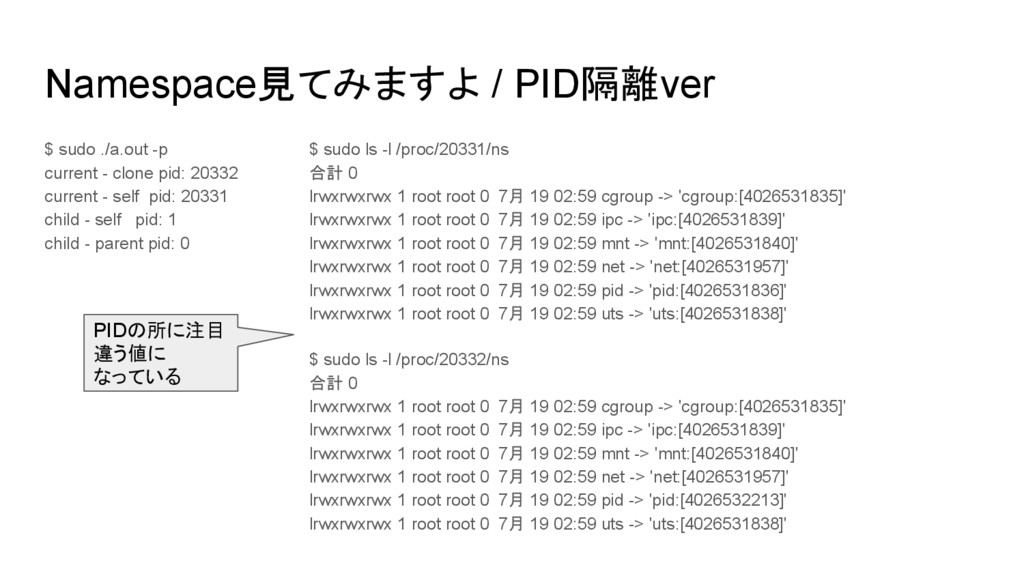
Namespace見てみますよ / PID隔離ver $ sudo ./a.out -p current - clone
pid: 20332 current - self pid: 20331 child - self pid: 1 child - parent pid: 0 $ sudo ls -l /proc/20331/ns 合計 0 lrwxrwxrwx 1 root root 0 7月 19 02:59 cgroup -> 'cgroup:[4026531835]' lrwxrwxrwx 1 root root 0 7月 19 02:59 ipc -> 'ipc:[4026531839]' lrwxrwxrwx 1 root root 0 7月 19 02:59 mnt -> 'mnt:[4026531840]' lrwxrwxrwx 1 root root 0 7月 19 02:59 net -> 'net:[4026531957]' lrwxrwxrwx 1 root root 0 7月 19 02:59 pid -> 'pid:[4026531836]' lrwxrwxrwx 1 root root 0 7月 19 02:59 uts -> 'uts:[4026531838]' $ sudo ls -l /proc/20332/ns 合計 0 lrwxrwxrwx 1 root root 0 7月 19 02:59 cgroup -> 'cgroup:[4026531835]' lrwxrwxrwx 1 root root 0 7月 19 02:59 ipc -> 'ipc:[4026531839]' lrwxrwxrwx 1 root root 0 7月 19 02:59 mnt -> 'mnt:[4026531840]' lrwxrwxrwx 1 root root 0 7月 19 02:59 net -> 'net:[4026531957]' lrwxrwxrwx 1 root root 0 7月 19 02:59 pid -> 'pid:[4026532213]' lrwxrwxrwx 1 root root 0 7月 19 02:59 uts -> 'uts:[4026531838]' PIDの所に注目 違う値に なっている
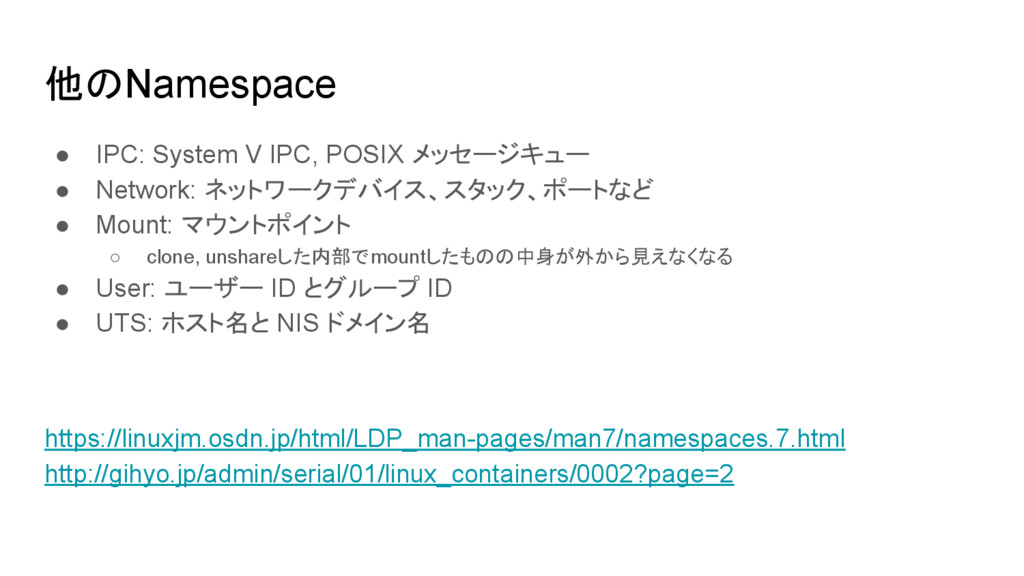
他のNamespace • IPC: System V IPC, POSIX メッセージキュー • Network:
ネットワークデバイス、スタック、ポートなど • Mount: マウントポイント ◦ clone, unshareした内部でmountしたものの中身が外から見えなくなる • User: ユーザー ID とグループ ID • UTS: ホスト名と NIS ドメイン名 https://linuxjm.osdn.jp/html/LDP_man-pages/man7/namespaces.7.html http://gihyo.jp/admin/serial/01/linux_containers/0002?page=2
とりあえず次、chroot
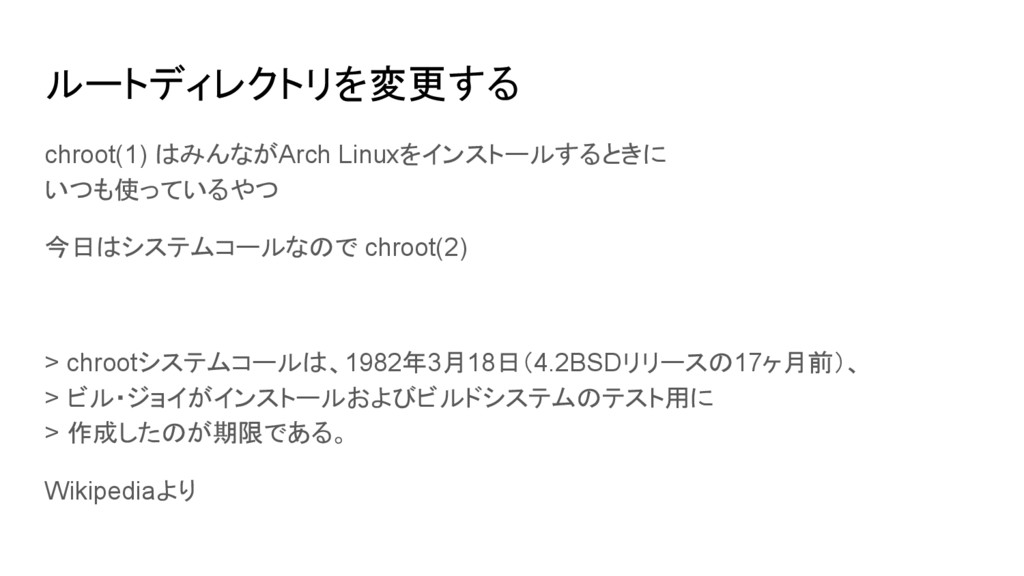
ルートディレクトリを変更する chroot(1) はみんながArch Linuxをインストールするときに いつも使っているやつ 今日はシステムコールなので chroot(2) > chrootシステムコールは、1982年3月18日(4.2BSDリリースの17ヶ月前)、 >
ビル・ジョイがインストールおよびビルドシステムのテスト用に > 作成したのが期限である。 Wikipediaより
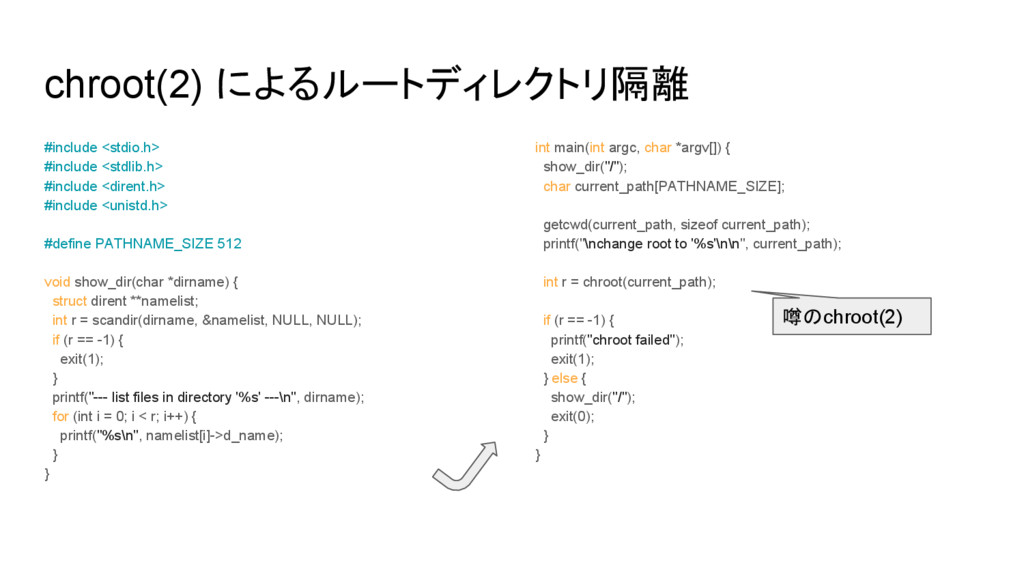
chroot(2) によるルートディレクトリ隔離 #include <stdio.h> #include <stdlib.h> #include <dirent.h> #include <unistd.h>
#define PATHNAME_SIZE 512 void show_dir(char *dirname) { struct dirent **namelist; int r = scandir(dirname, &namelist, NULL, NULL); if (r == -1) { exit(1); } printf("--- list files in directory '%s' ---\n", dirname); for (int i = 0; i < r; i++) { printf("%s\n", namelist[i]->d_name); } } int main(int argc, char *argv[]) { show_dir("/"); char current_path[PATHNAME_SIZE]; getcwd(current_path, sizeof current_path); printf("\nchange root to '%s'\n\n", current_path); int r = chroot(current_path); if (r == -1) { printf("chroot failed"); exit(1); } else { show_dir("/"); exit(0); } } 噂のchroot(2)
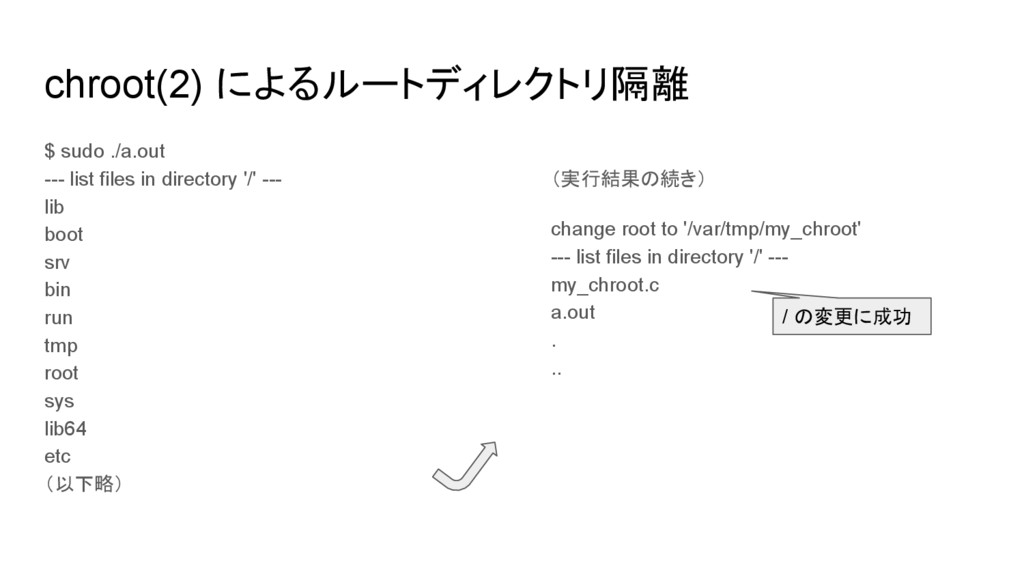
chroot(2) によるルートディレクトリ隔離 $ sudo ./a.out --- list files in directory
'/' --- lib boot srv bin run tmp root sys lib64 etc (以下略) (実行結果の続き) change root to '/var/tmp/my_chroot' --- list files in directory '/' --- my_chroot.c a.out . .. / の変更に成功
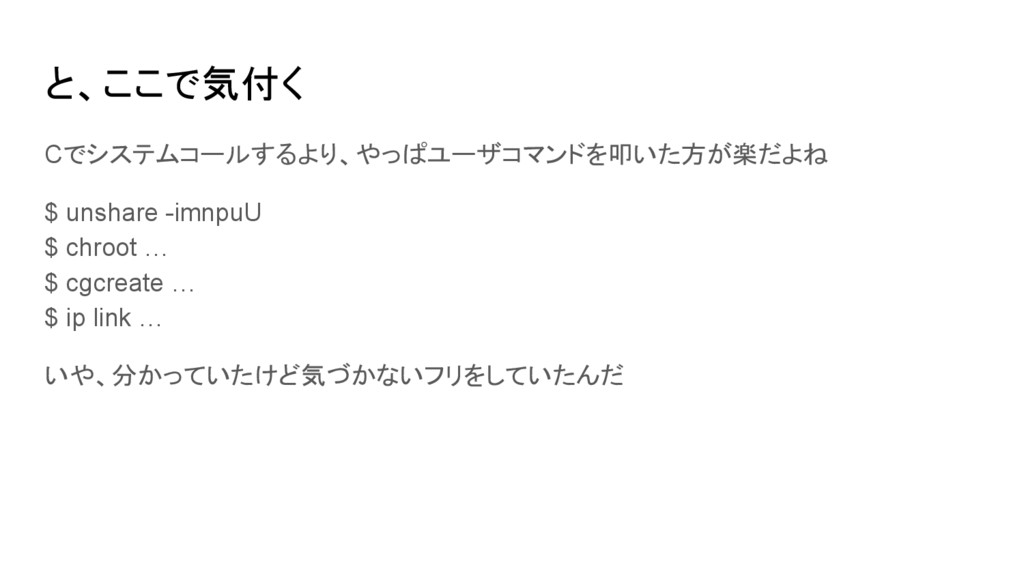
と、ここで気付く Cでシステムコールするより、やっぱユーザコマンドを叩いた方が楽だよね $ unshare -imnpuU $ chroot … $ cgcreate
… $ ip link … いや、分かっていたけど気づかないフリをしていたんだ
すごいぞユーザコマンド! コンテナを作るのが楽になる!!
まとめというか感想 • こんな感じで地道にやっていけばいつか自前コンテナは立ち上がる ◦ ユーザコマンドまじ有能 ◦ Dockerは甘え • 温故知新 •
WebプログラマはWeb f/w使いになりがちなので、たまにはこういうのを書くのは充 足感がある • ちなみに今回のコードはここに置いた ◦ https://github.com/xorphitus/making-linux-container


 xorphitus
 repunit11
 colorful12
 texmeijin
 mpyw
mpyw
 morizo_1984
 y0hgi
y0hgi
 minodriven
 steliosf
 reimaru
 irinanazarova
 htkym
htkym
 ken_tunc
 cassininazir
 denniskardys
 garrettdimon
 bcantrill
 eileencodes
 inesmontani
 ryanjones
 techseoconnect
 aki_iinuma
 codingconduct
 aemeredith
![Namespaceの情報ってどこにあるの? /proc/[pid]/ns にある 先ほどのプログラムを少し変更して、上記のパスを見てみる static int child_fn() { printf("child -](https://files.speakerdeck.com/presentations/7c2f8dfaabeb4c00a44ce6ba369cae83/slide_11.jpg)