Solar Subsidy Application in Haryana: Step by Step With Documents
This guide explains how to apply for the solar subsidy in Haryana which documents you'll need, and what to watch for at each stage. It covers the Pradhan Mantri solar panel yojana officially the PM Surya Ghar Muft Bijli Yojana.
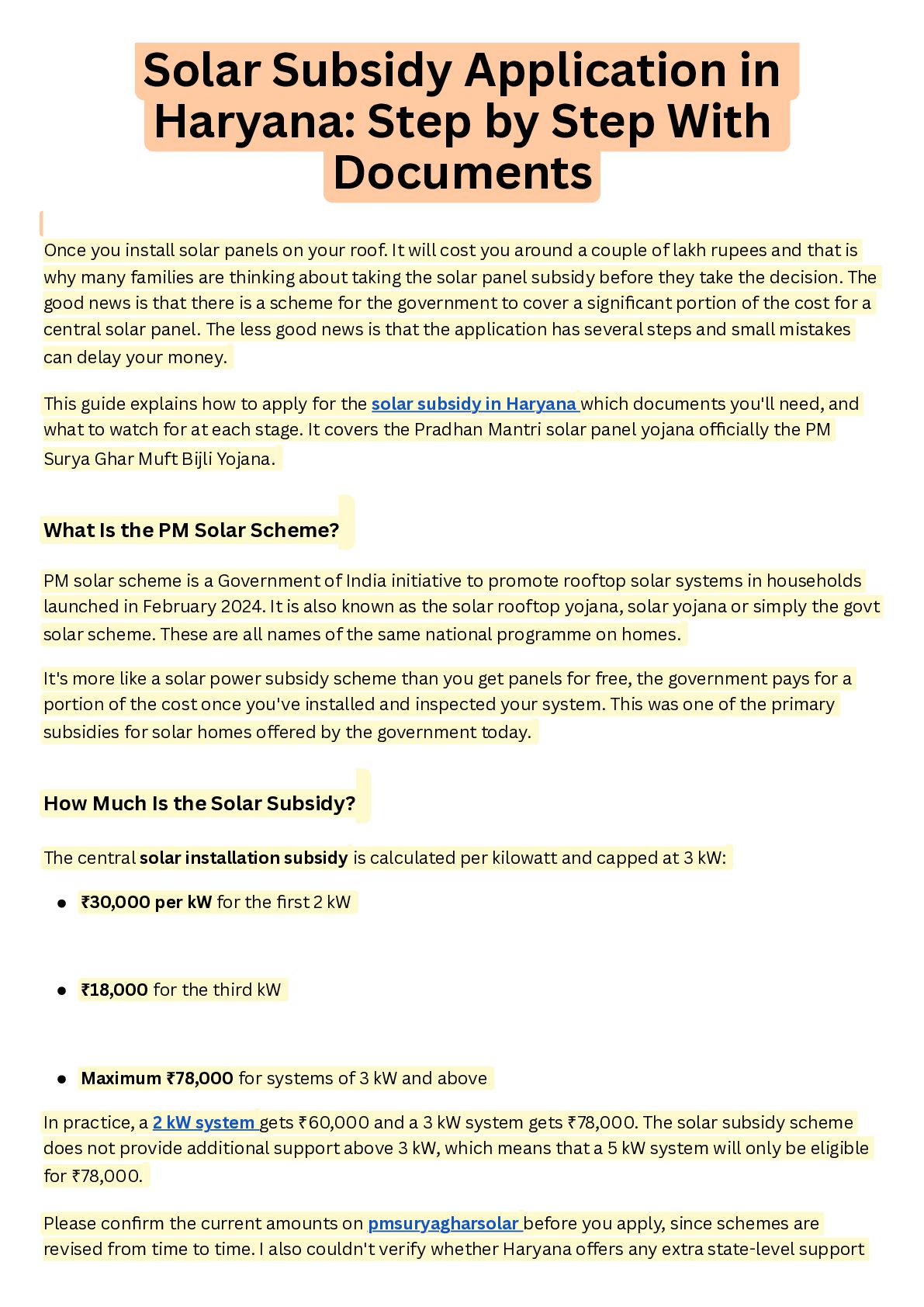
Once you install solar panels on your roof. It will cost you around a couple of lakh rupees and that is why many families are thinking about taking the solar panel subsidy before they take the decision. The good news is that there is a scheme for the government to cover a significant portion of the cost for a central solar panel. The less good news is that the application has several steps and small mistakes can delay your money. This guide explains how to apply for the solar subsidy in Haryana which documents you'll need, and what to watch for at each stage. It covers the Pradhan Mantri solar panel yojana officially the PM Surya Ghar Muft Bijli Yojana. What Is the PM Solar Scheme? PM solar scheme is a Government of India initiative to promote rooftop solar systems in households launched in February 2024. It is also known as the solar rooftop yojana, solar yojana or simply the govt solar scheme. These are all names of the same national programme on homes. It's more like a solar power subsidy scheme than you get panels for free, the government pays for a portion of the cost once you've installed and inspected your system. This was one of the primary subsidies for solar homes offered by the government today. How Much Is the Solar Subsidy? The central solar installation subsidy is calculated per kilowatt and capped at 3 kW: ₹30,000 per kW for the first 2 kW ₹18,000 for the third kW Maximum ₹78,000 for systems of 3 kW and above In practice, a 2 kW system gets ₹60,000 and a 3 kW system gets ₹78,000. The solar subsidy scheme does not provide additional support above 3 kW, which means that a 5 kW system will only be eligible for ₹78,000. Please confirm the current amounts on pmsuryagharsolar before you apply, since schemes are revised from time to time. I also couldn't verify whether Haryana offers any extra state-level support
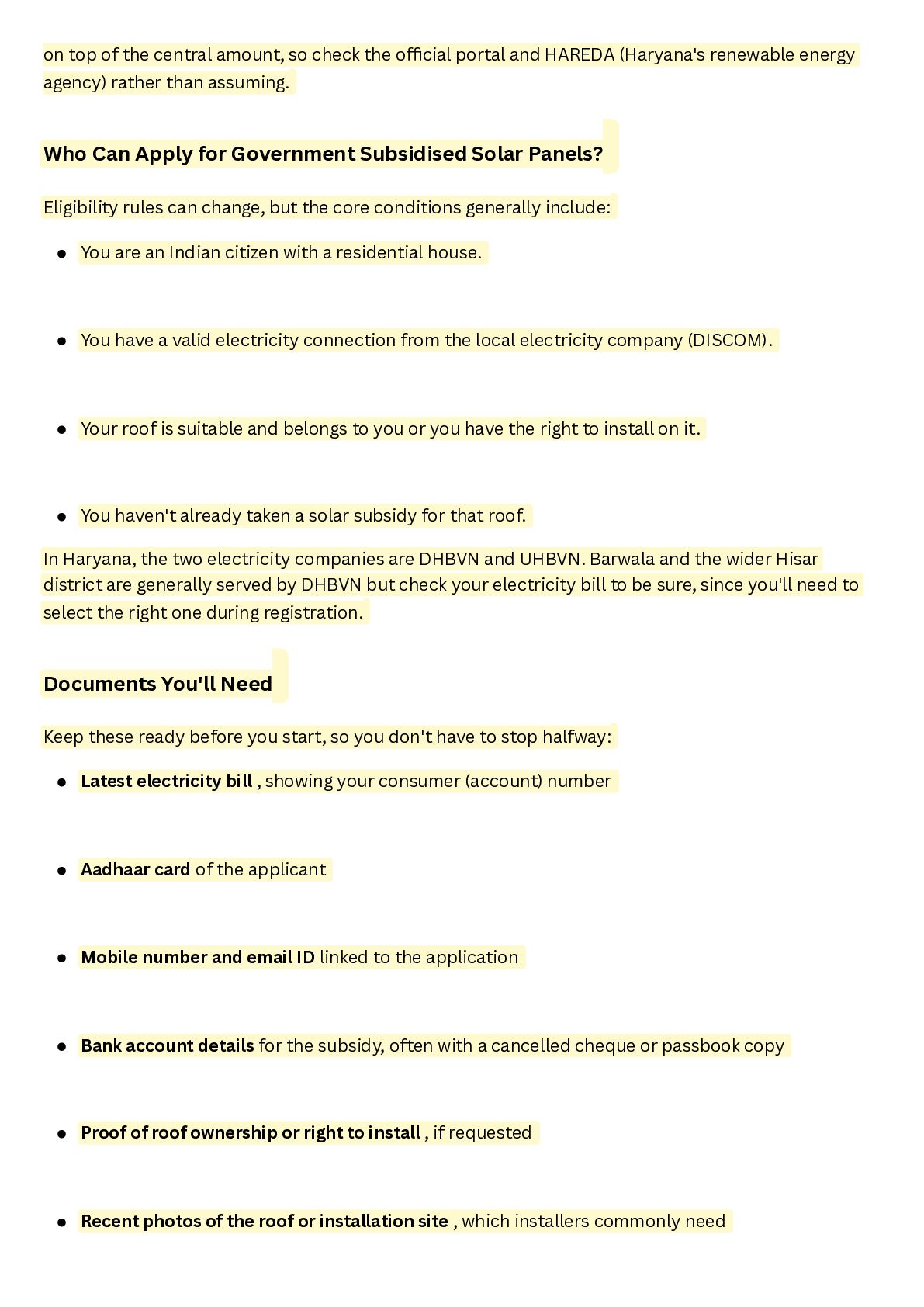
portal and HAREDA (Haryana's renewable energy agency) rather than assuming. Who Can Apply for Government Subsidised Solar Panels? Eligibility rules can change, but the core conditions generally include: You are an Indian citizen with a residential house. You have a valid electricity connection from the local electricity company (DISCOM). Your roof is suitable and belongs to you or you have the right to install on it. You haven't already taken a solar subsidy for that roof. In Haryana, the two electricity companies are DHBVN and UHBVN. Barwala and the wider Hisar district are generally served by DHBVN but check your electricity bill to be sure, since you'll need to select the right one during registration. Documents You'll Need Keep these ready before you start, so you don't have to stop halfway: Latest electricity bill , showing your consumer (account) number Aadhaar card of the applicant Mobile number and email ID linked to the application Bank account details for the subsidy, often with a cancelled cheque or passbook copy Proof of roof ownership or right to install , if requested Recent photos of the roof or installation site , which installers commonly need
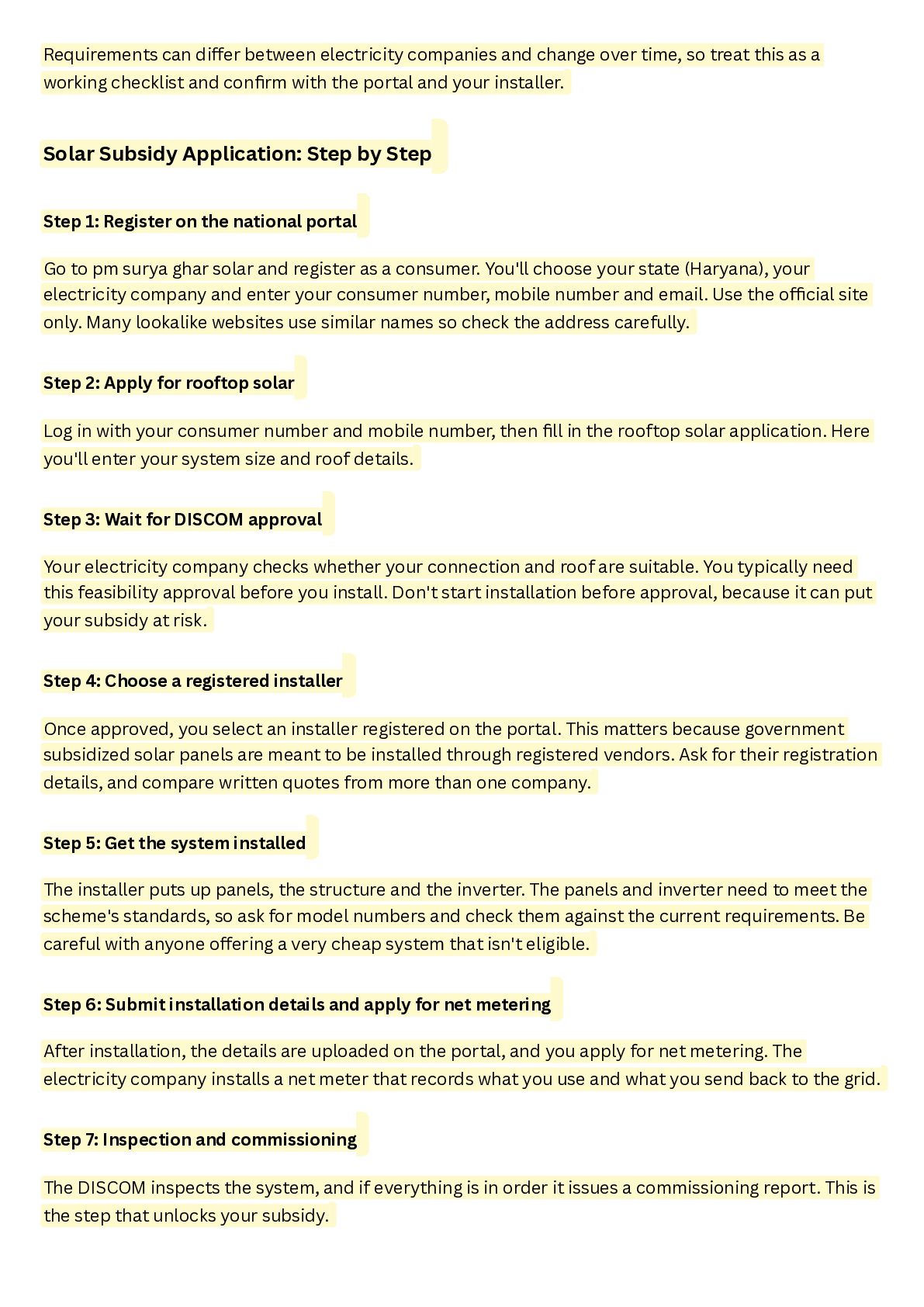
so treat this as a working checklist and confirm with the portal and your installer. Solar Subsidy Application: Step by Step Step 1: Register on the national portal Go to pm surya ghar solar and register as a consumer. You'll choose your state (Haryana), your electricity company and enter your consumer number, mobile number and email. Use the official site only. Many lookalike websites use similar names so check the address carefully. Step 2: Apply for rooftop solar Log in with your consumer number and mobile number, then fill in the rooftop solar application. Here you'll enter your system size and roof details. Step 3: Wait for DISCOM approval Your electricity company checks whether your connection and roof are suitable. You typically need this feasibility approval before you install. Don't start installation before approval, because it can put your subsidy at risk. Step 4: Choose a registered installer Once approved, you select an installer registered on the portal. This matters because government subsidized solar panels are meant to be installed through registered vendors. Ask for their registration details, and compare written quotes from more than one company. Step 5: Get the system installed The installer puts up panels, the structure and the inverter. The panels and inverter need to meet the scheme's standards, so ask for model numbers and check them against the current requirements. Be careful with anyone offering a very cheap system that isn't eligible. Step 6: Submit installation details and apply for net metering After installation, the details are uploaded on the portal, and you apply for net metering. The electricity company installs a net meter that records what you use and what you send back to the grid. Step 7: Inspection and commissioning The DISCOM inspects the system, and if everything is in order it issues a commissioning report. This is the step that unlocks your subsidy.
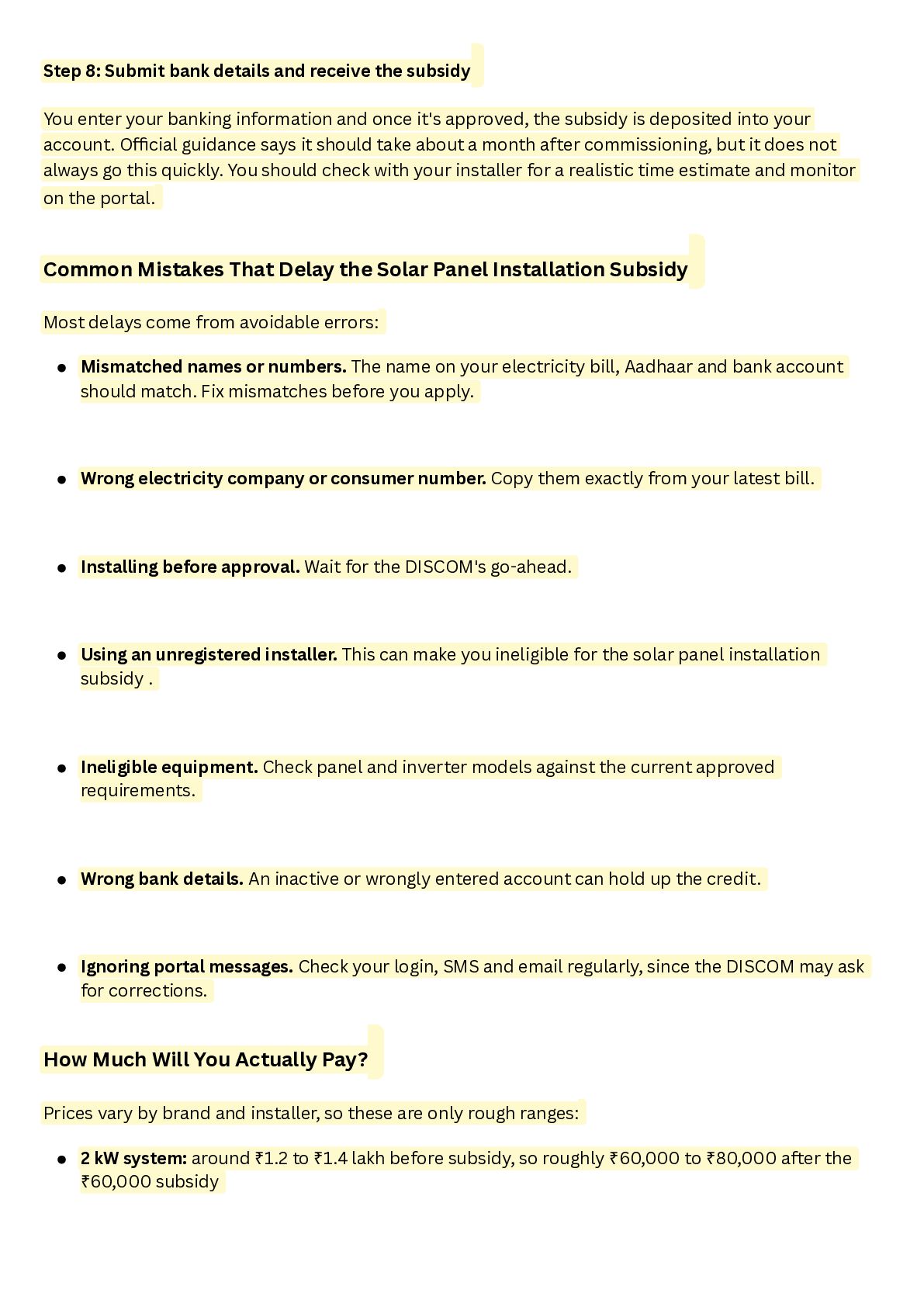
enter your banking information and once it's approved, the subsidy is deposited into your account. Official guidance says it should take about a month after commissioning, but it does not always go this quickly. You should check with your installer for a realistic time estimate and monitor on the portal. Common Mistakes That Delay the Solar Panel Installation Subsidy Most delays come from avoidable errors: Mismatched names or numbers. The name on your electricity bill, Aadhaar and bank account should match. Fix mismatches before you apply. Wrong electricity company or consumer number. Copy them exactly from your latest bill. Installing before approval. Wait for the DISCOM's go-ahead. Using an unregistered installer. This can make you ineligible for the solar panel installation subsidy . Ineligible equipment. Check panel and inverter models against the current approved requirements. Wrong bank details. An inactive or wrongly entered account can hold up the credit. Ignoring portal messages. Check your login, SMS and email regularly, since the DISCOM may ask for corrections. How Much Will You Actually Pay? Prices vary by brand and installer, so these are only rough ranges: 2 kW system: around ₹1.2 to ₹1.4 lakh before subsidy, so roughly ₹60,000 to ₹80,000 after the ₹60,000 subsidy
so roughly ₹1 to ₹1.2 lakh after the ₹78,000 subsidy That is why the scheme gets described as free solar in some advertising but it isn't. You pay first and the subsidy reimburses part of the cost later. Banks also offer loans for rooftop solar , so ask about current rates if you don't want to pay the full amount upfront. Is the Solar Subsidy Worth It? For most homes with a decent monthly bill and a usable roof, yes. Subsidised solar panels reduce your electricity bill for many years, and the subsidy shortens the payback period. But results depend on your usage, roof and system size, and your bill may not become exactly zero because fixed charges and seasonal changes remain. Be wary of any company that guarantees a zero bill or 100% free solar. A reliable installer explains both the savings and the limits. How to Spot a Fake or Misleading Solar Subsidy Offer Because the scheme is popular, misleading offers appear too. Watch for these signs: Asking for a large registration fee to apply on your behalf. Registration on the official portal is done by you, directly on the website. Promising a subsidy amount above what the scheme allows. Refusing to show registration details or a written quote. Asking for full payment upfront. Claiming to be the government or an official agent. Installers and helpers are independent businesses. Commonly Asked Questions Can I apply for the solar subsidy myself? Yes. You register and apply on the official portal, and an installer can help with the paperwork. You stay in control of your own account.
scheme is meant for house owners, so a tenant would generally need the owner's consent and involvement. Check the official rules for your case. Can I get the subsidy for a system larger than 3 kW? You can install a larger system but the subsidy stops at ₹78,000. How long does the whole process take? It depends on approvals, installer schedule and inspection. Many households find it takes several weeks from application to commissioning, with the subsidy arriving afterwards. Does the subsidy cover batteries or hybrid systems? The scheme is built around grid-connected rooftop systems. I haven't verified how it treats batteries, so confirm with the portal and your DISCOM before buying a hybrid system. Get Help With Your Application in Barwala The application isn't difficult, but it has enough steps that many families want a guide. If you're in Barwala or nearby, Ult Solar can check your roof, review your bill, explain which documents you need, and give you an honest written quote. Every application is made on the official portal, and we're an independent installer, not the government. Book a free site visit to get started. Share:


 terasawat
 yatabe
 cbtlibrary
 ainischool
 robintux
 bvr7352
 kentaroy47
 akiraasano
 frievea
 ichiroc
 terazawa
 notwaldorf
 davidcarrasco
 bkeepers
 joshbly
 afnizarnur
 lara
 chriscoyier
 ryanjones
 varn
 mclloyd
 geoffreycrofte
 rkendrick25