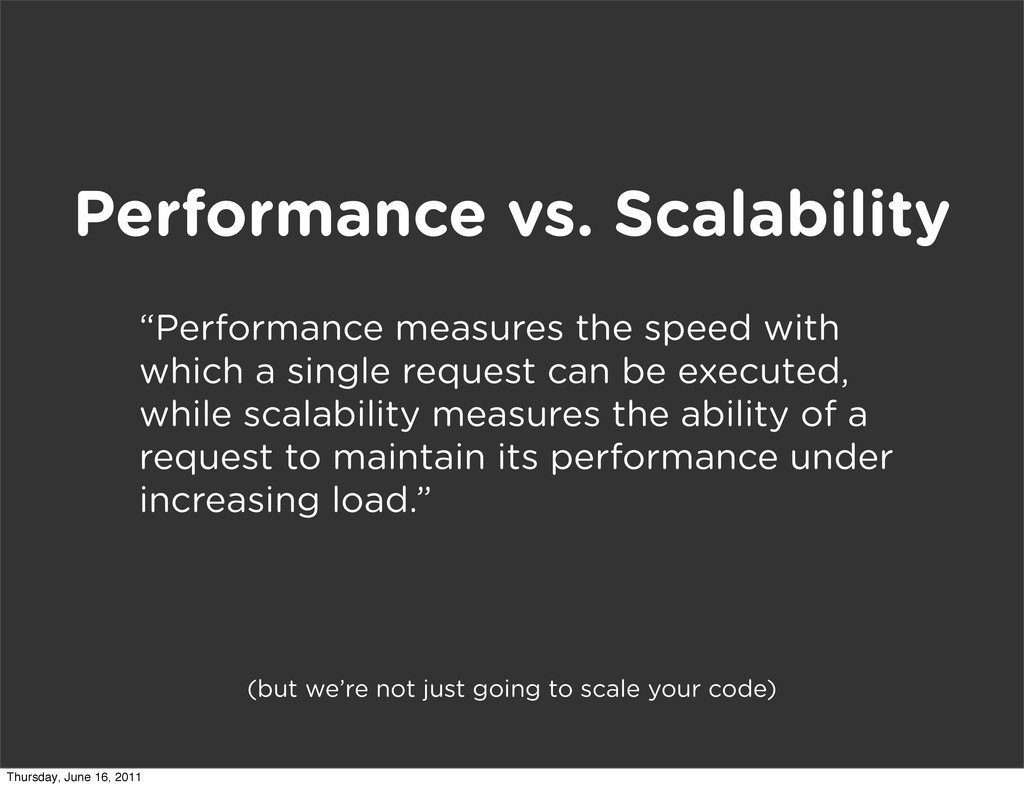
be executed, while scalability measures the ability of a request to maintain its performance under increasing load.” Performance vs. Scalability (but we’re not just going to scale your code) Thursday, June 16, 2011
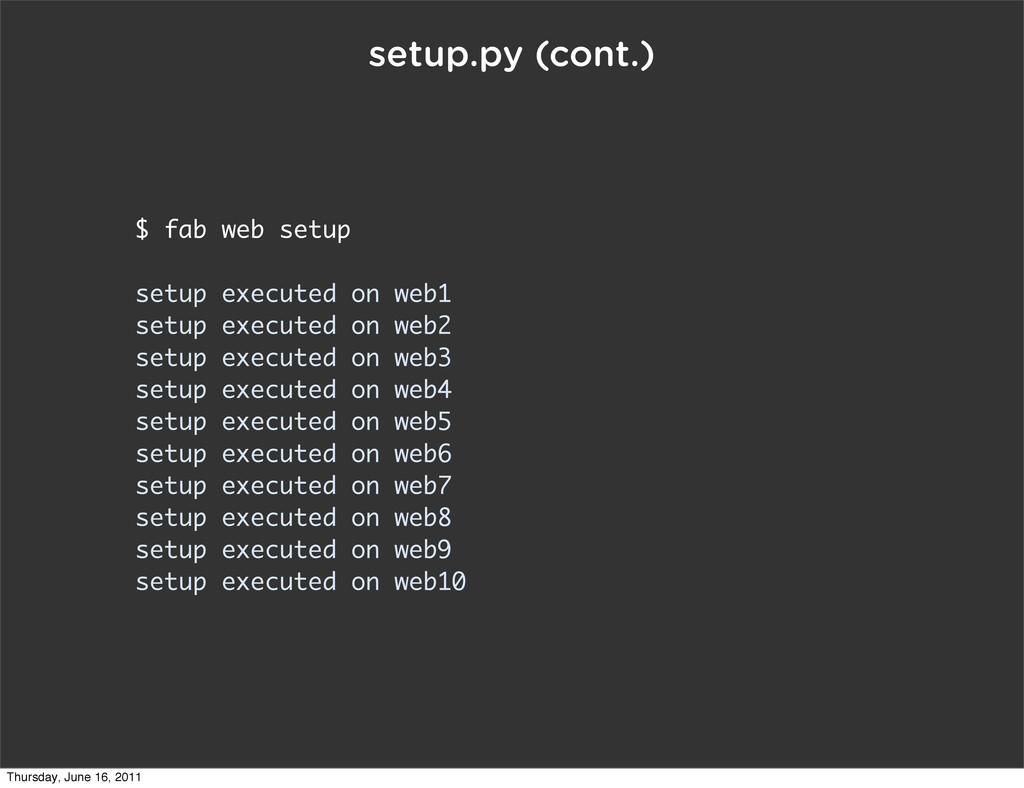
setup executed on web2 setup executed on web3 setup executed on web4 setup executed on web5 setup executed on web6 setup executed on web7 setup executed on web8 setup executed on web9 setup executed on web10 Thursday, June 16, 2011
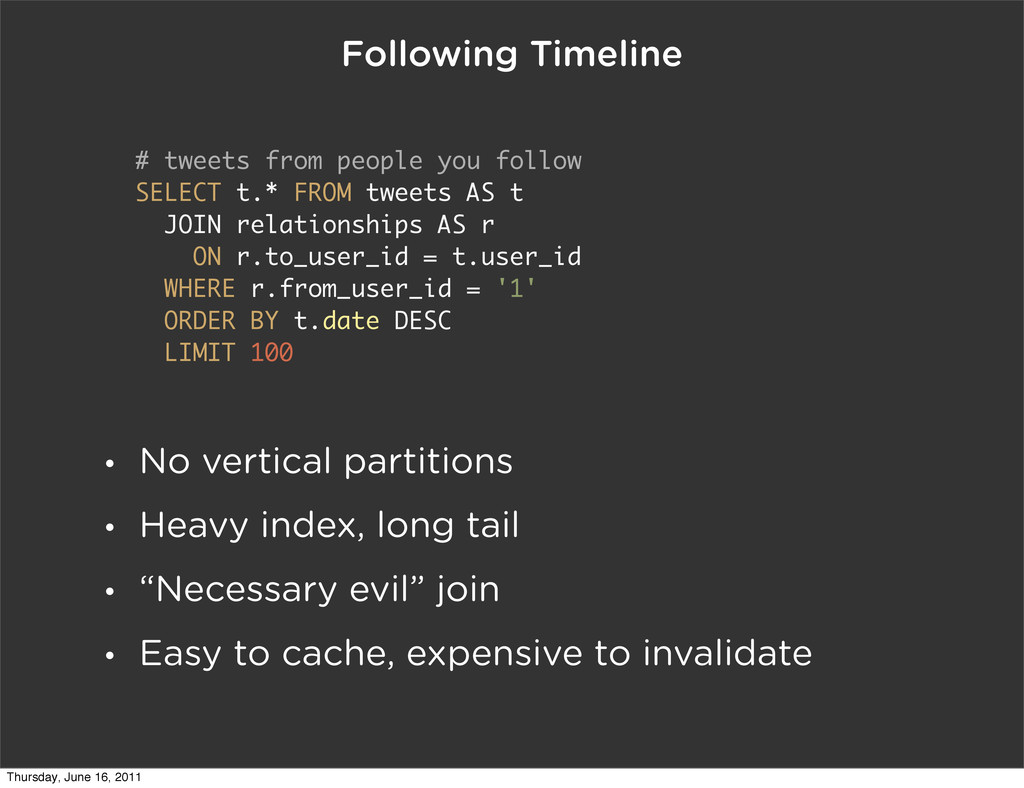
tail • “Necessary evil” join • Easy to cache, expensive to invalidate # tweets from people you follow SELECT t.* FROM tweets AS t JOIN relationships AS r ON r.to_user_id = t.user_id WHERE r.from_user_id = '1' ORDER BY t.date DESC LIMIT 100 Thursday, June 16, 2011
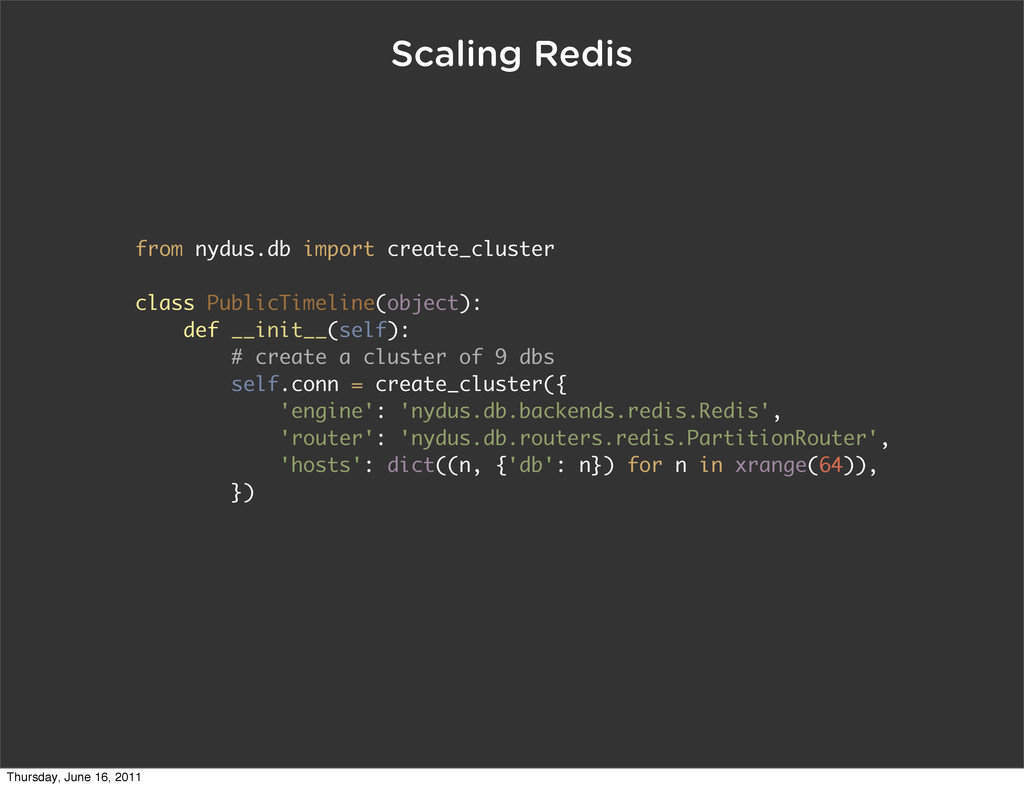
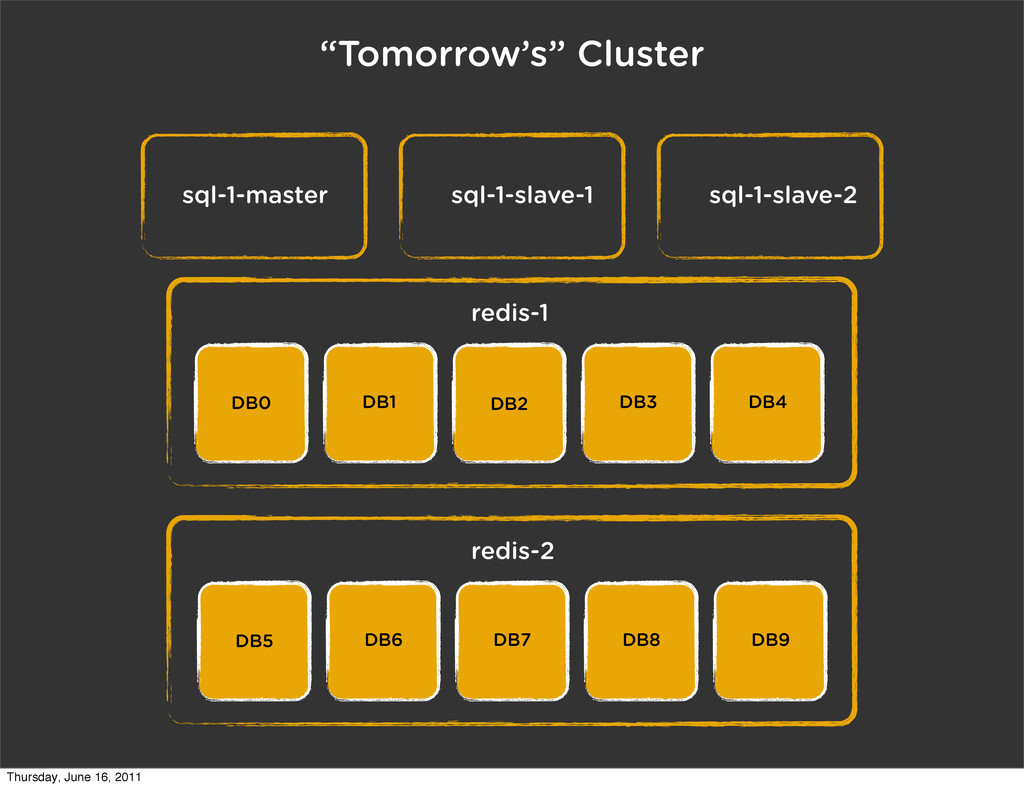
# create a cluster of 9 dbs self.conn = create_cluster({ 'engine': 'nydus.db.backends.redis.Redis', 'router': 'nydus.db.routers.redis.PartitionRouter', 'hosts': dict((n, {'db': n}) for n in xrange(64)), }) Thursday, June 16, 2011
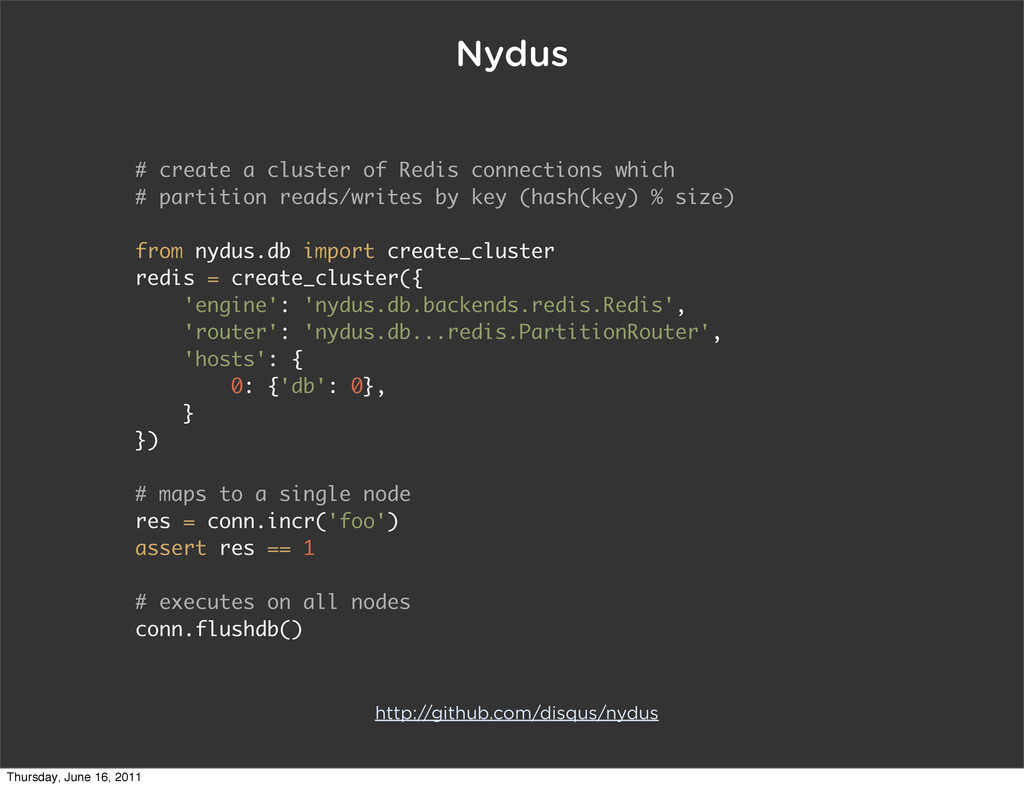
partition reads/writes by key (hash(key) % size) from nydus.db import create_cluster redis = create_cluster({ 'engine': 'nydus.db.backends.redis.Redis', 'router': 'nydus.db...redis.PartitionRouter', 'hosts': { 0: {'db': 0}, } }) # maps to a single node res = conn.incr('foo') assert res == 1 # executes on all nodes conn.flushdb() http://github.com/disqus/nydus Thursday, June 16, 2011
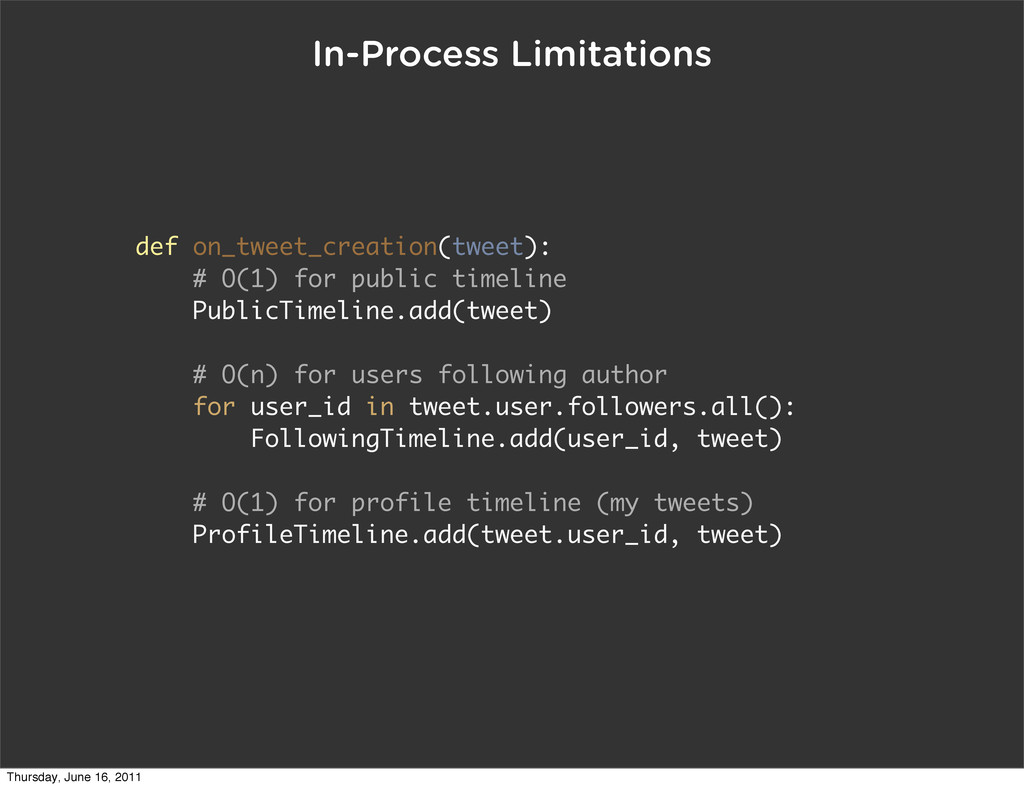
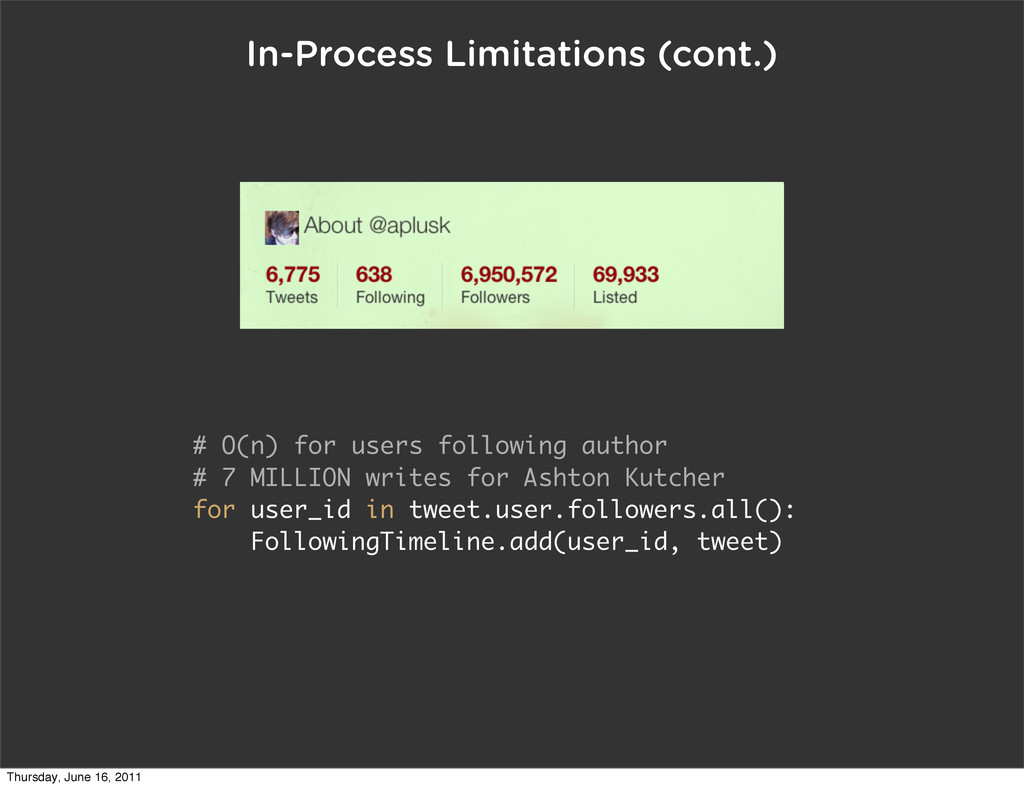
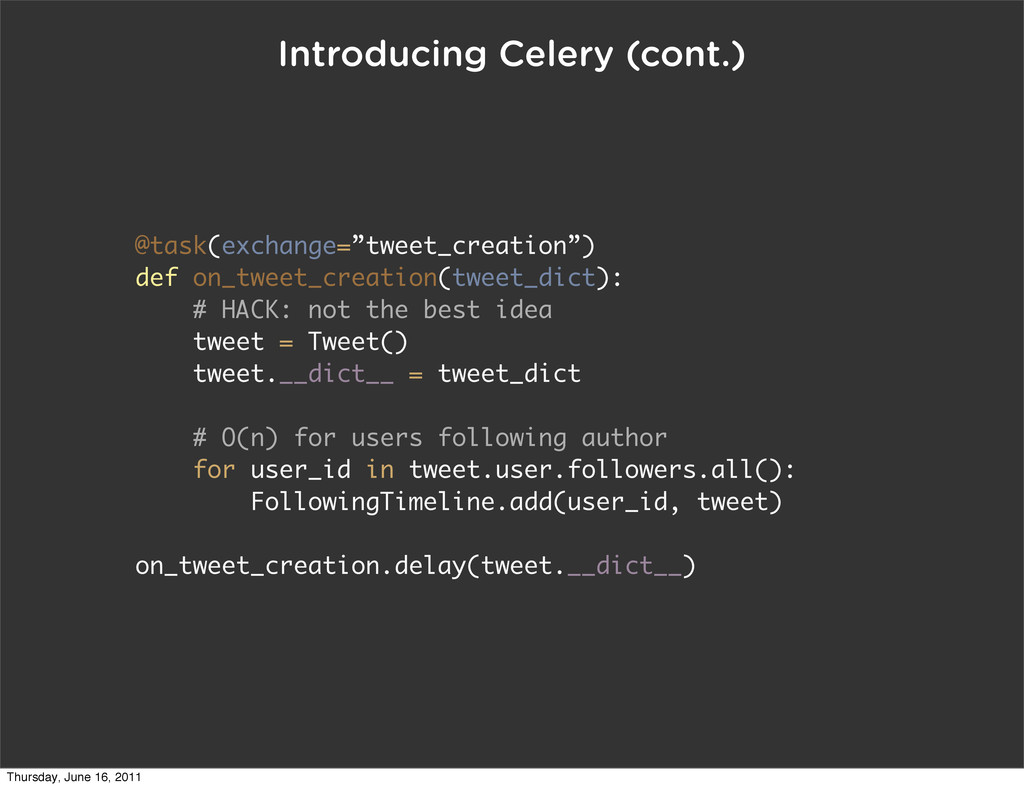
# O(n) for users following author for user_id in tweet.user.followers.all(): FollowingTimeline.add(user_id, tweet) # O(1) for profile timeline (my tweets) ProfileTimeline.add(tweet.user_id, tweet) Thursday, June 16, 2011
best idea tweet = Tweet() tweet.__dict__ = tweet_dict # O(n) for users following author for user_id in tweet.user.followers.all(): FollowingTimeline.add(user_id, tweet) on_tweet_creation.delay(tweet.__dict__) Thursday, June 16, 2011
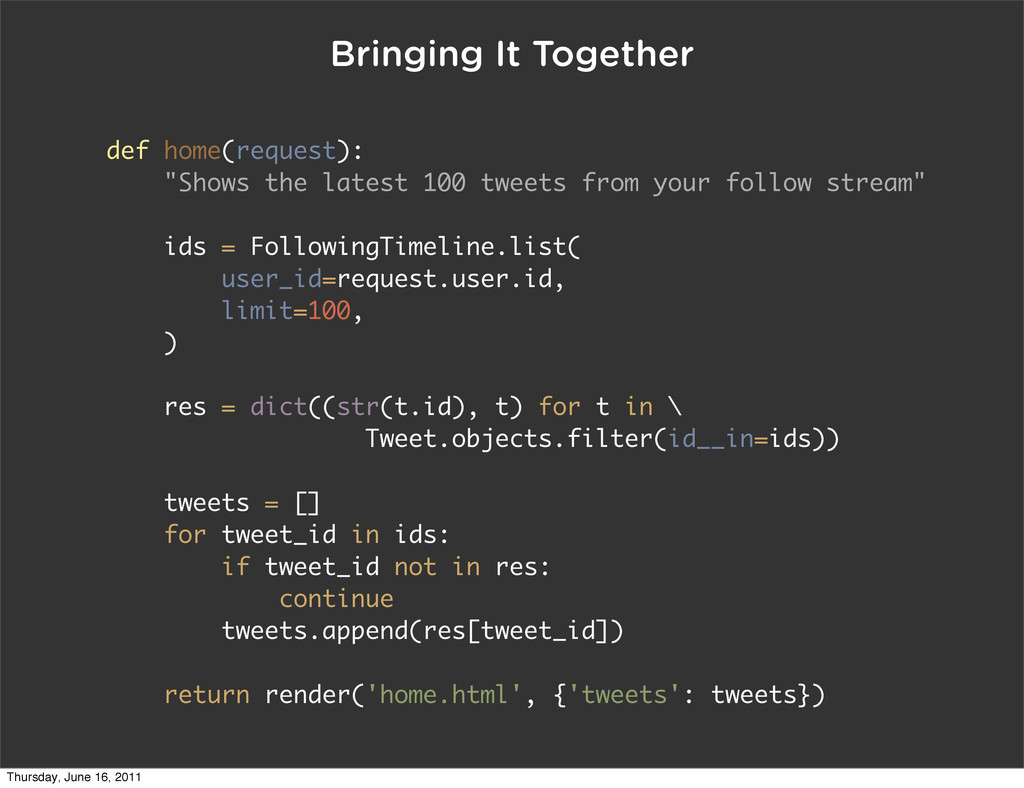
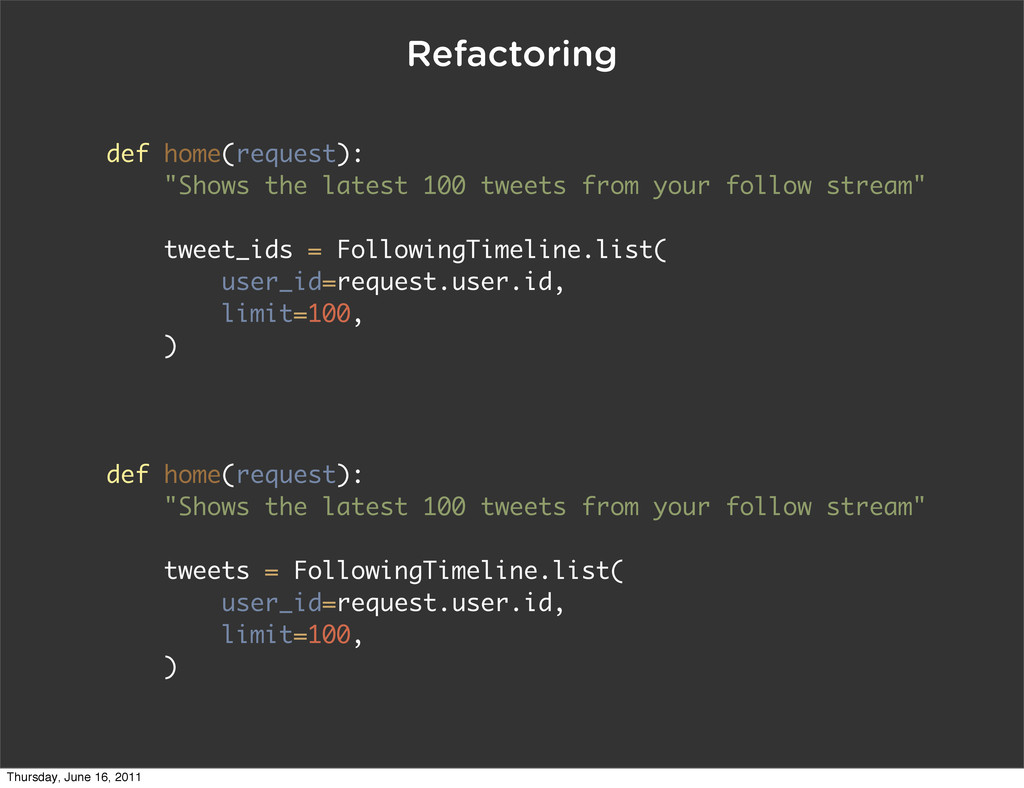
from your follow stream" ids = FollowingTimeline.list( user_id=request.user.id, limit=100, ) res = dict((str(t.id), t) for t in \ Tweet.objects.filter(id__in=ids)) tweets = [] for tweet_id in ids: if tweet_id not in res: continue tweets.append(res[tweet_id]) return render('home.html', {'tweets': tweets}) Thursday, June 16, 2011
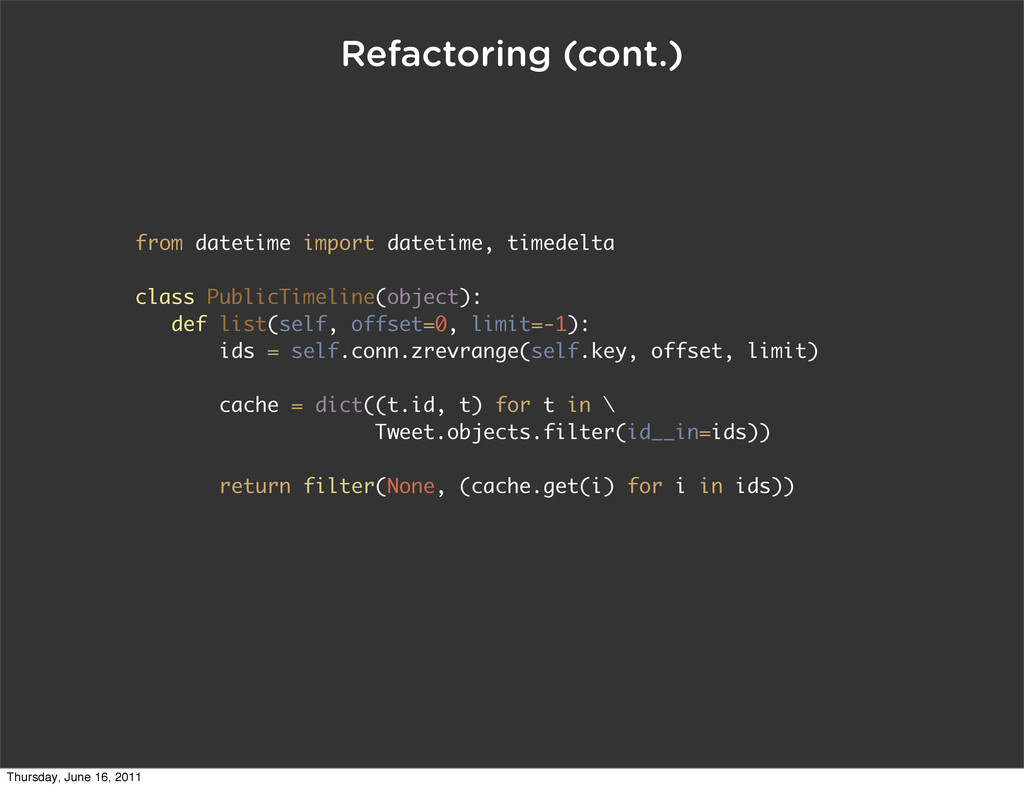
list(self, offset=0, limit=-1): ids = self.conn.zrevrange(self.key, offset, limit) cache = dict((t.id, t) for t in \ Tweet.objects.filter(id__in=ids)) return filter(None, (cache.get(i) for i in ids)) Thursday, June 16, 2011
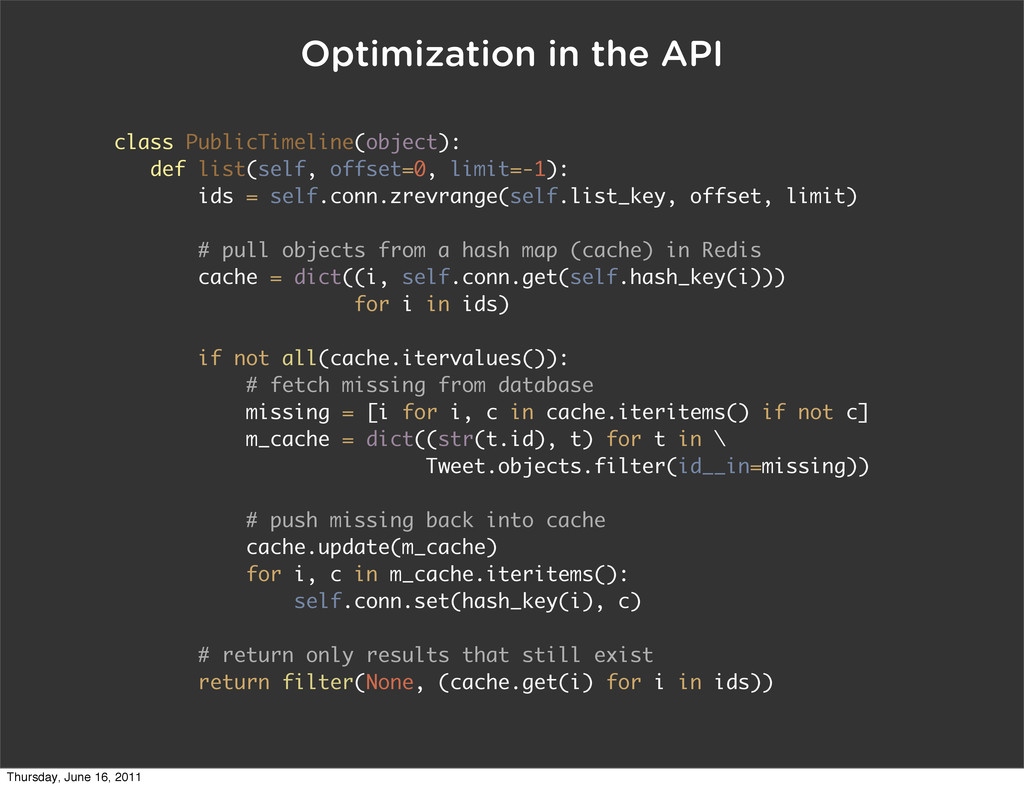
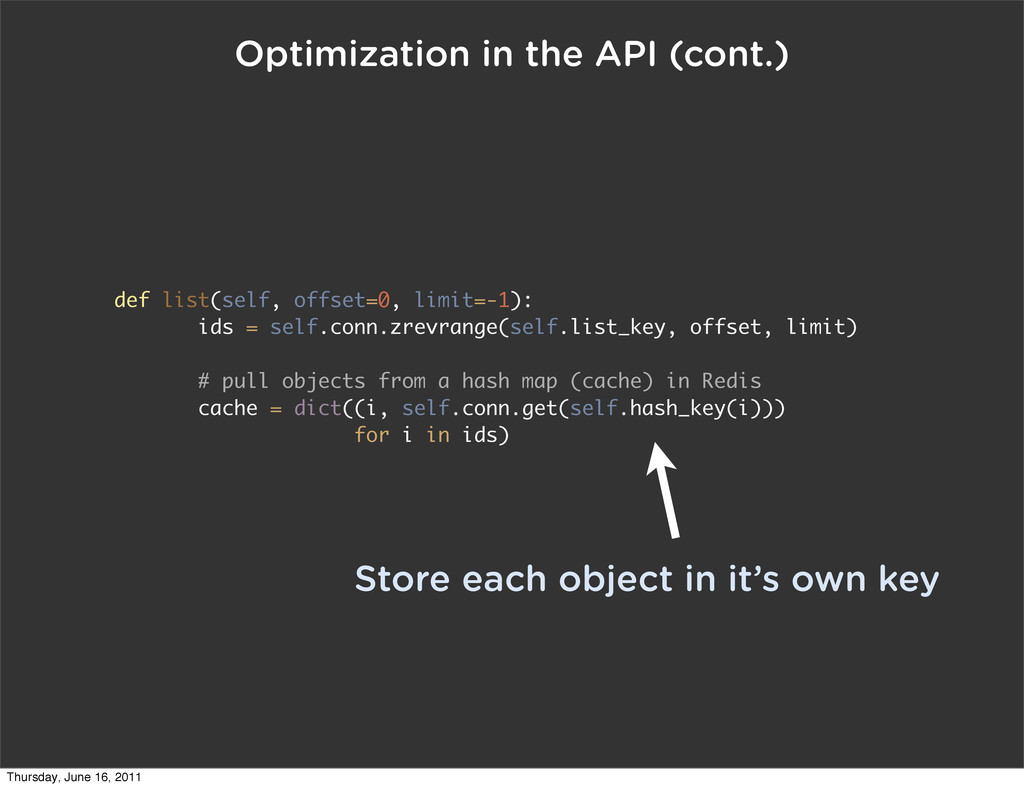
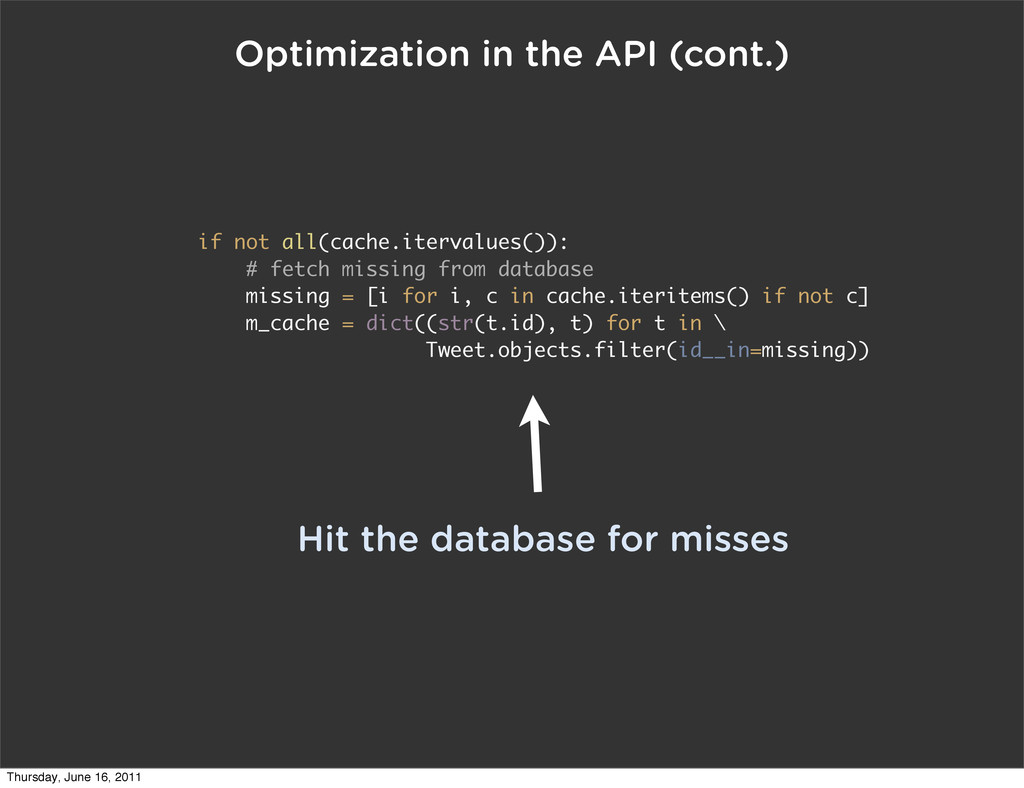
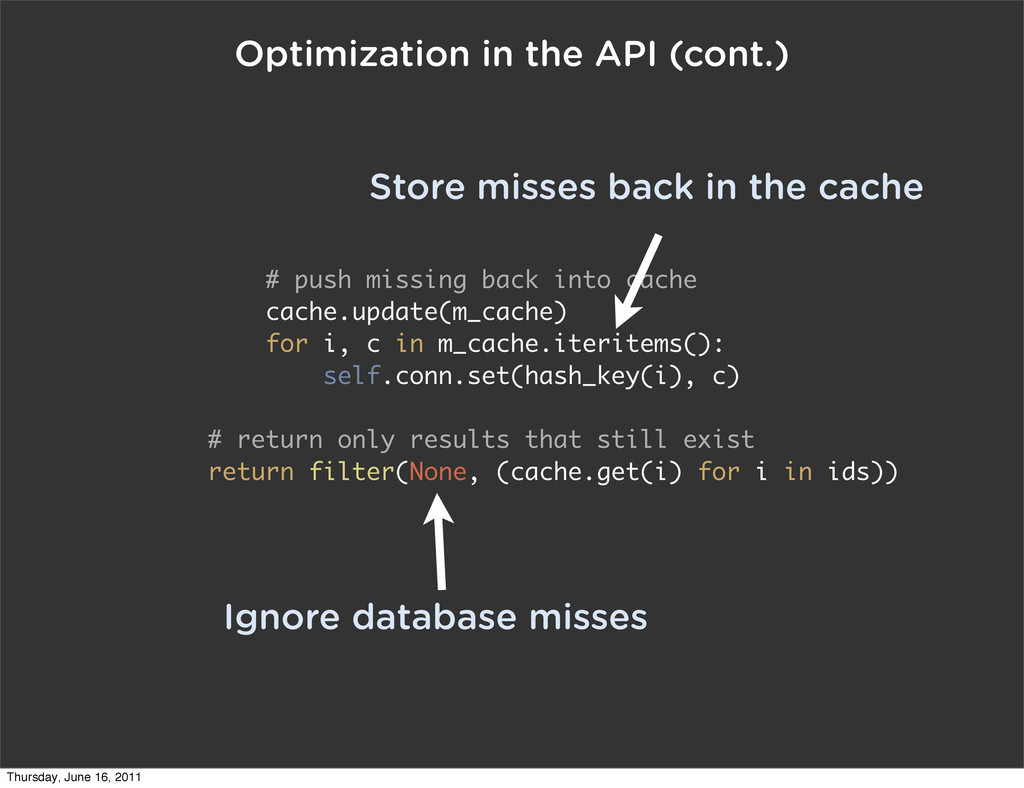
ids = self.conn.zrevrange(self.list_key, offset, limit) # pull objects from a hash map (cache) in Redis cache = dict((i, self.conn.get(self.hash_key(i))) for i in ids) if not all(cache.itervalues()): # fetch missing from database missing = [i for i, c in cache.iteritems() if not c] m_cache = dict((str(t.id), t) for t in \ Tweet.objects.filter(id__in=missing)) # push missing back into cache cache.update(m_cache) for i, c in m_cache.iteritems(): self.conn.set(hash_key(i), c) # return only results that still exist return filter(None, (cache.get(i) for i in ids)) Thursday, June 16, 2011
= self.conn.zrevrange(self.list_key, offset, limit) # pull objects from a hash map (cache) in Redis cache = dict((i, self.conn.get(self.hash_key(i))) for i in ids) Store each object in it’s own key Thursday, June 16, 2011
missing from database missing = [i for i, c in cache.iteritems() if not c] m_cache = dict((str(t.id), t) for t in \ Tweet.objects.filter(id__in=missing)) Hit the database for misses Thursday, June 16, 2011
cache cache.update(m_cache) for i, c in m_cache.iteritems(): self.conn.set(hash_key(i), c) # return only results that still exist return filter(None, (cache.get(i) for i in ids)) Store misses back in the cache Ignore database misses Thursday, June 16, 2011
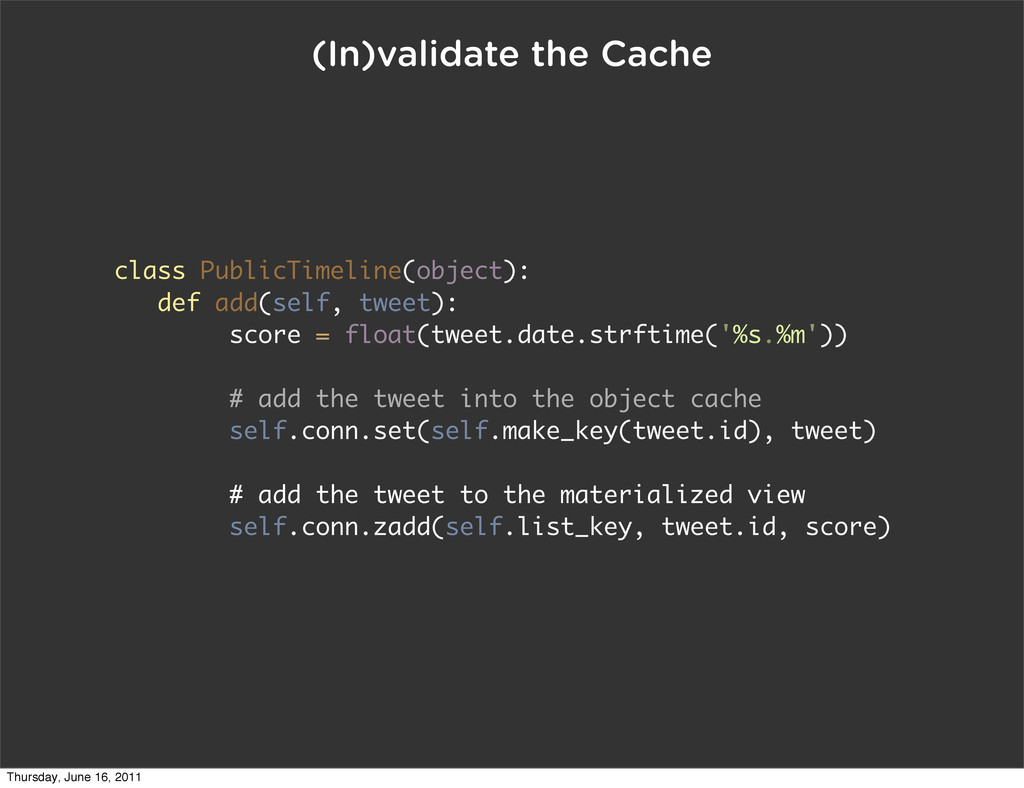
float(tweet.date.strftime('%s.%m')) # add the tweet into the object cache self.conn.set(self.make_key(tweet.id), tweet) # add the tweet to the materialized view self.conn.zadd(self.list_key, tweet.id, score) Thursday, June 16, 2011
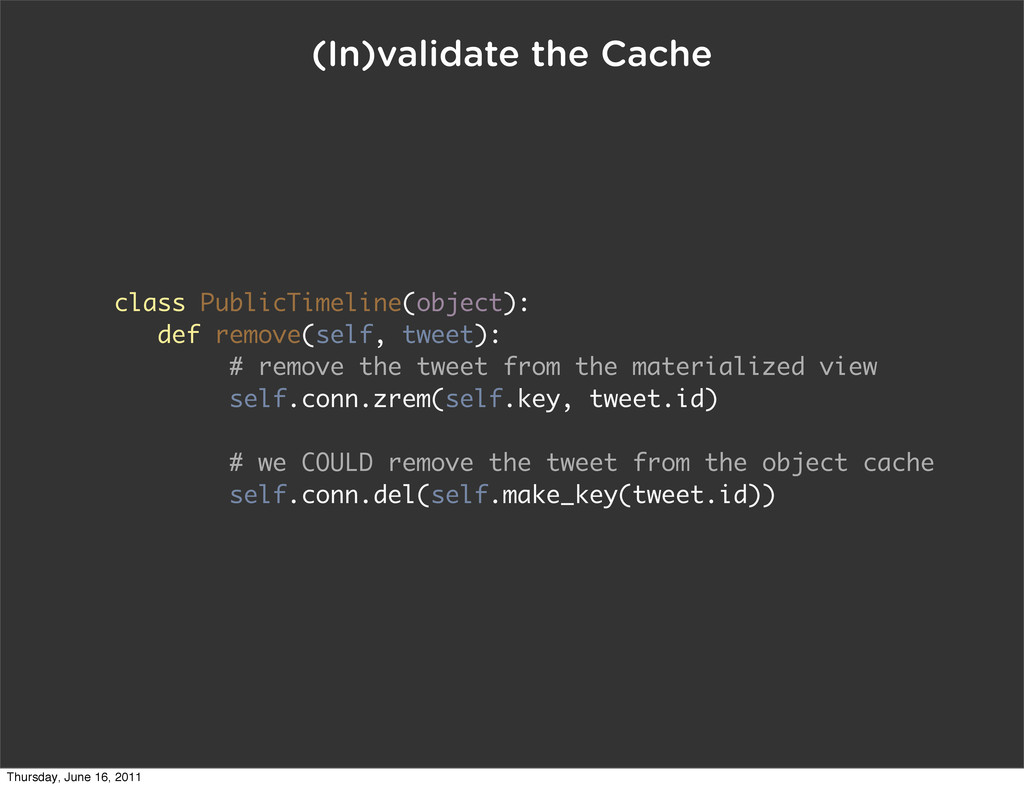
the tweet from the materialized view self.conn.zrem(self.key, tweet.id) # we COULD remove the tweet from the object cache self.conn.del(self.make_key(tweet.id)) Thursday, June 16, 2011


 zeeg
zeeg
 ytaka23
 kinunori
 kakutani
 inariku
 yappli_developers
 yama3133
 konippi
 pensuke628
 shunsock
 oracle4engineer
 genda
genda
 masakiokuda
 aleyda
 codingconduct
 427marketing
 moore
moore
 reverentgeek
 addyosmani
 michielstock
 baasie
 techseoconnect
 chriscoyier
 raygrieselhuber
 3n
3n



![Materializing Views PUBLIC_TIMELINE = [] def on_tweet_creation(tweet): global PUBLIC_TIME PUBLIC_TIMELINE.insert(0,](https://files.speakerdeck.com/presentations/4e80d6455cc0ec00630003e6/slide_22.jpg)
![DISQUS Questions? psst, we’re hiring [email protected] Thursday, June 16, 2011](https://files.speakerdeck.com/presentations/4e80d6455cc0ec00630003e6/slide_46.jpg)