Share
Embed
Transcript
71 slides
-
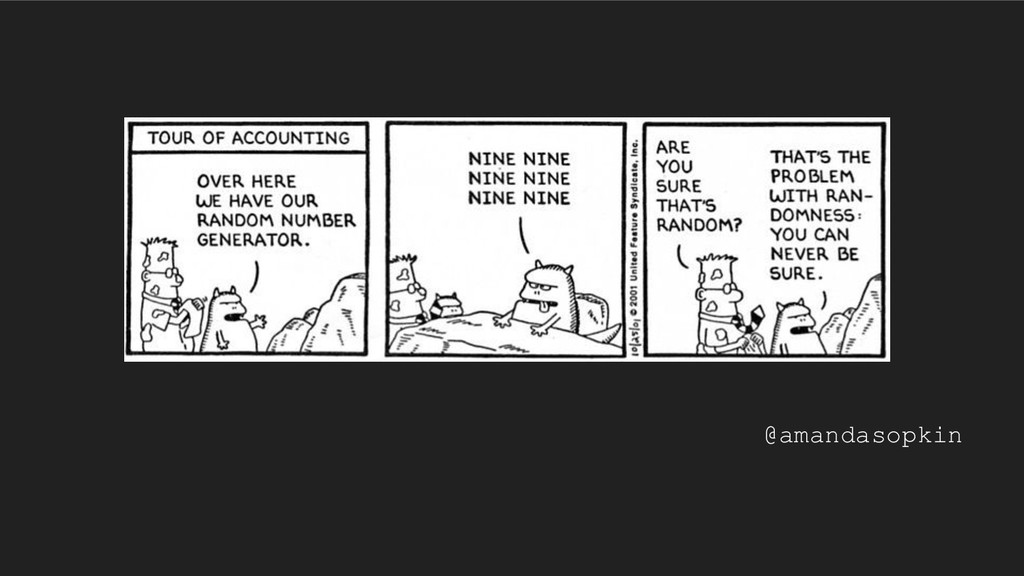
Randomness Makes processes secure Mathematically/computationally, biologically, philosophically important Difficult to
actually achieve @amandasopkin -
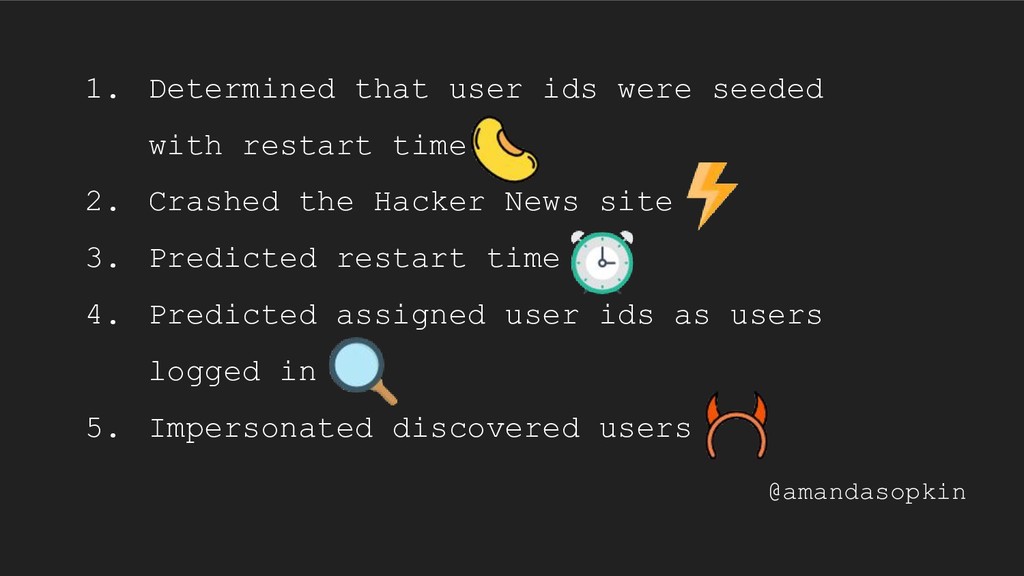
1. Determined that user ids were seeded with restart time
2. Crashed the Hacker News site 3. Predicted restart time 4. Predicted assigned user ids as users logged in 5. Impersonated discovered users @amandasopkin -
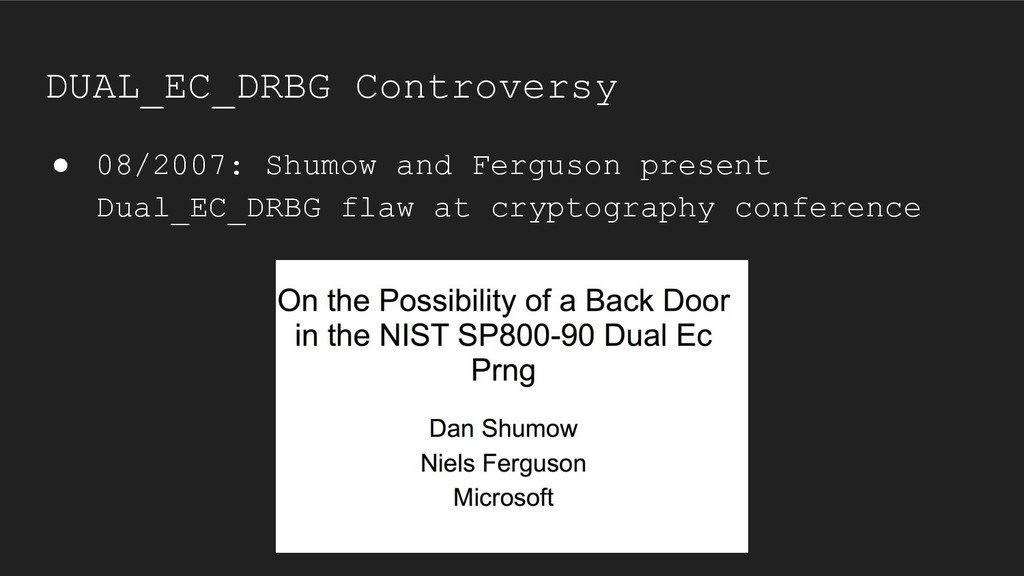
• 08/2007: Shumow and Ferguson present Dual_EC_DRBG flaw at cryptography
conference DUAL_EC_DRBG Controversy -
• 11/2007: Schneier bases article in Wired on their findings
DUAL_EC_DRBG Controversy -
“...would allow NSA to determine the state of the random
number generator, and thereby eventually be able to read all data sent over the SSL connection.” DUAL_EC_DRBG Controversy -
• 09/2013: One of the purposes of Bullrun is described
as being "to covertly introduce weaknesses into the encryption standards followed by hardware and software developers around the world." DUAL_EC_DRBG Controversy -
• NIST recommends removal of the algorithm as a standard
DUAL_EC_DRBG Controversy -
• 2004: Dual EC PRNG introduced • 08/2007: Shumow and
Ferguson present Dual_EC_DRBG flaw at cryptography conference • 11/2007: Schneier bases article in Wired on their findings DUAL_EC_DRBG Controversy -
• 09/2013: One of the purposes of Bullrun is described
as being "to covertly introduce weaknesses into the encryption standards followed by hardware and software developers around the world." • 12/2013: Presidential advisory examines encryption standards • 2014: Standard is removed DUAL_EC_DRBG Controversy -
Who did this impact? Microsoft, Google, Apple, McAfee, Docker, IBM,
Oracle, Cisco, VMWare, Juniper, HP, Red Hat, Samsung, Toshiba, DELL, Ruckus, F5 Networks, Lenovo, Nokia, the RSA BSAFE libraries for Java and C++ and more.... -
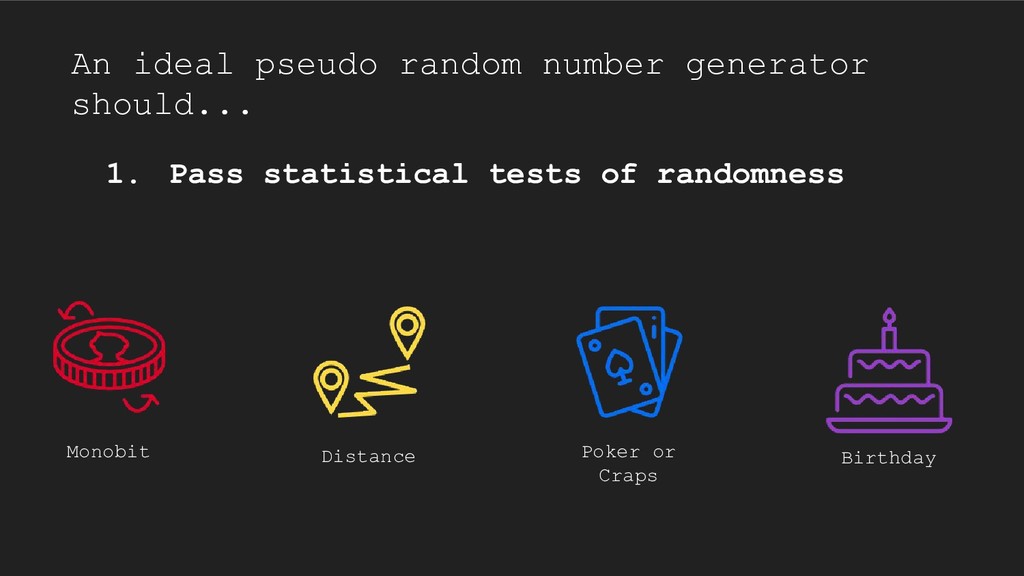
1. Pass statistical tests of randomness An ideal pseudo random
number generator should... Monobit Distance Poker or Craps Birthday -
1. Pass statistical tests of randomness 2. Take a long
time before repeating An ideal pseudo random number generator should... Have a long “period” -
1. Pass statistical tests of randomness 2. Take a long
time before repeating 3. Execute efficiently An ideal pseudo random number generator should... & Quick Low storage -
1. Pass statistical tests of randomness 2. Take a long
time before repeating 3. Execute efficiently 4. Be repeatable An ideal pseudo random number generator should... -
1. Pass statistical tests of randomness 2. Take a long
time before repeating 3. Execute efficiently 4. Be repeatable 5. Be portable An ideal pseudo random number generator should... Can be run on any machine or system -
Linear congruential generators Linear congruential generators take the form xk
= (axk−1 + c) (mod M) where x0 is the seed, the integer M is the largest representable integer, and the period is at most M. -
Linear combination generators a = 3 c = 9 m
= 16 xi = 4394 def lcg(): xi = seed() for i in range(10): xi = (a*xi + c)%m print(xi) -
Linear combination generators Algorithm: xi = (a*xi + c)%m 7
14 3 2 15 6 11 10 7 -
Any one who considers arithmetical methods of producing random digits
is, of course, in a state of sin. -
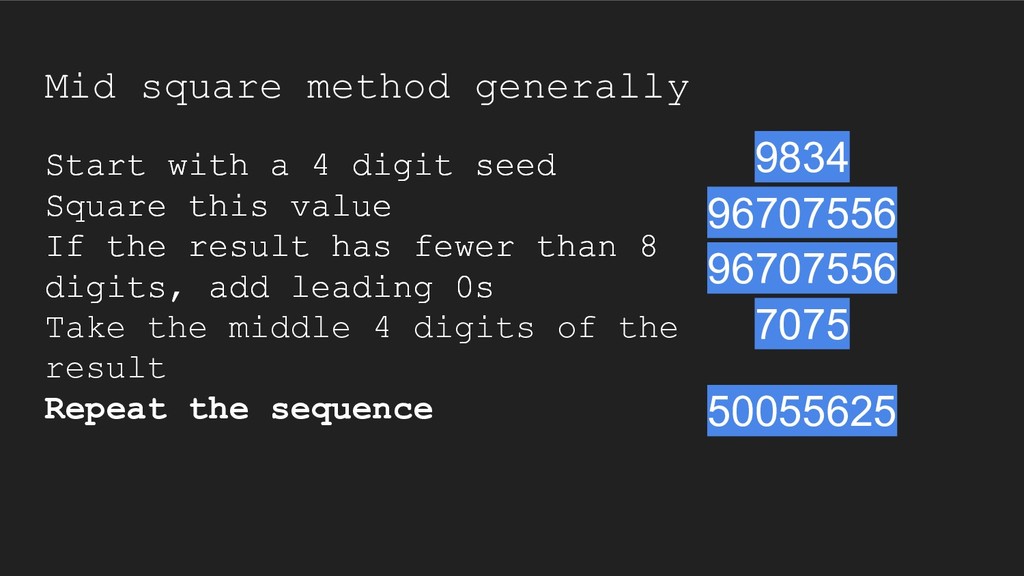
Mid square method generally Start with a 4 digit seed
Square this value If the result has fewer than 8 digits, add leading 0s Take the middle 4 digits of the result Repeat the sequence -
Mid square method generally Start with a 4 digit seed
Square this value 96707556 9834 -
Mid square method generally Start with a 4 digit seed
Square this value If the result has fewer than 8 digits, add leading 0s 96707556 9834 96707556 -
Mid square method generally Start with a 4 digit seed
Square this value If the result has fewer than 8 digits, add leading 0s Take the middle 4 digits of the result Start with a 4 digit seed Square this value If the result has fewer than 8 digits, add leading 0s 9834 96707556 96707556 7075 -
Mid square method generally Start with a 4 digit seed
Square this value If the result has fewer than 8 digits, add leading 0s Take the middle 4 digits of the result Repeat the sequence Start with a 4 digit seed Square this value If the result has fewer than 8 digits, add leading 0s 9834 96707556 96707556 7075 50055625 -
Mid square method seed_number = int(input("Please enter a four digit
number:\n[####] ")) number = seed_number already_seen = set() counter = 0 while number not in already_seen: counter += 1 already_seen.add(number) number = int(str(number * number).zfill(8)[2:6]) print(f"#{counter}: {number}") print(f"We began with the seed {seed_number}, and" f" we repeated ourselves after {counter} steps" f" with {number}.") -
Mid square method Please enter a four digit number: [####]
5859 #1: 3278 #2: 7452 #3: 5323 #4: 3343 #5: 1756 #6: 835 #7: 6972 #8: 6087 #9: 515 #10: 2652 ....... #59: 24 #60: 5 #61: 0 #62: 0 We began with the seed 5859, and we repeated ourselves after 62 steps with 0. -
Issues with mid square method Relatively slow Statistically unsatisfactory Sample
of random numbers may be too short -
Most used pseudo random number generator Very long period (the
Mersenne prime: 219937 − 1) Not cryptographically secure The Mersenne Twister -
Predicting the random() module from random import random import matplotlib.pyplot
as plt def uni(n, m, a, c, seed): sequence = [] Xn = seed for i in range(n): Xn = ((a*Xn + c) % m) sequence.append(Xn/float(m-1)) return(sequence) x = range(1000) y_1 = uni(1000, 2**32, 11695477, 1, datetime.now().microsecond) y_2 = [random() for i in range(1000)] plt.plot(x, y_1, "o", color="blue") plt.show() plt.plot(x, y_2, "o", color="red") plt.show() -
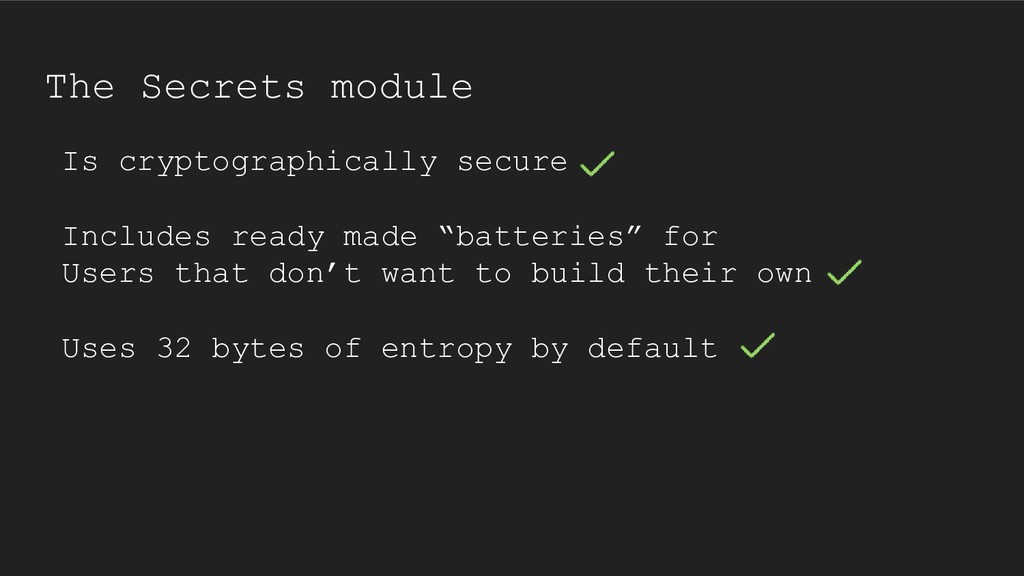
The Secrets module Is cryptographically secure Includes ready made “batteries”
for Users that don’t want to build their own Uses 32 bytes of entropy by default -
Source code of Secrets module from random import SystemRandom _sysrand
= SystemRandom() randbits = _sysrand.getrandbits choice = _sysrand.choice def randbelow(exclusive_upper_bound): return _sysrand._randbelow(exclusive_upper_bound) DEFAULT_ENTROPY = 32 # number of bytes to return by default def token_bytes(nbytes=None): if nbytes is None: nbytes = DEFAULT_ENTROPY return os.urandom(nbytes) def token_hex(nbytes=None): return binascii.hexlify(token_bytes(nbytes)).decode('ascii') def token_urlsafe(nbytes=None): tok = token_bytes(nbytes) return base64.urlsafe_b64encode(tok).rstrip(b'=').decode('ascii') -
SystemRandom Uses OS as a source of randomness Not available
on all systems Does not rely on software states Sequences are not repeatable -
/dev/random Will block without sufficient entropy Relies on “the kernel
entropy pool” Slower than /dev/urandom -
/dev/urandom Will not block without sufficient entropy Relies on “the
kernel entropy pool” Faster than /dev/random Theoretically vulnerable to attack -
Using the secrets module to get tokens import secrets token1
= secrets.token_hex(16) token2 = secrets.token_hex(10) print(token1) print(token2) d2bdc979d5ecec0dccf67854459c5284 584d93ac921d3c74be9c -
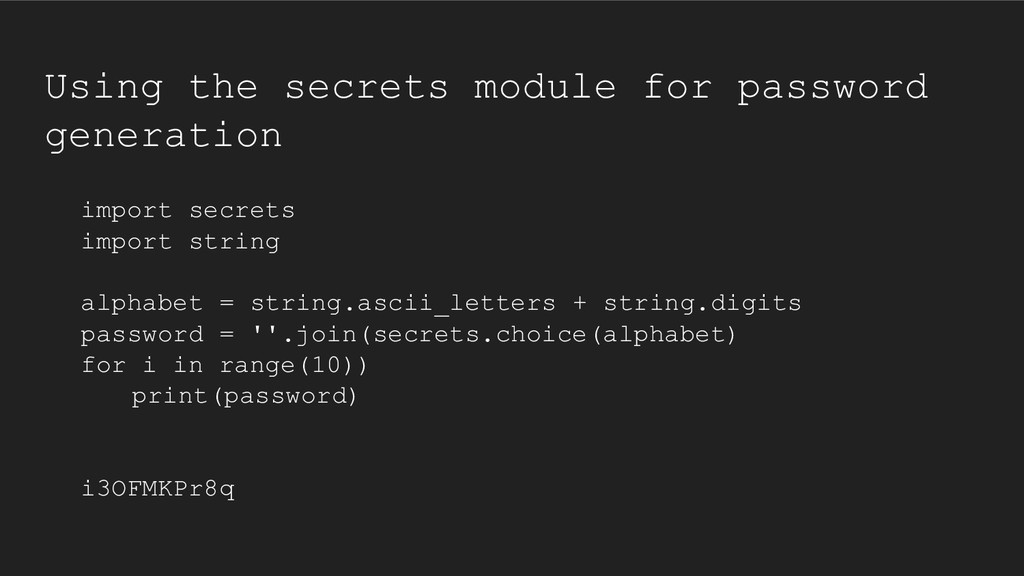
Using the secrets module for password generation import secrets import
string alphabet = string.ascii_letters + string.digits password = ''.join(secrets.choice(alphabet) for i in range(10)) print(password) i3OFMKPr8q -
Python’s “nuclear reactor” of Randomness "...folks really are better off
learning to use things like cryptography.io for security sensitive software, so this change is just about harm mitigation given that it's inevitable that a non-trivial proportion of the millions of current and future Python developers won't do that." -
Is very important for security Difficult to truly achieve Can
be simulated Randomness... @amandasopkin -
Sources: • Icons taken from flaticon.com • https://crypto.stackexchange.com/questions/51232/using- 32-hexadecimal-digits-vs-ascii-equivalent-16-character- password
• https://dev.to/walker/pseudo-random-numbers-in-python-f rom-arithmetic-to-probability-distributions • Wired Magazine • The Washington Post • NYT • Dilbert