Share
Embed
Лекция № 4. Базовый C++. Часть 2
ООП АФТИ НГУ ФФ, зимний семестр 2018
Oleg Dashevskii
February 26, 2018
Transcript
29 slides
-
ПРЕОБРАЗОВАНИЕ ТИПОВ int x = 100; unsigned y, z; y
= (unsigned)x; // старый способ из C z = unsigned(x); // новый способ из C++ printf("%u %u\n", y, z); // 100 100 -
CONST 1. Способ задать константы // Замена для #define const
int SQUARE_3 = 9; const int SQUARE_9 = 81; const double PI = 3.141592653589793238462643383; -
2. Модификатор для ссылок и указателей int square(const int &n)
{ // Изменить n здесь невозможно return n * n; } void square2(int &n) { n *= n; } void f(int i) { int j = square(i); int nine = square(3); int k = i; square2(k); // OK square2(3); // Ошибка! } -
const int *p1; int *const p2; int const *p1 int
*const p2 p1++; // OK *p1; // OK *p1 = 10; // ERROR p2++; // ERROR *p2; // OK *p2 = 10; // OK -
class Foo { public: Foo() : foo(0) {} int getFoo()
const { return foo; } void setFoo(int _foo) { foo = _foo; } private: int foo; }; //---------------------------------------- Foo f; Foo &fr = f; fr.setFoo(100); fr.getFoo(); // 100 const Foo &frc = f; frc.getFoo(); // 100 frc.setFoo(200); // Ошибка! 3. const-члены класса -
int sqrt(int n); double sqrt(double d); char *sqrt(char *); void
f() { int i = sqrt(36); double d1 = sqrt(49.0); double d2 = sqrt(double(i*i)); char *s = sqrt("36"); } Перегрузка функций -
Прототип GNU C++ Microsoft Visual C++ void h(int); _Z1hi ?h@@YAXH@Z
void h(int, char); _Z1hic ?h@@YAXHD@Z void h(void); _Z1hv ?h@@YAXXZ «Манглинг» (mangling) -
char *format_number(double d, int precision = 2); format_number(10.0, 3); //
d: 10.0, precision: 3 format_number(10.0, 2); // d: 10.0, precision: 2 format_number(10.0); // d: 10.0, precision: 2 void f(int a, int b = 2, int c = 3); // OK void g(int a = 1, int b = 2, int c); // ERROR! void h(int a, int b = 3, int c); // ERROR! Параметры функций по умолчанию -
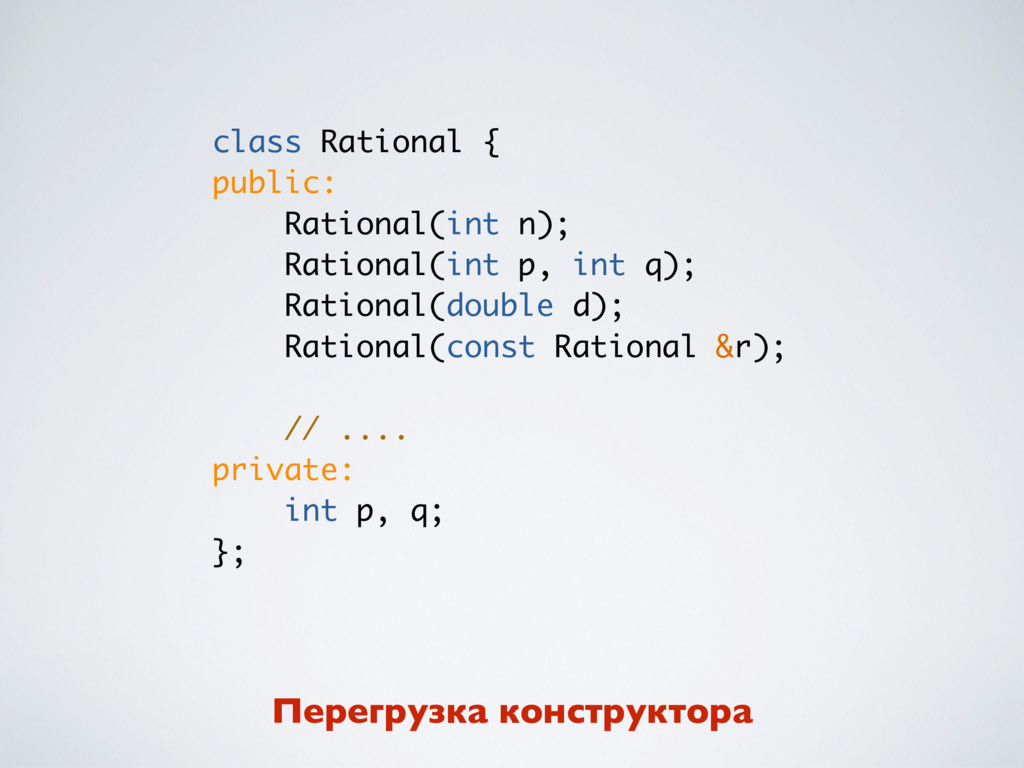
class Rational { public: Rational(int n); Rational(int p, int q);
Rational(double d); Rational(const Rational &r); // .... private: int p, q; }; Перегрузка конструктора -
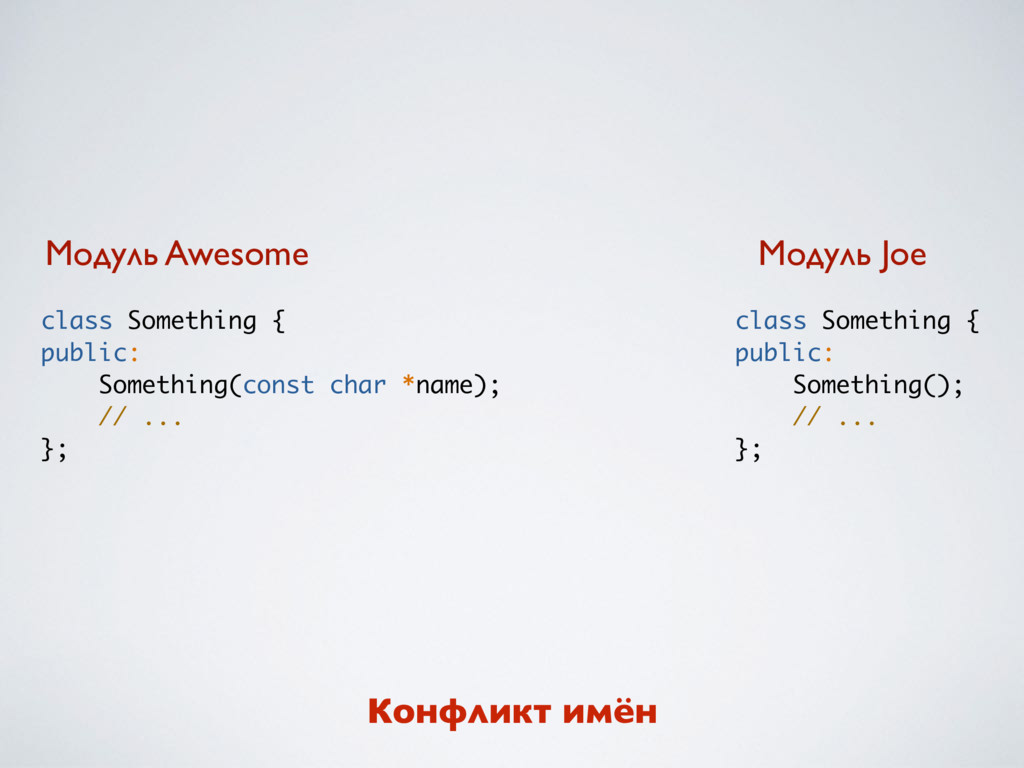
class Something { public: Something(const char *name); // ... };
Модуль Awesome class Something { public: Something(); // ... }; Модуль Joe Конфликт имён -
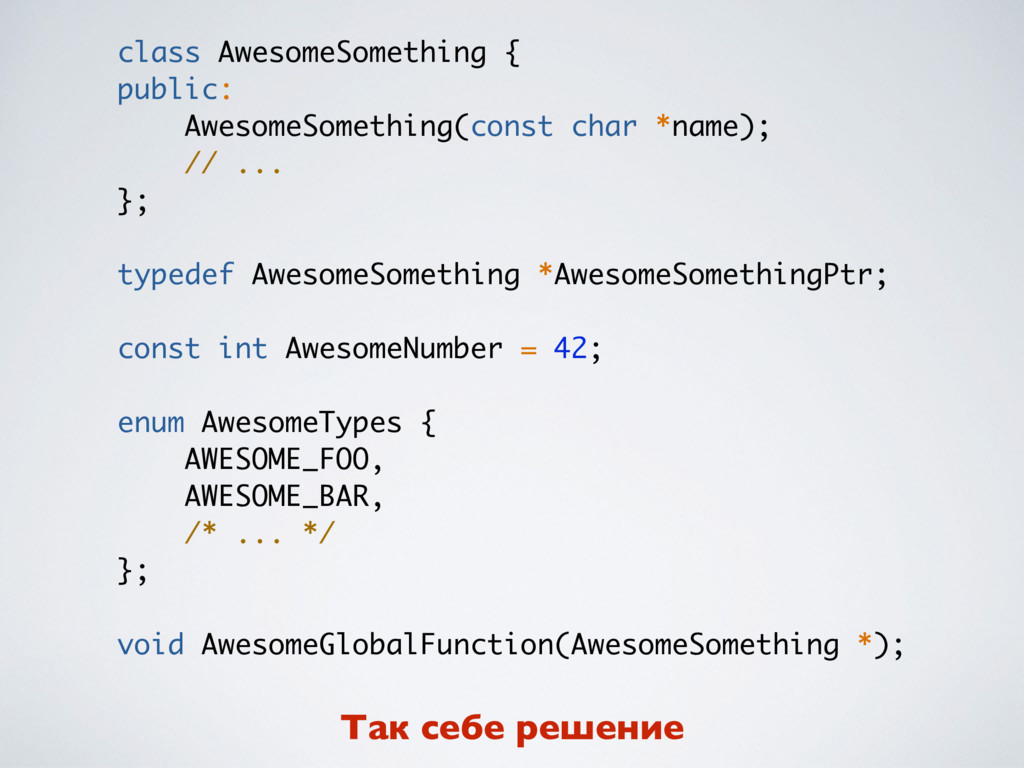
class AwesomeSomething { public: AwesomeSomething(const char *name); // ... };
typedef AwesomeSomething *AwesomeSomethingPtr; const int AwesomeNumber = 42; enum AwesomeTypes { AWESOME_FOO, AWESOME_BAR, /* ... */ }; void AwesomeGlobalFunction(AwesomeSomething *); Так себе решение -
// awesome.h namespace Awesome { class Something { public: Something(const
char *name); // ... }; typedef Something *SomethingPtr; const int Number = 42; enum Types { FOO, BAR, /* ... */ }; void GlobalFunction(Something *); } Настоящее решение — создать пространство имён -
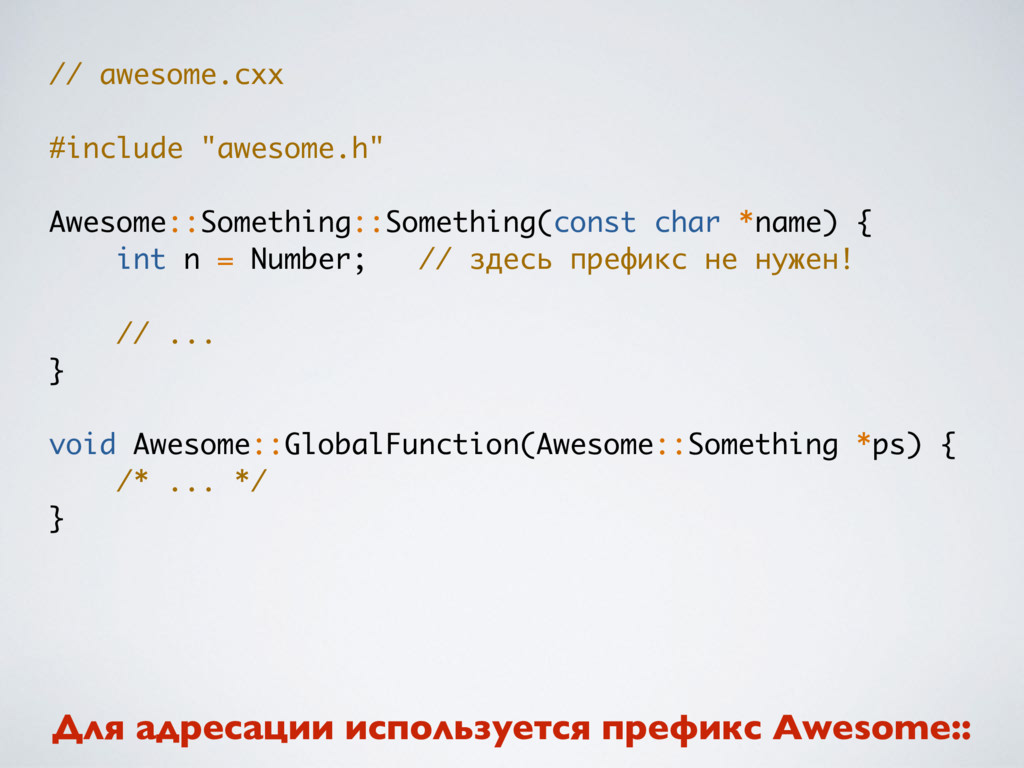
// awesome.cxx #include "awesome.h" Awesome::Something::Something(const char *name) { int n
= Number; // здесь префикс не нужен! // ... } void Awesome::GlobalFunction(Awesome::Something *ps) { /* ... */ } Для адресации используется префикс Awesome:: -
// client.cxx #include "awesome.h" void f(int q) { Awesome::Something x;
int n = Awesome::Number; if (q == Awesome::FOO) { ... } Awesome::GlobalFunction(&x); } // client.cxx #include "awesome.h" using namespace Awesome; void f(int q) { Something x; int n = Number; if (q == FOO) { ... } GlobalFunction(&x); } Клиентский код -
// something.c void public_interface_function() { // ... internal_function2(); } void
one_more_public_interface_function() { internal_function1(); // ... } static void internal_function1() { // ... } static void internal_function2() { // ... } Сокрытие деталей реализации, C-style -
// something.cxx namespace { void internal_function1() { // .... }
void internal_function2() { // .... } } void public_interface_function() { // .... internal_function2(); } void one_more_public_interface_function() { internal_function1(); // .... } C++ style. Безымянное пространство имён -
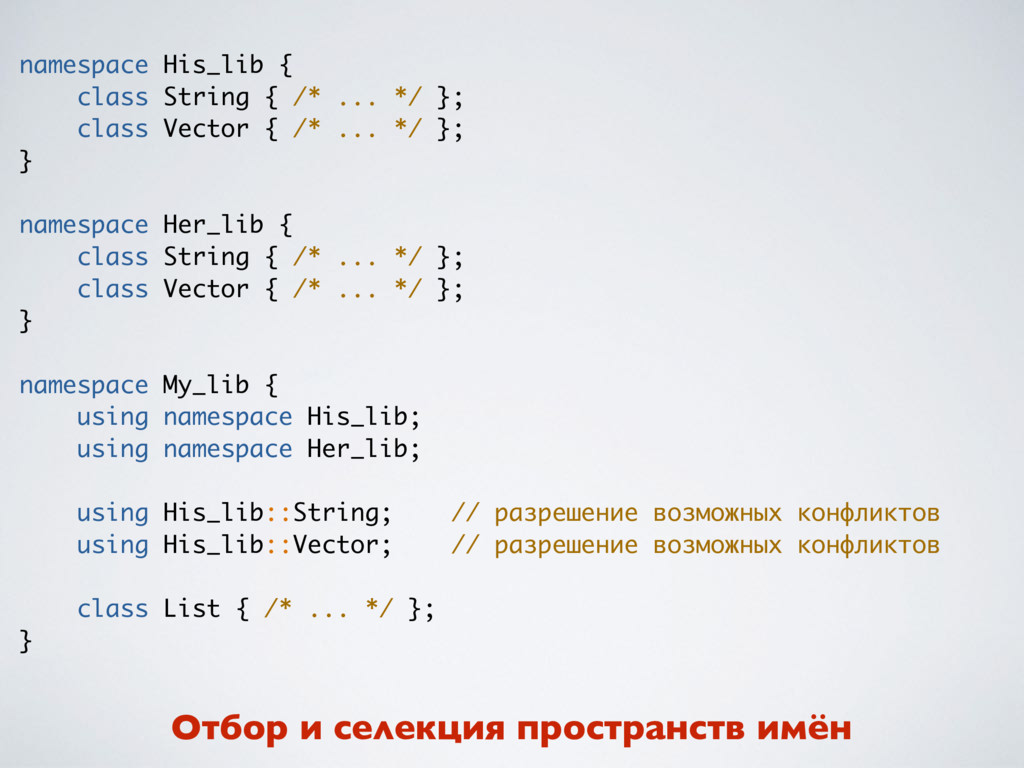
namespace His_lib { class String { /* ... */ };
class Vector { /* ... */ }; } namespace Her_lib { class String { /* ... */ }; class Vector { /* ... */ }; } namespace My_lib { using namespace His_lib; using namespace Her_lib; using His_lib::String; // разрешение возможных конфликтов using His_lib::Vector; // разрешение возможных конфликтов class List { /* ... */ }; } Отбор и селекция пространств имён -
МОТИВАЦИЯ • Вспомним АТД «Очередь». • Двойная абстракция: • …от
деталей реализации (способа хранения элементов в памяти). • …от типа хранимых данных. -
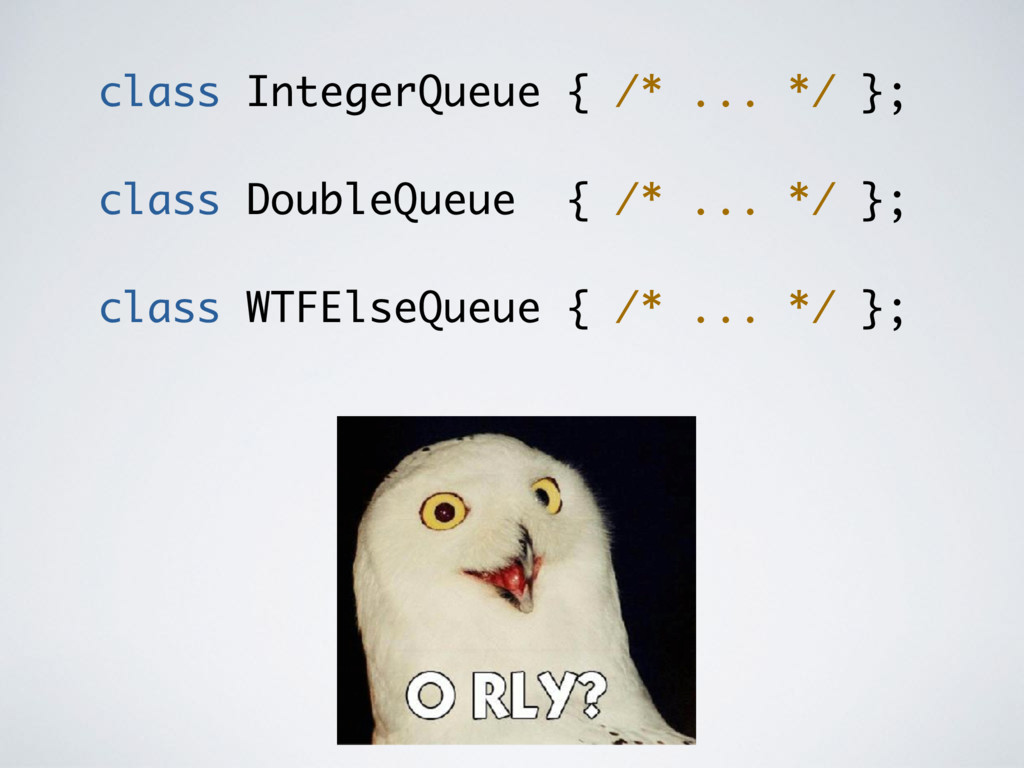
class IntegerQueue { /* ... */ }; class DoubleQueue {
/* ... */ }; class WTFElseQueue { /* ... */ }; -
Шаблон класса template <typename T> class Queue { public: Queue();
void enqueue(const T &el); bool empty() const; T dequeue(); const T &peek() const; private: T *buf, *head; size_t buf_size; }; class Person { /* ...... */ }; Queue<double> doubleQ; Queue<int> intQ; Queue<Person> personQ; -
ПЕРЕОПРЕДЕЛЕНИЕ ОПЕРАТОРОВ struct Vector2D { double x, y; // ....
}; // можно писать так: Vector2D x, y; Vector2D z = x.add(y); z = z.mul(x); z = z.sub(x.div(y)); // а хочется писать так: z = x + y; z *= x; z -= x / y; -
// Превращается в: z = operator+(x, y); z.operator*=(x); z.operator-=(operator/(x, y));
// Остаётся только определить // эти функции и методы… // Магия C++: z = x + y; z *= x; z -= x / y; -
class Vector2D { public: // ... Vector2D &operator*=(const Vector2D &other);
Vector2D &operator*=(double x); Vector2D &operator-=(const Vector2D &other); }; Vector2D operator+(const Vector2D &a, const Vector2D &b); Vector2D operator/(const Vector2D &a, const Vector2D &b);