| Safe Harbor Statement The following is intended to provide some insight into a line of research in Oracle Labs. It is intended for information purposes only, and may not be incorporated into any contract. It is not a commitment to deliver any material, code, or functionality, and should not be relied upon in making purchasing decisions. Oracle reserves the right to alter its development plans and practices at any time, and the development, release, and timing of any features or functionality described in connection with any Oracle product or service remains at the sole discretion of Oracle. Any views expressed in this presentation are my own and do not necessarily reflect the views of Oracle. 3
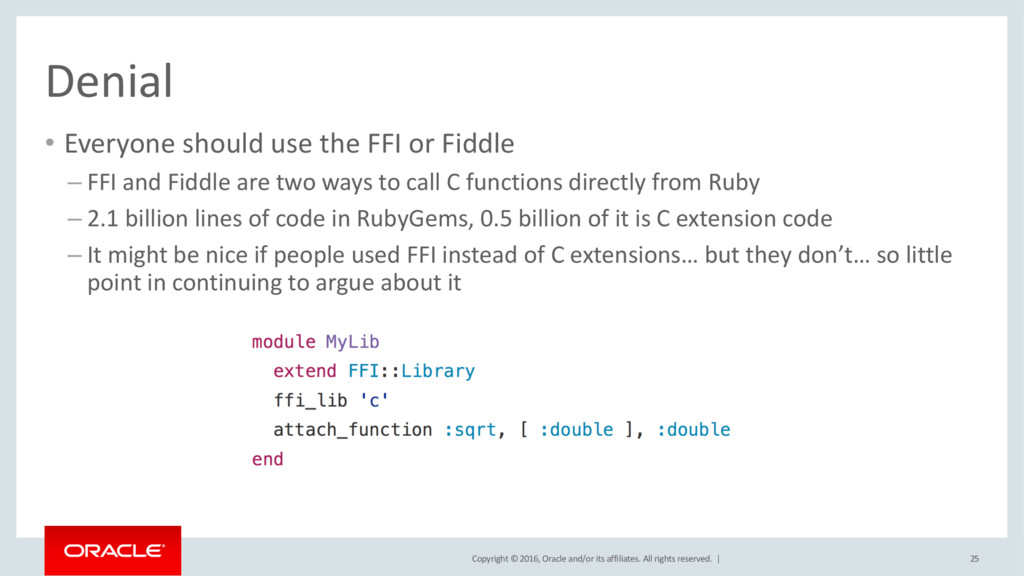
| Denial • Everyone should use the FFI or Fiddle – FFI and Fiddle are two ways to call C functions directly from Ruby – 2.1 billion lines of code in RubyGems, 0.5 billion of it is C extension code – It might be nice if people used FFI instead of C extensions… but they don’t… so little point in continuing to argue about it 25
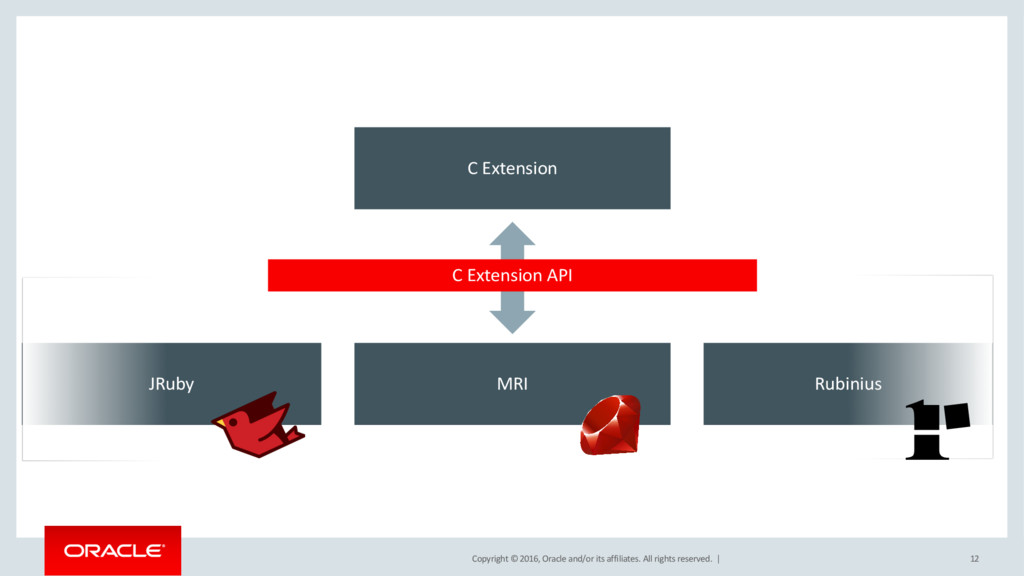
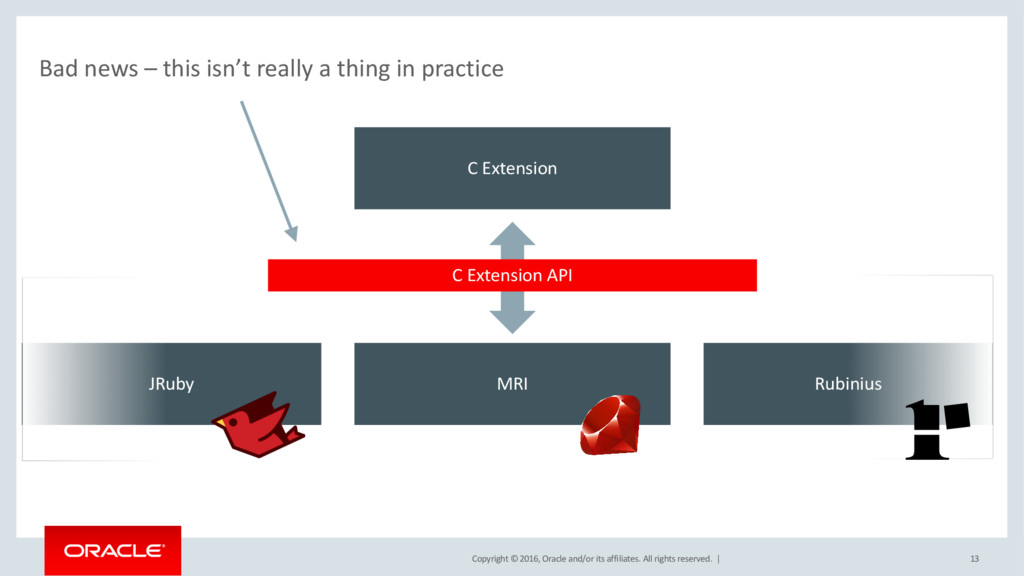
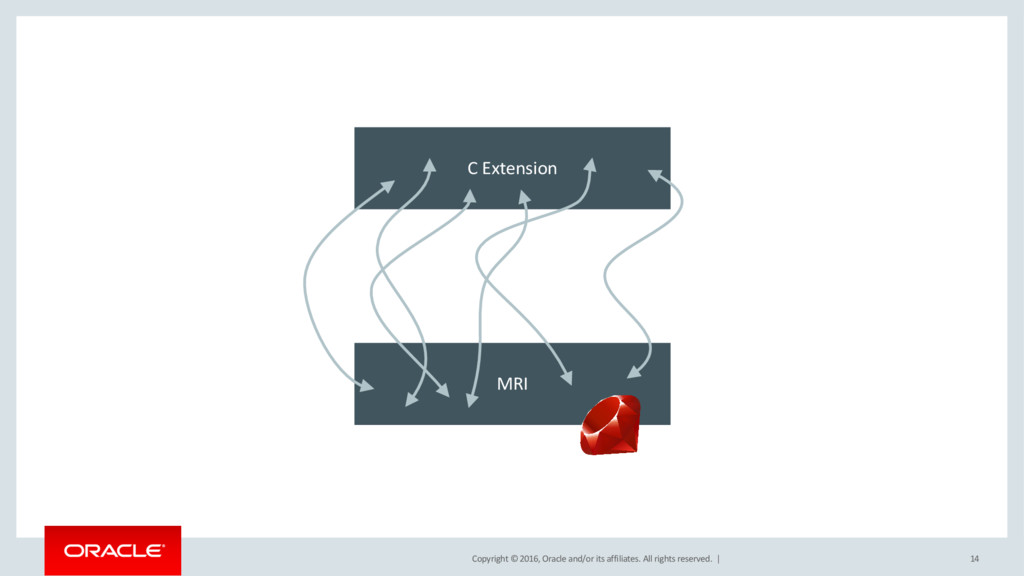
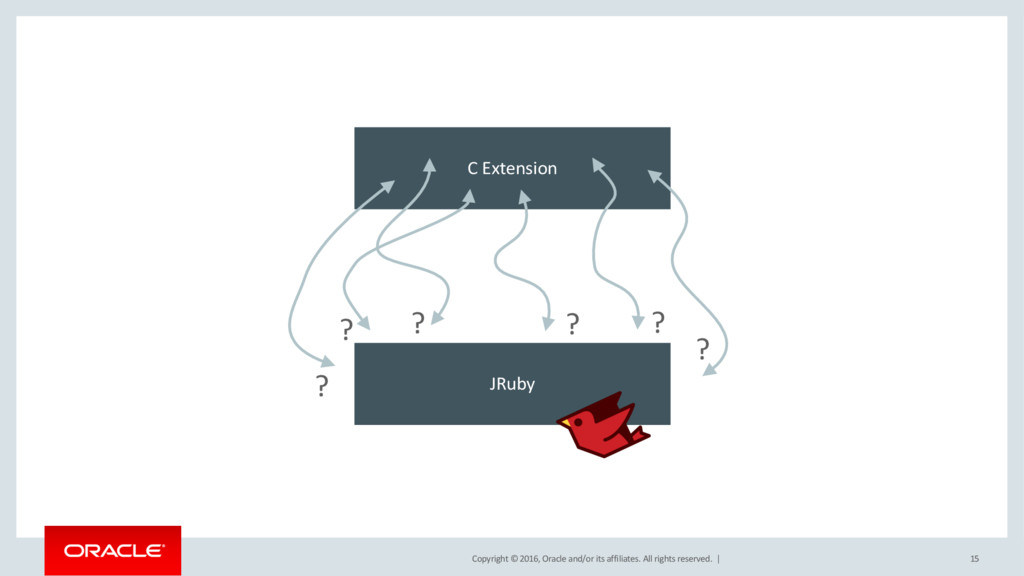
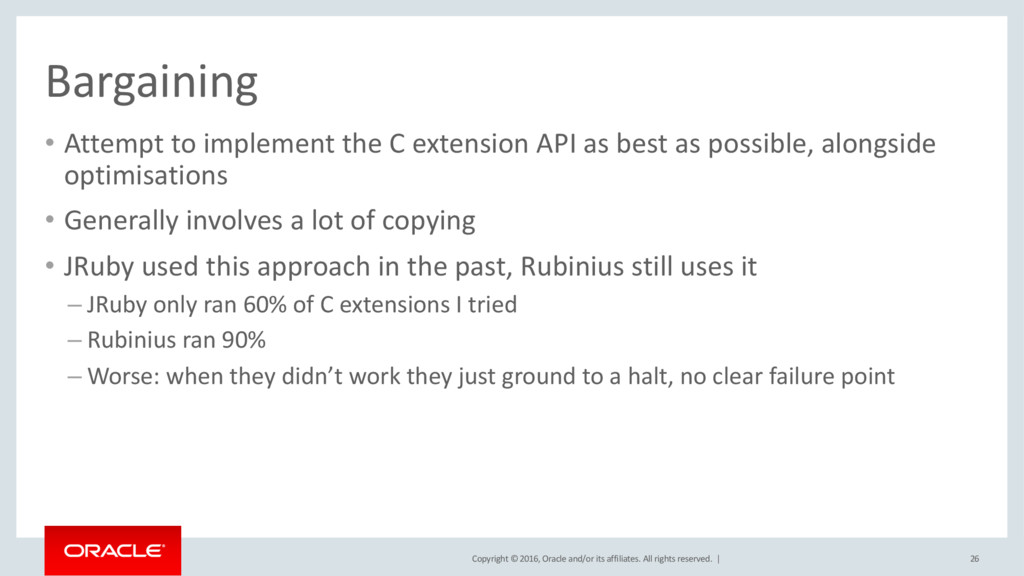
| Bargaining • Attempt to implement the C extension API as best as possible, alongside optimisations • Generally involves a lot of copying • JRuby used this approach in the past, Rubinius still uses it – JRuby only ran 60% of C extensions I tried – Rubinius ran 90% – Worse: when they didn’t work they just ground to a halt, no clear failure point 26
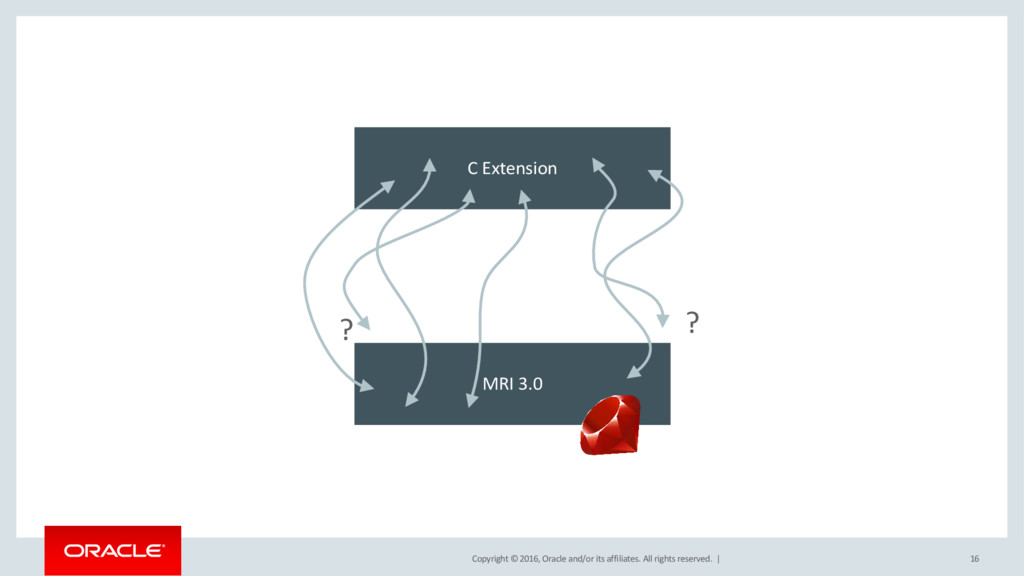
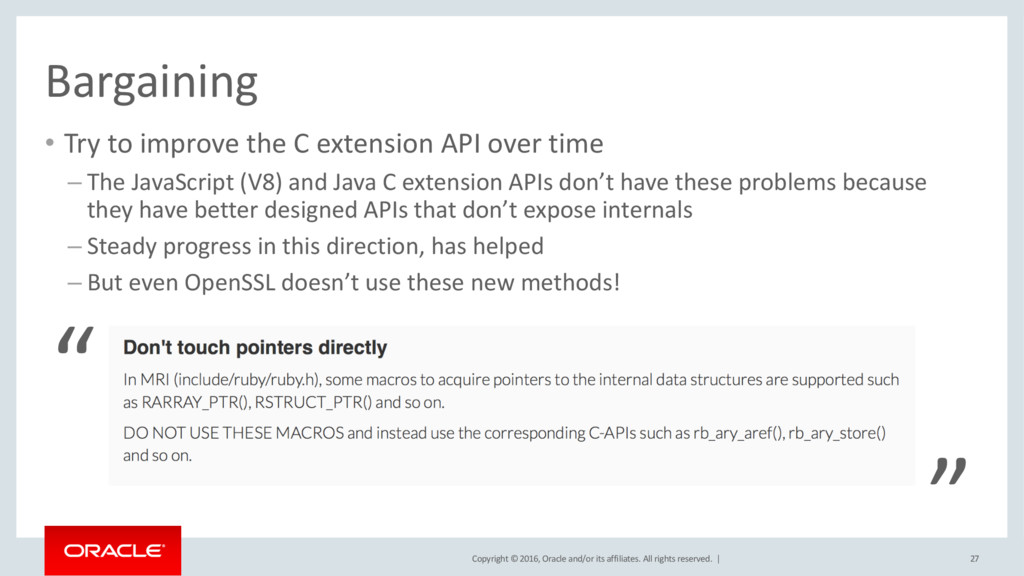
| Bargaining • Try to improve the C extension API over time – The JavaScript (V8) and Java C extension APIs don’t have these problems because they have better designed APIs that don’t expose internals – Steady progress in this direction, has helped – But even OpenSSL doesn’t use these new methods! 27 “ “
| Depression • JRuby unfortunately had to give up on their C extension work – They didn’t have the resources to maintain it after the original developer moved on – Limited compatibility and limited performance – In the end, in was removed entirely – Maybe it’ll return in the future (they could use the same approach as us) 28
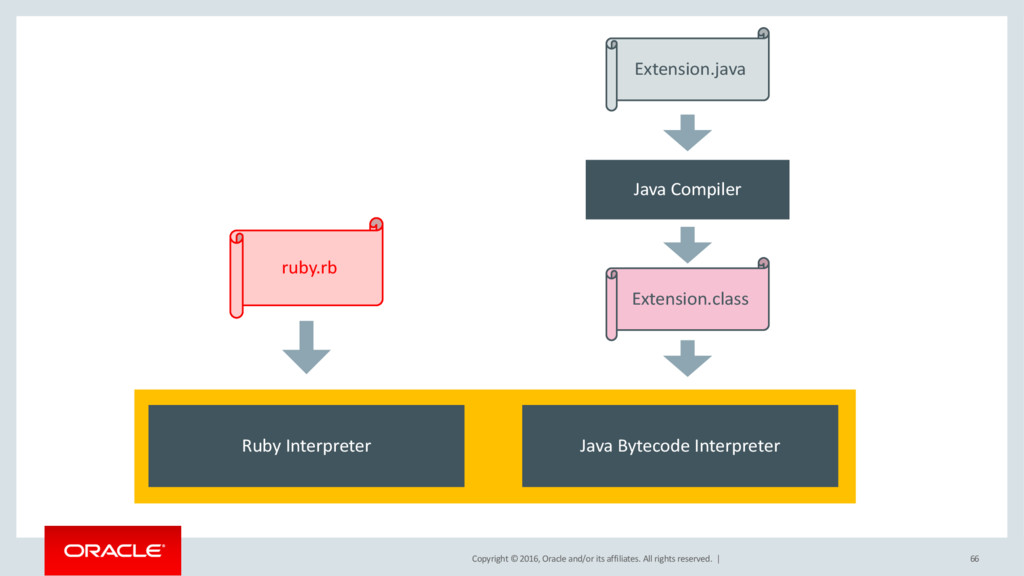
| Acceptance • JRuby encourage Java extensions instead of C extensions • Try to optimise Ruby while keeping most of the internals the same – IBM’s OMR adds a new GC and JIT to Ruby while keeping support for C extensions – The techniques they can use are therefore limited – And so performance increases expected from OMR are more modest 29
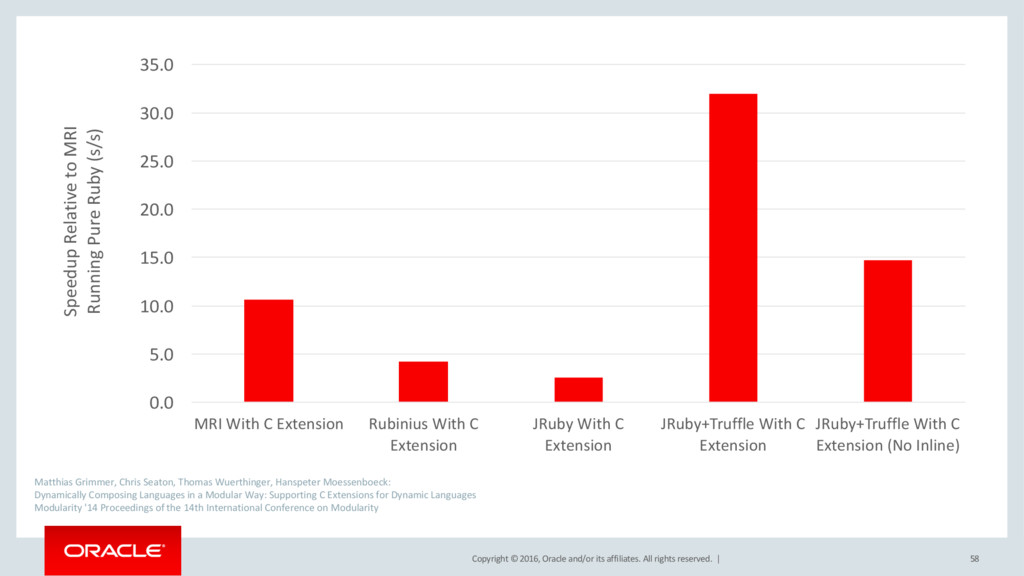
| Matthias Grimmer, Chris Seaton, Thomas Wuerthinger, Hanspeter Moessenboeck: Dynamically Composing Languages in a Modular Way: Supporting C Extensions for Dynamic Languages Modularity '14 Proceedings of the 14th International Conference on Modularity 58 0.0 5.0 10.0 15.0 20.0 25.0 30.0 35.0 MRI With C Extension Rubinius With C Extension JRuby With C Extension JRuby+Truffle With C Extension JRuby+Truffle With C Extension (No Inline) Speedup Relative to MRI Running Pure Ruby (s/s)
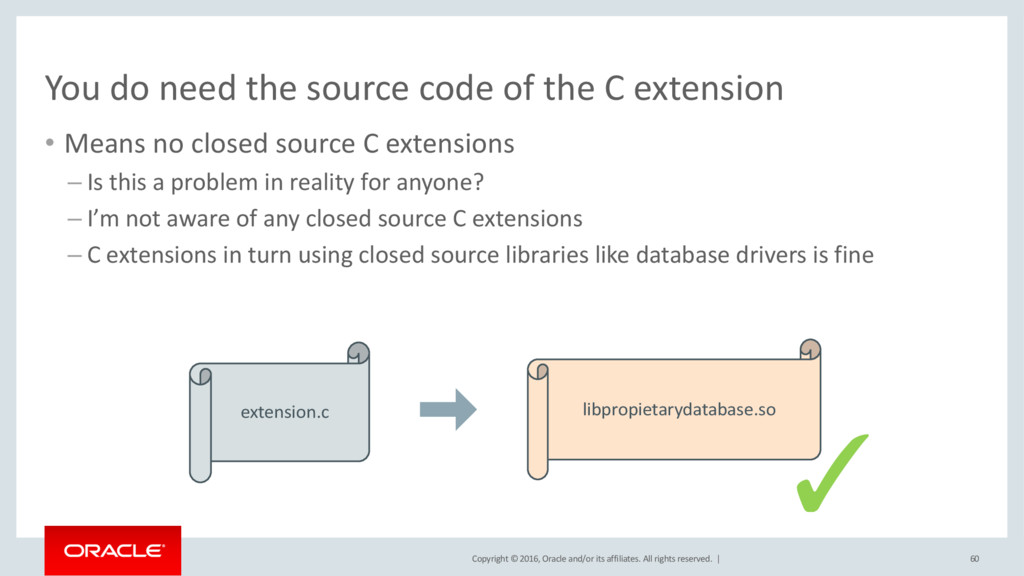
| You do need the source code of the C extension • Means no closed source C extensions – Is this a problem in reality for anyone? – I’m not aware of any closed source C extensions – C extensions in turn using closed source libraries like database drivers is fine extension.c libpropietarydatabase.so ✓ 60
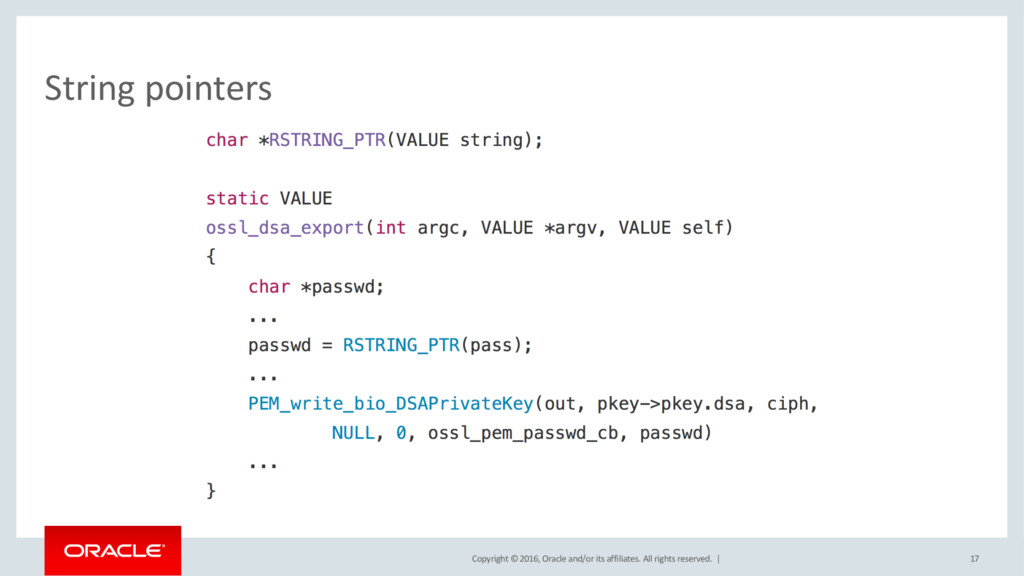
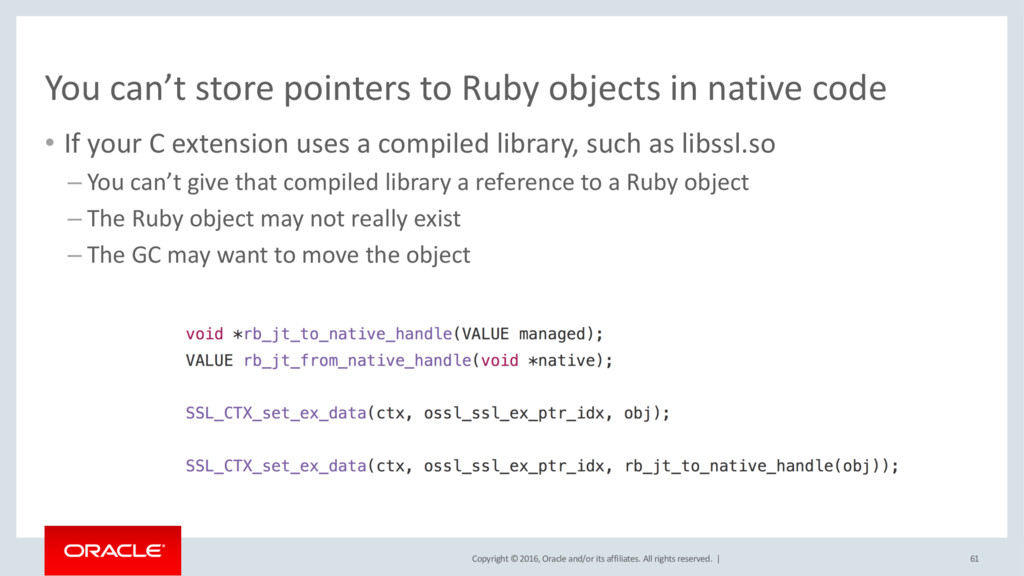
| You can’t store pointers to Ruby objects in native code • If your C extension uses a compiled library, such as libssl.so – You can’t give that compiled library a reference to a Ruby object – The Ruby object may not really exist – The GC may want to move the object 61
| By the way… • It is probably still best to use the FFI if you are writing new extensions – Wide support across Ruby implementations – Although we don’t actually implement the FFI in JRuby+Truffle yet – Implementing the FFI in JRuby+Truffle would be a great internship project! • If you do write a C extension for performance – Write a pure Ruby baseline version as well • Or if you just needed better performance: – Write pure Ruby code – Run with JRuby+Truffle 62
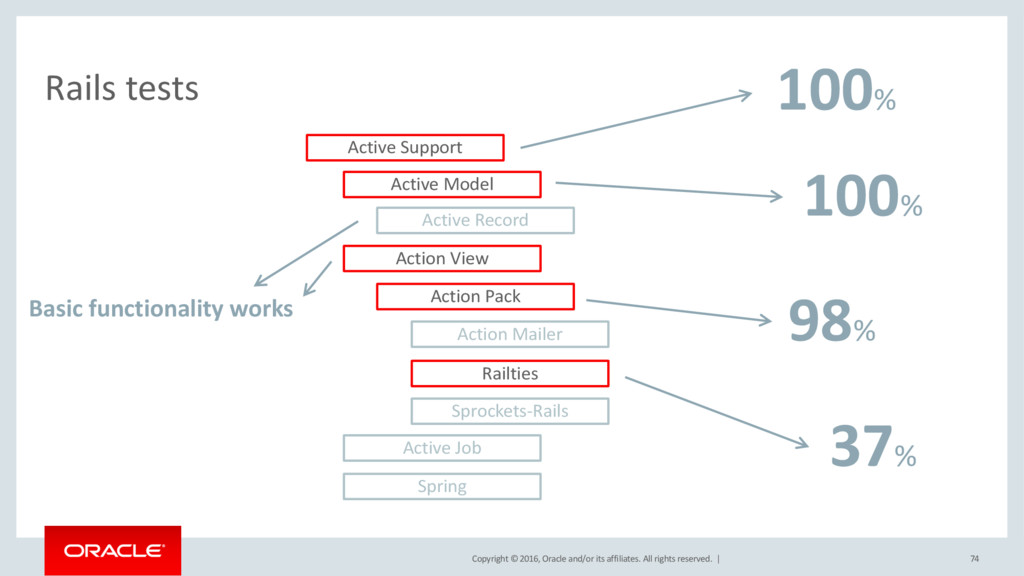
| Rails tests Active Model Active Support Active Record Action View Action Pack Action Mailer Railties Sprockets-Rails Active Job Spring 100% 100% 98% Basic functionality works 37% 74
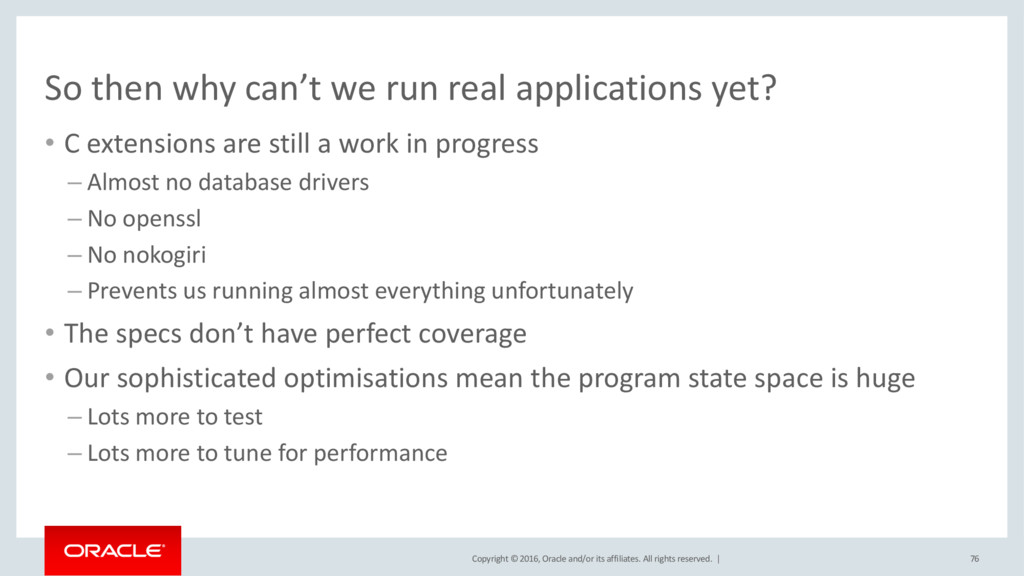
| So then why can’t we run real applications yet? • C extensions are still a work in progress – Almost no database drivers – No openssl – No nokogiri – Prevents us running almost everything unfortunately • The specs don’t have perfect coverage • Our sophisticated optimisations mean the program state space is huge – Lots more to test – Lots more to tune for performance 76
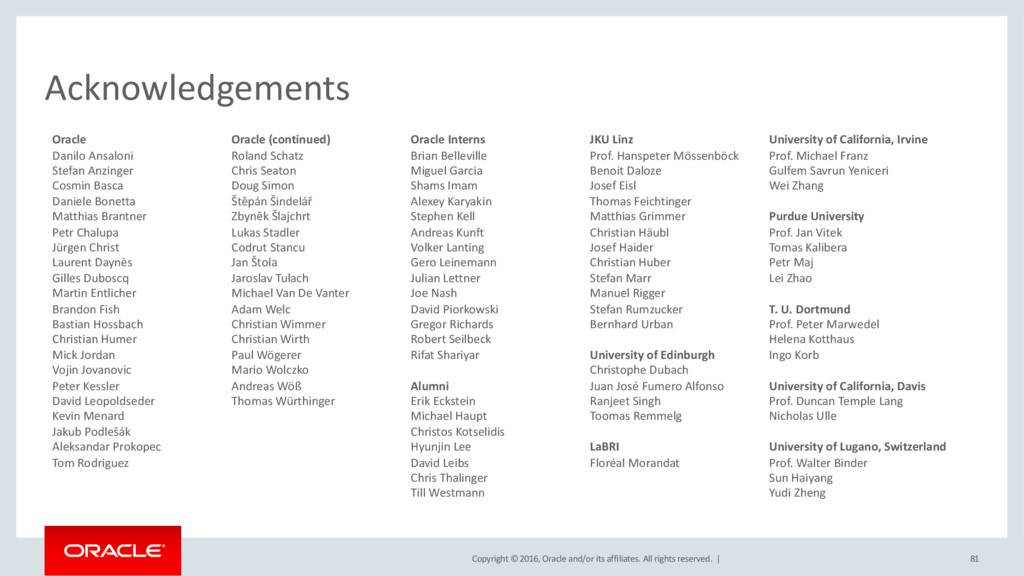
| Acknowledgements Oracle Danilo Ansaloni Stefan Anzinger Cosmin Basca Daniele Bonetta Matthias Brantner Petr Chalupa Jürgen Christ Laurent Daynès Gilles Duboscq Martin Entlicher Brandon Fish Bastian Hossbach Christian Humer Mick Jordan Vojin Jovanovic Peter Kessler David Leopoldseder Kevin Menard Jakub Podlešák Aleksandar Prokopec Tom Rodriguez Oracle (continued) Roland Schatz Chris Seaton Doug Simon Štěpán Šindelář Zbyněk Šlajchrt Lukas Stadler Codrut Stancu Jan Štola Jaroslav Tulach Michael Van De Vanter Adam Welc Christian Wimmer Christian Wirth Paul Wögerer Mario Wolczko Andreas Wöß Thomas Würthinger JKU Linz Prof. Hanspeter Mössenböck Benoit Daloze Josef Eisl Thomas Feichtinger Matthias Grimmer Christian Häubl Josef Haider Christian Huber Stefan Marr Manuel Rigger Stefan Rumzucker Bernhard Urban University of Edinburgh Christophe Dubach Juan José Fumero Alfonso Ranjeet Singh Toomas Remmelg LaBRI Floréal Morandat University of California, Irvine Prof. Michael Franz Gulfem Savrun Yeniceri Wei Zhang Purdue University Prof. Jan Vitek Tomas Kalibera Petr Maj Lei Zhao T. U. Dortmund Prof. Peter Marwedel Helena Kotthaus Ingo Korb University of California, Davis Prof. Duncan Temple Lang Nicholas Ulle University of Lugano, Switzerland Prof. Walter Binder Sun Haiyang Yudi Zheng Oracle Interns Brian Belleville Miguel Garcia Shams Imam Alexey Karyakin Stephen Kell Andreas Kunft Volker Lanting Gero Leinemann Julian Lettner Joe Nash David Piorkowski Gregor Richards Robert Seilbeck Rifat Shariyar Alumni Erik Eckstein Michael Haupt Christos Kotselidis Hyunjin Lee David Leibs Chris Thalinger Till Westmann 81
| Safe Harbor Statement The preceding is intended to provide some insight into a line of research in Oracle Labs. It is intended for information purposes only, and may not be incorporated into any contract. It is not a commitment to deliver any material, code, or functionality, and should not be relied upon in making purchasing decisions. Oracle reserves the right to alter its development plans and practices at any time, and the development, release, and timing of any features or functionality described in connection with any Oracle product or service remains at the sole discretion of Oracle. Any views expressed in this presentation are my own and do not necessarily reflect the views of Oracle. 82


 chrisseaton
 analokmaus
 hotchpotch
 sishi2026
 microbaseinc
 institudelelevage
 wataruuuuu
 ayatokanada
.png) satai
satai
 afroscript
 yukako_nakano
 letsgokoyo
 aki_iinuma
 sferik
 akademiya2063
 portentint
 danielanewman
 mongodb
 destraynor
 jonoalderson
 techseoconnect
 reverentgeek
 greggifford