Upgrade to Pro — share decks privately, control downloads, hide ads and more …

Agentic AI vs Generative AI — Key Differences, ...

Agentic AI vs Generative AI — Key Differences, Use Cases & Future Trends

Discover the key differences between Generative AI and Agentic AI, and understand how each is transforming modern enterprises. This presentation explores their core technologies, real-world applications, and future trends—from content creation and intelligent automation to autonomous decision-making and workflow optimization. Learn how businesses can leverage both approaches to drive innovation, enhance productivity, and accelerate digital transformation.

🔗 Read more: https://shorturl.at/1zJp0

Avatar for Codeflix Global

Codeflix Global

March 04, 2026

Other Decks in Business

Transcript

  1. Introduction to Agentic AI vs Generative AI: • For the

    past decade, the term “AI” (Artificial Intelligence) has emerged as a popular topic; more recently, terms such as “generative AI” and “agentic AI” have gained traction. • Traditional AI primarily focuses on analyzing data and identifying patterns, whereas generative AI goes a step further by producing new, original content such as text, images, videos, audio, and even software code. • Agentic AI takes innovation further by enhancing autonomy within a robust digital ecosystem. By integrating large language models (LLMs), machine learning, and natural language processing (NLP), it can independently plan, decide, and execute tasks on behalf of users or connected systems.
  2. • A gen AI model, which has gained more attention,

    is ChatGPT; this product provides similar creative abilities to Agent AI, but not the same ones. • Agentic AI emphasizes autonomous decision-making rather than simply generating content, functioning with minimal reliance on human prompts or ongoing manual supervision. • Early-stage examples of Agentic AI include autonomous vehicles, virtual assistants, and task-oriented copilots. • Generative AI and Agentic AI tools are delivering significant productivity gains for both individuals and organizations, streamlining tasks, accelerating workflows, and enhancing overall efficiency. • It is crucial to clearly differentiate between these two approaches and recognize how each drives innovation while empowering smarter, data-driven decision- making.
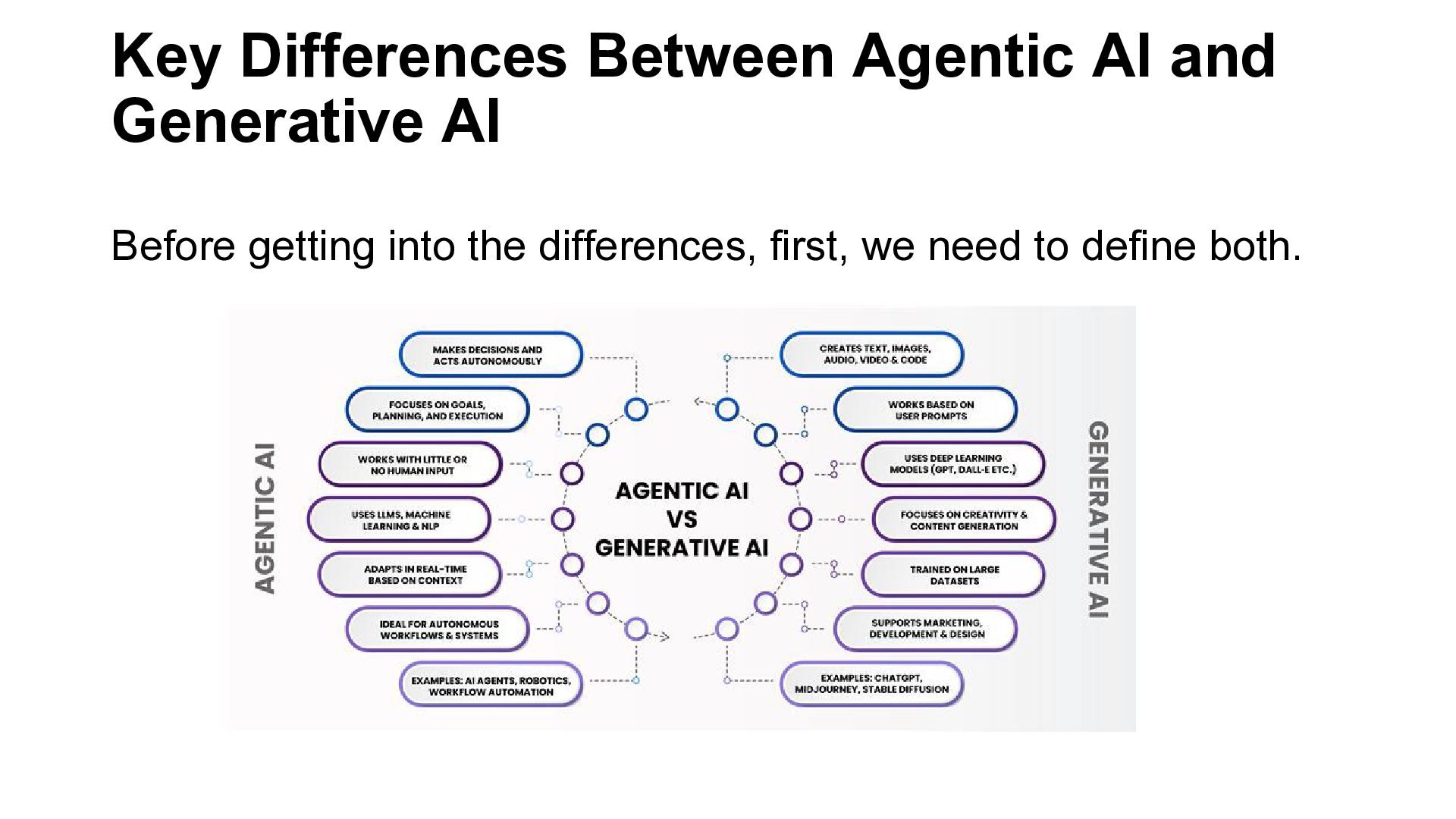
  3. Key Differences Between Agentic AI and Generative AI Before getting

    into the differences, first, we need to define both.
  4. Generative AI • Generative AI is artificial intelligence that responds

    to user prompts or requests and creates original content, such as images, text, video, audio, or software code. • Generative AI is powered by deep learning models—advanced algorithms that mimic human learning and decision-making—supported by complementary technologies such as Robotic Process Automation (RPA). • These models operate by detecting and encoding patterns and relationships within vast datasets, enabling them to understand users’ natural language inputs. Leveraging this learned knowledge, they generate high-quality text, images, and other content types—transforming training data into meaningful, real-world outputs.
  5. Agentic AI • Agentic AI is designed in a way

    that it makes decisions and acts with the ability to pursue complex goals without human intervention or with limited supervision. • It blends the adaptability of large language models with the precision of traditional programming. To accomplish its objectives, this type of AI operates autonomously, leveraging technologies such as natural language processing (NLP), machine learning, reinforcement learning, and knowledge representation. • This represents a proactive, AI-driven approach, whereas generative AI primarily responds reactively to user prompts. Agentic AI adapts to changing contexts and makes autonomous decisions, making it ideal for domains that require independent operation, such as robotics, advanced analytics, and intelligent virtual assistants. • Both Agentic AI and generative AI have objectives and distinct attributes that make them stand out from one another.
  6. Key Features of Generative AI Content Creation: • This is

    one of the areas where generative AI excels, as these models can produce coherent, context-rich content—ranging from detailed essays to structured solutions for complex challenges. • With user inputs, AI applications like OpenAI’s ChatGPT can generate responses, create lists, and provide guidance whenever needed. • Generative AI tools support developers at every skill level by assisting with code creation and streamlining multiple phases of the software development lifecycle.
  7. Data Analysis: • Generative AI can analyze a large amount

    of data and utilize that analysis to find patterns and trends. • Generative AI models can optimize complex workflows— particularly in supply chain management—while simultaneously enhancing the overall customer experience.
  8. Adaptability: • Generative AI can enhance its responses based on

    user input, dynamically adjusting its outputs when specific feedback is given. • The results adapt to more closely match the user’s intent, continually refining and enhancing the overall output. Personalization: • Generative AI technology can deliver personalized recommendations and experiences based on users’ inputs. • For example, in the retail sector, generative AI facilitates highly personalized customer experiences by delivering in-depth insights into individual preferences and behaviors.
  9. Key features of Agentic AI Decision-Making: These AI systems operate

    with predefined objectives and strategic plans, enabling them to assess situations and determine the appropriate course of action with little to no human intervention. Problem Solving: • Agentic AI follows a four-step approach to problem-solving: perceive, reason, learn, and act. This process begins with AI agents gathering and processing data. • Large language models (LLMs) function as orchestrators, analyzing input data to interpret the current context. They integrate with external tools and systems, continuously evolving by learning from feedback and refining their performance over time.
  10. Autonomy: • Agentic AI is defined by its autonomous capabilities.

    Its capacity to learn and operate independently—without continuous human oversight—positions it as a powerful solution for organizations aiming to streamline workflows and delegate complex tasks with minimal manual intervention. Interactivity: • Because of its proactive nature, Agent AI can communicate with the outside environment and collect data to adjust in real time. • This can be illustrated with self-driving vehicles, which continuously analyze their surroundings and make precise, informed driving decisions. Planning: • Agentic AI models are capable of handling complex situations and carrying out multi-step strategies to accomplish clearly defined goals.
  11. Agentic AI vs AI Agents: Understanding the Difference • It

    is necessary to differentiate between agentic AI and AI agents. Essentially, agentic AI is the framework; AI agents are the building blocks within the framework. • Agentic AI refers to a comprehensive framework designed to address problems with minimal human input, whereas an AI agent is a specific component within that framework, tasked with carrying out actions and overseeing processes with a degree of autonomy. • This model is transforming human–AI interaction, as agentic AI can precisely understand a user’s goals and intent, then utilize available data to deliver efficient, outcome-focused solutions.
  12. • To describe this as an example, assume a smart

    home where agentic AI manages and runs the overall energy consumption system. • This is accomplished by using real-time data and user preferences to intelligently coordinate individual AI agents—such as smart thermostats, lighting systems, and other connected devices—ensuring seamless and efficient operation. • These agents work together within the agentic AI framework to achieve the homeowner’s energy goals. and have individual goals and assignments. • There are numerous use cases for Generative AI; however, many applications of Agentic AI are still in the early stages of development. • Emerging applications of agentic AI extend across a wide range of industries— including customer service, healthcare, security, financial risk management, and workflow optimization—demonstrating its expanding influence across diverse sectors.
  13. Use Cases of Generative AI SEO Content Creation • Today,

    businesses use Gen AI to produce a large volume of SEO optimized content, such as blogs and landing pages, that help drive organic traffic. • For instance, a digital marketing agency can use generative AI to produce high- quality, keyword-optimized blog posts or web pages for clients—enhancing brand visibility and boosting search engine rankings. Marketing and sales • Sales teams are frequently burdened with administrative responsibilities, even though their core priority should be identifying, nurturing, and converting potential leads. • For a long time sales team has been a generative AI use case now through chatbots and virtual assistants. • AI technology can manage targeted, high-value tasks and enhance sales team productivity—especially in areas like lead generation and personalized customer engagement.
  14. Product design and development • The gen AI capabilities present

    can support organizations in creating new product concepts or designs based on market research, trends, and user preferences. • This can significantly accelerate the product development cycle. For example, a fashion brand can leverage generative AI to design a new clothing line by generating creative concepts informed by consumer feedback and insights drawn from market data analysis. Customer support automation • With Generative AI, companies can automatically generate responses to customer service queries. • The tools can craft answers for general questions and troubleshoot issues in real time. • For instance, an e-commerce business can use generative AI–powered chatbots to handle tasks such as tracking order status, processing refund requests, and addressing shipping-related inquiries.
  15. Use Cases of Agentic AI Customer service • Traditional customer

    chatbot models were limited by their pre-programmed nature and often required human intervention to handle complex or unexpected queries. • In contrast, autonomous agents can precisely understand customers’ intent and emotions, enabling them to take appropriate actions and resolve issues efficiently. • These autonomous systems can therefore predictively access a situation and help ensure a smoother customer interaction with a business. • In today’s intensely competitive landscape, customer experience is crucial for fostering retention and long-term loyalty. Agentic AI, in particular, can automate routine operations by collecting, cleaning, and organizing organizational data—enhancing efficiency and supporting more informed decision-making. • These systems can take responsibility for human employees and free them up to do more high-impact projects and tasks.
  16. Healthcare • The healthcare field uses AI technology in diagnostics,

    patient care, and streamlining administrative tasks. • Cybersecurity is a fundamental requirement for any AI solution deployed in the healthcare sector, given the sensitive nature of patient data and associated privacy concerns. These same rigorous standards and safeguards must also be extended to emerging agentic AI technologies. • A suitable use case example for this comes from Propeller Health, which is integrating agentic AI into its smart inhaler technology. • It gathers real-time data on patients’ medication adherence and environmental conditions such as air quality, automatically notifies healthcare professionals when intervention is needed, and continuously monitors patients’ overall health status.
  17. Automated workflow management • Agentic AI can independently oversee business

    operations and execute complex tasks, including replenishing inventory and optimizing supply chain workflows. • It can regulate internal workflows, making it easier for human employees without any need for physical intervention. • For instance, a logistics company can deploy an agentic AI system to automatically optimize delivery routes and schedules, dynamically adjusting in real time to evolving traffic conditions and changing shipment priorities. • Agentic AI presents a compelling opportunity for the logistics sector, enabling greater scalability and significantly expanding operational capacity.
  18. Financial risk management • Agentic AI empowers industries to achieve

    client goals and optimize outcomes in real time by analyzing market trends and financial data—supporting informed decisions related to investments and credit risk management. • Financial institutions aim to safeguard their clients’ investments and therefore focus on making intelligent, strategic decisions that drive higher returns. • Agentic AI can enhance these strategies by operating autonomously and continuously adapting its approach in response to real-time economic, social, and political changes. • For instance, a fintech company can leverage agentic AI to monitor market uncertainty and automatically adjust portfolio allocations.
  19. Agentic AI vs Generative AI: Current & Future Trends Generative

    AI trends Gen AI-Augmented Applications: • There is a growing shift toward Generative AI–augmented applications being integrated across various software and platforms, enhancing personalization and delivering more intelligent user experiences. Synthetic data for model training: • AI-generated synthetic data can be valuable for training models in scenarios where real- world data is limited, unavailable, or costly to obtain. Its application can be expanded across various industries, including robotics, autonomous driving, and finance. Deepfake technology: • This is one of the most notable applications of generative AI, allowing for the production of hyper-realistic images and videos that closely mimic genuine content. However, this powerful capability also brings serious ethical challenges, especially concerning misinformation and potential misuse.
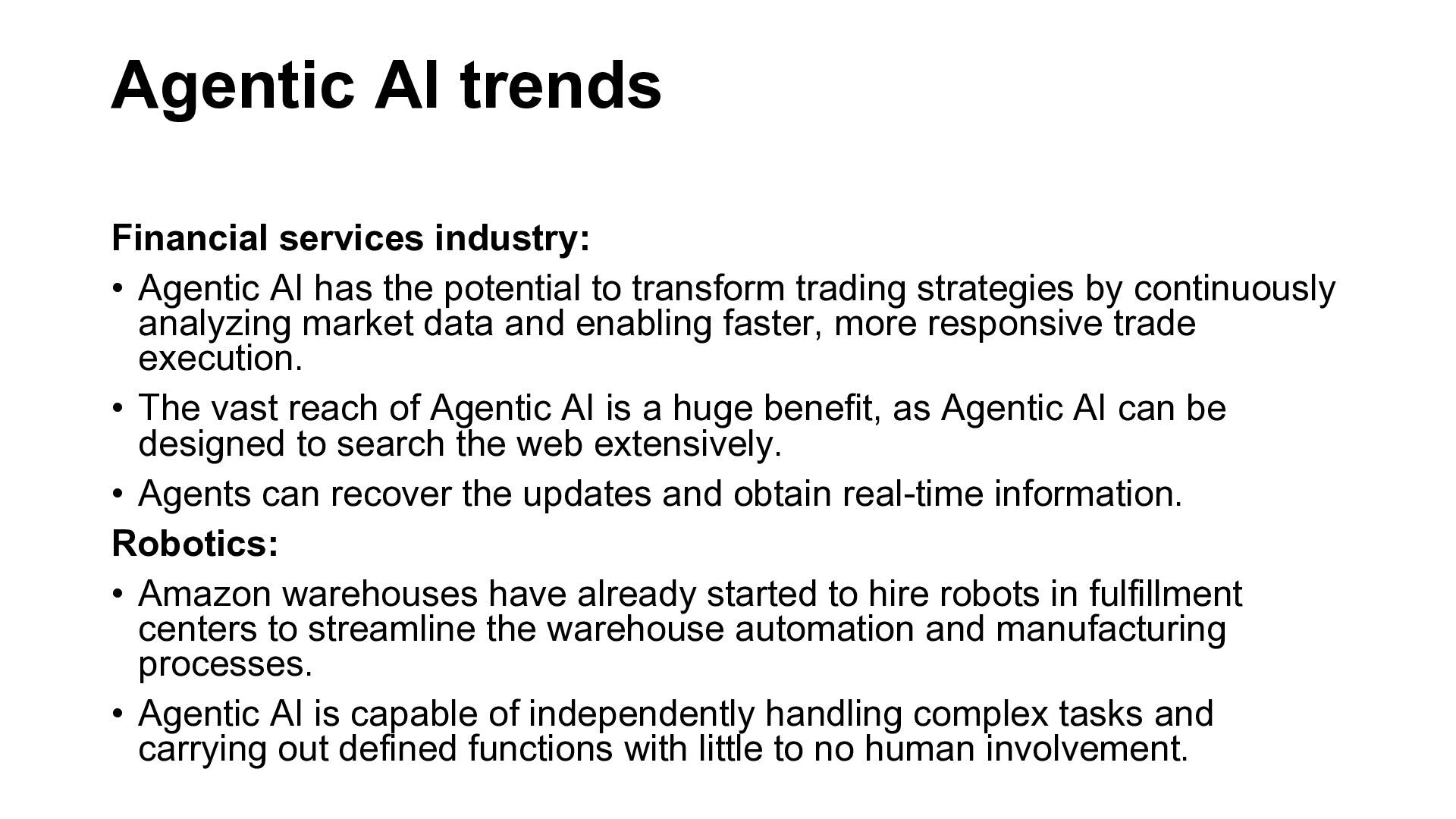
  20. Agentic AI trends Financial services industry: • Agentic AI has

    the potential to transform trading strategies by continuously analyzing market data and enabling faster, more responsive trade execution. • The vast reach of Agentic AI is a huge benefit, as Agentic AI can be designed to search the web extensively. • Agents can recover the updates and obtain real-time information. Robotics: • Amazon warehouses have already started to hire robots in fulfillment centers to streamline the warehouse automation and manufacturing processes. • Agentic AI is capable of independently handling complex tasks and carrying out defined functions with little to no human involvement.
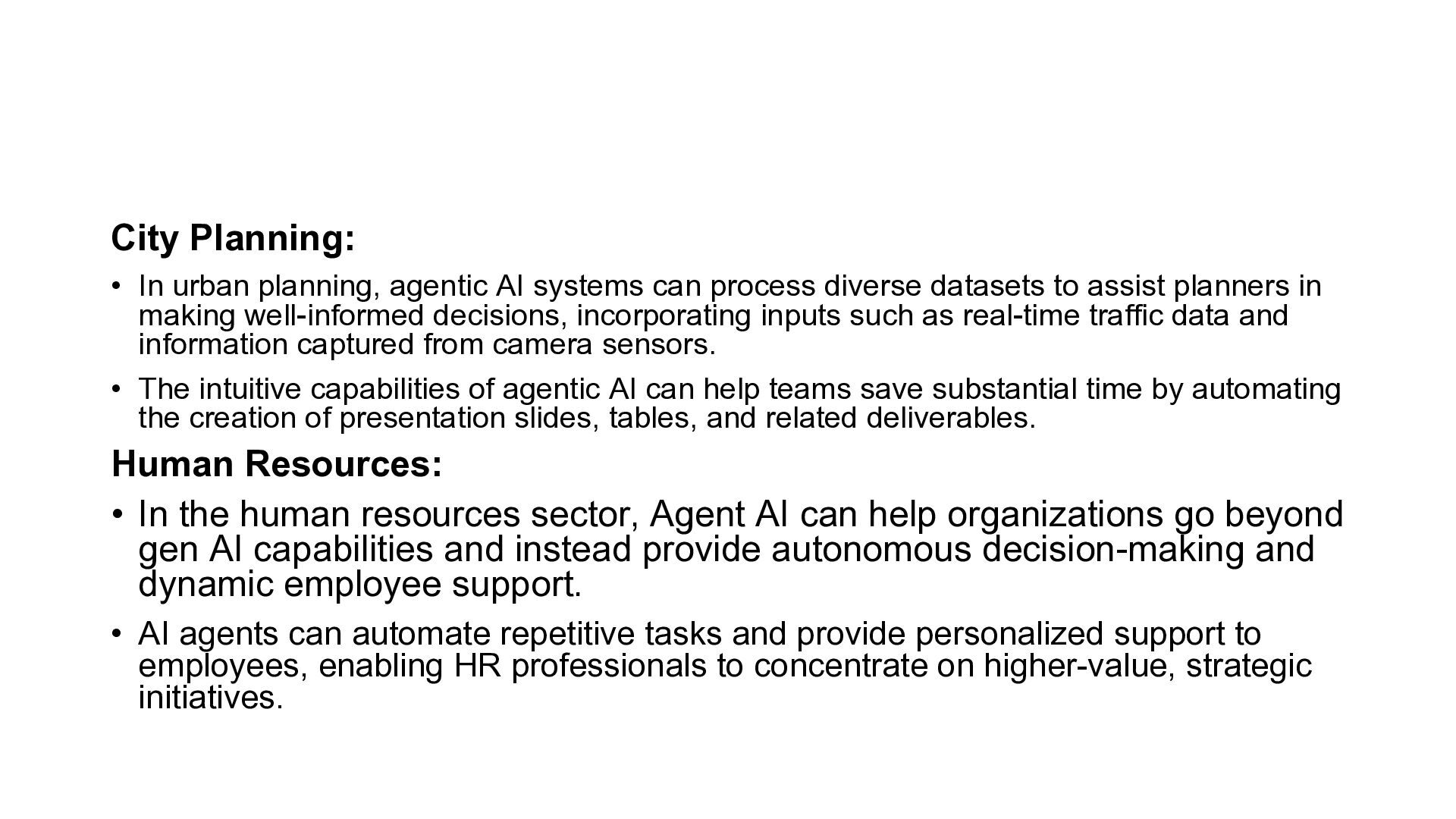
  21. City Planning: • In urban planning, agentic AI systems can

    process diverse datasets to assist planners in making well-informed decisions, incorporating inputs such as real-time traffic data and information captured from camera sensors. • The intuitive capabilities of agentic AI can help teams save substantial time by automating the creation of presentation slides, tables, and related deliverables. Human Resources: • In the human resources sector, Agent AI can help organizations go beyond gen AI capabilities and instead provide autonomous decision-making and dynamic employee support. • AI agents can automate repetitive tasks and provide personalized support to employees, enabling HR professionals to concentrate on higher-value, strategic initiatives.
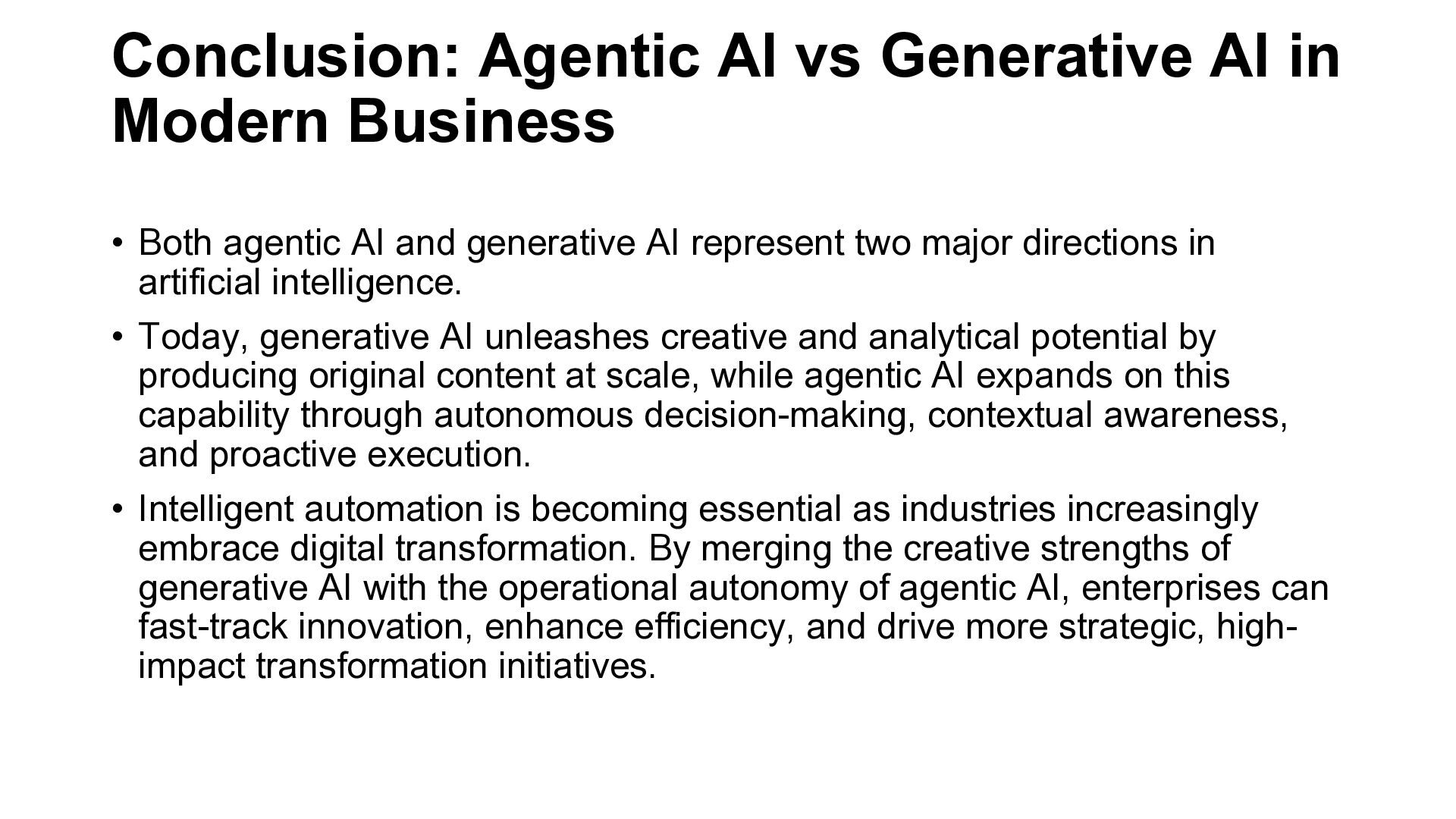
  22. Conclusion: Agentic AI vs Generative AI in Modern Business •

    Both agentic AI and generative AI represent two major directions in artificial intelligence. • Today, generative AI unleashes creative and analytical potential by producing original content at scale, while agentic AI expands on this capability through autonomous decision-making, contextual awareness, and proactive execution. • Intelligent automation is becoming essential as industries increasingly embrace digital transformation. By merging the creative strengths of generative AI with the operational autonomy of agentic AI, enterprises can fast-track innovation, enhance efficiency, and drive more strategic, high- impact transformation initiatives.