Upgrade to Pro — share decks privately, control downloads, hide ads and more …

Best Trading Course

Best Trading Course

Learn the fundamentals of stock market trading with a practical and structured approach. This trading course covers essential concepts such as technical analysis, chart patterns, price action, risk management, trading psychology, and effective trading strategies. Whether you are a beginner or looking to improve your existing skills, the course helps you understand how financial markets work and how to make more informed trading decisions.

Avatar for DelhiTrading

DelhiTrading

August 24, 2026

Other Decks in Business

Transcript

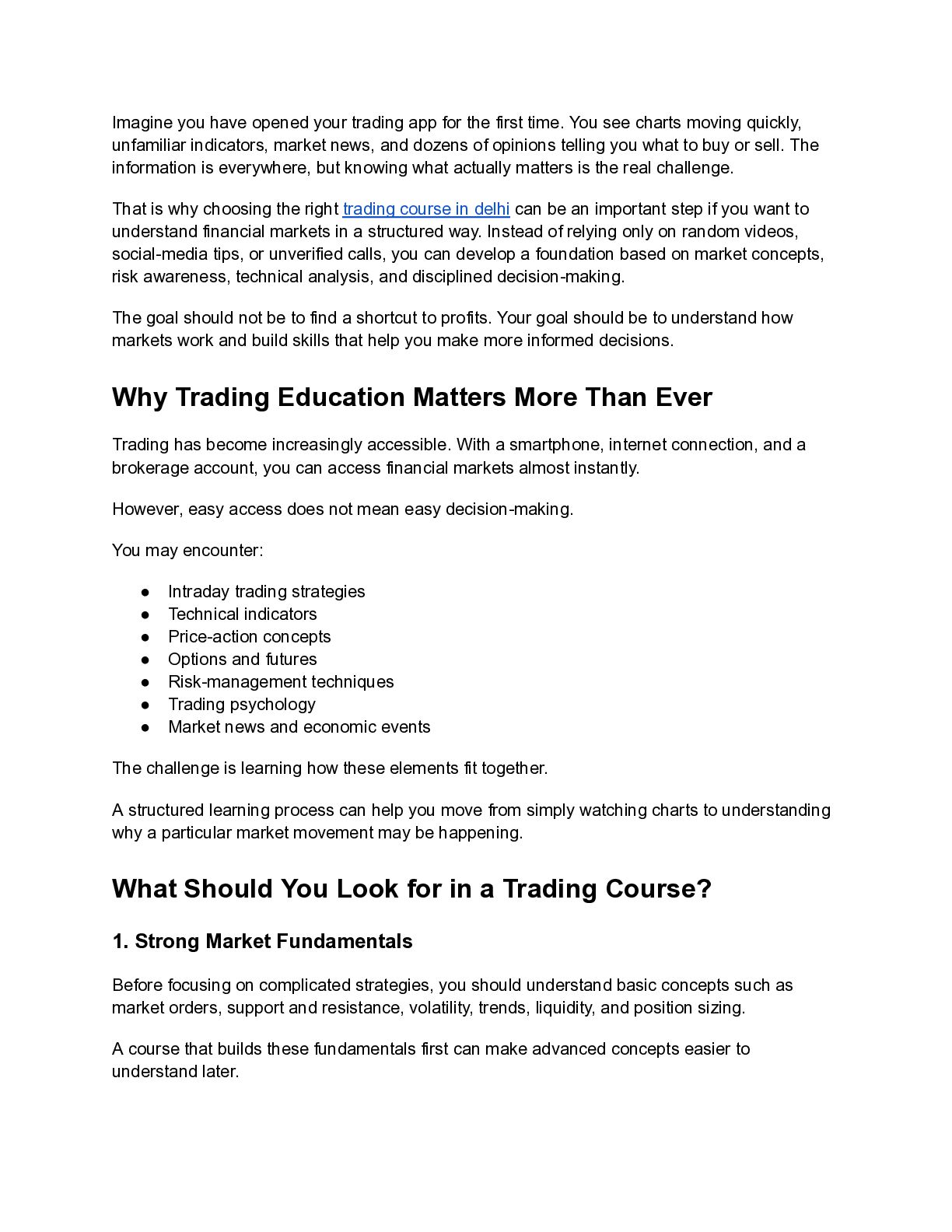
  1. How to Choose the Right Trading Course in Delhi: A

    Practical Guide for Smarter Learning Introduction
  2. Imagine you have opened your trading app for the first

    time. You see charts moving quickly, unfamiliar indicators, market news, and dozens of opinions telling you what to buy or sell. The information is everywhere, but knowing what actually matters is the real challenge. That is why choosing the right trading course in delhi can be an important step if you want to understand financial markets in a structured way. Instead of relying only on random videos, social-media tips, or unverified calls, you can develop a foundation based on market concepts, risk awareness, technical analysis, and disciplined decision-making. The goal should not be to find a shortcut to profits. Your goal should be to understand how markets work and build skills that help you make more informed decisions. Why Trading Education Matters More Than Ever Trading has become increasingly accessible. With a smartphone, internet connection, and a brokerage account, you can access financial markets almost instantly. However, easy access does not mean easy decision-making. You may encounter: •​ •​ •​ •​ •​ •​ •​ Intraday trading strategies Technical indicators Price-action concepts Options and futures Risk-management techniques Trading psychology Market news and economic events The challenge is learning how these elements fit together. A structured learning process can help you move from simply watching charts to understanding why a particular market movement may be happening. What Should You Look for in a Trading Course? 1. Strong Market Fundamentals Before focusing on complicated strategies, you should understand basic concepts such as market orders, support and resistance, volatility, trends, liquidity, and position sizing. A course that builds these fundamentals first can make advanced concepts easier to understand later.
  3. 2. Practical Risk Management Risk management should be treated as

    a core skill rather than an optional chapter. You should learn concepts such as: •​ •​ •​ •​ •​ Position sizing Stop-loss planning Risk-to-reward ratios Trading capital management Avoiding excessive leverage The purpose is not to eliminate every losing trade. Losses are part of trading. The objective is to prevent individual decisions from causing disproportionate damage to your capital. 3. Trading Psychology You might have a technically sound strategy and still make poor decisions because of fear, impatience, overconfidence, or revenge trading. Good education should therefore help you recognize emotional patterns and develop a repeatable decision-making process. How to Evaluate Your Learning Progress Instead of asking, “How much money can I make?” ask yourself better questions. Can you explain why you entered a trade? Can you identify where your idea becomes invalid? Can you calculate the potential risk before entering? Can you maintain a trading journal? Can you follow your predefined rules when the market moves against you? These questions can tell you much more about your progress than a few profitable trades. Using a Trading Course as a Research Framework A useful trading course in delhi should encourage you to research rather than blindly follow predictions.
  4. You can compare historical charts, study market behavior, review your

    previous trades, and test ideas using historical data before considering real-money implementation. This approach turns trading education into an ongoing research process. Common Mistakes Beginners Should Avoid Following Guaranteed-Profit Claims Markets are uncertain. Promises of guaranteed returns should immediately make you cautious. Copying Every Online Trade Another person's entry may not fit your risk tolerance, capital, or trading timeframe. Using Too Many Indicators Adding more indicators does not automatically produce better analysis. Sometimes a simpler chart with a clear methodology can be easier to interpret. Ignoring Trading Records Without maintaining records, it becomes difficult to identify recurring mistakes. A trading journal can help you evaluate your decisions objectively. Building a Smarter Learning Routine You can create a simple routine: 1.​ Learn one market concept at a time. 2.​ Study historical examples. 3.​ Practice identifying setups without risking money. 4.​ Record your observations. 5.​ Review mistakes regularly. 6.​ Gradually develop a personal trading framework. This process may feel slower than chasing the latest strategy, but consistent learning can provide a much stronger foundation. Conclusion Choosing education should be about developing knowledge, discipline, research skills, and risk awareness—not searching for a guaranteed shortcut.
  5. If you're researching a trading course in delhi, compare the

    curriculum, practical learning approach, risk-management coverage, teaching methodology, and transparency before making a decision. The most valuable outcome is not simply learning when to enter a trade. It is learning how to think before you enter one. Frequently Asked Questions Is trading education useful for beginners? Yes. A structured learning path can help beginners understand market terminology, analysis, risk management, and trading discipline before making independent decisions. What should a beginner learn first? Start with market fundamentals, risk management, basic technical analysis, and trading psychology before moving toward complex strategies. Is trading profitable for everyone? No. Trading involves financial risk, and there are no guaranteed returns. Your results depend on strategy, discipline, risk management, market conditions, and many other factors. Should you use many technical indicators? Not necessarily. More indicators can create confusion. A focused methodology that you understand and can consistently apply may be more useful. How can you improve your trading skills? Keep studying, practice with historical market data, maintain a trading journal, review your decisions, and continuously evaluate your risk-management