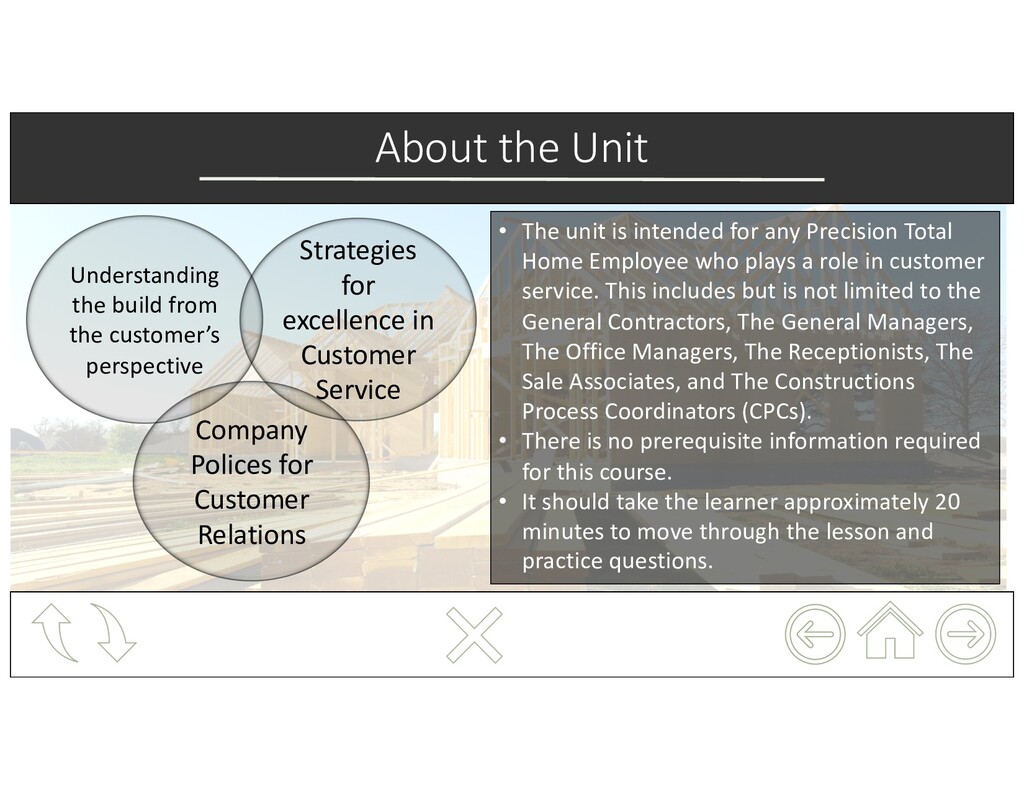
Strategies for excellence in Customer Service Company Polices for Customer Relations • The unit is intended for any Precision Total Home Employee who plays a role in customer service. This includes but is not limited to the General Contractors, The General Managers, The Office Managers, The Receptionists, The Sale Associates, and The Constructions Process Coordinators (CPCs). • There is no prerequisite information required for this course. • It should take the learner approximately 20 minutes to move through the lesson and practice questions.
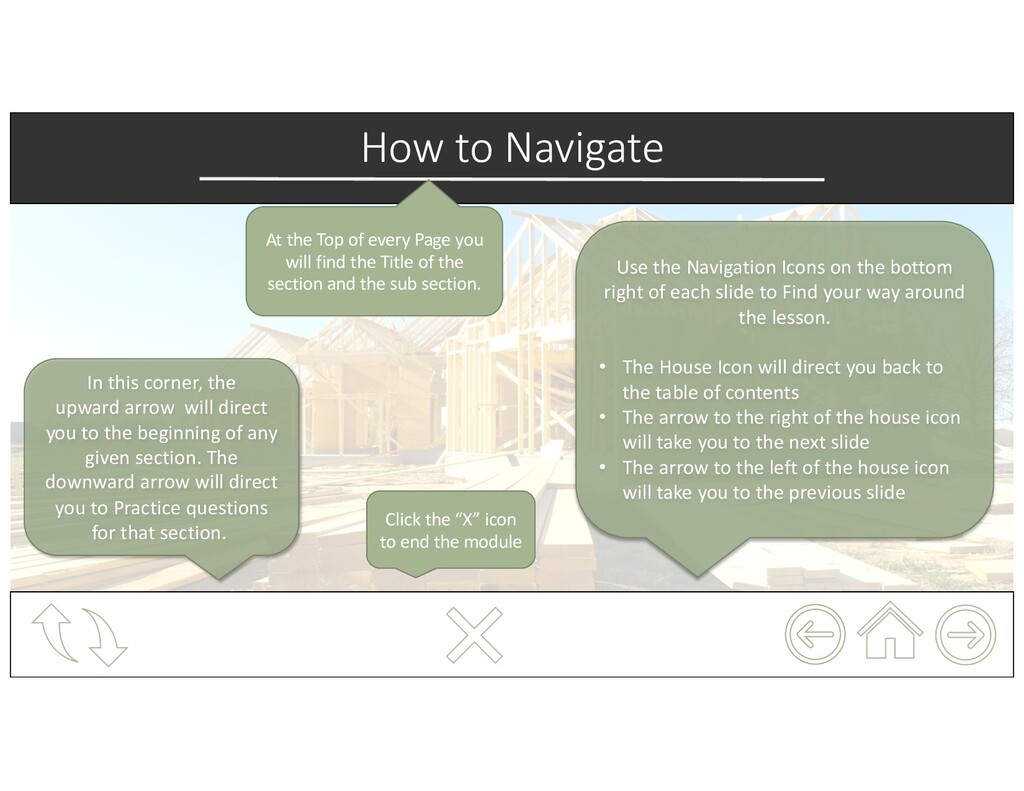
right of each slide to Find your way around the lesson. • The House Icon will direct you back to the table of contents • The arrow to the right of the house icon will take you to the next slide • The arrow to the left of the house icon will take you to the previous slide In this corner, the upward arrow will direct you to the beginning of any given section. The downward arrow will direct you to Practice questions for that section. At the Top of every Page you will find the Title of the section and the sub section. Click the “X” icon to end the module
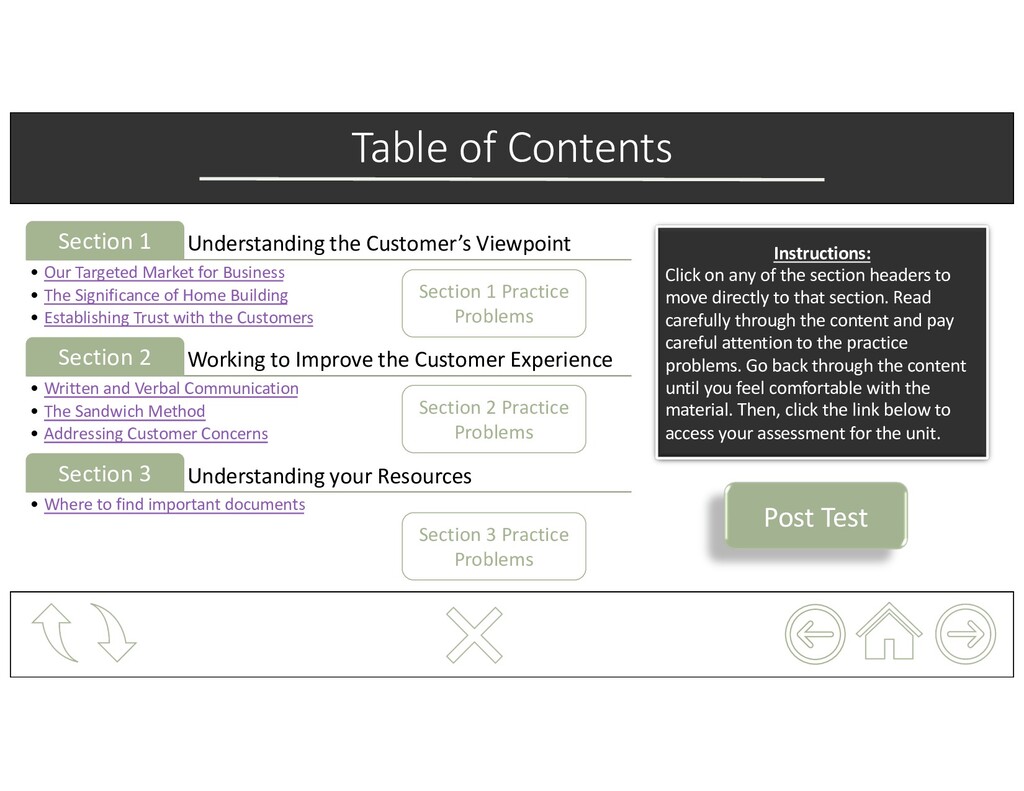
Our Targeted Market for Business • The Significance of Home Building • Establishing Trust with the Customers Working to Improve the Customer Experience Section 2 • Written and Verbal Communication • The Sandwich Method • Addressing Customer Concerns Understanding your Resources Section 3 • Where to find important documents Instructions: Click on any of the section headers to move directly to that section. Read carefully through the content and pay careful attention to the practice problems. Go back through the content until you feel comfortable with the material. Then, click the link below to access your assessment for the unit. Post Test Section 1 Practice Problems Section 2 Practice Problems Section 3 Practice Problems
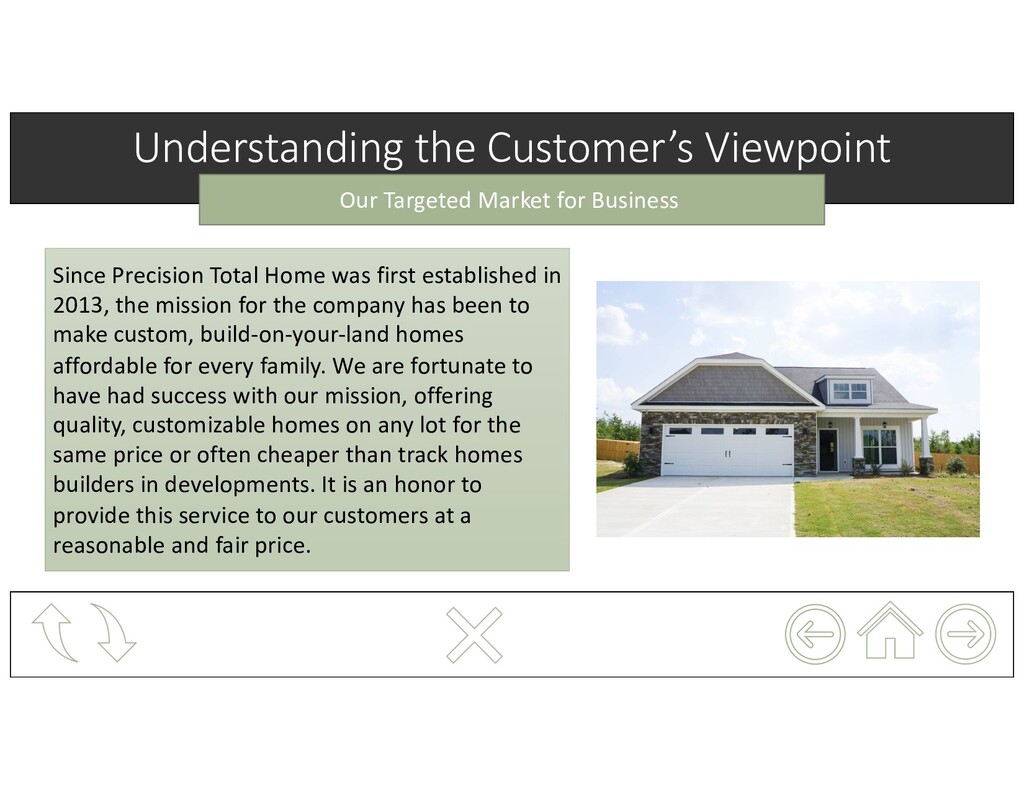
Precision Total Home was first established in 2013, the mission for the company has been to make custom, build-on-your-land homes affordable for every family. We are fortunate to have had success with our mission, offering quality, customizable homes on any lot for the same price or often cheaper than track homes builders in developments. It is an honor to provide this service to our customers at a reasonable and fair price.
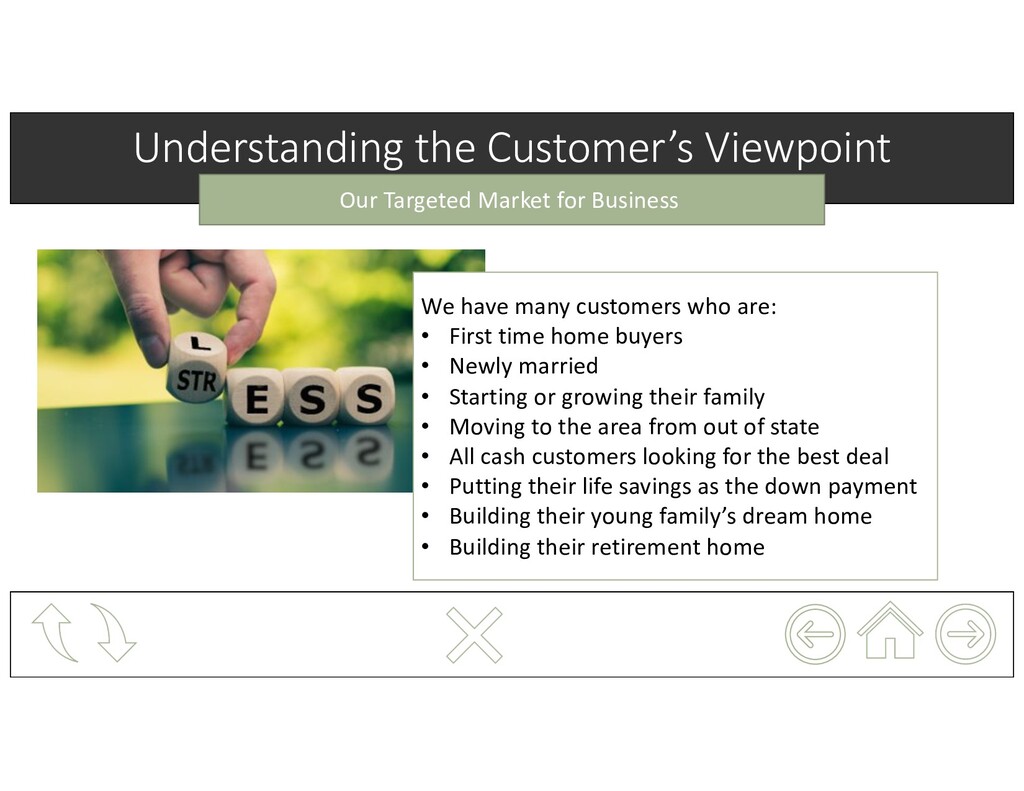
for Business We have many customers who are: • First time home buyers • Newly married • Starting or growing their family • Moving to the area from out of state • All cash customers looking for the best deal • Putting their life savings as the down payment • Building their young family’s dream home • Building their retirement home
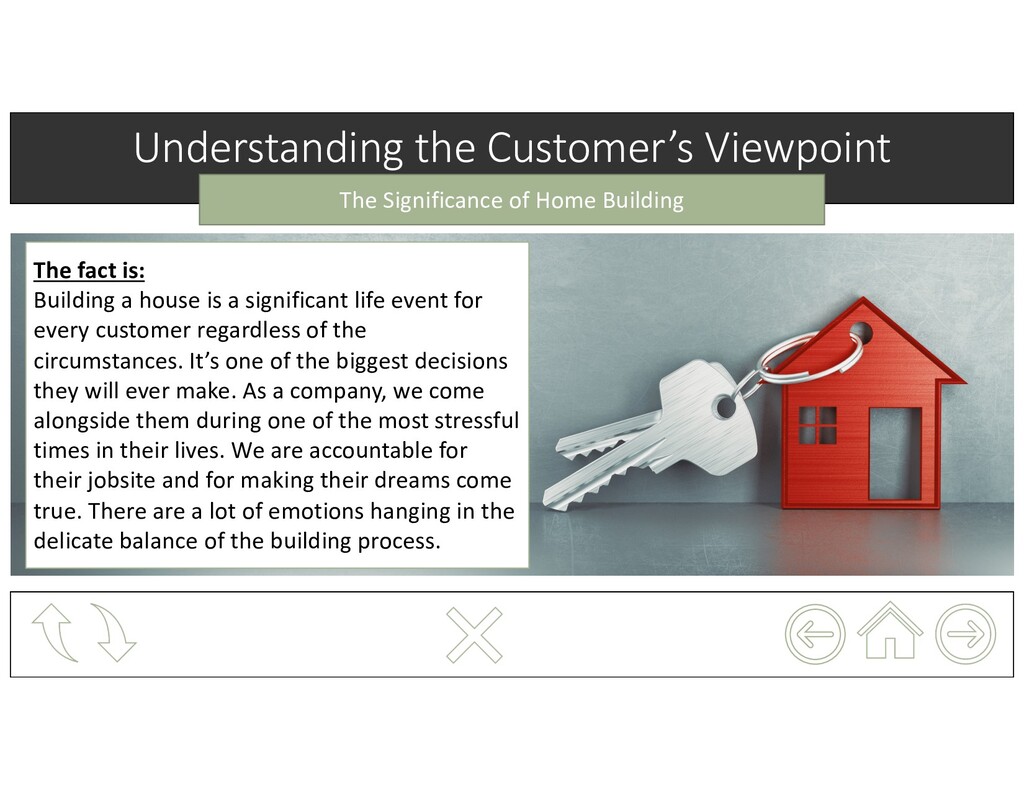
Home Building The fact is: Building a house is a significant life event for every customer regardless of the circumstances. It’s one of the biggest decisions they will ever make. As a company, we come alongside them during one of the most stressful times in their lives. We are accountable for their jobsite and for making their dreams come true. There are a lot of emotions hanging in the delicate balance of the building process.
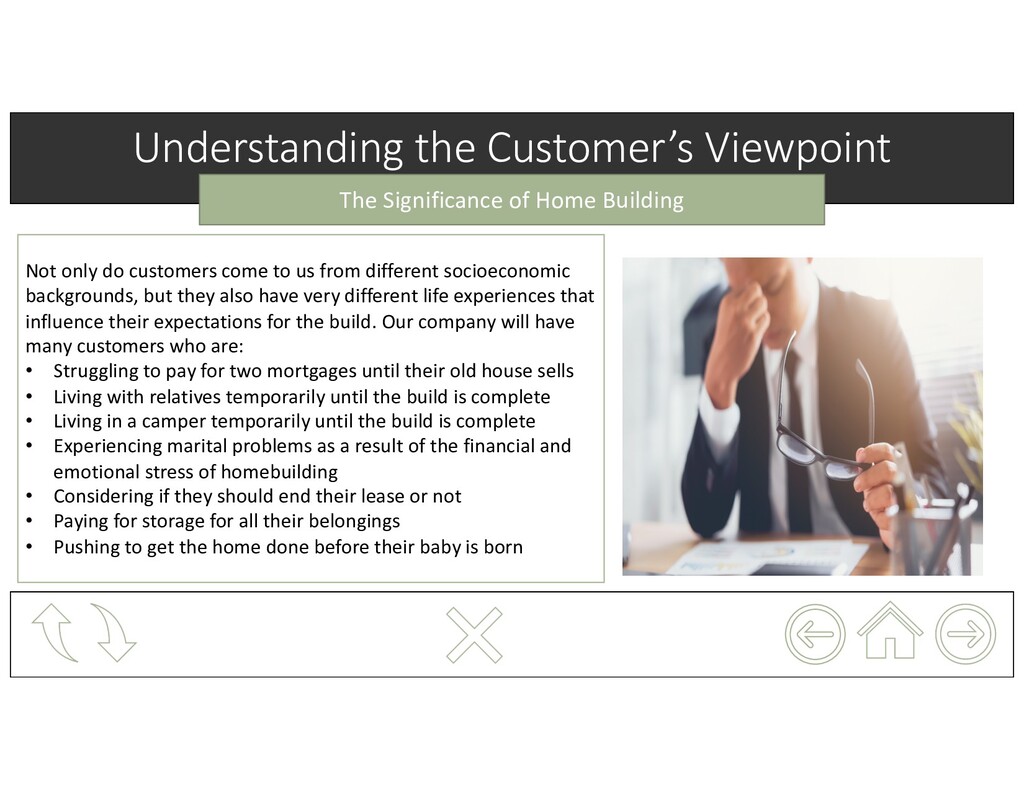
Home Building Not only do customers come to us from different socioeconomic backgrounds, but they also have very different life experiences that influence their expectations for the build. Our company will have many customers who are: • Struggling to pay for two mortgages until their old house sells • Living with relatives temporarily until the build is complete • Living in a camper temporarily until the build is complete • Experiencing marital problems as a result of the financial and emotional stress of homebuilding • Considering if they should end their lease or not • Paying for storage for all their belongings • Pushing to get the home done before their baby is born
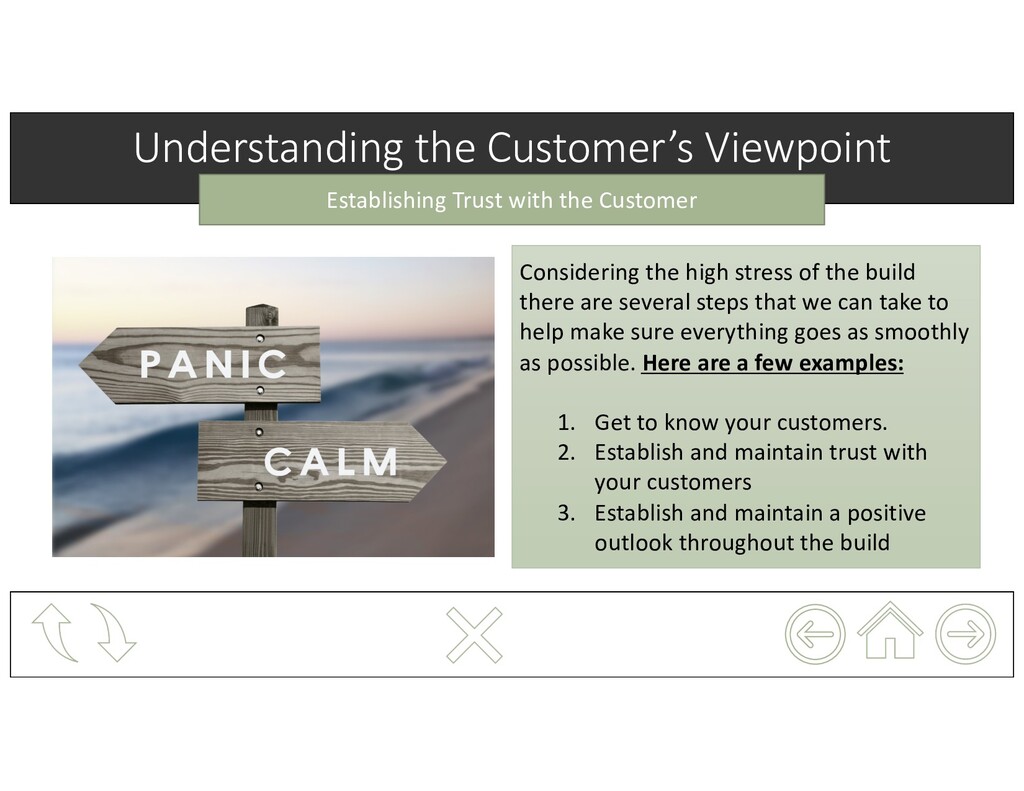
the Customer Considering the high stress of the build there are several steps that we can take to help make sure everything goes as smoothly as possible. Here are a few examples: 1. Get to know your customers. 2. Establish and maintain trust with your customers 3. Establish and maintain a positive outlook throughout the build
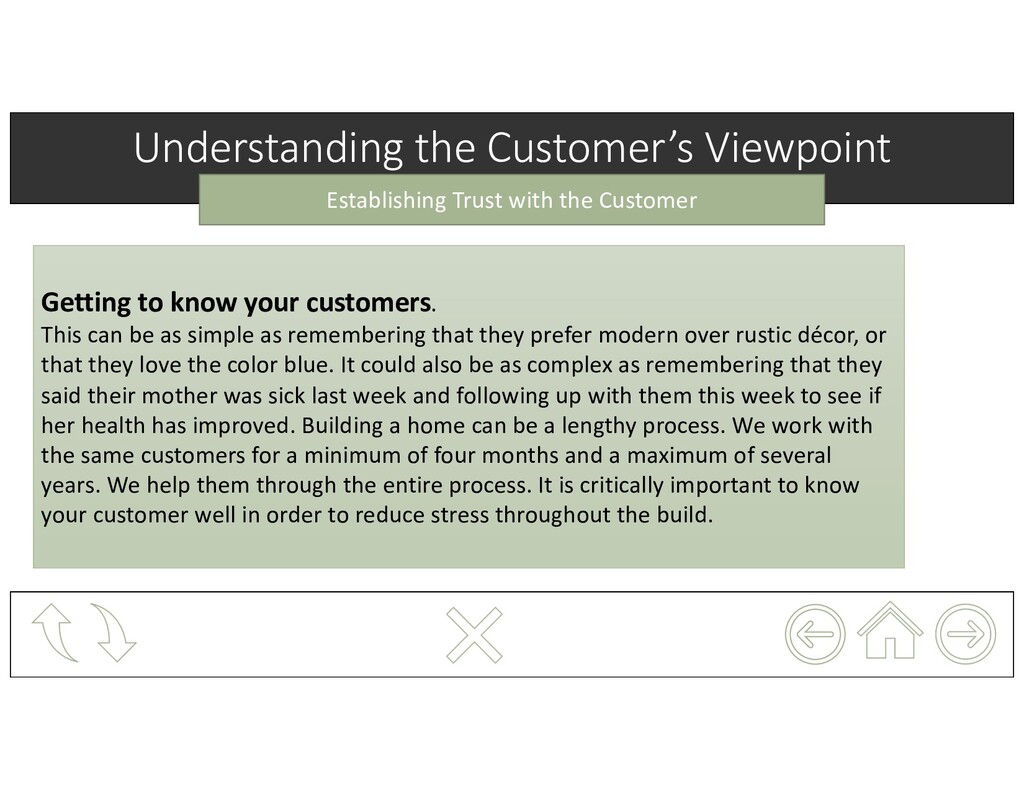
the Customer Getting to know your customers. This can be as simple as remembering that they prefer modern over rustic décor, or that they love the color blue. It could also be as complex as remembering that they said their mother was sick last week and following up with them this week to see if her health has improved. Building a home can be a lengthy process. We work with the same customers for a minimum of four months and a maximum of several years. We help them through the entire process. It is critically important to know your customer well in order to reduce stress throughout the build.
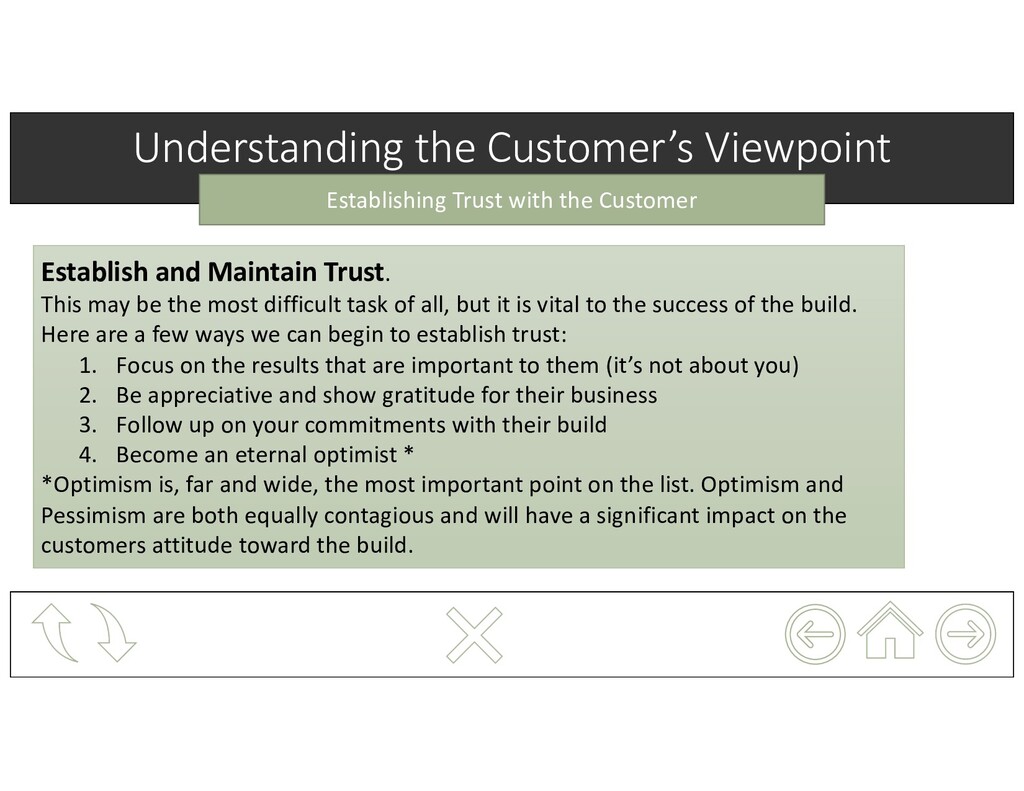
the Customer Establish and Maintain Trust. This may be the most difficult task of all, but it is vital to the success of the build. Here are a few ways we can begin to establish trust: 1. Focus on the results that are important to them (it’s not about you) 2. Be appreciative and show gratitude for their business 3. Follow up on your commitments with their build 4. Become an eternal optimist * *Optimism is, far and wide, the most important point on the list. Optimism and Pessimism are both equally contagious and will have a significant impact on the customers attitude toward the build.
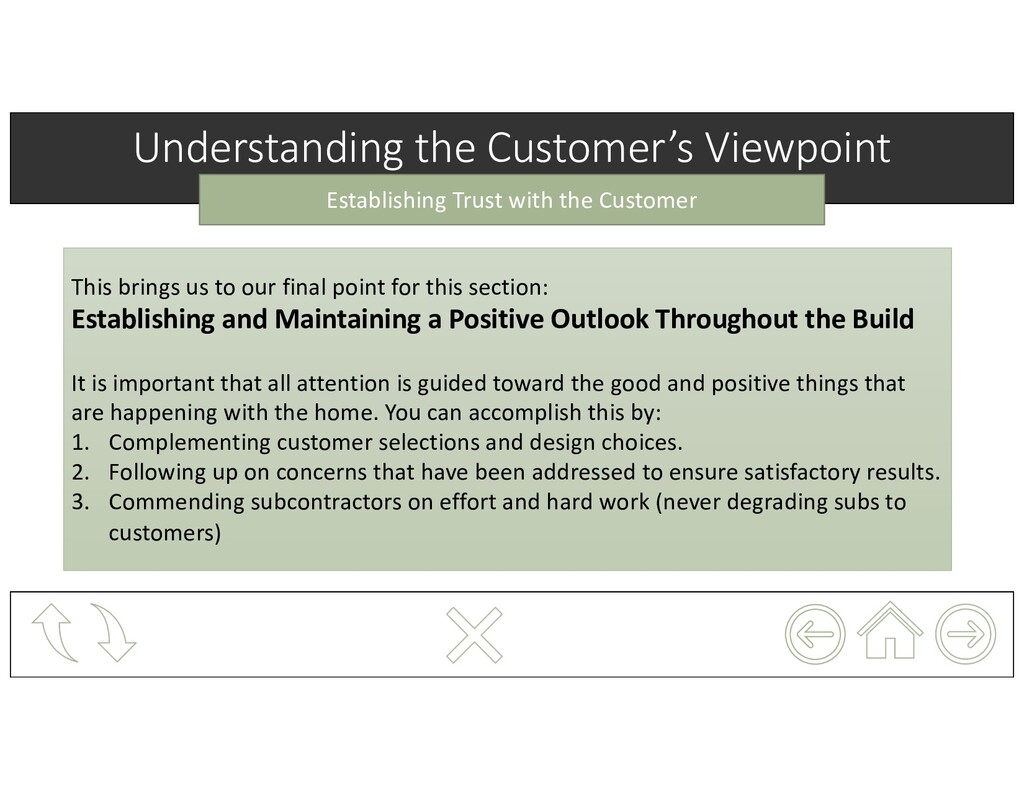
the Customer This brings us to our final point for this section: Establishing and Maintaining a Positive Outlook Throughout the Build It is important that all attention is guided toward the good and positive things that are happening with the home. You can accomplish this by: 1. Complementing customer selections and design choices. 2. Following up on concerns that have been addressed to ensure satisfactory results. 3. Commending subcontractors on effort and hard work (never degrading subs to customers)
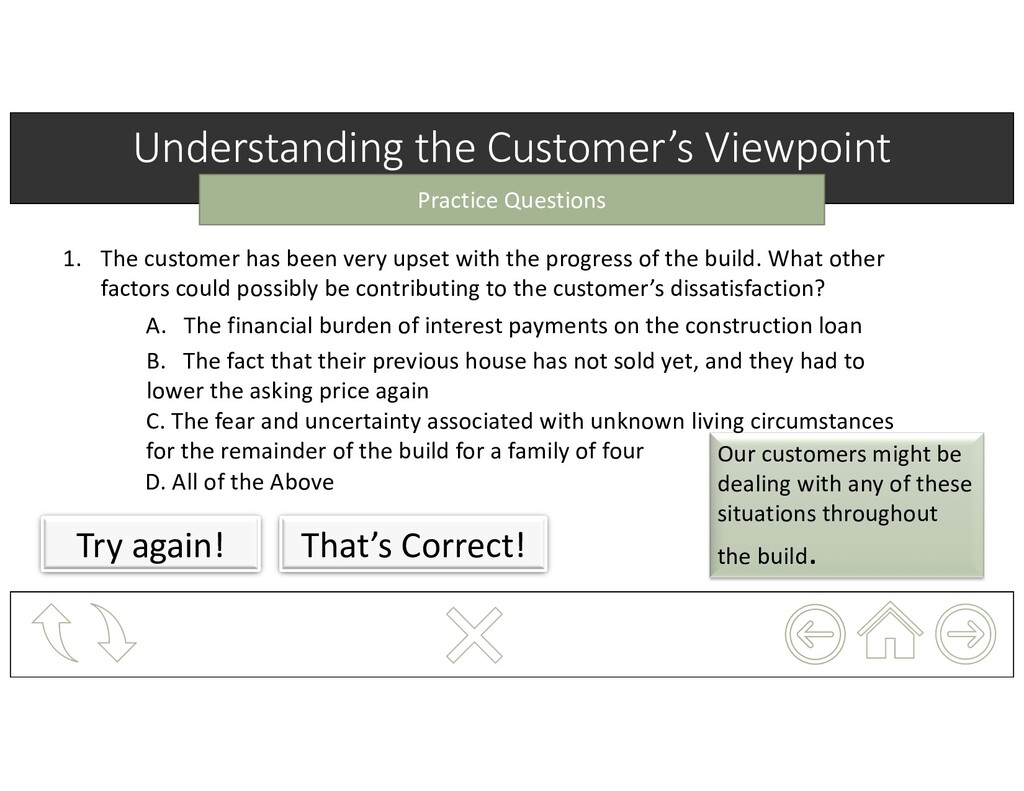
The customer has been very upset with the progress of the build. What other factors could possibly be contributing to the customer’s dissatisfaction? Try again! That’s Correct! Our customers might be dealing with any of these situations throughout the build. A. The financial burden of interest payments on the construction loan D. All of the Above C. The fear and uncertainty associated with unknown living circumstances for the remainder of the build for a family of four B. The fact that their previous house has not sold yet, and they had to lower the asking price again
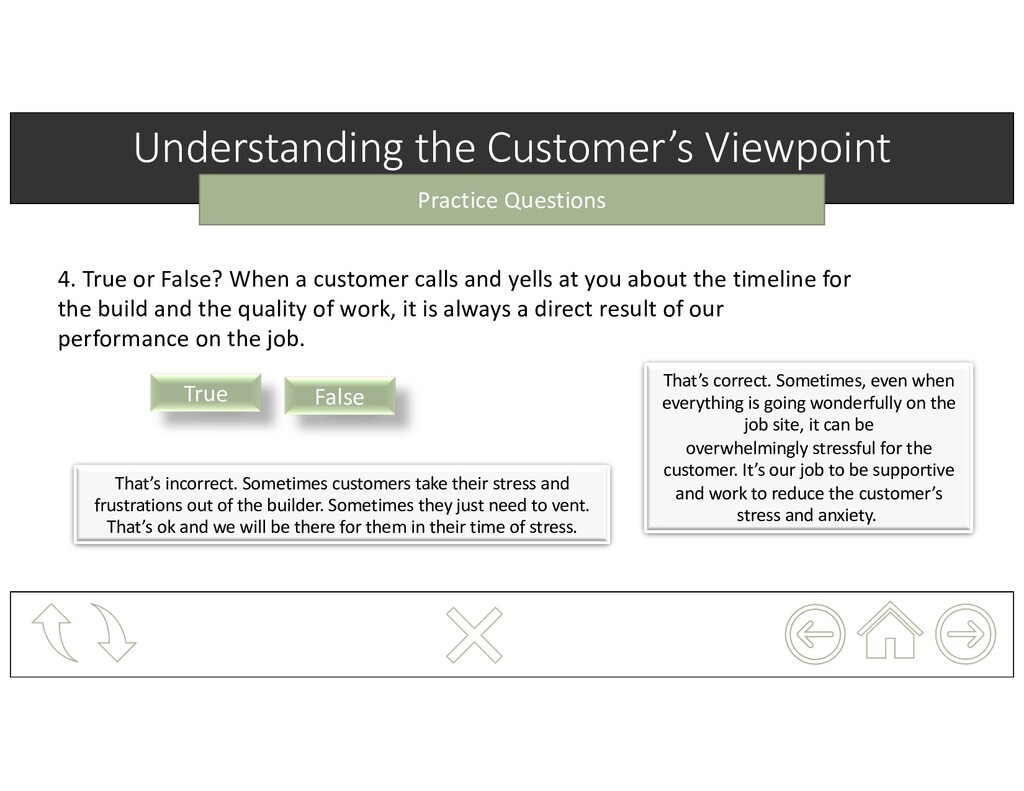
True or False? When a customer calls and yells at you about the timeline for the build and the quality of work, it is always a direct result of our performance on the job. True False That’s incorrect. Sometimes customers take their stress and frustrations out of the builder. Sometimes they just need to vent. That’s ok and we will be there for them in their time of stress. That’s correct. Sometimes, even when everything is going wonderfully on the job site, it can be overwhelmingly stressful for the customer. It’s our job to be supportive and work to reduce the customer’s stress and anxiety.
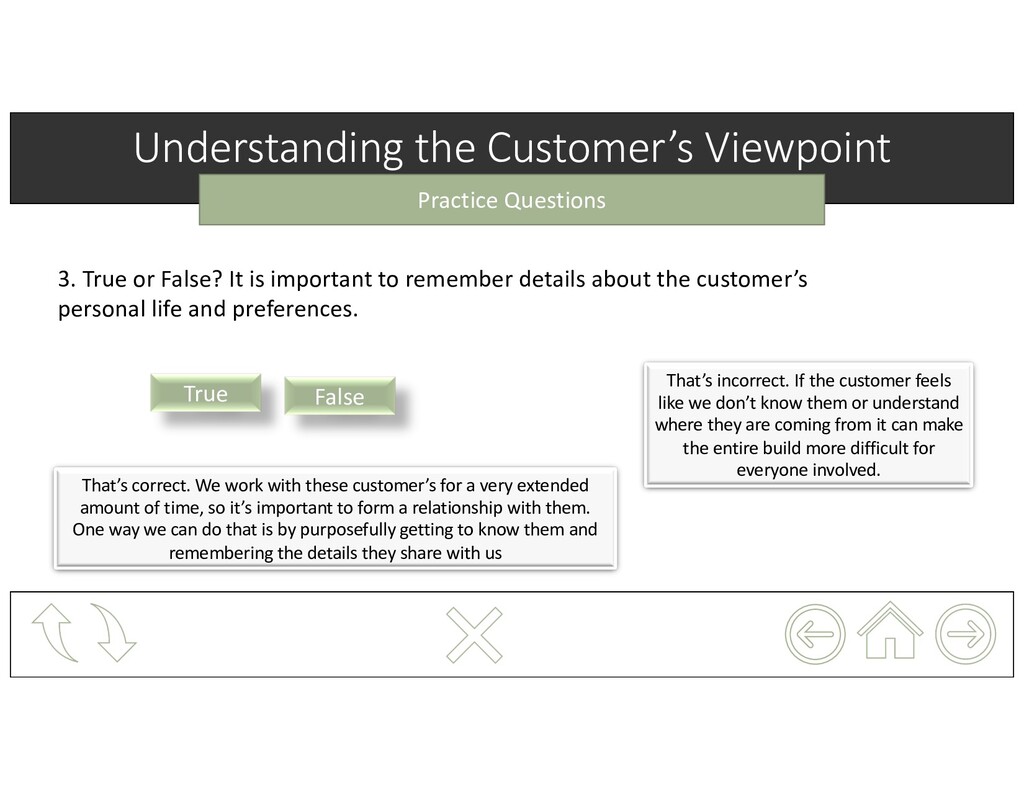
True or False? It is important to remember details about the customer’s personal life and preferences. True False That’s correct. We work with these customer’s for a very extended amount of time, so it’s important to form a relationship with them. One way we can do that is by purposefully getting to know them and remembering the details they share with us That’s incorrect. If the customer feels like we don’t know them or understand where they are coming from it can make the entire build more difficult for everyone involved.
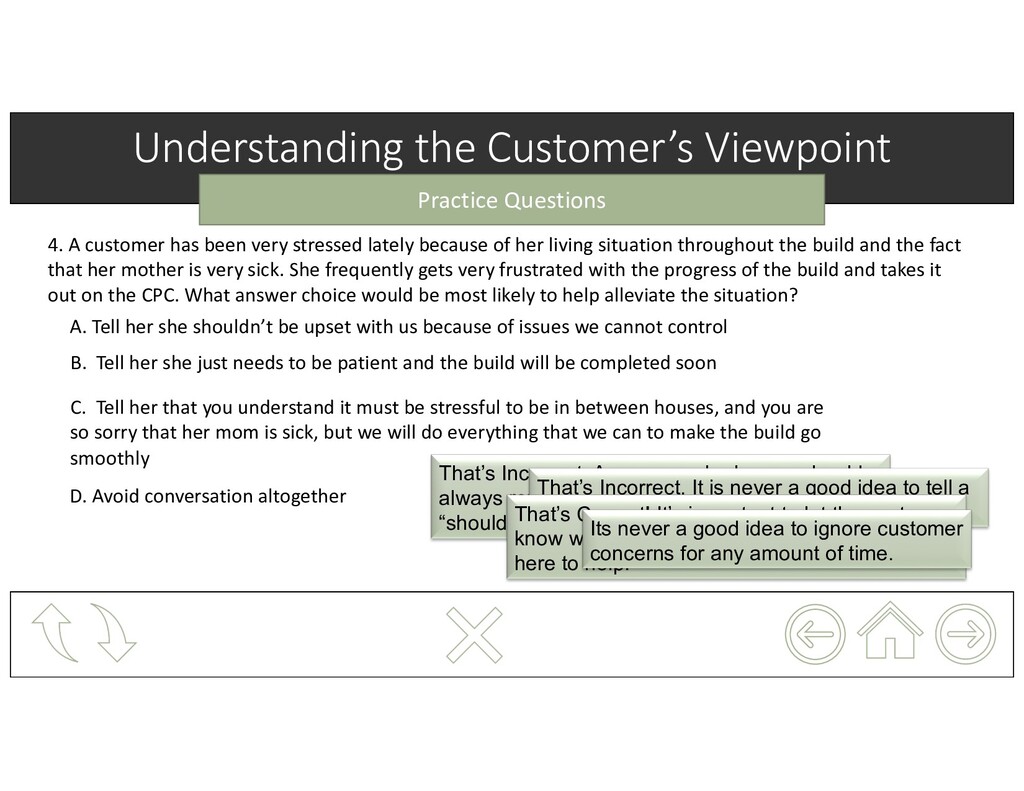
A customer has been very stressed lately because of her living situation throughout the build and the fact that her mother is very sick. She frequently gets very frustrated with the progress of the build and takes it out on the CPC. What answer choice would be most likely to help alleviate the situation? That’s Incorrect. As a general rule, you should always refrain from telling customers what they “should” do A. Tell her she shouldn’t be upset with us because of issues we cannot control D. Avoid conversation altogether C. Tell her that you understand it must be stressful to be in between houses, and you are so sorry that her mom is sick, but we will do everything that we can to make the build go smoothly B. Tell her she just needs to be patient and the build will be completed soon That’s Incorrect. It is never a good idea to tell a customer what they need to do That’s Correct! It’s important to let the customer know we understand how they feel and we’re here to help. Its never a good idea to ignore customer concerns for any amount of time.
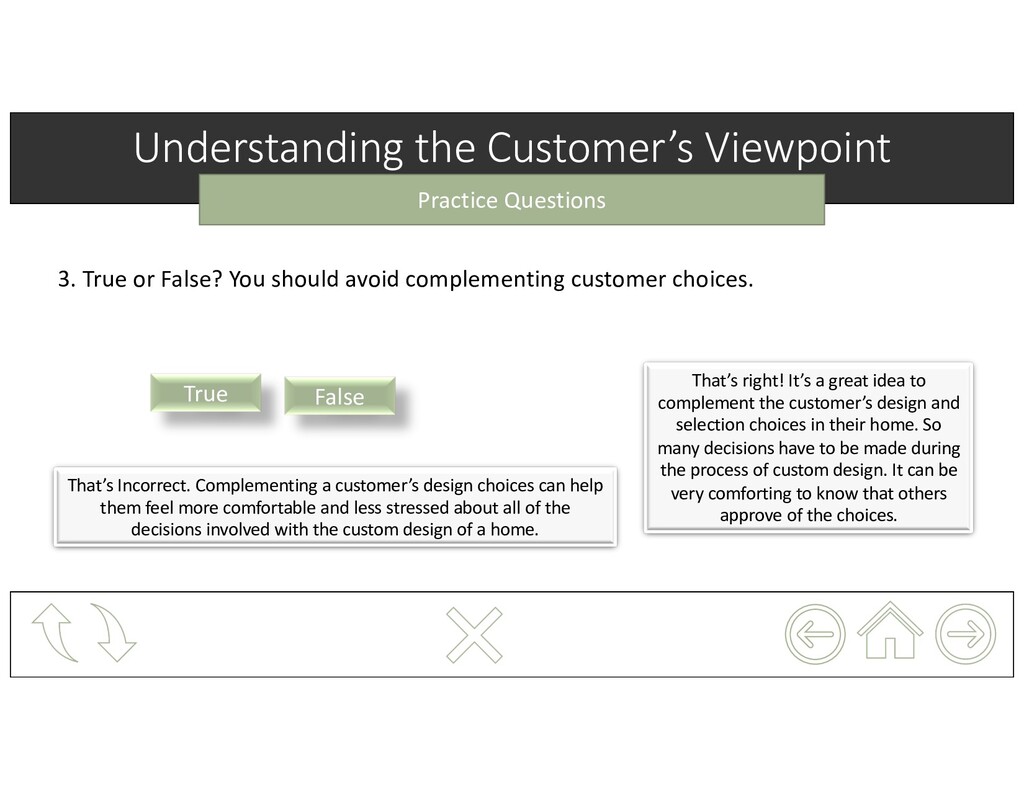
True or False? You should avoid complementing customer choices. True False That’s Incorrect. Complementing a customer’s design choices can help them feel more comfortable and less stressed about all of the decisions involved with the custom design of a home. That’s right! It’s a great idea to complement the customer’s design and selection choices in their home. So many decisions have to be made during the process of custom design. It can be very comforting to know that others approve of the choices.
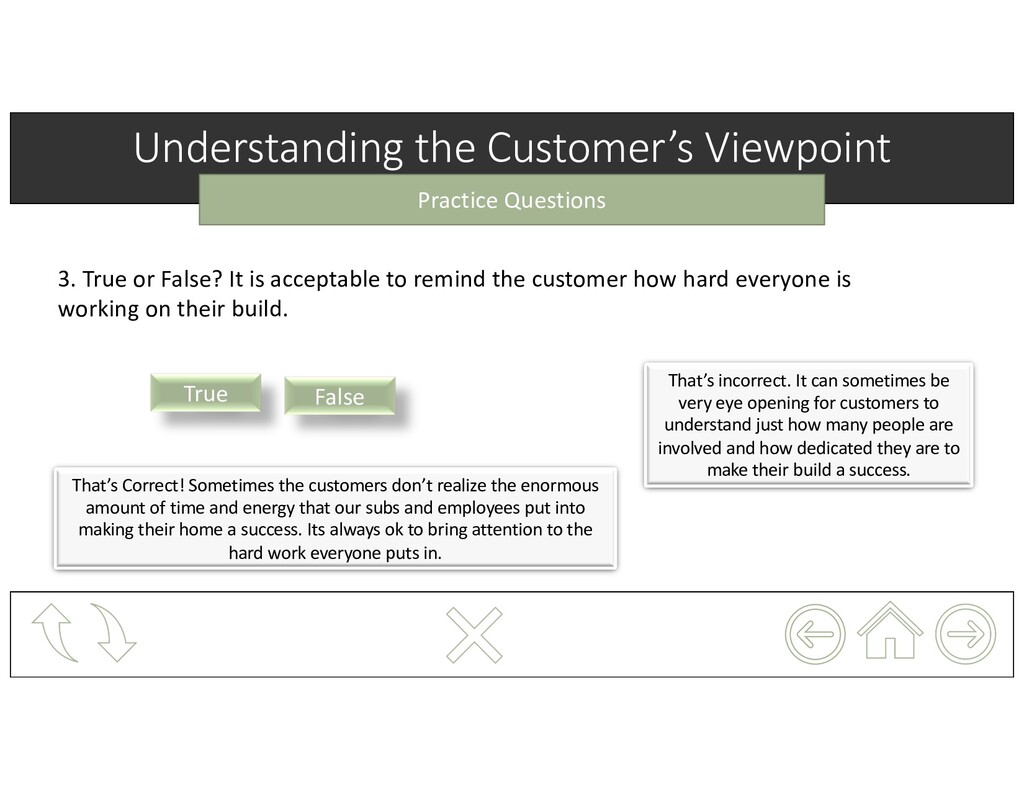
True or False? It is acceptable to remind the customer how hard everyone is working on their build. True False That’s Correct! Sometimes the customers don’t realize the enormous amount of time and energy that our subs and employees put into making their home a success. Its always ok to bring attention to the hard work everyone puts in. That’s incorrect. It can sometimes be very eye opening for customers to understand just how many people are involved and how dedicated they are to make their build a success.
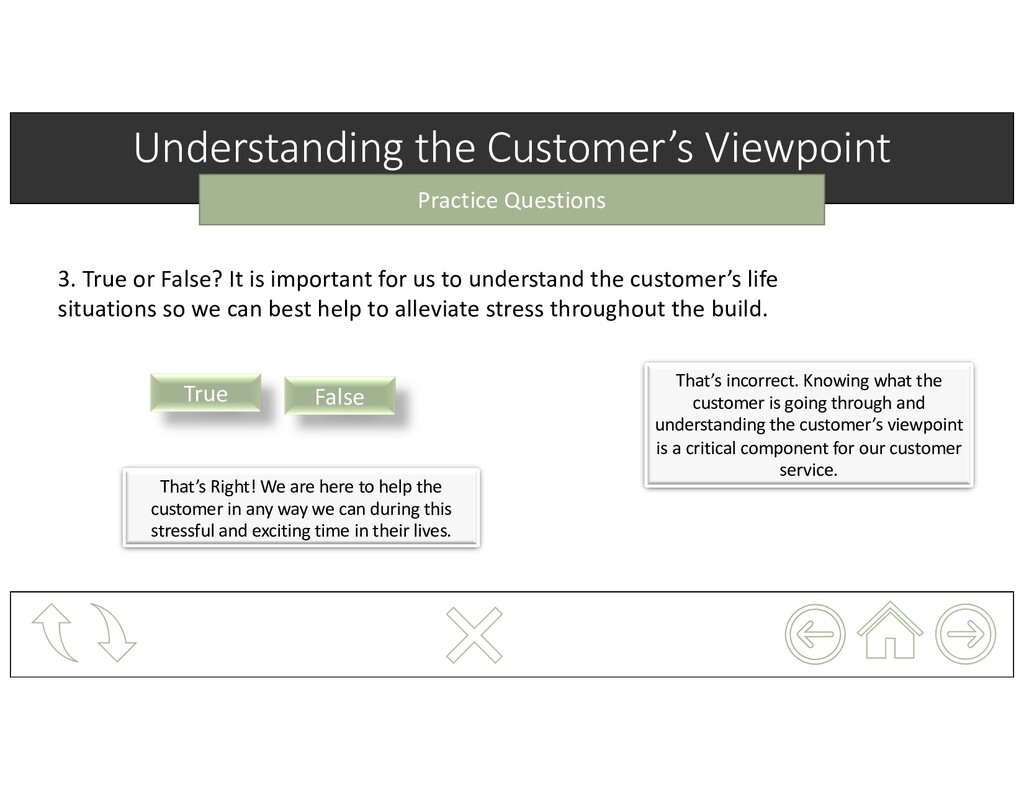
True or False? It is important for us to understand the customer’s life situations so we can best help to alleviate stress throughout the build. True False That’s Right! We are here to help the customer in any way we can during this stressful and exciting time in their lives. That’s incorrect. Knowing what the customer is going through and understanding the customer’s viewpoint is a critical component for our customer service.
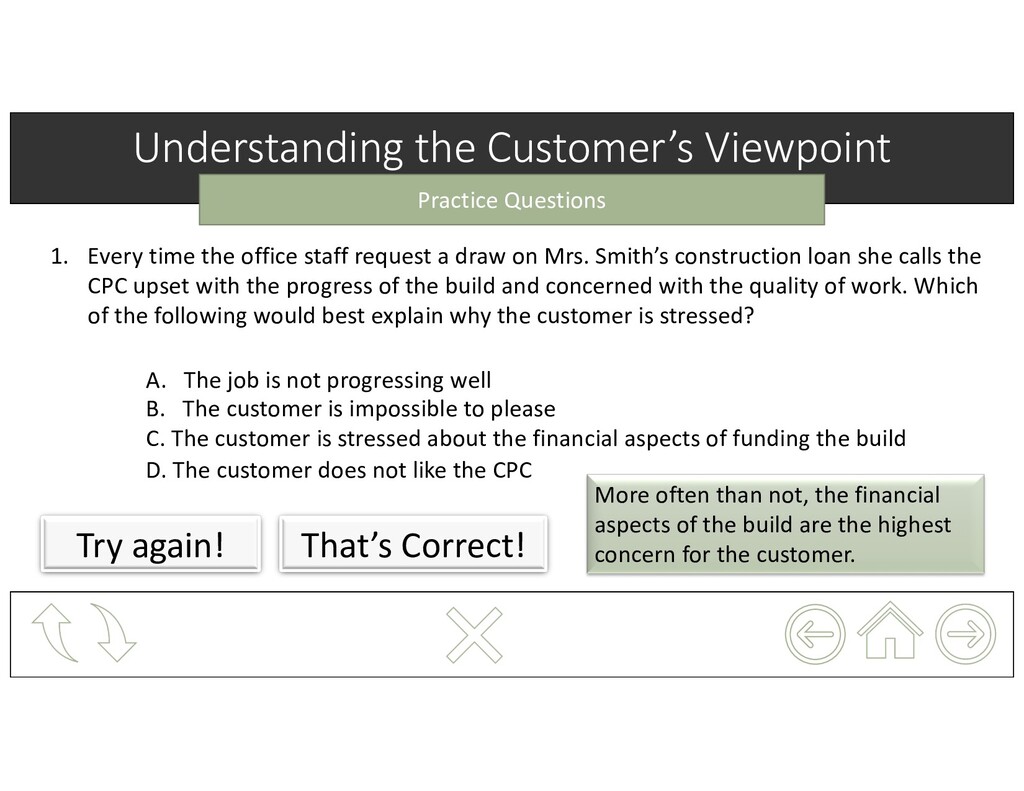
Every time the office staff request a draw on Mrs. Smith’s construction loan she calls the CPC upset with the progress of the build and concerned with the quality of work. Which of the following would best explain why the customer is stressed? Try again! That’s Correct! More often than not, the financial aspects of the build are the highest concern for the customer. A. The job is not progressing well D. The customer does not like the CPC C. The customer is stressed about the financial aspects of funding the build B. The customer is impossible to please
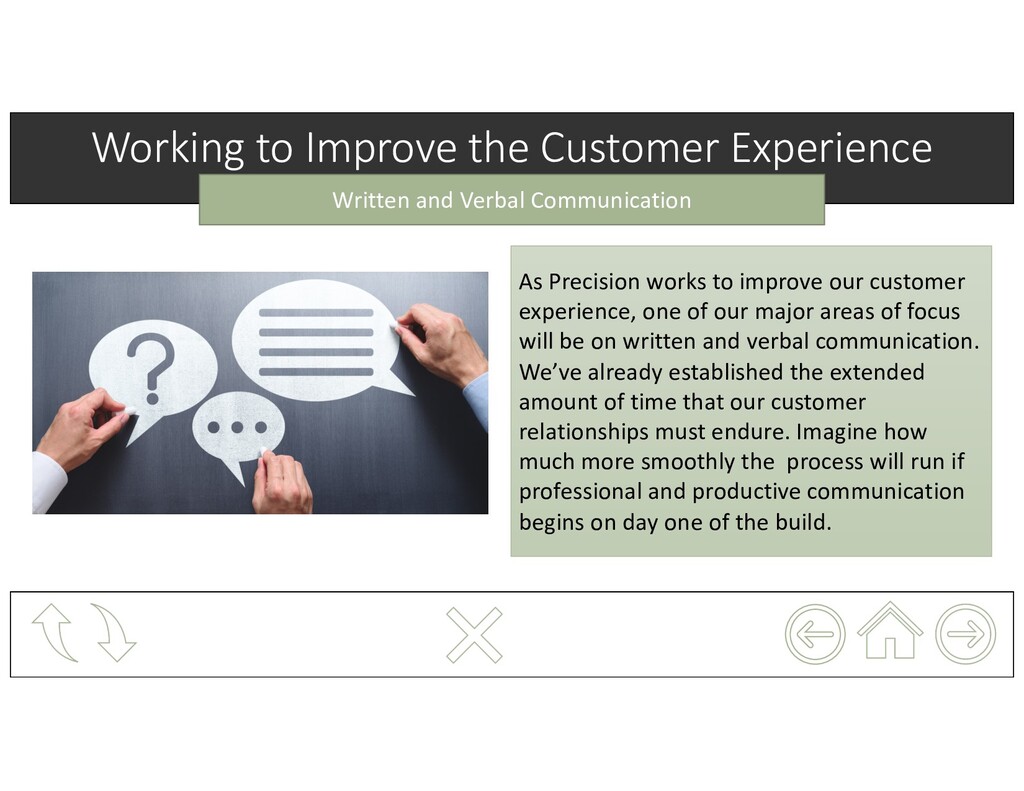
As Precision works to improve our customer experience, one of our major areas of focus will be on written and verbal communication. We’ve already established the extended amount of time that our customer relationships must endure. Imagine how much more smoothly the process will run if professional and productive communication begins on day one of the build.
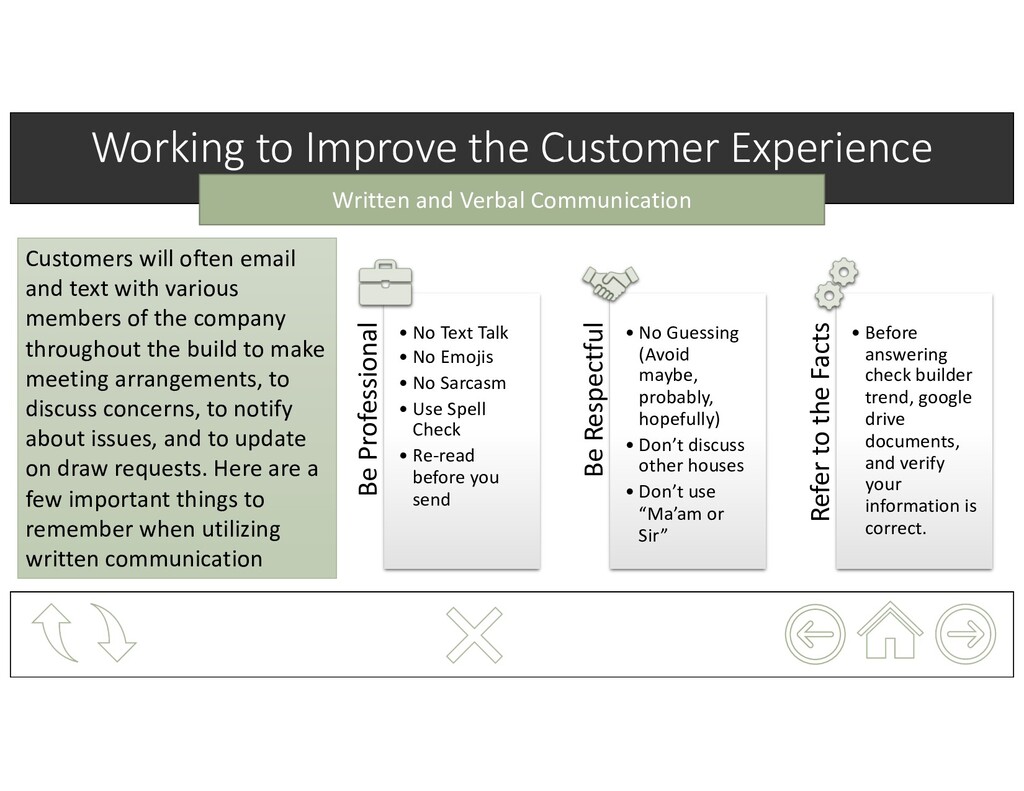
Customers will often email and text with various members of the company throughout the build to make meeting arrangements, to discuss concerns, to notify about issues, and to update on draw requests. Here are a few important things to remember when utilizing written communication Be Professional • No Text Talk • No Emojis • No Sarcasm • Use Spell Check • Re-read before you send Be Respectful • No Guessing (Avoid maybe, probably, hopefully) • Don’t discuss other houses • Don’t use “Ma’am or Sir” Refer to the Facts • Before answering check builder trend, google drive documents, and verify your information is correct.
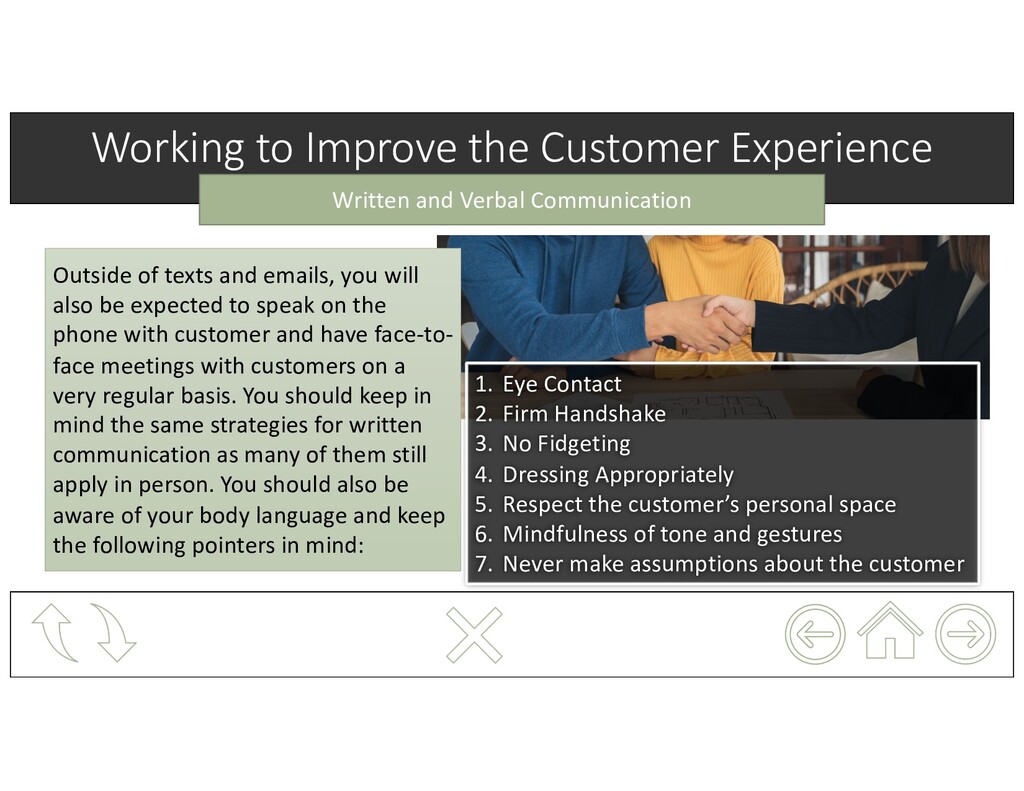
Outside of texts and emails, you will also be expected to speak on the phone with customer and have face-to- face meetings with customers on a very regular basis. You should keep in mind the same strategies for written communication as many of them still apply in person. You should also be aware of your body language and keep the following pointers in mind: 1. Eye Contact 2. Firm Handshake 3. No Fidgeting 4. Dressing Appropriately 5. Respect the customer’s personal space 6. Mindfulness of tone and gestures 7. Never make assumptions about the customer
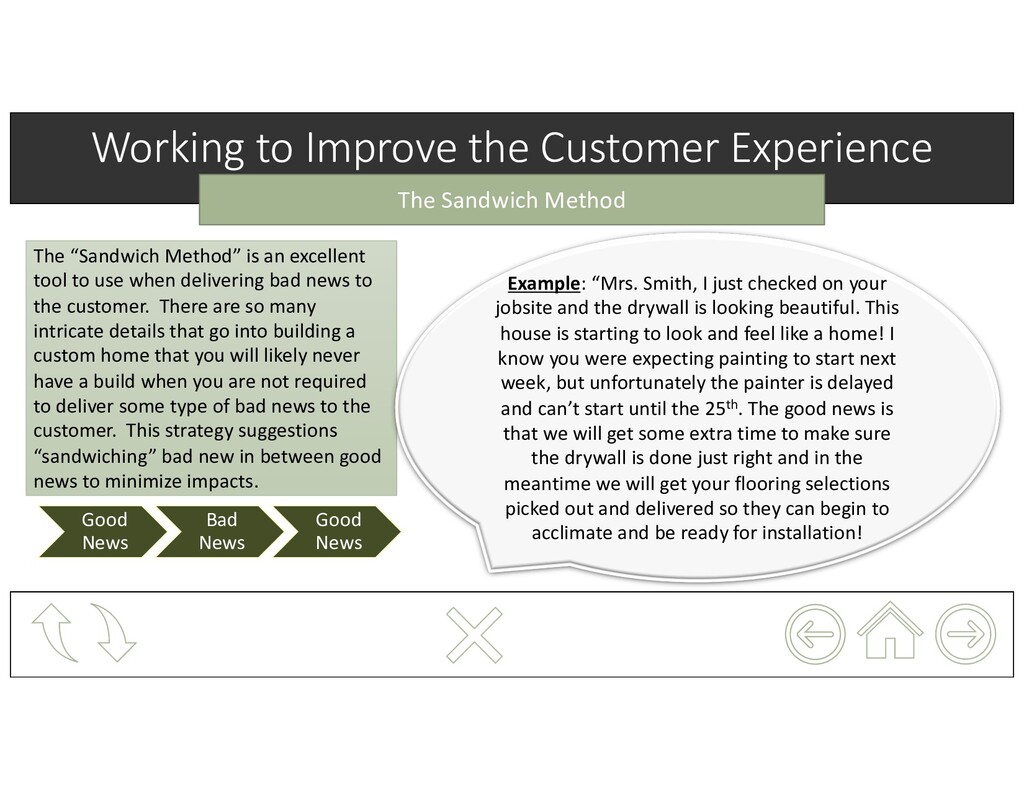
“Sandwich Method” is an excellent tool to use when delivering bad news to the customer. There are so many intricate details that go into building a custom home that you will likely never have a build when you are not required to deliver some type of bad news to the customer. This strategy suggestions “sandwiching” bad new in between good news to minimize impacts. Good News Bad News Good News Example: “Mrs. Smith, I just checked on your jobsite and the drywall is looking beautiful. This house is starting to look and feel like a home! I know you were expecting painting to start next week, but unfortunately the painter is delayed and can’t start until the 25th. The good news is that we will get some extra time to make sure the drywall is done just right and in the meantime we will get your flooring selections picked out and delivered so they can begin to acclimate and be ready for installation!
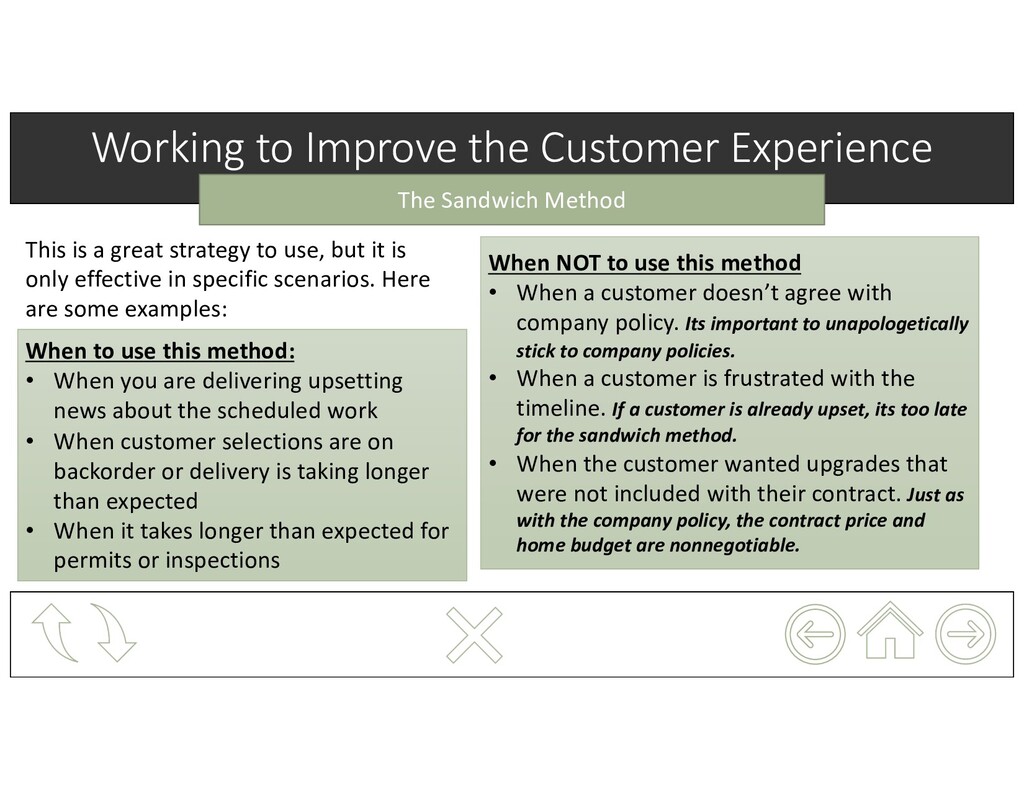
to use this method: • When you are delivering upsetting news about the scheduled work • When customer selections are on backorder or delivery is taking longer than expected • When it takes longer than expected for permits or inspections When NOT to use this method • When a customer doesn’t agree with company policy. Its important to unapologetically stick to company policies. • When a customer is frustrated with the timeline. If a customer is already upset, its too late for the sandwich method. • When the customer wanted upgrades that were not included with their contract. Just as with the company policy, the contract price and home budget are nonnegotiable. This is a great strategy to use, but it is only effective in specific scenarios. Here are some examples:
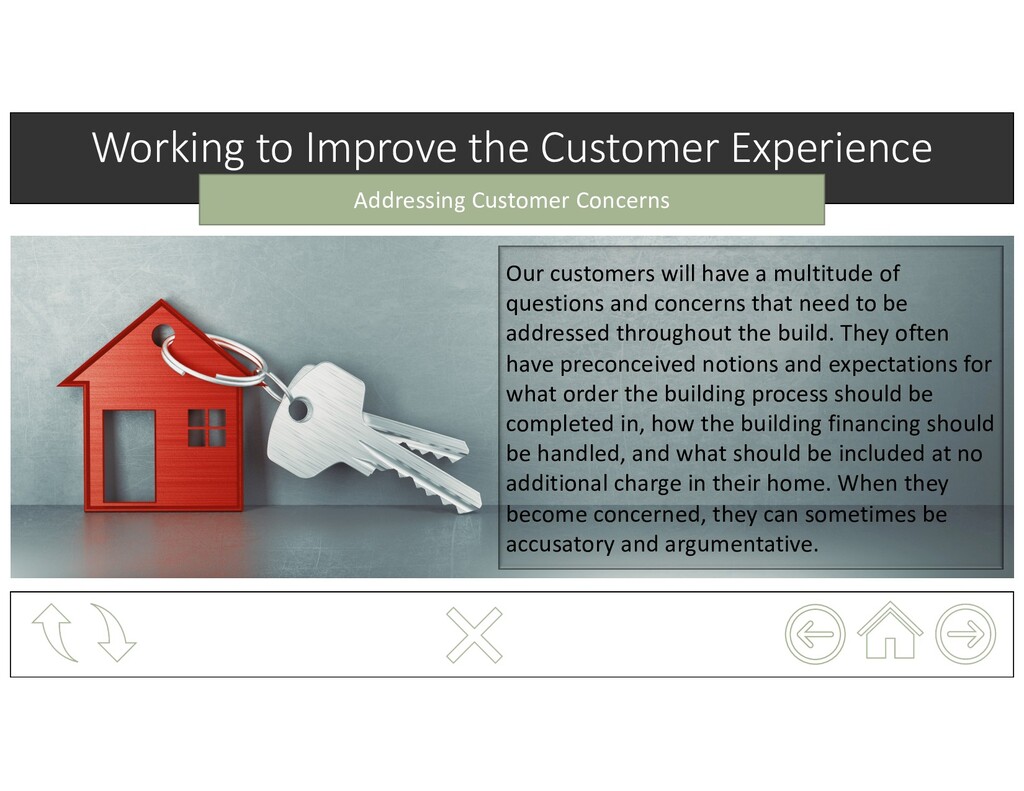
customers will have a multitude of questions and concerns that need to be addressed throughout the build. They often have preconceived notions and expectations for what order the building process should be completed in, how the building financing should be handled, and what should be included at no additional charge in their home. When they become concerned, they can sometimes be accusatory and argumentative.
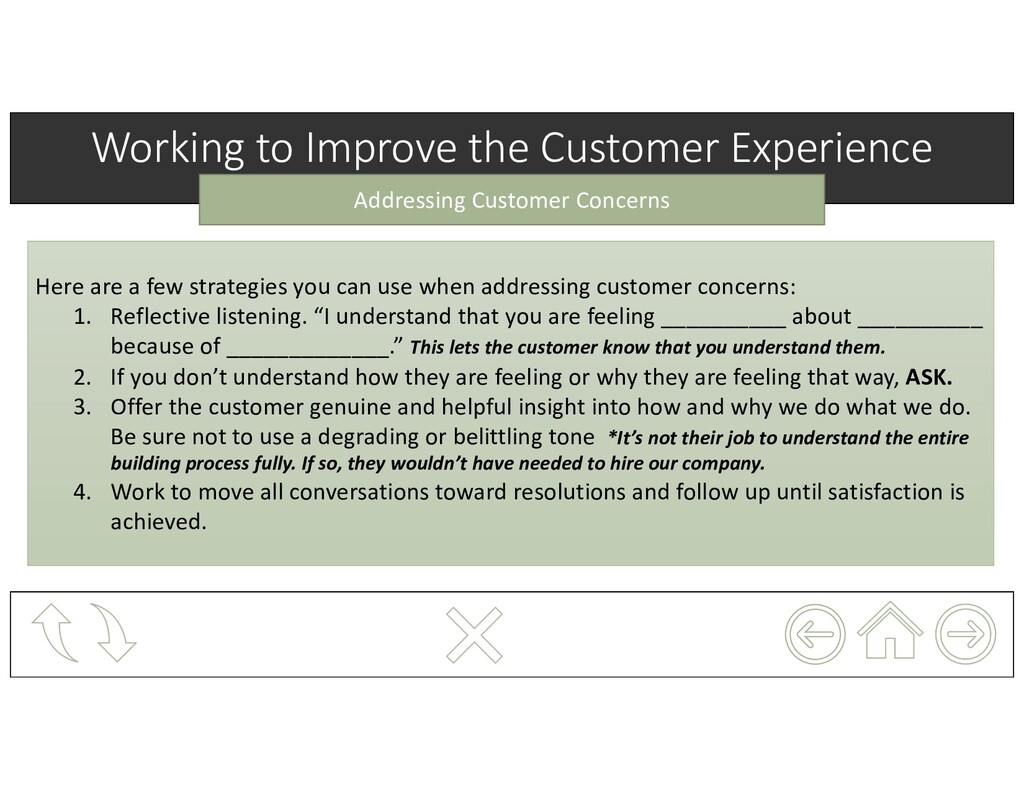
are a few strategies you can use when addressing customer concerns: 1. Reflective listening. “I understand that you are feeling __________ about __________ because of _____________.” This lets the customer know that you understand them. 2. If you don’t understand how they are feeling or why they are feeling that way, ASK. 3. Offer the customer genuine and helpful insight into how and why we do what we do. Be sure not to use a degrading or belittling tone *It’s not their job to understand the entire building process fully. If so, they wouldn’t have needed to hire our company. 4. Work to move all conversations toward resolutions and follow up until satisfaction is achieved.
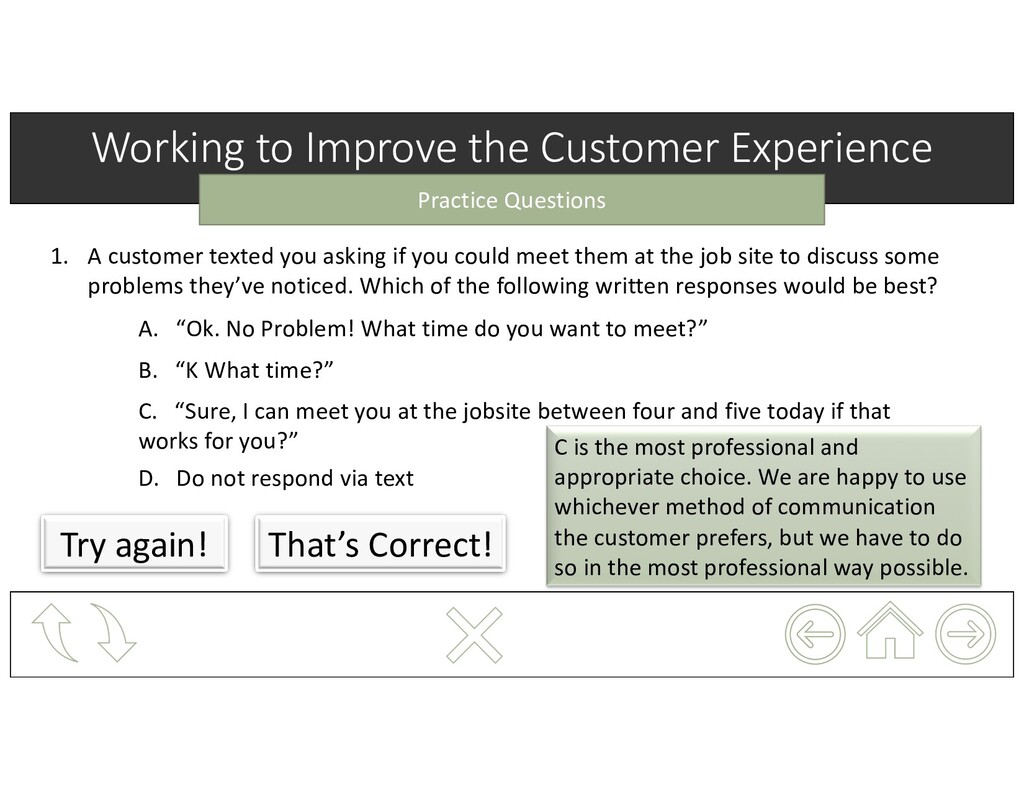
Questions 1. A customer texted you asking if you could meet them at the job site to discuss some problems they’ve noticed. Which of the following written responses would be best? Try again! That’s Correct! C is the most professional and appropriate choice. We are happy to use whichever method of communication the customer prefers, but we have to do so in the most professional way possible. A. “Ok. No Problem! What time do you want to meet?” D. Do not respond via text C. “Sure, I can meet you at the jobsite between four and five today if that works for you?” B. “K What time?”
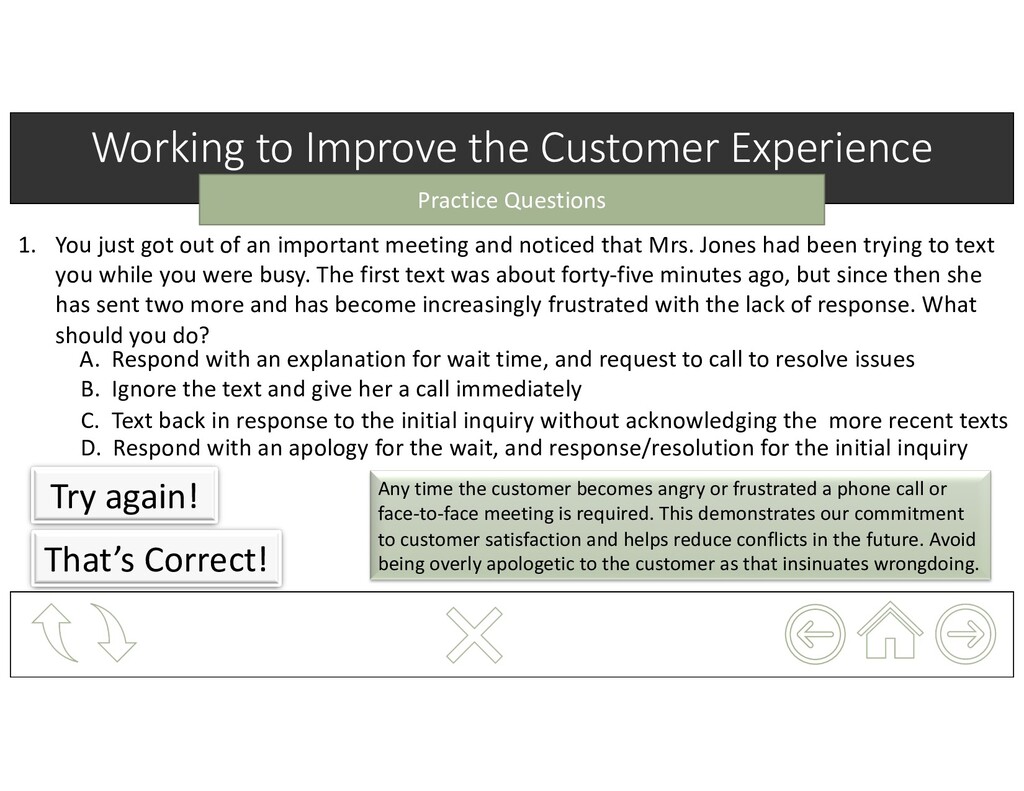
Questions 1. You just got out of an important meeting and noticed that Mrs. Jones had been trying to text you while you were busy. The first text was about forty-five minutes ago, but since then she has sent two more and has become increasingly frustrated with the lack of response. What should you do? Try again! That’s Correct! Any time the customer becomes angry or frustrated a phone call or face-to-face meeting is required. This demonstrates our commitment to customer satisfaction and helps reduce conflicts in the future. Avoid being overly apologetic to the customer as that insinuates wrongdoing. A. Respond with an explanation for wait time, and request to call to resolve issues D. Respond with an apology for the wait, and response/resolution for the initial inquiry C. Text back in response to the initial inquiry without acknowledging the more recent texts B. Ignore the text and give her a call immediately
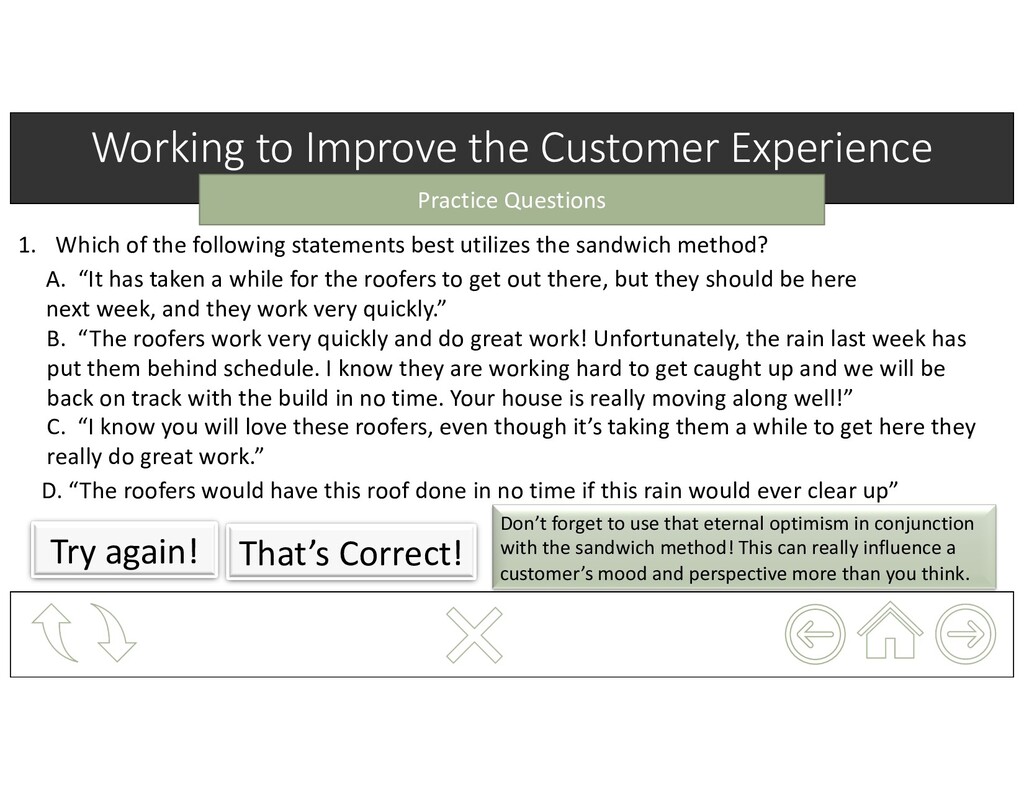
Questions 1. Which of the following statements best utilizes the sandwich method? Try again! That’s Correct! Don’t forget to use that eternal optimism in conjunction with the sandwich method! This can really influence a customer’s mood and perspective more than you think. A. “It has taken a while for the roofers to get out there, but they should be here next week, and they work very quickly.” D. “The roofers would have this roof done in no time if this rain would ever clear up” C. “I know you will love these roofers, even though it’s taking them a while to get here they really do great work.” B. “The roofers work very quickly and do great work! Unfortunately, the rain last week has put them behind schedule. I know they are working hard to get caught up and we will be back on track with the build in no time. Your house is really moving along well!”
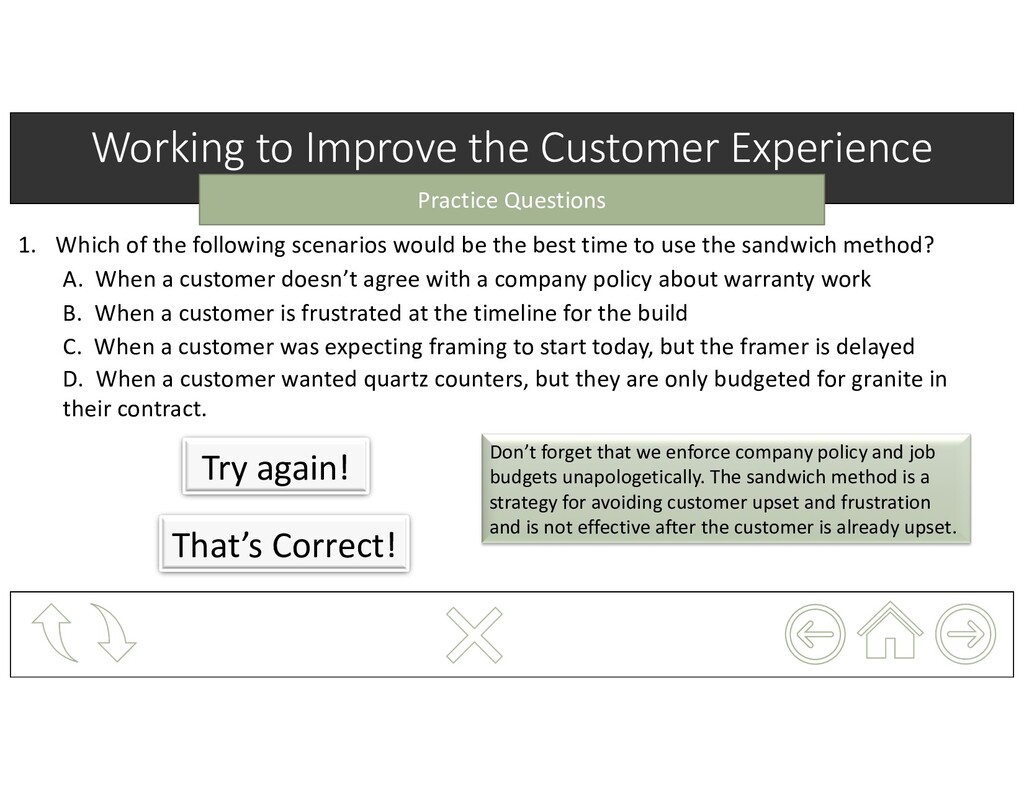
Questions 1. Which of the following scenarios would be the best time to use the sandwich method? Try again! That’s Correct! Don’t forget that we enforce company policy and job budgets unapologetically. The sandwich method is a strategy for avoiding customer upset and frustration and is not effective after the customer is already upset. A. When a customer doesn’t agree with a company policy about warranty work D. When a customer wanted quartz counters, but they are only budgeted for granite in their contract. C. When a customer was expecting framing to start today, but the framer is delayed B. When a customer is frustrated at the timeline for the build
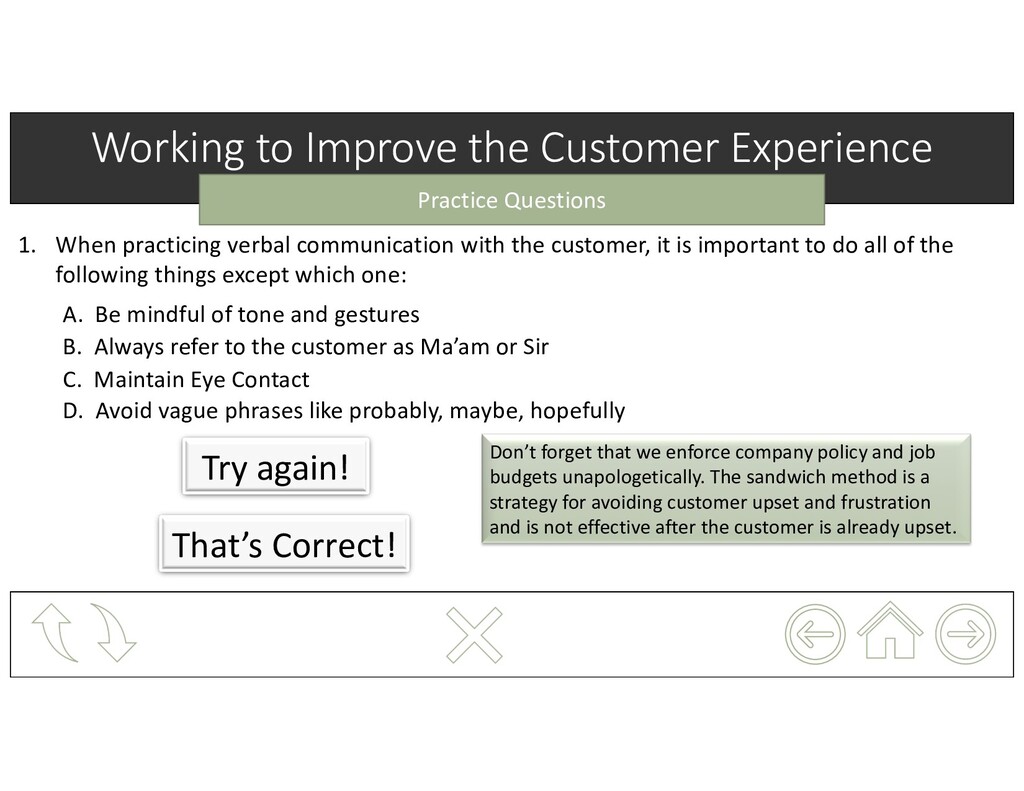
Questions 1. When practicing verbal communication with the customer, it is important to do all of the following things except which one: Try again! That’s Correct! Don’t forget that we enforce company policy and job budgets unapologetically. The sandwich method is a strategy for avoiding customer upset and frustration and is not effective after the customer is already upset. A. Be mindful of tone and gestures D. Avoid vague phrases like probably, maybe, hopefully C. Maintain Eye Contact B. Always refer to the customer as Ma’am or Sir
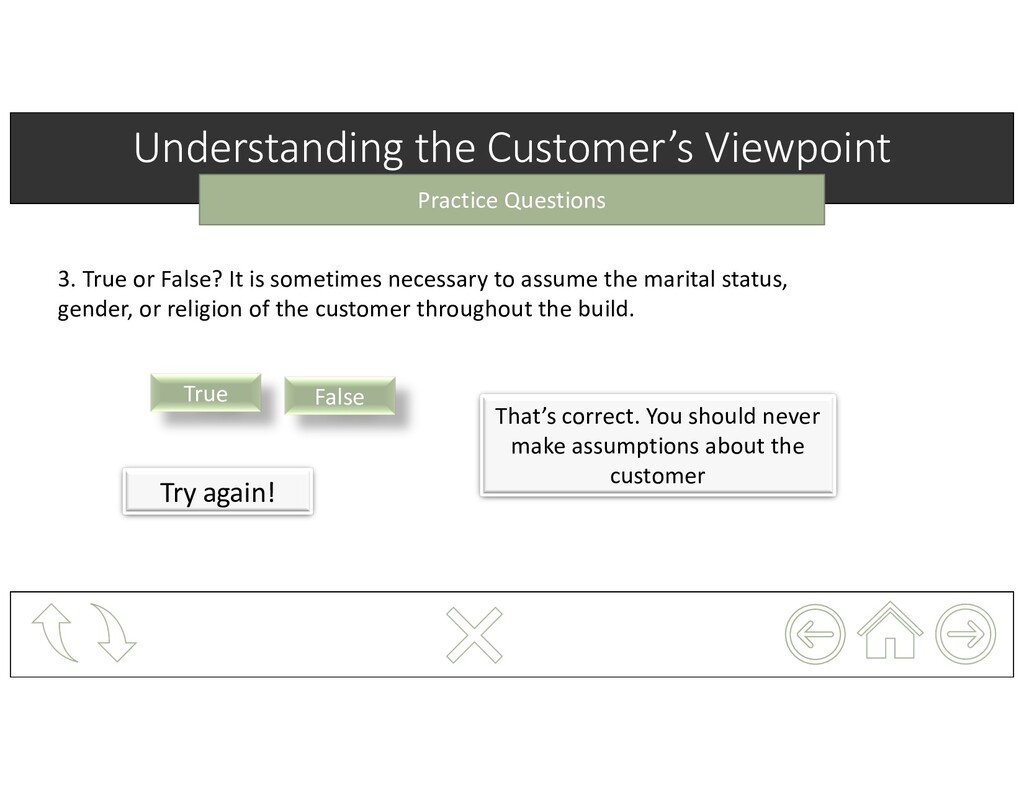
True or False? It is sometimes necessary to assume the marital status, gender, or religion of the customer throughout the build. True False Try again! That’s correct. You should never make assumptions about the customer
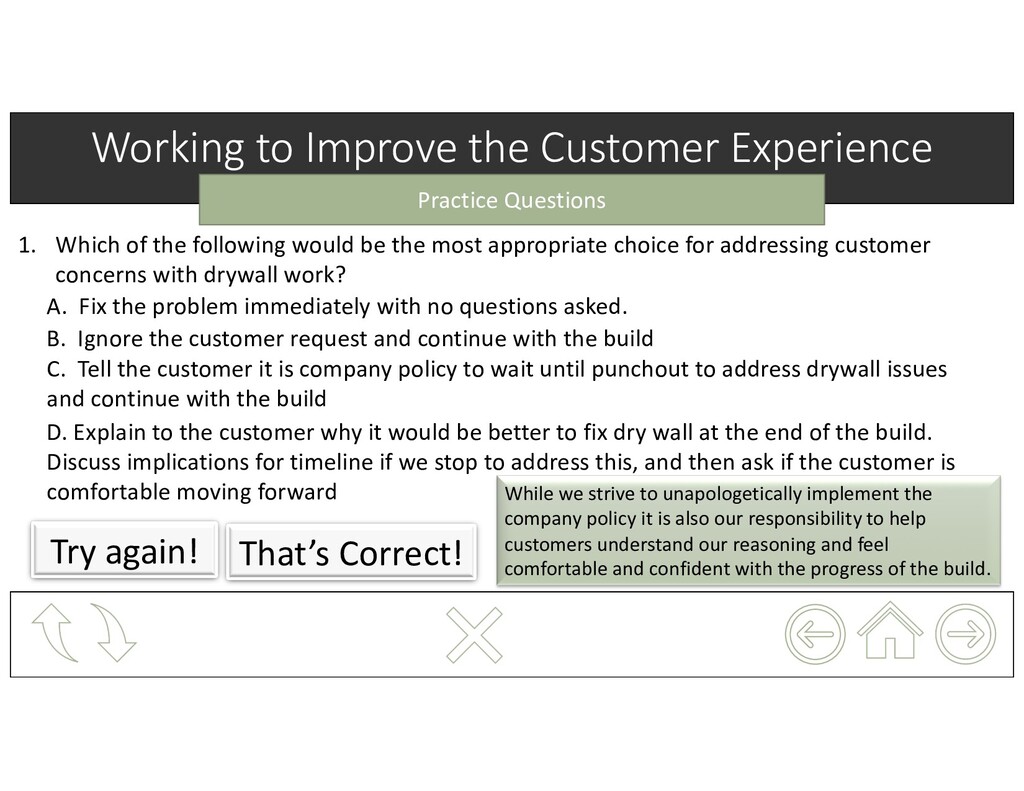
Questions 1. Which of the following would be the most appropriate choice for addressing customer concerns with drywall work? Try again! That’s Correct! While we strive to unapologetically implement the company policy it is also our responsibility to help customers understand our reasoning and feel comfortable and confident with the progress of the build. A. Fix the problem immediately with no questions asked. D. Explain to the customer why it would be better to fix dry wall at the end of the build. Discuss implications for timeline if we stop to address this, and then ask if the customer is comfortable moving forward C. Tell the customer it is company policy to wait until punchout to address drywall issues and continue with the build B. Ignore the customer request and continue with the build
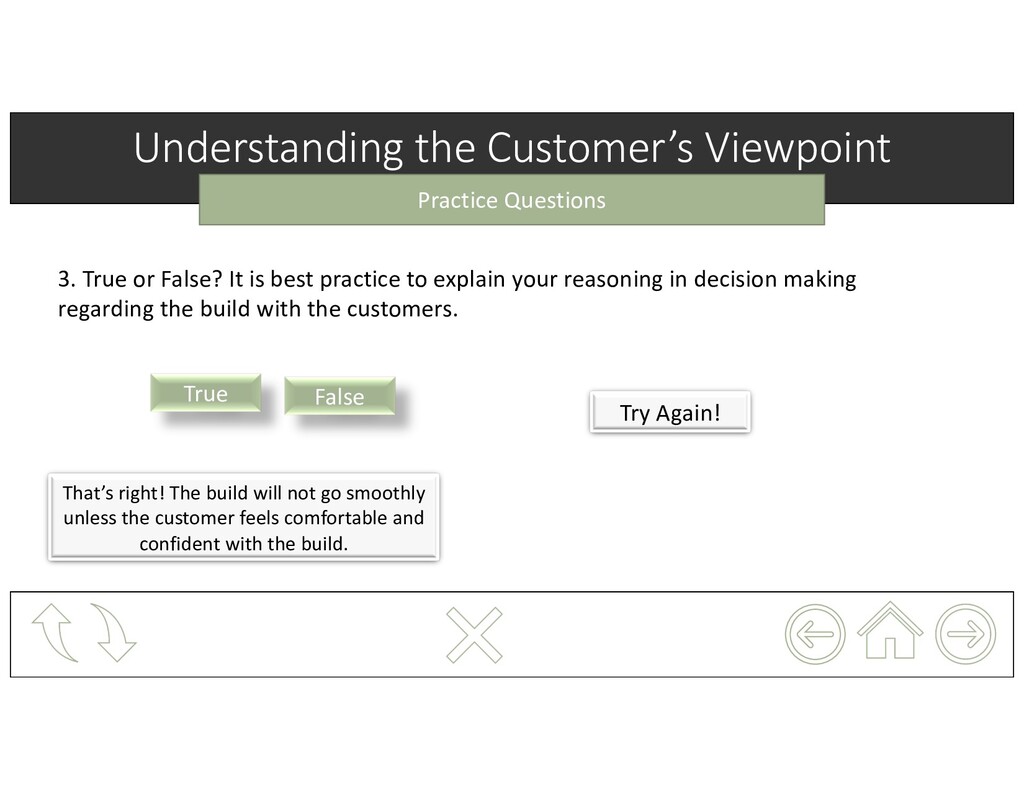
True or False? It is best practice to explain your reasoning in decision making regarding the build with the customers. True False That’s right! The build will not go smoothly unless the customer feels comfortable and confident with the build. Try Again!
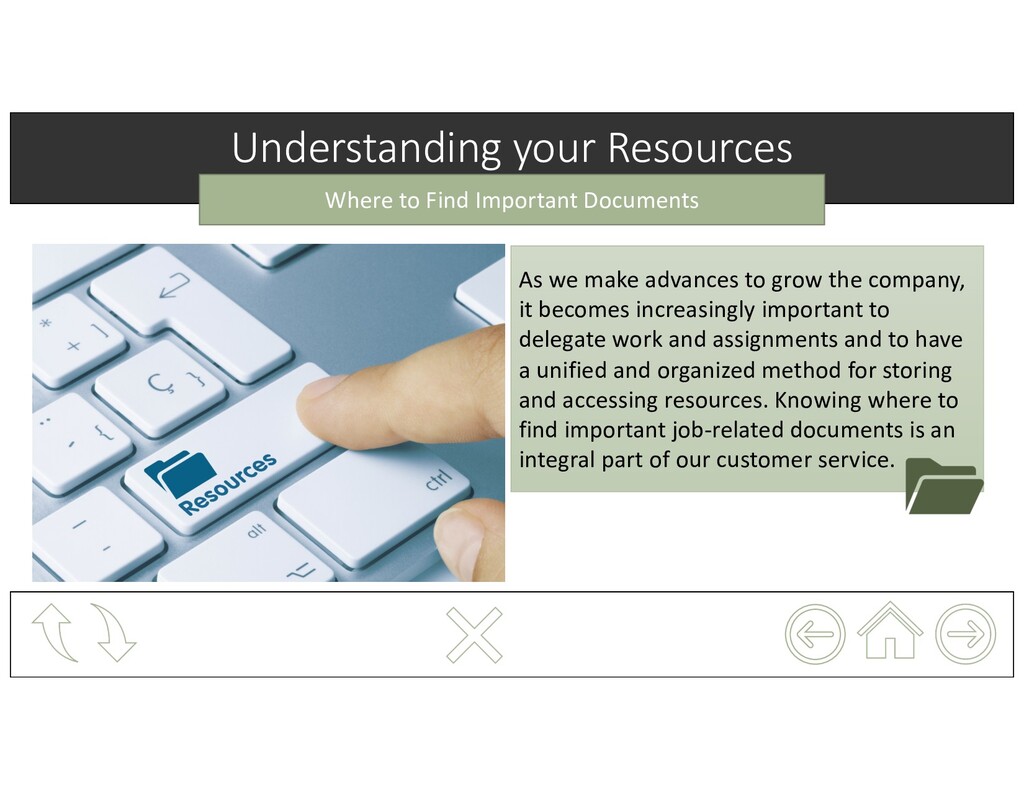
make advances to grow the company, it becomes increasingly important to delegate work and assignments and to have a unified and organized method for storing and accessing resources. Knowing where to find important job-related documents is an integral part of our customer service.
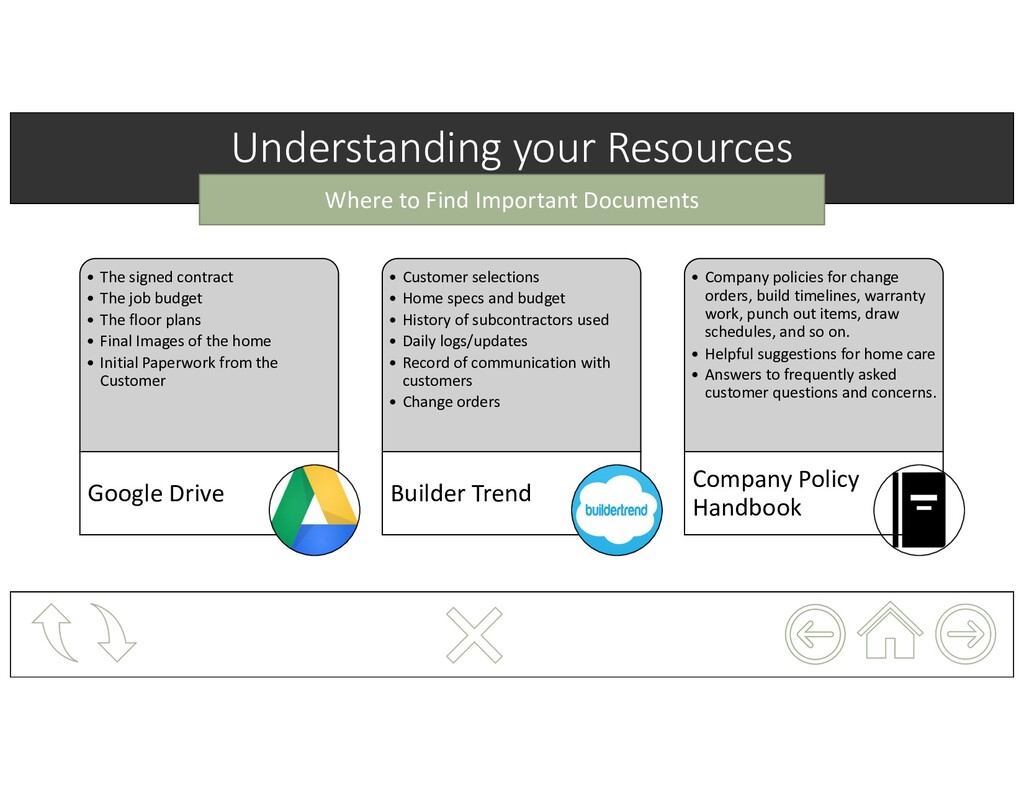
signed contract • The job budget • The floor plans • Final Images of the home • Initial Paperwork from the Customer Google Drive • Customer selections • Home specs and budget • History of subcontractors used • Daily logs/updates • Record of communication with customers • Change orders Builder Trend • Company policies for change orders, build timelines, warranty work, punch out items, draw schedules, and so on. • Helpful suggestions for home care • Answers to frequently asked customer questions and concerns. Company Policy Handbook
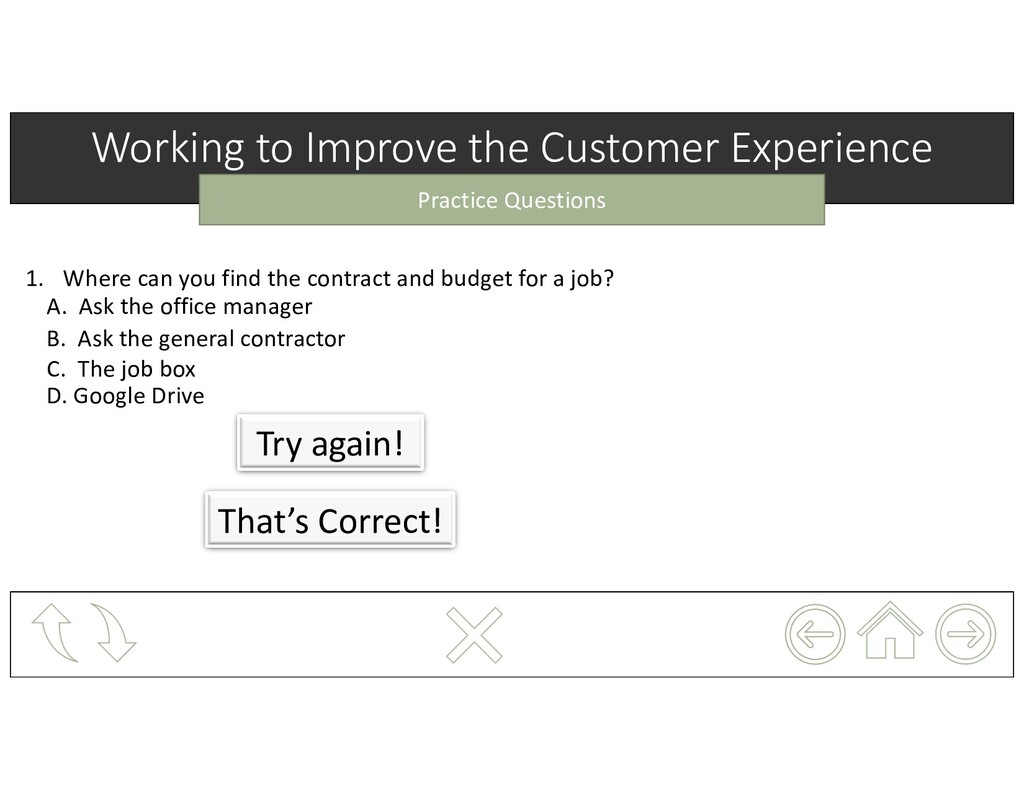
Questions 1. Where can you find the contract and budget for a job? Try again! That’s Correct! A. Ask the office manager D. Google Drive C. The job box B. Ask the general contractor
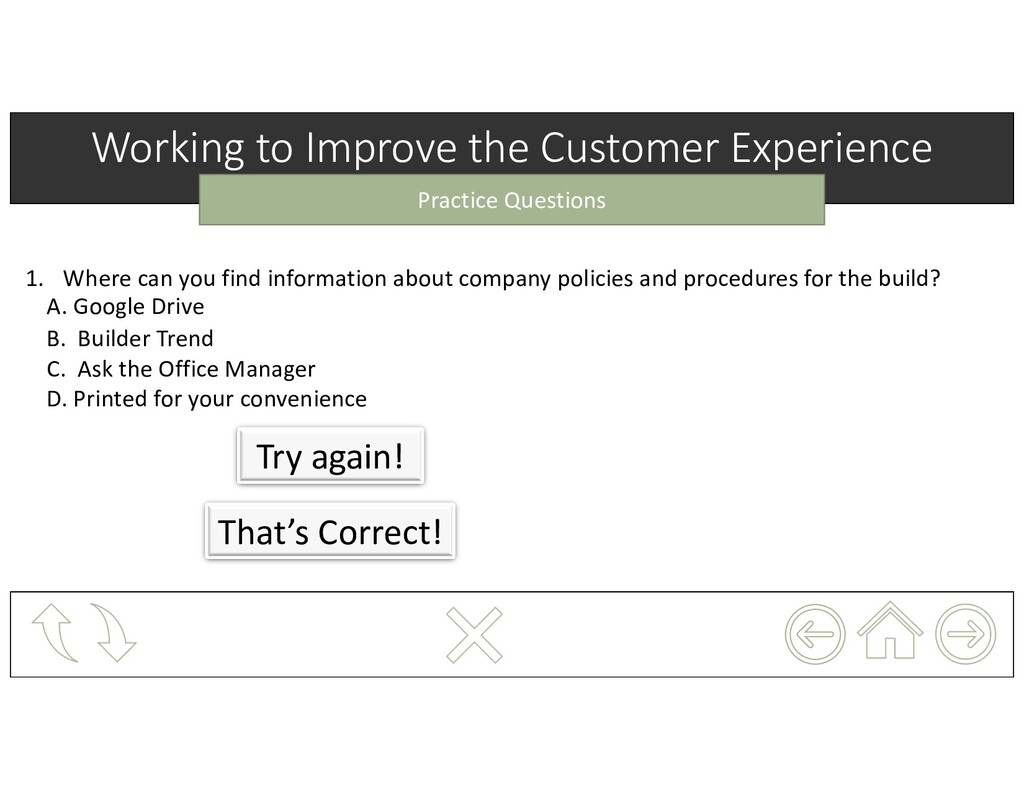
Questions 1. Where can you find information about company policies and procedures for the build? Try again! That’s Correct! A. Google Drive D. Printed for your convenience C. Ask the Office Manager B. Builder Trend
to the left to take the post assessment for this unit. • If you would like more time on any section, use the home icon on the bottom right to move back to the table of contents and navigate to any section of the material you would like to. Post Test

 Your Podcast. Everywhere. Effortlessly.


 uluru_hr
 kamadamakoto
 forest8810
 openwork
 uemura2024
 behealthy
 maruishi
 makaibito
 gpol
 ashisuto_career
 so_kotani
 uxyall
 pwiseman
 addyosmani
 nonsquared
 tenderlove
 tomoyanonymous
 inesmontani
 lara
 akihiro_kokubo
 marktimemedia
 sstephenson
 brettharned