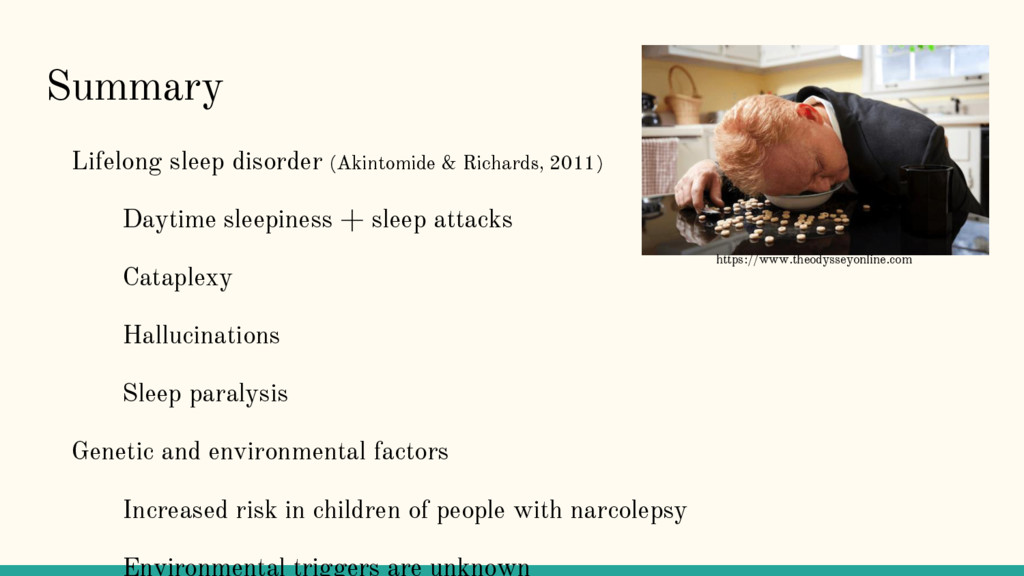
+ sleep attacks Cataplexy Hallucinations Sleep paralysis Genetic and environmental factors Increased risk in children of people with narcolepsy Environmental triggers are unknown https://www.theodysseyonline.com
Can occur when falling asleep or waking up Hallucinations Cataplexy (NINDS, 2016) Muscle weakness while a person is awake Feeling of loss of voluntary muscle control http://www.nejm.org/
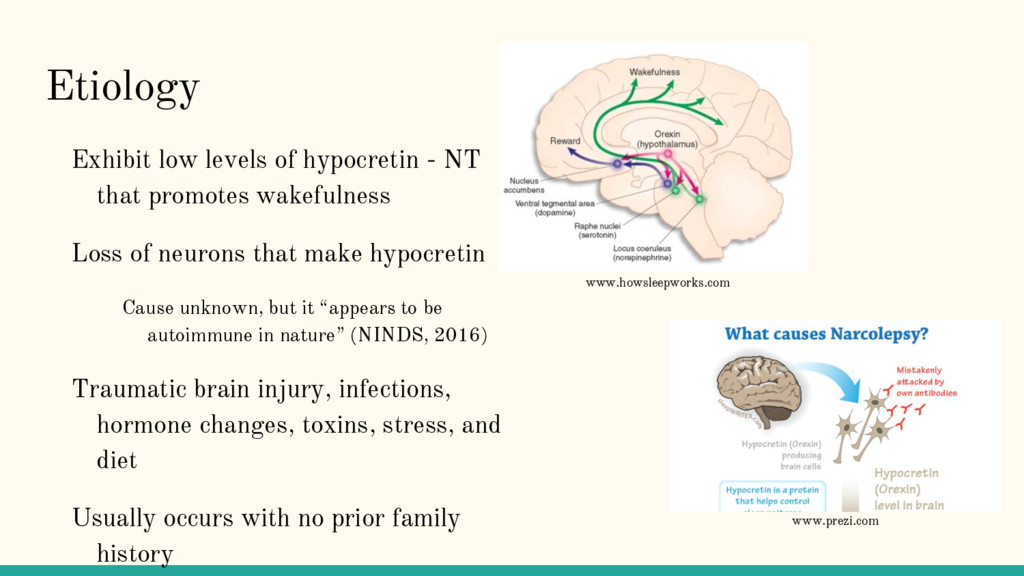
wakefulness Loss of neurons that make hypocretin Cause unknown, but it “appears to be autoimmune in nature” (NINDS, 2016) Traumatic brain injury, infections, hormone changes, toxins, stress, and diet Usually occurs with no prior family history www.howsleepworks.com www.prezi.com
2011) Narcolepsy with cataplexy Narcolepsy without cataplexy Secondary Narcolepsy Signs of Narcolepsy Cataplexy and other physical symptoms Polysomnography with MSLT test scores <8 minutes Must rely on clinical symptoms and test results www.paradisesleep.com
Membership ◦ Awareness ◦ Donation site ◦ Resource for support groups and nearby doctors ◦ Research participation opportunities • Support Groups http://narcolepsynetwork.org/
a review. Neuropsychiatric Disease and Treatment, 7, 507–518. http://doi.org/10.2147/NDT.S23624 Billiard, M. (2008). Narcolepsy: Current treatment options and future approaches. Neuropsychiatric Disease and Treatment. Narcolepsy fast facts. (2013). Retrieved from http://narcolepsynetwork.org/about-narcolepsy/ narcolepsy- fast-facts/ Narcolepsy Network. (n.d.). Retrieved November 28, 2016, from http://narcolepsynetwork.org/ O., N., & N. (2016, April 6). Narcolepsy Fact Sheet. Retrieved November 14, 2016, from http://www.ninds.nih.gov/disorders/narcolepsy/detail_narcolepsy.htm N., & N. (2016, April 6). Narcolepsy Fact Sheet. Retrieved November 10, 2016, from http://www.ninds.nih.gov/disorders/narcolepsy/detail_narcolepsy.htm


 takusamar
 naokimuroki
 estie
 konakalab
 miyayou
 sshimizu2006
 nozakijcom
 trycycle
 arfon
 hiranabe
 ryanjones
 baasie
 wayneb77
 addyosmani
 tammyeverts
 nikkihalliwell
 bluesmoon
 sabderemane
 chriscoyier
 codingconduct