Share
Embed

Transcript
61 slides
-
© 2015, Amazon Web Services, Inc. or its Affiliates. All
rights reserved. Julio M. Faerman @jmfaerman TOTVS Tech Trends Meetup – 16/03/2015 BDT310 - Siva Raghupathy, Principal Solutions Architect Padrões e Práticas para Big Data na AWS -
What to Expect from the Session Big data challenges How
to simplify big data processing What technologies should you use? • Why? • How? Reference architecture Design patterns -
Plethora of Tools Amazon Glacier S3 DynamoDB RDS
EMR Amazon Redshift Data Pipeline Amazon Kinesis Cassandra CloudSearch Kinesis- enabled app Lambda ML SQS ElastiCache DynamoDB Streams -
Is there a reference architecture ? What tools should I
use ? How ? Why ? -
Architectural Principles • Decoupled “data bus” • Data → Store
→ Process → Answers • Use the right tool for the job • Data structure, latency, throughput, access patterns • Use Lambda architecture ideas • Immutable (append-only) log, batch/speed/serving layer • Leverage AWS managed services • No/low admin • Big data ≠ big cost -
Simplify Big Data Processing ingest / collect store process /
analyze consume / visualize Time to Answer (Latency) Throughput Cost -
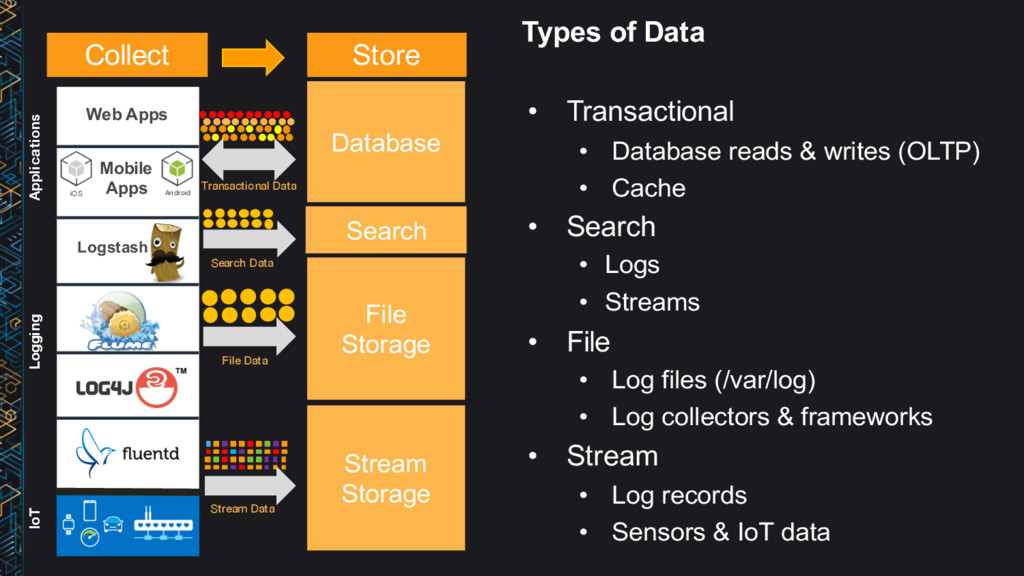
Types of Data • Transactional • Database reads & writes
(OLTP) • Cache • Search • Logs • Streams • File • Log files (/var/log) • Log collectors & frameworks • Stream • Log records • Sensors & IoT data Database File Storage Stream Storage A iOS Android Web Apps Logstash Logging IoT Applications Transactional Data File Data Stream Data Mobile Apps Search Data Search Collect Store Logging IoT -
Stream Storage A iOS Android Web Apps Logstash Amazon
RDS Amazon DynamoDB Amazon ES Amazon S3 Apache Kafka Amazon Glacier Amazon Kinesis Amazon DynamoDB Amazon ElastiCache Search SQL NoSQL Cache Stream Storage File Storage Transactional Data File Data Stream Data Mobile Apps Search Data Database File Storage Search Collect Store Logging IoT Applications ü -
Stream Storage Options • AWS managed services • Amazon Kinesis
→ streams • DynamoDB Streams → table + streams • Amazon SQS → queue • Amazon SNS → pub/sub • Unmanaged • Apache Kafka → stream -
Why Stream Storage? • Decouple producers & consumers • Persistent
buffer • Collect multiple streams • Preserve client ordering • Streaming MapReduce • Parallel consumption 4 4 3 3 2 2 1 1 4 3 2 1 4 3 2 1 4 3 2 1 4 3 2 1 4 4 3 3 2 2 1 1 Shard 1 / Partition 1 Shard 2 / Partition 2 Consumer 1 Count of Red = 4 Count of Violet = 4 Consumer 2 Count of Blue = 4 Count of Green = 4 Kafka Topic DynamoDB Stream Kinesis Stream -
What About Queues & Pub/Sub ? • Decouple producers
& consumers/subscribers • Persistent buffer • Collect multiple streams • No client ordering • No parallel consumption for Amazon SQS • Amazon SNS can route to multiple queues or ʎ functions • No streaming MapReduce Consumers Producers Producers Amazon SNS Amazon SQS queue topic function ʎ AWS Lambda Amazon SQS queue Subscriber -
Which stream storage should I use? Amazon Kinesis DynamoDB Streams
Amazon SQS Amazon SNS Kafka Managed Yes Yes Yes No Ordering Yes Yes No Yes Delivery at-least-once exactly-once at-least-once at-least-once Lifetime 7 days 24 hours 14 days Configurable Replication 3 AZ 3 AZ 3 AZ Configurable Throughput No Limit No Limit No Limit ~ Nodes Parallel Clients Yes Yes No (SQS) Yes MapReduce Yes Yes No Yes Record size 1MB 400KB 256KB Configurable Cost Low Higher(table cost) Low-Medium Low (+admin) -
File Storage A iOS Android Web Apps Logstash Amazon RDS
Amazon DynamoDB Amazon ES Amazon S3 Apache Kafka Amazon Glacier Amazon Kinesis Amazon DynamoDB Amazon ElastiCache Search SQL NoSQL Cache Stream Storage File Storage Transactional Data File Data Stream Data Mobile Apps Search Data Database Search Collect Store Logging IoT Applications ü -
Why Is Amazon S3 Good for Big Data? • Natively
supported by big data frameworks (Spark, Hive, Presto, etc.) • No need to run compute clusters for storage (unlike HDFS) • Can run transient Hadoop clusters & Amazon EC2 Spot instances • Multiple distinct (Spark, Hive, Presto) clusters can use the same data • Unlimited number of objects • Very high bandwidth – no aggregate throughput limit • Highly available – can tolerate AZ failure • Designed for 99.999999999% durability • Tired-storage (Standard, IA, Amazon Glacier) via life-cycle policy • Secure – SSL, client/server-side encryption at rest • Low cost -
What about HDFS & Amazon Glacier? • Use HDFS for
very frequently accessed (hot) data • Use Amazon S3 Standard for frequently accessed data • Use Amazon S3 Standard – IA for infrequently accessed data • Use Amazon Glacier for archiving cold data -
Database + Search Tier A iOS Android Web
Apps Logstash Amazon RDS Amazon DynamoDB Amazon ES Amazon S3 Apache Kafka Amazon Glacier Amazon Kinesis Amazon DynamoDB Amazon ElastiCache Search SQL NoSQL Cache Stream Storage File Storage Transactional Data File Data Stream Data Mobile Apps Search Data Collect Store ü -
Best Practice — Use the Right Tool for the Job
Data Tier Search Amazon Elasticsearch Service Amazon CloudSearch Cache Redis Memcached SQL Amazon Aurora MySQL PostgreSQL Oracle SQL Server NoSQL Cassandra Amazon DynamoDB HBase MongoDB Applications Database + Search Tier -
What Data Store Should I Use? • Data structure →
Fixed schema, JSON, key-value • Access patterns → Store data in the format you will access it • Data / access characteristics → Hot, warm, cold • Cost → Right cost -
Data Structure and Access Patterns Access Patterns What to use?
Put/Get (Key, Value) Cache, NoSQL Simple relationships → 1:N, M:N NoSQL Cross table joins, transaction, SQL SQL Faceting, Search Search Data Structure What to use? Fixed schema SQL, NoSQL Schema-free (JSON) NoSQL, Search (Key, Value) Cache, NoSQL -
Data / Access Characteristics: Hot, Warm, Cold Hot Warm Cold
Volume MB–GB GB–TB PB Item size B–KB KB–MB KB–TB Latency ms ms, sec min, hrs Durability Low–High High Very High Request rate Very High High Low Cost/GB $$-$ $-¢¢ ¢ Hot Data Warm Data Cold Data -
What Data Store Should I Use? Amazon ElastiCache Amazon
DynamoDB Amazon Aurora Amazon Elasticsearch Amazon EMR (HDFS) Amazon S3 Amazon Glacier Average latency ms ms ms, sec ms,sec sec,min,hrs ms,sec,min (~ size) hrs Data volume GB GB–TBs (no limit) GB–TB (64 TB Max) GB–TB GB–PB (~nodes) MB–PB (no limit) GB–PB (no limit) Item size B-KB KB (400 KB max) KB (64 KB) KB (1 MB max) MB-GB KB-GB (5 TB max) GB (40 TB max) Request rate High - Very High Very High (no limit) High High Low – Very High Low – Very High (no limit) Very Low Storage cost GB/month $$ ¢¢ ¢¢ ¢¢ ¢ ¢ ¢/10 Durability Low - Moderate Very High Very High High High Very High Very High Hot Data Warm Data Cold Data Hot Data Warm Data Cold Data -
Cache SQL Request Rate High Low Cost/GB High Low Latency
Low High Data Volume Low High Glacier Structure NoSQL Hot Data Warm Data Cold Data Low High Search -
Cost Conscious Design Example: Should I use Amazon S3
or Amazon DynamoDB? “I’m currently scoping out a project that will greatly increase my team’s use of Amazon S3. Hoping you could answer some questions. The current iteration of the design calls for many small files, perhaps up to a billion during peak. The total size would be on the order of 1.5 TB per month…” Request rate (Writes/sec) Object size (Bytes) Total size (GB/month) Objects per month 300 2048 1483 777,600,000 -
Cost Conscious Design Example: Should I use Amazon S3
or Amazon DynamoDB? https://calculator.s3.amazonaws.com/index.html -
Request rate (Writes/sec) Object size (Bytes) Total size (GB/month)
Objects per month 300 2,048 1,483 777,600,000 Amazon S3 or Amazon DynamoDB? -
Request rate (Writes/sec) Object size (Bytes) Total size (GB/month)
Objects per month Scenario 1300 2,048 1,483 777,600,000 Scenario 2300 32,768 23,730 777,600,000 Amazon S3 Amazon DynamoDB use use -
Analyze A iOS Android Web Apps Logstash Amazon RDS Amazon
DynamoDB Amazon ES Amazon S3 Apache Kafka Amazon Glacier Amazon Kinesis Amazon DynamoDB Amazon Redshift Impala Pig Amazon ML Streaming Amazon Kinesis AWS Lambda Amazon Elastic MapReduce Amazon ElastiCache Search SQL NoSQL Cache Stream Processing Batch Interactive Logging Stream Storage IoT Applications File Storage Hot Cold War m Hot Hot ML Transactional Data File Data Stream Data Mobile Apps Search Data Collect Store Analyze ü ü -
Process / Analyze Analysis of data is a process of
inspecting, cleaning, transforming, and modeling data with the goal of discovering useful information, suggesting conclusions, and supporting decision-making. Examples • Interactive dashboards → Interactive analytics • Daily/weekly/monthly reports → Batch analytics • Billing/fraud alerts, 1 minute metrics → Real-time analytics • Sentiment analysis, prediction models → Machine learning -
Interactive Analytics Takes large amount of (warm/cold) data Takes seconds
to get answers back Example: Self-service dashboards -
Batch Analytics Takes large amount of (warm/cold) data Takes minutes
or hours to get answers back Example: Generating daily, weekly, or monthly reports -
Real-Time Analytics Take small amount of hot data and ask
questions Takes short amount of time (milliseconds or seconds) to get your answer back • Real-time (event) • Real-time response to events in data streams • Example: Billing/Fraud Alerts • Near real-time (micro-batch) • Near real-time operations on small batches of events in data streams • Example: 1 Minute Metrics -
Predictions via Machine Learning ML gives computers the ability to
learn without being explicitly programmed Machine Learning Algorithms: - Supervised Learning ← “teach” program - Classification ← Is this transaction fraud? (Yes/No) - Regression ← Customer Life-time value? - Unsupervised Learning ← let it learn by itself - Clustering ← Market Segmentation -
Analysis Tools and Frameworks Machine Learning • Mahout, Spark ML,
Amazon ML Interactive Analytics • Amazon Redshift, Presto, Impala, Spark Batch Processing • MapReduce, Hive, Pig, Spark Stream Processing • Micro-batch: Spark Streaming, KCL, Hive, Pig • Real-time: Storm, AWS Lambda, KCL Amazon Redshift Impala Pig Amazon Machine Learning Streaming Amazon Kinesis AWS Lambda Amazon Elastic MapReduce Stream Processing Batch Interactive ML Analyze -
What Stream Processing Technology Should I Use? Spark Streaming Apache
Storm Amazon Kinesis Client Library AWS Lambda Amazon EMR (Hive, Pig) Scale / Throughput ~ Nodes ~ Nodes ~ Nodes Automatic ~ Nodes Batch or Real- time Real-time Real-time Real-time Real-time Batch Manageability Yes (Amazon EMR) Do it yourself Amazon EC2 + Auto Scaling AWS managed Yes (Amazon EMR) Fault Tolerance Single AZ Configurable Multi-AZ Multi-AZ Single AZ Programming languages Java, Python, Scala Any language via Thrift Java, via MultiLangDaemon ( .Net, Python, Ruby, Node.js) Node.js, Java Hive, Pig, Streaming languages High -
What Data Processing Technology Should I Use? Amazon Redshift Impala
Presto Spark Hive Query Latency Low Low Low Low Medium (Tez) – High (MapReduce) Durability High High High High High Data Volume 1.6 PB Max ~Nodes ~Nodes ~Nodes ~Nodes Managed Yes Yes (EMR) Yes (EMR) Yes (EMR) Yes (EMR) Storage Native HDFS / S3A* HDFS / S3 HDFS / S3 HDFS / S3 SQL Compatibility High Medium High Low (SparkSQL) Medium (HQL) High Medium -
Collect Store Analyze Consume A iOS Android Web Apps Logstash
Amazon RDS Amazon DynamoDB Amazon ES Amazon S3 Apache Kafka Amazon Glacier Amazon Kinesis Amazon DynamoDB Amazon Redshift Impala Pig Amazon ML Streaming Amazon Kinesis AWS Lambda Amazon Elastic MapReduce Amazon ElastiCache Search SQL NoSQL Cache Stream Processing Batch Interactive Logging Stream Storage IoT Applications File Storage Analysis & Visualization Hot Cold War m Hot Slow Hot ML Fast Fast Transactional Data File Data Stream Data Notebook s Predictions Apps & APIs Mobile Apps IDE Search Data ETL Amazon QuickSight -
Consume • Predictions • Analysis and Visualization • Notebooks
• IDE • Applications & API Consume Analysis & Visualization Amazon QuickSight Notebook s Predictions Apps & APIs IDE Store Analyze Consume ETL Business users Data Scientist, Developers -
Collect Store Analyze Consume A iOS Android Web Apps Logstash
Amazon RDS Amazon DynamoDB Amazon ES Amazon S3 Apache Kafka Amazon Glacier Amazon Kinesis Amazon DynamoDB Amazon Redshift Impala Pig Amazon ML Streaming Amazon Kinesis AWS Lambda Amazon Elastic MapReduce Amazon ElastiCache Search SQL NoSQL Cache Stream Processing Batch Interactive Logging Stream Storage IoT Applications File Storage Analysis & Visualization Hot Cold War m Hot Slow Hot ML Fast Fast Amazon QuickSight Transactional Data File Data Stream Data Notebook s Predictions Apps & APIs Mobile Apps IDE Search Data ETL Reference Architecture -
Multi-Stage Decoupled “Data Bus” • Multiple stages • Storage decoupled
from processing Store Process Store Process process store -
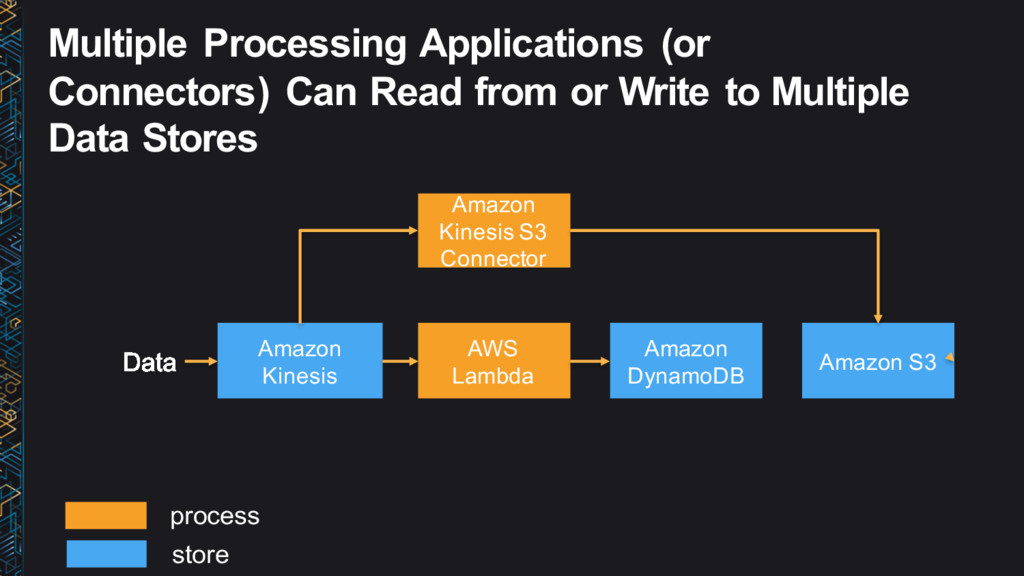
Multiple Processing Applications (or Connectors) Can Read
from or Write to Multiple Data Stores Amazon Kinesis AWS Lambda Amazon DynamoDB Amazon Kinesis S3 Connector Amazon S3 process store -
Processing Frameworks (KCL, Storm, Hive, Spark, etc.) Could Read
from Multiple Data Stores Amazon Kinesis AWS Lambda Amazon S3 Amazon DynamoDB Hive Spark Storm Amazon Kinesis S3 Connector process store -
Spark Streaming Apache Storm AWS Lambda KCL Amazon
Redshift Spark Impala Presto Hive Amazon Redshift Hive Spark Presto Impala Amazon Kinesis Apache Kafka Amazon DynamoDB Amazon S3 data Hot Cold Data Temperature Processing Latency Low High Answers Amazon EMR (HDFS) Hive Native KCL AWS Lambda Data Temperature vs Processing Latency Batch -
Real-time Analytics Producer Apache Kafka KCL AWS Lambda Spark Streaming
Apache Storm Amazon SNS Amazon ML Notifications Amazon ElastiCache (Redis) Amazon DynamoDB Amazon RDS Amazon ES Alert App state Real-time Prediction KPI process store DynamoDB Streams Amazon Kinesis -
Interactive & Batch Analytics Producer Amazon S3 Amazon EMR
Hive Pig Spark Amazon ML process store Consume Amazon Redshift Amazon EMR Presto Impala Spark Batch Interactive Batch Prediction Real-time Prediction -
Batch Layer Amazon Kinesis data process store Lambda Architecture Amazon
Kinesis S3 Connector Amazon S3 A p p l i c a t i o n s Amazon Redshift Amazon EMR Presto Hive Pig Spark answer Speed Layer answer Serving Layer Amazon ElastiCache Amazon DynamoDB Amazon RDS Amazon ES answer Amazon ML KCL AWS Lambda Spark Streaming Storm -
Summary • Build decoupled “data bus” • Data → Store
↔ Process → Answers • Use the right tool for the job • Latency, throughput, access patterns • Use Lambda architecture ideas • Immutable (append-only) log, batch/speed/serving layer • Leverage AWS managed services • No/low admin • Be cost conscious • Big data ≠ big cost -
* As of 1 Mar 2016 2009 48 280 722
82 2011 2013 2015 AWS has been continually expanding its’ services to support virtually any cloud workload and now has more than 70 services that range from compute, storage, networking, database, analytics, application services, deployment, management and mobile. AWS has launched a total of 106 new features and/or services year to date*, for a total of 2,002 new features and/or services since inception in 2006. AWS Rapid Pace of Innovation -
© 2015, Amazon Web Services, Inc. or its Affiliates. All
rights reserved. Julio M. Faerman @jmfaerman TOTVS Tech Trends Meetup – 16/03/2015 Obrigado! Perguntas?
 faermanj
 nobitabashi
 oidfj
 inariku
 bulbulpaul
 nagix
 sms_tech
 yoshidashingo
 torounit
 gotok365
 optim
 akuwano
 takai
 axbom
 eileencodes
 chriscoyier
 inesmontani
 nikkihalliwell
 portentint
 mfonobong
 rabernat
 lara
 marketingsoph
 stephaniewalter