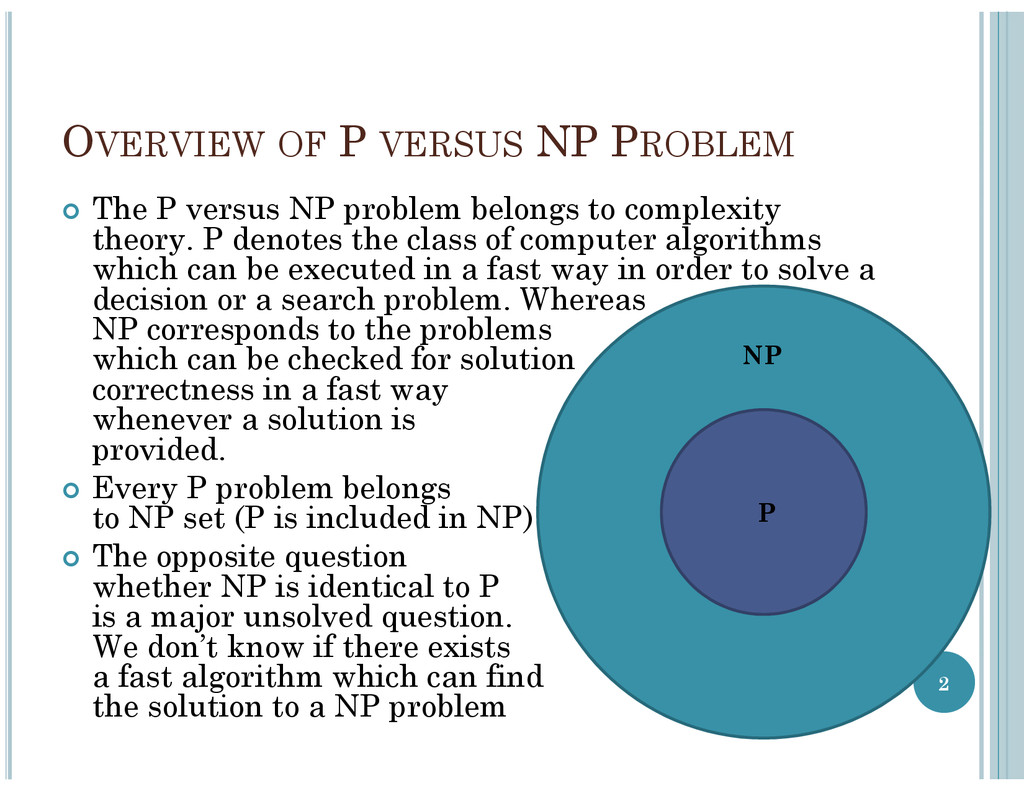
NP problem belongs to complexity theory. P denotes the class of computer algorithms which can be executed in a fast way in order to solve a decision or a search problem. Whereas NP corresponds to the problems which can be checked for solution correctness in a fast way whenever a solution is provided. Every P problem belongs to NP set (P is included in NP) The opposite question whether NP is identical to P is a major unsolved question. We don’t know if there exists a fast algorithm which can find the solution to a NP problem P NP 2
is the class of problems solved by a deterministic Turing machine in a polynomial time. NP is the class of problems which are solved by a non-deterministic Turing machine in a polynomial time, which means it can be solved by brute force algorithm in an exponential time. We know that any P problem is also an NP one. In fact the fast algorithm that solves the P problem can be its fast verification algorithm. The question is could we find an NP problem which doesn’t have definitely a fast algorithm to solve it. If so then NP is different from P. If no then NP is identical to P. 3
problem in theoretical computer science. Its solution can deepen our understanding of algorithm complexity or maybe it will give us a mathematical tool for solving hard problems in an efficient way. Great work has been spent on providing a solution but no one has ever been able to solve it. 4
by Cook in 1971 in a paper where he proved the first NP-Complete problem: the Boolean satisfiability problem. Also he proved that any NP problem could be reduced to an NP-Complete one using a Turing machine in a polynomial time. In 1973 Karp gave another 21 NP-Complete problems. Since then tremendous effort has been deployed to find an algorithm that will reduce any NP problem to P, or on the contrary to prove that these two classes of problems are different. 5
large impact which makes it a fundamental open problem. Imagine one could derive a polynomial time algorithm for solving an NP-Complete problem, then any NP problem with exponential time could be reduced and solved in a polynomial time in an efficient way. No such algorithm has been found, nor the impossibility to find such an algorithm has been proved. 6
the result will have an impact on several domains: theorem proving could be done in an efficient and tractable way. Optimization and resource management will be an easy matter. The impact will be tremendous on many and unthought-of domains such as evolutional biology and economics and much more. If P equals NP then current cryptographic schemes will be broken in a reasonable time and power. The one way functions assumed to be hard could be broken like a piece of toy. But many experts think that P is not equal to NP. 7


 akiraasano
 juanmartin2026
 signer
 drpoonamkc
 pawan_pharm
 2720japanoke
 kentaroy47
 cbtlibrary
 masakiokuda
 soudai
 ainischool
 reverentgeek
 addyosmani
 jmmastey
 shpigford
 mfonobong
 inesmontani
 kimpetersen
 helenjbeal
 schroneko
 tammyeverts
 tamaranovitovic
 skipperchong