Upgrade to Pro — share decks privately, control downloads, hide ads and more …

Memb - The Importance of Intonation

Sponsored · Your Podcast. Everywhere. Effortlessly. Share. Educate. Inspire. Entertain. You do you. We'll handle the rest.

Memb - The Importance of Intonation

Transcript

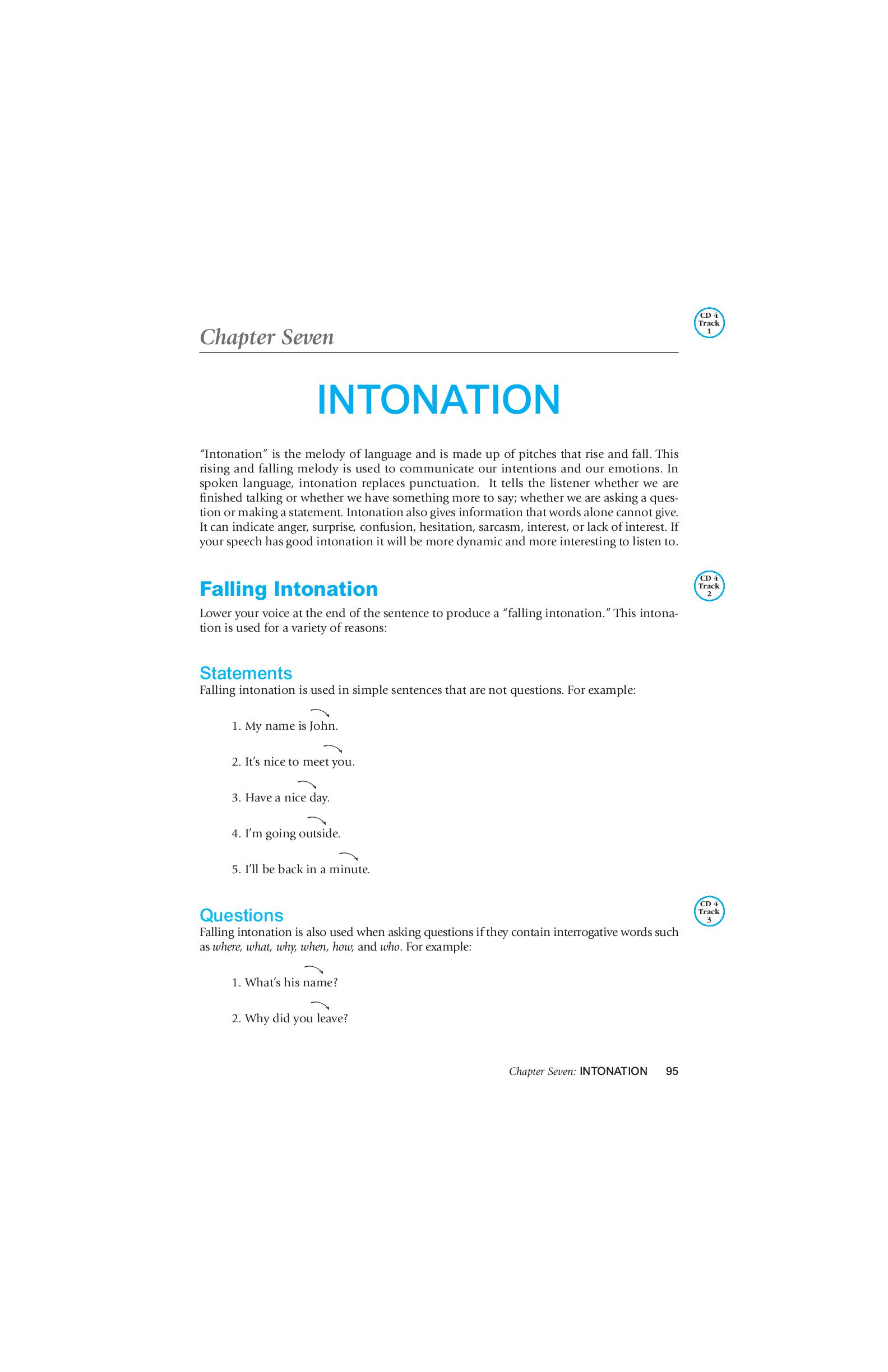
  1. CD 4 Track 1 Chapter Seven INTONATION “Intonation” is the

    melody of language and is made up of pitches that rise and fall. This rising and falling melody is used to communicate our intentions and our emotions. In spoken language, intonation replaces punctuation. It tells the listener whether we are finished talking or whether we have something more to say; whether we are asking a question or making a statement. Intonation also gives information that words alone cannot give. It can indicate anger, surprise, confusion, hesitation, sarcasm, interest, or lack of interest. If your speech has good intonation it will be more dynamic and more interesting to listen to. CD 4 Track 2 Falling Intonation Lower your voice at the end of the sentence to produce a “falling intonation.” This intonation is used for a variety of reasons: Statements Falling intonation is used in simple sentences that are not questions. For example: 哬 1. My name is John. 哬 2. It’s nice to meet you. 哬 3. Have a nice day. 哬 4. I’m going outside. 哬 5. I’ll be back in a minute. CD 4 Track 3 Questions Falling intonation is also used when asking questions if they contain interrogative words such as where, what, why, when, how, and who. For example: 哬 1. What’s his name? 哬 2. Why did you leave? Chapter Seven: INTONATION 95
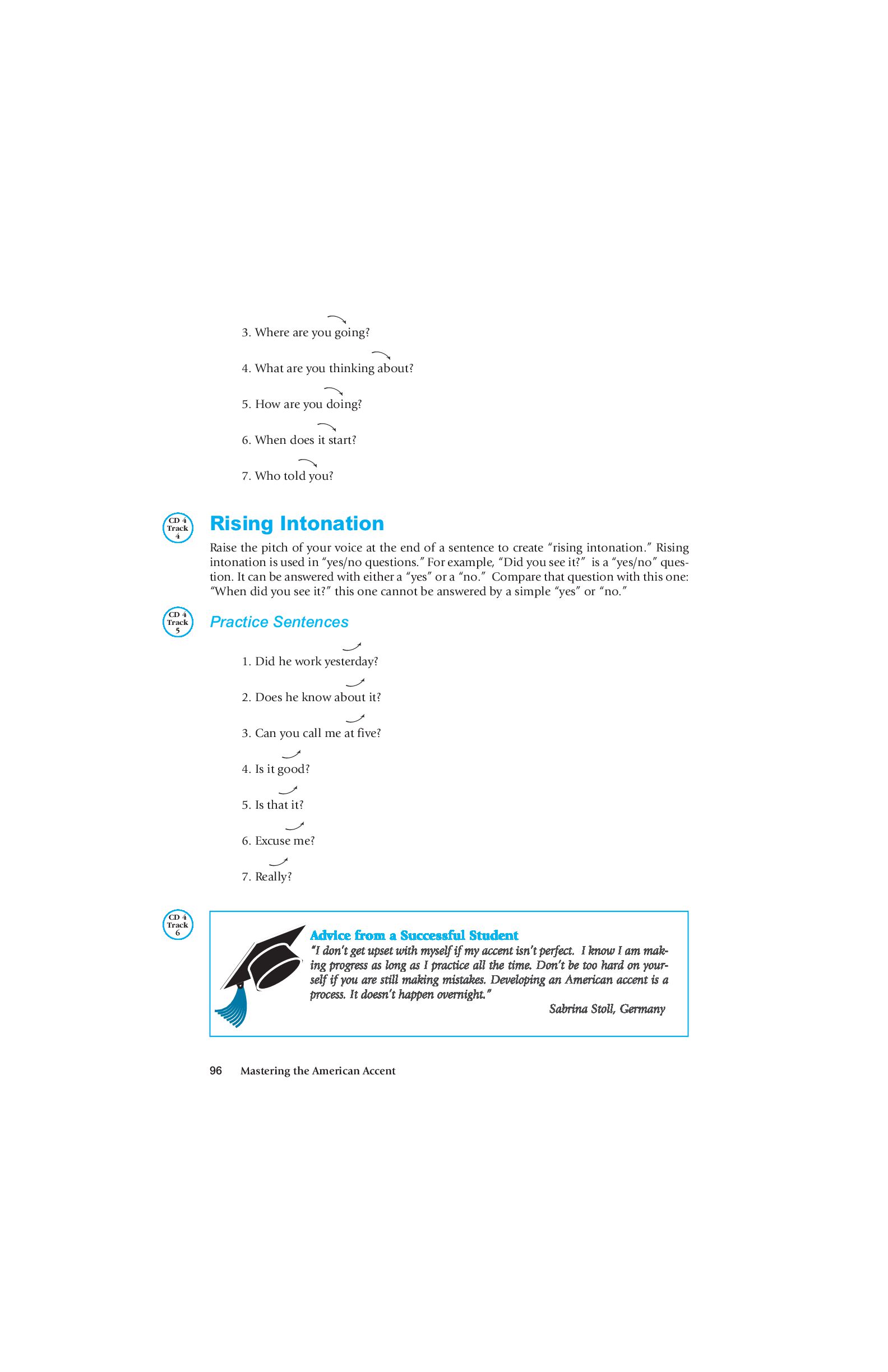
  2. 哬 3. Where are you going? 哬 4. What are

    you thinking about? 哬 5. How are you doing? 哬 6. When does it start? 哬 7. Who told you? CD 4 Track 4 Rising Intonation Raise the pitch of your voice at the end of a sentence to create “rising intonation.” Rising intonation is used in “yes/no questions.” For example, “Did you see it?” is a “yes/no” question. It can be answered with either a “yes” or a “no.” Compare that question with this one: “When did you see it?” this one cannot be answered by a simple “yes” or “no.” CD 4 Track 5 Practice Sentences 哭 1. Did he work yesterday? 哭 2. Does he know about it? 哭 3. Can you call me at five? 哭 4. Is it good? 哭 5. Is that it? 哭 6. Excuse me? 哭 7. Really? CD 4 Track 6 Advice from a Successful Student 1B “I don’t get upset with myself if my accent isn’t perfect. I know I am making progress as long as I practice all the time. Don’t be too hard on yourself if you are still making mistakes. Developing an American accent is a process. It doesn’t happen overnight.” Sabrina Stoll, Germany 96 Mastering the American Accent
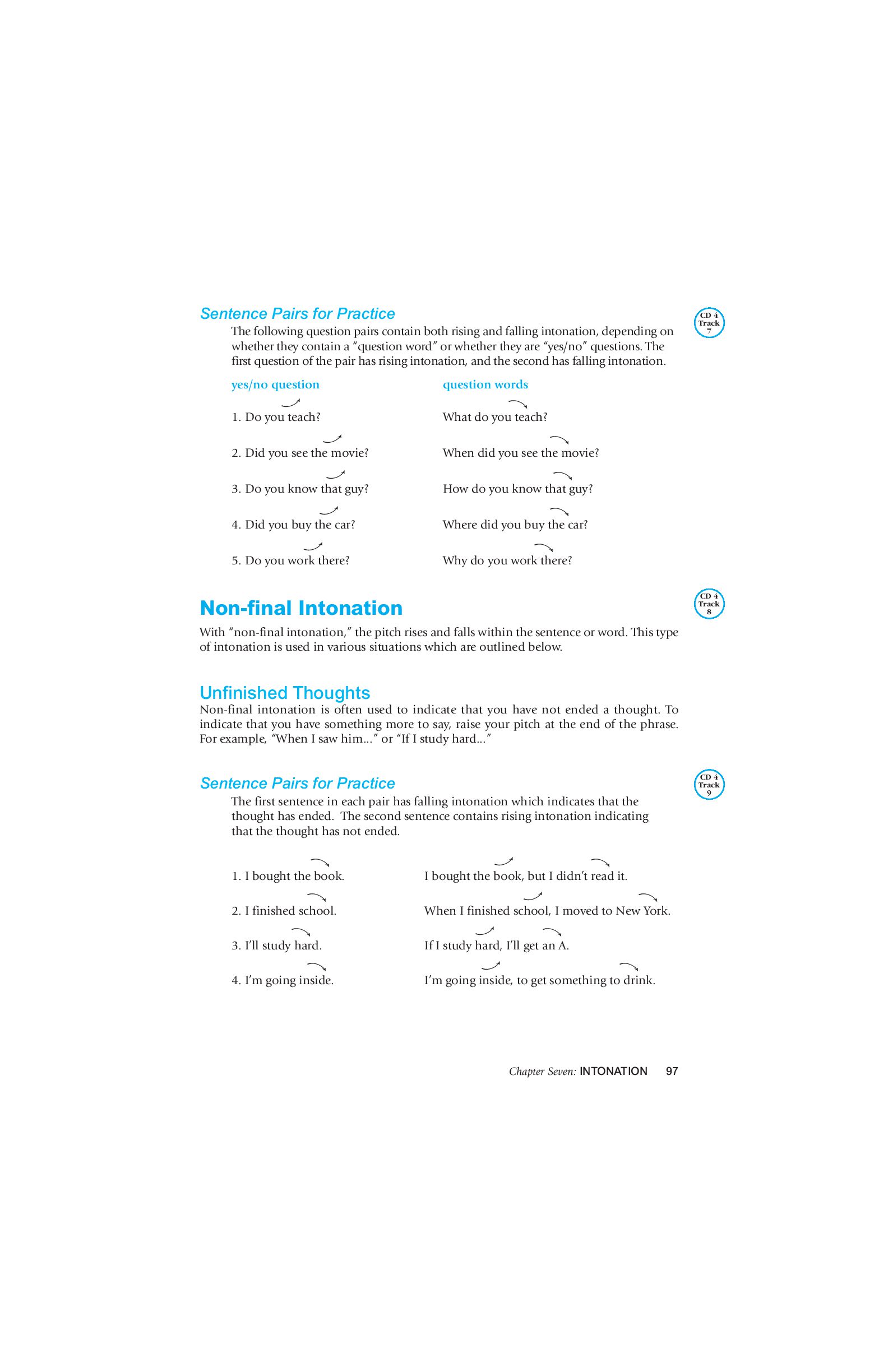
  3. Sentence Pairs for Practice The following question pairs contain both

    rising and falling intonation, depending on whether they contain a “question word” or whether they are “yes/no” questions. The first question of the pair has rising intonation, and the second has falling intonation. yes/no question 哭 1. Do you teach? 哭 2. Did you see the movie? 哭 3. Do you know that guy? 哭 4. Did you buy the car? 哭 5. Do you work there? CD 4 Track 7 question words 哬 What do you teach? 哬 When did you see the movie? 哬 How do you know that guy? 哬 Where did you buy the car? 哬 Why do you work there? CD 4 Track 8 Non-final Intonation With “non-final intonation,” the pitch rises and falls within the sentence or word. This type of intonation is used in various situations which are outlined below. Unfinished Thoughts Non-final intonation is often used to indicate that you have not ended a thought. To indicate that you have something more to say, raise your pitch at the end of the phrase. For example, “When I saw him...” or “If I study hard...” CD 4 Track 9 Sentence Pairs for Practice The first sentence in each pair has falling intonation which indicates that the thought has ended. The second sentence contains rising intonation indicating that the thought has not ended. 哬 1. I bought the book. 哬 2. I finished school. 哬 3. I’ll study hard. 哬 4. I’m going inside. 哬 哭 I bought the book, but I didn’t read it. 哬 哭 When I finished school, I moved to New York. 哬 哭 If I study hard, I’ll get an A. 哬 哭 I’m going inside, to get something to drink. Chapter Seven: INTONATION 97
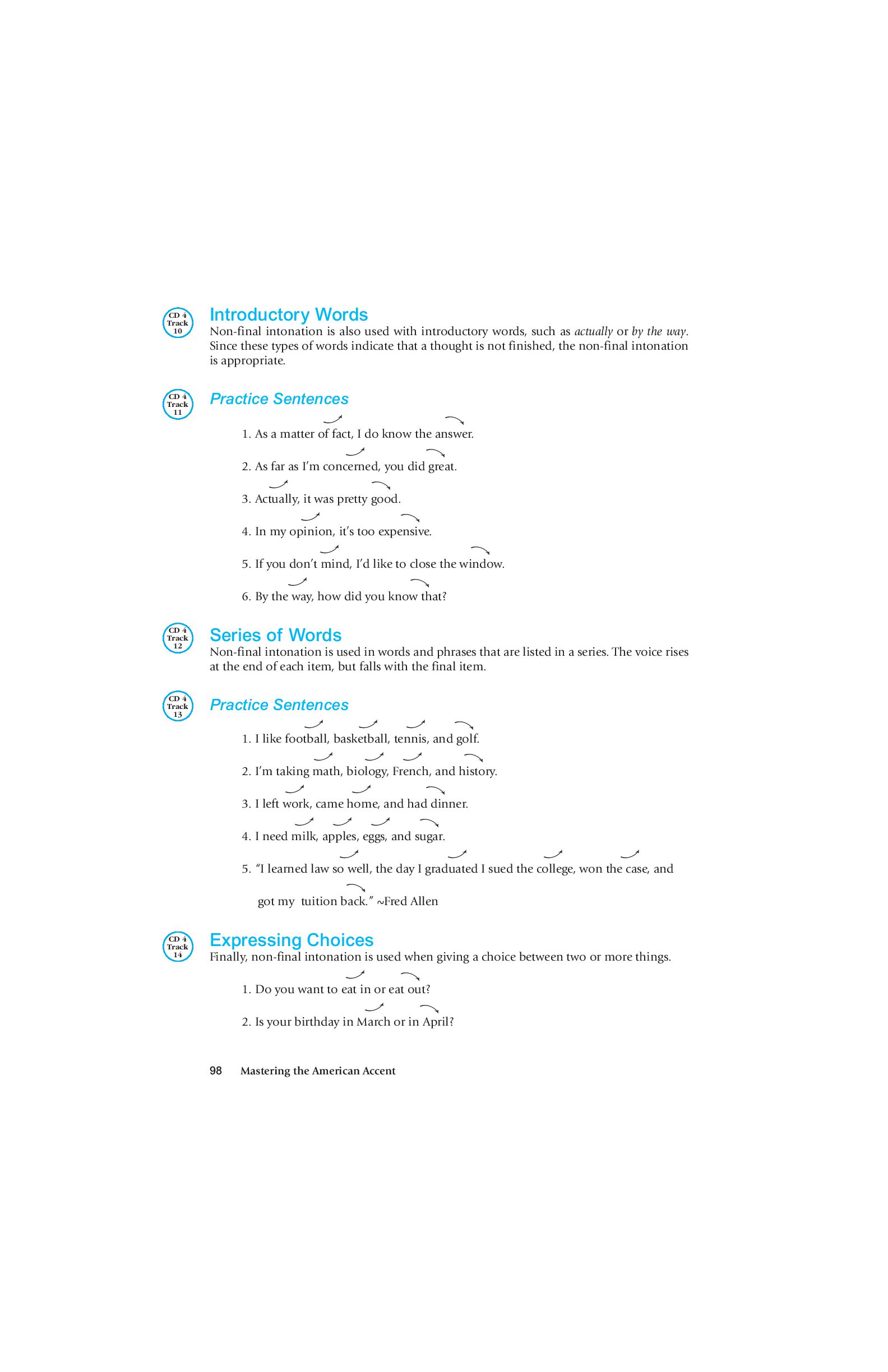
  4. CD 4 Track 10 Introductory Words Non-final intonation is also

    used with introductory words, such as actually or by the way. Since these types of words indicate that a thought is not finished, the non-final intonation is appropriate. CD 4 Track 11 Practice Sentences CD 4 Track 12 Series of Words CD 4 Track 13 Practice Sentences 哬 哭 1. As a matter of fact, I do know the answer. 哬 哭 2. As far as I’m concerned, you did great. 哬 哭 3. Actually, it was pretty good. 哬 哭 4. In my opinion, it’s too expensive. 哬 哭 5. If you don’t mind, I’d like to close the window. 哬 哭 6. By the way, how did you know that? Non-final intonation is used in words and phrases that are listed in a series. The voice rises at the end of each item, but falls with the final item. 哬 哭 哭 哭 1. I like football, basketball, tennis, and golf. 哬 哭 哭 哭 2. I’m taking math, biology, French, and history. 哬 哭 哭 3. I left work, came home, and had dinner. 哬 哭 哭 哭 4. I need milk, apples, eggs, and sugar. 哭 哭 哭 哭 5. “I learned law so well, the day I graduated I sued the college, won the case, and 哬 got my tuition back.” ~Fred Allen CD 4 Track 14 Expressing Choices Finally, non-final intonation is used when giving a choice between two or more things. 哬 哭 1. Do you want to eat in or eat out? 哬 哭 2. Is your birthday in March or in April? 98 Mastering the American Accent
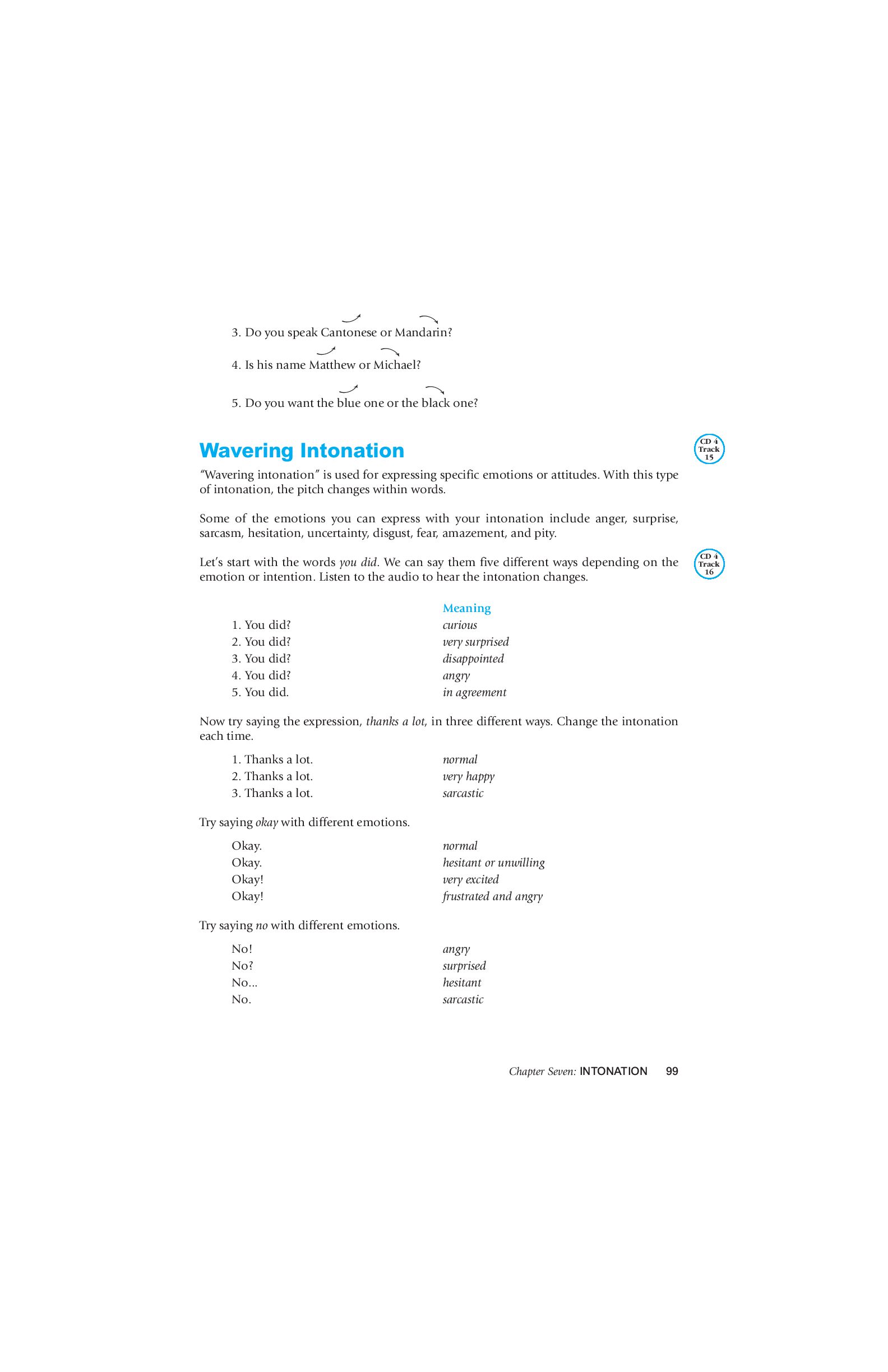
  5. 哬 哭 3. Do you speak Cantonese or Mandarin? 哬

    哭 4. Is his name Matthew or Michael? 哬 哭 5. Do you want the blue one or the black one? CD 4 Track 15 Wavering Intonation “Wavering intonation” is used for expressing specific emotions or attitudes. With this type of intonation, the pitch changes within words. Some of the emotions you can express with your intonation include anger, surprise, sarcasm, hesitation, uncertainty, disgust, fear, amazement, and pity. Let’s start with the words you did. We can say them five different ways depending on the emotion or intention. Listen to the audio to hear the intonation changes. 1. You did? 2. You did? 3. You did? 4. You did? 5. You did. Meaning curious very surprised disappointed angry in agreement Now try saying the expression, thanks a lot, in three different ways. Change the intonation each time. 1. Thanks a lot. 2. Thanks a lot. 3. Thanks a lot. normal very happy sarcastic Try saying okay with different emotions. Okay. Okay. Okay! Okay! normal hesitant or unwilling very excited frustrated and angry Try saying no with different emotions. No! No? No... No. angry surprised hesitant sarcastic Chapter Seven: INTONATION 99 CD 4 Track 16
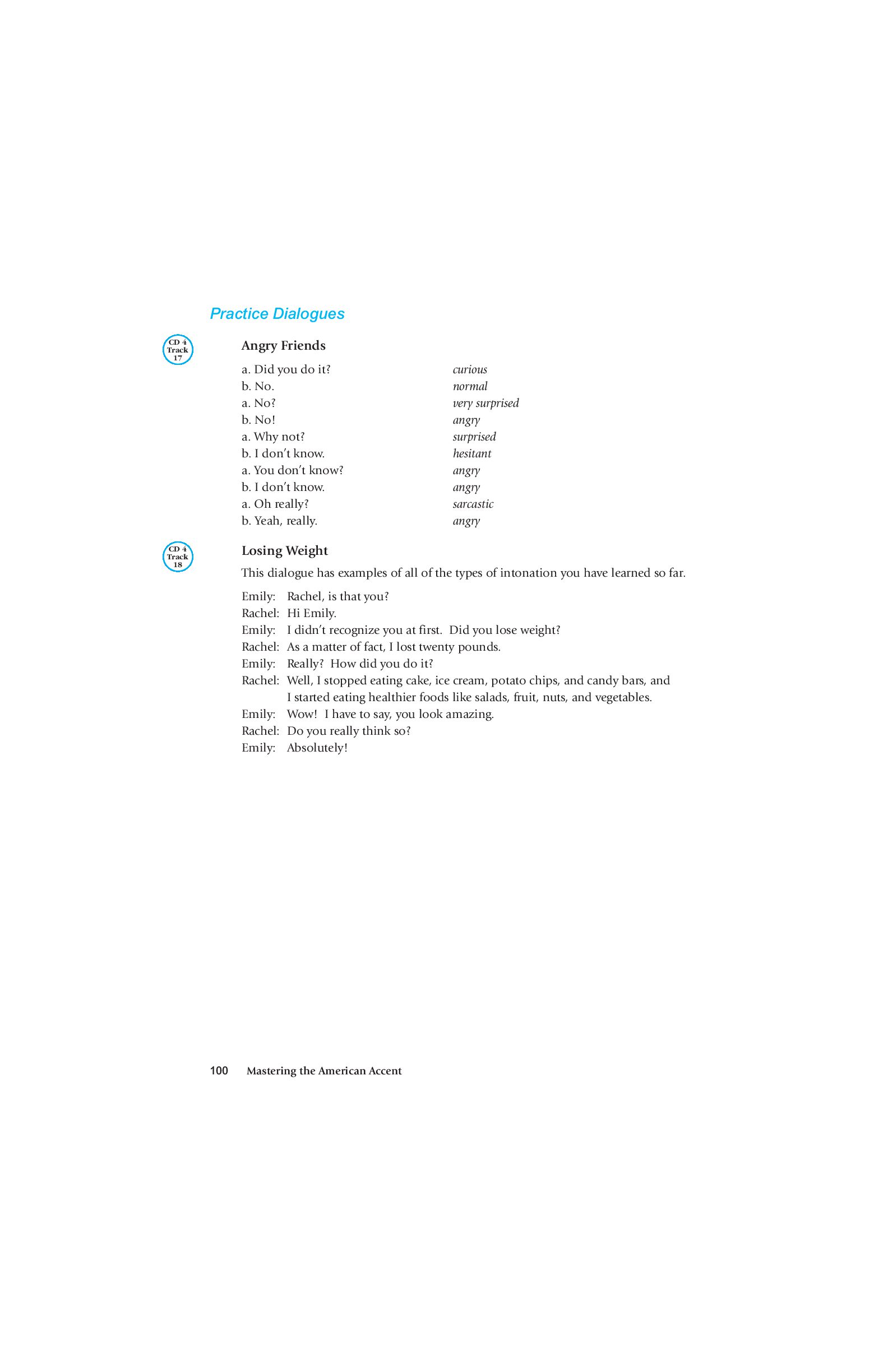
  6. Practice Dialogues CD 4 Track 17 Angry Friends a. Did

    you do it? b. No. a. No? b. No! a. Why not? b. I don’t know. a. You don’t know? b. I don’t know. a. Oh really? b. Yeah, really. curious normal very surprised angry surprised hesitant angry angry sarcastic angry Losing Weight CD 4 Track 18 This dialogue has examples of all of the types of intonation you have learned so far. Emily: Rachel, is that you? Rachel: Hi Emily. Emily: I didn’t recognize you at first. Did you lose weight? Rachel: As a matter of fact, I lost twenty pounds. Emily: Really? How did you do it? Rachel: Well, I stopped eating cake, ice cream, potato chips, and candy bars, and I started eating healthier foods like salads, fruit, nuts, and vegetables. Emily: Wow! I have to say, you look amazing. Rachel: Do you really think so? Emily: Absolutely! 100 Mastering the American Accent