EMR Developing Random Forest Models for Medication Response and Implementation in the Epic EMR Peter D.R. Higgins, MD, PhD, MSc (CRDSA) University of Michigan @ibddoctor
EMR Outline of Talk • Background – IBD, IBD Therapies, Epic EMR • Thiopurines and Patterns • Building the Team • Available Data in Clinical Data Warehouse • ThioMon modeling and validation • Missing Laboratory Data • ThioMon implementation • Challenges and Lessons Learned/Learning • Vedolizumab
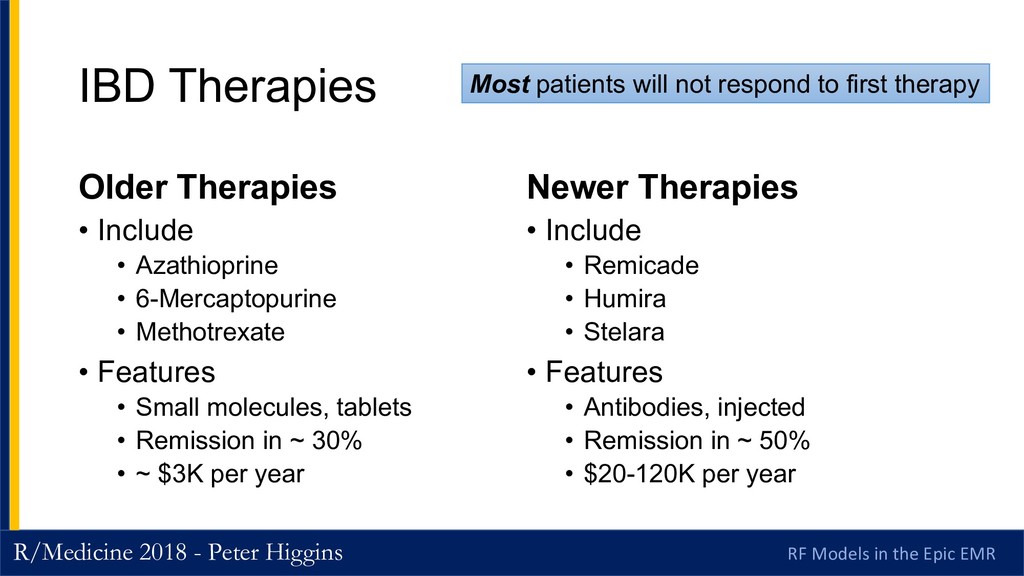
EMR IBD Therapies Older Therapies • Include • Azathioprine • 6-Mercaptopurine • Methotrexate • Features • Small molecules, tablets • Remission in ~ 30% • ~ $3K per year Newer Therapies • Include • Remicade • Humira • Stelara • Features • Antibodies, injected • Remission in ~ 50% • $20-120K per year Most patients will not respond to first therapy
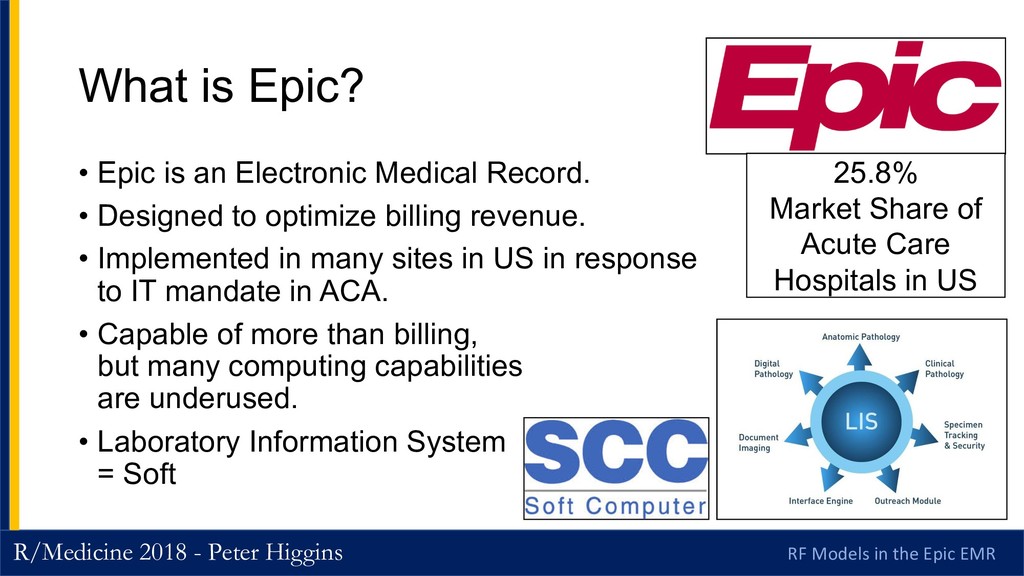
EMR What is Epic? • Epic is an Electronic Medical Record. • Designed to optimize billing revenue. • Implemented in many sites in US in response to IT mandate in ACA. • Capable of more than billing, but many computing capabilities are underused. • Laboratory Information System = Soft 25.8% Market Share of Acute Care Hospitals in US
EMR Thiopurines and Patterns • Thiopurines are old chemotherapy drugs – generic, inexpensive • At low doses, are very effective immune suppressants • Work really well in IBD in ~ 30% of patients • Which patients? • How do you know if drug is working vs. spontaneous remission? • Dan Present – I don’t need expensive metabolite tests • I can look at the patterns in the labs • Blood counts – white cells decreased, size of red cells increased • Chemistries – mild rise in alkaline phosphatase • Then I know it is working well. Dan Present, MD
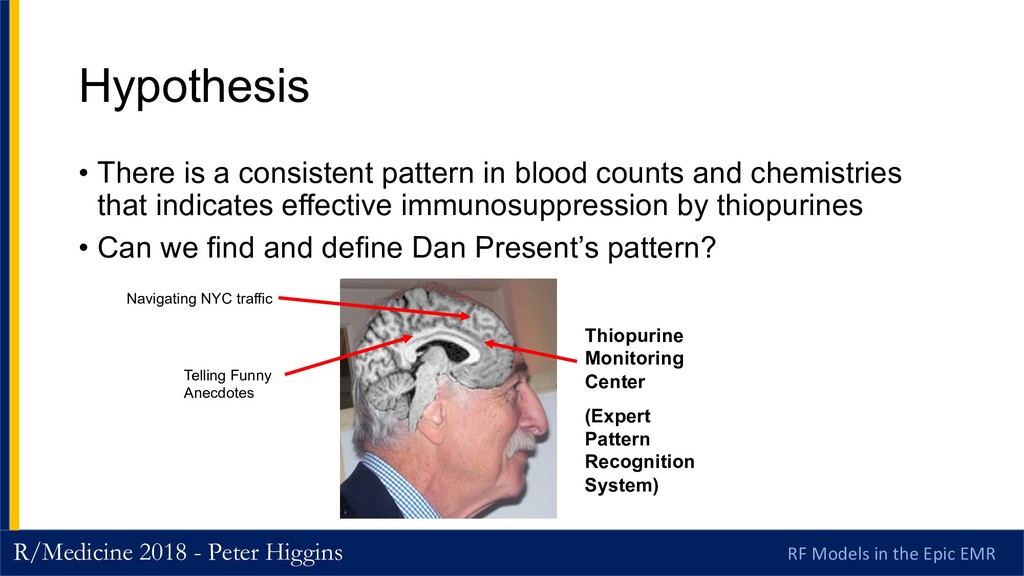
EMR Hypothesis • There is a consistent pattern in blood counts and chemistries that indicates effective immunosuppression by thiopurines • Can we find and define Dan Present’s pattern? Thiopurine Monitoring Center (Expert Pattern Recognition System) Navigating NYC traffic Telling Funny Anecdotes
EMR Data in the Clinical Data Warehouse • Patients on thiopurines are at risk of toxicity • Bone marrow (blood counts plus differential) • Liver (chemistry panel) • 31 distinct results • Routine monitoring every 3 months while on drug • Over 1,000 patients on thiopurines with lab data • Very high quality data – CLIA certified, regular QI • All available electronically • Clinical data in EMR • Outcomes defined • Requires a lot of expert clinical grunt work to accurately classify success vs. failure • Some cases with inadequate documentation
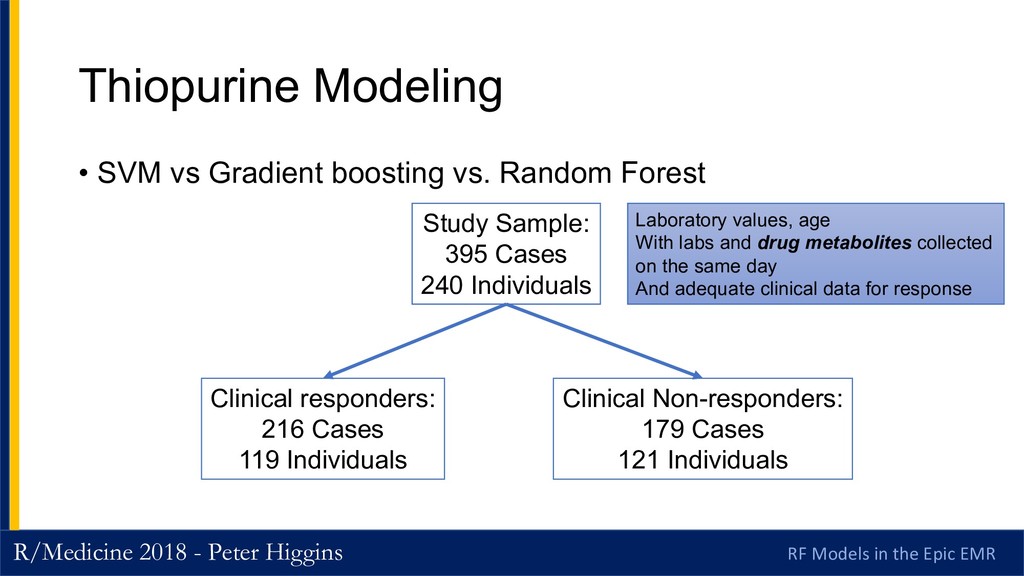
EMR Thiopurine Modeling • SVM vs Gradient boosting vs. Random Forest Study Sample: 395 Cases 240 Individuals Clinical responders: 216 Cases 119 Individuals Clinical Non-responders: 179 Cases 121 Individuals Laboratory values, age With labs and drug metabolites collected on the same day And adequate clinical data for response
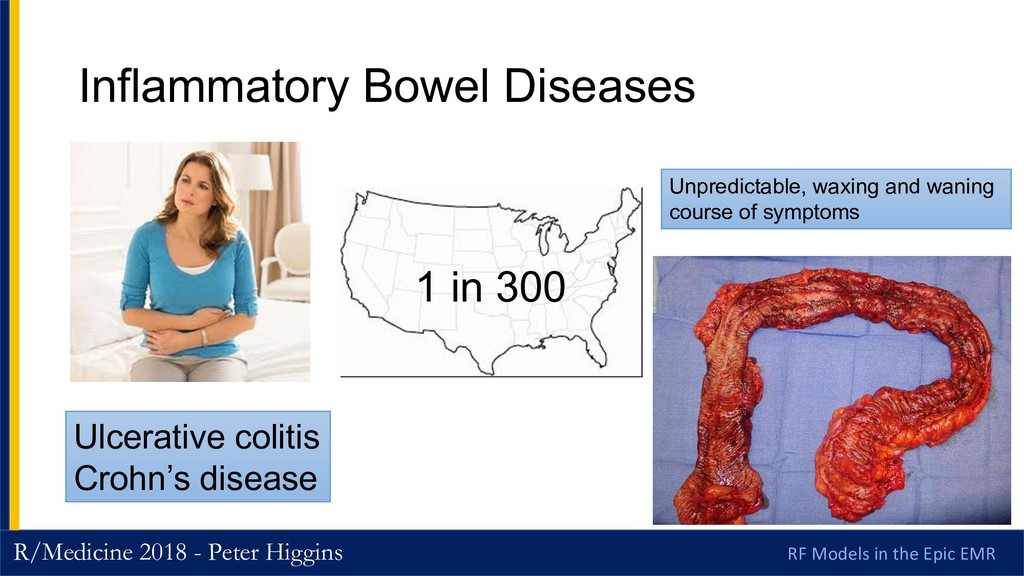
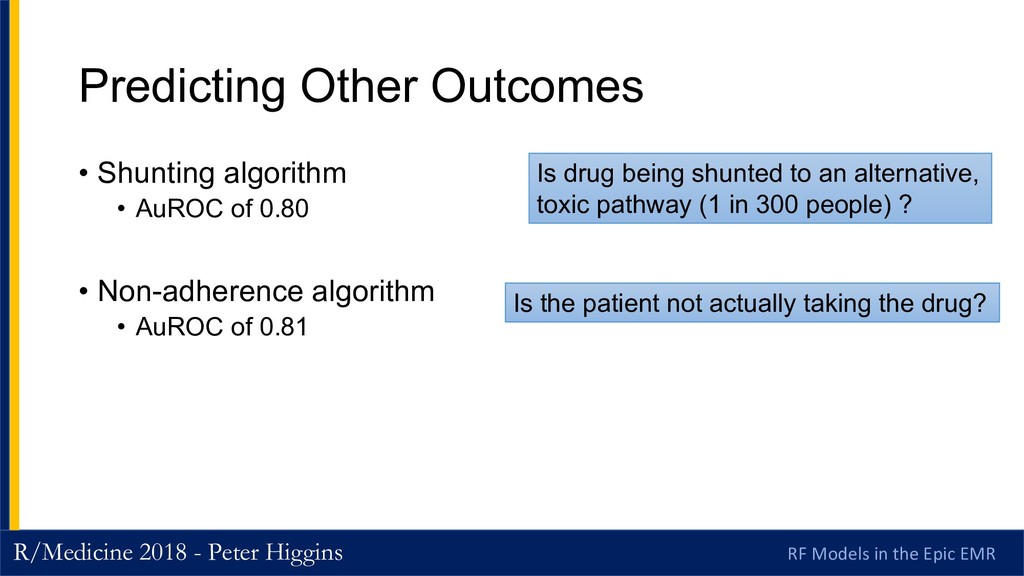
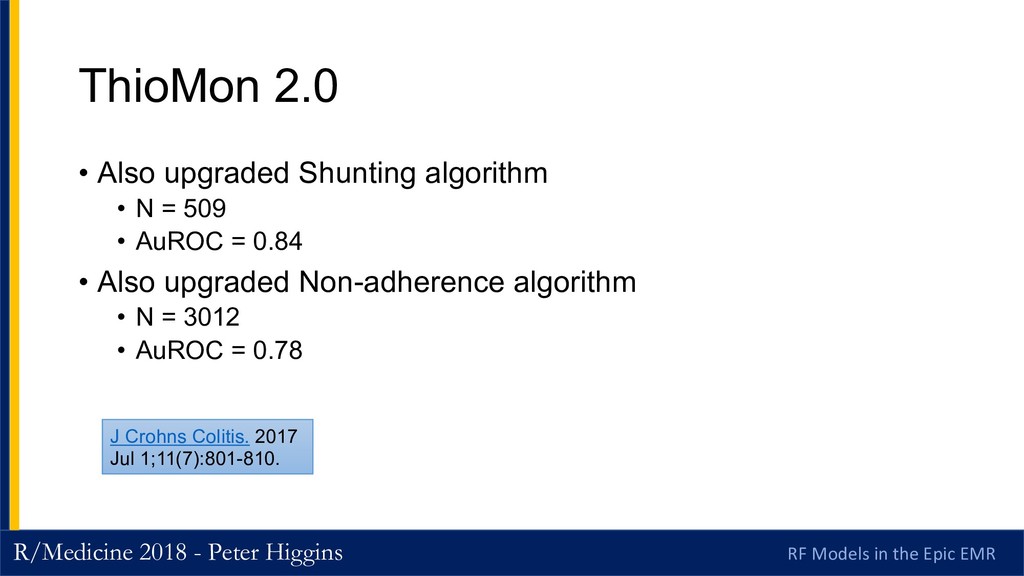
EMR Predicting Other Outcomes • Shunting algorithm • AuROC of 0.80 • Non-adherence algorithm • AuROC of 0.81 Is drug being shunted to an alternative, toxic pathway (1 in 300 people) ? Is the patient not actually taking the drug?
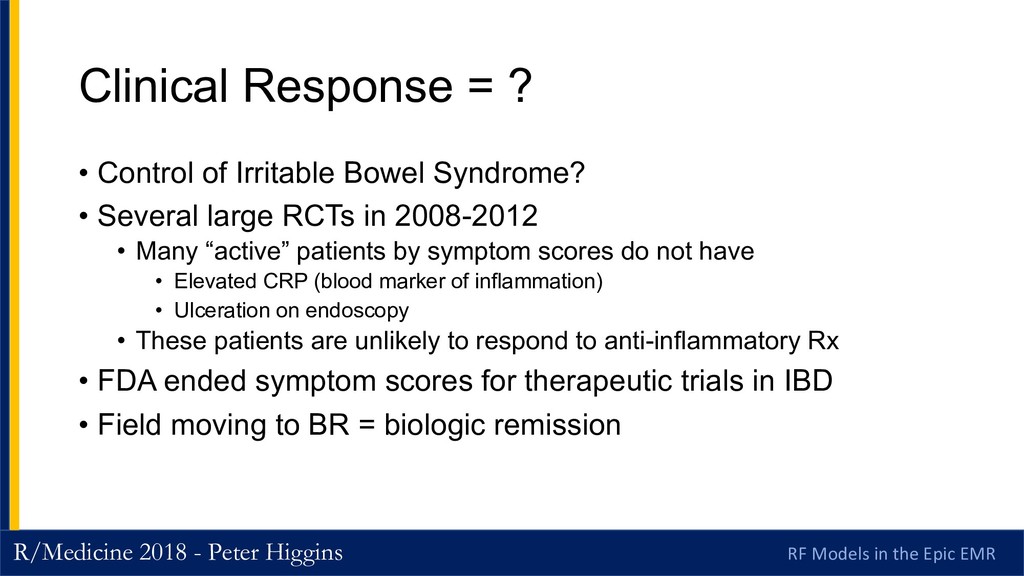
EMR Clinical Response = ? • Control of Irritable Bowel Syndrome? • Several large RCTs in 2008-2012 • Many “active” patients by symptom scores do not have • Elevated CRP (blood marker of inflammation) • Ulceration on endoscopy • These patients are unlikely to respond to anti-inflammatory Rx • FDA ended symptom scores for therapeutic trials in IBD • Field moving to BR = biologic remission
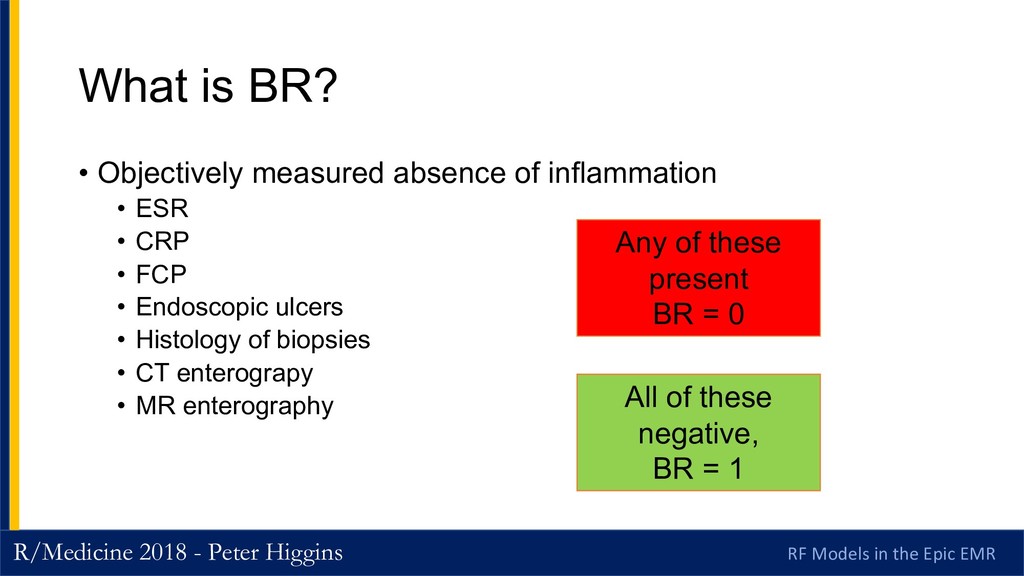
EMR What is BR? • Objectively measured absence of inflammation • ESR • CRP • FCP • Endoscopic ulcers • Histology of biopsies • CT enterograpy • MR enterography Any of these present BR = 0 All of these negative, BR = 1
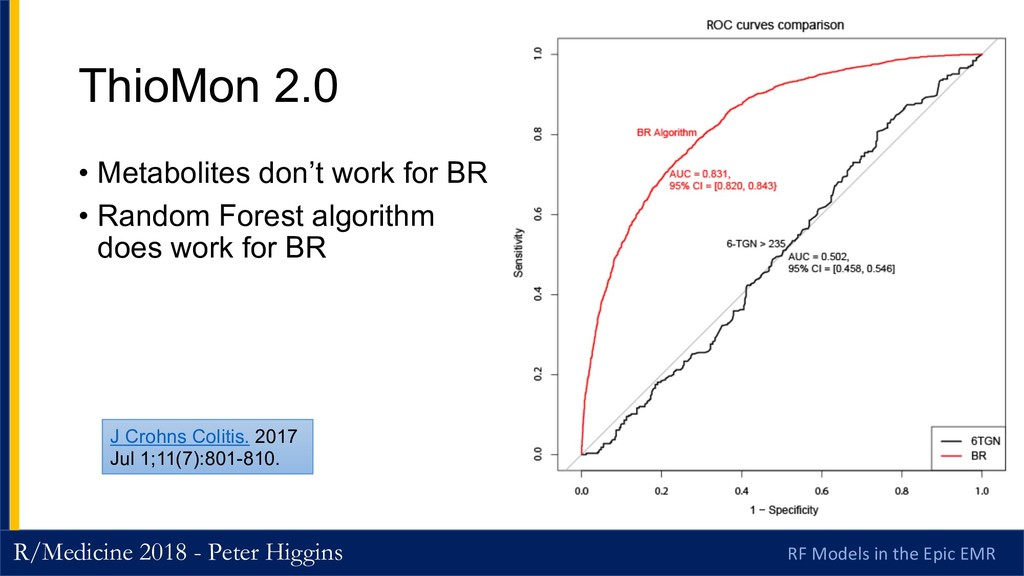
EMR The ThioMon 2.0 Overhaul • Rebuild it, using BR as the gold standard • MUCH higher bar • N= 3300 subject evaluations • 1090 unique patients • Enormous chart review task • Same Random Forest approach
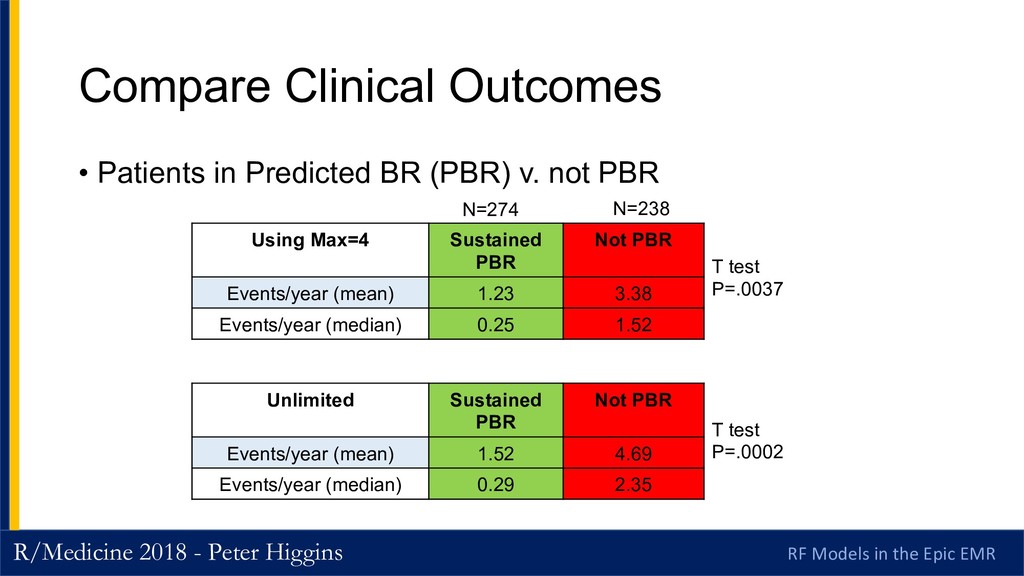
EMR Compare Clinical Outcomes • Patients in Predicted BR (PBR) v. not PBR Using Max=4 Sustained PBR Not PBR Events/year (mean) 1.23 3.38 Events/year (median) 0.25 1.52 Unlimited Sustained PBR Not PBR Events/year (mean) 1.52 4.69 Events/year (median) 0.29 2.35 T test P=.0037 T test P=.0002 N=274 N=238
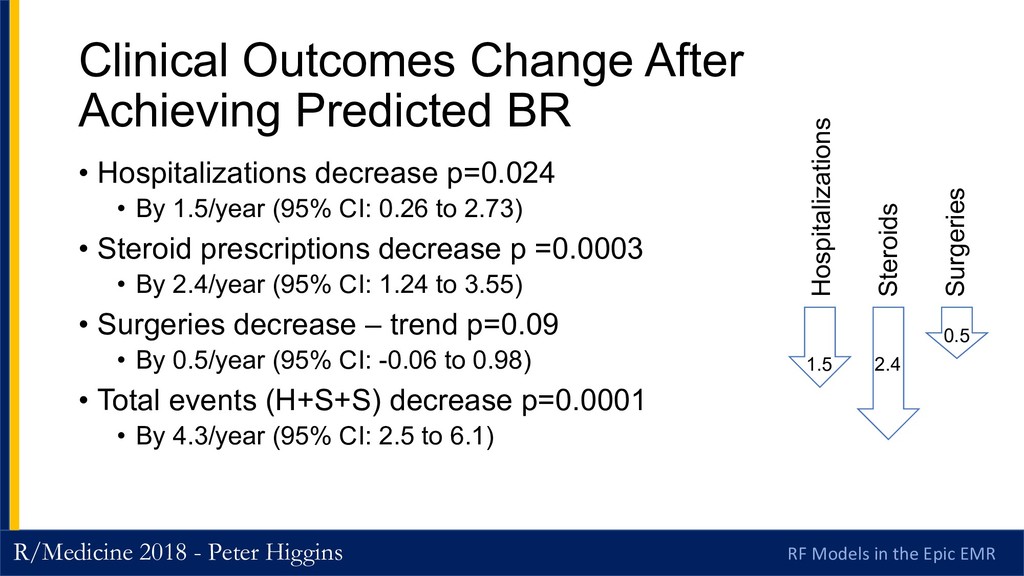
EMR Can this Guide Dosing? • Look for patients with • Consistently low predicted BR that changes to • Consistently high predicted BR (N=32) • Measure Events Pre/Post change • Prediction – fewer events with high PBR (Predicted Biologic Remission) • Paired t test Low PBR (Not Immune Suppressed Pattern) High PBR (Immune Suppressed Pattern)
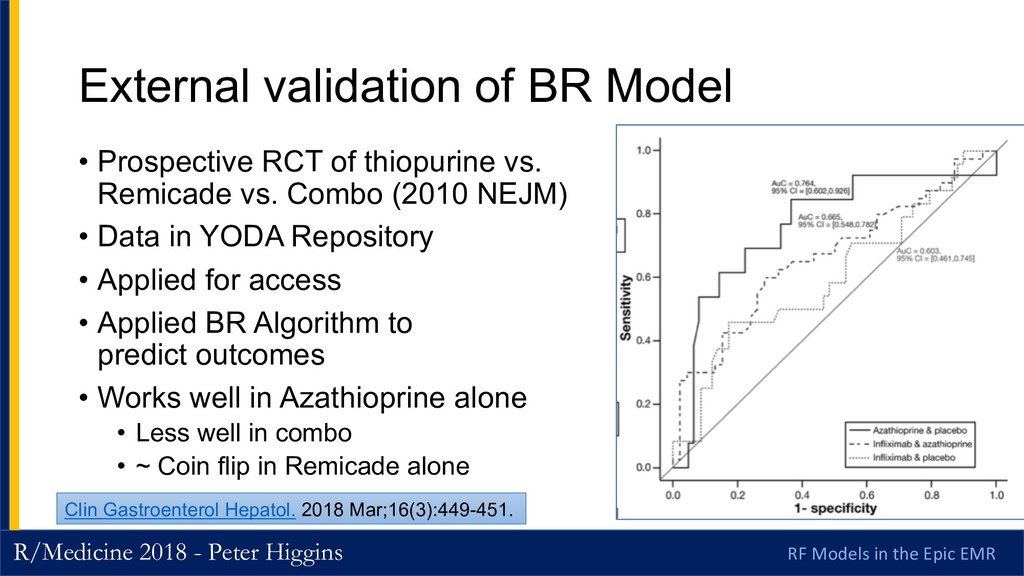
EMR External validation of BR Model • Prospective RCT of thiopurine vs. Remicade vs. Combo (2010 NEJM) • Data in YODA Repository • Applied for access • Applied BR Algorithm to predict outcomes • Works well in Azathioprine alone • Less well in combo • ~ Coin flip in Remicade alone Clin Gastroenterol Hepatol. 2018 Mar;16(3):449-451.
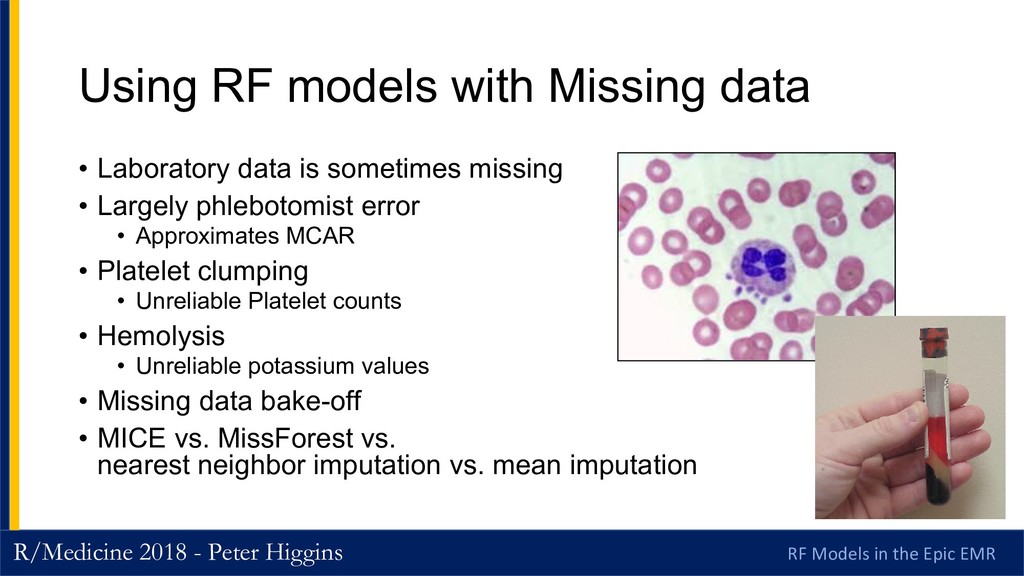
EMR Using RF models with Missing data • Laboratory data is sometimes missing • Largely phlebotomist error • Approximates MCAR • Platelet clumping • Unreliable Platelet counts • Hemolysis • Unreliable potassium values • Missing data bake-off • MICE vs. MissForest vs. nearest neighbor imputation vs. mean imputation
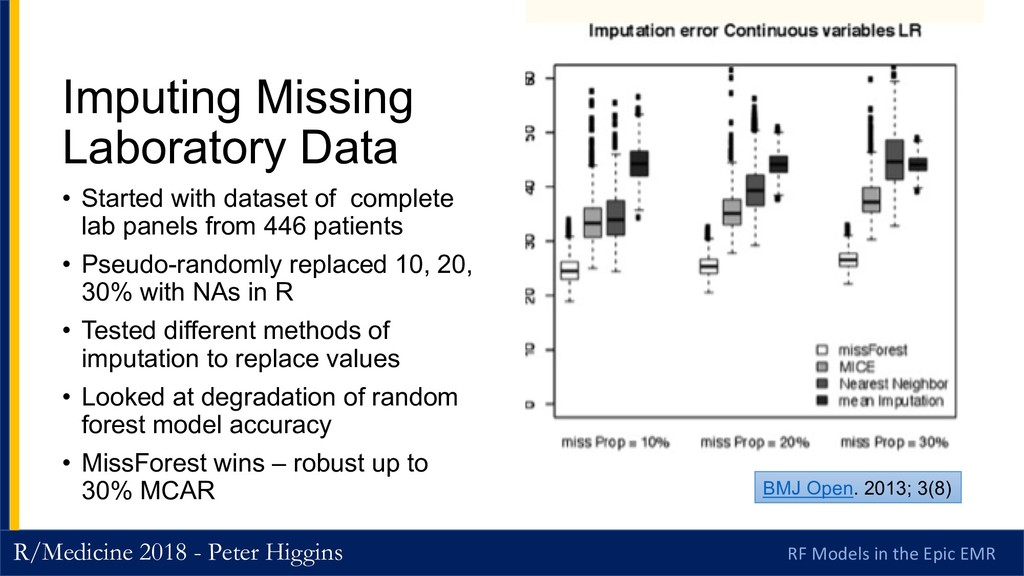
EMR Imputing Missing Laboratory Data • Started with dataset of complete lab panels from 446 patients • Pseudo-randomly replaced 10, 20, 30% with NAs in R • Tested different methods of imputation to replace values • Looked at degradation of random forest model accuracy • MissForest wins – robust up to 30% MCAR BMJ Open. 2013; 3(8)
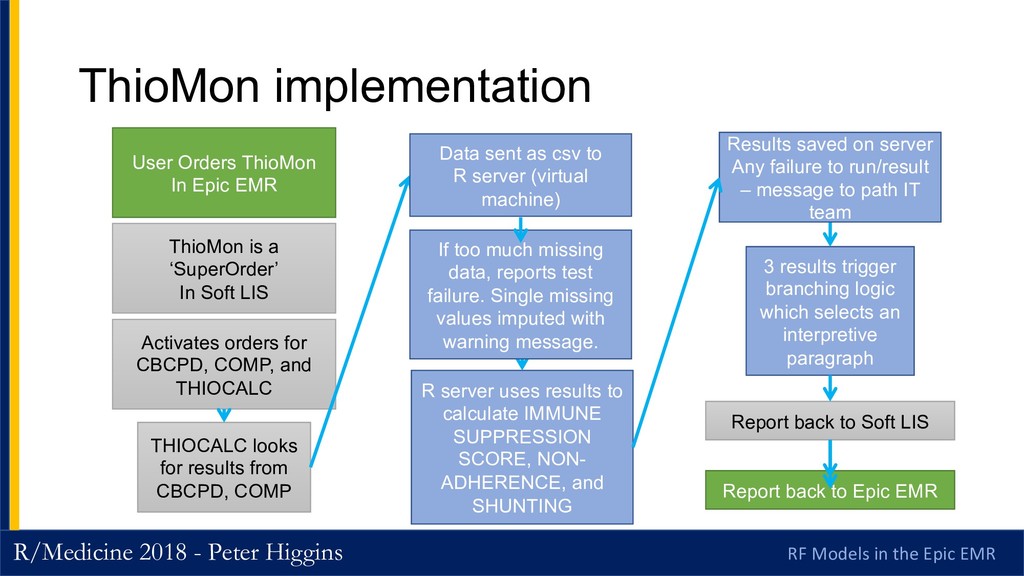
EMR ThioMon implementation Activates orders for CBCPD, COMP, and THIOCALC THIOCALC looks for results from CBCPD, COMP R server uses results to calculate IMMUNE SUPPRESSION SCORE, NON- ADHERENCE, and SHUNTING 3 results trigger branching logic which selects an interpretive paragraph Report back to Soft LIS ThioMon is a ‘SuperOrder’ In Soft LIS User Orders ThioMon In Epic EMR Report back to Epic EMR Data sent as csv to R server (virtual machine) Results saved on server Any failure to run/result – message to path IT team If too much missing data, reports test failure. Single missing values imputed with warning message.
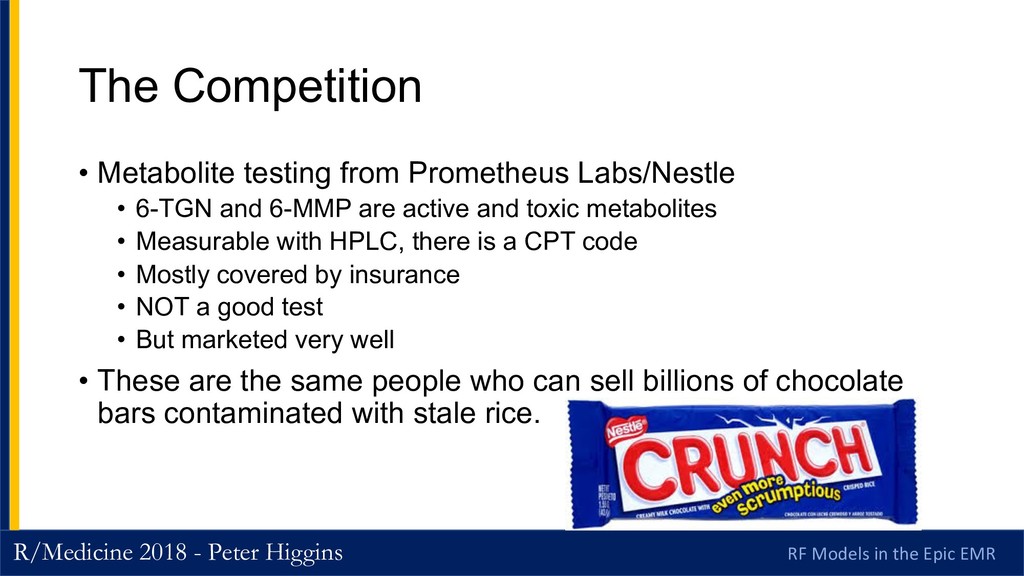
EMR The Competition • Metabolite testing from Prometheus Labs/Nestle • 6-TGN and 6-MMP are active and toxic metabolites • Measurable with HPLC, there is a CPT code • Mostly covered by insurance • NOT a good test • But marketed very well • These are the same people who can sell billions of chocolate bars contaminated with stale rice.
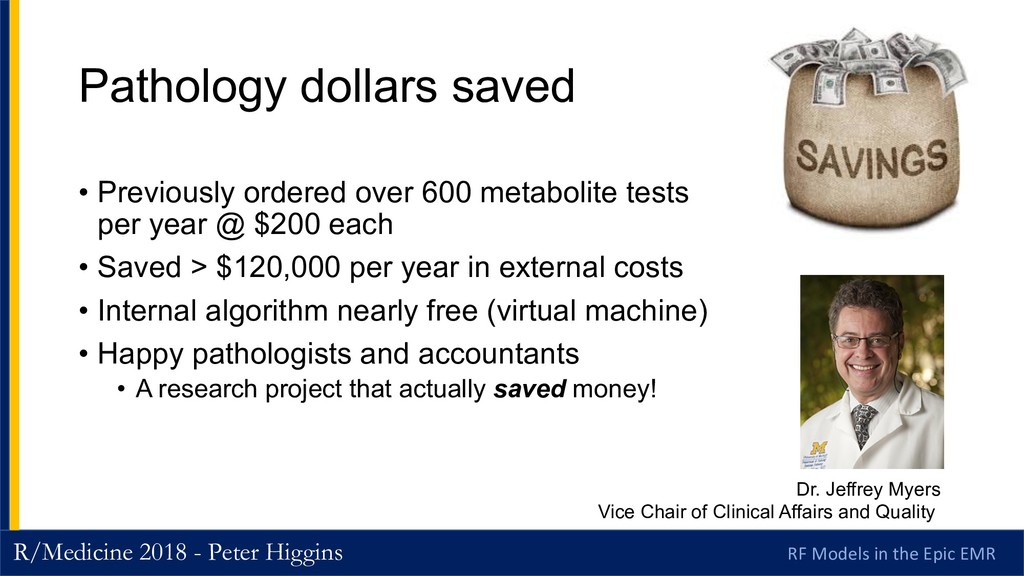
EMR Pathology dollars saved • Previously ordered over 600 metabolite tests per year @ $200 each • Saved > $120,000 per year in external costs • Internal algorithm nearly free (virtual machine) • Happy pathologists and accountants • A research project that actually saved money! Dr. Jeffrey Myers Vice Chair of Clinical Affairs and Quality
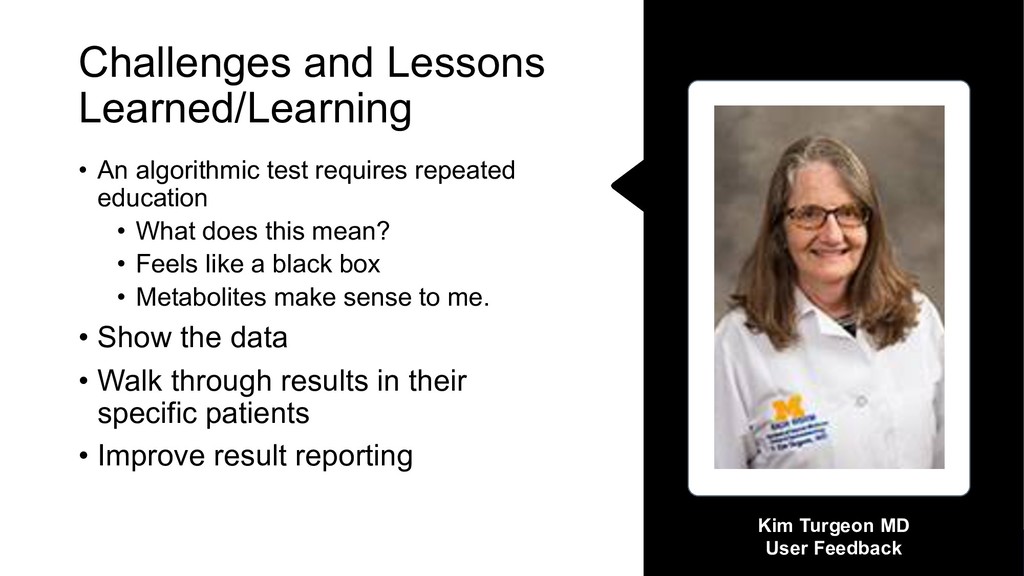
EMR Challenges and Lessons Learned/Learning • An algorithmic test requires repeated education • What does this mean? • Feels like a black box • Metabolites make sense to me. • Show the data • Walk through results in their specific patients • Improve result reporting Kim Turgeon MD User Feedback
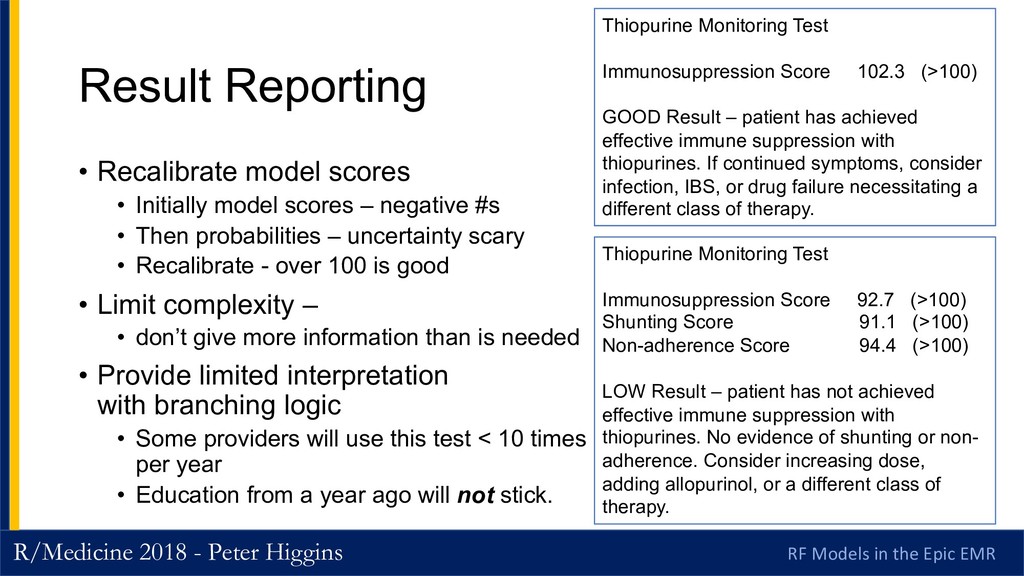
EMR Result Reporting • Recalibrate model scores • Initially model scores – negative #s • Then probabilities – uncertainty scary • Recalibrate - over 100 is good • Limit complexity – • don’t give more information than is needed • Provide limited interpretation with branching logic • Some providers will use this test < 10 times per year • Education from a year ago will not stick. Thiopurine Monitoring Test Immunosuppression Score 102.3 (>100) GOOD Result – patient has achieved effective immune suppression with thiopurines. If continued symptoms, consider infection, IBS, or drug failure necessitating a different class of therapy. Thiopurine Monitoring Test Immunosuppression Score 92.7 (>100) Shunting Score 91.1 (>100) Non-adherence Score 94.4 (>100) LOW Result – patient has not achieved effective immune suppression with thiopurines. No evidence of shunting or non- adherence. Consider increasing dose, adding allopurinol, or a different class of therapy.
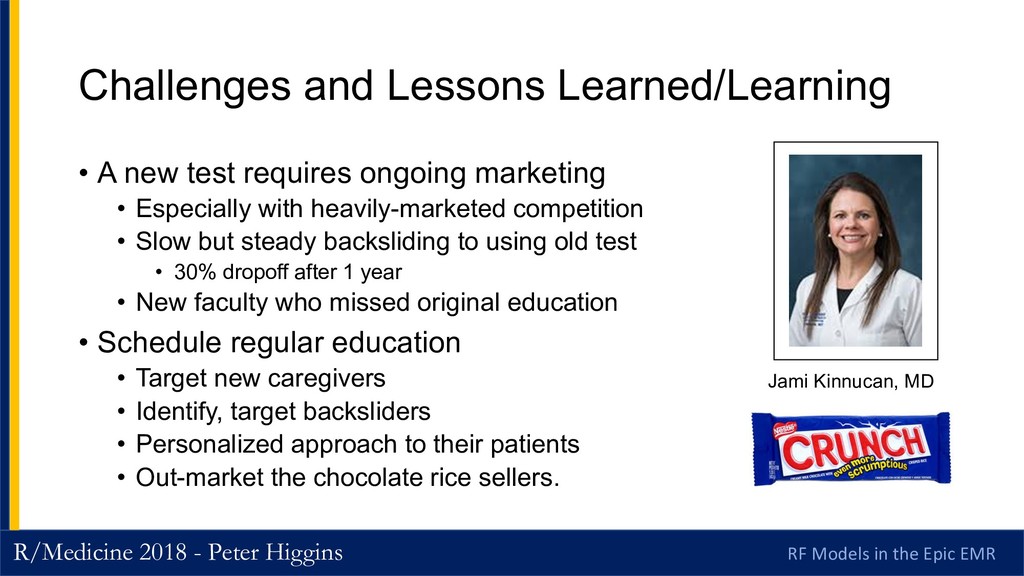
EMR Challenges and Lessons Learned/Learning • A new test requires ongoing marketing • Especially with heavily-marketed competition • Slow but steady backsliding to using old test • 30% dropoff after 1 year • New faculty who missed original education • Schedule regular education • Target new caregivers • Identify, target backsliders • Personalized approach to their patients • Out-market the chocolate rice sellers. Jami Kinnucan, MD
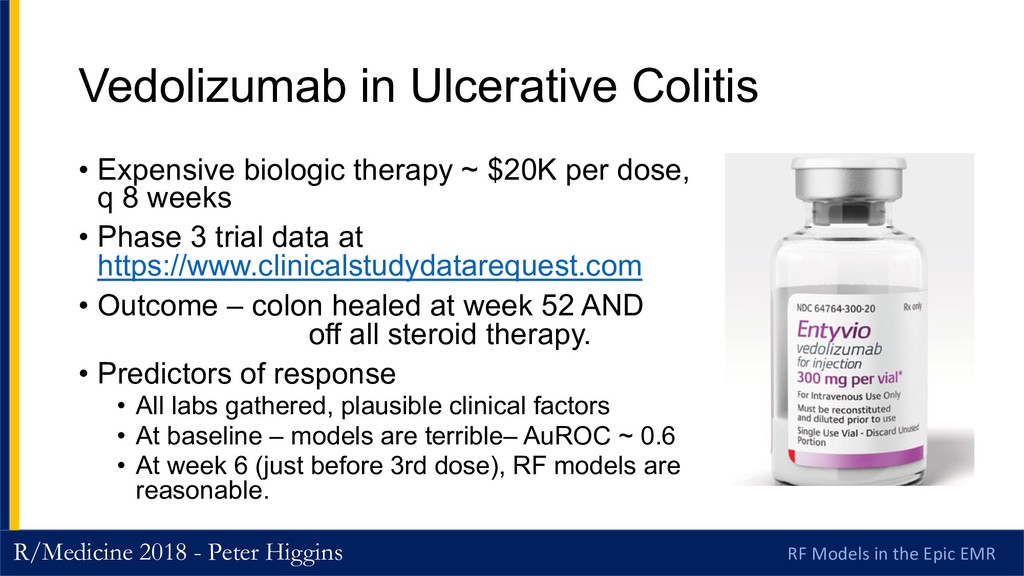
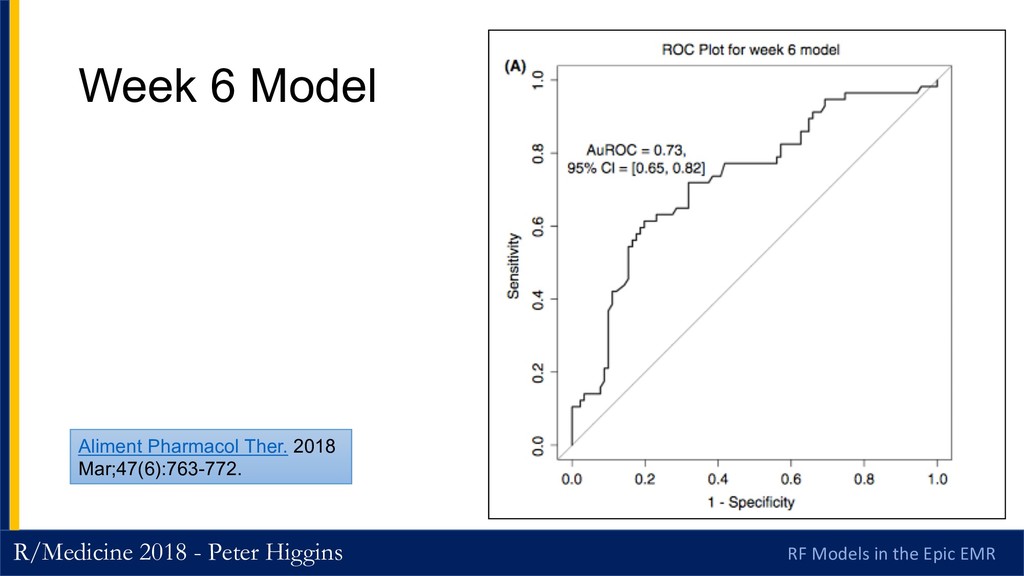
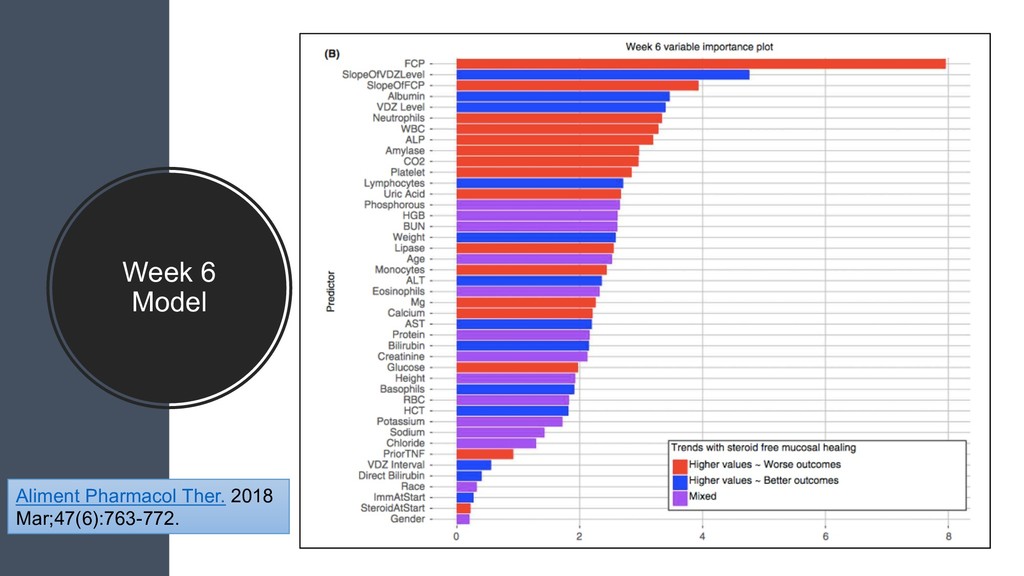
EMR Vedolizumab in Ulcerative Colitis • Expensive biologic therapy ~ $20K per dose, q 8 weeks • Phase 3 trial data at https://www.clinicalstudydatarequest.com • Outcome – colon healed at week 52 AND off all steroid therapy. • Predictors of response • All labs gathered, plausible clinical factors • At baseline – models are terrible– AuROC ~ 0.6 • At week 6 (just before 3rd dose), RF models are reasonable.
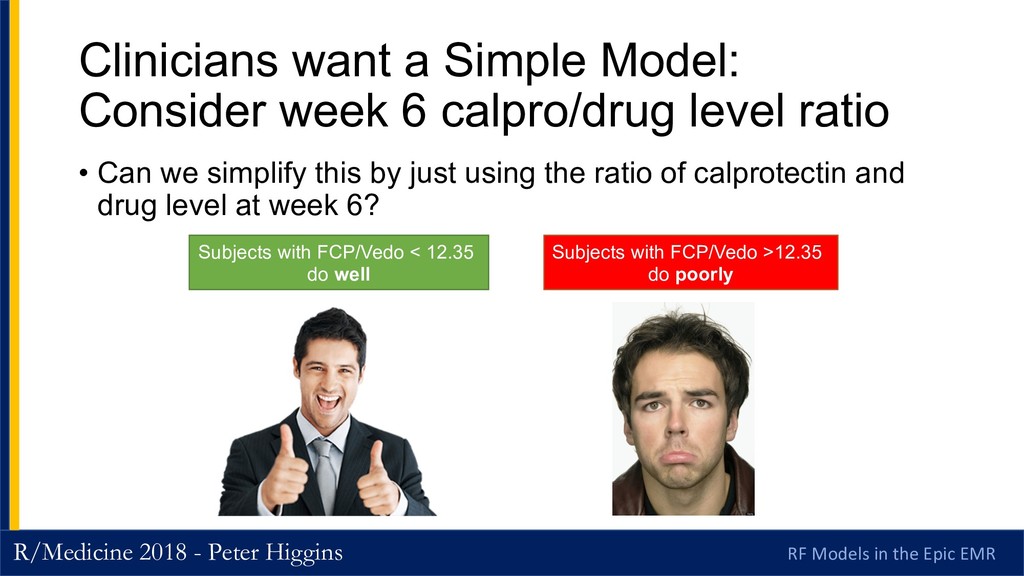
EMR Clinicians want a Simple Model: Consider week 6 calpro/drug level ratio • Can we simplify this by just using the ratio of calprotectin and drug level at week 6? Subjects with FCP/Vedo < 12.35 do well Subjects with FCP/Vedo >12.35 do poorly
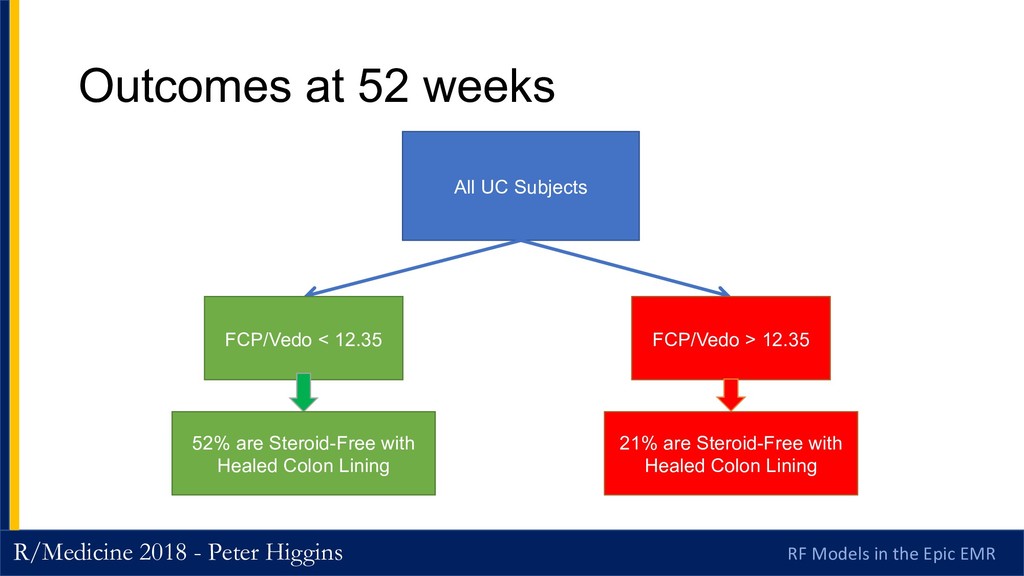
EMR Outcomes at 52 weeks All UC Subjects FCP/Vedo < 12.35 FCP/Vedo > 12.35 52% are Steroid-Free with Healed Colon Lining 21% are Steroid-Free with Healed Colon Lining
EMR Thanks To… • Ji Zhu and his grad students • Ul Balis and his IT implementation team • Clinicians for user feedback Boang Liu Sijian Wang Ashin Mukherjee
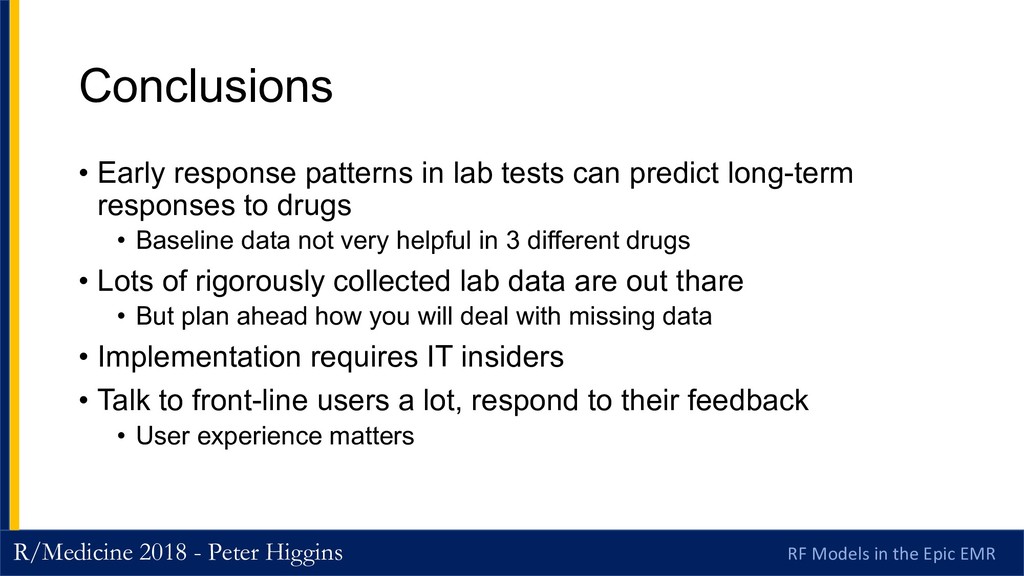
EMR Conclusions • Early response patterns in lab tests can predict long-term responses to drugs • Baseline data not very helpful in 3 different drugs • Lots of rigorously collected lab data are out thare • But plan ahead how you will deal with missing data • Implementation requires IT insiders • Talk to front-line users a lot, respond to their feedback • User experience matters


 higgi13425
 jct
jct
 tmiket
 minecr
 greggifford
 pauljervisheath
 reverentgeek
 sstephenson
 tammyeverts
 iamctodd
 cassininazir
 helmedeiros
 lara
lara