Upgrade to Pro — share decks privately, control downloads, hide ads and more …

Best Knowledge Sharing Guide in Ai Era

Best Knowledge Sharing Guide in Ai Era

The slides cover the difference between passive content consumption and active learning, the value of building a personal knowledge system, the importance of searchable notes, and practical methods for organizing information without creating unnecessary complexity. It also examines how artificial intelligence is changing the way people discover, summarize, verify, and apply information while emphasizing that human judgment, critical thinking, and personal experience remain essential.

Avatar for M.ibrahim

M.ibrahim

July 18, 2026

Other Decks in Business

Transcript

  1. Knowledge Management for the AI Era 1 Knowledge Management for

    the AI Era How to capture, organize, retrieve, and apply information more effectively A practical guide for developers, creators, students, and modern knowledge workers
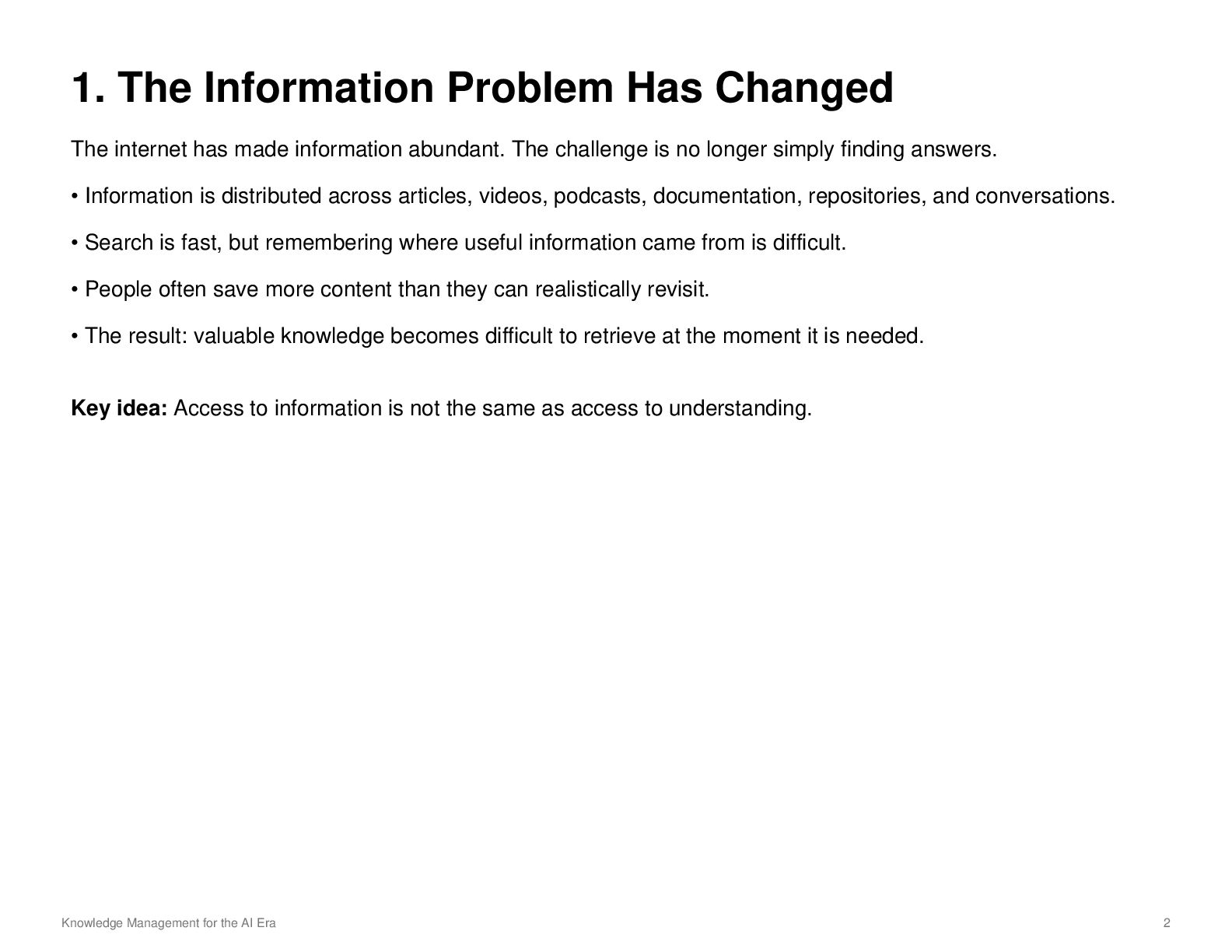
  2. Knowledge Management for the AI Era 2 1. The Information

    Problem Has Changed The internet has made information abundant. The challenge is no longer simply finding answers. • Information is distributed across articles, videos, podcasts, documentation, repositories, and conversations. • Search is fast, but remembering where useful information came from is difficult. • People often save more content than they can realistically revisit. • The result: valuable knowledge becomes difficult to retrieve at the moment it is needed. Key idea: Access to information is not the same as access to understanding.
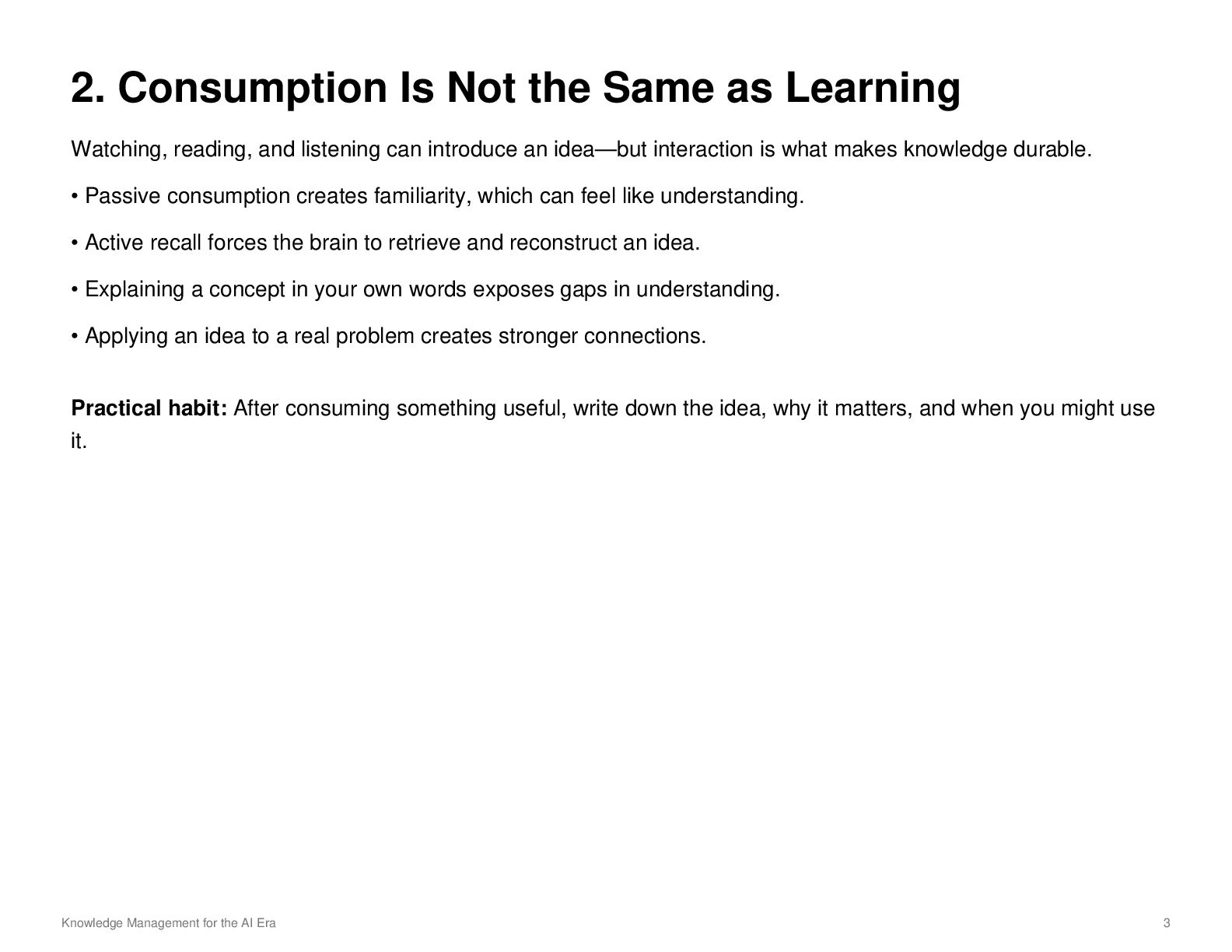
  3. Knowledge Management for the AI Era 3 2. Consumption Is

    Not the Same as Learning Watching, reading, and listening can introduce an idea—but interaction is what makes knowledge durable. • Passive consumption creates familiarity, which can feel like understanding. • Active recall forces the brain to retrieve and reconstruct an idea. • Explaining a concept in your own words exposes gaps in understanding. • Applying an idea to a real problem creates stronger connections. Practical habit: After consuming something useful, write down the idea, why it matters, and when you might use it.
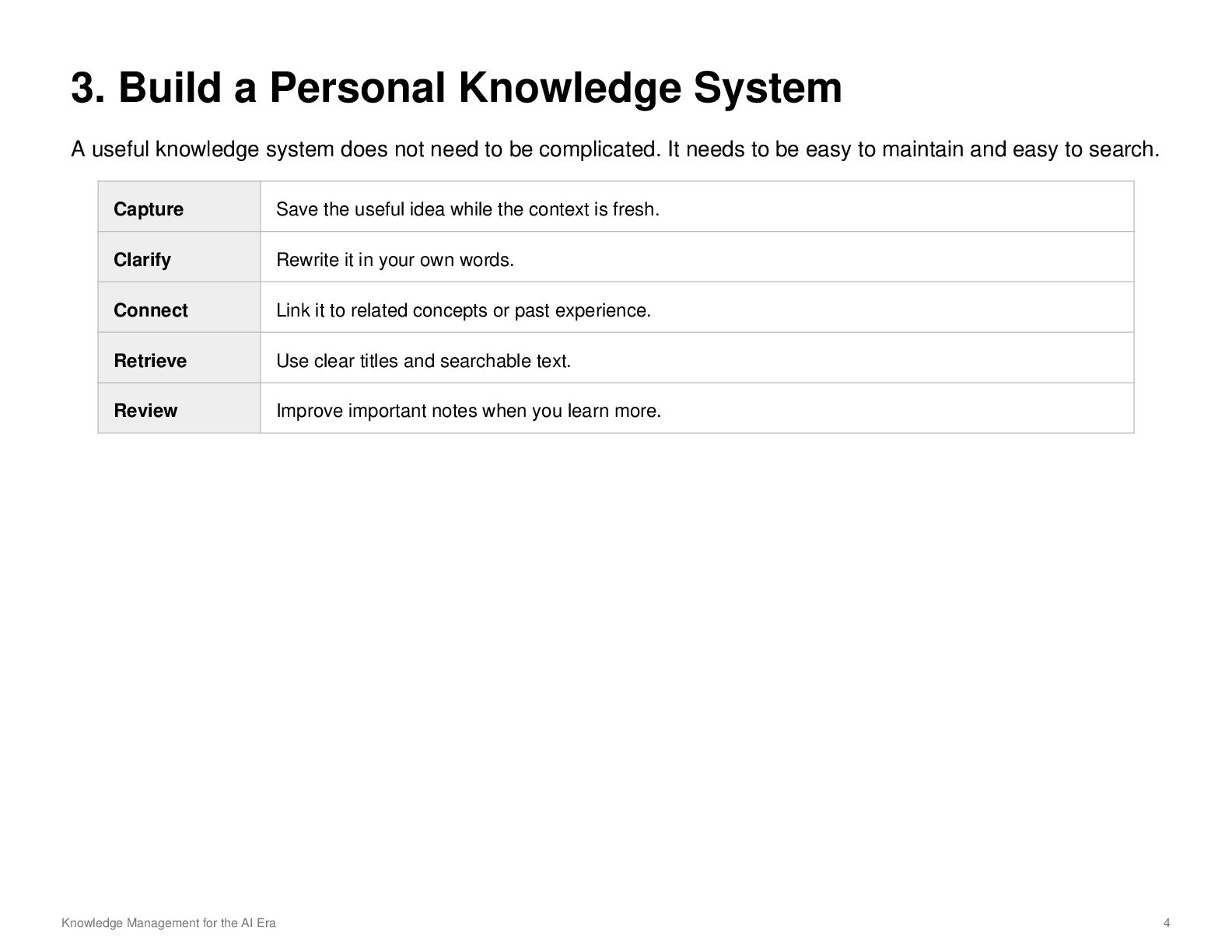
  4. Knowledge Management for the AI Era 4 3. Build a

    Personal Knowledge System A useful knowledge system does not need to be complicated. It needs to be easy to maintain and easy to search. Capture Save the useful idea while the context is fresh. Clarify Rewrite it in your own words. Connect Link it to related concepts or past experience. Retrieve Use clear titles and searchable text. Review Improve important notes when you learn more.
  5. Knowledge Management for the AI Era 5 4. Searchability Is

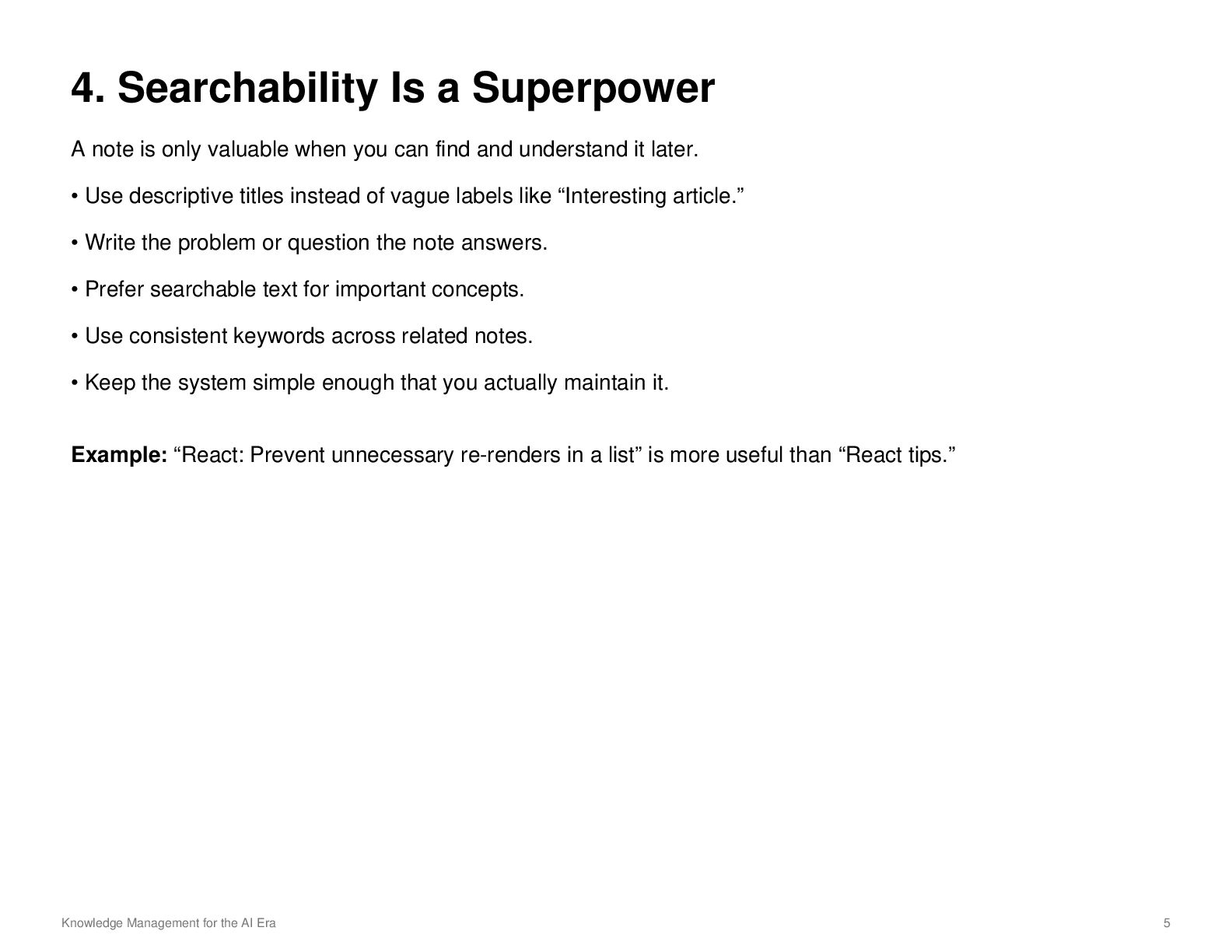
    a Superpower A note is only valuable when you can find and understand it later. • Use descriptive titles instead of vague labels like “Interesting article.” • Write the problem or question the note answers. • Prefer searchable text for important concepts. • Use consistent keywords across related notes. • Keep the system simple enough that you actually maintain it. Example: “React: Prevent unnecessary re-renders in a list” is more useful than “React tips.”
  6. Knowledge Management for the AI Era 6 5. AI Changes

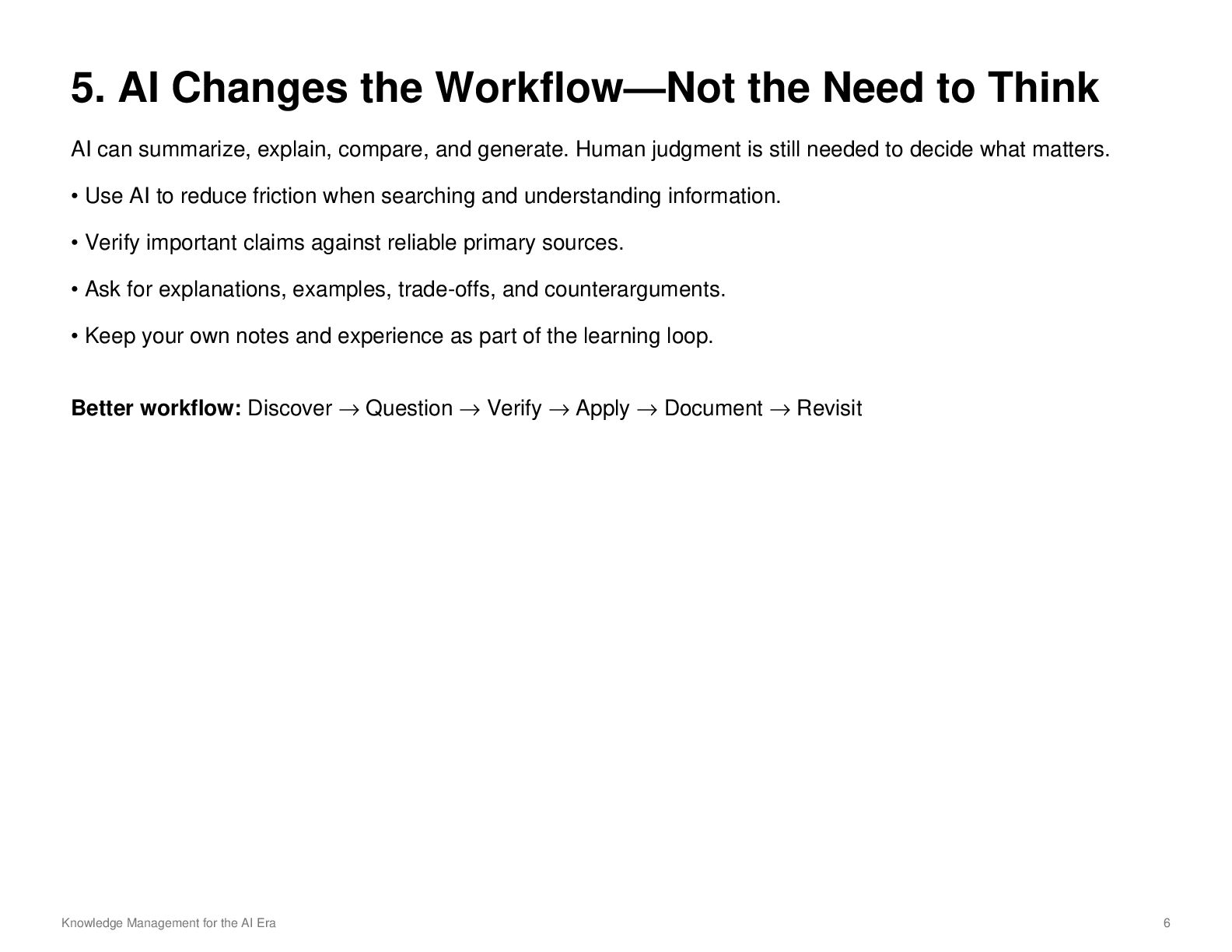
    the Workflow—Not the Need to Think AI can summarize, explain, compare, and generate. Human judgment is still needed to decide what matters. • Use AI to reduce friction when searching and understanding information. • Verify important claims against reliable primary sources. • Ask for explanations, examples, trade-offs, and counterarguments. • Keep your own notes and experience as part of the learning loop. Better workflow: Discover → Question → Verify → Apply → Document → Revisit
  7. Knowledge Management for the AI Era 7 6. A Simple

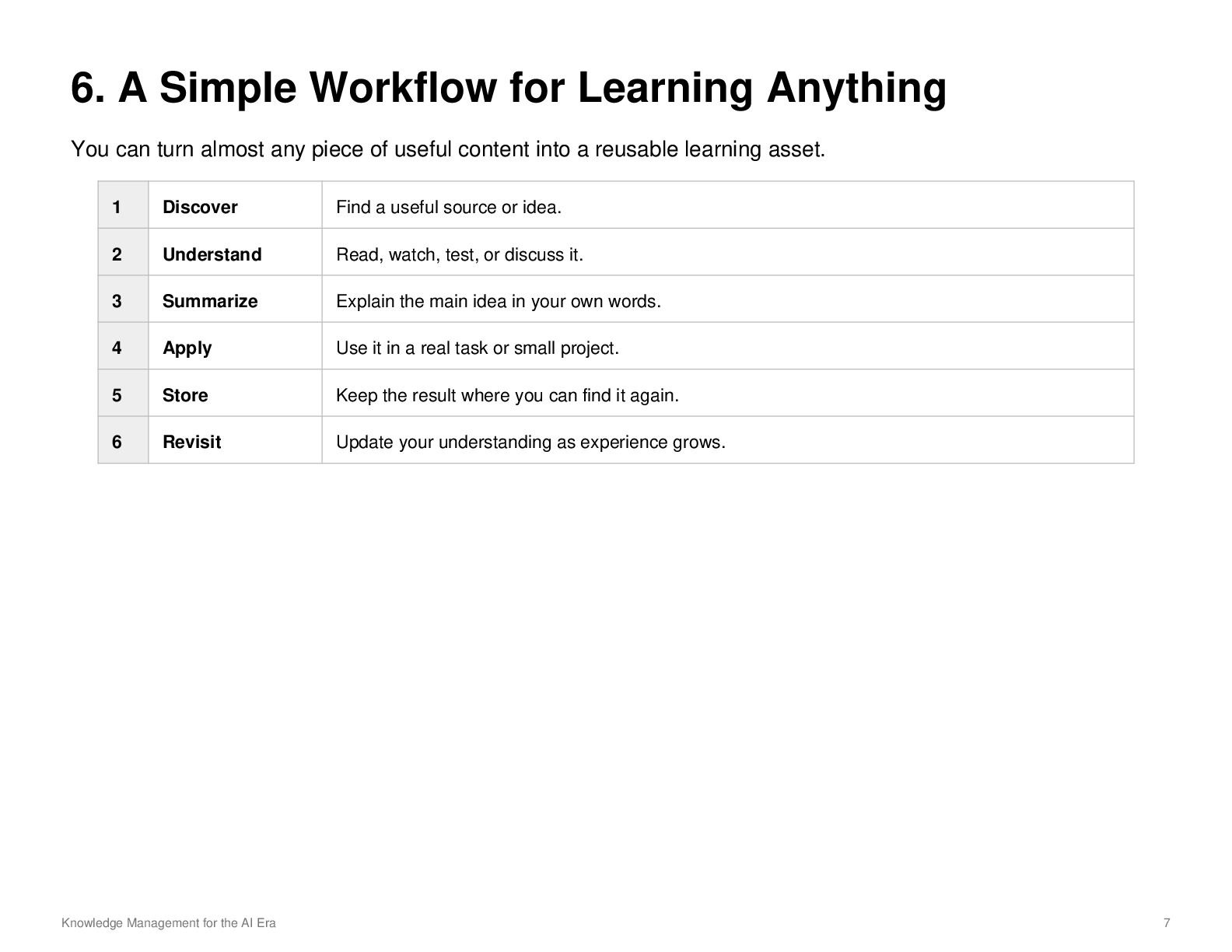
    Workflow for Learning Anything You can turn almost any piece of useful content into a reusable learning asset. 1 Discover Find a useful source or idea. 2 Understand Read, watch, test, or discuss it. 3 Summarize Explain the main idea in your own words. 4 Apply Use it in a real task or small project. 5 Store Keep the result where you can find it again. 6 Revisit Update your understanding as experience grows.
  8. Knowledge Management for the AI Era 8 7. Common Mistakes

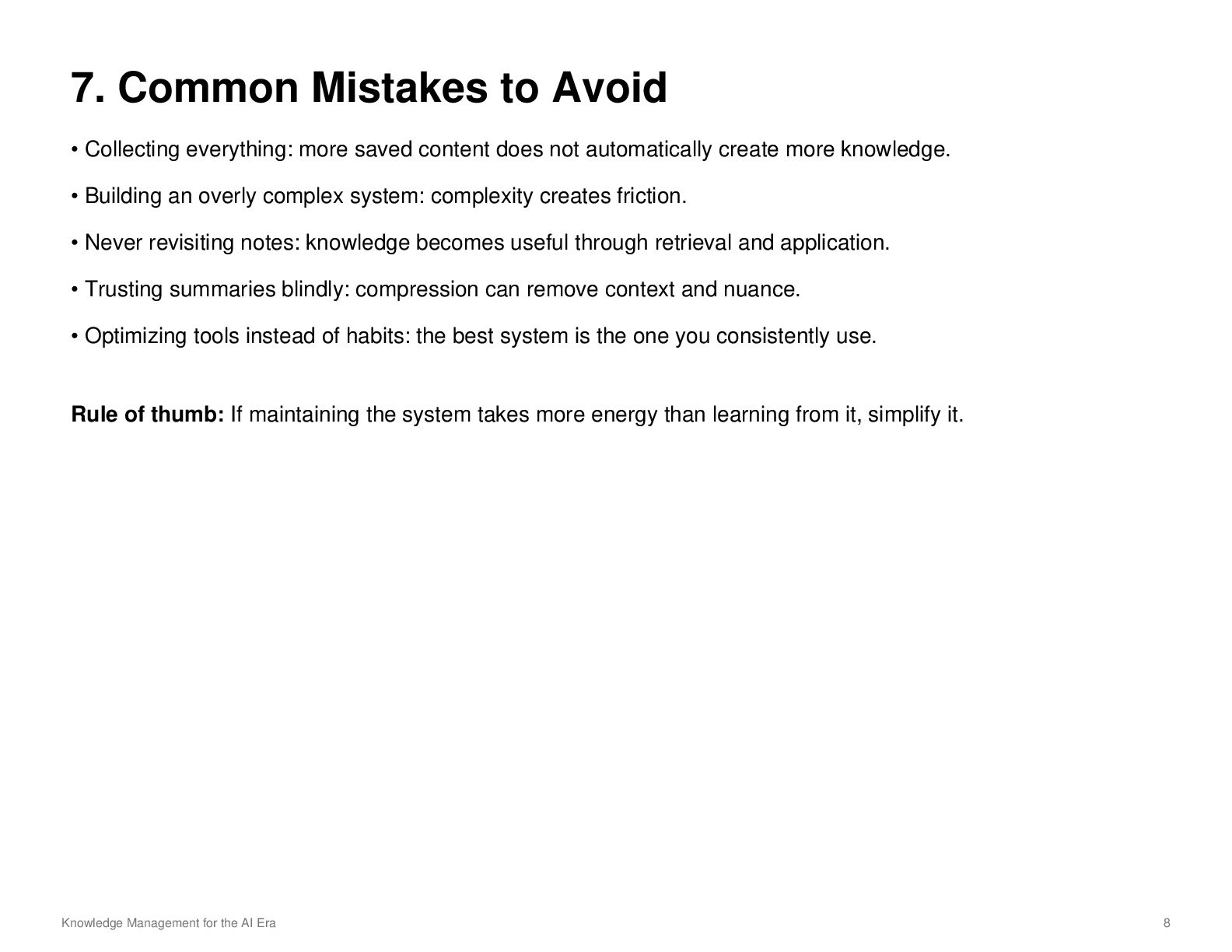
    to Avoid • Collecting everything: more saved content does not automatically create more knowledge. • Building an overly complex system: complexity creates friction. • Never revisiting notes: knowledge becomes useful through retrieval and application. • Trusting summaries blindly: compression can remove context and nuance. • Optimizing tools instead of habits: the best system is the one you consistently use. Rule of thumb: If maintaining the system takes more energy than learning from it, simplify it.
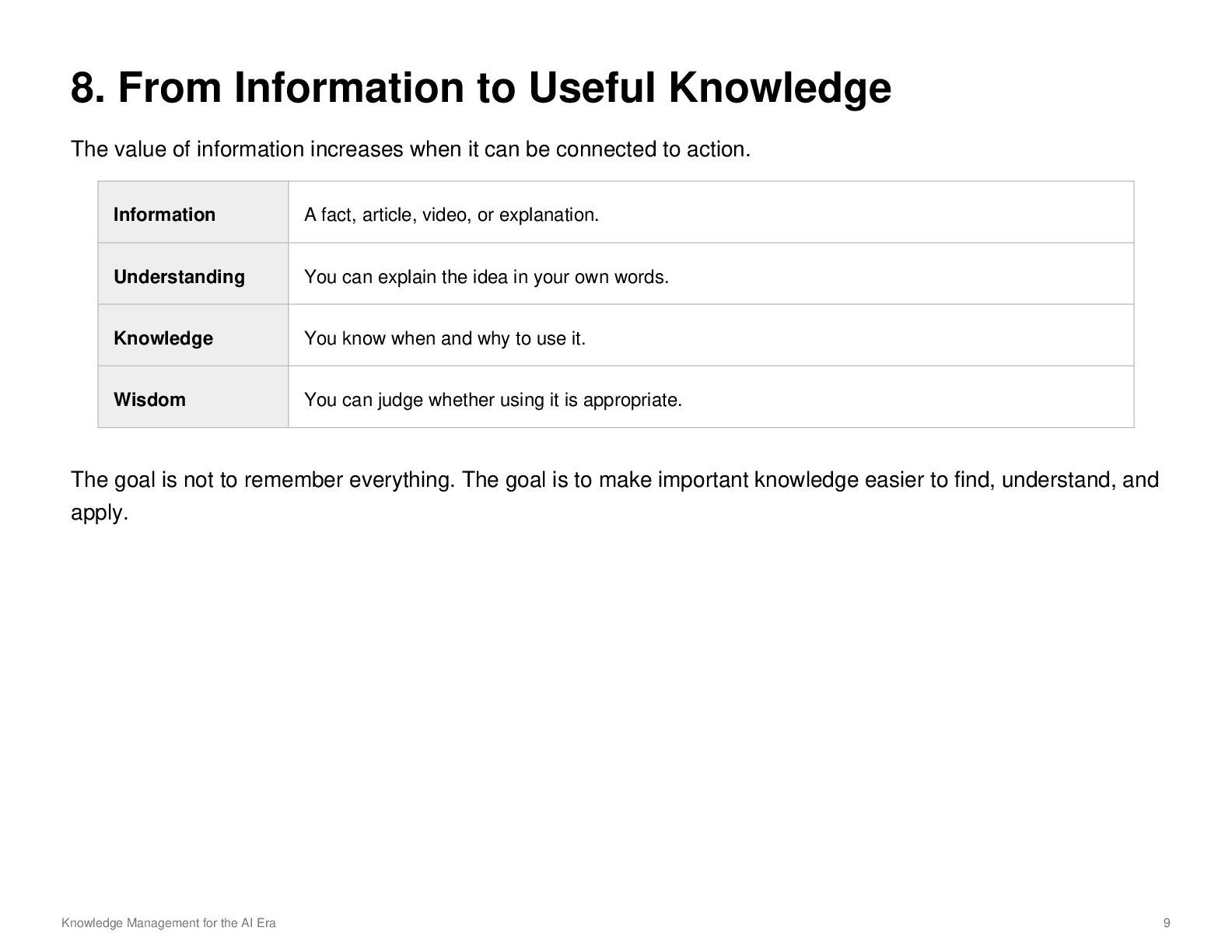
  9. Knowledge Management for the AI Era 9 8. From Information

    to Useful Knowledge The value of information increases when it can be connected to action. Information A fact, article, video, or explanation. Understanding You can explain the idea in your own words. Knowledge You know when and why to use it. Wisdom You can judge whether using it is appropriate. The goal is not to remember everything. The goal is to make important knowledge easier to find, understand, and apply.
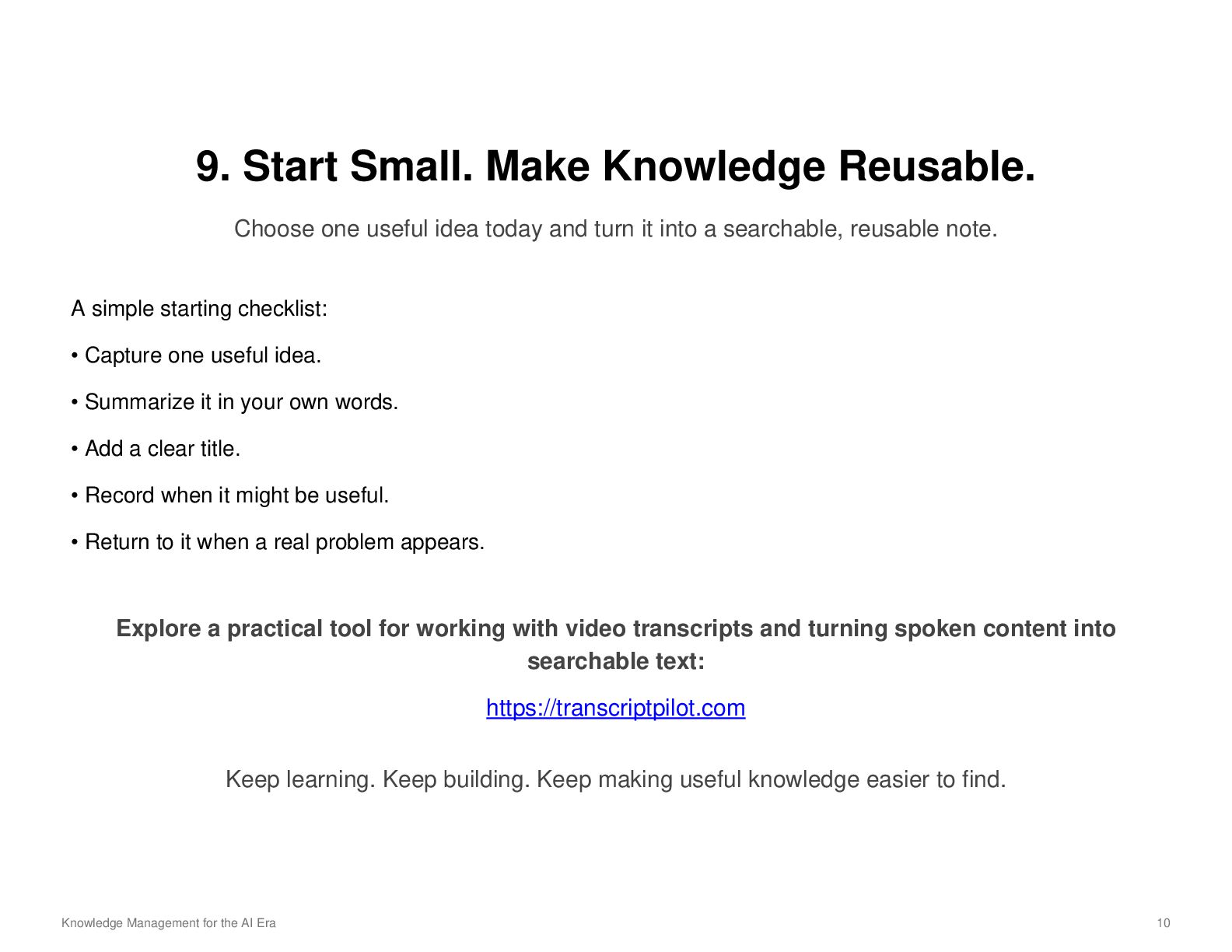
  10. Knowledge Management for the AI Era 10 9. Start Small.

    Make Knowledge Reusable. Choose one useful idea today and turn it into a searchable, reusable note. A simple starting checklist: • Capture one useful idea. • Summarize it in your own words. • Add a clear title. • Record when it might be useful. • Return to it when a real problem appears. Explore a practical tool for working with video transcripts and turning spoken content into searchable text: https://transcriptpilot.com Keep learning. Keep building. Keep making useful knowledge easier to find.