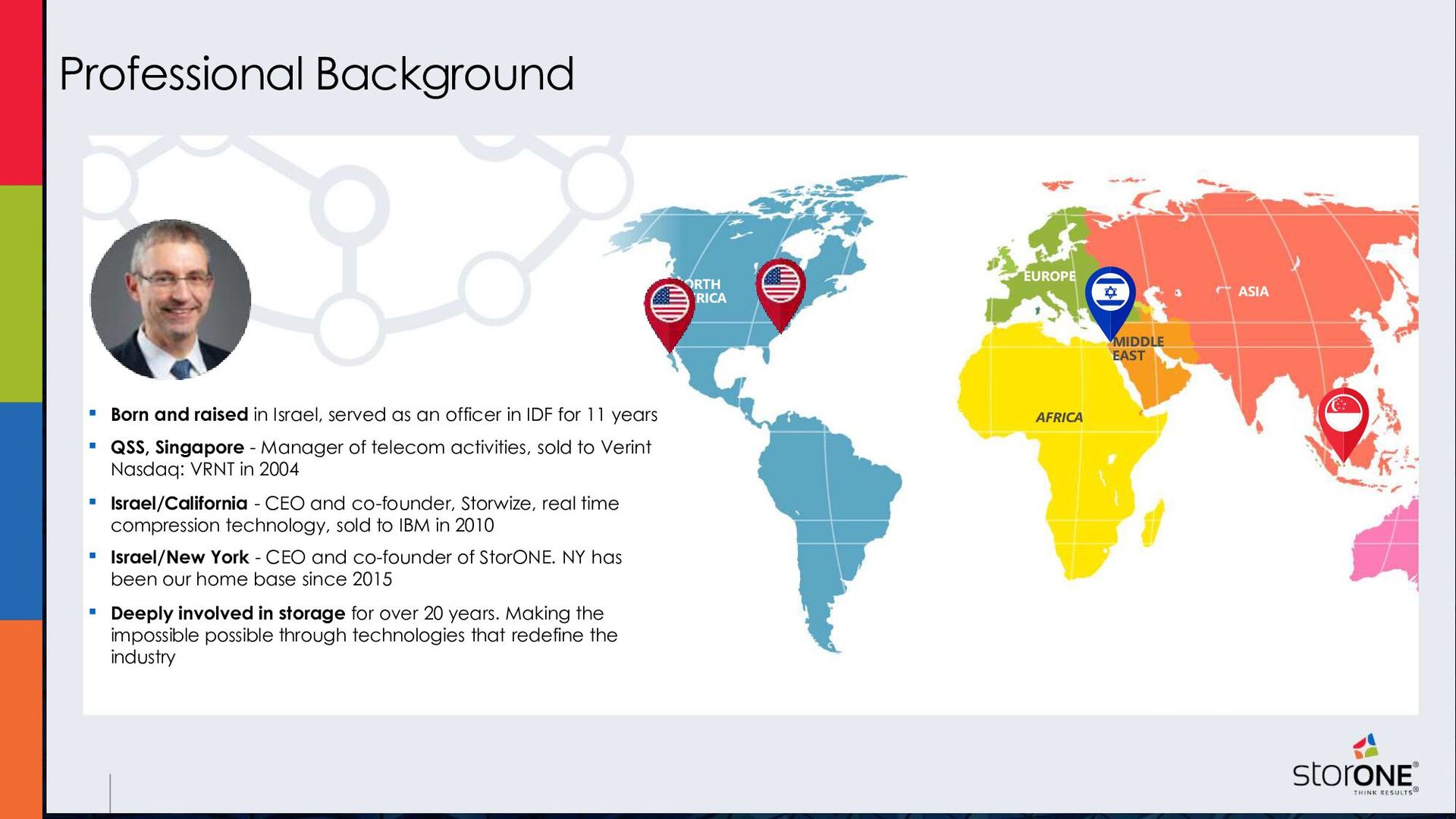
raised in Israel, served as an officer in IDF for 11 years ▪ QSS, Singapore - Manager of telecom activities, sold to Verint Nasdaq: VRNT in 2004 ▪ Israel/California - CEO and co-founder, Storwize, real time compression technology, sold to IBM in 2010 ▪ Israel/New York - CEO and co-founder of StorONE. NY has been our home base since 2015 ▪ Deeply involved in storage for over 20 years. Making the impossible possible through technologies that redefine the industry Professional Background
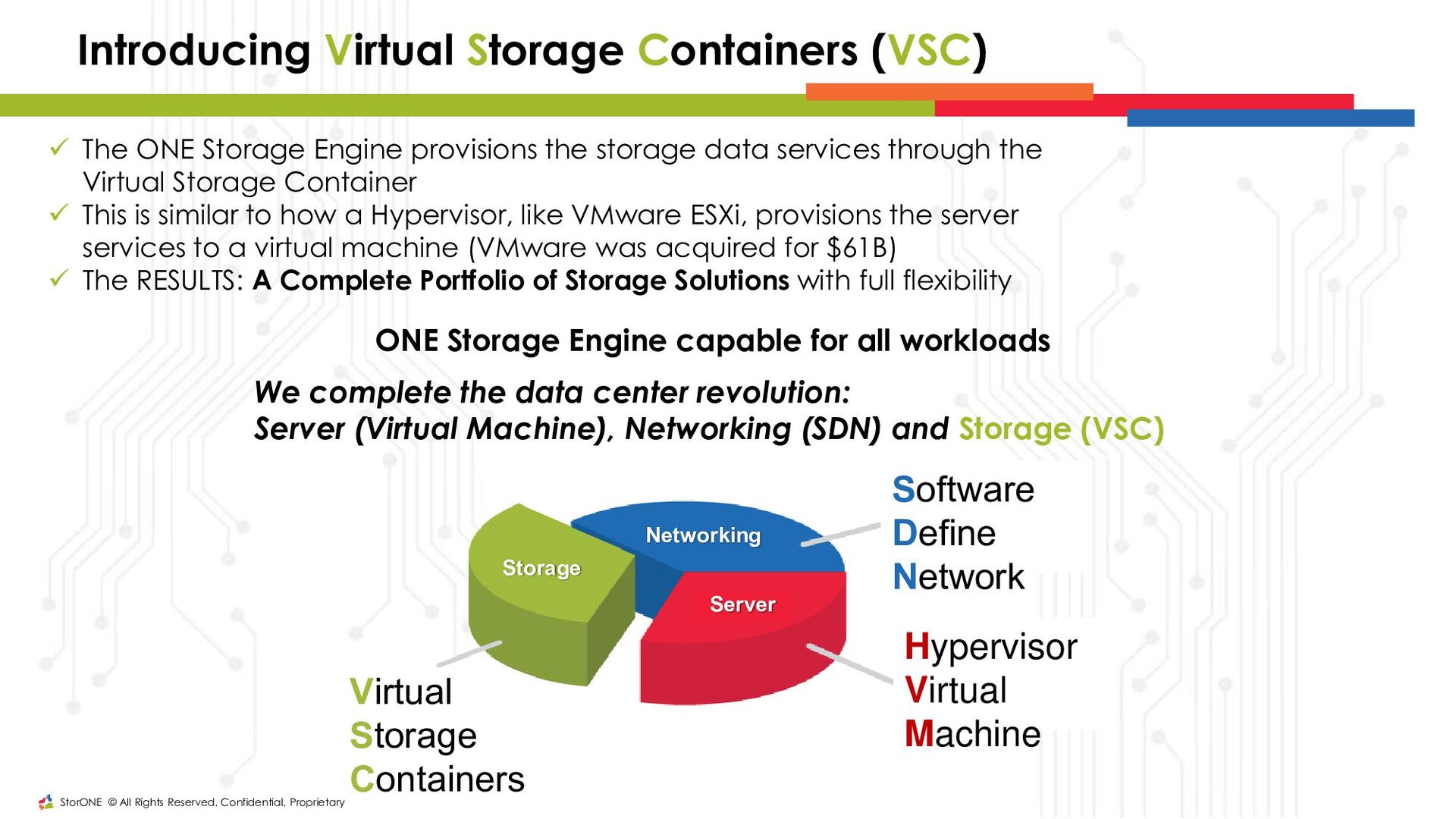
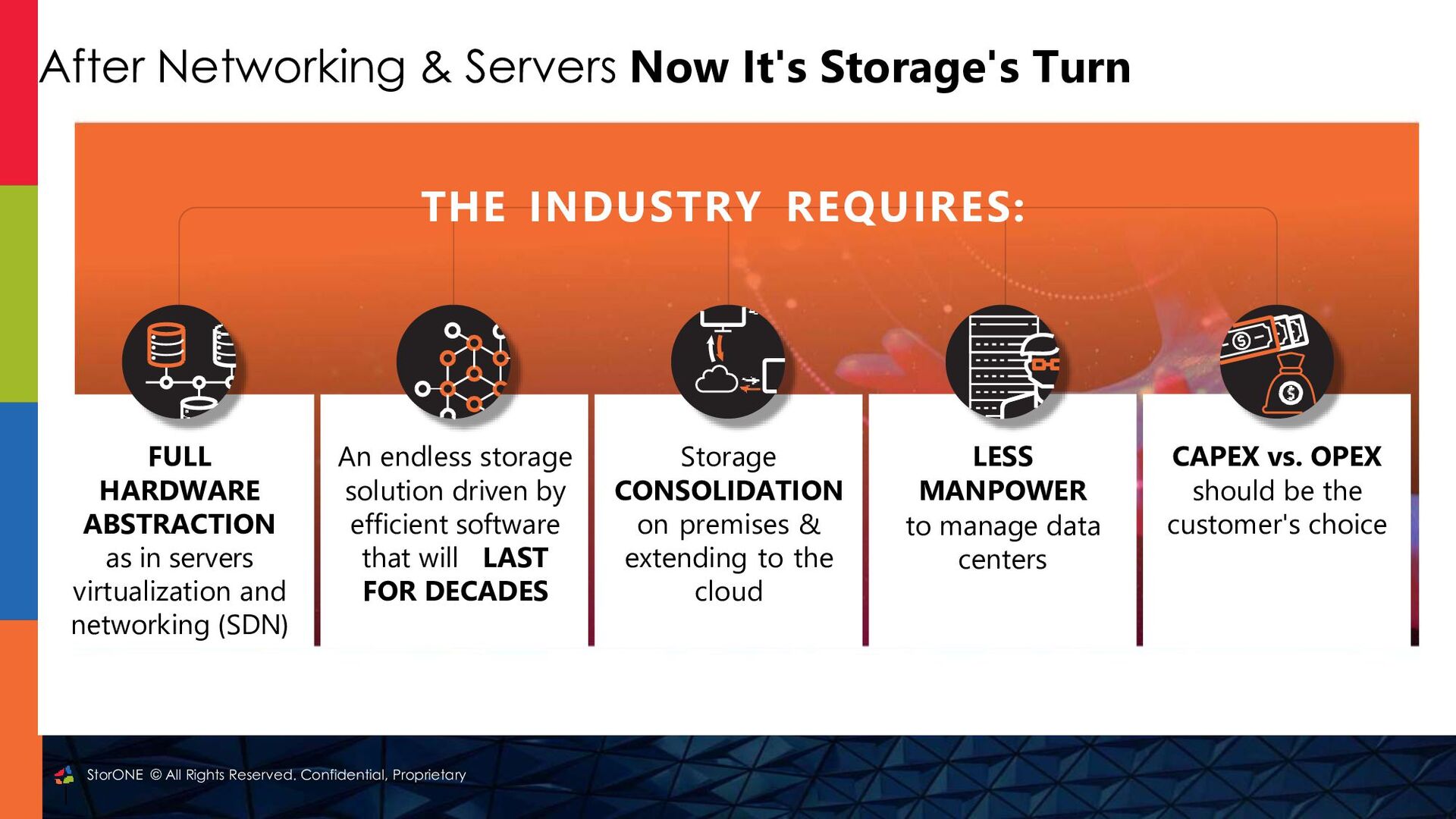
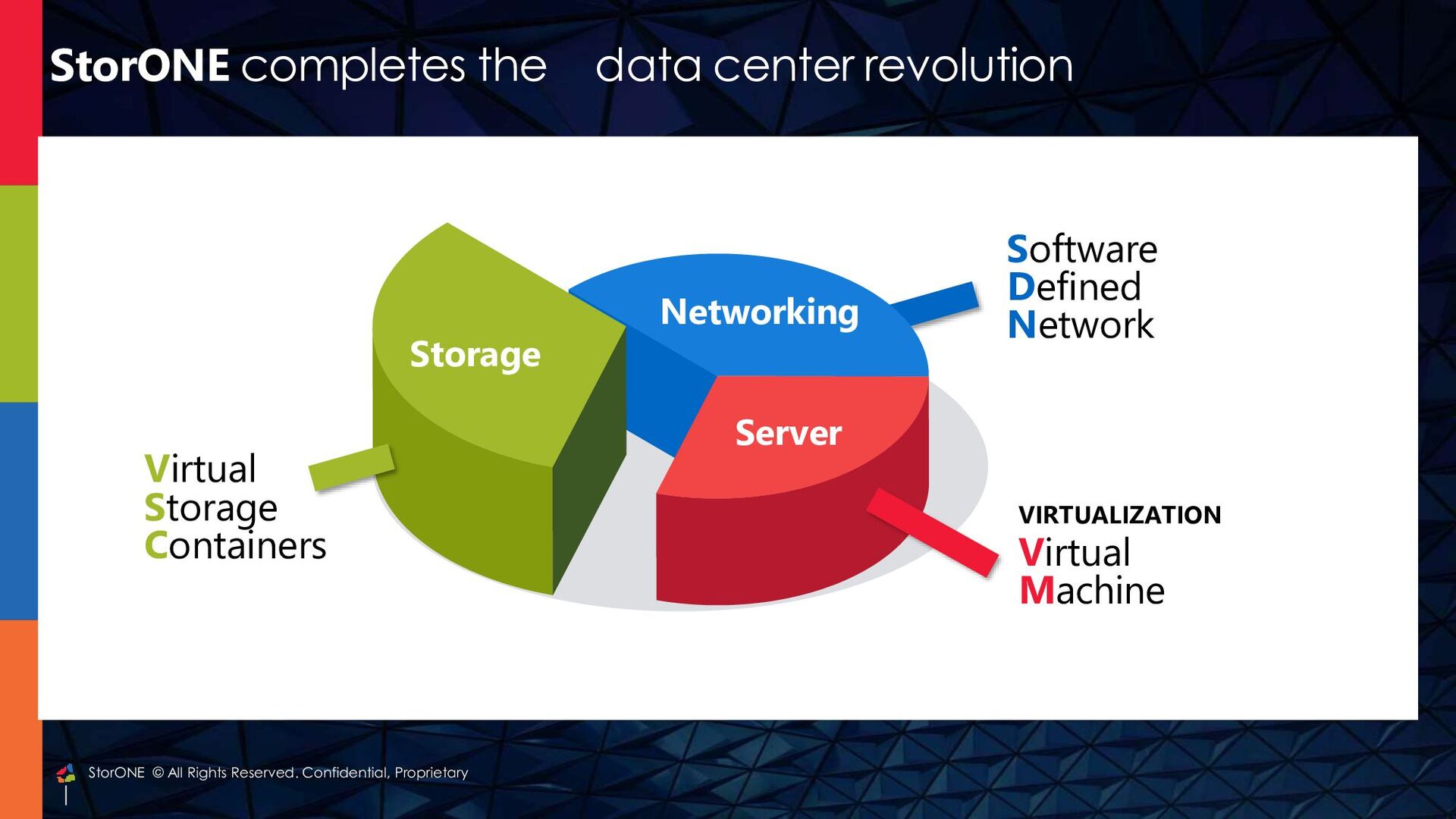
Who is StorONE? StorONE is doing for storage what Hypervisors did for servers. We complete the data center revolution: Server (Virtual Machine), Networking (SDN) and Storage (VSC) ONE Storage Engine (E.g. Hypervisor) is an enterprise class storage solution, developed by StorONE for deploying and serving Virtual Storage Containers (E.g. Virtual Machines)
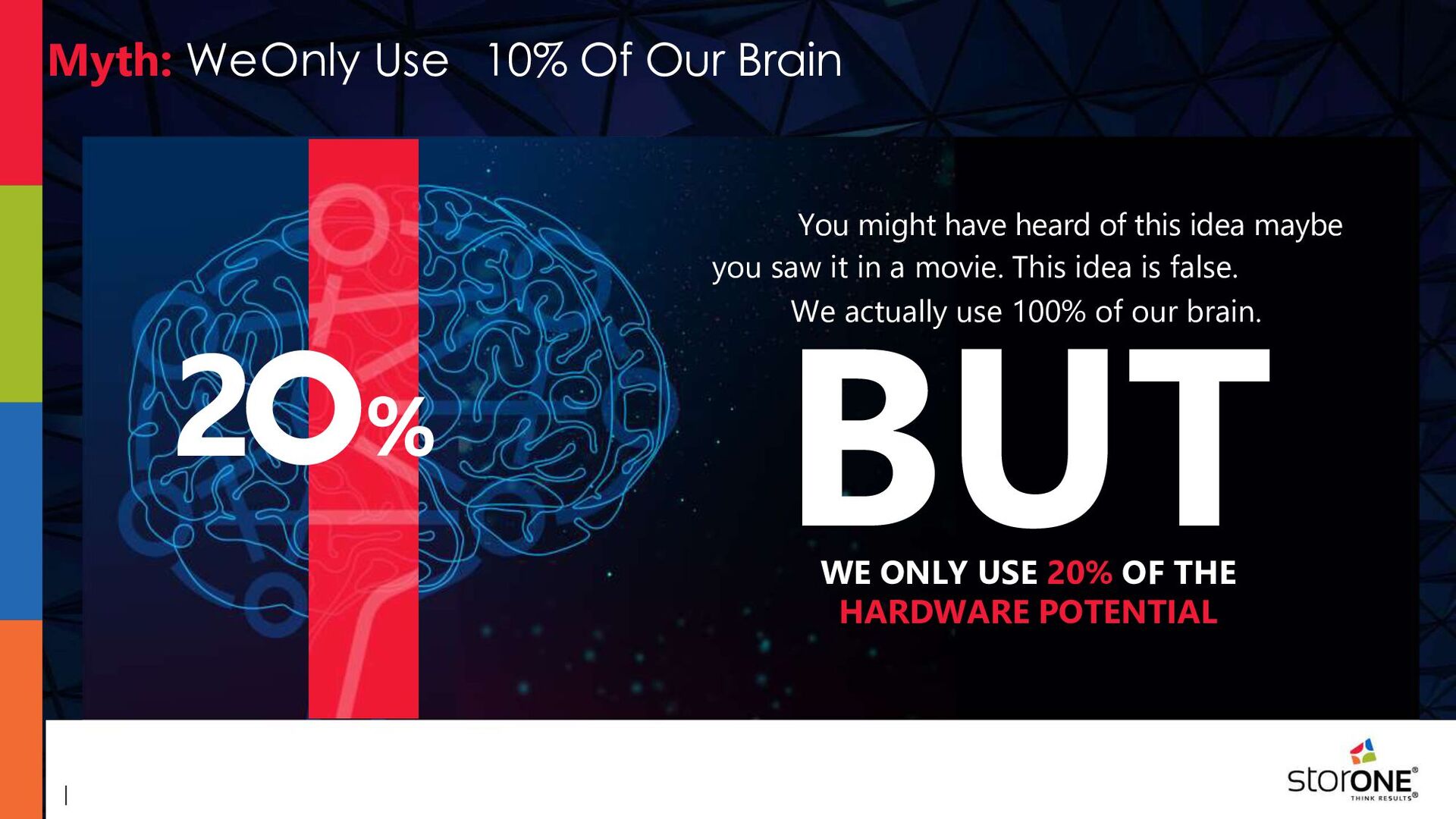
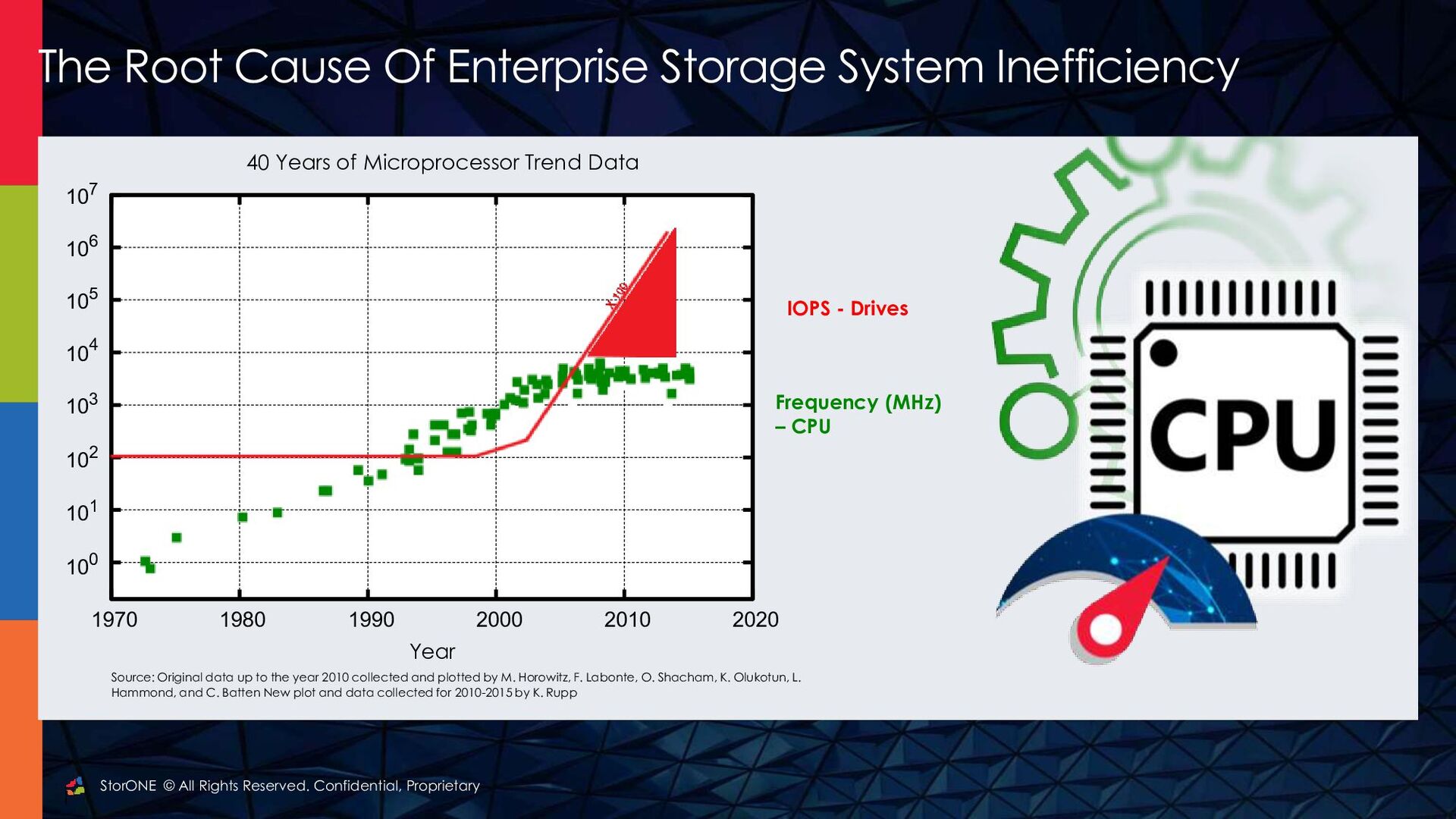
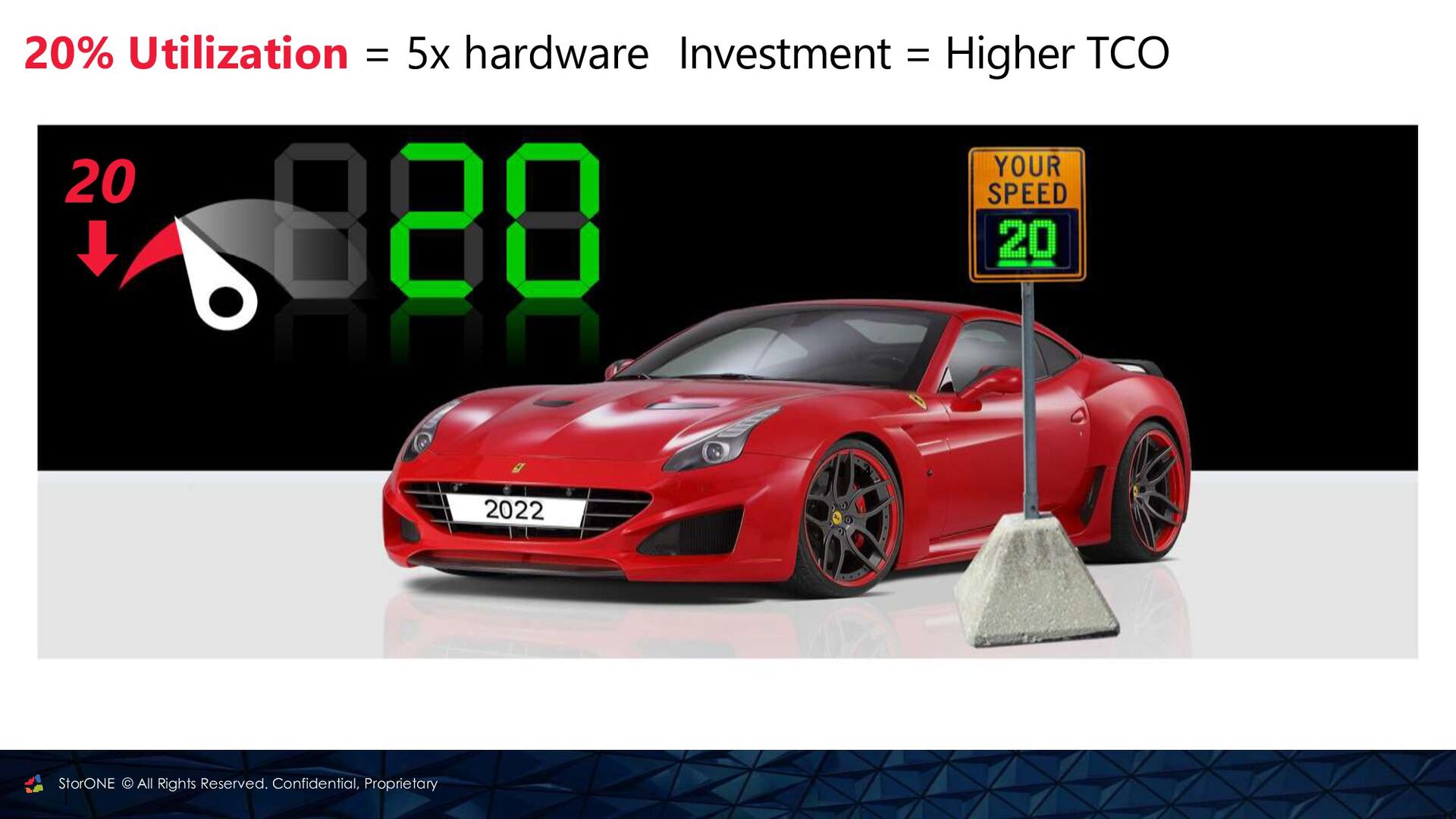
it in a movie. This idea is false. We actually use 100% of our brain. Myth: WeOnly Use 10% Of Our Brain BUT 2 % WE ONLY USE 20% OF THE HARDWARE POTENTIAL
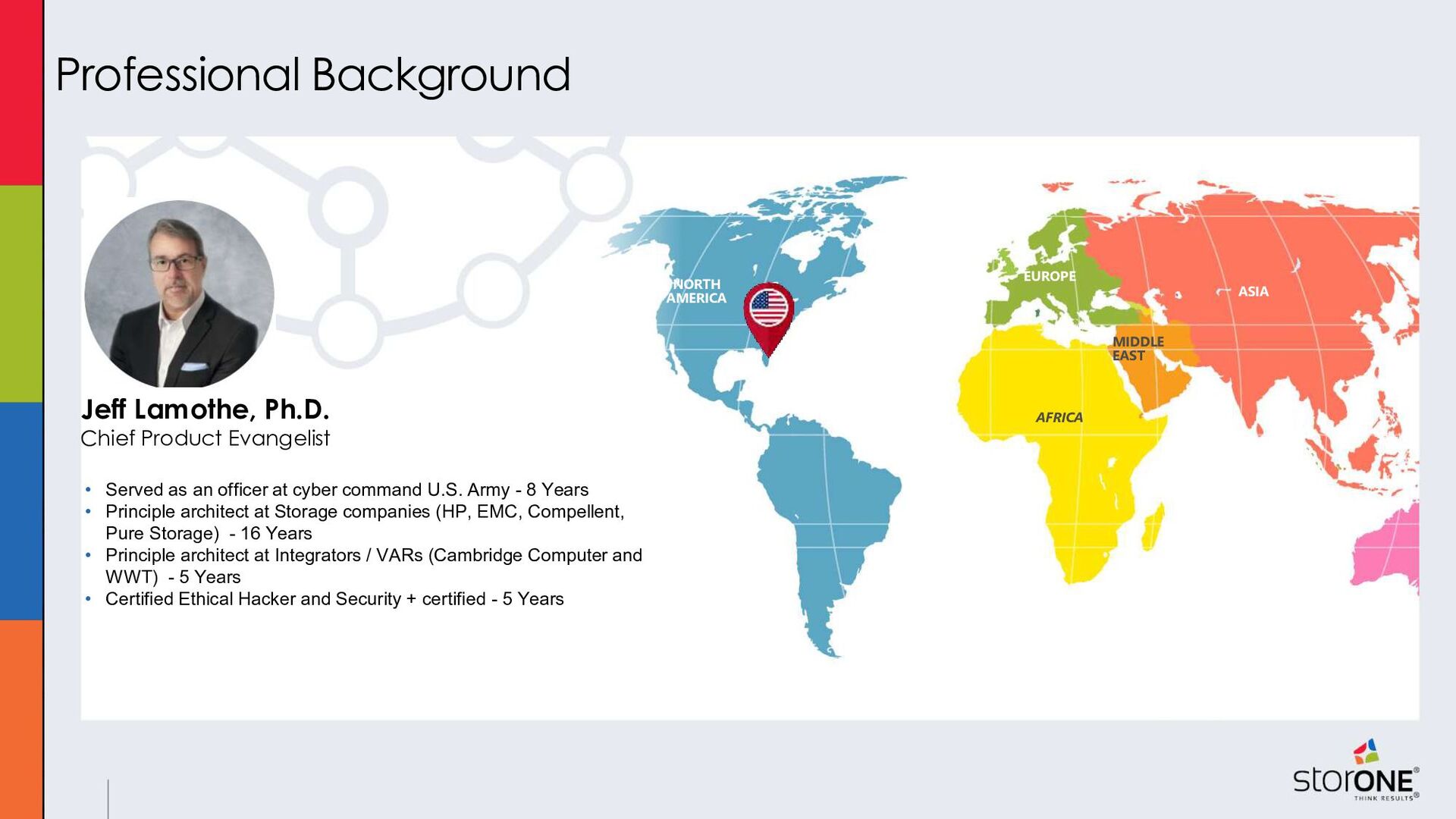
an officer at cyber command U.S. Army - 8 Years • Principle architect at Storage companies (HP, EMC, Compellent, Pure Storage) - 16 Years • Principle architect at Integrators / VARs (Cambridge Computer and WWT) - 5 Years • Certified Ethical Hacker and Security + certified - 5 Years Professional Background Jeff Lamothe, Ph.D. Chief Product Evangelist
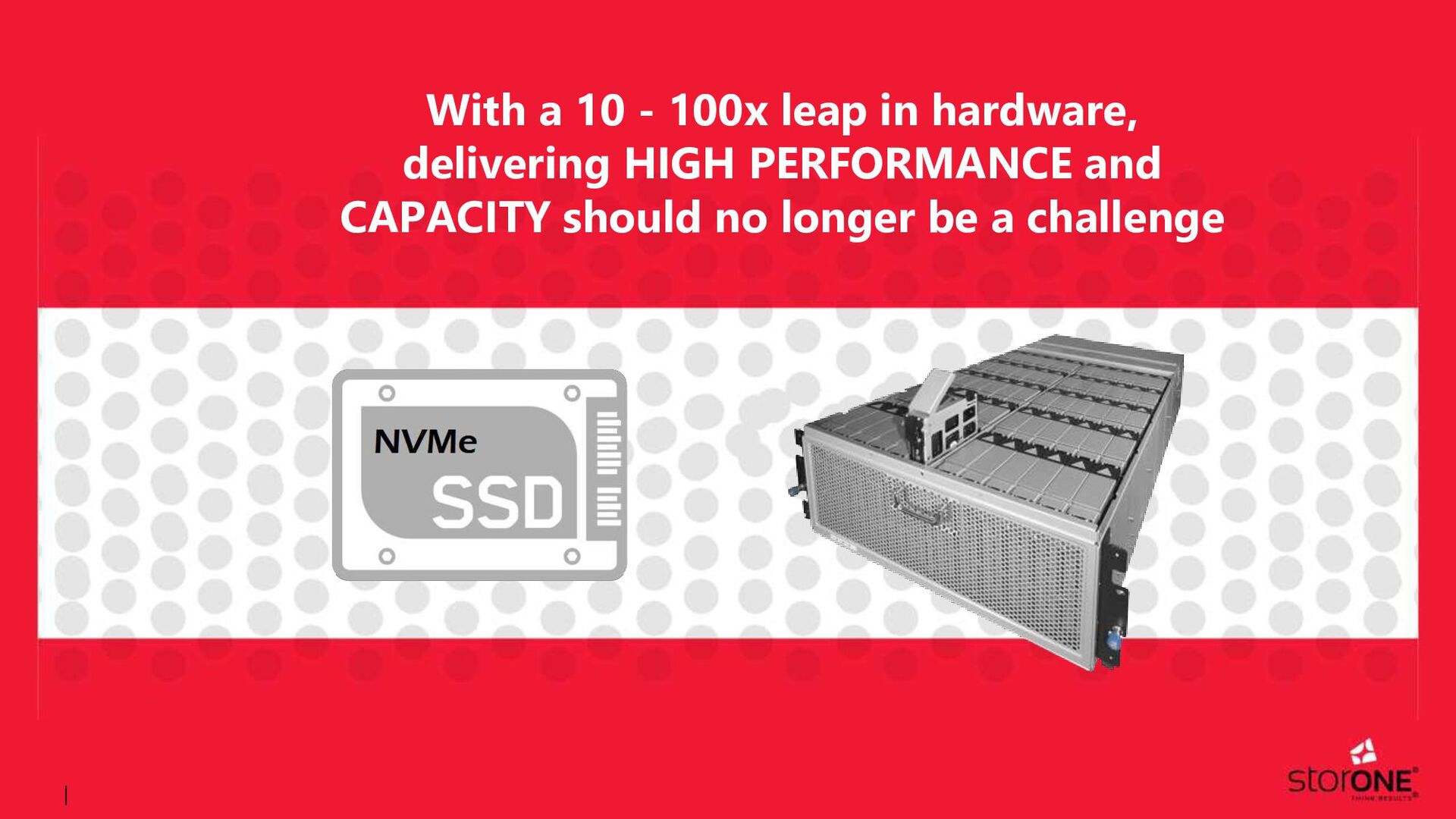
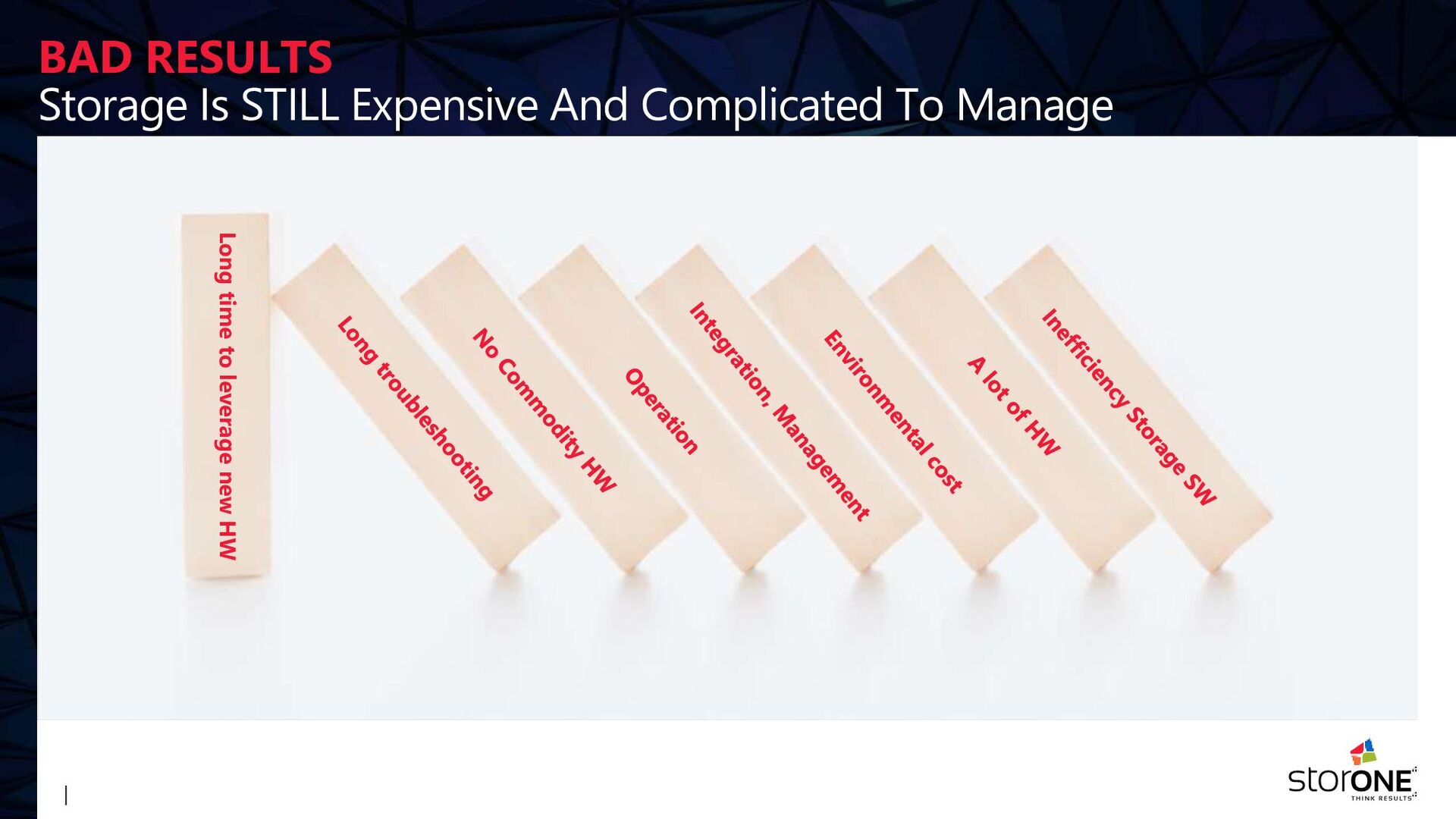
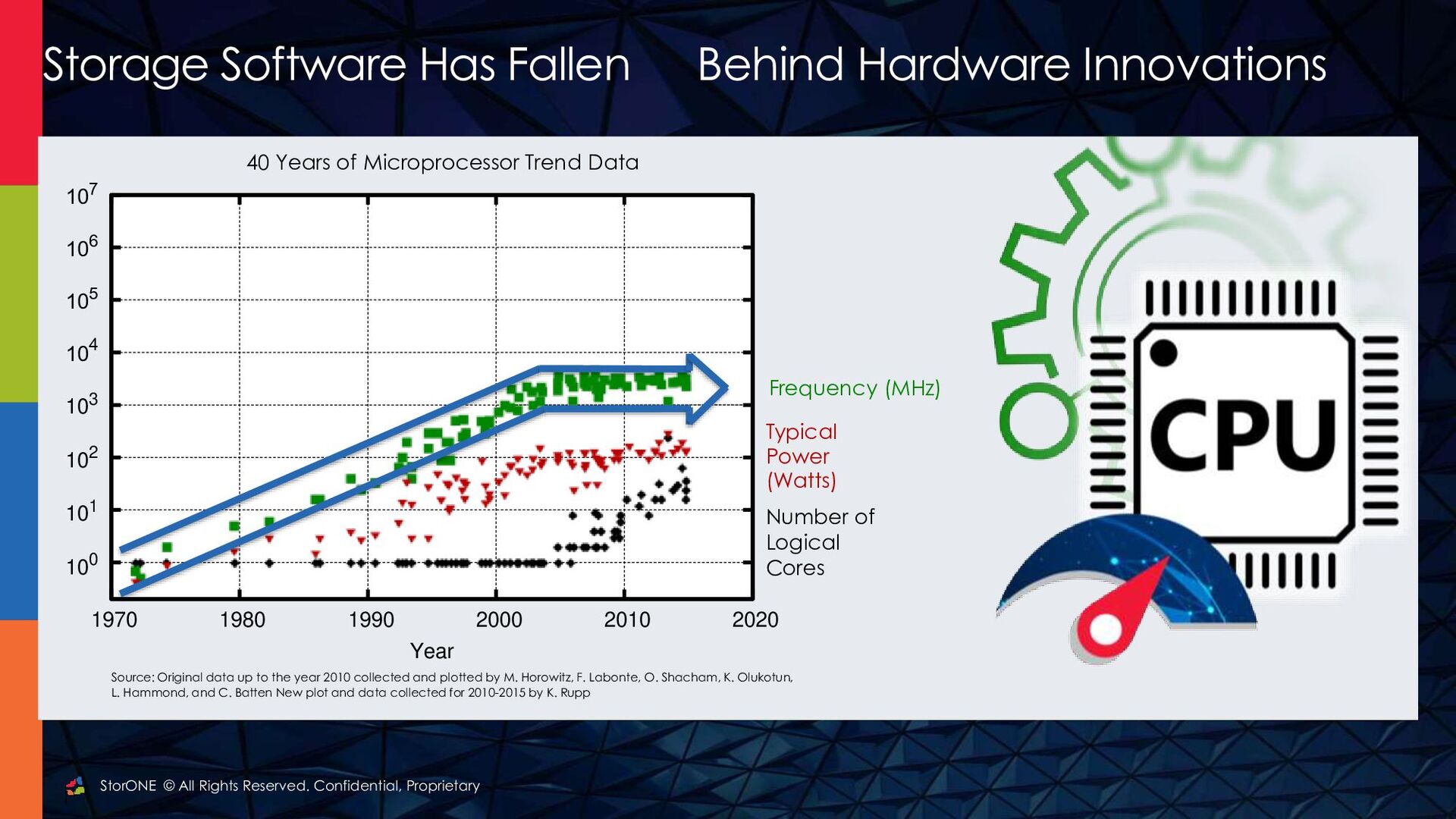
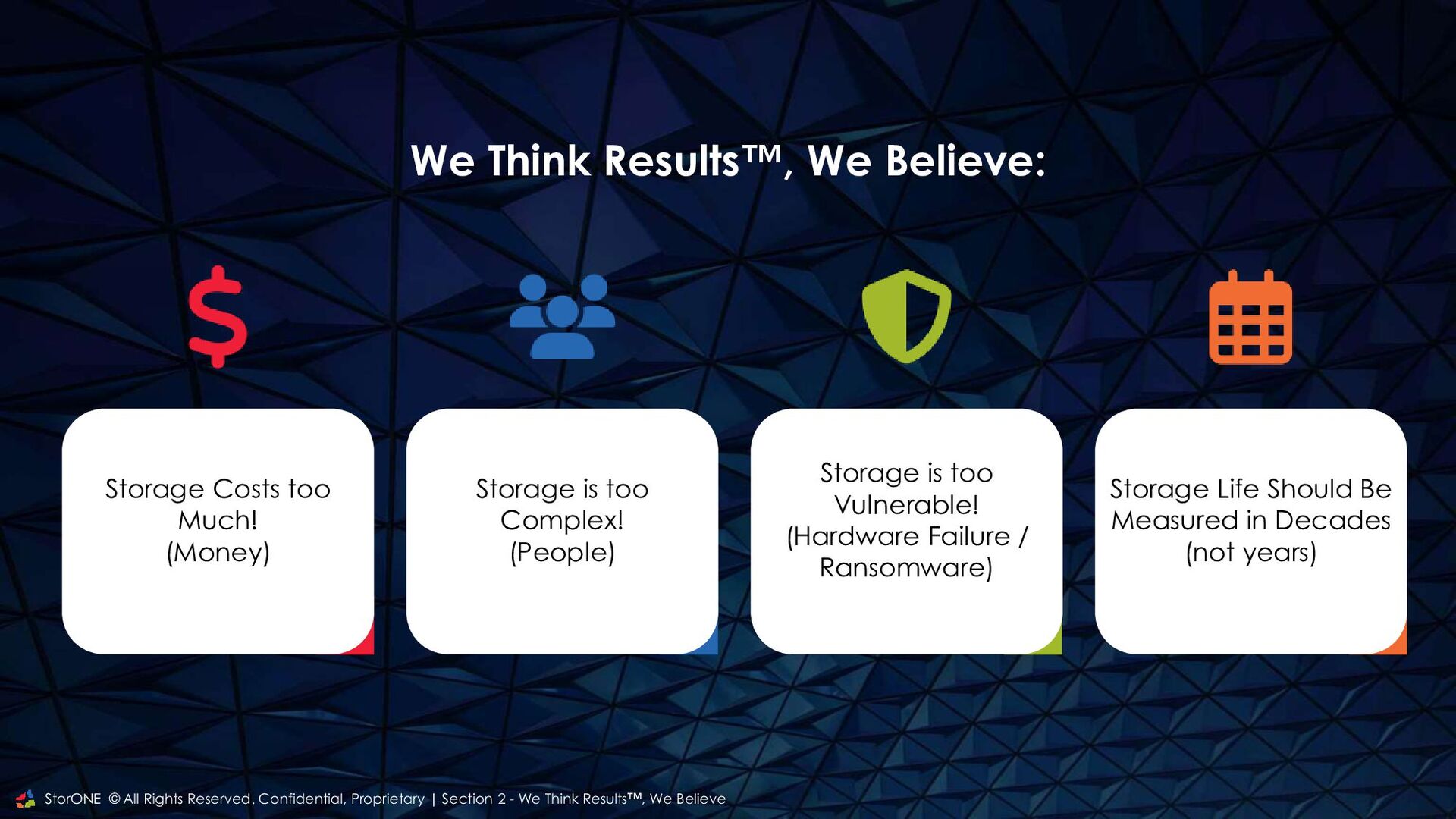
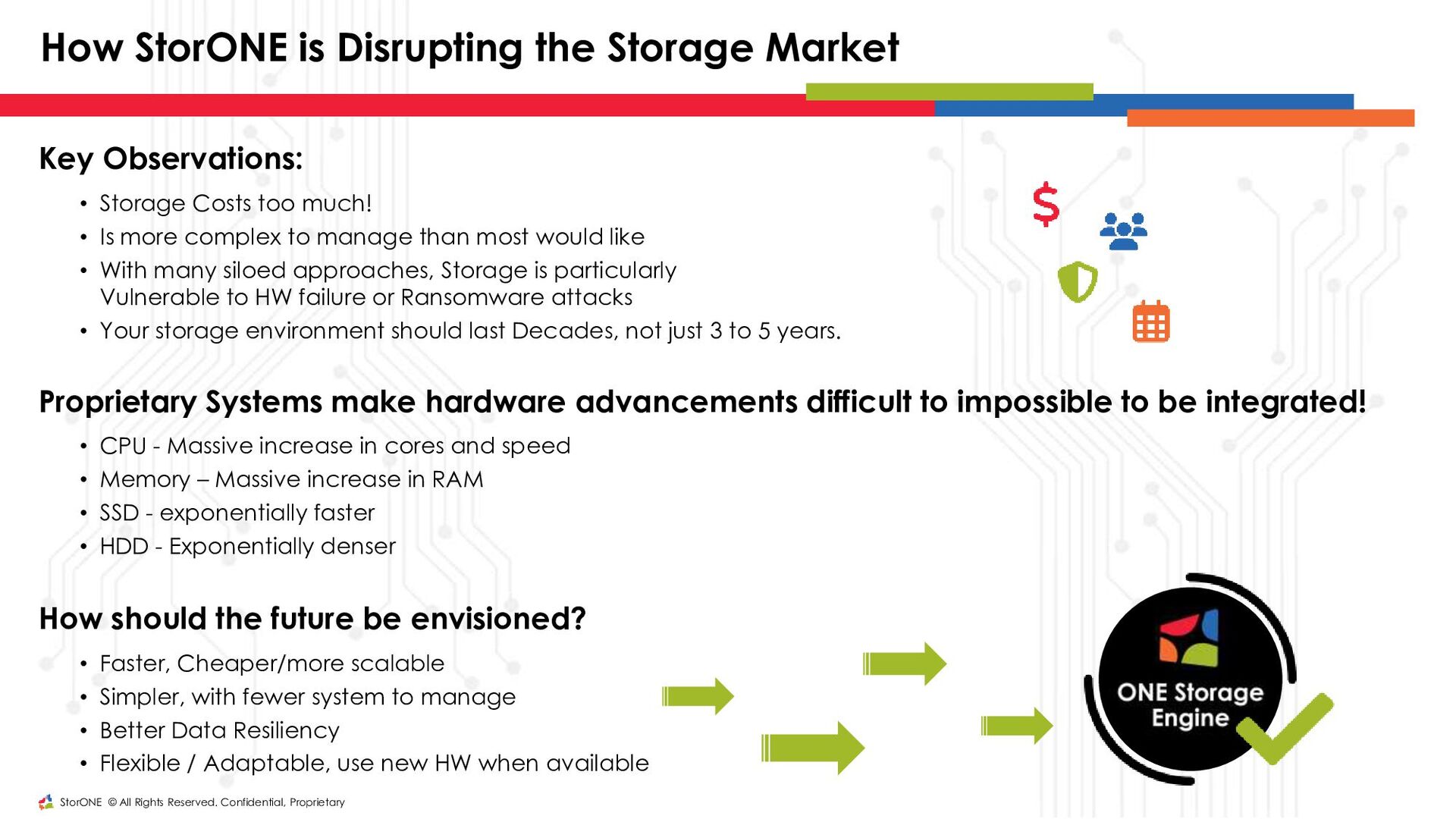
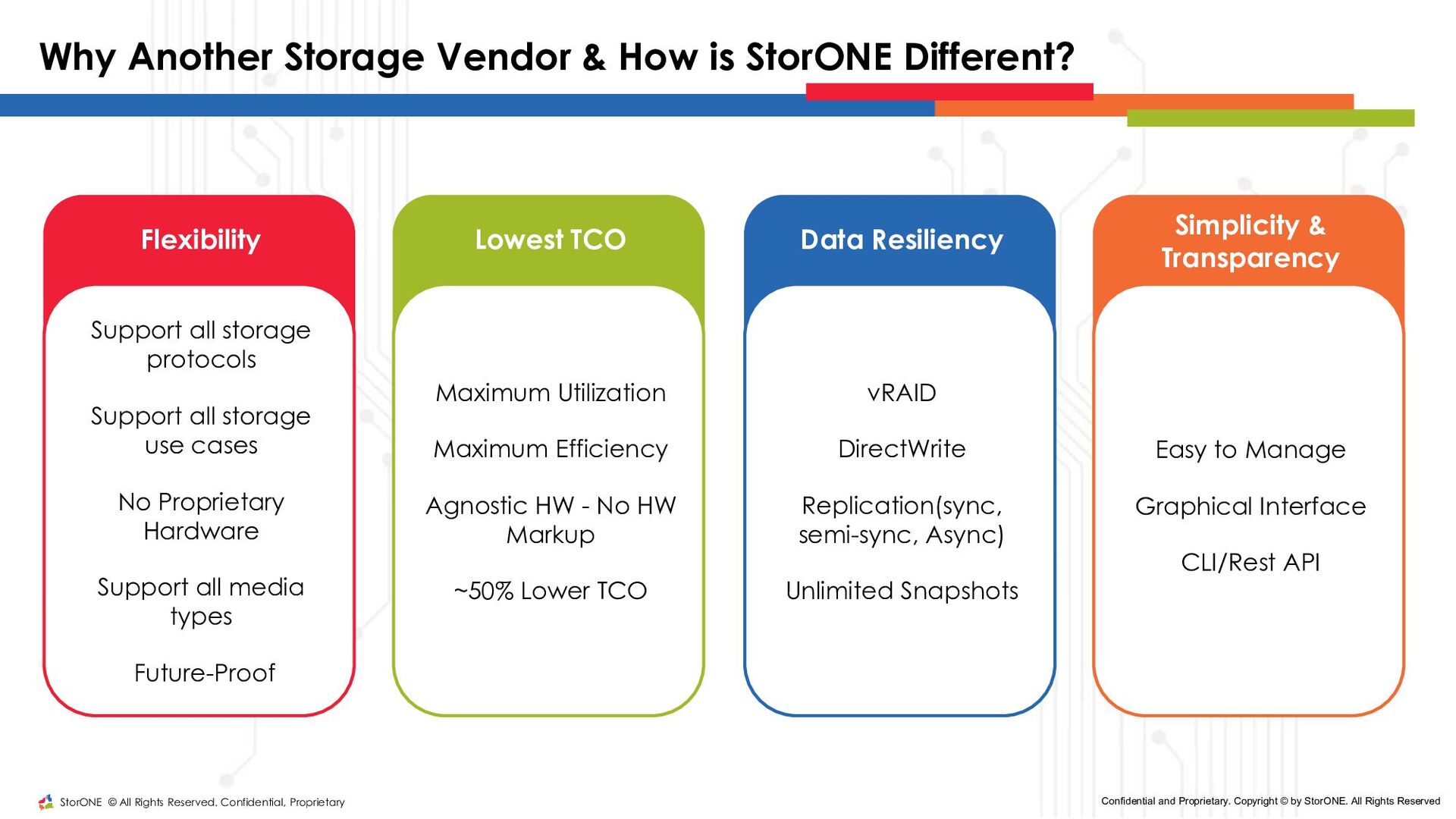
Storage Costs too much! • Is more complex to manage than most would like • With many siloed approaches, Storage is particularly Vulnerable to HW failure or Ransomware attacks • Your storage environment should last Decades, not just 3 to 5 years. Proprietary Systems make hardware advancements difficult to impossible to be integrated! • CPU - Massive increase in cores and speed • Memory – Massive increase in RAM • SSD - exponentially faster • HDD - Exponentially denser How should the future be envisioned? • Faster, Cheaper/more scalable • Simpler, with fewer system to manage • Better Data Resiliency • Flexible / Adaptable, use new HW when available How StorONE is Disrupting the Storage Market
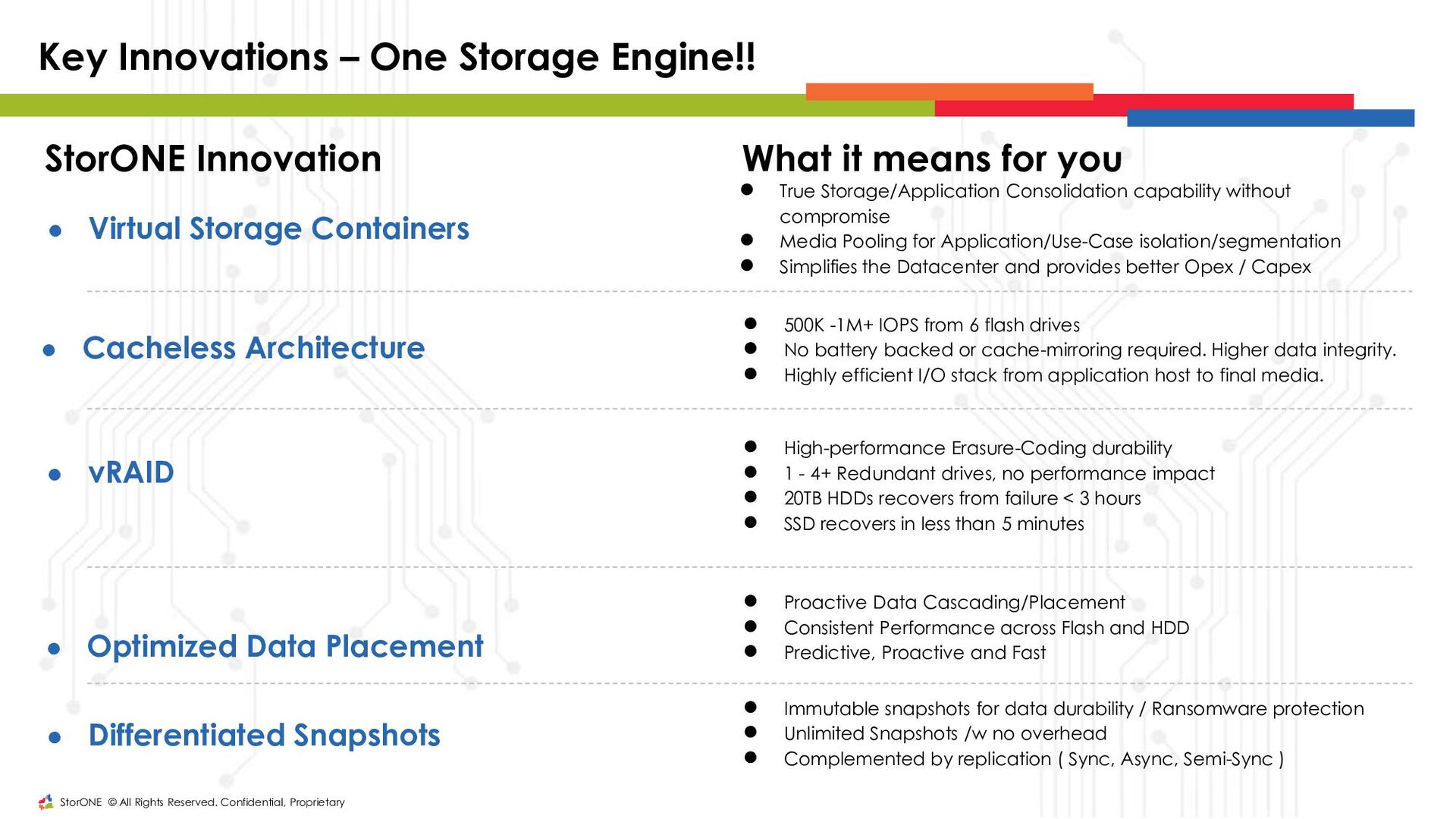
One Storage Engine!! • Cacheless Architecture StorONE Innovation What it means for you • 500K -1M+ IOPS from 6 flash drives • No battery backed or cache-mirroring required. Higher data integrity. • Highly efficient I/O stack from application host to final media. • vRAID • High-performance Erasure-Coding durability • 1 - 4+ Redundant drives, no performance impact • 20TB HDDs recovers from failure < 3 hours • SSD recovers in less than 5 minutes • Optimized Data Placement • Proactive Data Cascading/Placement • Consistent Performance across Flash and HDD • Predictive, Proactive and Fast • Differentiated Snapshots • Immutable snapshots for data durability / Ransomware protection • Unlimited Snapshots /w no overhead • Complemented by replication ( Sync, Async, Semi-Sync ) • Virtual Storage Containers • True Storage/Application Consolidation capability without compromise • Media Pooling for Application/Use-Case isolation/segmentation • Simplifies the Datacenter and provides better Opex / Capex
Networking Server Storage Hypervisor Virtual Machine Software Define Network ONE Storage Engine capable for all workloads Introducing Virtual Storage Containers (VSC) ✓ The ONE Storage Engine provisions the storage data services through the Virtual Storage Container ✓ This is similar to how a Hypervisor, like VMware ESXi, provisions the server services to a virtual machine (VMware was acquired for $61B) ✓ The RESULTS: A Complete Portfolio of Storage Solutions with full flexibility We complete the data center revolution: Server (Virtual Machine), Networking (SDN) and Storage (VSC)
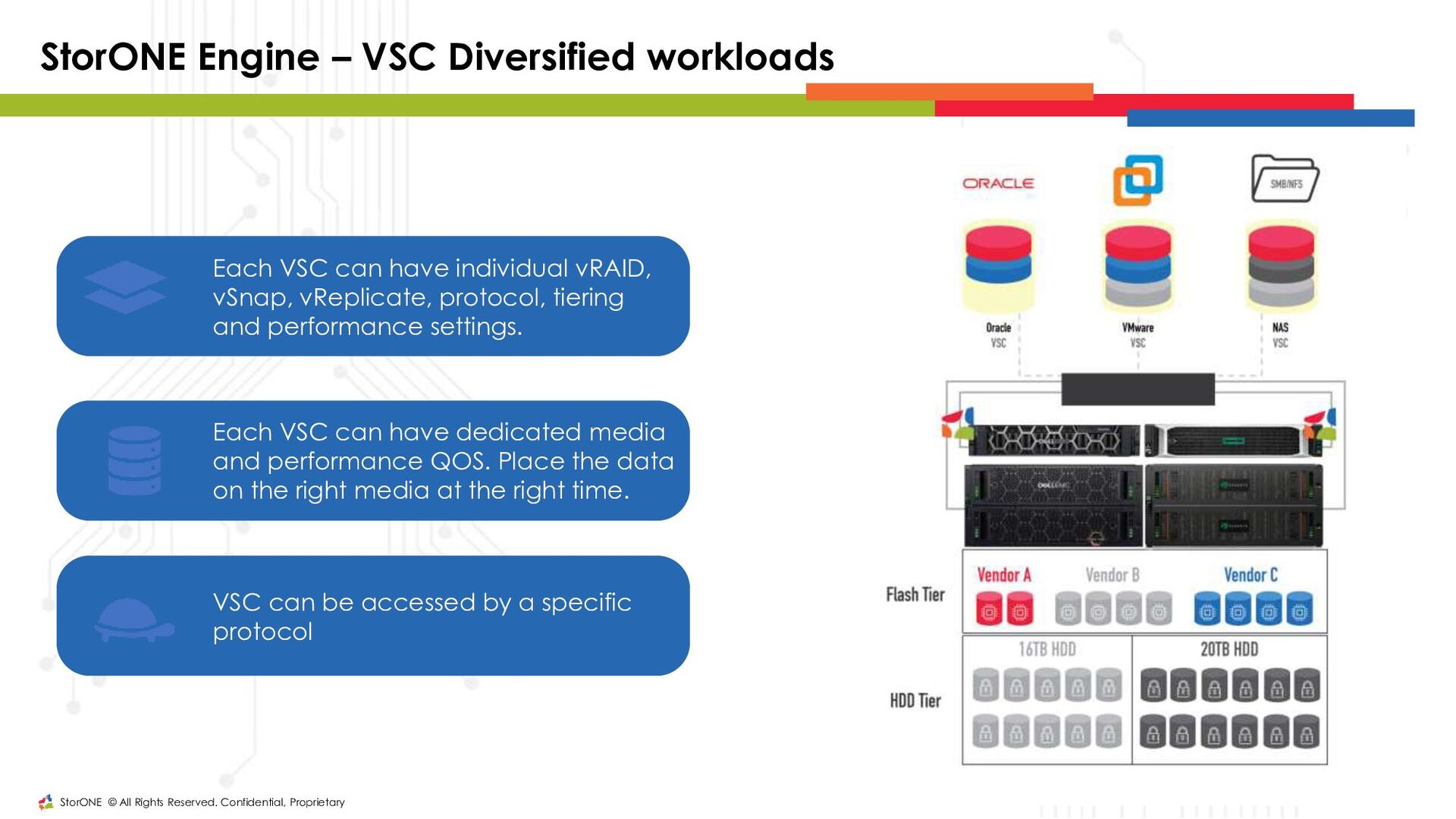
VSC Diversified workloads Each VSC can have individual vRAID, vSnap, vReplicate, protocol, tiering and performance settings. Each VSC can have dedicated media and performance QOS. Place the data on the right media at the right time. VSC can be accessed by a specific protocol
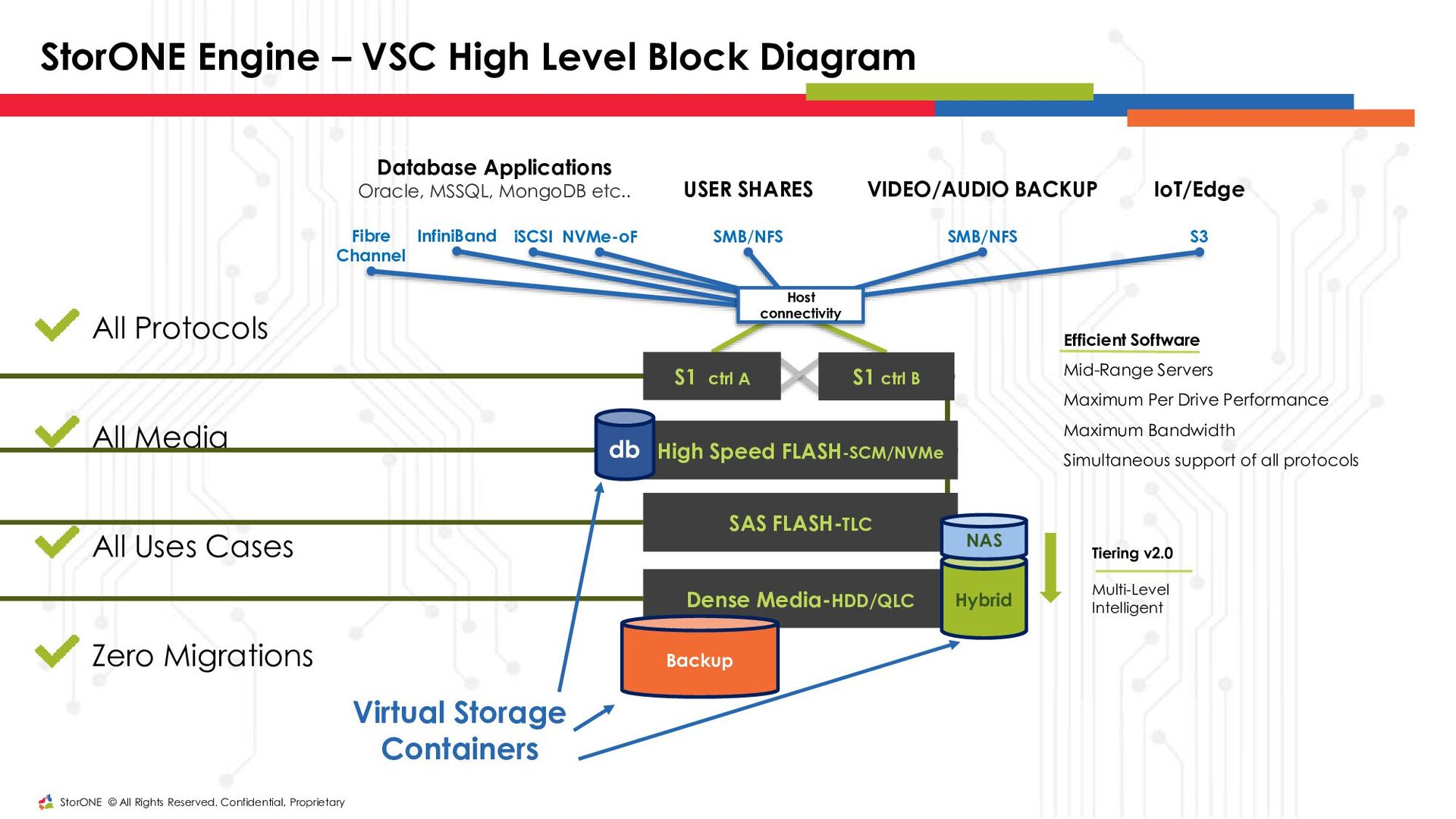
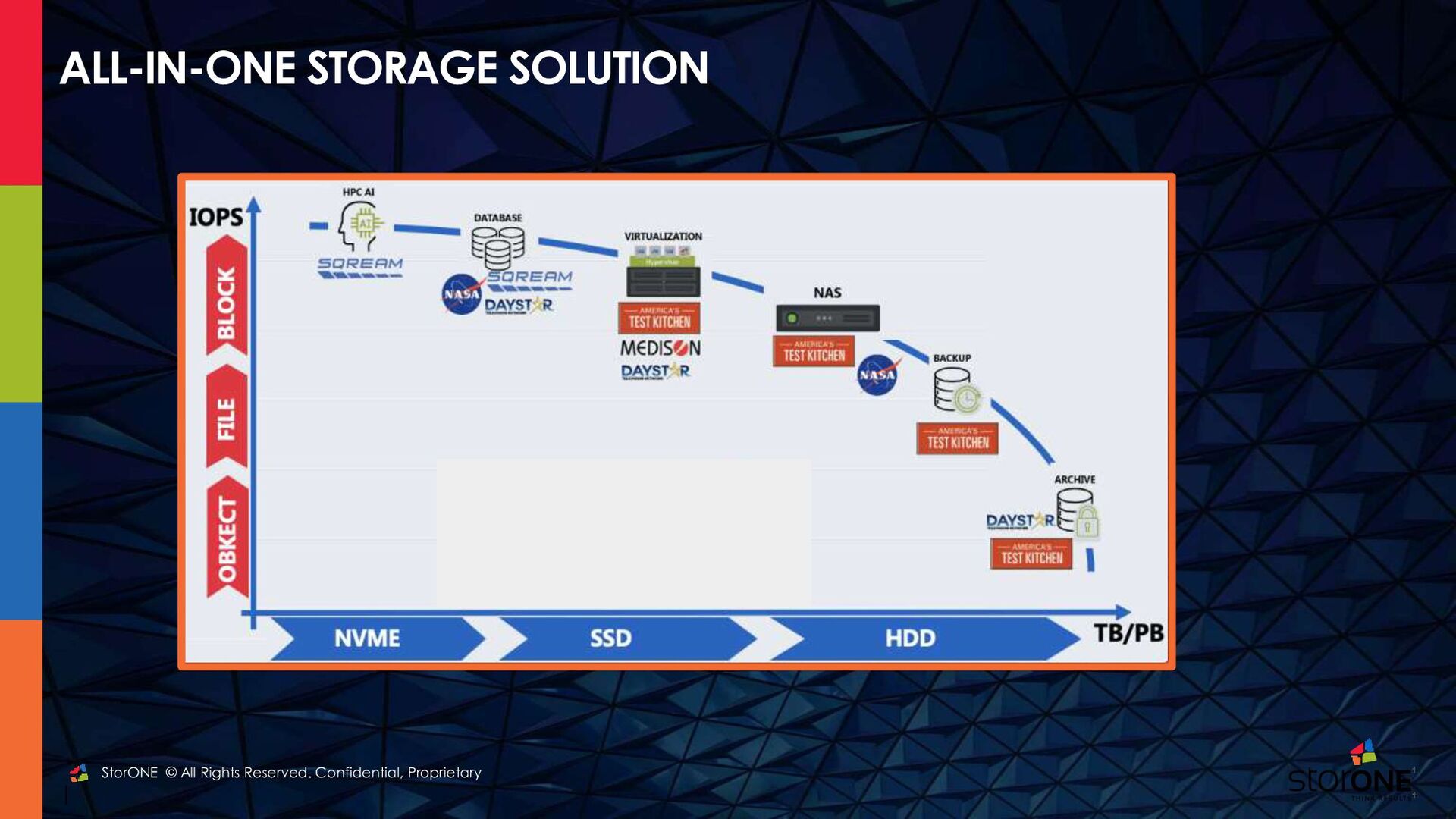
VSC High Level Block Diagram SMB/NFS USER SHARES S3 IoT/Edge VIDEO/AUDIO BACKUP SMB/NFS Database Applications Oracle, MSSQL, MongoDB etc.. iSCSI NVMe-oF Fibre Channel All Protocols All Media All Uses Cases Zero Migrations Efficient Software Mid-Range Servers Maximum Per Drive Performance Maximum Bandwidth Simultaneous support of all protocols Host connectivity High Speed FLASH-SCM/NVMe SAS FLASH-TLC Dense Media-HDD/QLC S1 ctrl A S1 ctrl B InfiniBand Tiering v2.0 Multi-Level Intelligent Virtual Storage Containers Hybrid NAS Backup db
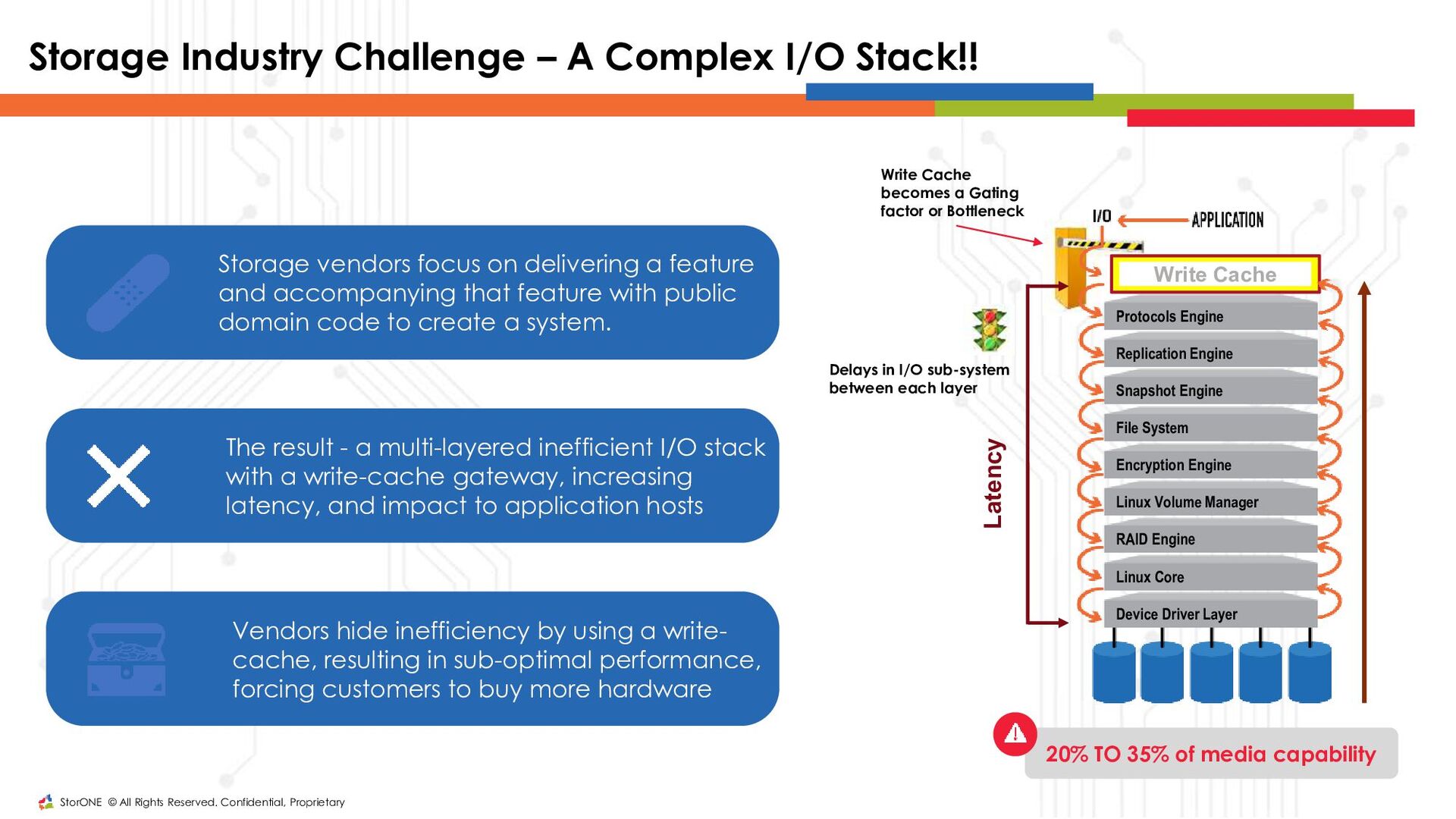
– A Complex I/O Stack!! Storage vendors focus on delivering a feature and accompanying that feature with public domain code to create a system. Vendors hide inefficiency by using a write- cache, resulting in sub-optimal performance, forcing customers to buy more hardware Write Cache Latency Delays in I/O sub-system between each layer Write Cache becomes a Gating factor or Bottleneck Device Driver Layer Linux Core RAID Engine Linux Volume Manager File System Snapshot Engine Encryption Engine Replication Engine Protocols Engine The result - a multi-layered inefficient I/O stack with a write-cache gateway, increasing latency, and impact to application hosts 20% TO 35% of media capability
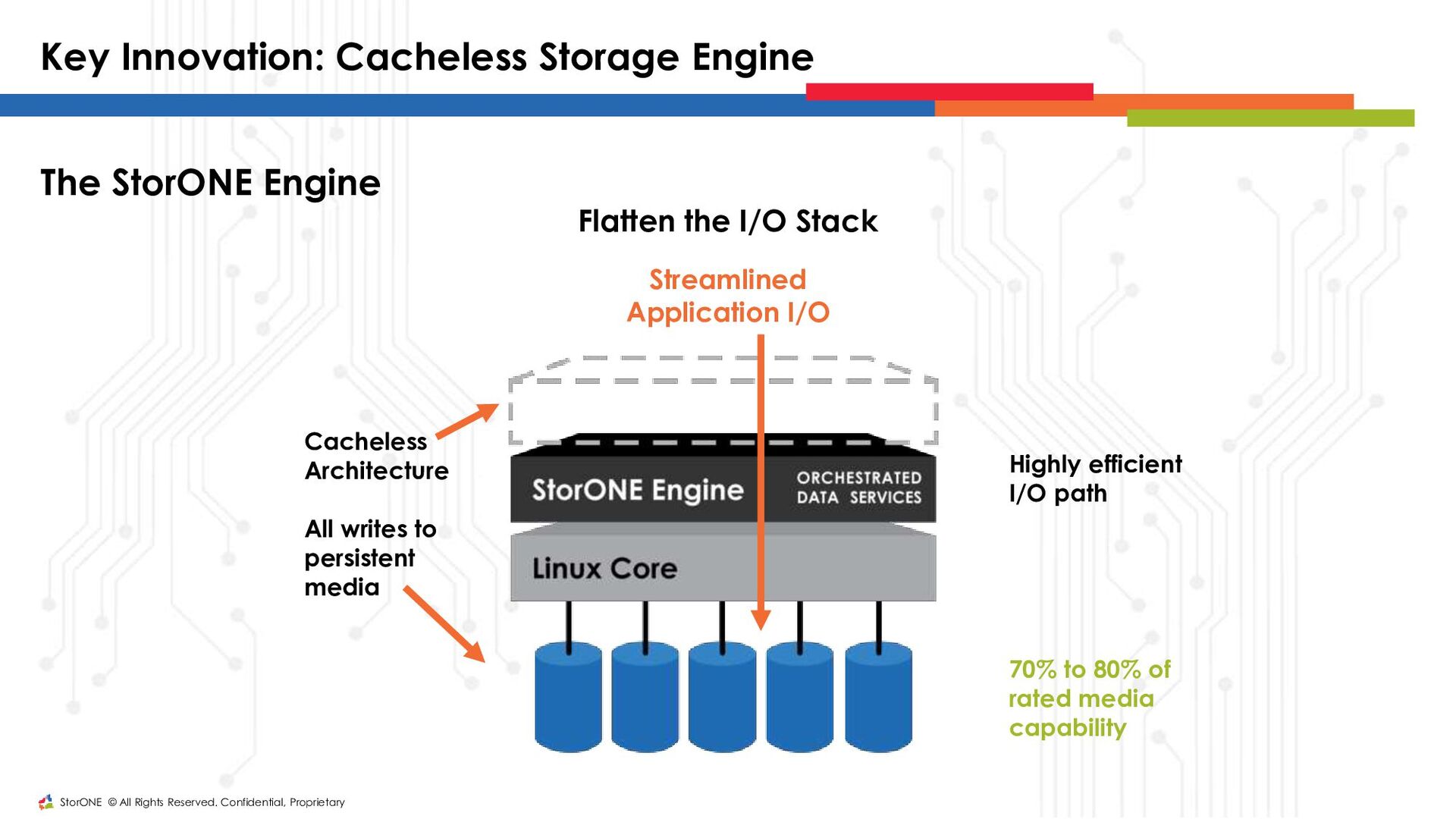
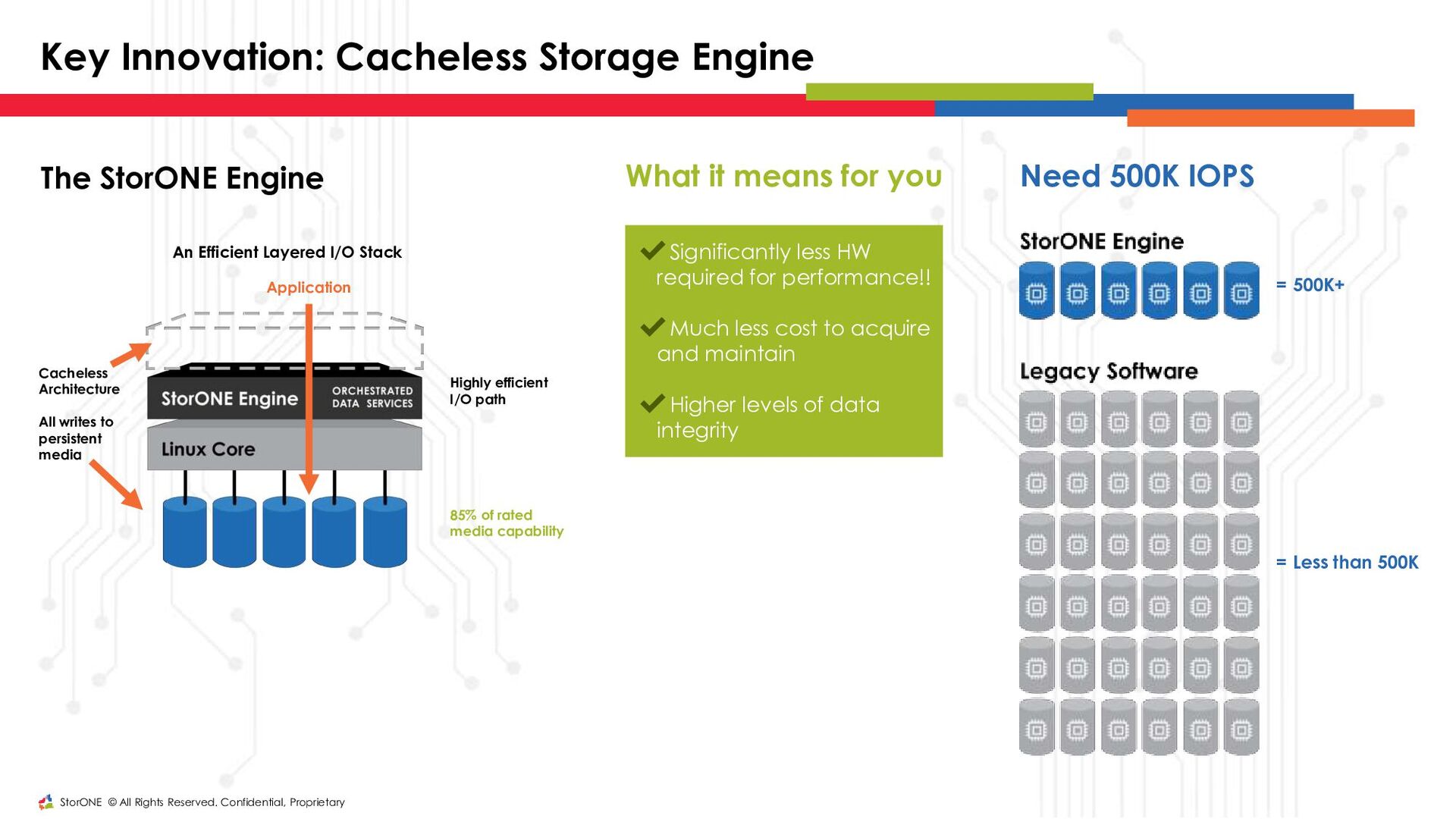
Storage Engine The StorONE Engine Cacheless Architecture All writes to persistent media Highly efficient I/O path Streamlined Application I/O 70% to 80% of rated media capability Flatten the I/O Stack
Storage Engine What it means for you ✔Significantly less HW required for performance!! ✔Much less cost to acquire and maintain ✔Higher levels of data integrity Cacheless Architecture All writes to persistent media Highly efficient I/O path Application 85% of rated media capability An Efficient Layered I/O Stack The StorONE Engine Need 500K IOPS = 500K+ = Less than 500K
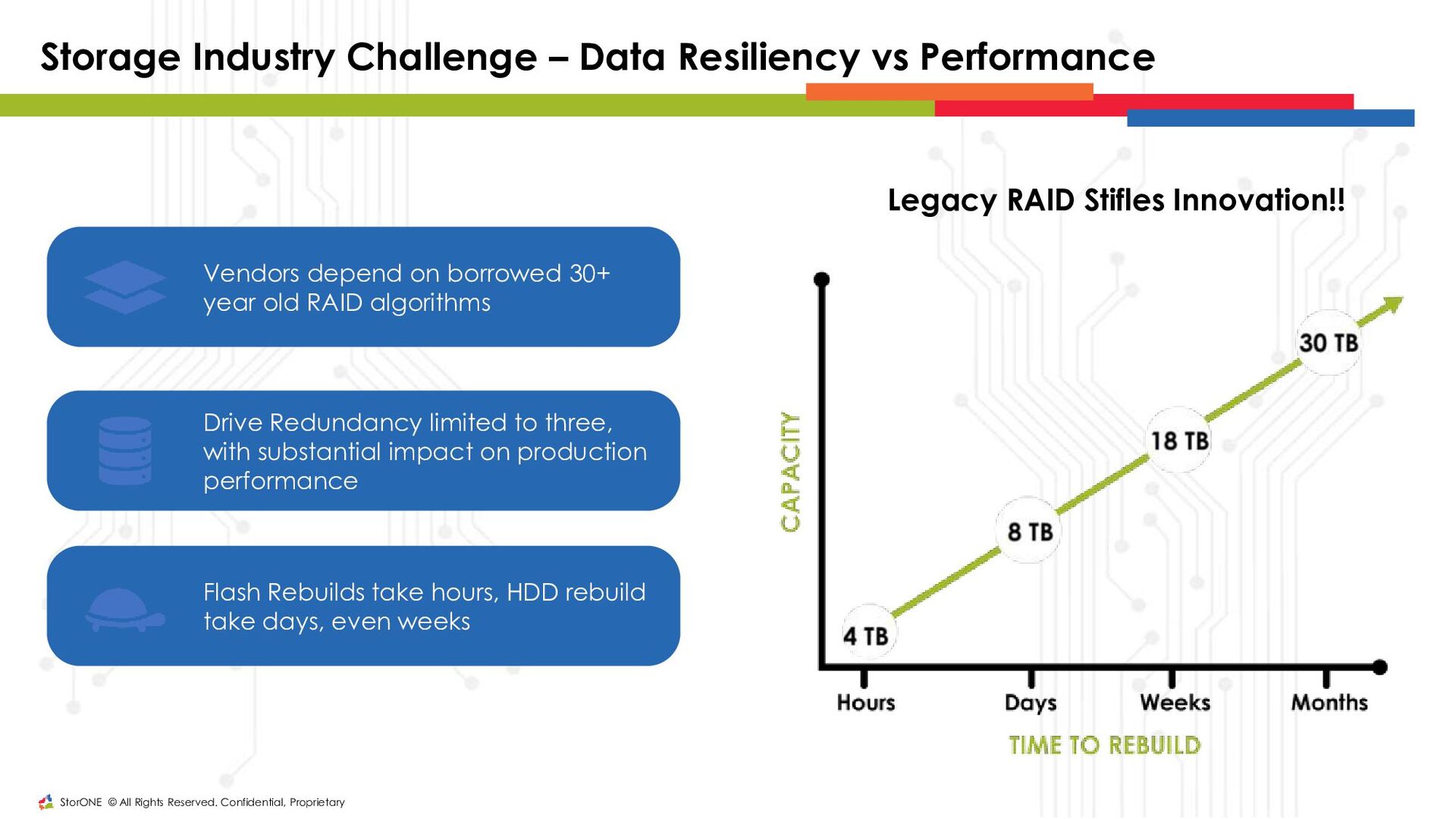
– Data Resiliency vs Performance Vendors depend on borrowed 30+ year old RAID algorithms Drive Redundancy limited to three, with substantial impact on production performance Flash Rebuilds take hours, HDD rebuild take days, even weeks Legacy RAID Stifles Innovation!!
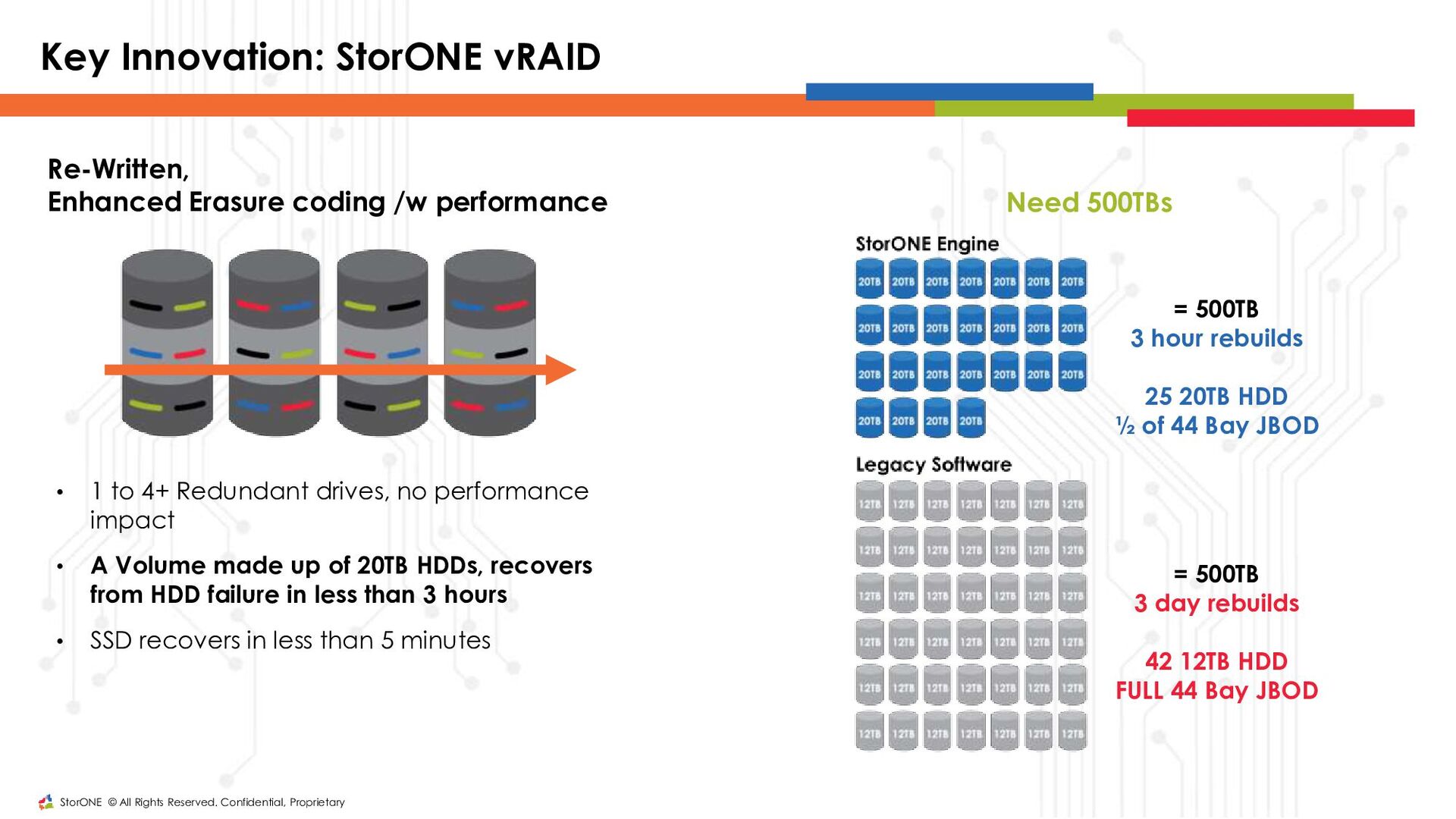
vRAID • 1 to 4+ Redundant drives, no performance impact • A Volume made up of 20TB HDDs, recovers from HDD failure in less than 3 hours • SSD recovers in less than 5 minutes Re-Written, Enhanced Erasure coding /w performance = 500TB 3 hour rebuilds 25 20TB HDD ½ of 44 Bay JBOD = 500TB 3 day rebuilds 42 12TB HDD FULL 44 Bay JBOD Need 500TBs
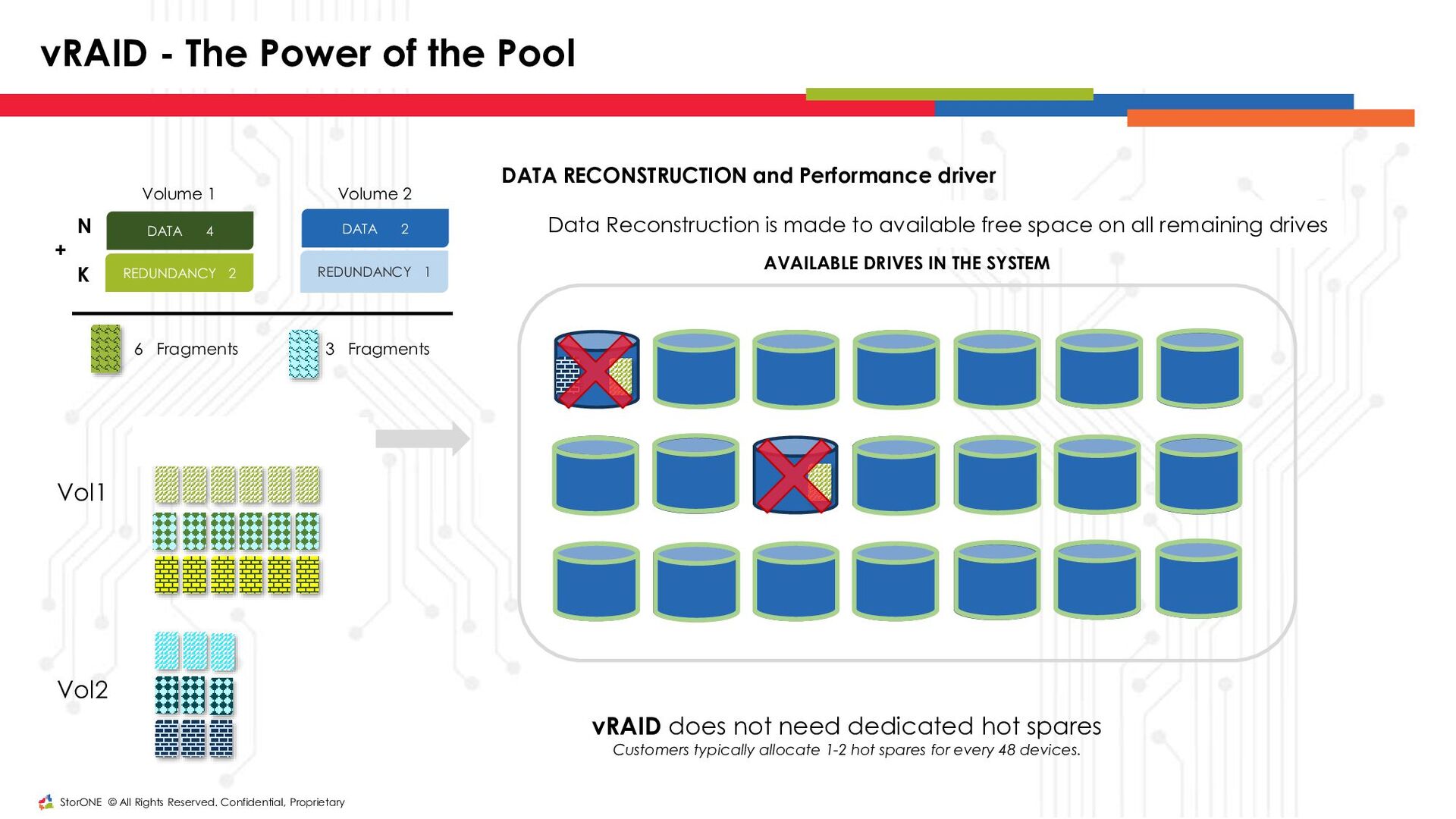
6 drives can be chosen per operation vRAID – with Performance DATA 4 REDUNDANCY 2 N + K 6 Fragments FIRST OPERATION AVAILABLE DRIVES IN THE SYSTEM SECOND OPERATION THIRD OPERATION HARDWARE FAILURE No Data Loss vRAID - HARDWARE FAILURE vRAID - The Power of the Pool vRAID does not need dedicated hot spares Customers typically allocate 1-2 hot spares for every 48 devices. Volume 1 DATA 2 REDUNDANCY 1 Volume 2 Vol1 Vol2 3 Fragments DATA RECONSTRUCTION and Performance driver Any 4/2 drives with can be used to recover 2 failed drives or Data Reconstruction is made to available free space on all remaining drives
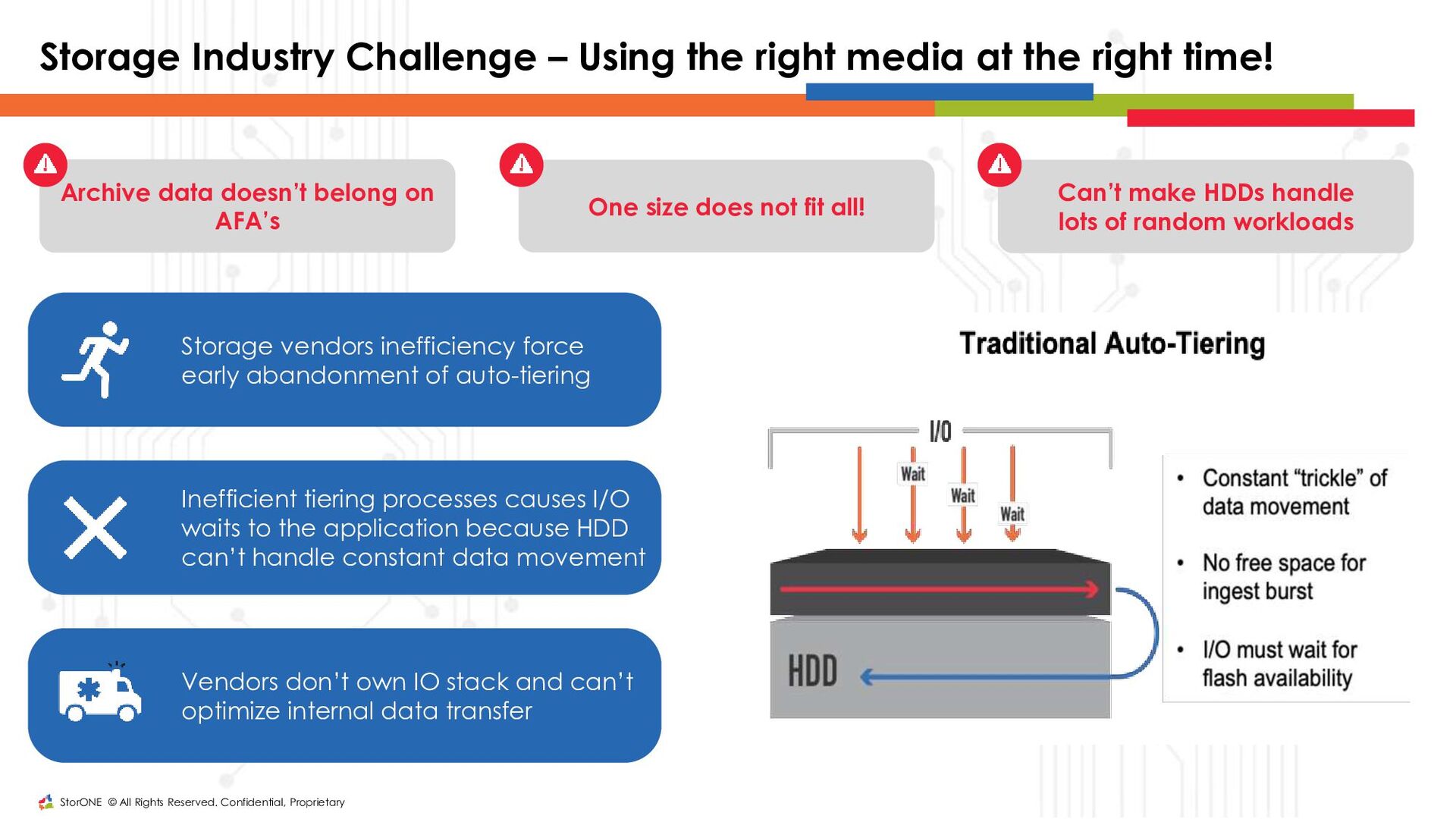
– Using the right media at the right time! Storage vendors inefficiency force early abandonment of auto-tiering Inefficient tiering processes causes I/O waits to the application because HDD can’t handle constant data movement Vendors don’t own IO stack and can’t optimize internal data transfer Archive data doesn’t belong on AFA’s One size does not fit all! Can’t make HDDs handle lots of random workloads
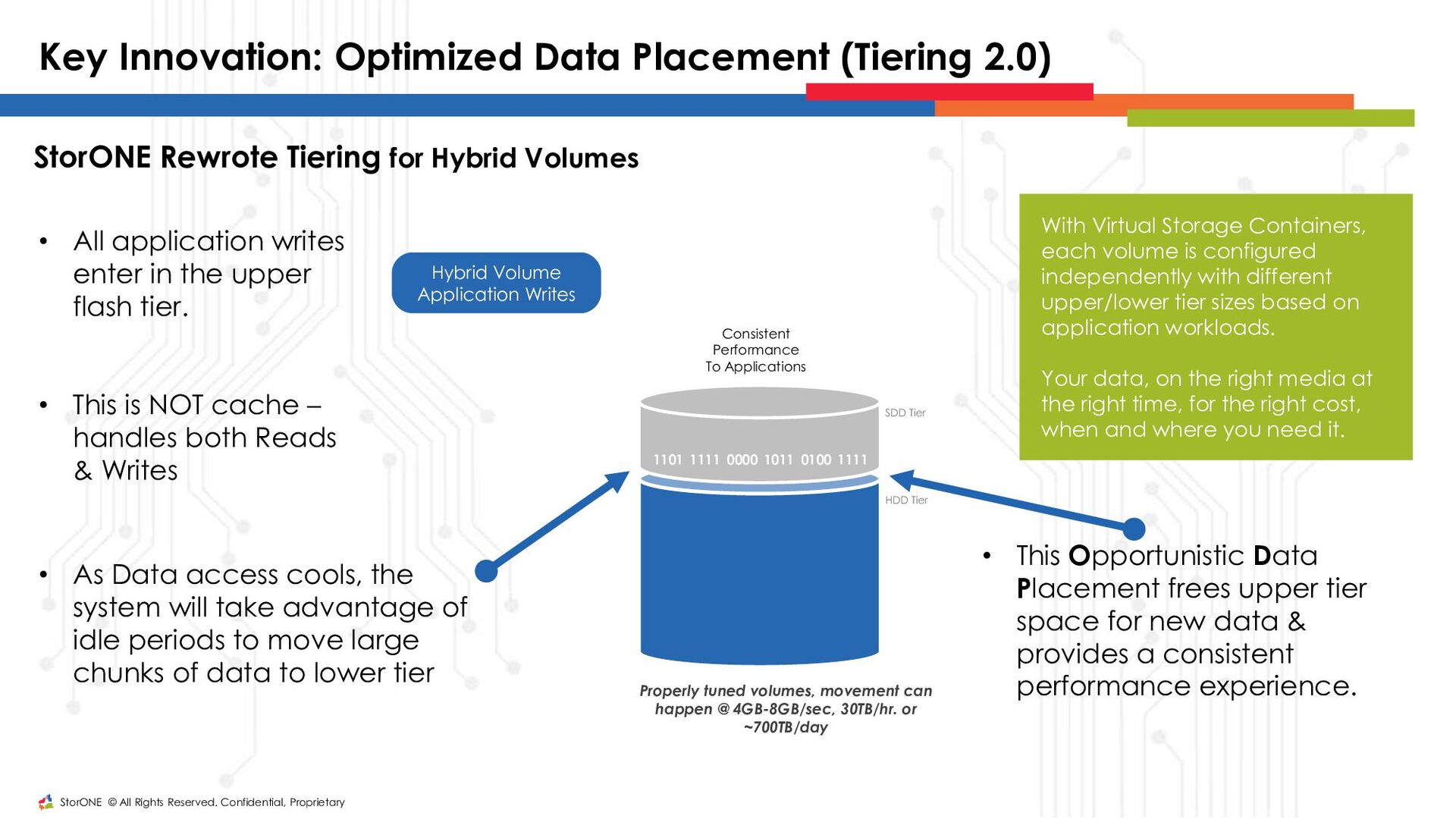
Data Placement (Tiering 2.0) 1101 1111 1011 0100 0000 1111 1101 1111 1011 0100 0000 1111 1101 1111 1011 0100 0000 1111 1101 1111 1011 0100 0000 1111 StorONE Rewrote Tiering for Hybrid Volumes • All application writes enter in the upper flash tier. • This is NOT cache – handles both Reads & Writes • As Data access cools, the system will take advantage of idle periods to move large chunks of data to lower tier • This Opportunistic Data Placement frees upper tier space for new data & provides a consistent performance experience. Properly tuned volumes, movement can happen @ 4GB-8GB/sec, 30TB/hr. or ~700TB/day With Virtual Storage Containers, each volume is configured independently with different upper/lower tier sizes based on application workloads. Your data, on the right media at the right time, for the right cost, when and where you need it. Consistent Performance To Applications HDD Tier SDD Tier Hybrid Volume Application Writes
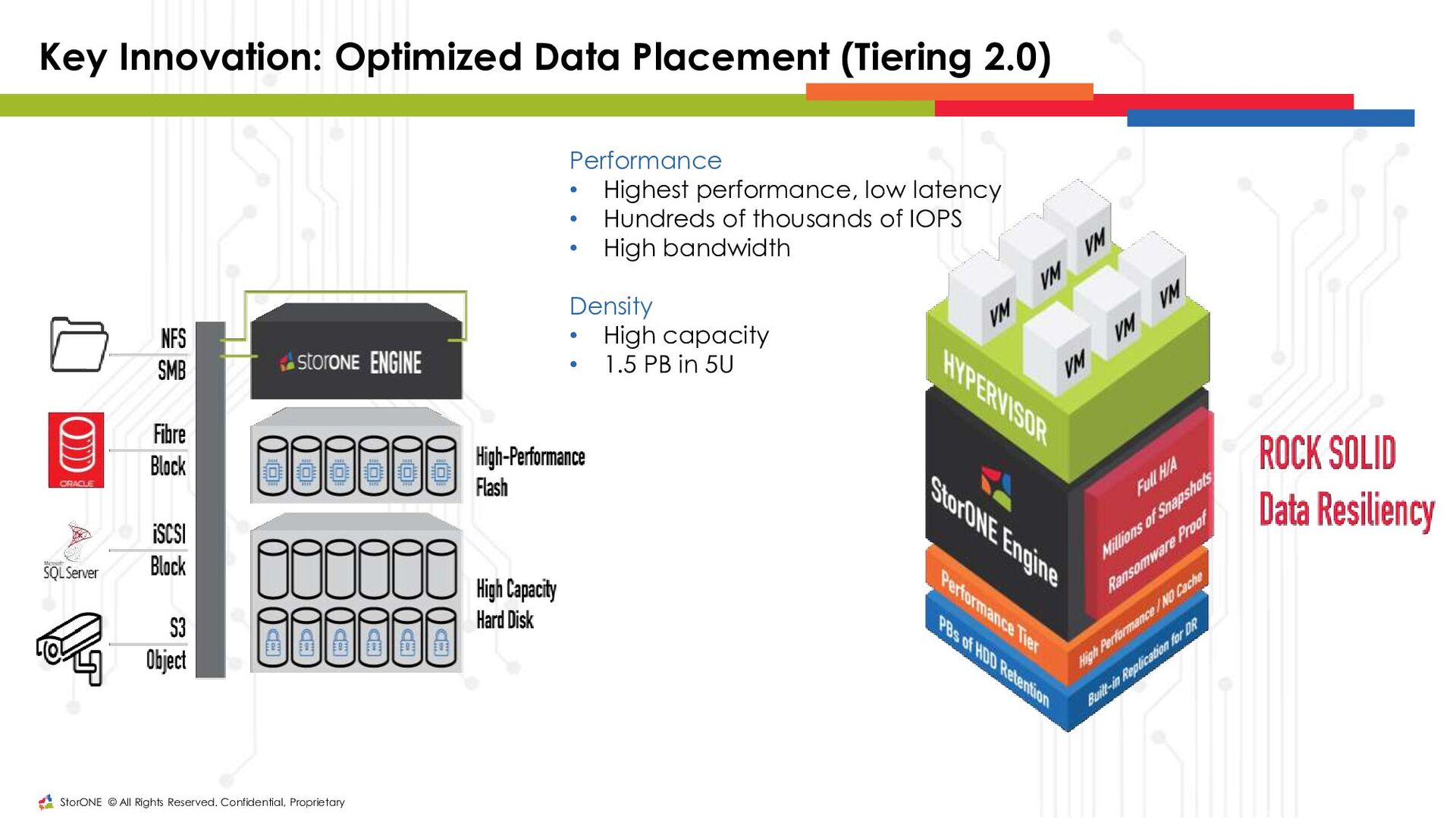
Data Placement (Tiering 2.0) Performance • Highest performance, low latency • Hundreds of thousands of IOPS • High bandwidth Density • High capacity • 1.5 PB in 5U
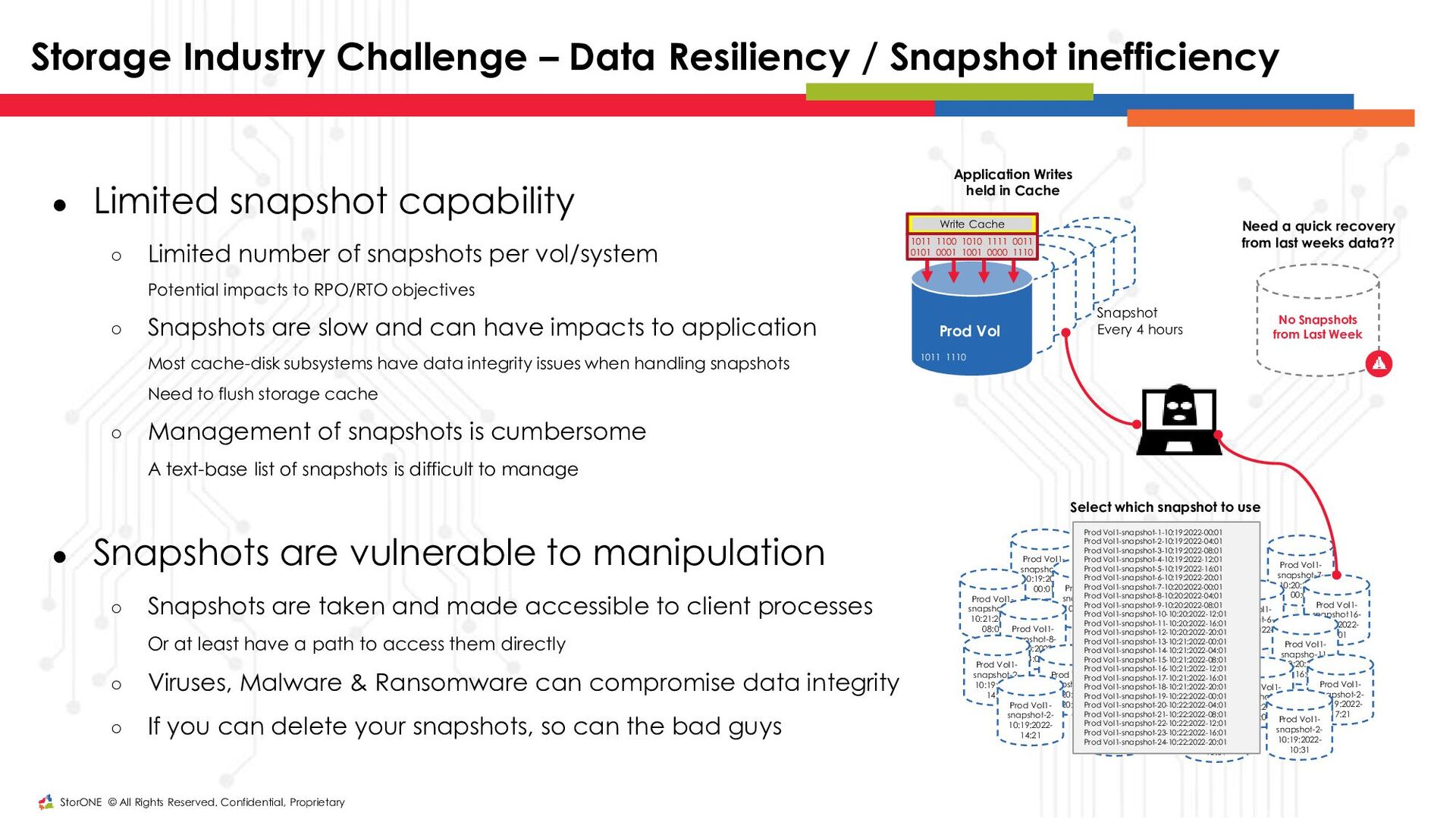
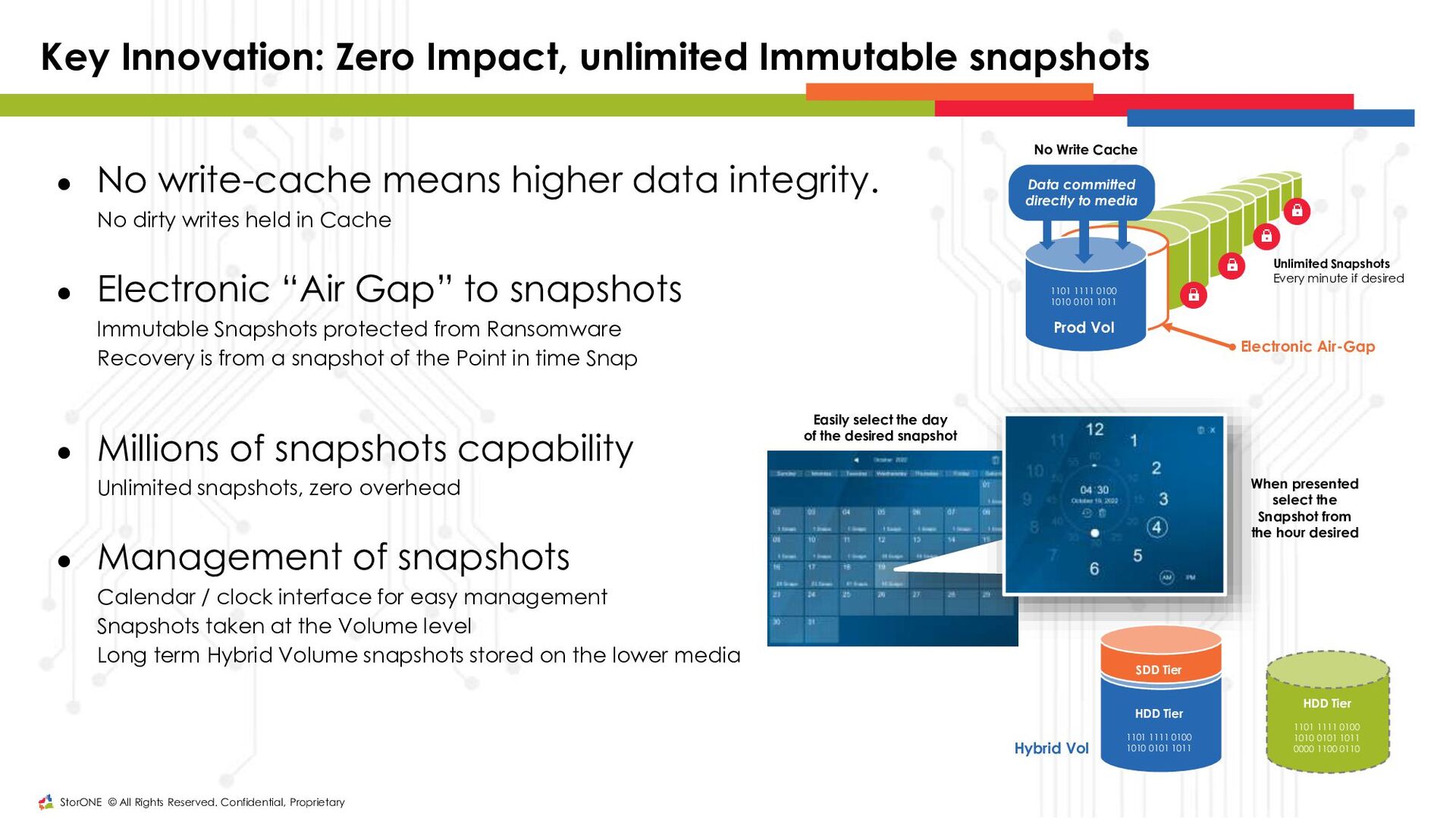
Impact, unlimited Immutable snapshots • No write-cache means higher data integrity. No dirty writes held in Cache • Electronic “Air Gap” to snapshots Immutable Snapshots protected from Ransomware Recovery is from a snapshot of the Point in time Snap • Millions of snapshots capability Unlimited snapshots, zero overhead • Management of snapshots Calendar / clock interface for easy management Snapshots taken at the Volume level Long term Hybrid Volume snapshots stored on the lower media Easily select the day of the desired snapshot When presented select the Snapshot from the hour desired Unlimited Snapshots Every minute if desired 1101 1111 0100 1010 0101 1011 Prod Vol Electronic Air-Gap No Write Cache Data committed directly to media HDD Tier 1101 1111 0100 1010 0101 1011 0000 1100 0110 HDD Tier 1101 1111 0100 1010 0101 1011 SDD Tier Hybrid Vol
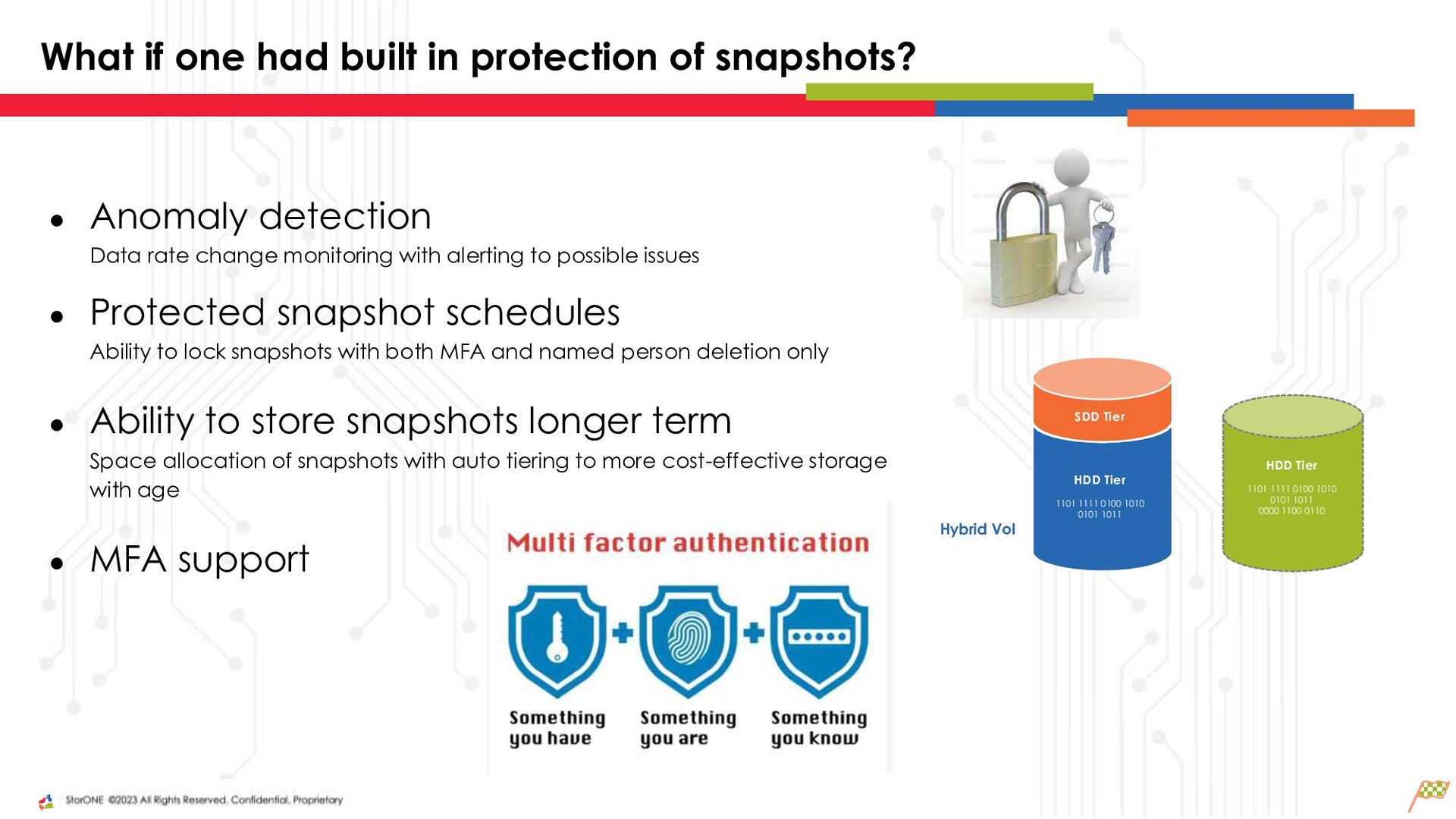
had built in protection of snapshots? • Anomaly detection Data rate change monitoring with alerting to possible issues • Protected snapshot schedules Ability to lock snapshots with both MFA and named person deletion only • Ability to store snapshots longer term Space allocation of snapshots with auto tiering to more cost-effective storage with age • MFA support HDD Tier 1101 1111 0100 1010 0101 1011 0000 1100 0110 HDD Tier 1101 1111 0100 1010 0101 1011 SDD Tier Hybrid Vol
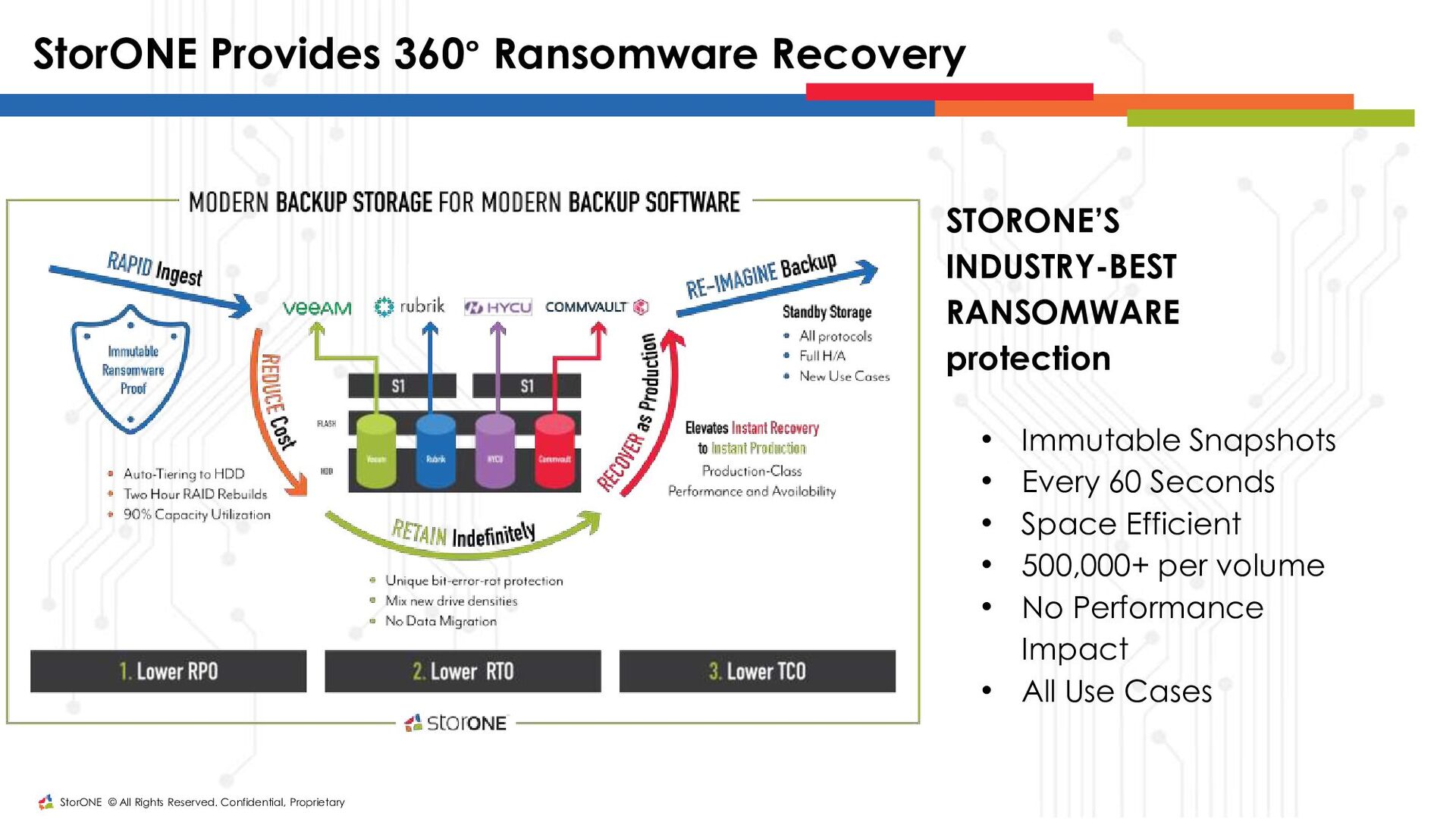
Ransomware Recovery STORONE’S INDUSTRY-BEST RANSOMWARE protection • Immutable Snapshots • Every 60 Seconds • Space Efficient • 500,000+ per volume • No Performance Impact • All Use Cases
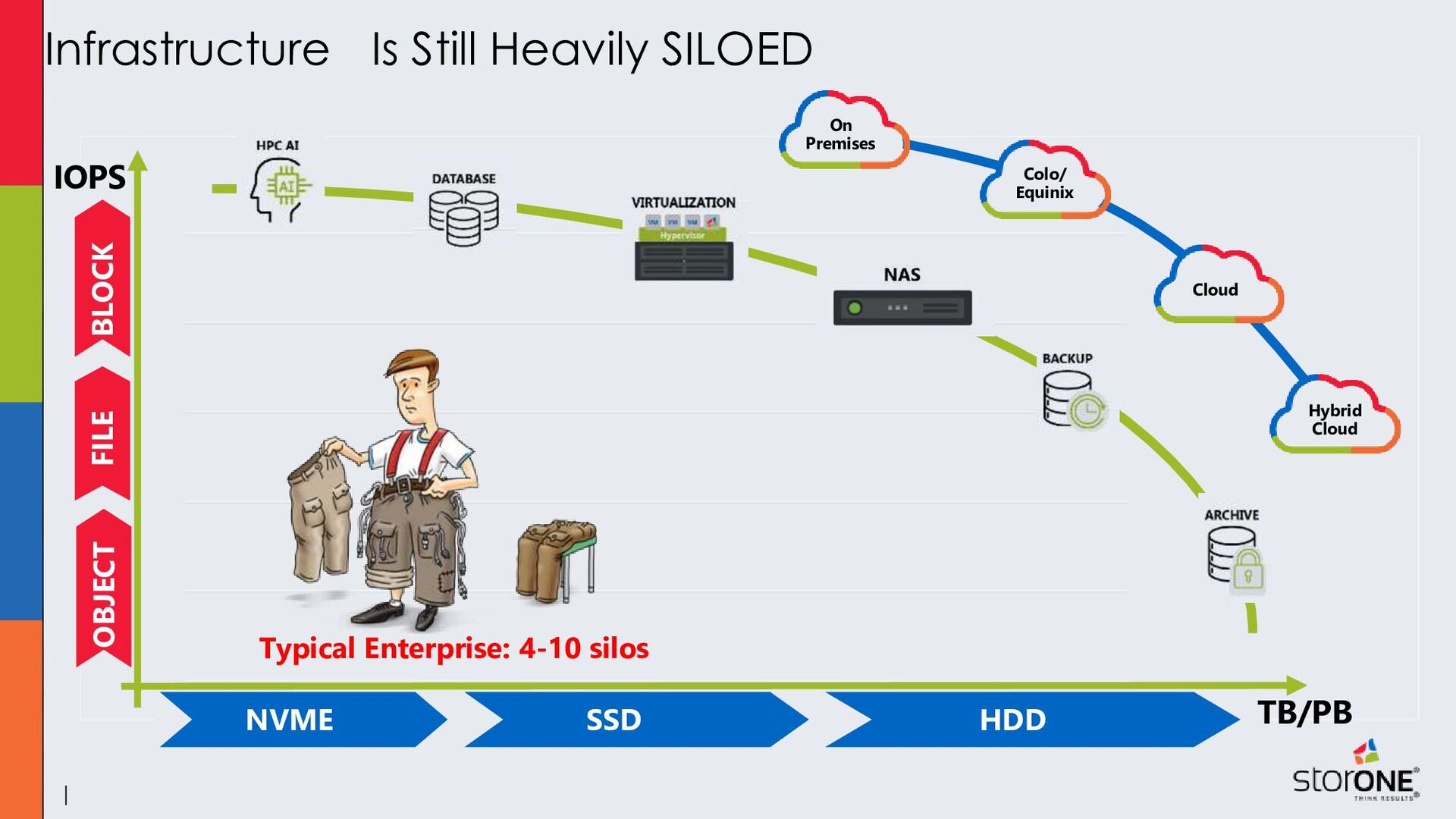
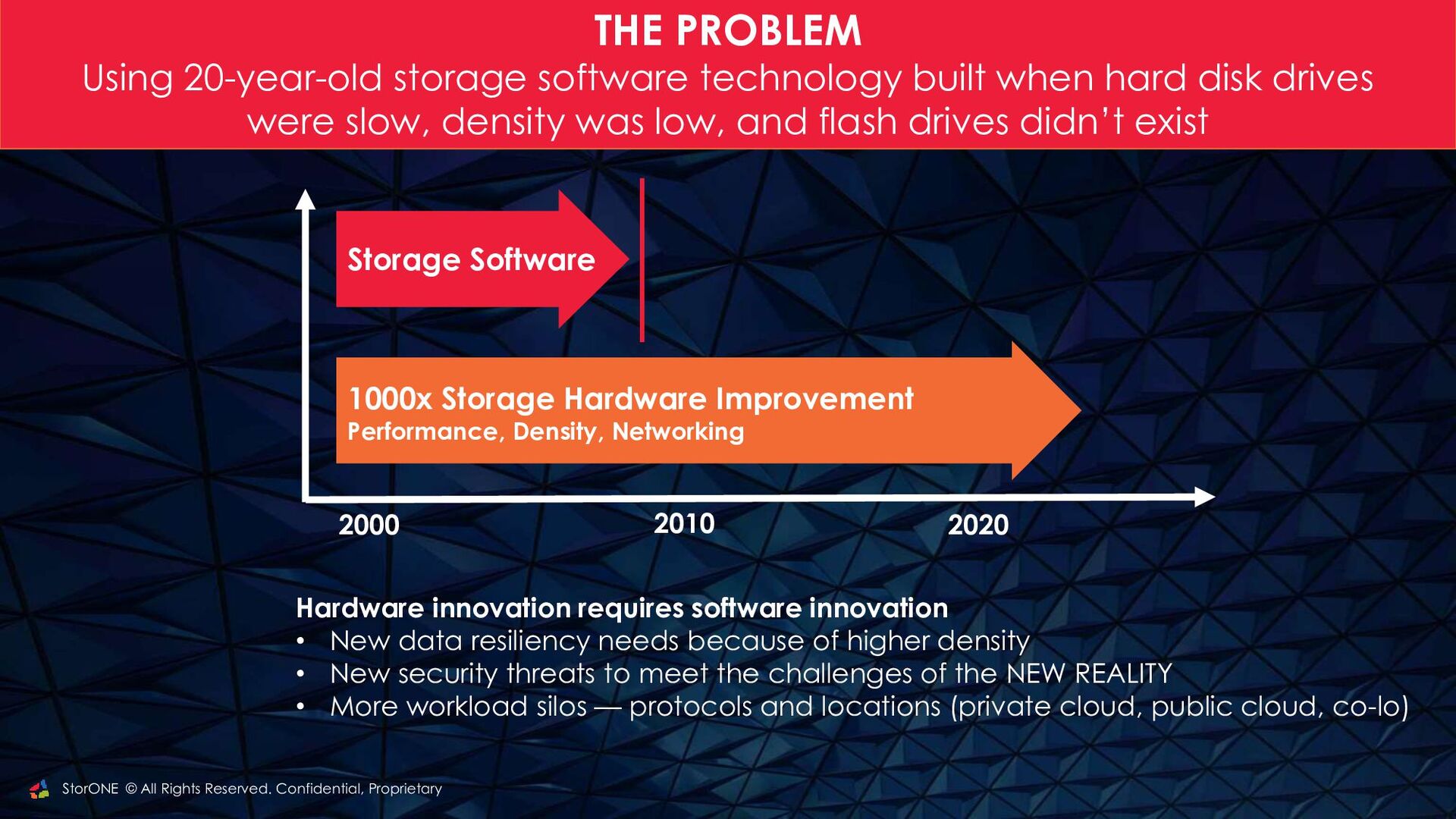
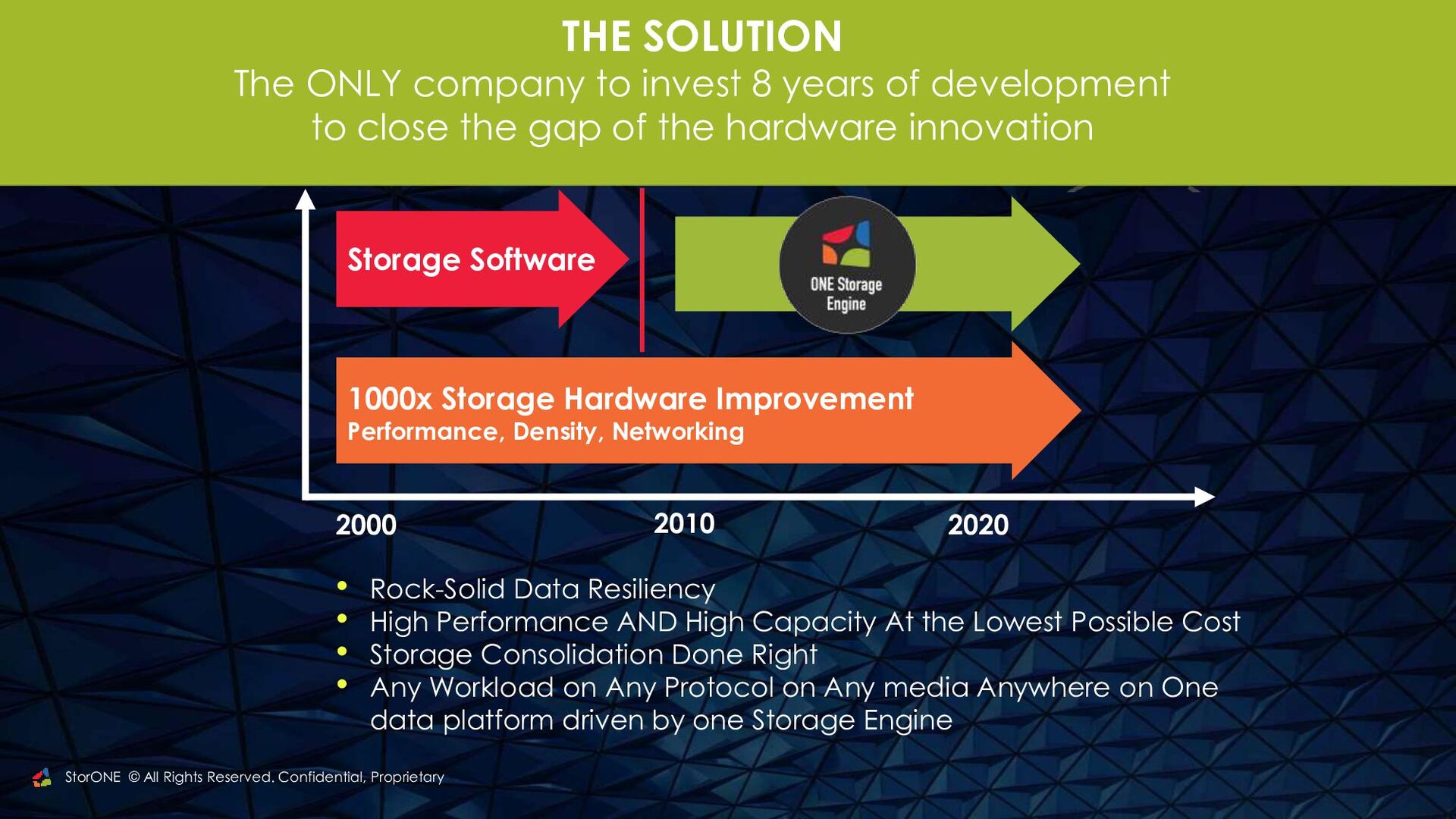
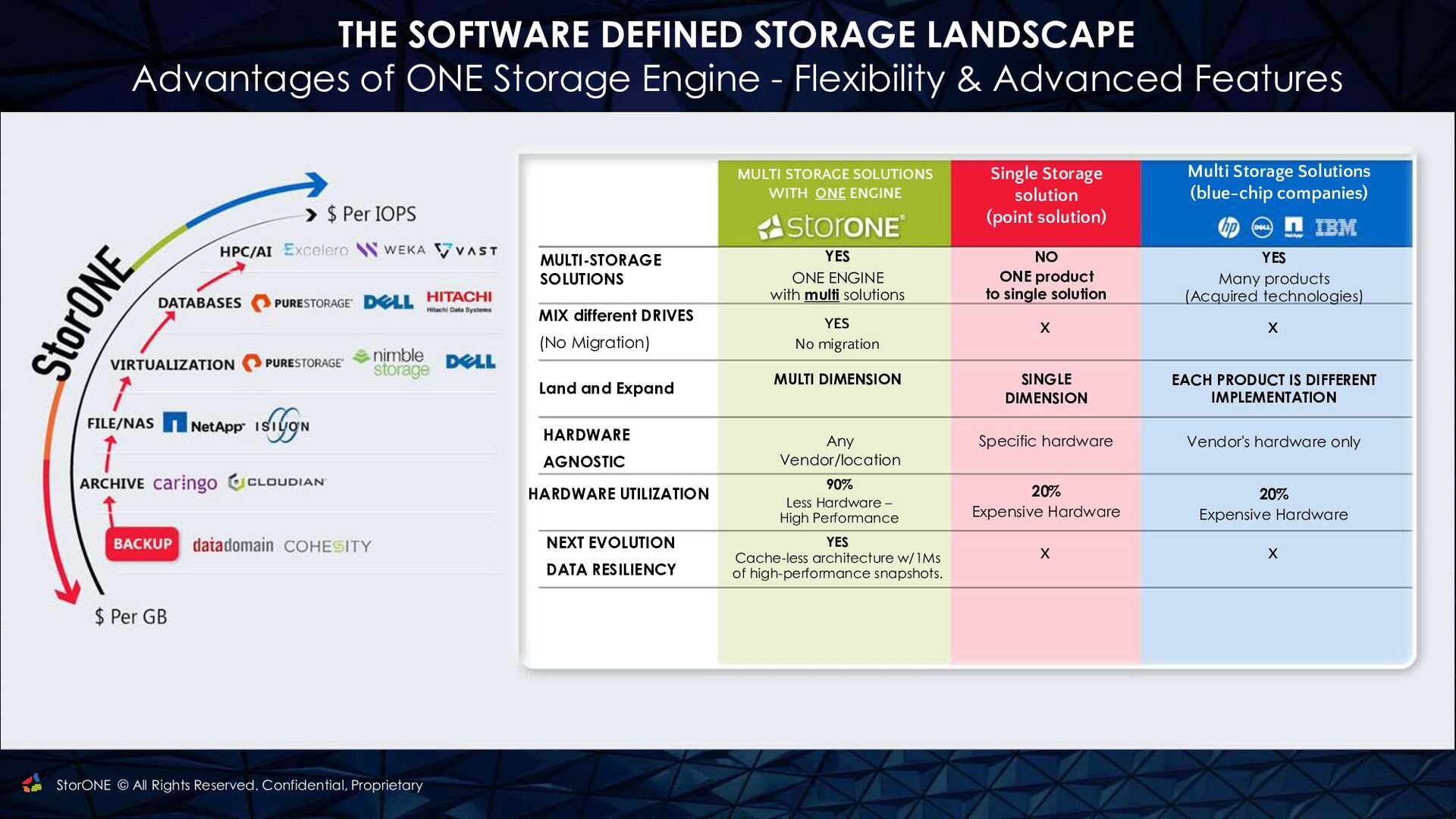
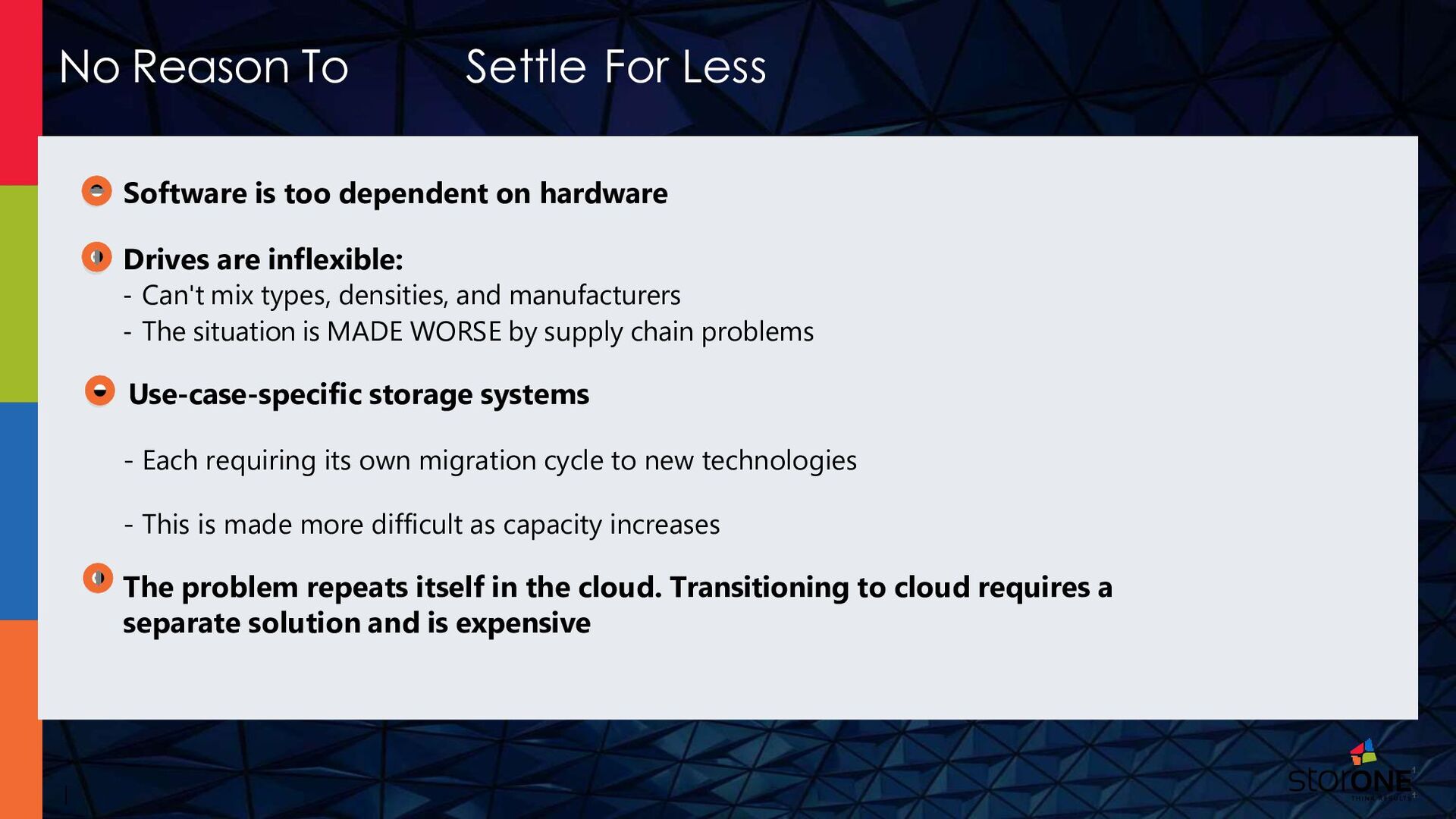
dependent on hardware ▪ Drives are inflexible: - Can't mix types, densities, and manufacturers - The situation is MADE WORSE by supply chain problems ▪ Use-case-specific storage systems - Each requiring its own migration cycle to new technologies - This is made more difficult as capacity increases ▪ The problem repeats itself in the cloud. Transitioning to cloud requires a separate solution and is expensive
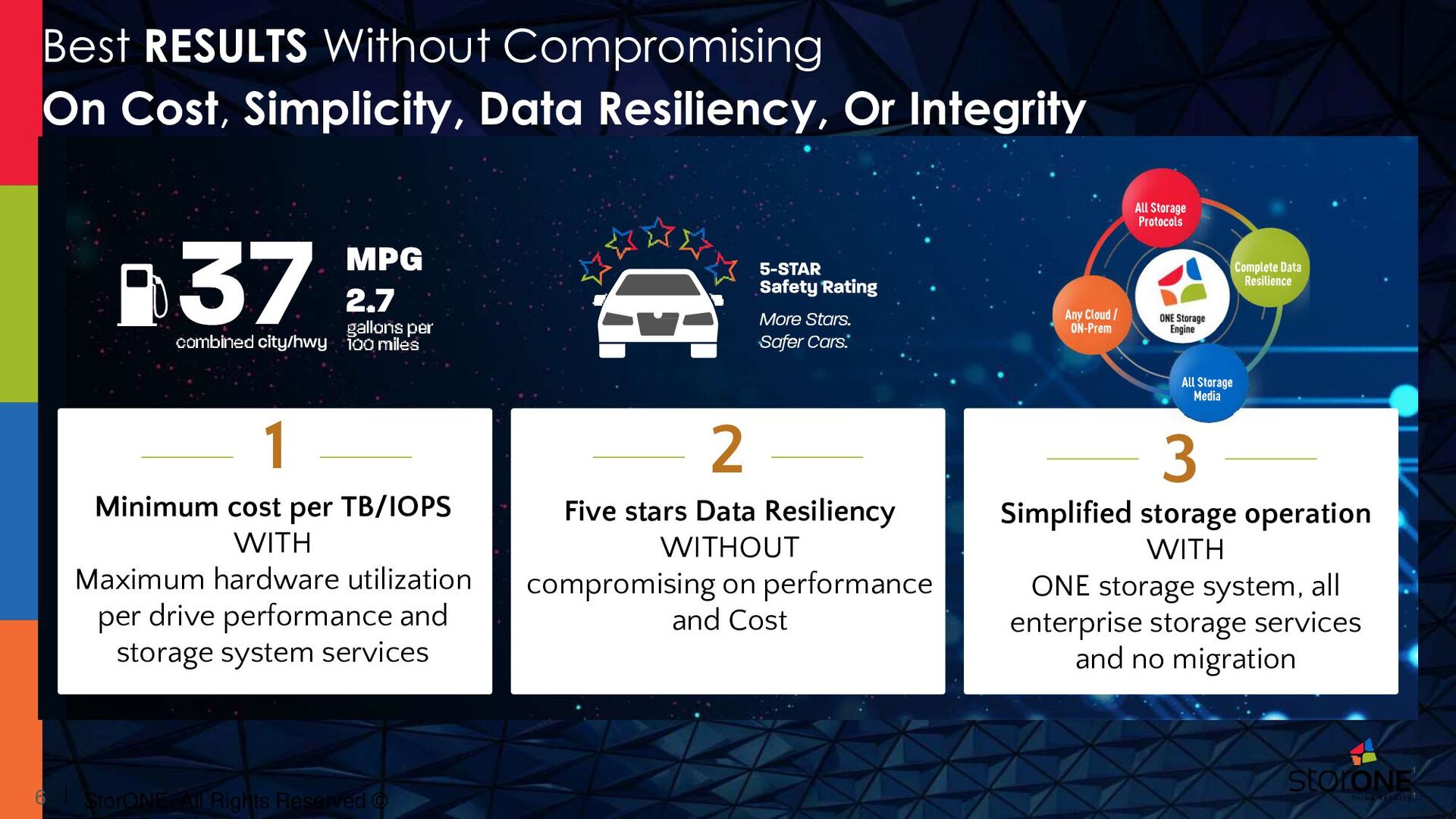
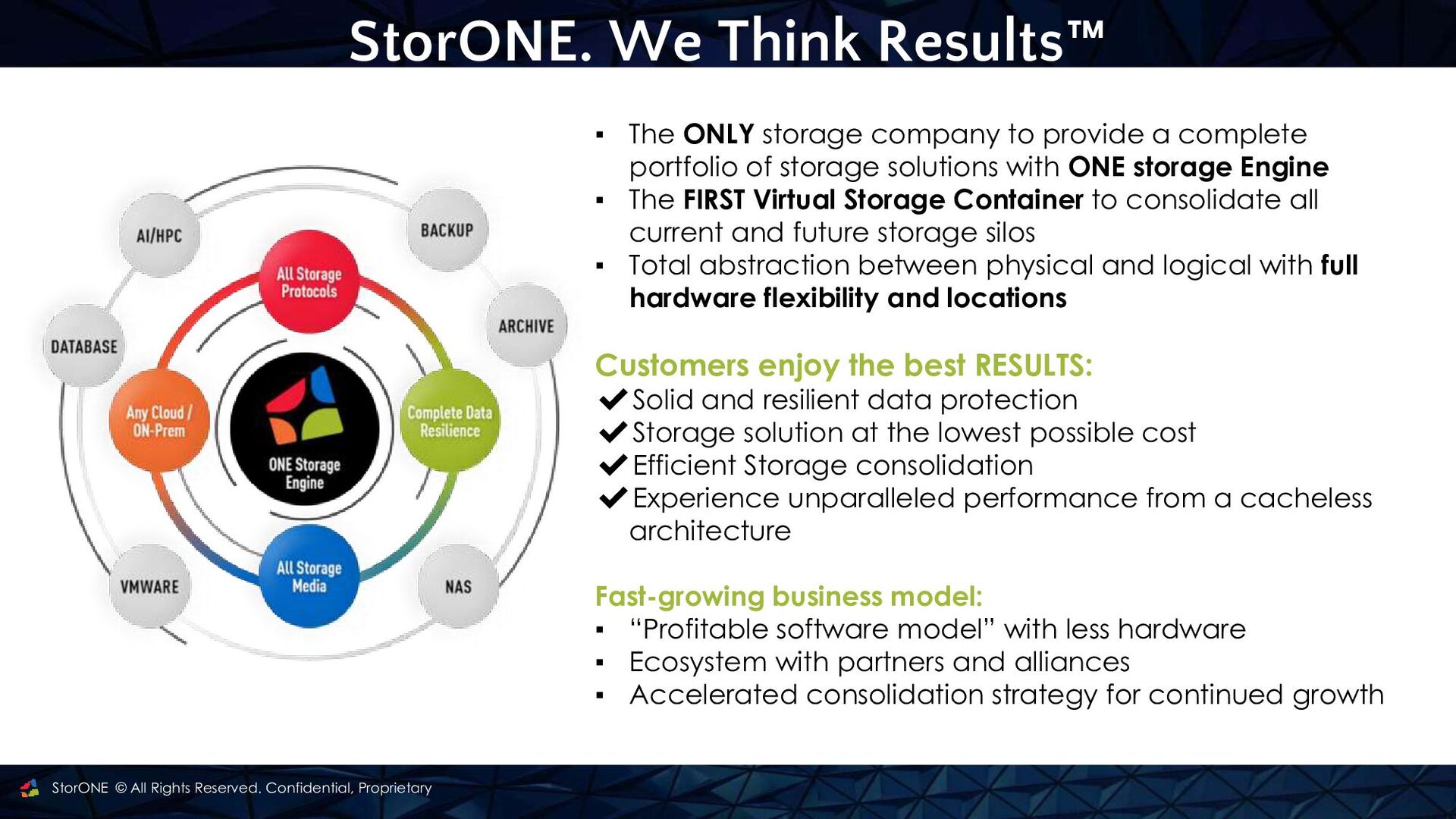
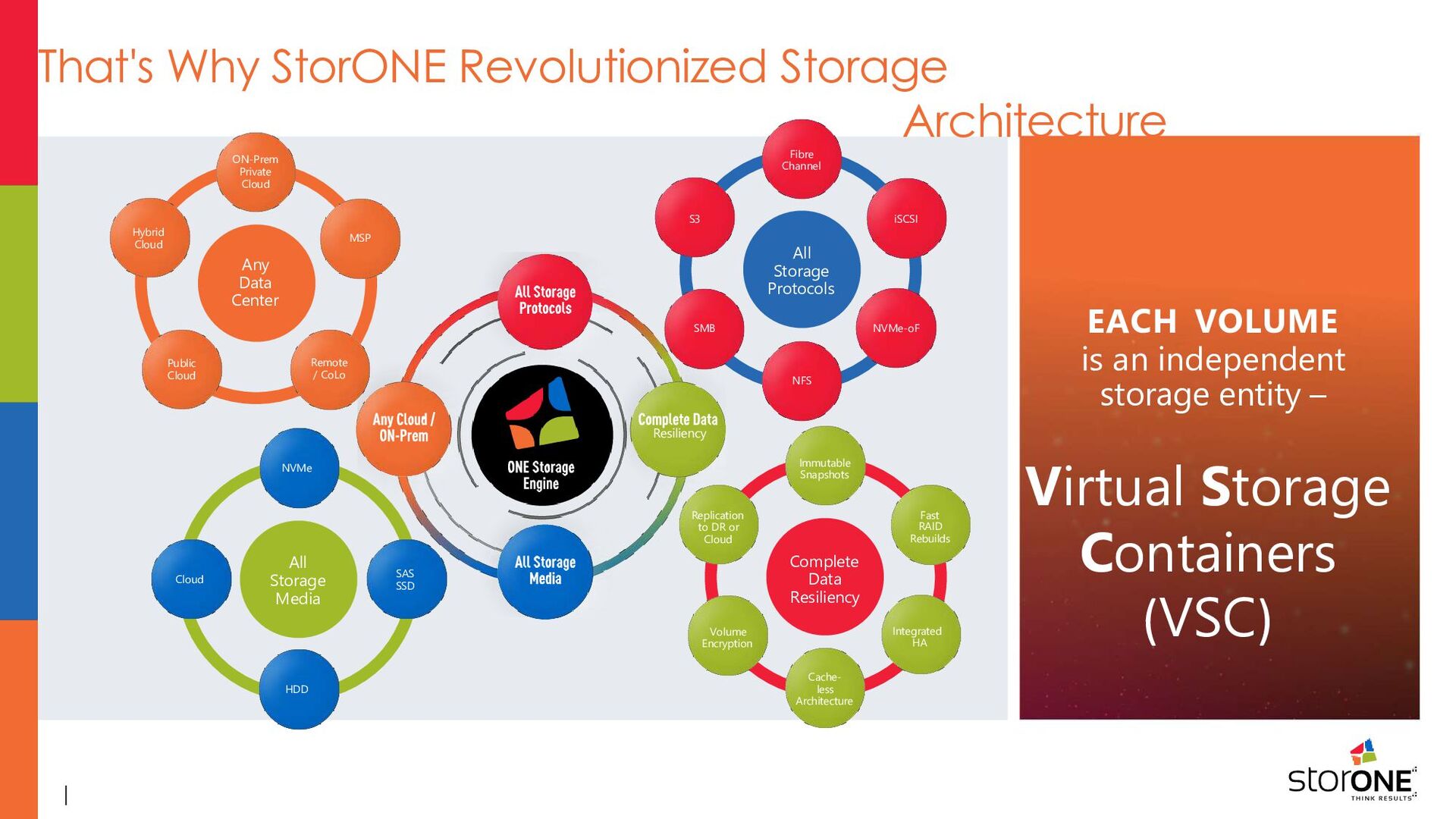
independent storage entity – MSP ON-Prem Private Cloud Hybrid Cloud Public Cloud Remote / CoLo Any Data Center SAS SSD Cloud HDD All Storage Media NVMe iSCSI Fibre Channel S3 SMB NFS NVMe-oF All Storage Protocols Fast RAID Rebuilds Immutable Snapshots Replication to DR or Cloud Volume Encryption Cache- less Architecture Integrated HA Complete Data Resiliency Resiliency Virtual Storage Containers (VSC)
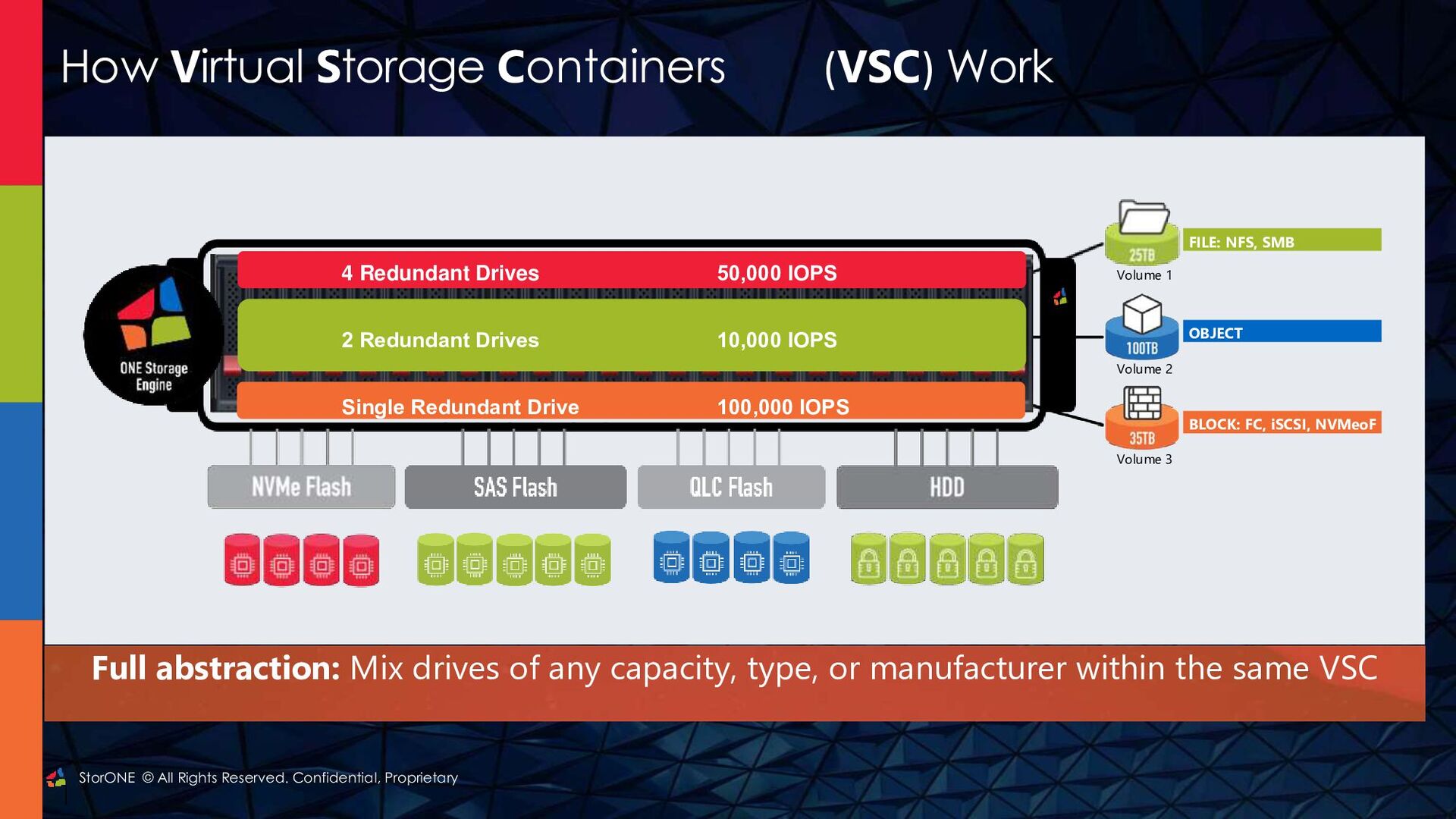
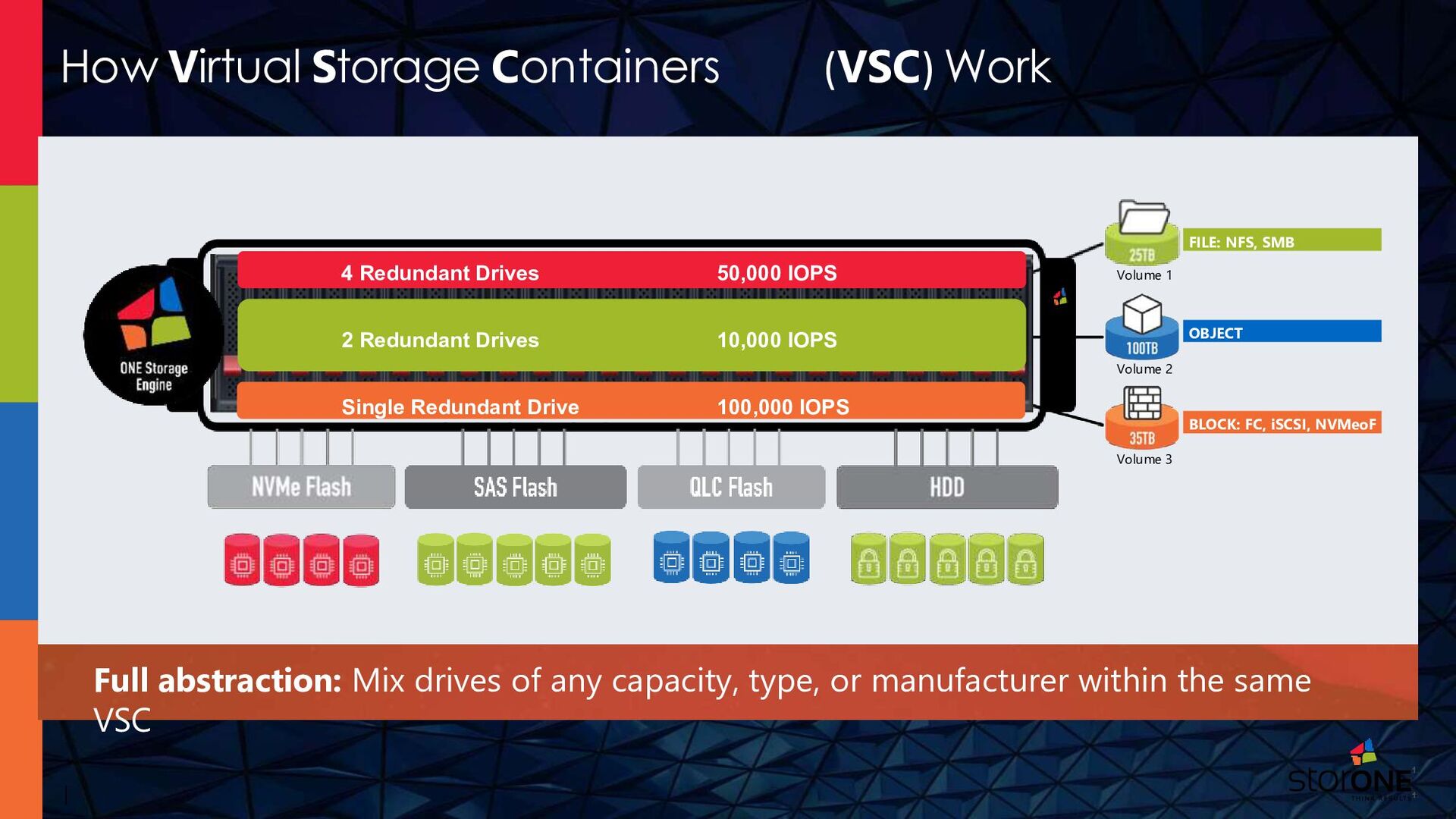
Volume 1 FILE: NFS, SMB BLOCK: FC, iSCSI, NVMeoF OBJECT Full abstraction: Mix drives of any capacity, type, or manufacturer within the same VSC 4 Redundant Drives 50,000 IOPS 2 Redundant Drives 10,000 IOPS Single Redundant Drive 100,000 IOPS


 itpresstour
 ishiirikie
 terurou
 harutiro
 moznion
 hlum
hlum
 kizawa2020
 naruoga
 mkdev10
 raspython3
 oikon48
 htan
htan
 occhi
occhi
 tomoyanonymous
 hannesfritz
 mlcsv
mlcsv
 nwiizo
 techseoconnect
 stephaniewalter
 cassininazir
 erikaheidi
 iamctodd
 garrettdimon
 aki_iinuma
 tamaranovitovic
![Questions? Storone.com [email protected] /StorONE @Stromatic](https://files.speakerdeck.com/presentations/b6946669a6c240ddab8645de3d4af333/slide_43.jpg)
![Questions? Storone.com [email protected] /storone @StorOne_Inc](https://files.speakerdeck.com/presentations/b6946669a6c240ddab8645de3d4af333/slide_49.jpg)