Share
Embed
A Happy Team Can Create Nothing: Measure Team Value, Not Mood
PEAKTEAMS is a free, anonymous 12-minute team survey that scores your team's value from 0 to 100, not its mood and flags the hidden concerns others miss.
Take the Peakteams Team Assessment Tool at https://www.peakteams.io/ and read the leadership style assessment at https://www.peakteams.io/resources/leadership-style-assessment.
M AZHAR FAROOQ PRO
November 18, 2026
Transcript
6 slides
-
A happy team can create nothing. Title: A Happy Team
Can Create Nothing: Measure Team Value, Not Mood Meta description (153 chars): PEAKTEAMS is a free, anonymous 12-minute team survey that scores your team's value from 0 to 100 — not its mood — and flags the hidden concerns others miss. Your last survey said everyone was happy. So why did nothing ship? PEAKTEAMS makes a blunt claim: happiness surveys measure the wrong thing. What matters is not how a team feels, but what it is worth. Most teams know this moment. The engagement scores come back green, morale is "strong," the meetings are pleasant and nobody is complaining — and the quarter still ends with very little to show for it. That is not a paradox. It is a measurement problem. A team can be comfortable and unproductive, relaxed and unfocused, friendly and quietly stuck, and a mood survey will congratulate it anyway. Happiness is a weather report. Value is the business. Nobody is against happiness. But it is, at best, one condition among many, and sometimes a sign that nobody is being stretched. A team doing hard, meaningful work may be tired and arguing, yet creating something. A team that is always comfortable may be creating nothing at all. If you only measure the mood, you cannot tell those two teams apart. That is the starting point for the Peakteams Team Assessment Tool. It is a free, anonymous team survey, and it scores a team's value rather than its mood. You can take it at https://www.peakteams.io/ — the questionnaire takes about 12 minutes, and it yields one number from 0 to 100. -
One number, in 12 minutes: a team identity The number
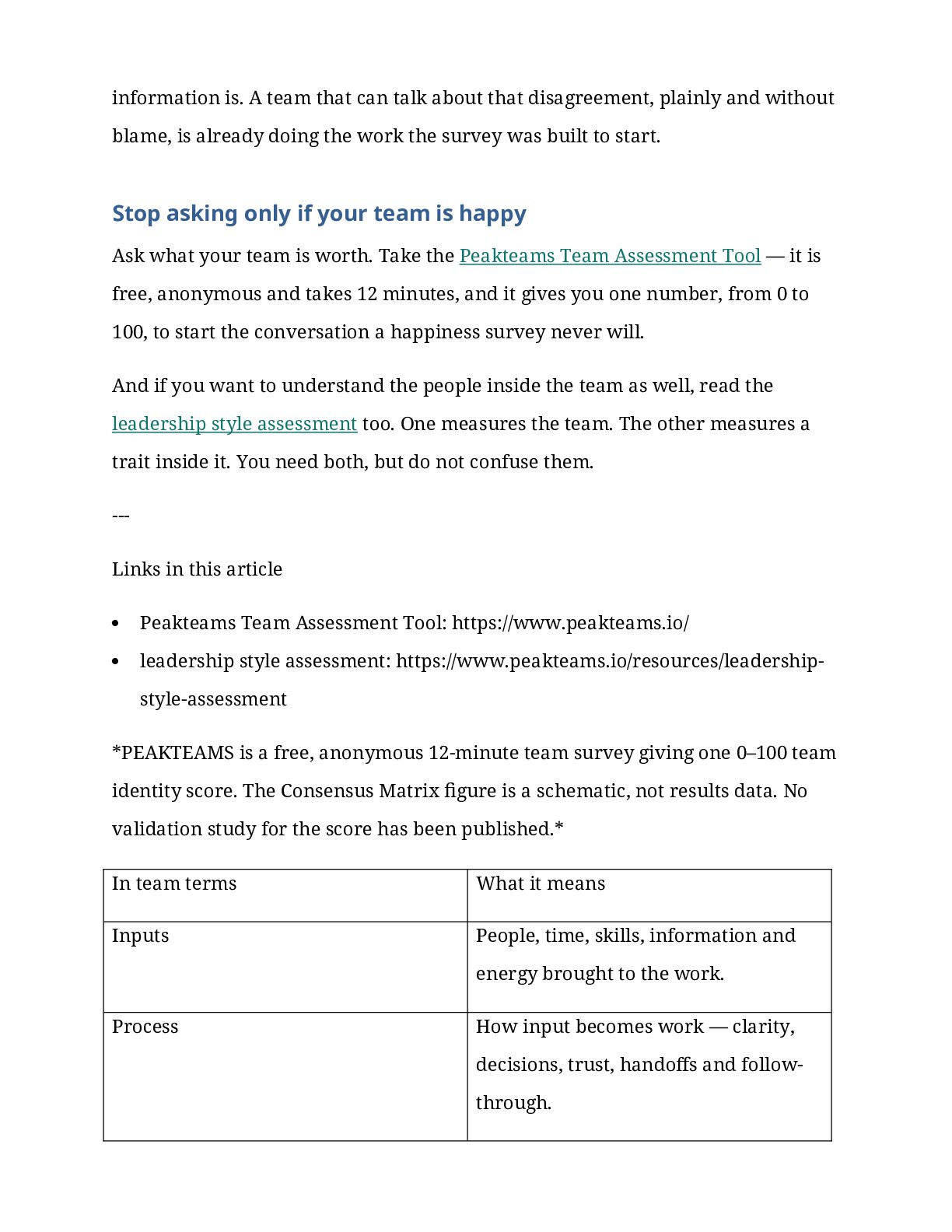
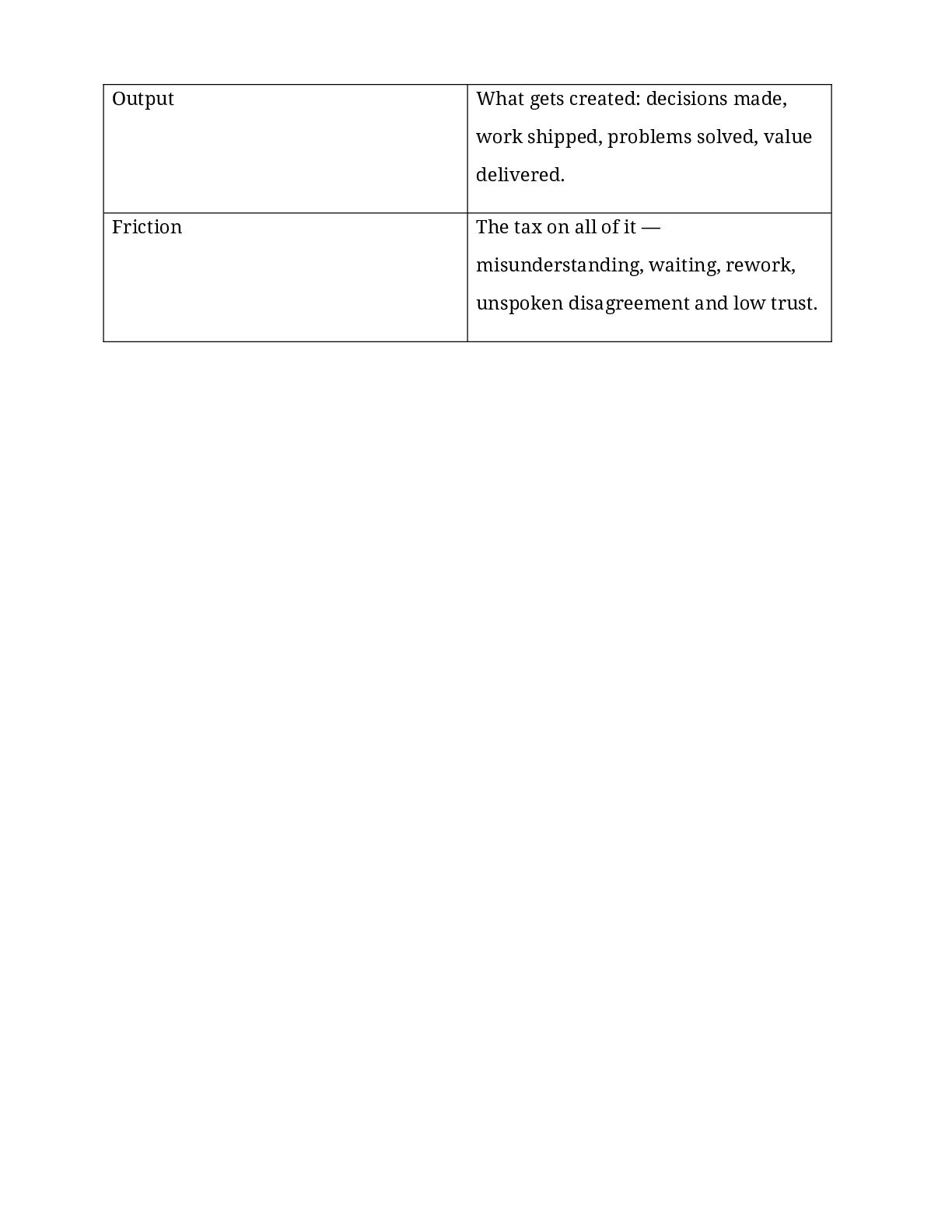
is deliberate. It is not a mood rating but a team "identity": what this team, as a working unit, amounts to. Everyone can see it, and ask the only useful next question: what is dragging it down? The survey looks at 18 key measures, grouped into four areas: what goes into the team, how the team works, what the team produces, and what gets in the way. The result is shown only once at least five members have answered, so no single person's answers can be picked out. That matters, because people answer honestly only when they believe the survey is genuinely anonymous. "A happy team can create nothing. A valuable team creates — even on the hard weeks." Treat a team like a small business PEAKTEAMS treats a team like a small business with a profit-and-loss account. It takes in inputs, runs a process, produces output, and loses potential wherever things jam, duplicate or stall. Friction is what mood surveys miss. It does not always make people unhappy. A team can be pleasant while paying a heavy friction tax: the decision that takes three meetings, the concern nobody raises, the work redone because the brief was never shared. Happy and comfortable, or focused and building? Mood alone cannot tell these two teams apart. Averages lie. Agreement tells the truth. Traditional surveys have a second, quieter flaw: they average people away. If half a team rates something 9 out of 10 and the other half rates it 3, the average looks safe, but the team does not agree, and that disagreement is the story. -
PEAKTEAMS addresses this with its Consensus Matrix, which plots every
score against how much the team agrees on it. The sharpest case is a high score that half the team disputes. PEAKTEAMS flags it as a "hidden concern," not a strength. Instead of celebrating it, the team must ask why some experience this so differently, and who sees the problem the rest are missing. A low score that everyone agrees on is, in a strange way, easier: at least the team knows where it stands. A high score with low agreement is the dangerous one, because it lets a team believe it is fine while half of it quietly disagrees. That is the kind of thing a single average will never show you. Built by practitioners, not theorists PEAKTEAMS was not built in a classroom. Its makers built it after running largescale transformation programmes, where the strategy was clear and the plan sound, yet the outcome hinged on whether teams trusted each other. The plan rarely fails on paper. It fails in the handoffs, the unspoken doubts, the meeting after the meeting. A practitioner's tool starts there. It asks whether the team can create value, and where the friction that stops it is hiding. That is a different question from whether people are happy this month, and it leads to different conversations — about who is waiting on whom, which decisions keep stalling, and which handoffs keep breaking. Mood is one trait. Value is the whole team. None of this makes other assessments useless. Complementary tests, such as a leadership style assessment, judge particular traits within a team: how someone leads, communicates or prefers to work. You can read more about it at -
https://www.peakteams.io/resources/leadership-style-assessment. Useful lenses, but lenses, not the whole picture. But
a trait is not a team. Knowing everyone's leadership style does not tell you whether the team, together, creates more value than its friction consumes. A team can be full of strong leaders and still ship nothing, if the handoffs between them are broken. The team score is the missing piece: it looks at the unit, not the individuals in it. When AI makes everything else cheap, how you work together is what is left Artificial intelligence is making concept, content and code cheap. Drafts, designs, prototypes and first versions that once took weeks now arrive in minutes. When those things are cheap, they stop being the scarce resource. What stays scarce is how people work together: judgement, trust, clarity, challenge. Ten people with the same AI tools will not produce the same result; the difference is the team, and collaboration is what a mood score cannot measure. The tools will keep getting better. The question is whether the teams using them can decide, disagree well, and follow through. What to do with your number Start with the score. Treat it as an identity, not a grade. Go to the hidden concerns. High scores with low consensus are where the honest conversation lives. Name the friction. Ask where time, trust and energy are taxed. Fix one thing, then measure again. Identity moves when the work does. Do not start by defending the score, and do not start by blaming the lowest one. Start with the place where the team disagrees most, because that is where the -
information is. A team that can talk about that disagreement,
plainly and without blame, is already doing the work the survey was built to start. Stop asking only if your team is happy Ask what your team is worth. Take the Peakteams Team Assessment Tool — it is free, anonymous and takes 12 minutes, and it gives you one number, from 0 to 100, to start the conversation a happiness survey never will. And if you want to understand the people inside the team as well, read the leadership style assessment too. One measures the team. The other measures a trait inside it. You need both, but do not confuse them. --Links in this article Peakteams Team Assessment Tool: https://www.peakteams.io/ leadership style assessment: https://www.peakteams.io/resources/leadershipstyle-assessment *PEAKTEAMS is a free, anonymous 12-minute team survey giving one 0–100 team identity score. The Consensus Matrix figure is a schematic, not results data. No validation study for the score has been published.* In team terms What it means Inputs People, time, skills, information and energy brought to the work. Process How input becomes work — clarity, decisions, trust, handoffs and followthrough. -
Output What gets created: decisions made, work shipped, problems solved,
value delivered. Friction The tax on all of it — misunderstanding, waiting, rework, unspoken disagreement and low trust.