a call from a client, one of the biggest retail chains in Sweden. They mananger said ”We’re drowning in e-mail!” And we said ”Well, perhaps you need an intranet?” He said ”We already have an intranet, but nobody is using it!” So we said ”Maybe you should redesign it?” He said ”We just did that. It didn’t help!” So we decided on something else.
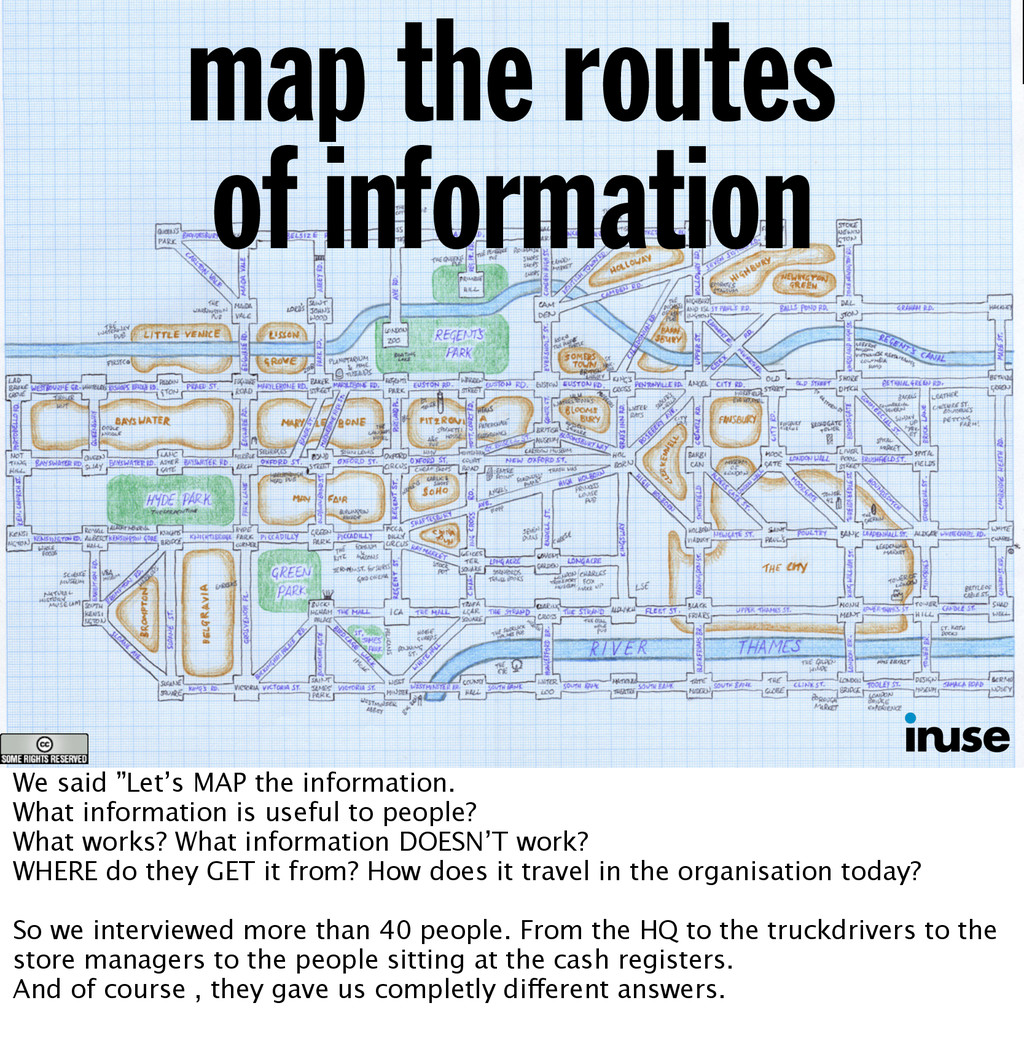
information. What information is useful to people? What works? What information DOESN’T work? WHERE do they GET it from? How does it travel in the organisation today? So we interviewed more than 40 people. From the HQ to the truckdrivers to the store managers to the people sitting at the cash registers. And of course , they gave us completly different answers.
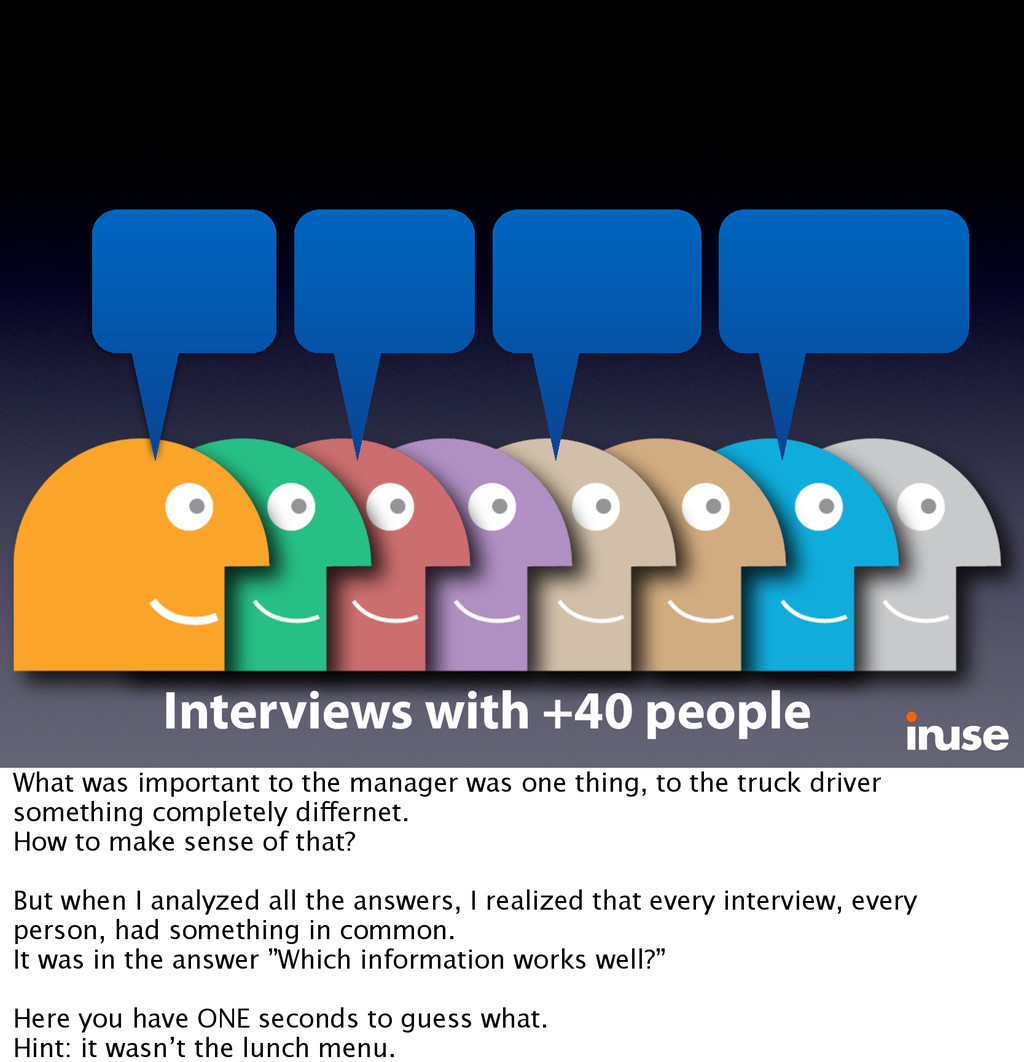
was one thing, to the truck driver something completely differnet. How to make sense of that? But when I analyzed all the answers, I realized that every interview, every person, had something in common. It was in the answer ”Which information works well?” Here you have ONE seconds to guess what. Hint: it wasn’t the lunch menu.
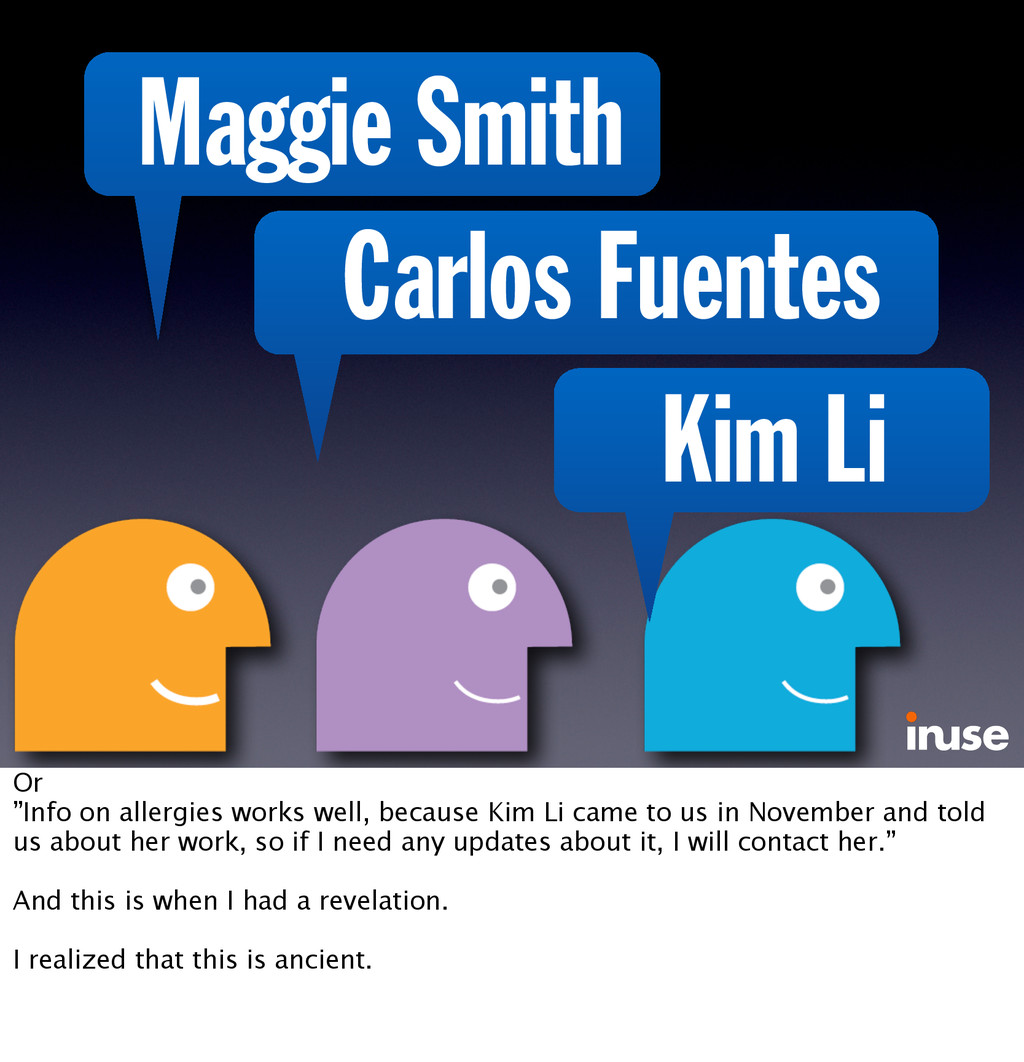
but everyone mentioned A SPECIFIC PERSON. They said things like ”Information on projects works well because Maggie Smith has a newsletter with updates, that she sends every thursday”. Or ”Info on rebates works well, because Carlos Fuentes has an Excel file with all numbers on his server, that we can access.
works well, because Kim Li came to us in November and told us about her work, so if I need any updates about it, I will contact her.” And this is when I had a revelation. I realized that this is ancient.
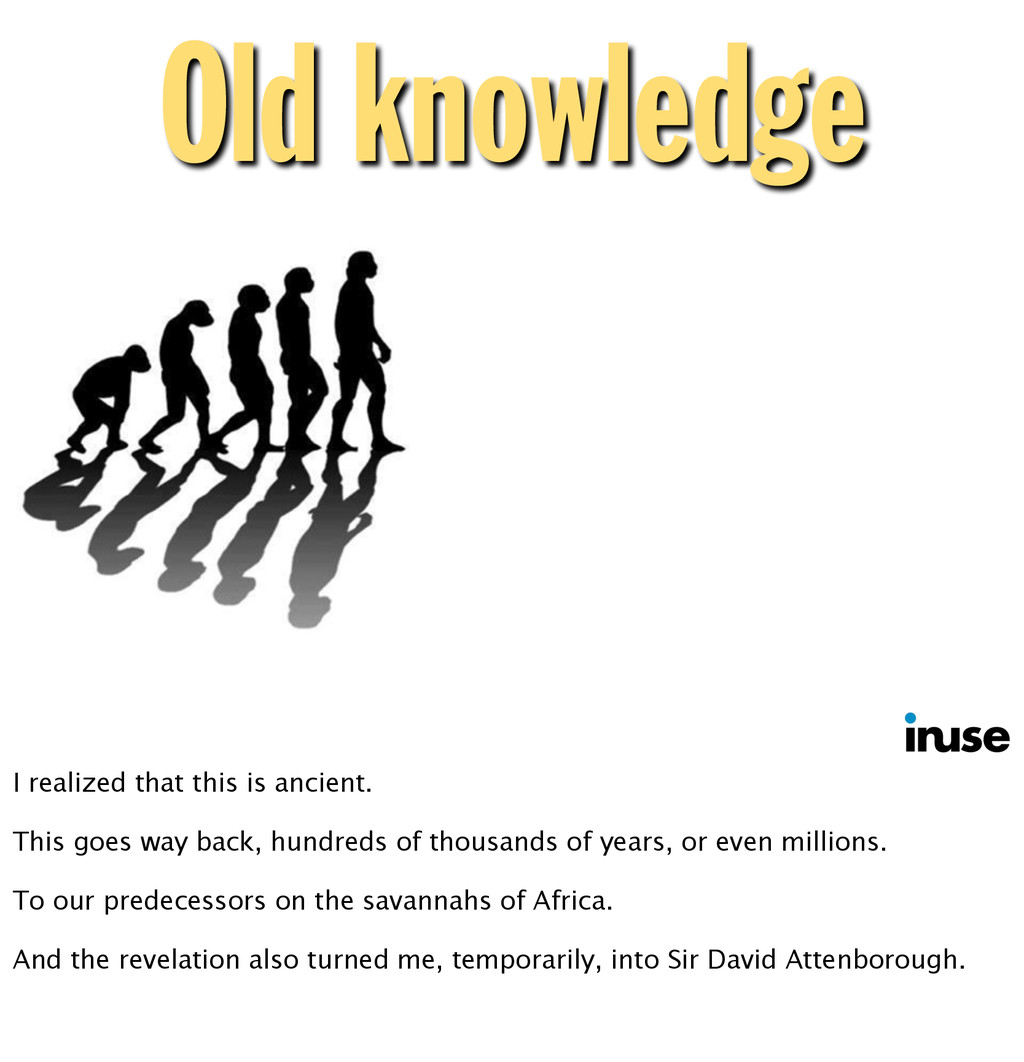
way back, hundreds of thousands of years, or even millions. To our predecessors on the savannahs of Africa. And the revelation also turned me, temporarily, into Sir David Attenborough.
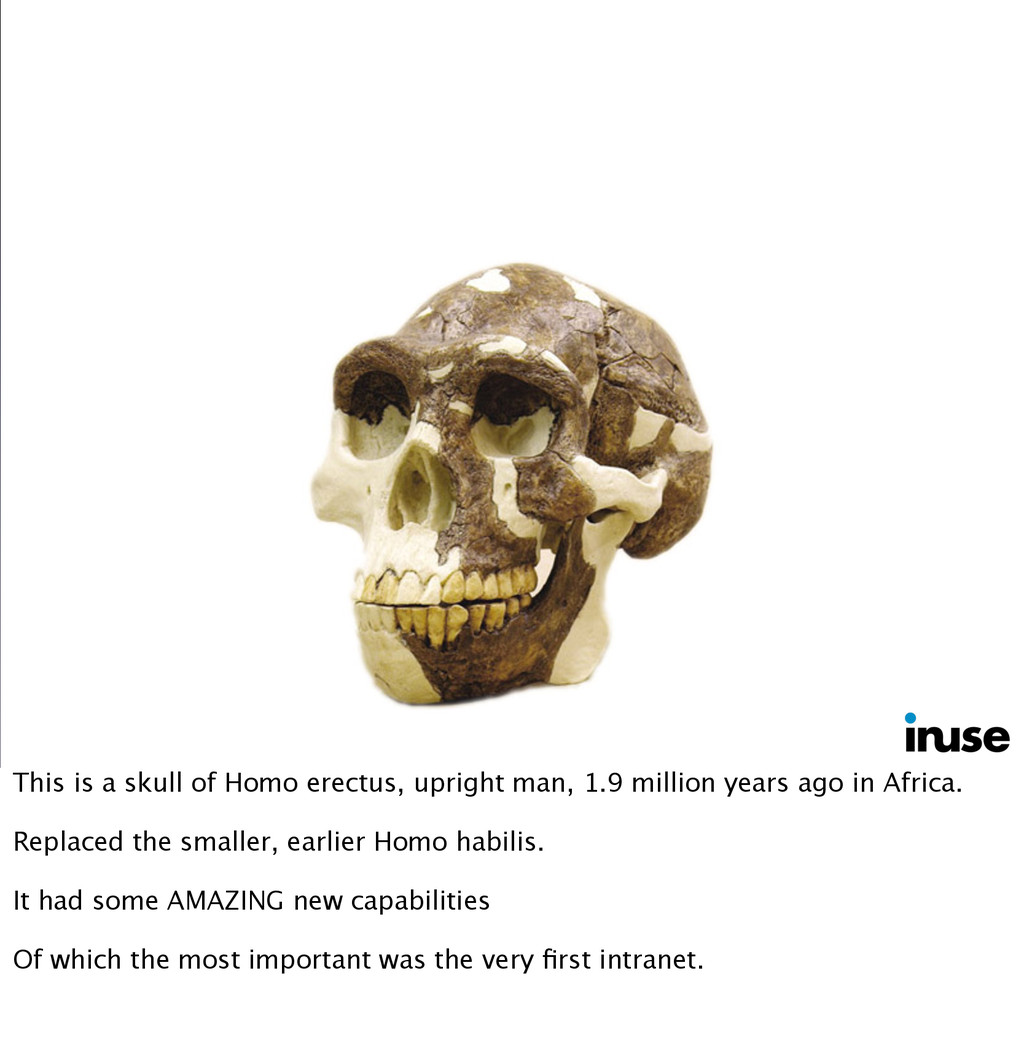
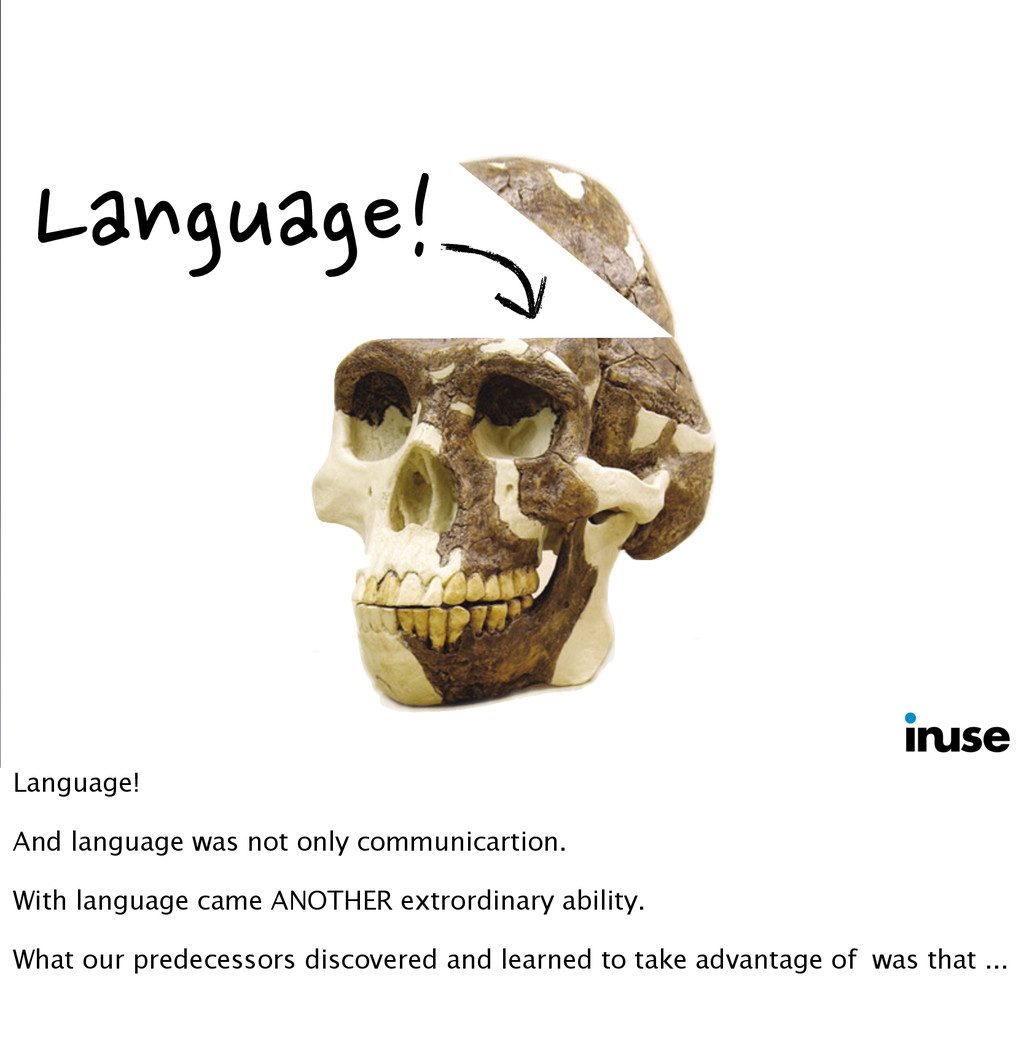
million years ago in Africa. Replaced the smaller, earlier Homo habilis. It had some AMAZING new capabilities Of which the most important was the very first intranet.
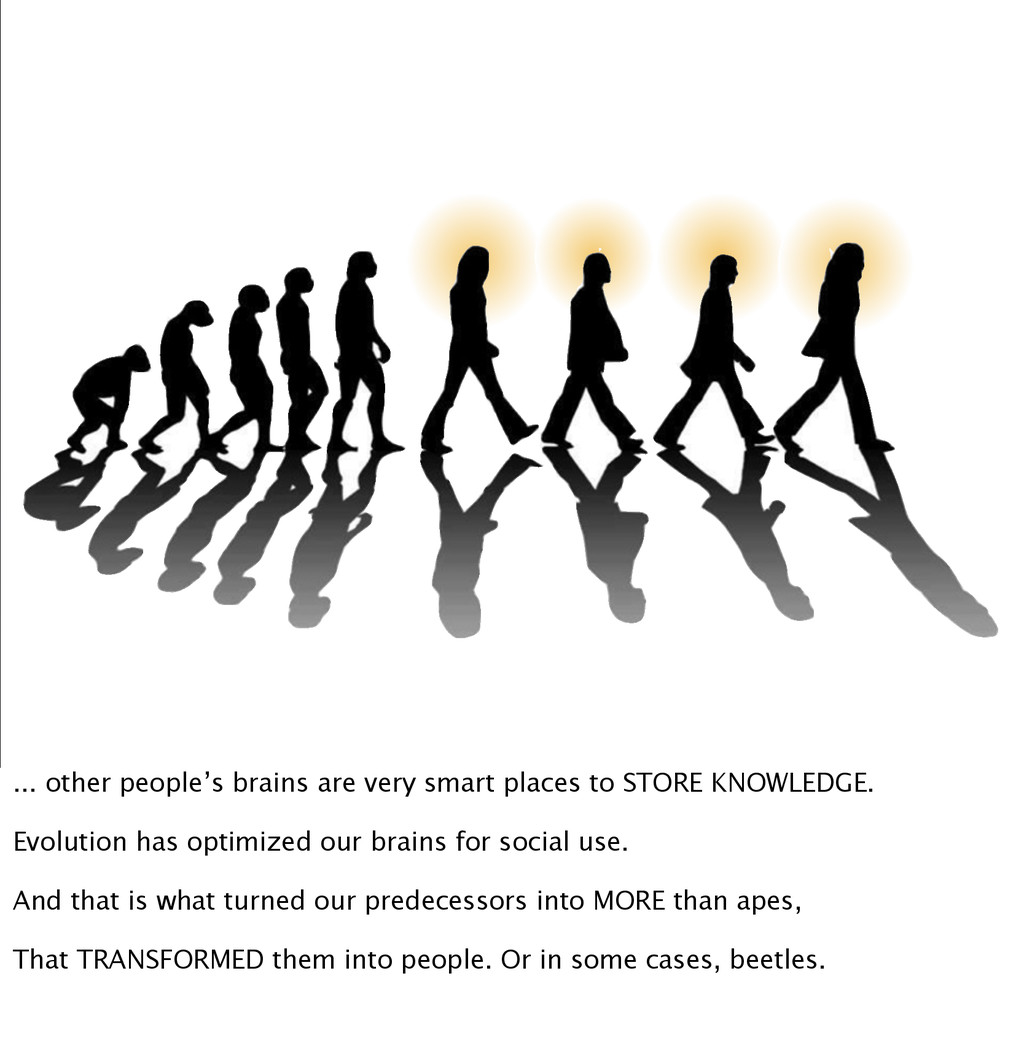
KNOWLEDGE. Evolution has optimized our brains for social use. And that is what turned our predecessors into MORE than apes, That TRANSFORMED them into people. Or in some cases, beetles.
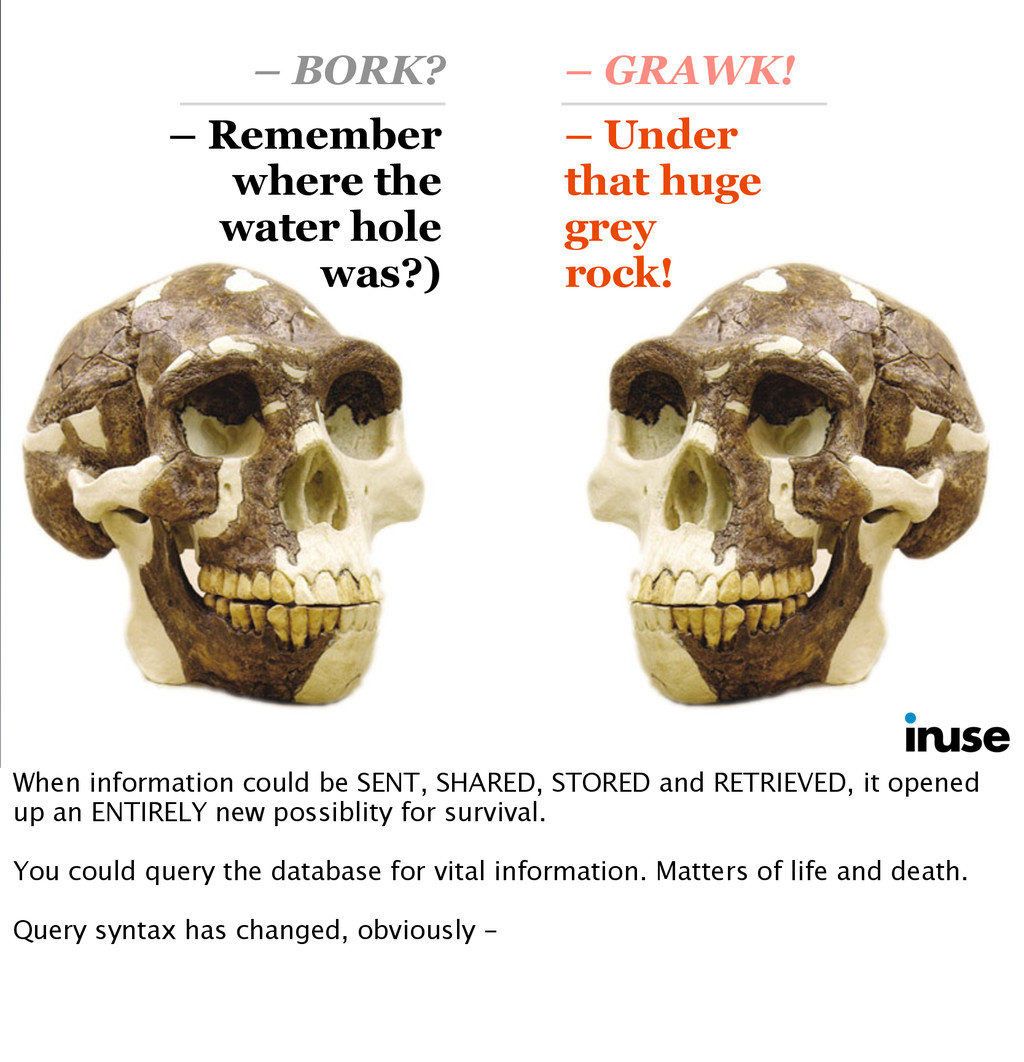
huge grey rock! – BORK? – GRAWK! When information could be SENT, SHARED, STORED and RETRIEVED, it opened up an ENTIRELY new possiblity for survival. You could query the database for vital information. Matters of life and death. Query syntax has changed, obviously -
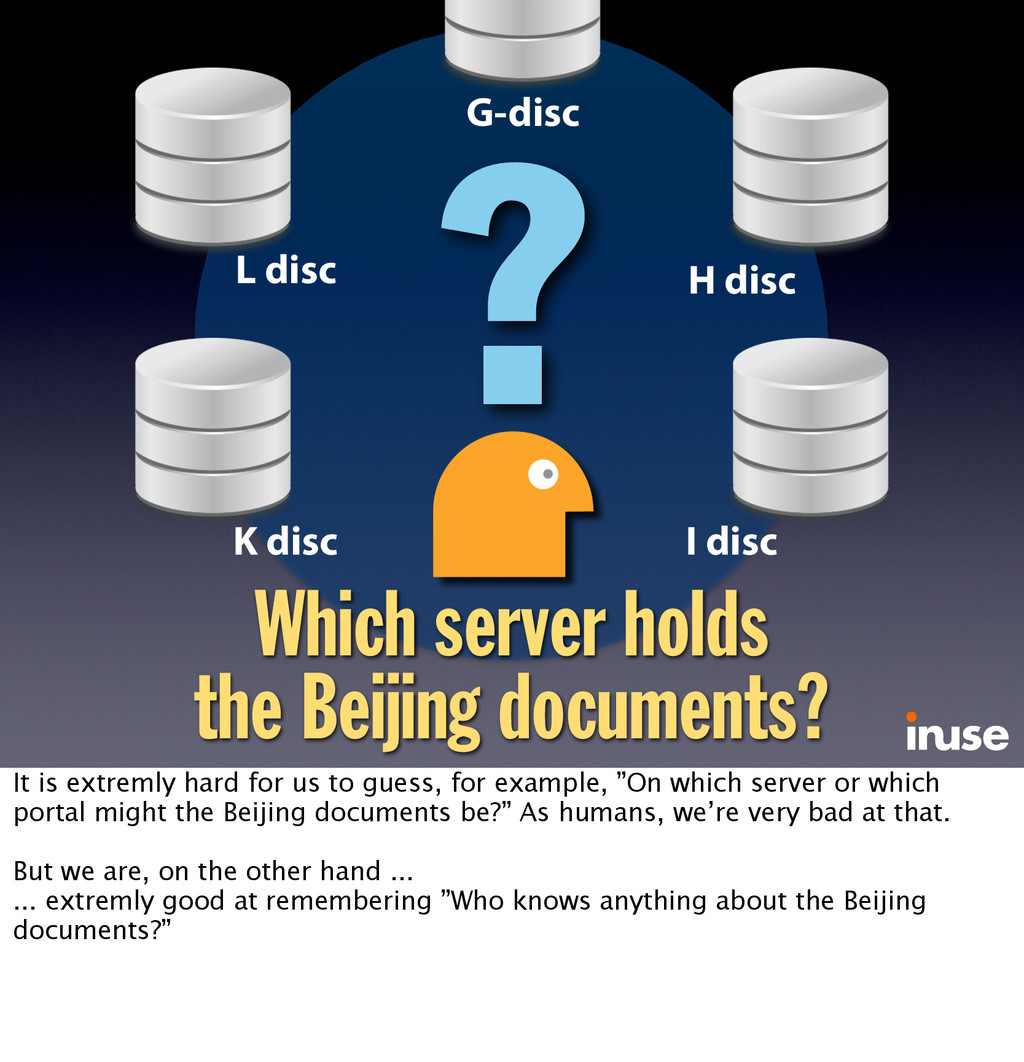
I disc K disc L disc It is extremly hard for us to guess, for example, ”On which server or which portal might the Beijing documents be?” As humans, we’re very bad at that. But we are, on the other hand ... ... extremly good at remembering ”Who knows anything about the Beijing documents?”
Liza Or even guessing ”Who MIGHT know anything about the Beijing documents?” And that’s the reason, if I ask you about the Beijing docs, and you say ”Yeah, there filed at K-disc slash projects, slash, China slash 2012 slash Finished slash background” then I will say... ” Could you mail it to me?”
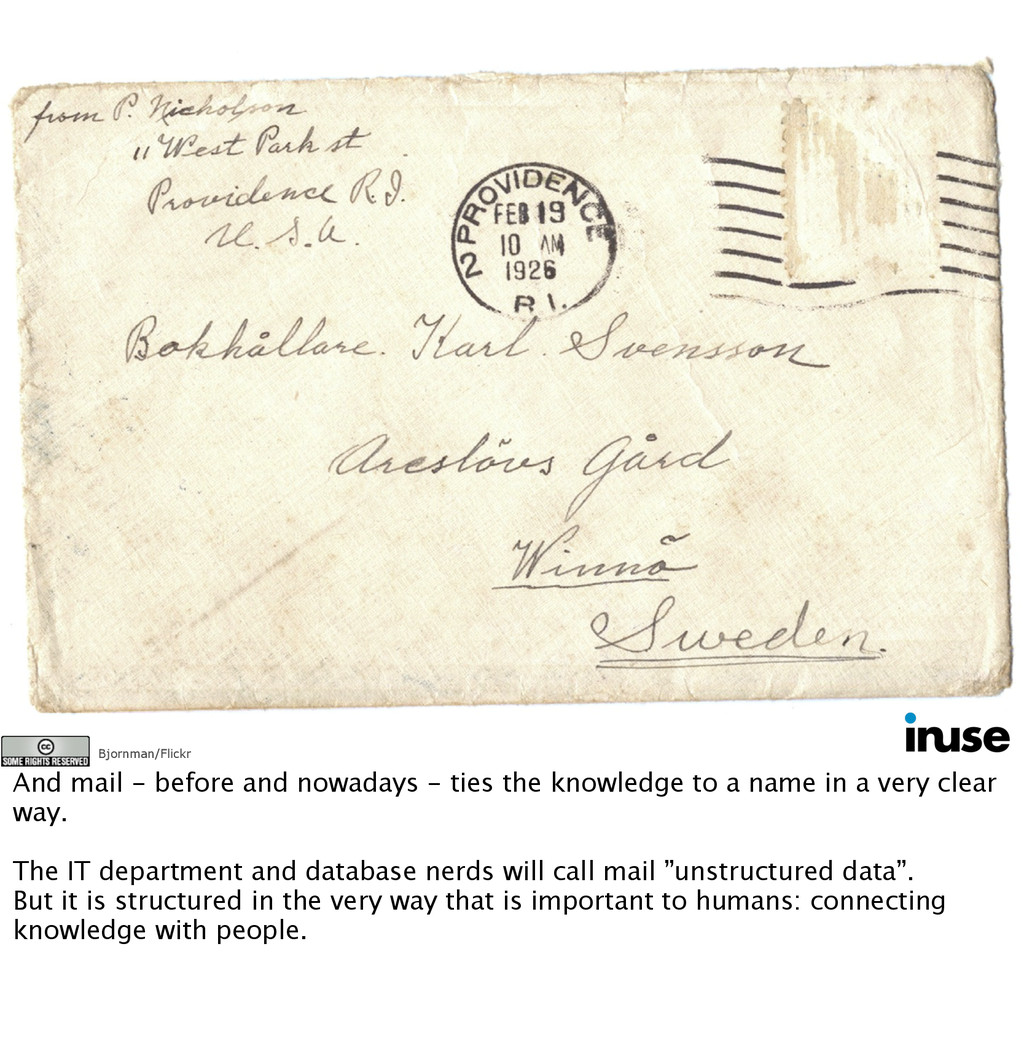
knowledge to a name in a very clear way. The IT department and database nerds will call mail ”unstructured data”. But it is structured in the very way that is important to humans: connecting knowledge with people.
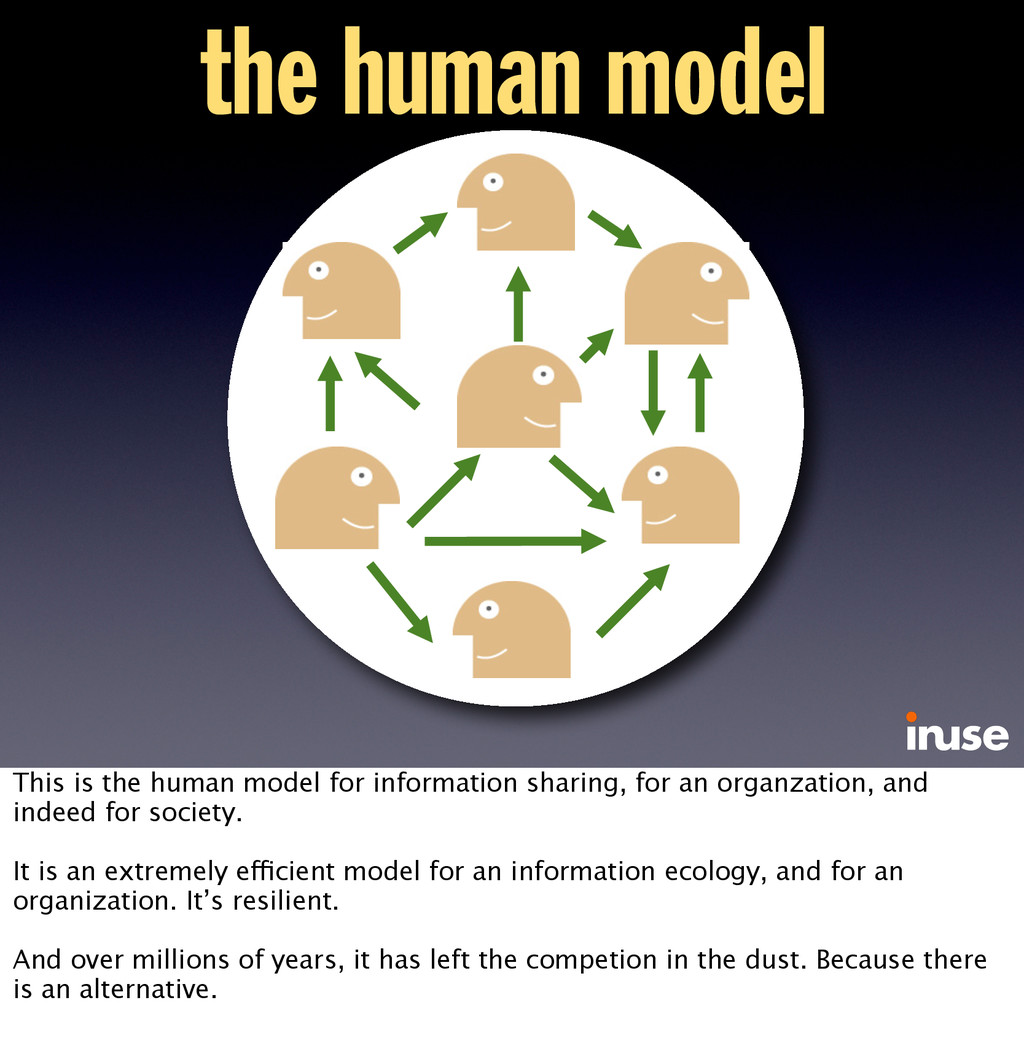
sharing, for an organzation, and indeed for society. It is an extremely efficient model for an information ecology, and for an organization. It’s resilient. And over millions of years, it has left the competion in the dust. Because there is an alternative.
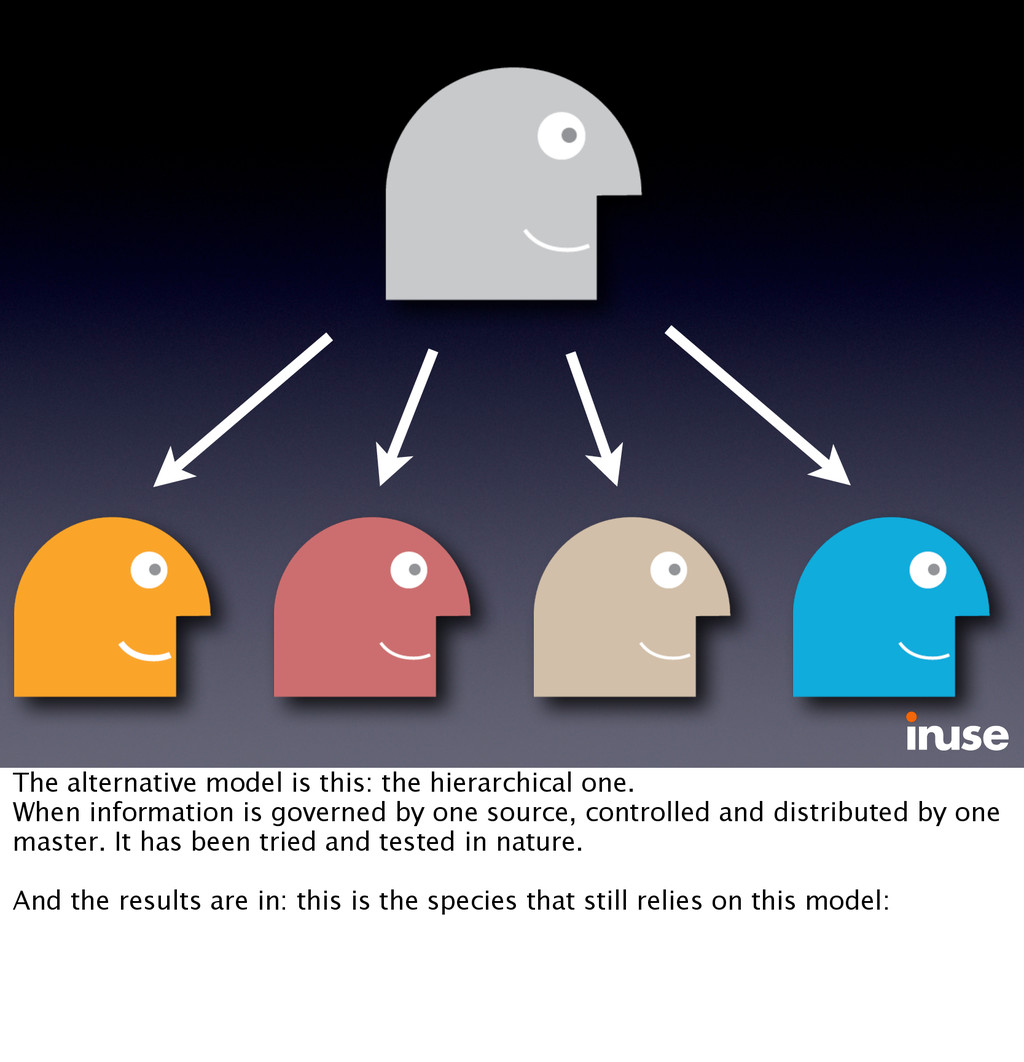
is governed by one source, controlled and distributed by one master. It has been tried and tested in nature. And the results are in: this is the species that still relies on this model:
dominated and controlled by one great silverback master. Preferred by many organizations, it’s nevertheless far less efficient. It never evolved to the agile, dynamic environment that characterizes human societies.
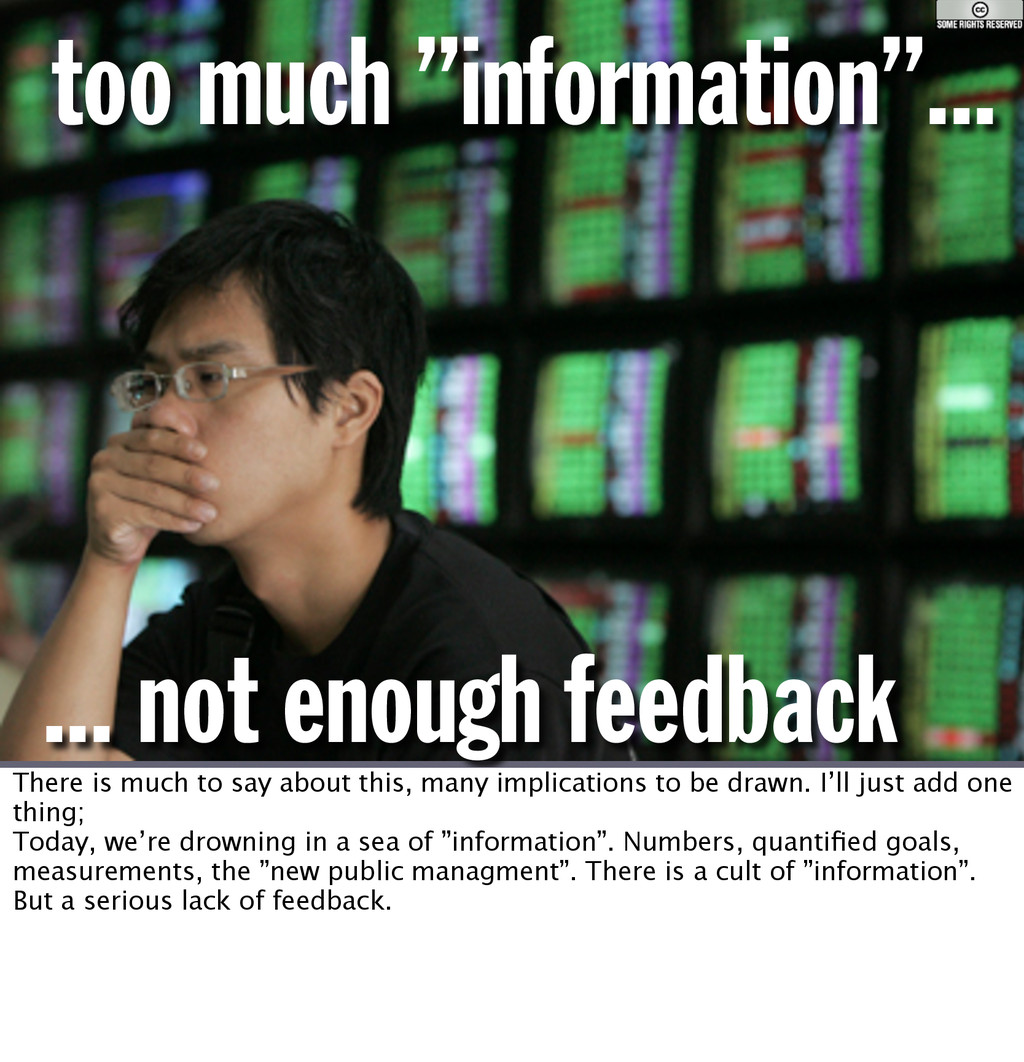
to say about this, many implications to be drawn. I’ll just add one thing; Today, we’re drowning in a sea of ”information”. Numbers, quantified goals, measurements, the ”new public managment”. There is a cult of ”information”. But a serious lack of feedback.
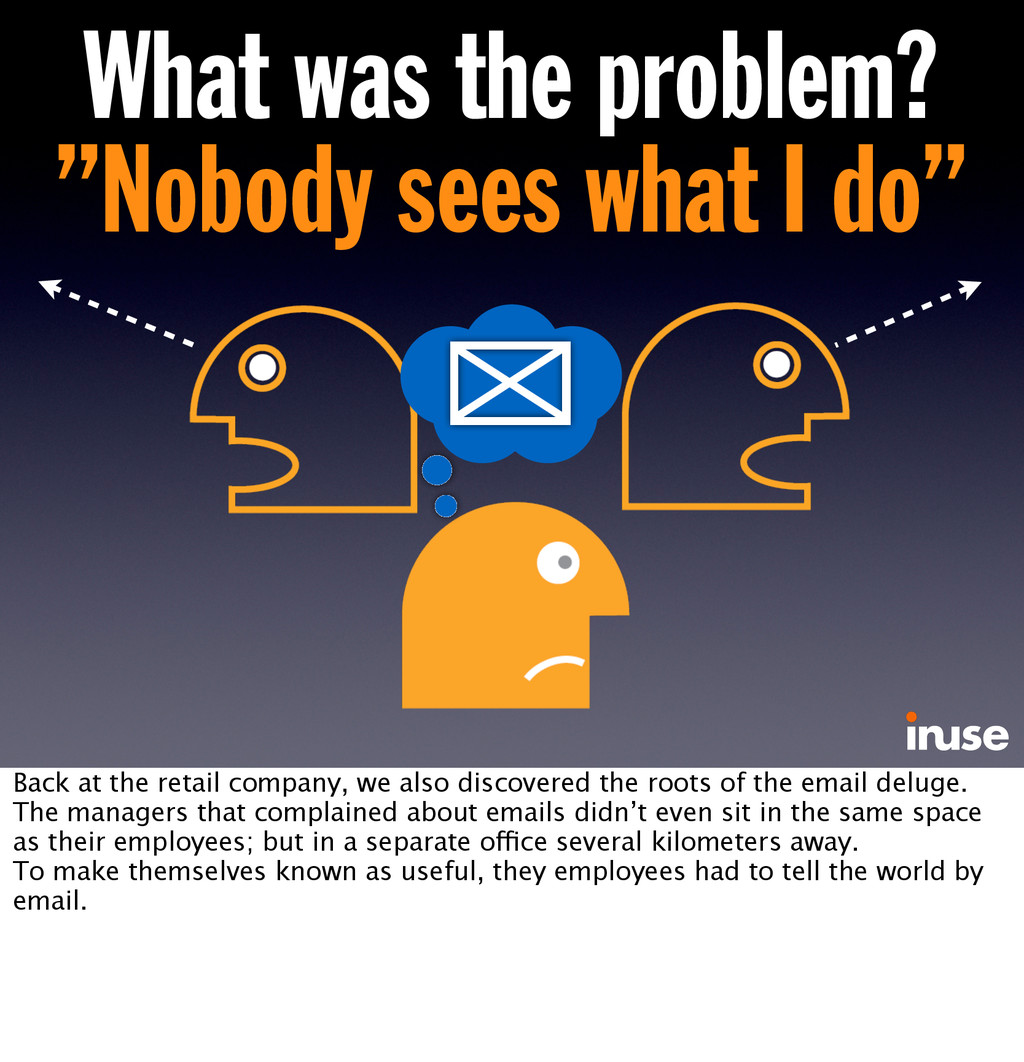
at the retail company, we also discovered the roots of the email deluge. The managers that complained about emails didn’t even sit in the same space as their employees; but in a separate office several kilometers away. To make themselves known as useful, they employees had to tell the world by email.
Although this was in 2004, long before Facebook and other social media, this simple study made it clear to me, that SOCIAL will trump anything This story actually continues with interesting connections to Joseph Stalin and some other stuff, but I’ll have to share that with you during drinks. The slides are available on Slideshare and Speakerdeck under my nicks - but I’m sure, that you’ll ask me: ”Can you mail it to me?” Thank you.
DSP 142: Drowning in M&Ms 2007-10-06 by vernhart / ickr Mappa Lundi by Matt Lancashire / ickr Japan-markets-stock by artemuestra / ickr mail by Bjornman / ickr


 jonas_blind_hen
 c0rp_mdm
 hubbleinc
 kintotechdev
.jpg) ikuodanaka
ikuodanaka
 layerx
 takemura_yuto
 so_kotani
 canvasedge
 infcurion
 yasslab
 cyberlinks
 natsumidnx
 wayneb77
 tapps
tapps
 tammyeverts
 jmmastey
 baasie
 ks91
ks91
 skipperchong
 lcolladotor
 palkan
 katiecoart
 ryanjones
 holman

![[a name] Everybody’s answer contained A NAME. A different name,](https://files.speakerdeck.com/presentations/5d174ea0c2b601314e2506393c0335dc/slide_3.jpg)