Upgrade to Pro
— share decks privately, control downloads, hide ads and more …
Speaker Deck
Sign up for free
Menu
Search
Features
All features
Private URLs
Password Protection
Custom URLS
Scheduled publishing
Remove Branding
Restrict embedding
Deck Collections
Notes
Features
All features
Private URLs
Password Protection
Custom URLS
Scheduled publishing
Remove Branding
Restrict embedding
Deck Collections
Notes
Explore
Featured decks
Featured speakers
Programming
Technology
Storyboards
Explore
Featured decks
Featured speakers
Programming
Technology
Storyboards
Pricing
Search
Sign in
Sign up for free
[Journal club] Improved Mean Flows: On the Chal...
Search
Sponsored
·
Your Podcast. Everywhere. Effortlessly.
Share. Educate. Inspire. Entertain. You do you. We'll handle the rest.
→
Semantic Machine Intelligence Lab., Keio Univ.
PRO
December 24, 2025
Technology
240
0
Share
Embed
Copy iframe code
Copy JS code
Copy link
Start on current slide
[Journal club] Improved Mean Flows: On the Challenges of Fastforward Generative Models
Semantic Machine Intelligence Lab., Keio Univ.
PRO
December 24, 2025
More Decks by Semantic Machine Intelligence Lab., Keio Univ.
See All by Semantic Machine Intelligence Lab., Keio Univ.
[EMNLP26] RIGEL: Self-Distilled Score Adaptation for Image and Video Captioning Evaluation
keio_smilab
PRO
0
64
[RSJ26] Building a VLA Model Based on Self-Distilled Classification
keio_smilab
PRO
0
210
[RSJ26] AnoleVLA: Lightweight Vision-Language-Action Model with Deep State Space Models for Mobile Manipulation
keio_smilab
PRO
0
180
[RSJ26] NarrativeFlow: Flow-Based Vision-Language-Action Model Using Robot Velocity Fields
keio_smilab
PRO
0
250
[RSJ26] Flow as Flow: Modeling Robot Velocity Fields as Probability Velocity Fields
keio_smilab
PRO
1
240
[RSJ26] Hierarchy-Aware Multimodal Retrieval-Augmented Generation for Embodied Question Answering
keio_smilab
PRO
1
200
[MIRU26] Open-Vocabulary Intention-Guided Object Detection in Diverse Scenes
keio_smilab
PRO
0
250
[Journal club] Evo-1: Lightweight Vision-Language-Action Model with Preserved Semantic Alignment
keio_smilab
PRO
0
74
[MIRU26] To What Extent Does MLLM-as-a-Judge Exhibit Cross-Model Preference Bias?
keio_smilab
PRO
0
330
Other Decks in Technology
See All in Technology
宣言型部分更新は何を解決しどこへ向かうのか
shuta13
1
470
初海外で注意すべきこと12選!!!安全快適なre:invent生活にするために
yuuuuuuu168
1
180
hackers_champloo_2026_tidb
makocchi
0
170
AI時代のPRレビューにどう向き合うか?
kairim0
1
240
Benchmarking Disaggregated Serving on vLLM + Dynamo with a Real Coding-Agent Workload
nttcom
1
200
TinyGoでオブザーバビリティ?OpenTelemetryはTinyGoで使えるのか / Is OpenTelemetry available in TinyGo environment?
ymotongpoo
2
140
AIカンパニーへの転換を支えた、エンジニアの仕事の再定義
kworkdev
PRO
2
1.3k
アウトプット初心者、半年間のふりかえり
4o1sobblue
0
440
"優秀な誰か"の下位互換にならないために
yut0naga1_fa
1
1.8k
自作バイナリを動かす「入口」8選
puhitaku
2
1.3k
Classmethod Company Deck
satoshi7
1
730
AI導入は済んだ。次は統制を作り替える番だ_AI×開発組織 Summit 2026
techtekt
PRO
0
320
Featured
See All Featured
XXLCSS - How to scale CSS and keep your sanity
sugarenia
250
1.3M
The #1 spot is gone: here's how to win anyway
tamaranovitovic
4
1.2k
Building Adaptive Systems
keathley
44
3.3k
The World Runs on Bad Software
bkeepers
PRO
72
12k
No one is an island. Learnings from fostering a developers community.
thoeni
21
3.9k
"I'm Feeling Lucky" - Building Great Search Experiences for Today's Users (#IAC19)
danielanewman
230
23k
Imperfection Machines: The Place of Print at Facebook
scottboms
270
14k
A Modern Web Designer's Workflow
chriscoyier
699
190k
Faster Mobile Websites
deanohume
310
32k
Designing Experiences People Love
moore
143
24k
Design and Strategy: How to Deal with People Who Don’t "Get" Design
morganepeng
133
20k
The Organizational Zoo: Understanding Human Behavior Agility Through Metaphoric Constructive Conversations (based on the works of Arthur Shelley, Ph.D)
kimpetersen
PRO
0
500
Transcript
杉浦孔明研究室 妹尾幸樹 Improved Mean Flows: On the Challenges of Fastforward
Generative Models Zhengyang Geng1,2,3,* Yiyang Lu4,2,∗ Zongze Wu3 Eli Shechtman3 J. Zico Kolter1 Kaiming He2 1CMU 2MIT 3Adobe 4THU Geng, Z., Lu, Y., Wu, Z., Shechtman, E., Kolter, J. Z., & He, K. (2025). Improved Mean Flows: On the Challenges of Fastforward Generative Models. arXiv preprint arXiv:2512.02012, 2025
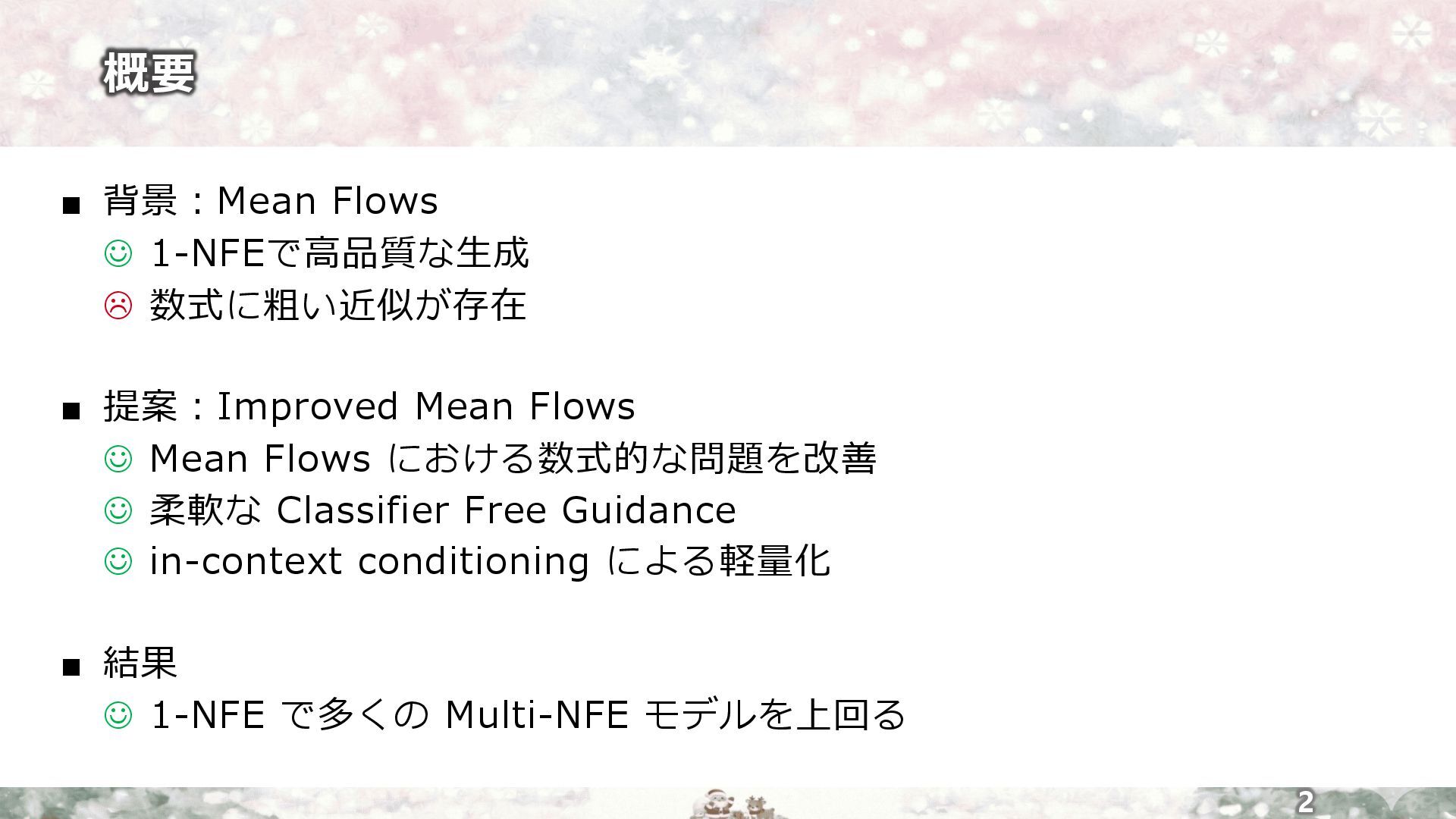
概要 2 ▪ 背景︓Mean Flows J 1-NFEで⾼品質な⽣成 L 数式に粗い近似が存在 ▪
提案︓Improved Mean Flows J Mean Flows における数式的な問題を改善 J 柔軟な Classifier Free Guidance J in-context conditioning による軽量化 ▪ 結果 J 1-NFE で多くの Multi-NFE モデルを上回る
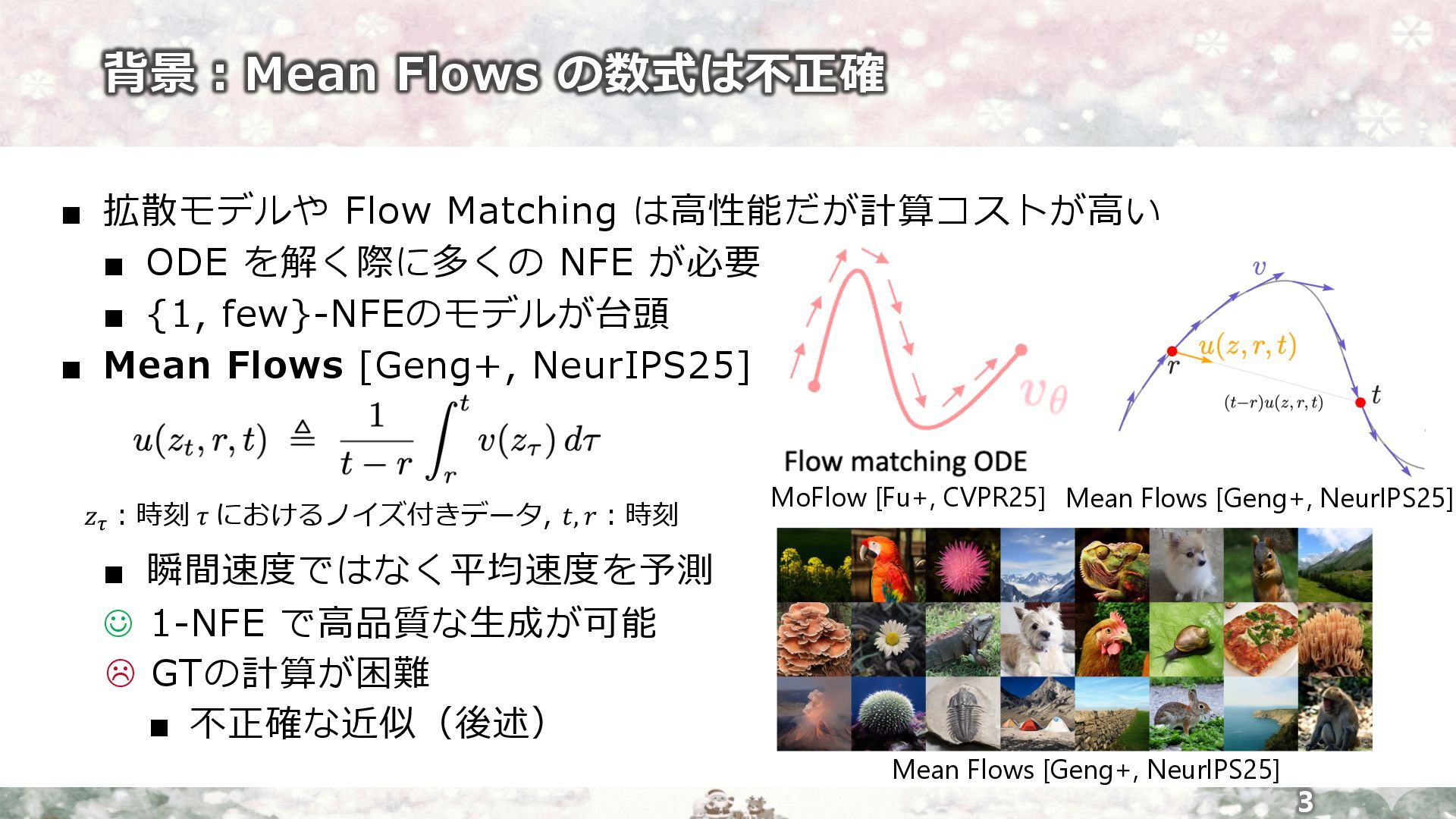
背景︓Mean Flows の数式は不正確 3 ▪ 拡散モデルや Flow Matching は⾼性能だが計算コストが⾼い ▪
ODE を解く際に多くの NFE が必要 ▪ {1, few}-NFEのモデルが台頭 ▪ Mean Flows [Geng+, NeurIPS25] ▪ 瞬間速度ではなく平均速度を予測 J 1-NFE で⾼品質な⽣成が可能 L GTの計算が困難 ▪ 不正確な近似(後述) MoFlow [Fu+, CVPR25] Mean Flows [Geng+, NeurIPS25] Mean Flows [Geng+, NeurIPS25] 𝑧! ︓時刻 𝜏 におけるノイズ付きデータ, 𝑡, 𝑟︓時刻
関連研究︓Mean Flows の改善 4 ⼿法 特徴 AlphaFlow [Zhang+, 25] Flow
Matching から MeanFlow へ段階的に移⾏する カリキュラム学習⼿法 Decoupled MeanFlow [Lee+, 25] 事前学習済み Flow Matching モデルを fine-tuning して MeanFlow モデルへ変換 CMT [Hu+, 25] 事前学習と事後学習の間に⼀貫性損失を⽤いた中間学習を導⼊ 事後学習における MeanFlow モデルの性能が向上 Decoupled Meanflow [Lee+, 25] AlphaFlow [Zhang+, 25]
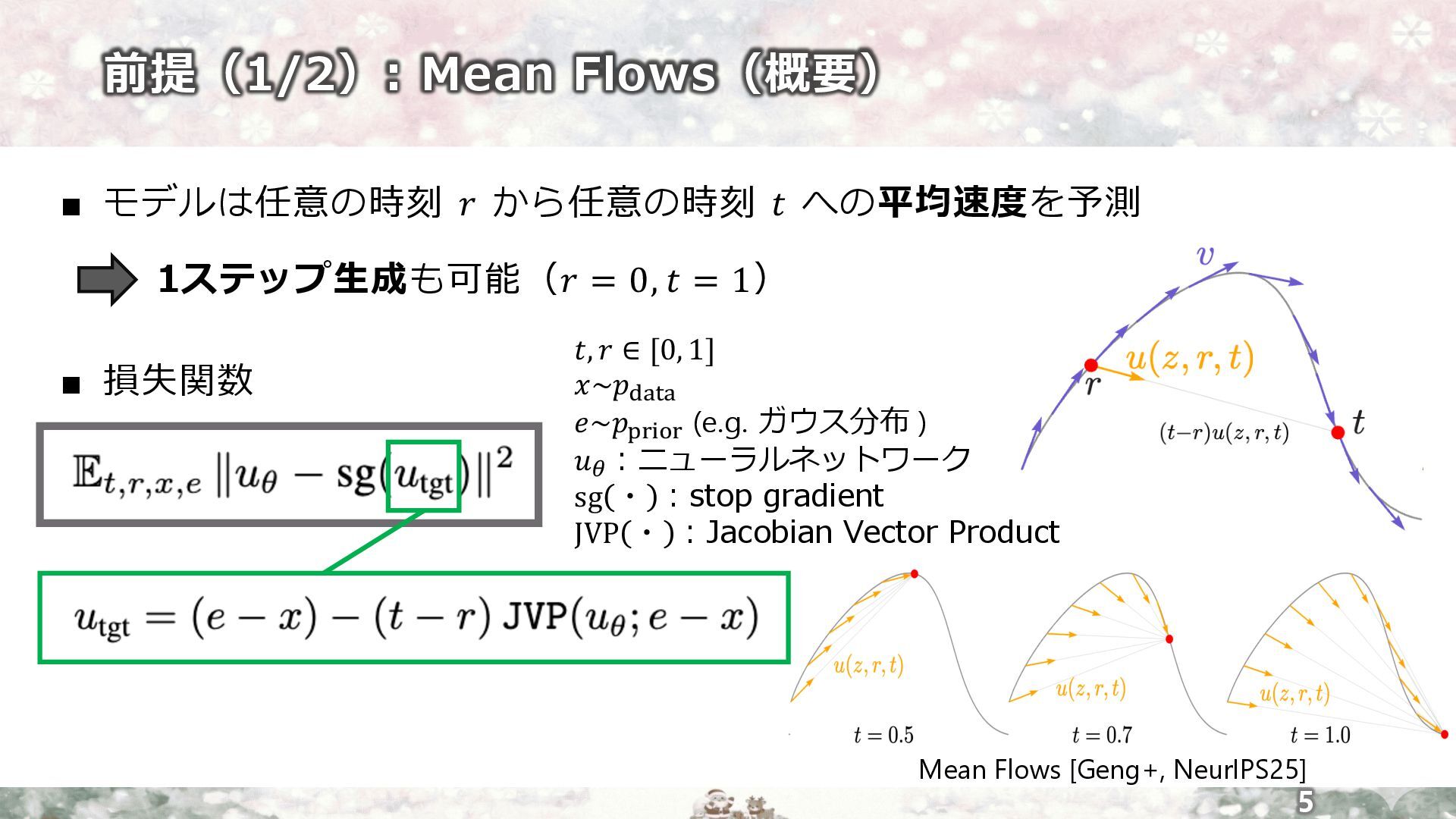
▪ モデルは任意の時刻 𝑟 から任意の時刻 𝑡 への平均速度を予測 1ステップ⽣成も可能(𝑟 = 0, 𝑡
= 1) ▪ 損失関数 前提(1/2): Mean Flows(概要) 5 𝑡, 𝑟 ∈ [0, 1] 𝑥~𝑝!"#" 𝑒~𝑝$%&'% (e.g. ガウス分布 ) 𝑢( ︓ニューラルネットワーク sg ・ ︓stop gradient JVP ・ ︓Jacobian Vector Product Mean Flows [Geng+, NeurIPS25]
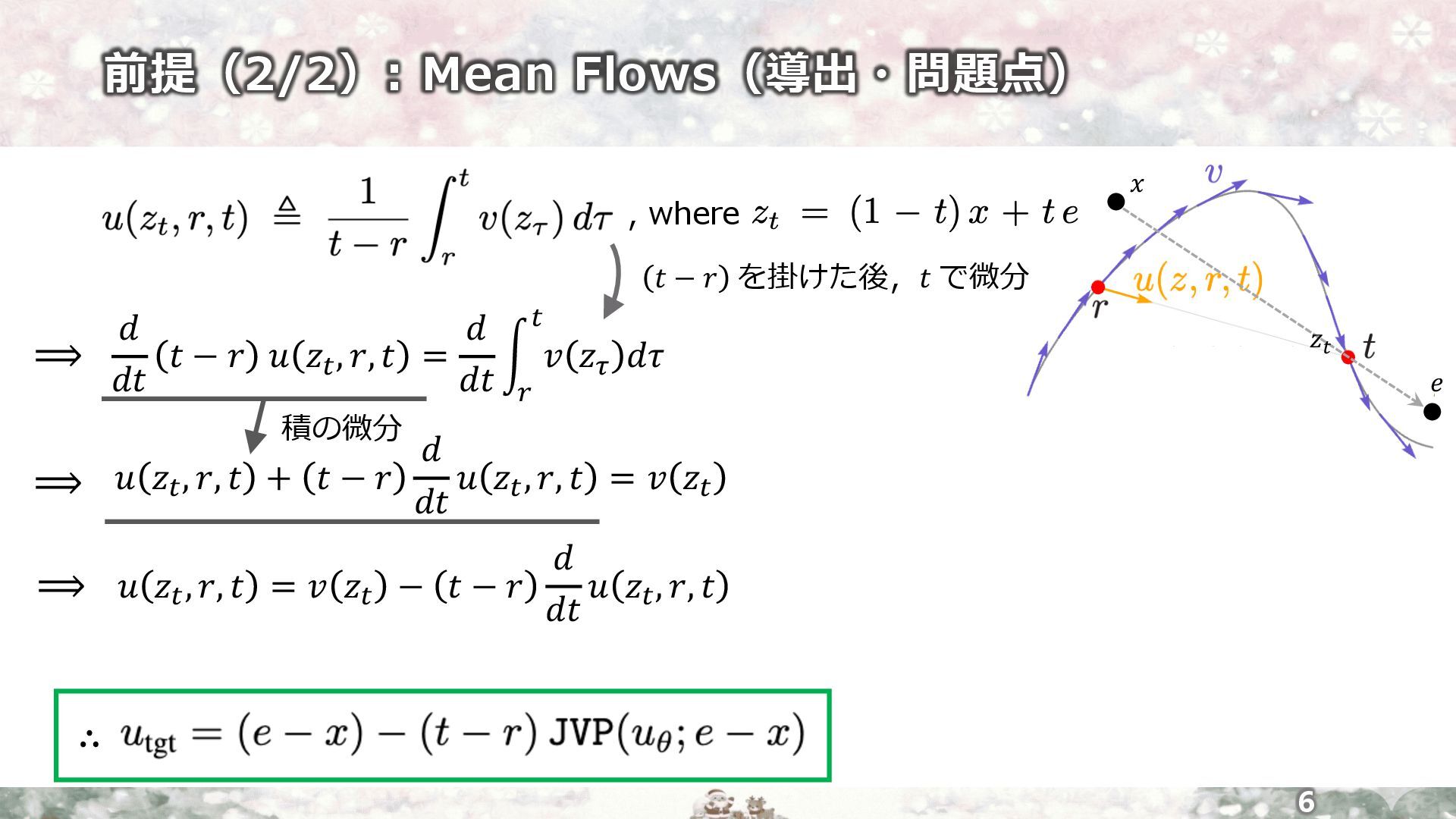
前提(2/2): Mean Flows(導出・問題点) 6 𝑢 𝑧&, 𝑟, 𝑡 + 𝑡
− 𝑟 𝑑 𝑑𝑡 𝑢 𝑧&, 𝑟, 𝑡 = 𝑣 𝑧& 𝑑 𝑑𝑡 𝑡 − 𝑟 𝑢 𝑧&, 𝑟, 𝑡 = 𝑑 𝑑𝑡 - ' & 𝑣 𝑧( 𝑑𝜏 𝑢 𝑧&, 𝑟, 𝑡 = 𝑣 𝑧& − 𝑡 − 𝑟 𝑑 𝑑𝑡 𝑢 𝑧&, 𝑟, 𝑡 , where 積の微分 ⟹ ⟹ ⟹ ∴ 𝑧" 𝑥 𝑒 𝑡 − 𝑟 を掛けた後,𝑡 で微分
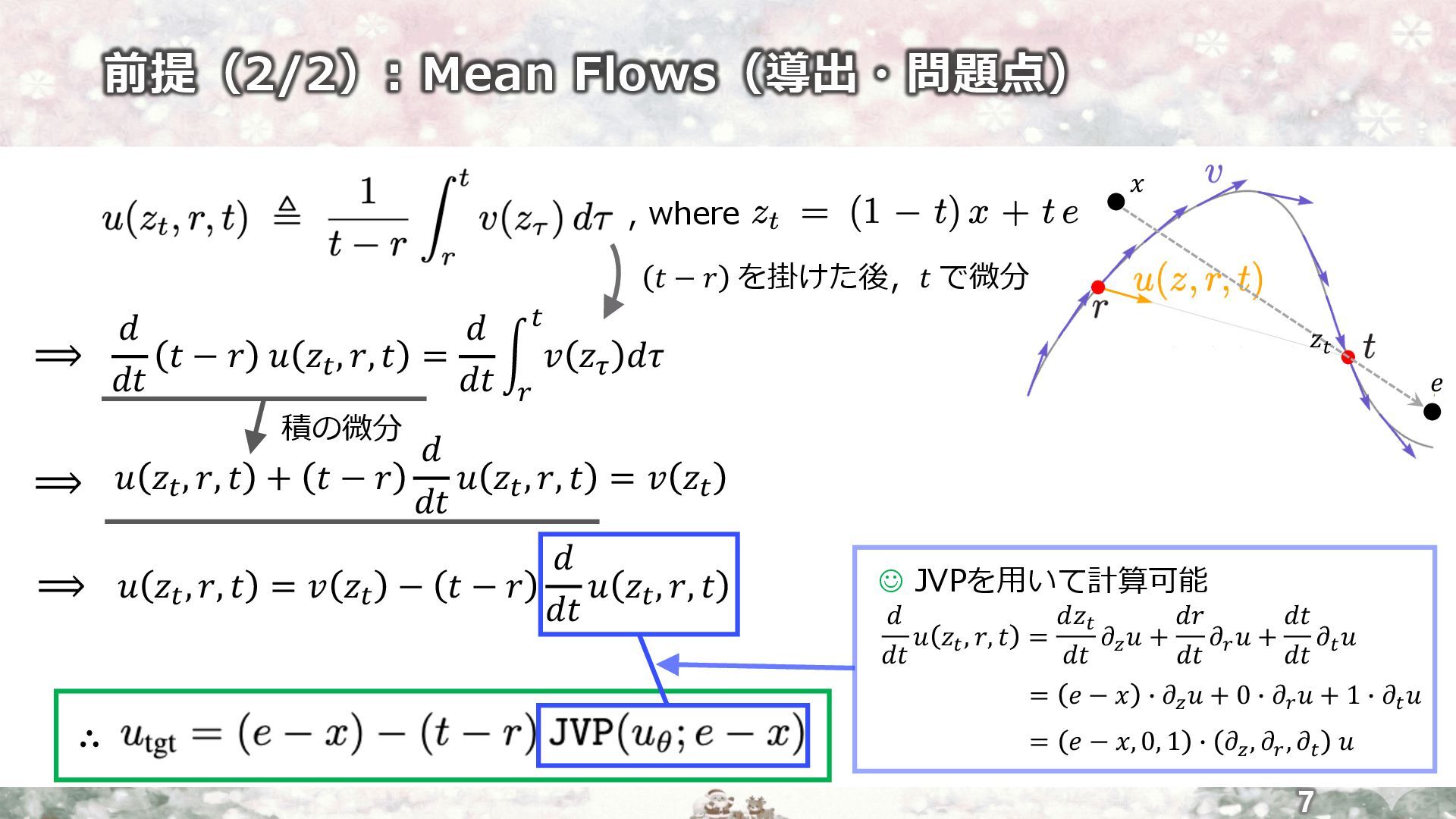
前提(2/2): Mean Flows(導出・問題点) 7 𝑢 𝑧&, 𝑟, 𝑡 + 𝑡
− 𝑟 𝑑 𝑑𝑡 𝑢 𝑧&, 𝑟, 𝑡 = 𝑣 𝑧& 𝑑 𝑑𝑡 𝑡 − 𝑟 𝑢 𝑧&, 𝑟, 𝑡 = 𝑑 𝑑𝑡 - ' & 𝑣 𝑧( 𝑑𝜏 𝑢 𝑧&, 𝑟, 𝑡 = 𝑣 𝑧& − 𝑡 − 𝑟 𝑑 𝑑𝑡 𝑢 𝑧&, 𝑟, 𝑡 , where 積の微分 = 𝑒 − 𝑥, 0, 1 / 𝜕# , 𝜕$ , 𝜕" 𝑢 = 𝑒 − 𝑥 / 𝜕# 𝑢 + 0 / 𝜕$ 𝑢 + 1 / 𝜕" 𝑢 J JVPを⽤いて計算可能 𝑑 𝑑𝑡 𝑢 𝑧" , 𝑟, 𝑡 = 𝑑𝑧" 𝑑𝑡 𝜕# 𝑢 + 𝑑𝑟 𝑑𝑡 𝜕$ 𝑢 + 𝑑𝑡 𝑑𝑡 𝜕" 𝑢 ⟹ ⟹ ⟹ ∴ 𝑧" 𝑥 𝑒 𝑡 − 𝑟 を掛けた後,𝑡 で微分
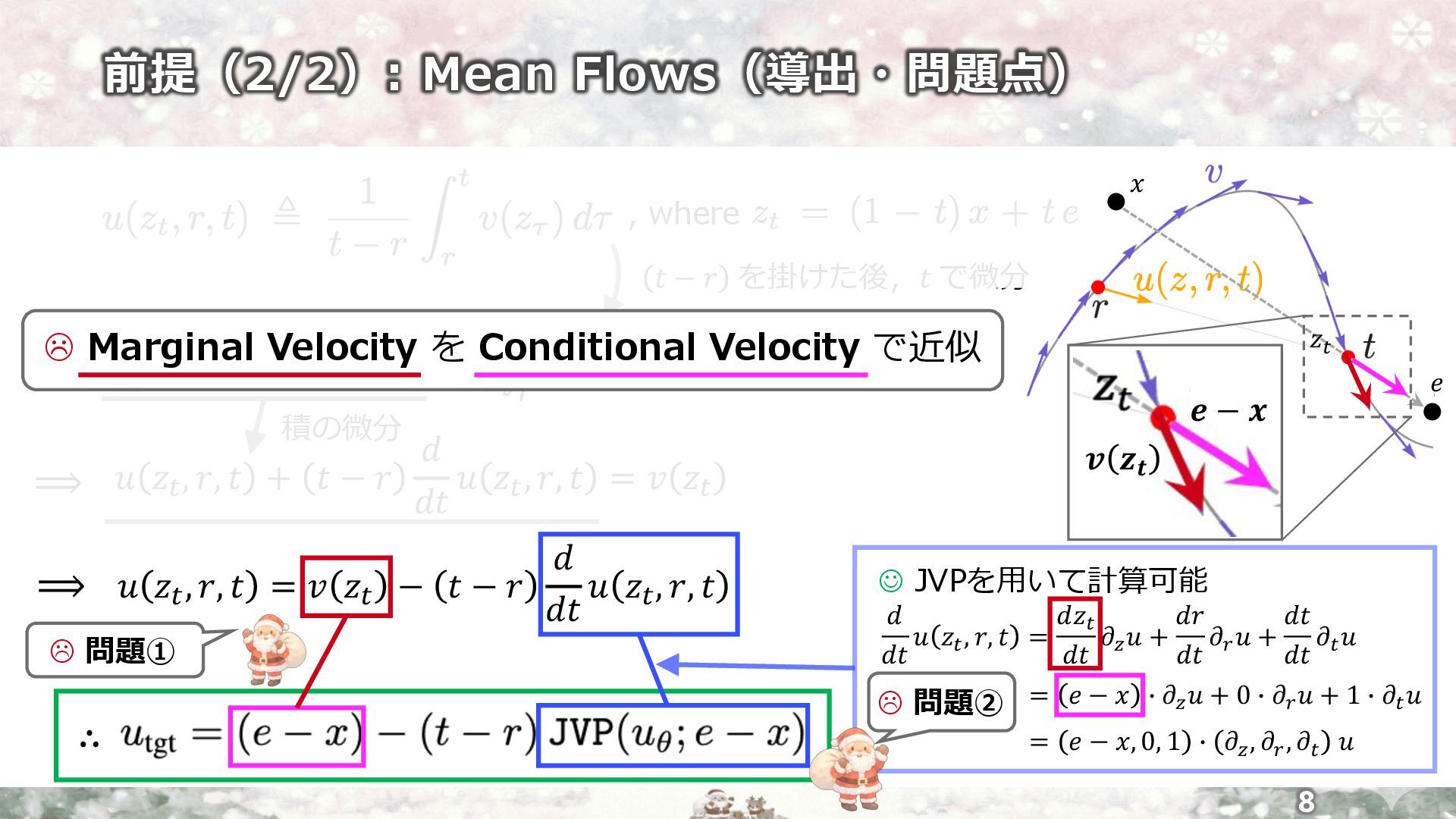
前提(2/2): Mean Flows(導出・問題点) 8 𝑢 𝑧&, 𝑟, 𝑡 + 𝑡
− 𝑟 𝑑 𝑑𝑡 𝑢 𝑧&, 𝑟, 𝑡 = 𝑣 𝑧& 𝑑 𝑑𝑡 𝑡 − 𝑟 𝑢 𝑧&, 𝑟, 𝑡 = 𝑑 𝑑𝑡 - ' & 𝑣 𝑧( 𝑑𝜏 𝑢 𝑧&, 𝑟, 𝑡 = 𝑣 𝑧& − 𝑡 − 𝑟 𝑑 𝑑𝑡 𝑢 𝑧&, 𝑟, 𝑡 , where 積の微分 = 𝑒 − 𝑥, 0, 1 / 𝜕# , 𝜕$ , 𝜕" 𝑢 = 𝑒 − 𝑥 / 𝜕# 𝑢 + 0 / 𝜕$ 𝑢 + 1 / 𝜕" 𝑢 J JVPを⽤いて計算可能 𝑑 𝑑𝑡 𝑢 𝑧" , 𝑟, 𝑡 = 𝑑𝑧" 𝑑𝑡 𝜕# 𝑢 + 𝑑𝑟 𝑑𝑡 𝜕$ 𝑢 + 𝑑𝑡 𝑑𝑡 𝜕" 𝑢 ⟹ ⟹ ⟹ ∴ L 問題① 𝑧" 𝑥 𝑒 𝑡 − 𝑟 を掛けた後,𝑡 で微分 𝒗 𝒛𝒕 𝒆 − 𝒙 L 問題② L Marginal Velocity を Conditional Velocity で近似
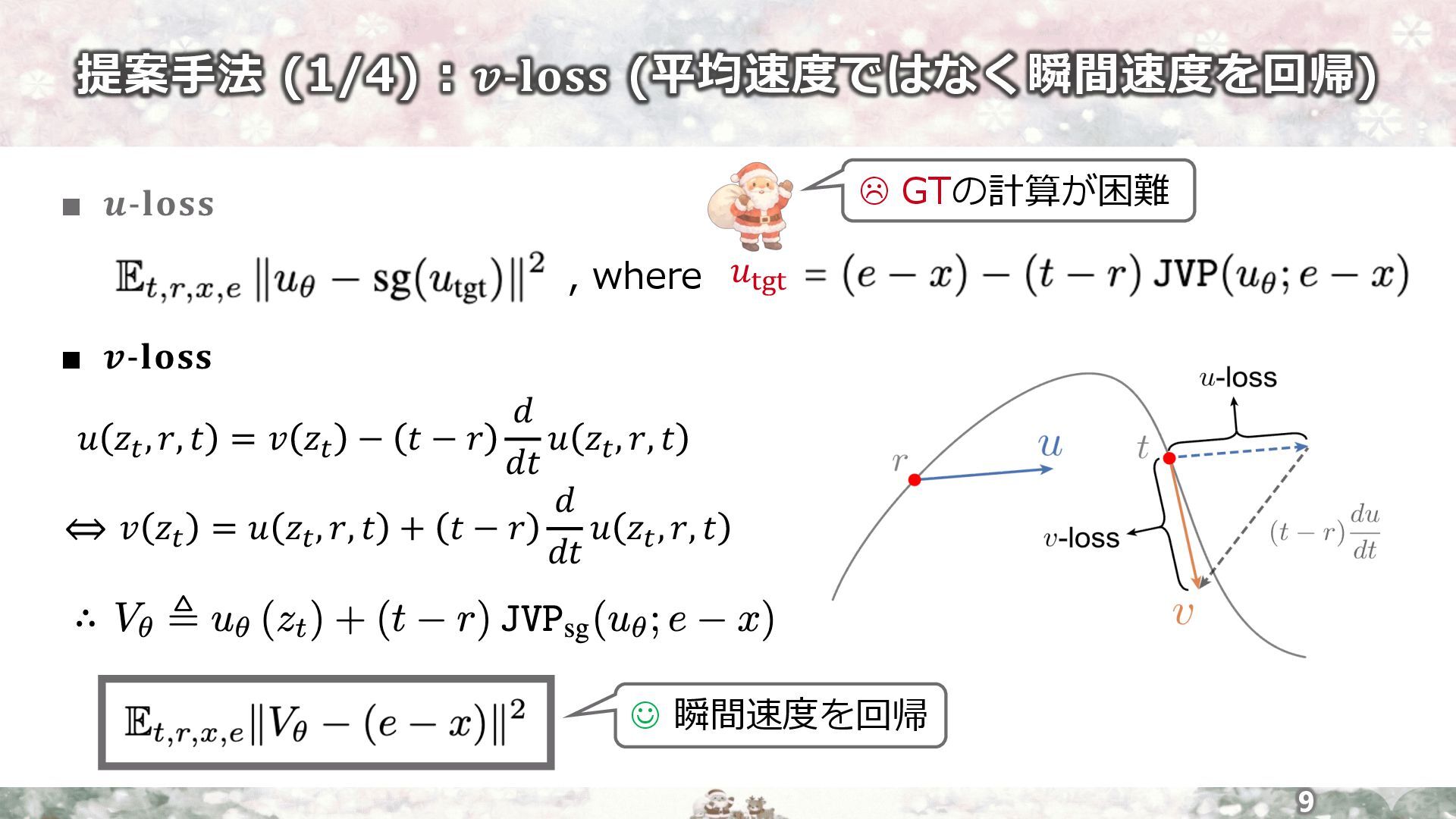
提案⼿法 (1/4) : 𝒗-𝐥𝐨𝐬𝐬 (平均速度ではなく瞬間速度を回帰) 9 ▪ 𝒖-𝐥𝐨𝐬𝐬 ▪ 𝒗-𝐥𝐨𝐬𝐬
⇔ , where L GTの計算が困難 J 瞬間速度を回帰 𝑣 𝑧& = 𝑢 𝑧& , 𝑟, 𝑡 + 𝑡 − 𝑟 𝑑 𝑑𝑡 𝑢 𝑧& , 𝑟, 𝑡 𝑢 𝑧&, 𝑟, 𝑡 = 𝑣 𝑧& − 𝑡 − 𝑟 𝑑 𝑑𝑡 𝑢 𝑧&, 𝑟, 𝑡 ∴ 𝑢454
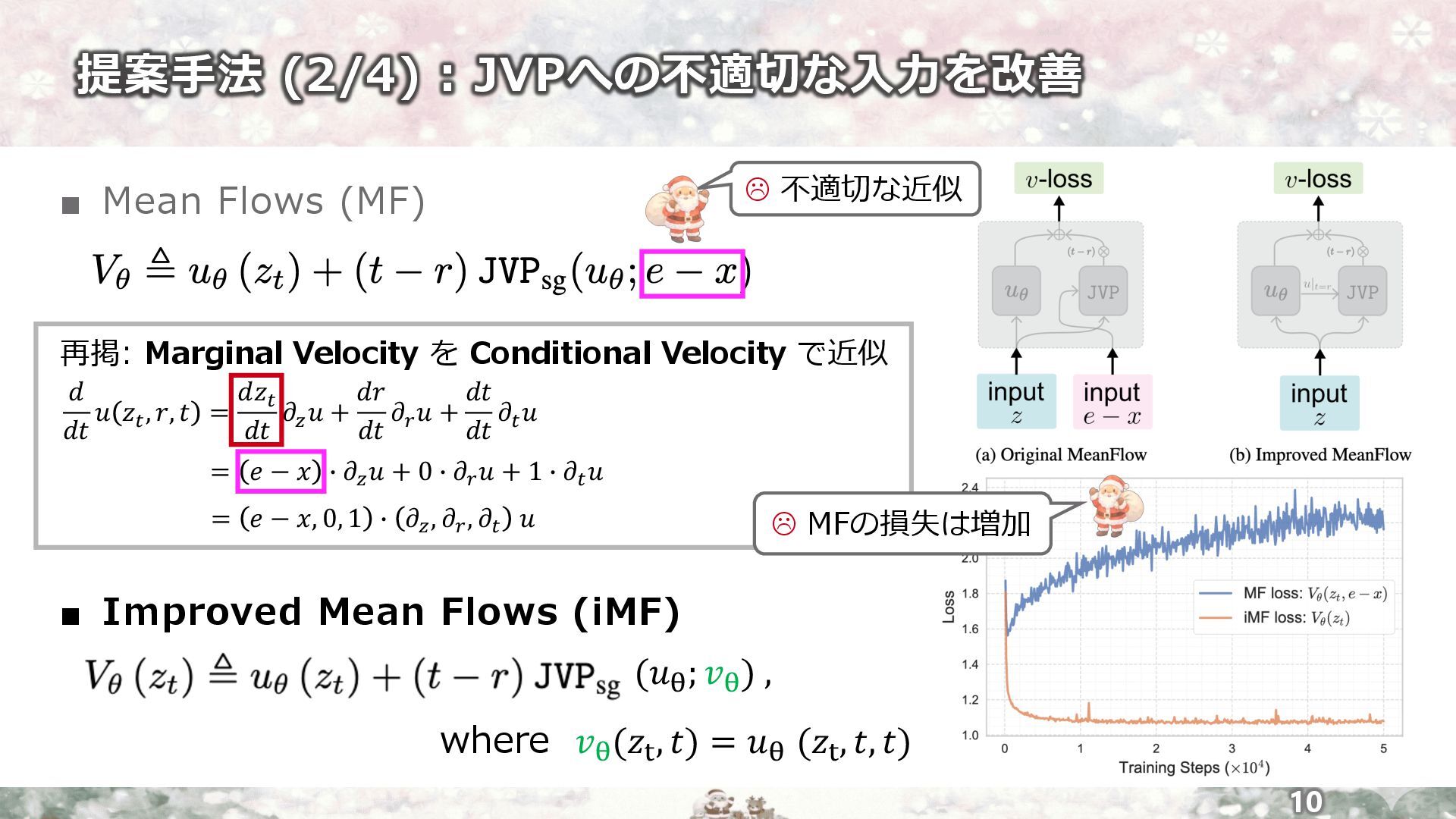
提案⼿法 (2/4) : JVPへの不適切な⼊⼒を改善 10 ▪ Mean Flows (MF) ▪
Improved Mean Flows (iMF) = 𝑒 − 𝑥, 0, 1 / 𝜕# , 𝜕$ , 𝜕" 𝑢 = 𝑒 − 𝑥 / 𝜕# 𝑢 + 0 / 𝜕$ 𝑢 + 1 / 𝜕" 𝑢 再掲: Marginal Velocity を Conditional Velocity で近似 𝑑 𝑑𝑡 𝑢 𝑧" , 𝑟, 𝑡 = 𝑑𝑧" 𝑑𝑡 𝜕# 𝑢 + 𝑑𝑟 𝑑𝑡 𝜕$ 𝑢 + 𝑑𝑡 𝑑𝑡 𝜕" 𝑢 L 不適切な近似 (𝑢6 ; 𝑣6 ) , where 𝑣6 (𝑧4 , 𝑡) = 𝑢6 (𝑧4 , 𝑡, 𝑡) L MFの損失は増加
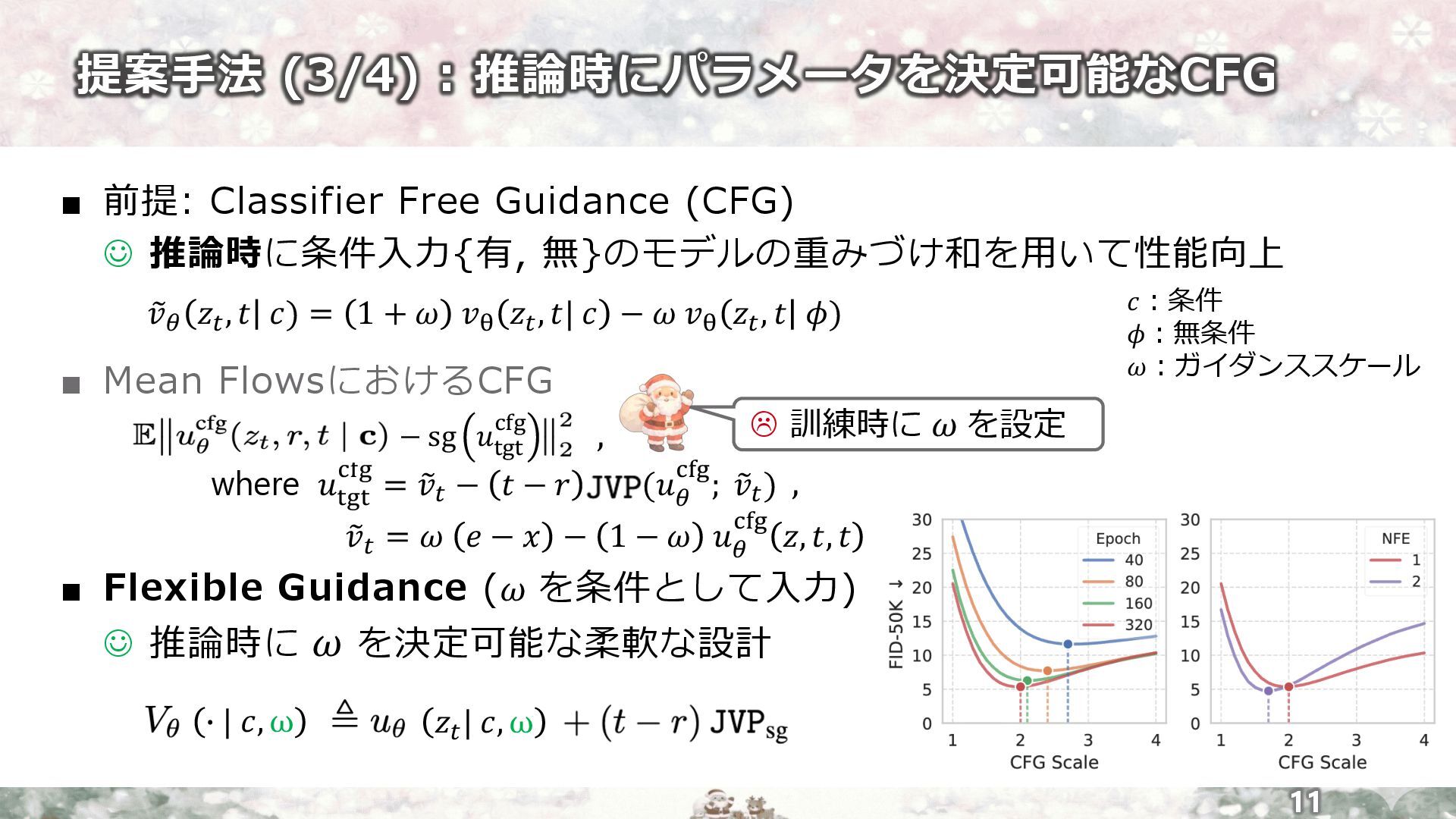
提案⼿法 (3/4) : 推論時にパラメータを決定可能なCFG 11 ▪ 前提: Classifier Free Guidance
(CFG) J 推論時に条件⼊⼒{有, 無}のモデルの重みづけ和を⽤いて性能向上 ▪ Mean FlowsにおけるCFG ▪ Flexible Guidance (𝜔 を条件として⼊⼒) J 推論時に 𝜔 を決定可能な柔軟な設計 & 𝑣# 𝑧$ , 𝑡 𝑐) = 1 + 𝜔 𝑣% 𝑧$ , 𝑡| 𝑐 − 𝜔 𝑣% 𝑧$ , 𝑡 𝜙) & 𝑣$ = 𝜔 𝑒 − 𝑥 − 1 − 𝜔 𝑢 # &'( 𝑧, 𝑡, 𝑡 where 𝑢)() &'( = & 𝑣$ − 𝑡 − 𝑟 JVP(𝑢 # &'(; & 𝑣$ ) , − sg 𝑢!"! #$" , 𝑐︓条件 𝜙︓無条件 𝜔︓ガイダンススケール L 訓練時に 𝜔 を設定 < | 𝑐, ω 𝑧$ | 𝑐, ω
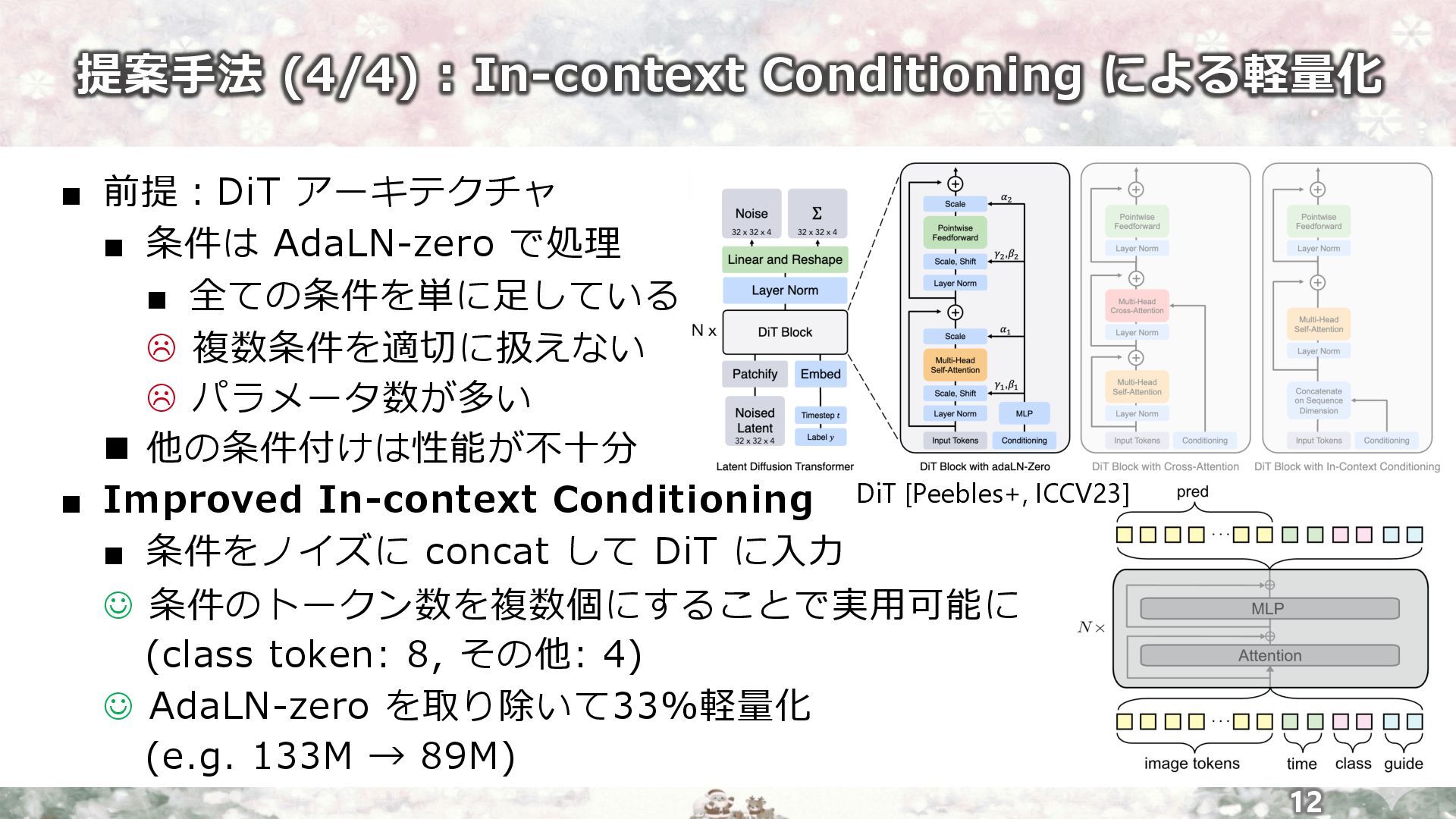
提案⼿法 (4/4) : In-context Conditioning による軽量化 12 ▪ 前提︓DiT アーキテクチャ
▪ 条件は AdaLN-zero で処理 ▪ 全ての条件を単に⾜している L 複数条件を適切に扱えない L パラメータ数が多い n 他の条件付けは性能が不⼗分 ▪ Improved In-context Conditioning ▪ 条件をノイズに concat して DiT に⼊⼒ J 条件のトークン数を複数個にすることで実⽤可能に (class token: 8, その他: 4) J AdaLN-zero を取り除いて33%軽量化 (e.g. 133M → 89M) DiT [Peebles+, ICCV23]
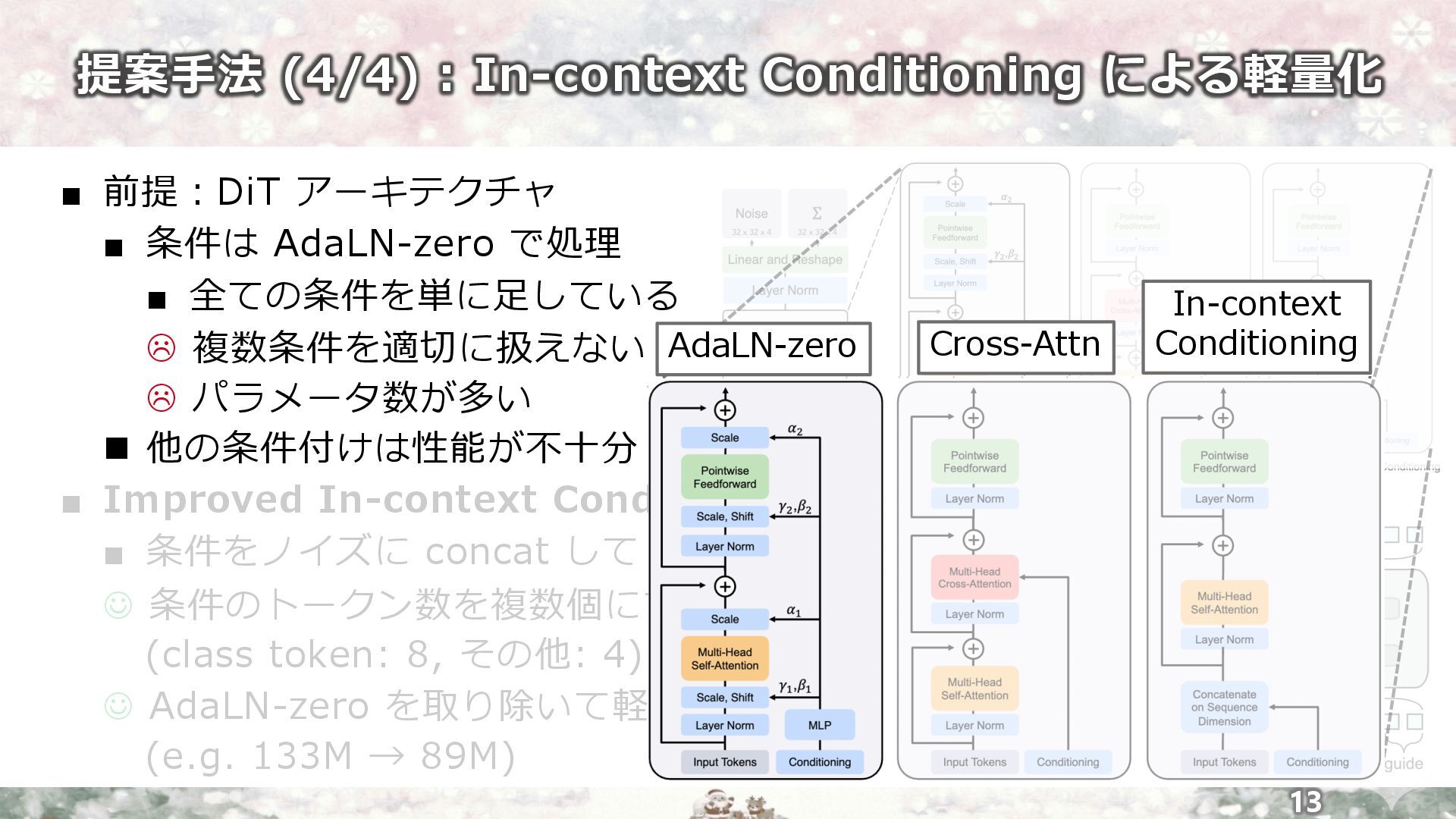
提案⼿法 (4/4) : In-context Conditioning による軽量化 13 ▪ 前提︓DiT アーキテクチャ
▪ 条件は AdaLN-zero で処理 ▪ 全ての条件を単に⾜している L 複数条件を適切に扱えない L パラメータ数が多い n 他の条件付けは性能が不⼗分 ▪ Improved In-context Conditioning ▪ 条件をノイズに concat して Transformer に⼊⼒ J 条件のトークン数を複数個にすることで実⽤可能に (class token: 8, その他: 4) J AdaLN-zero を取り除いて軽量化 (e.g. 133M → 89M) DiT [Peebles+, ICCV23] AdaLN-zero Cross-Attn In-context Conditioning
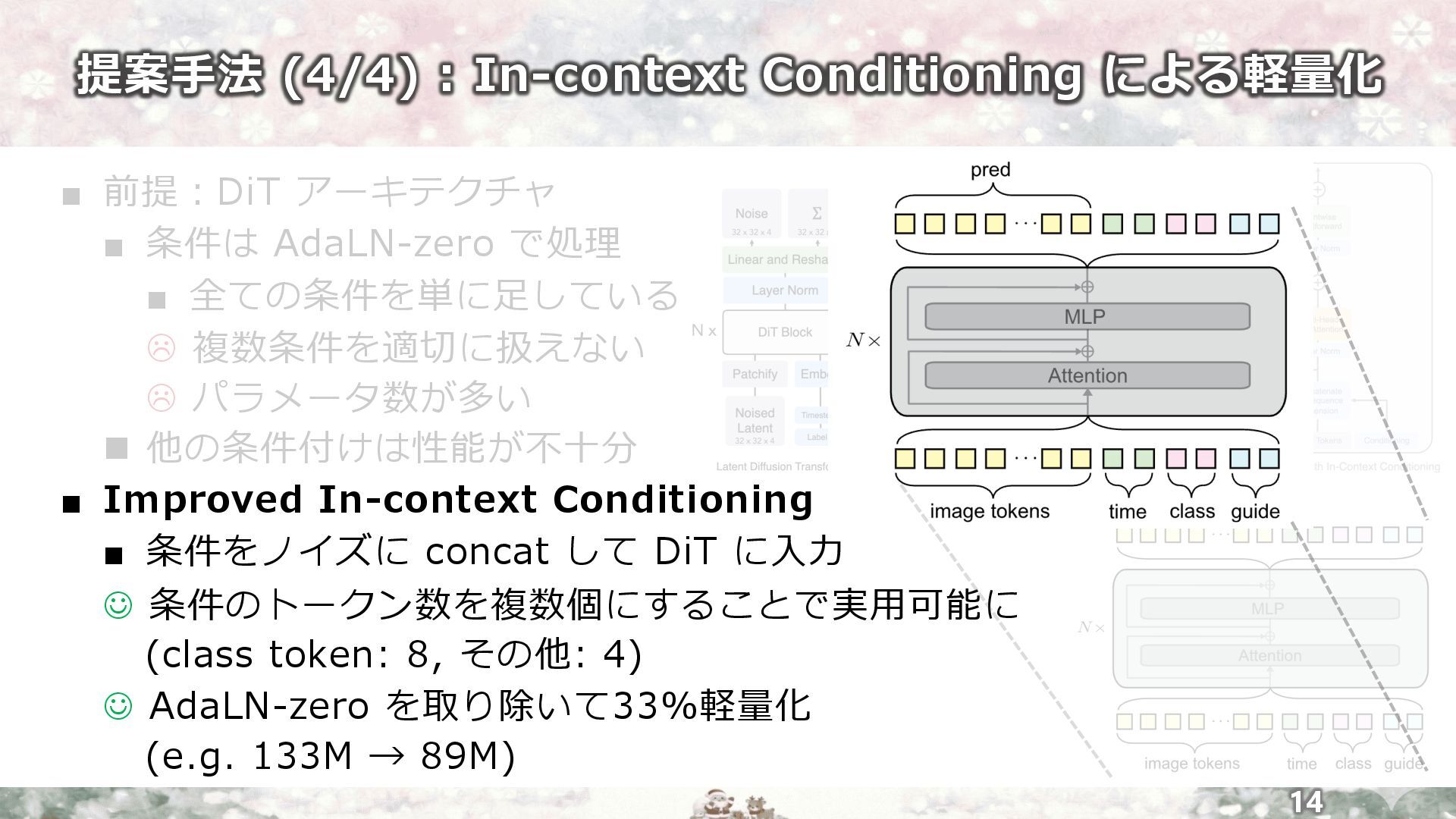
提案⼿法 (4/4) : In-context Conditioning による軽量化 14 ▪ 前提︓DiT アーキテクチャ
▪ 条件は AdaLN-zero で処理 ▪ 全ての条件を単に⾜している L 複数条件を適切に扱えない L パラメータ数が多い n 他の条件付けは性能が不⼗分 ▪ Improved In-context Conditioning ▪ 条件をノイズに concat して DiT に⼊⼒ J 条件のトークン数を複数個にすることで実⽤可能に (class token: 8, その他: 4) J AdaLN-zero を取り除いて33%軽量化 (e.g. 133M → 89M) DiT [Peebles+, ICCV23]
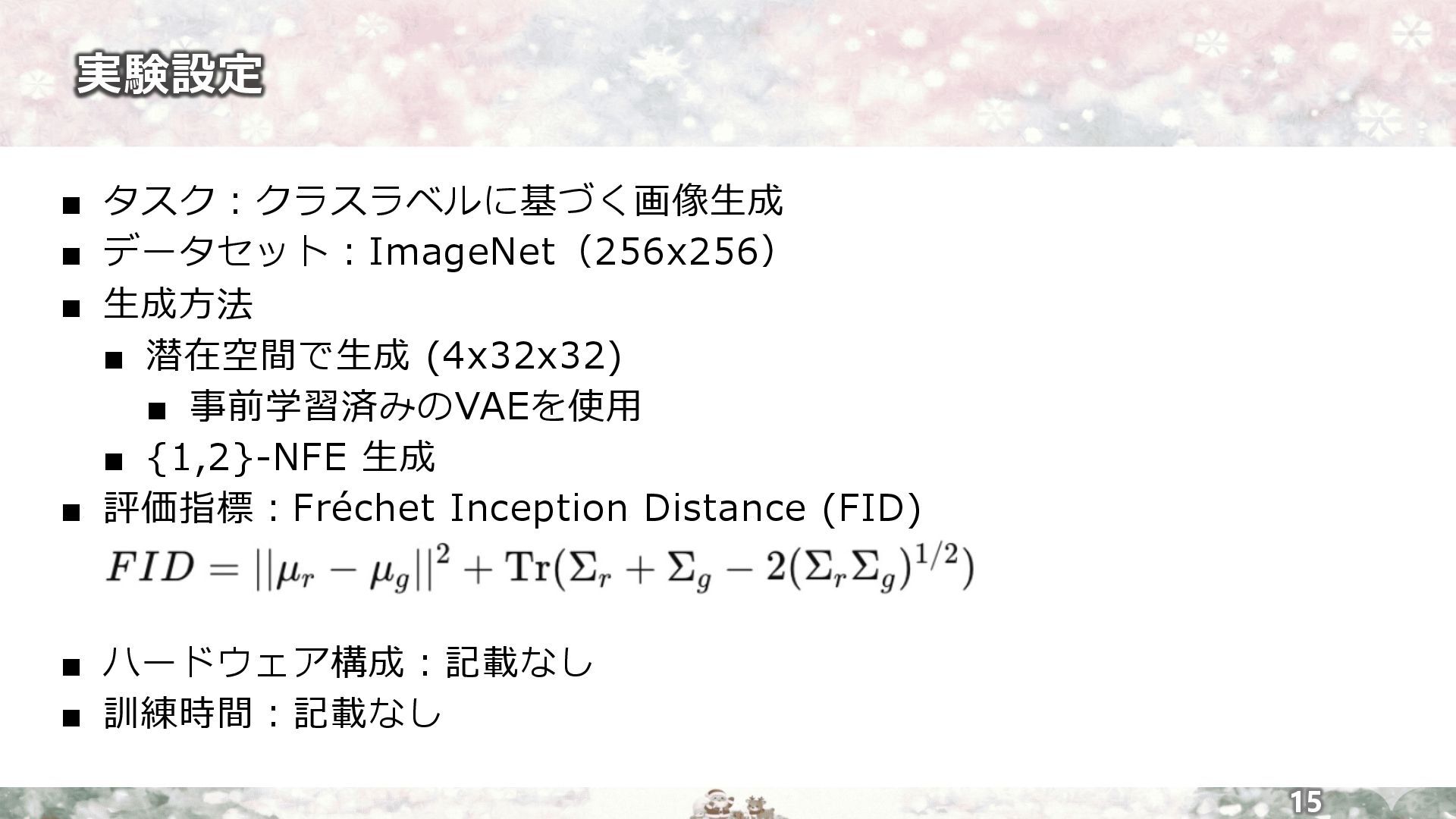
実験設定 15 ▪ タスク︓クラスラベルに基づく画像⽣成 ▪ データセット︓ImageNet(256x256) ▪ ⽣成⽅法 ▪ 潜在空間で⽣成
(4x32x32) ▪ 事前学習済みのVAEを使⽤ ▪ {1,2}-NFE ⽣成 ▪ 評価指標︓Fréchet Inception Distance (FID) ▪ ハードウェア構成︓記載なし ▪ 訓練時間︓記載なし
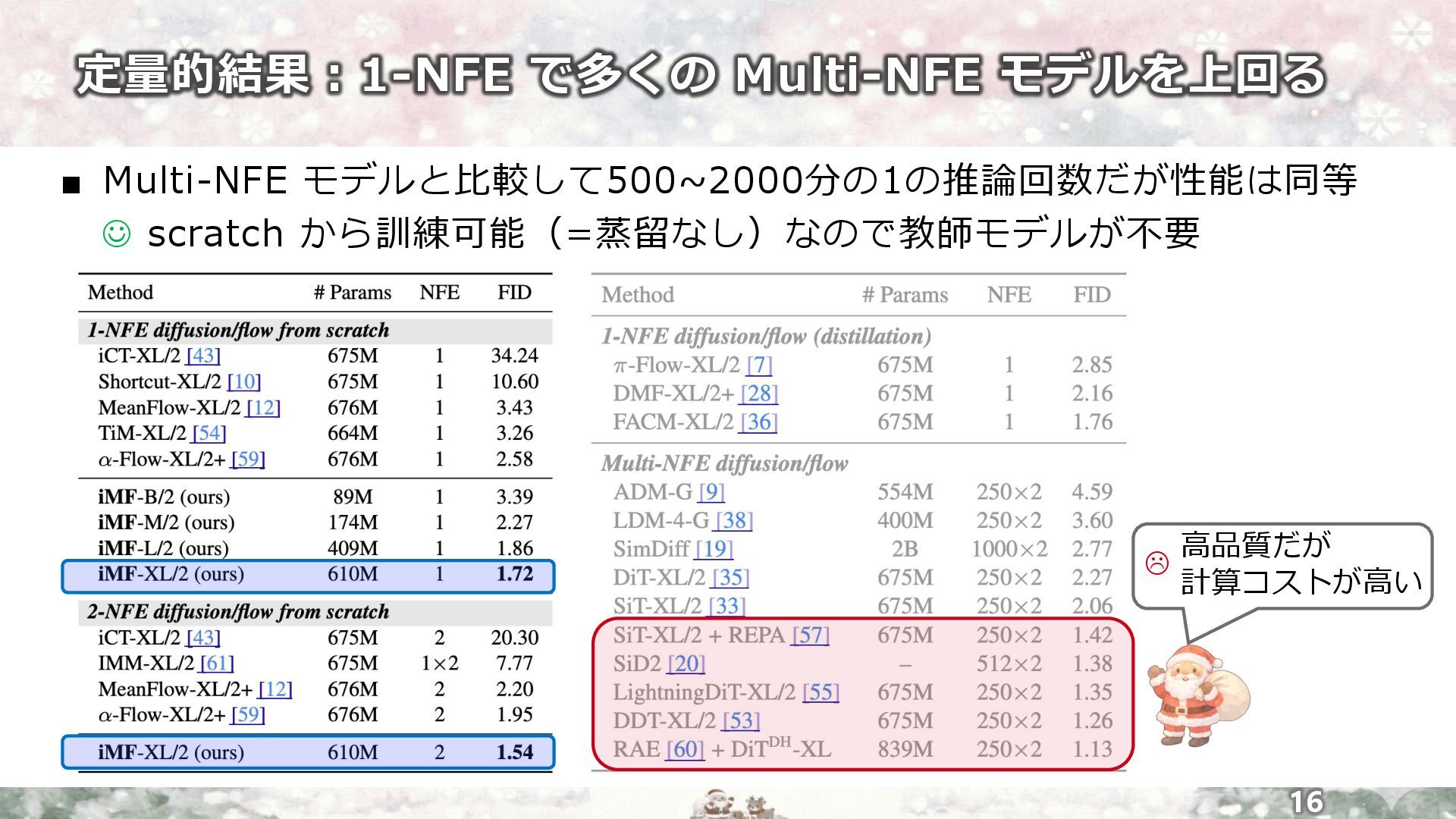
定量的結果︓1-NFE で多くの Multi-NFE モデルを上回る 16 ▪ Multi-NFE モデルと⽐較して500~2000分の1の推論回数だが性能は同等 J scratch
から訓練可能(=蒸留なし)なので教師モデルが不要 ⾼品質だが 計算コストが⾼い L
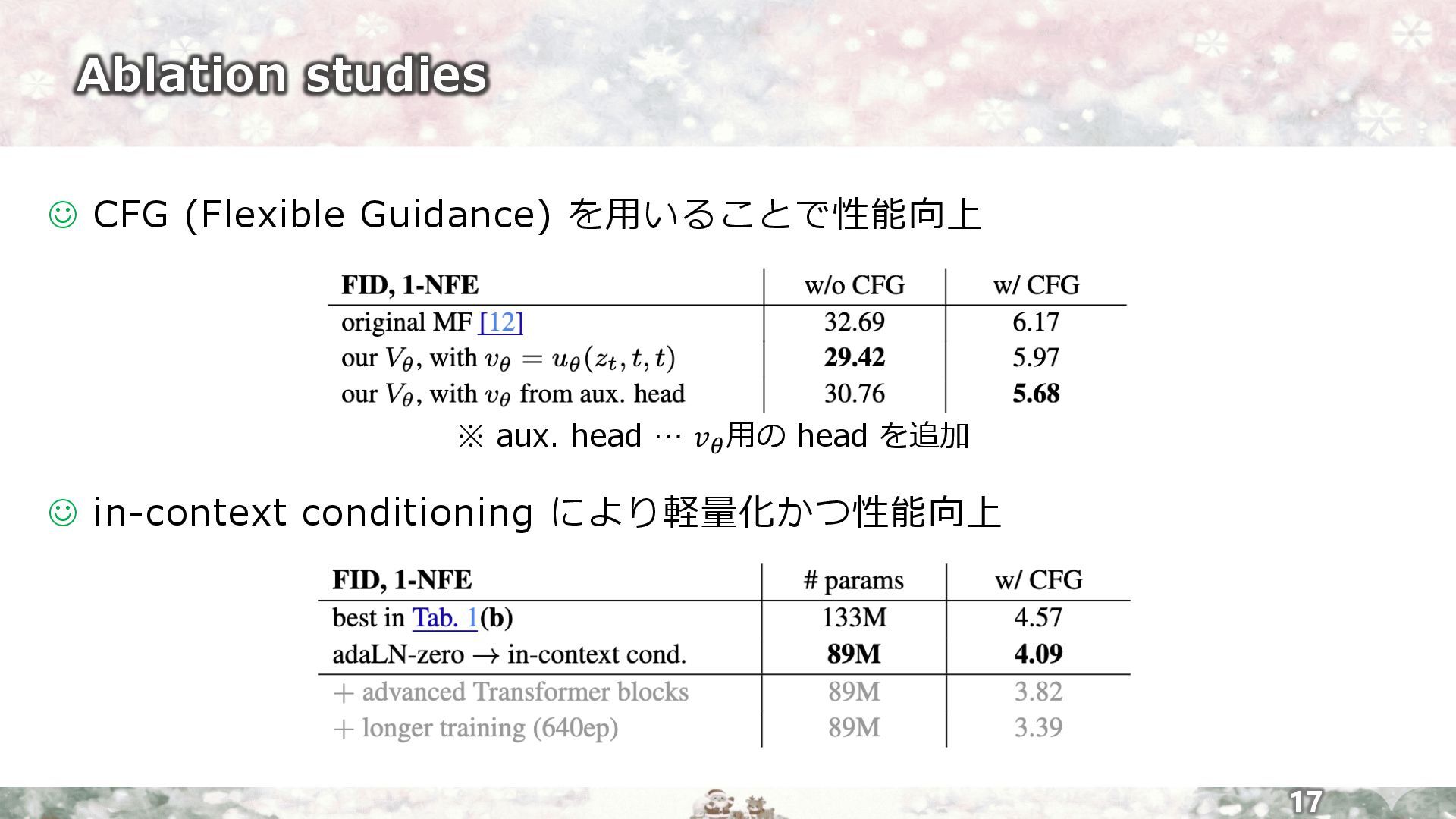
Ablation studies 17 J CFG (Flexible Guidance) を⽤いることで性能向上 J in-context
conditioning により軽量化かつ性能向上 ※ aux. head … 𝑣% ⽤の head を追加
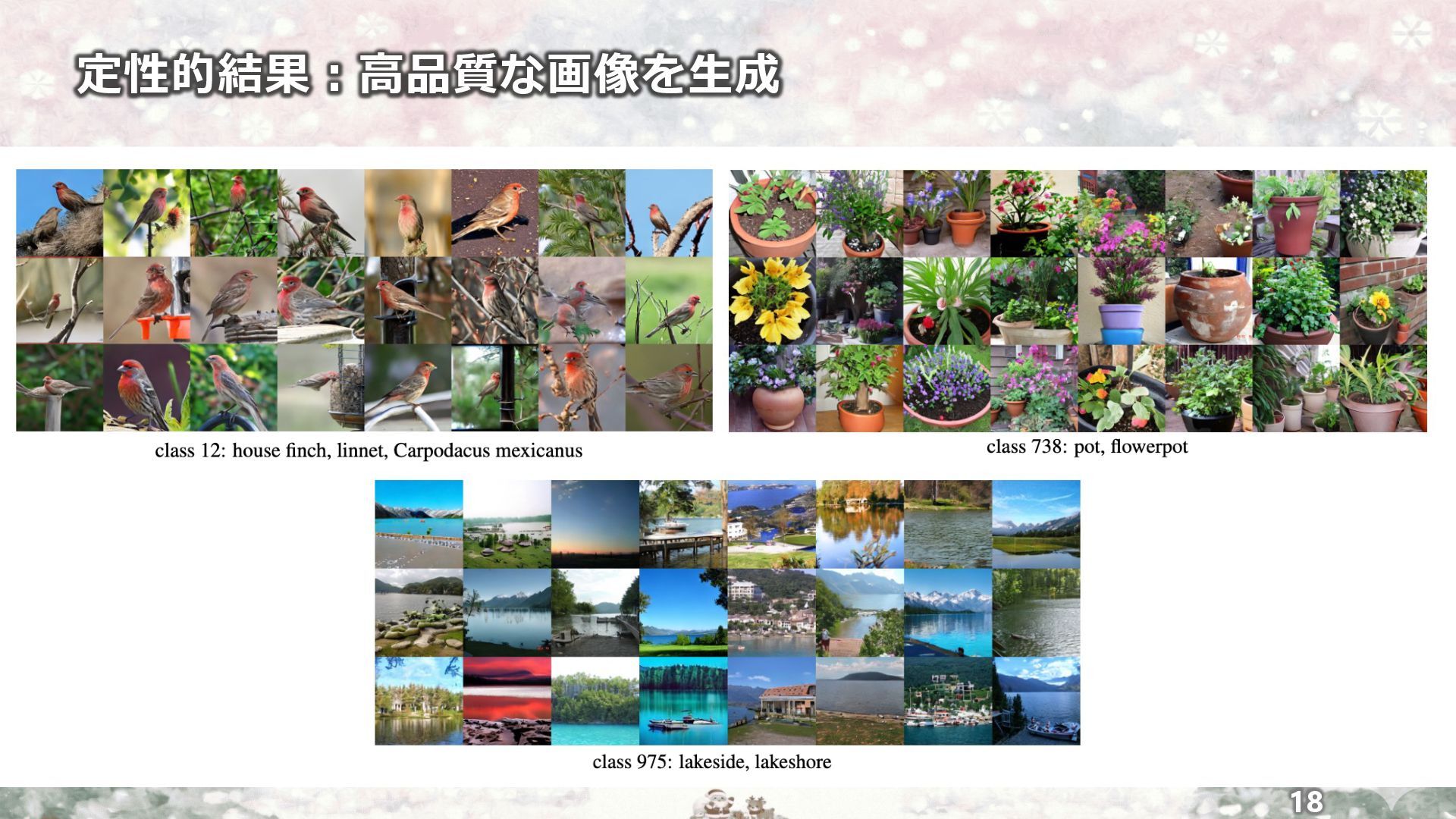
定性的結果︓⾼品質な画像を⽣成 18
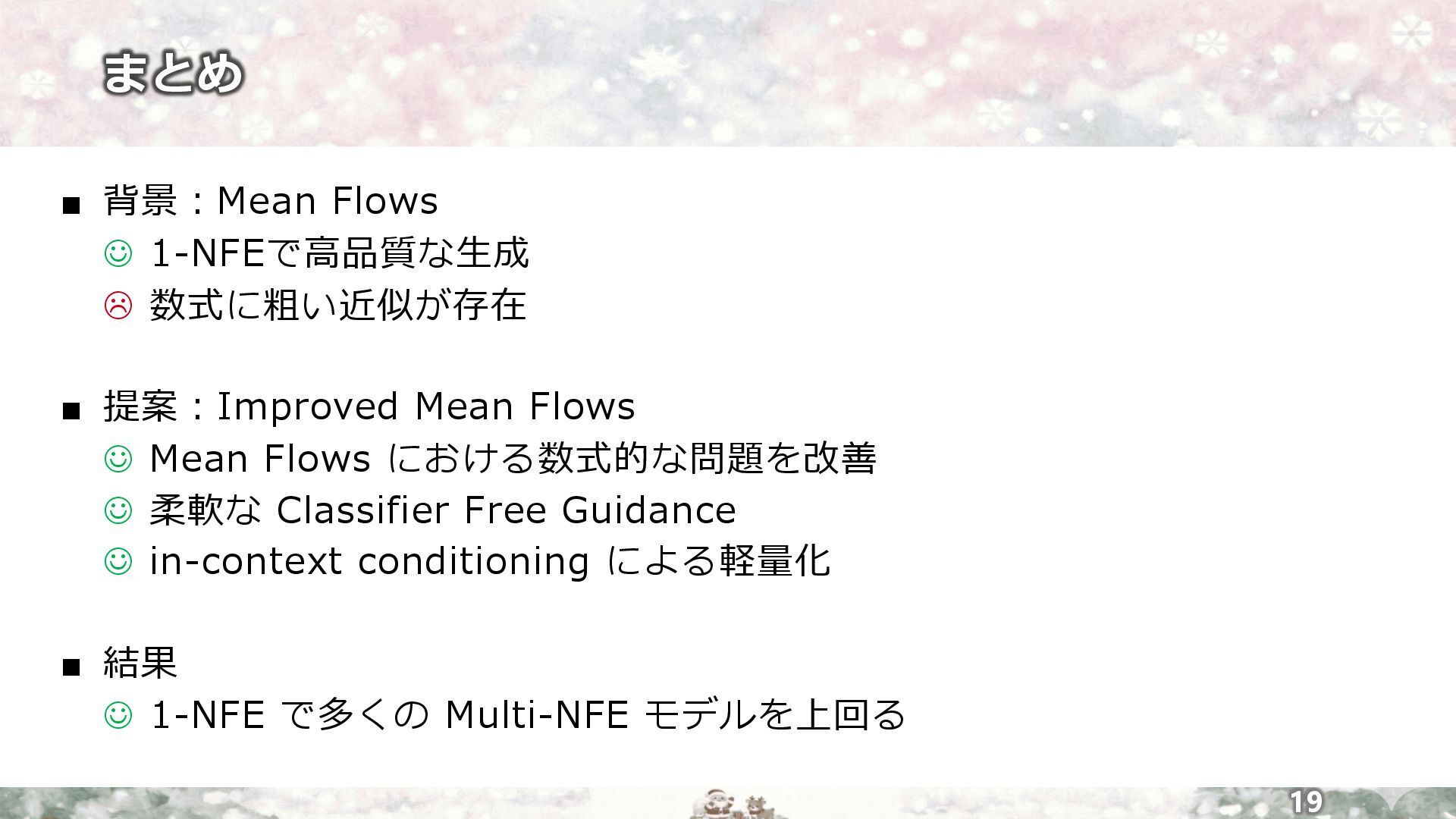
まとめ 19 ▪ 背景︓Mean Flows J 1-NFEで⾼品質な⽣成 L 数式に粗い近似が存在 ▪
提案︓Improved Mean Flows J Mean Flows における数式的な問題を改善 J 柔軟な Classifier Free Guidance J in-context conditioning による軽量化 ▪ 結果 J 1-NFE で多くの Multi-NFE モデルを上回る


 keio_smilab
 shuta13
 yuuuuuuu168
 makocchi
 kairim0
 nttcom
 ymotongpoo
 kworkdev
 4o1sobblue
 yut0naga1_fa
 puhitaku
 satoshi7
 techtekt
 sugarenia
 tamaranovitovic
 keathley
 bkeepers
 thoeni
 danielanewman
 scottboms
 chriscoyier
 deanohume
 moore
 morganepeng
 kimpetersen