Upgrade to Pro
— share decks privately, control downloads, hide ads and more …
Speaker Deck
Sign up for free
Menu
Search
Features
All features
Private URLs
Password Protection
Custom URLS
Scheduled publishing
Remove Branding
Restrict embedding
Deck Collections
Notes
Features
All features
Private URLs
Password Protection
Custom URLS
Scheduled publishing
Remove Branding
Restrict embedding
Deck Collections
Notes
Explore
Featured decks
Featured speakers
Programming
Technology
Storyboards
Explore
Featured decks
Featured speakers
Programming
Technology
Storyboards
Pricing
Search
Sign in
Sign up for free
[Journal club] Pix2seq: A Language Modeling Fra...
Search
Sponsored
·
SiteGround - Reliable hosting with speed, security, and support you can count on.
→
Semantic Machine Intelligence Lab., Keio Univ.
PRO
November 17, 2022
Technology
370
0
Share
Embed
Copy iframe code
Copy JS code
Copy link
Start on current slide
[Journal club] Pix2seq: A Language Modeling Framework for Object Detection
Semantic Machine Intelligence Lab., Keio Univ.
PRO
November 17, 2022
More Decks by Semantic Machine Intelligence Lab., Keio Univ.
See All by Semantic Machine Intelligence Lab., Keio Univ.
[EMNLP26] RIGEL: Self-Distilled Score Adaptation for Image and Video Captioning Evaluation
keio_smilab
PRO
0
40
[RSJ26] Building a VLA Model Based on Self-Distilled Classification
keio_smilab
PRO
0
210
[RSJ26] AnoleVLA: Lightweight Vision-Language-Action Model with Deep State Space Models for Mobile Manipulation
keio_smilab
PRO
0
180
[RSJ26] NarrativeFlow: Flow-Based Vision-Language-Action Model Using Robot Velocity Fields
keio_smilab
PRO
0
250
[RSJ26] Flow as Flow: Modeling Robot Velocity Fields as Probability Velocity Fields
keio_smilab
PRO
1
240
[RSJ26] Hierarchy-Aware Multimodal Retrieval-Augmented Generation for Embodied Question Answering
keio_smilab
PRO
1
200
[MIRU26] Open-Vocabulary Intention-Guided Object Detection in Diverse Scenes
keio_smilab
PRO
0
240
[Journal club] Evo-1: Lightweight Vision-Language-Action Model with Preserved Semantic Alignment
keio_smilab
PRO
0
73
[MIRU26] To What Extent Does MLLM-as-a-Judge Exhibit Cross-Model Preference Bias?
keio_smilab
PRO
0
330
Other Decks in Technology
See All in Technology
AI コーディングと人間の認知スループット / CTO Night & Day 2026 Morning Session / AI Coding and Human Cognitive Throughput
prog893
4
1k
無理せず続ける、子育てエンジニアの学び
codmoninc
PRO
0
860
Webの常識が通じないHTMLメールのダークモード
teamlab
PRO
0
120
Classmethod Company Deck
satoshi7
1
680
「Docker Desktop不要の時代」は 来たのか?
ueponx
0
770
Running Kotlin + Quarkus with Lambda
nealle
1
3.7k
Benchmarking Disaggregated Serving on vLLM + Dynamo with a Real Coding-Agent Workload
nttcom
1
190
⾮構造化データを価値に変える AI エージェント基盤とその組織
ivry_presentationmaterials
0
190
Railsで挑む大量データ永続化 〜600億件を永続化するための設計とボトルネックとの戦い〜
occhi
1
580
会社説明資料
persolserverworks
0
9.8k
今さら理解するウェブフォントver.2026
takanorip
3
770
ブラウザとサーバーから考えるAI時代のフロントエンド監視
shogo4131
3
940
Featured
See All Featured
Digital Projects Gone Horribly Wrong (And the UX Pros Who Still Save the Day) - Dean Schuster
uxyall
1
3.4k
Measuring & Analyzing Core Web Vitals
bluesmoon
9
1k
Collaborative Software Design: How to facilitate domain modelling decisions
baasie
1
340
The agentic SEO stack - context over prompts
schlessera
0
970
AI in Enterprises - Java and Open Source to the Rescue
ivargrimstad
0
1.5k
10 Git Anti Patterns You Should be Aware of
lemiorhan
PRO
659
62k
Money Talks: Using Revenue to Get Sh*t Done
nikkihalliwell
0
520
Bash Introduction
62gerente
615
220k
Stewardship and Sustainability of Urban and Community Forests
pwiseman
0
550
Fireside Chat
paigeccino
43
4.1k
Rebuilding a faster, lazier Slack
samanthasiow
85
9.7k
Testing 201, or: Great Expectations
jmmastey
46
8.3k
Transcript
Ting Chen1, Saurabh Saxena1, Lala Li1, David J. Fleet1, Geoffrey
Hinton1 1: Google Research, Brain Team 慶應義塾大学 杉浦孔明研究室 小槻誠太郎 T. Chen, S. Saxena, L. Li, D.J. Fleet, and G. Hinton, “Pix2seq: A language modeling framework for object detection,” ICLR, 2022.
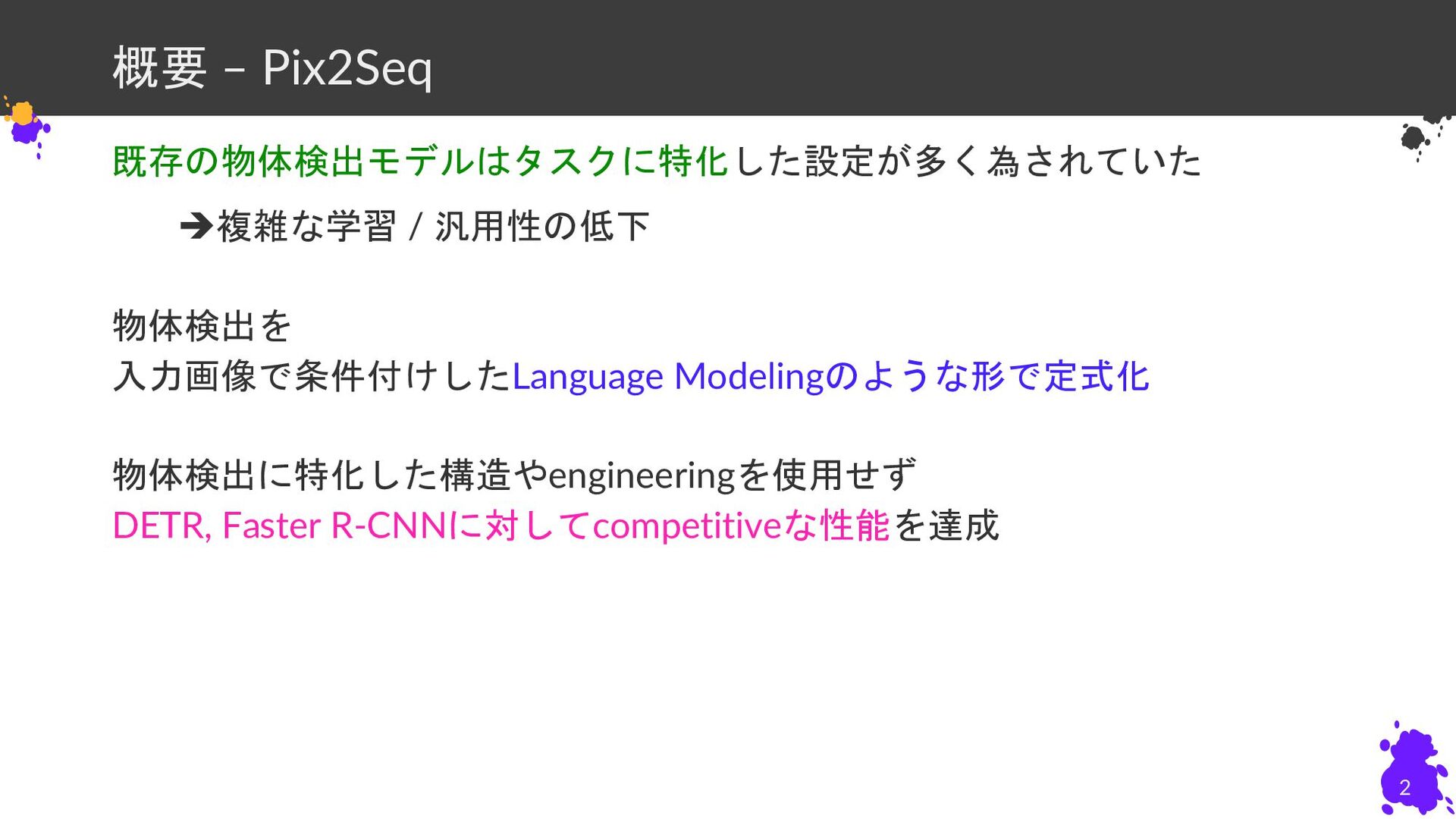
概要 – Pix2Seq 既存の物体検出モデルはタスクに特化した設定が多く為されていた ➔複雑な学習 / 汎用性の低下 物体検出を 入力画像で条件付けしたLanguage Modelingのような形で定式化
物体検出に特化した構造やengineeringを使用せず DETR, Faster R-CNNに対してcompetitiveな性能を達成 2
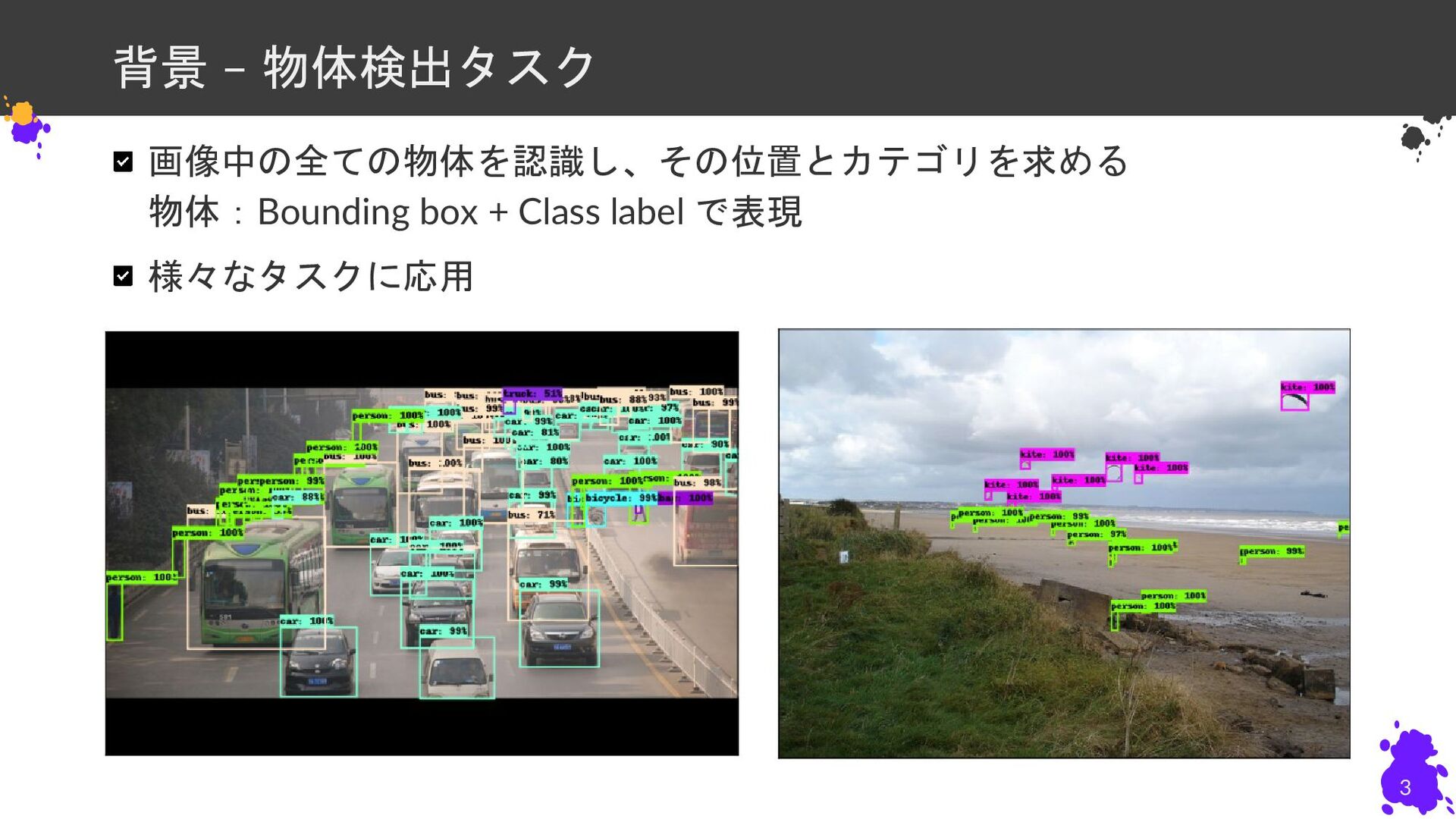
背景 – 物体検出タスク 画像中の全ての物体を認識し、その位置とカテゴリを求める 物体:Bounding box + Class label で表現
様々なタスクに応用 3
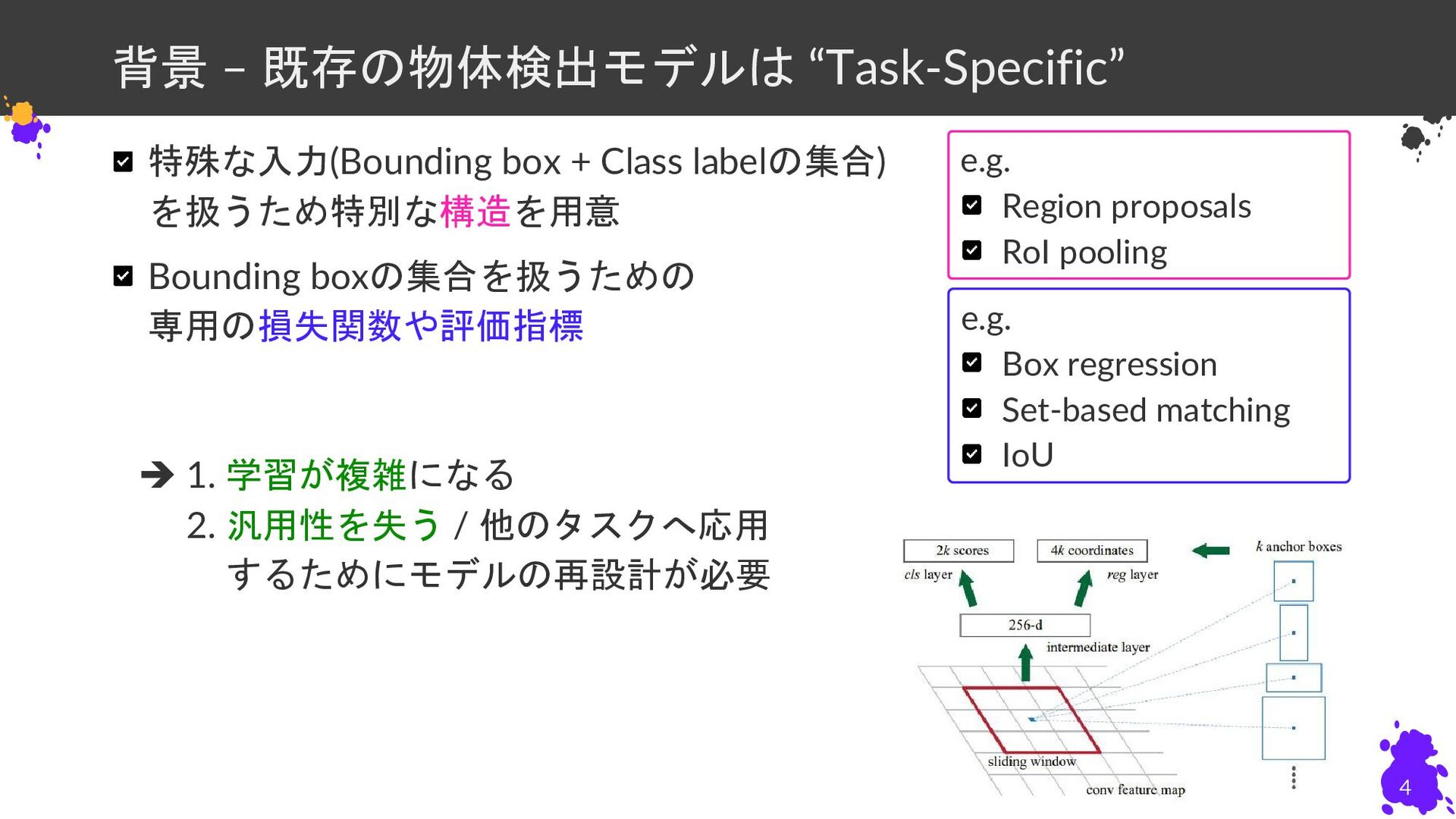
背景 – 既存の物体検出モデルは “Task-Specific” 特殊な入力(Bounding box + Class labelの集合) を扱うため特別な構造を用意
Bounding boxの集合を扱うための 専用の損失関数や評価指標 ➔ 1. 学習が複雑になる ➔ 2. 汎用性を失う / 他のタスクへ応用 ➔ 2. するためにモデルの再設計が必要 4 e.g. Region proposals RoI pooling e.g. Box regression Set-based matching IoU
関連研究 – 既存の物体検出モデルは “Task-Specific” 5 Faster R-CNN [Ren+, NeurIPS15] •
標準的な物体検出手法 • Bounding boxの集合を予測するため大量のProposal • 人手で設定する要素(Anchorsなど)に依存 • 重複を削除するためによくNMSが用いられる DETR [Carion+, ECCV20] • Transformerを採用し、End-to-Endの物体検出 • 大量のProposalを出してNMSを行うことを避けた • 学習で獲得する”object query”が必要
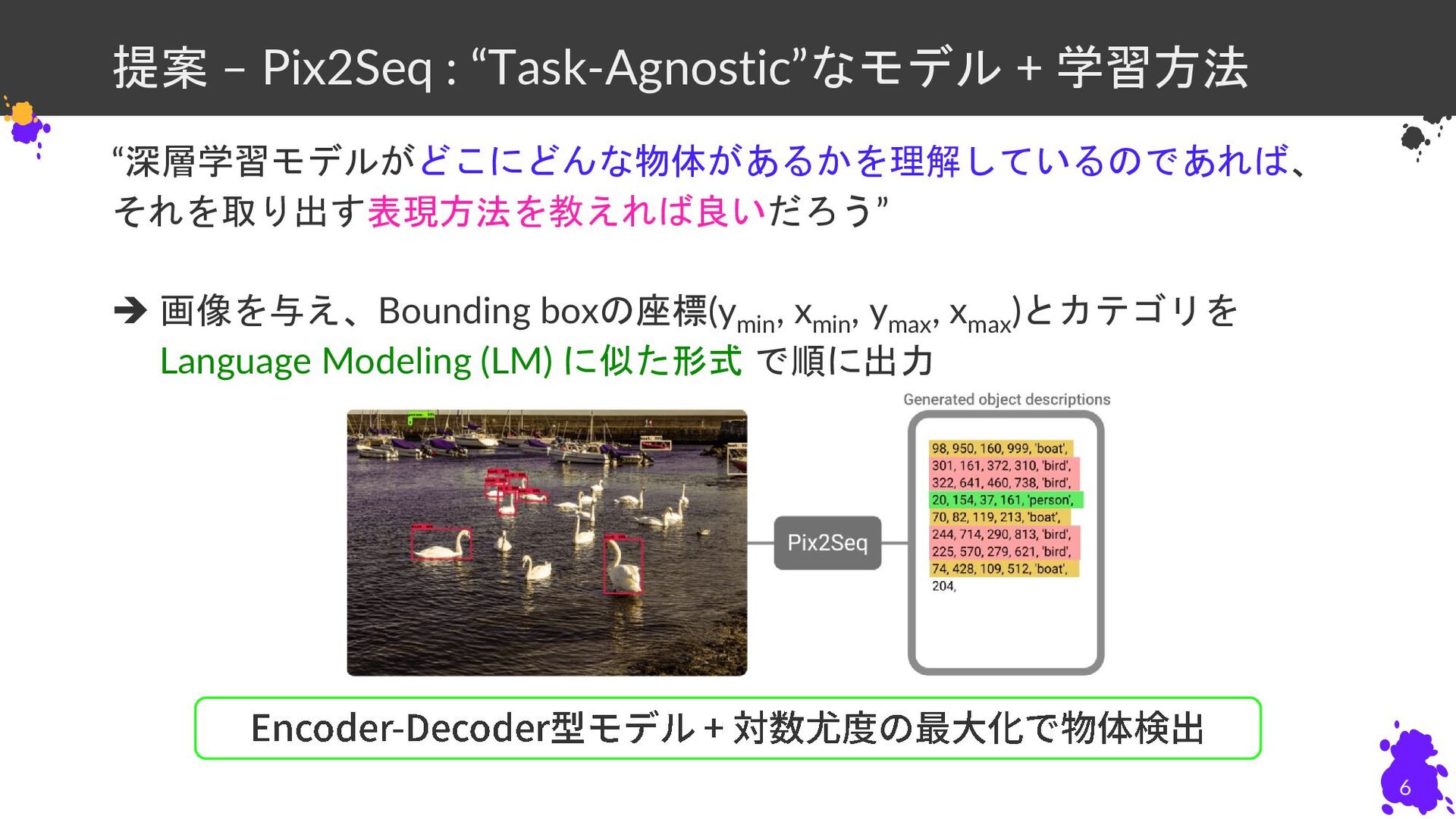
提案 – Pix2Seq : “Task-Agnostic”なモデル + 学習方法 “深層学習モデルがどこにどんな物体があるかを理解しているのであれば、 それを取り出す表現方法を教えれば良いだろう” ➔
画像を与え、Bounding boxの座標(y min , x min , y max , x max )とカテゴリを ➔ Language Modeling (LM) に似た形式 で順に出力 6
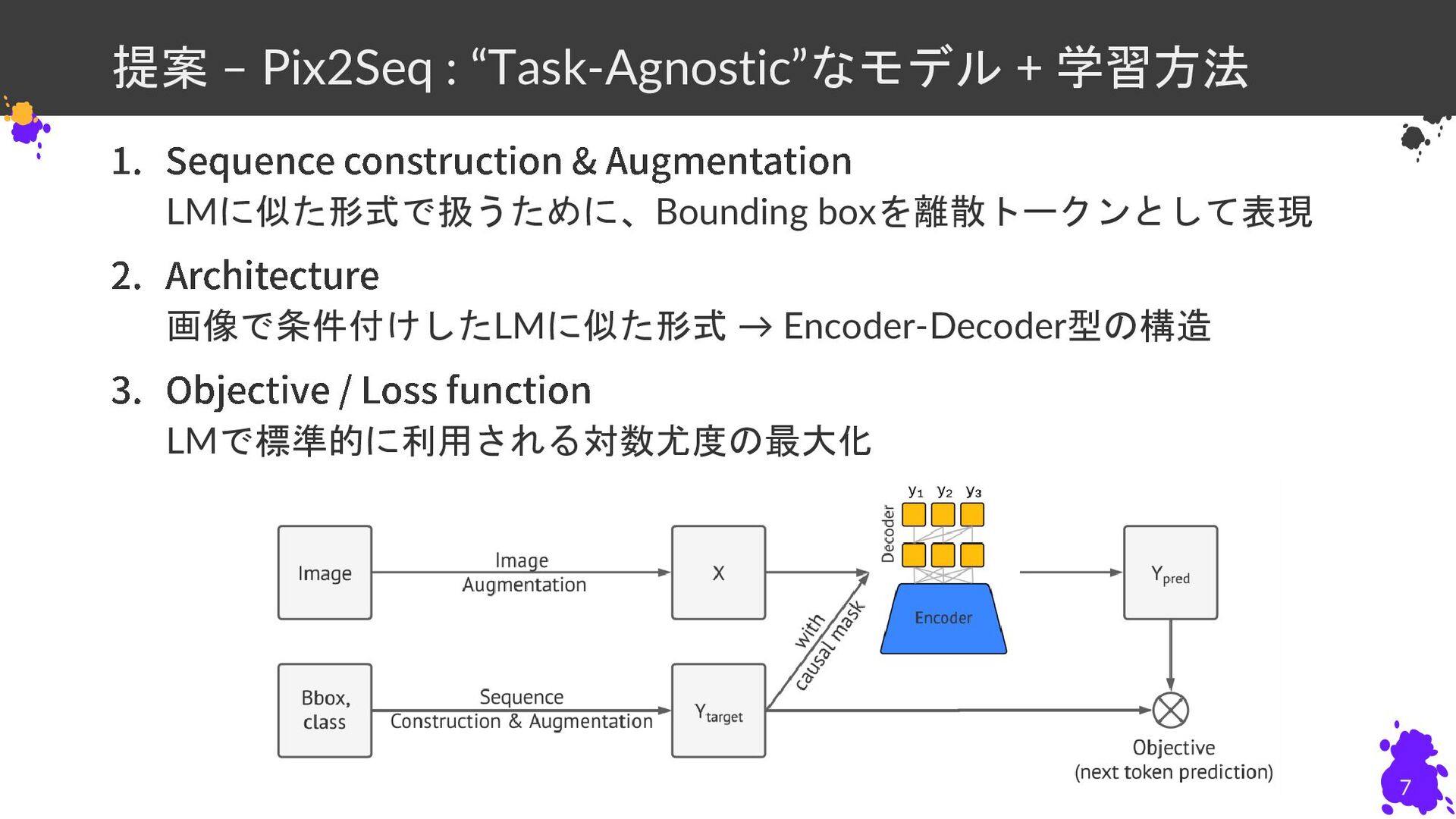
提案 – Pix2Seq : “Task-Agnostic”なモデル + 学習方法 LMに似た形式で扱うために、Bounding boxを離散トークンとして表現 画像で条件付けしたLMに似た形式
→ Encoder-Decoder型の構造 LMで標準的に利用される対数尤度の最大化 7
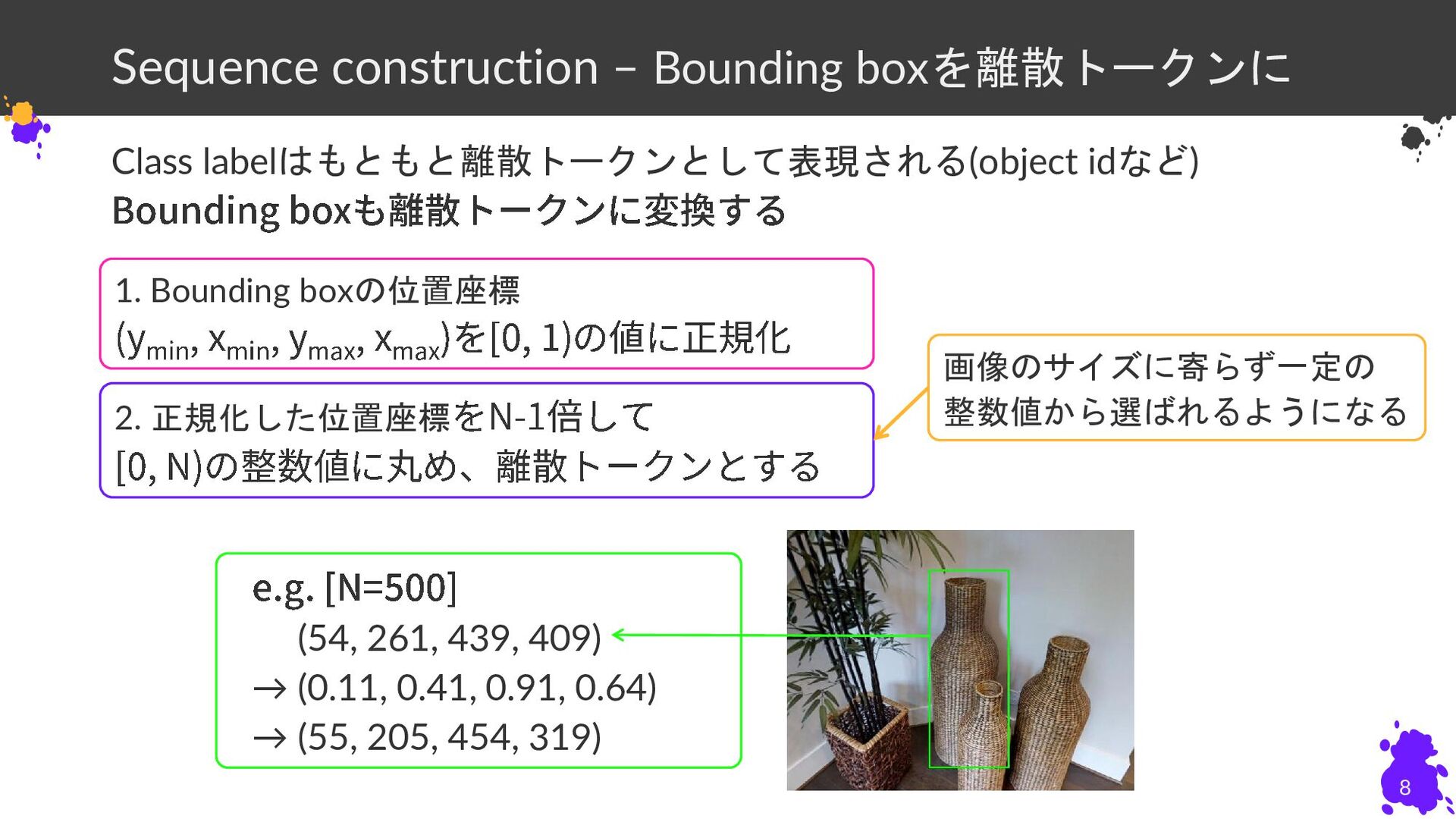
Sequence construction – Bounding boxを離散トークンに Class labelはもともと離散トークンとして表現される(object idなど) 8 1.
Bounding boxの位置座標 2. 正規化した位置座標 → (54, 261, 439, 409) → (0.11, 0.41, 0.91, 0.64) → (55, 205, 454, 319) 画像のサイズに寄らず一定の 整数値から選ばれるようになる
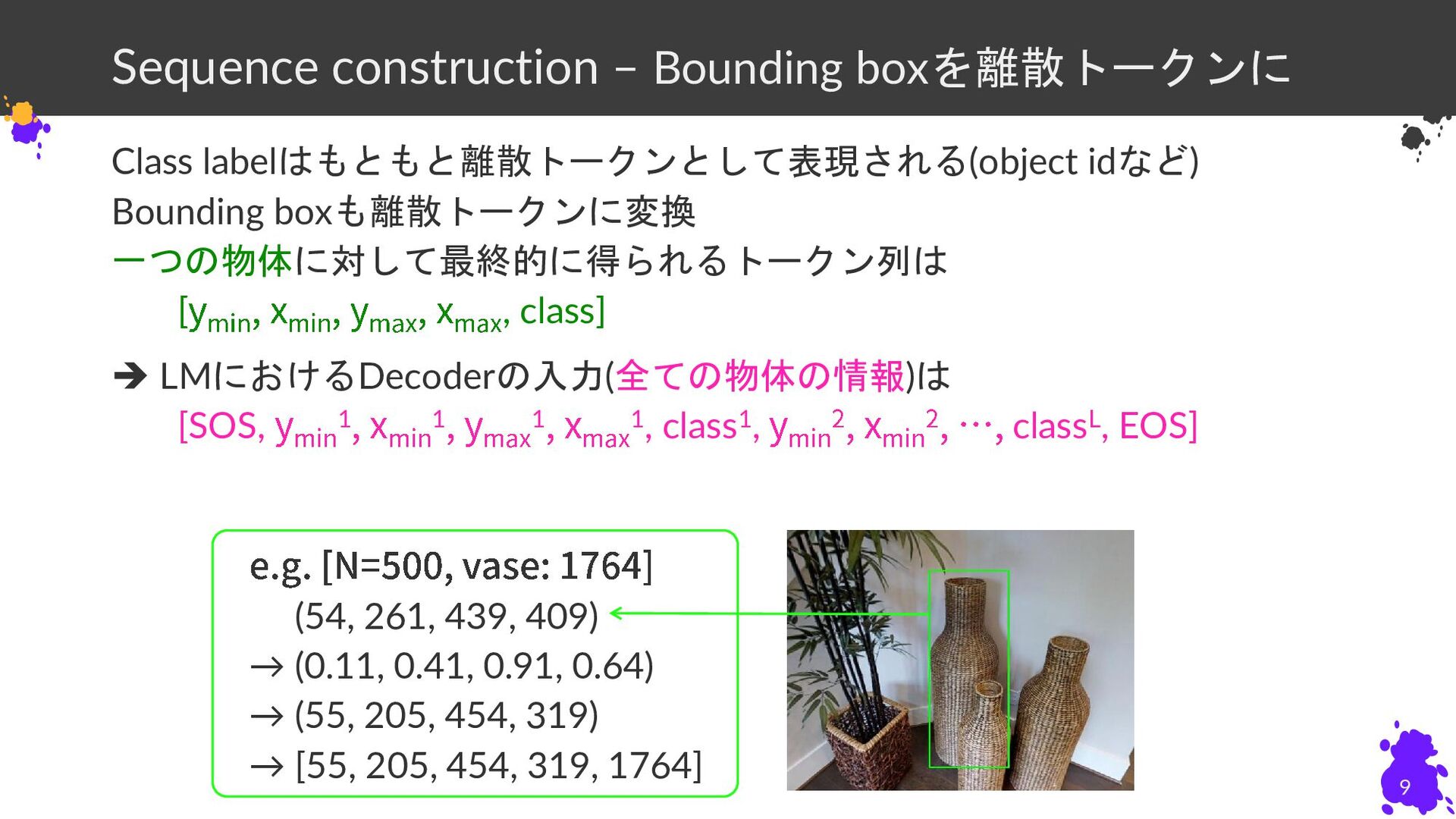
Sequence construction – Bounding boxを離散トークンに Class labelはもともと離散トークンとして表現される(object idなど) Bounding boxも離散トークンに変換
一つの物体に対して最終的に得られるトークン列は [ , class] ➔ LMにおけるDecoderの入力(全ての物体の情報)は [SOS, 1 1 1 1, class1, classL, EOS] 9 → (54, 261, 439, 409) → (0.11, 0.41, 0.91, 0.64) → (55, 205, 454, 319) → [55, 205, 454, 319, 1764]
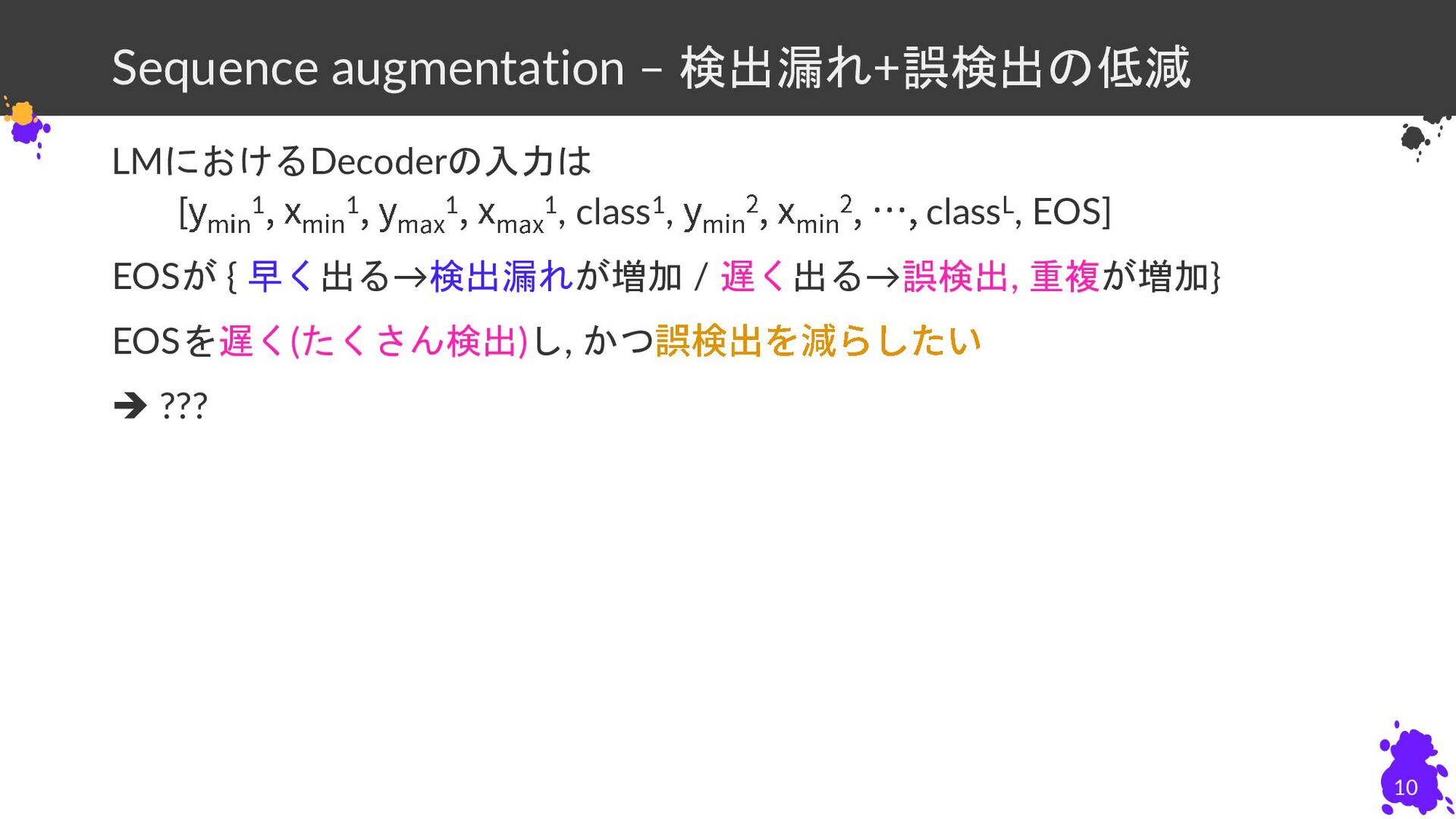
Sequence augmentation – 検出漏れ+誤検出の低減 LMにおけるDecoderの入力は [ 1 1 1 1,
class1, classL, EOS] EOSが { 早く出る→検出漏れが増加 / 遅く出る→誤検出, 重複が増加} EOSを遅く(たくさん検出)し, かつ ➔ ??? 10
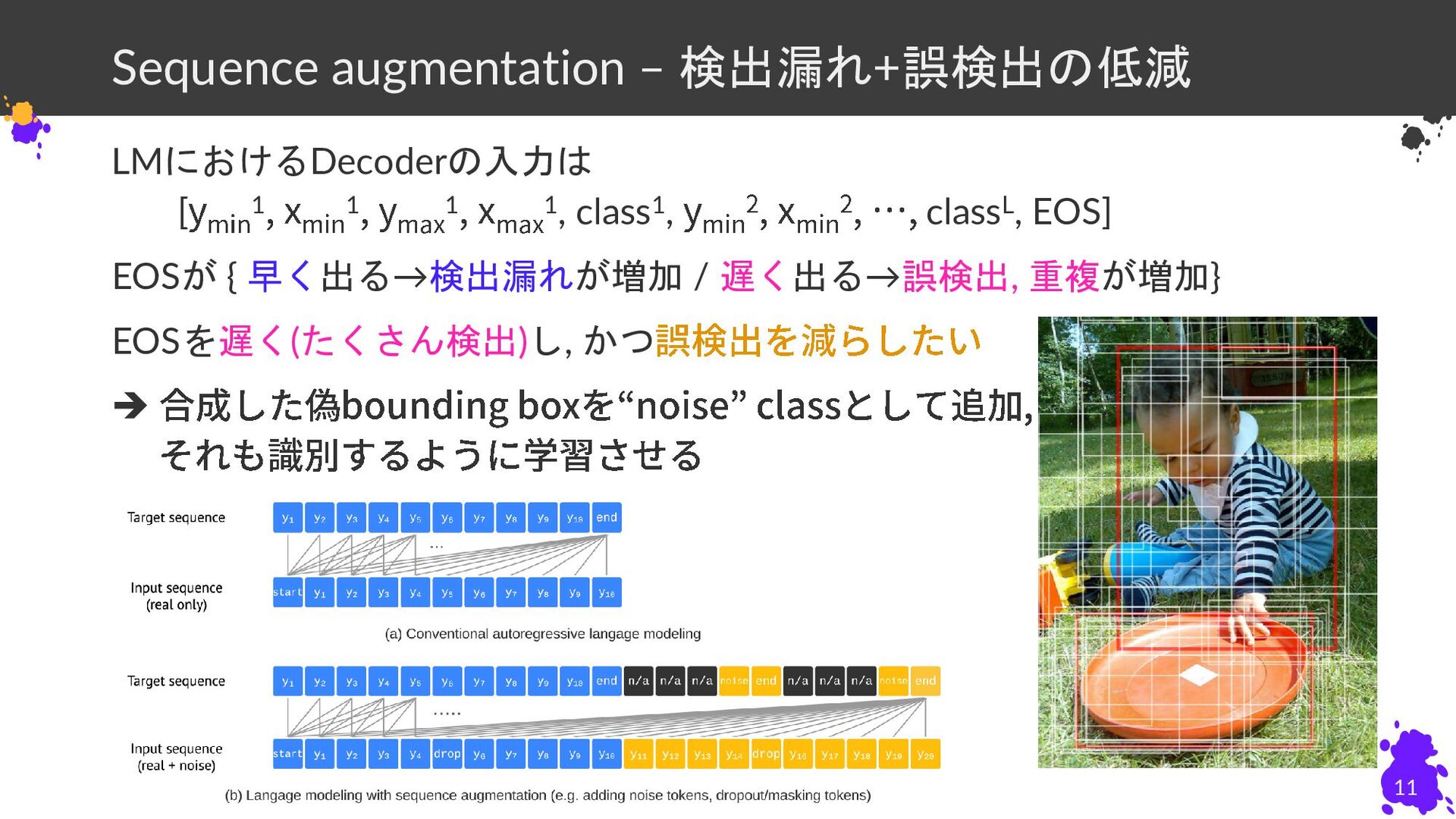
Sequence augmentation – 検出漏れ+誤検出の低減 LMにおけるDecoderの入力は [ 1 1 1 1,
class1, classL, EOS] EOSが { 早く出る→検出漏れが増加 / 遅く出る→誤検出, 重複が増加} EOSを遅く(たくさん検出)し, かつ ➔ ➔ 11
LMにおけるDecoderの入力は [ 1 1 1 1, class1, classL, EOS] EOSが
{ 早く出る→検出漏れが増加 / 遅く出る→誤検出, 重複が増加} EOSを遅く(たくさん検出)し, かつ ➔ ➔ Sequence augmentation – 検出漏れ+誤検出の低減 12 後半に偽bounding boxを追加 偽bounding boxに対する座標の予測はback prop.しない (どこからが偽物かは学習時は分かるので狙ってdetach可能)
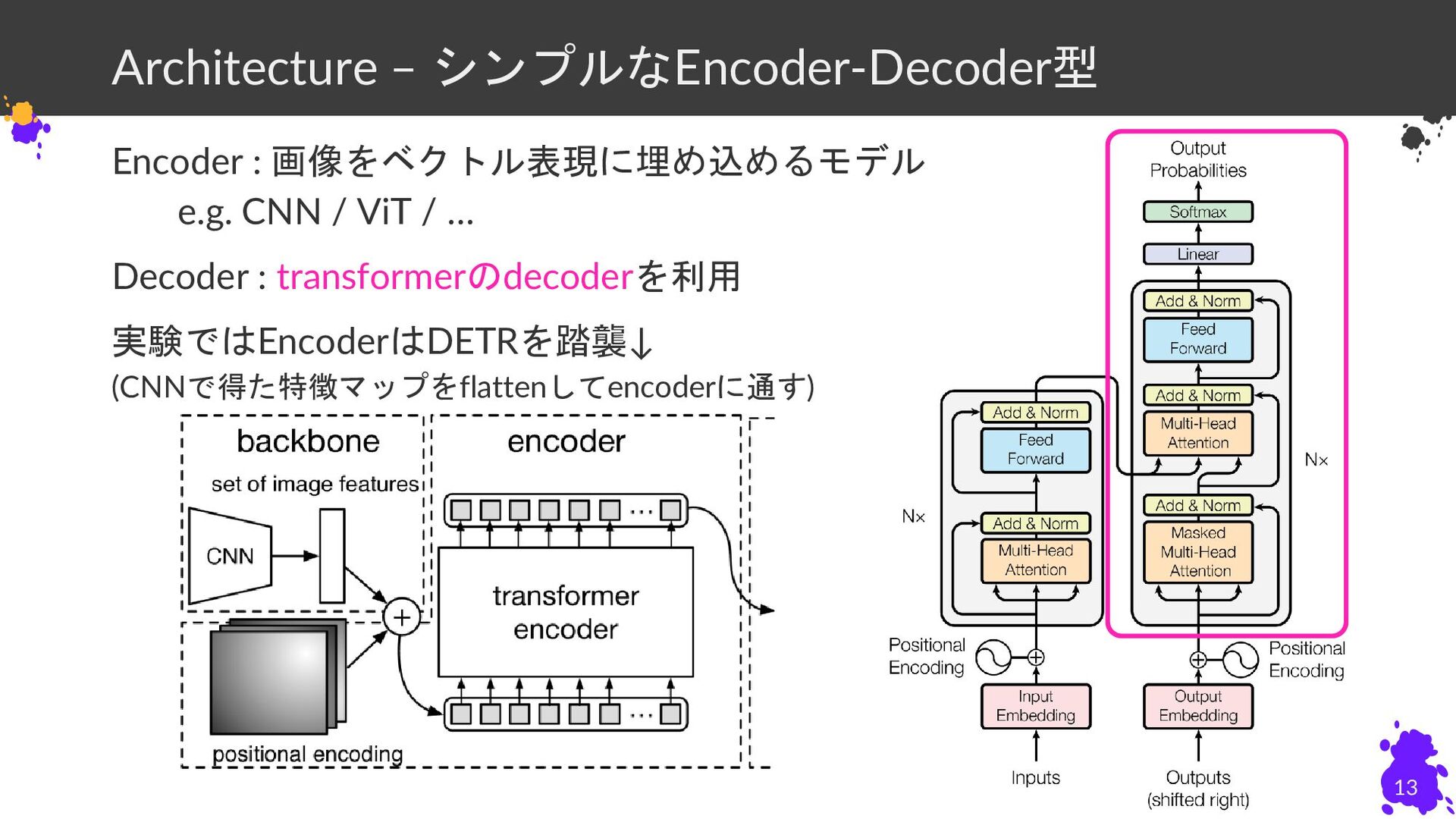
Architecture – シンプルなEncoder-Decoder型 Encoder : 画像をベクトル表現に埋め込めるモデル e.g. CNN / ViT
/ … Decoder : transformerのdecoderを利用 実験ではEncoderはDETRを踏襲↓ (CNNで得た特徴マップをflattenしてencoderに通す) 13
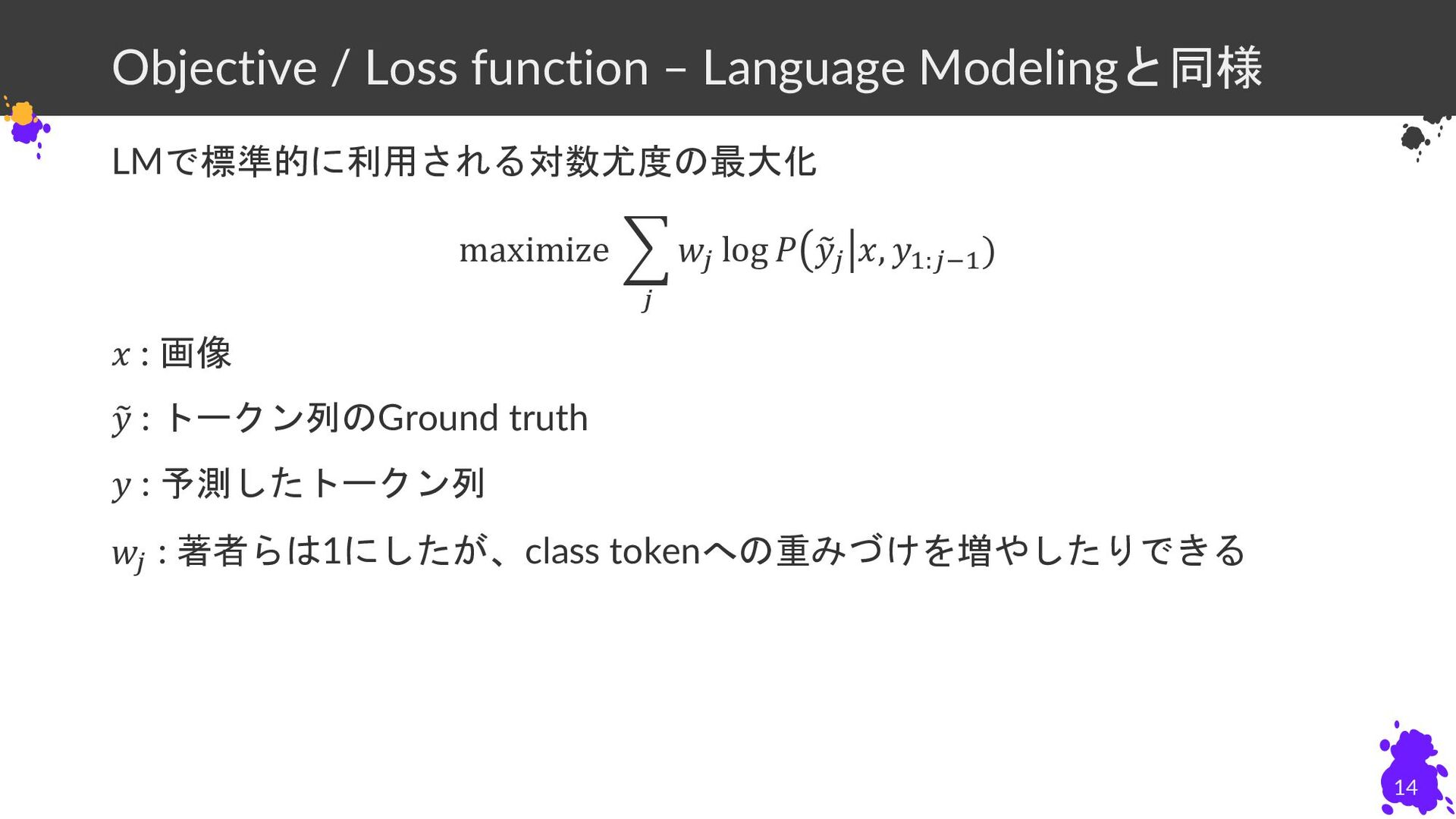
Objective / Loss function – Language Modelingと同様 LMで標準的に利用される対数尤度の最大化 maximize
𝑗 𝑤𝑗 log 𝑃 𝑦𝑗 𝑥, 𝑦1:𝑗−1 ) 𝑥 : 画像 𝑦 : トークン列のGround truth 𝑦 : 予測したトークン列 𝑤𝑗 : 著者らは1にしたが、class tokenへの重みづけを増やしたりできる 14
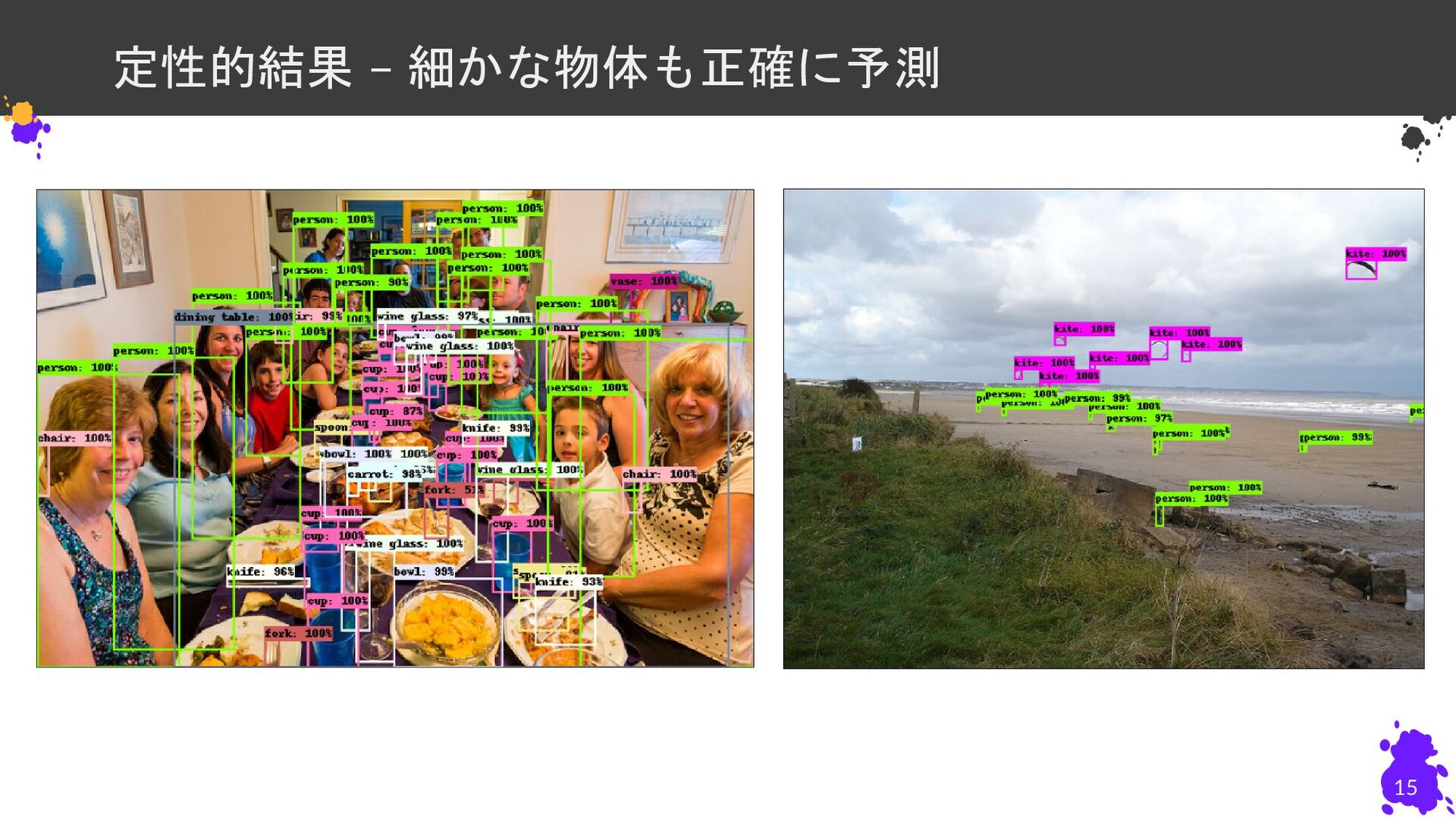
定性的結果 – 細かな物体も正確に予測 15
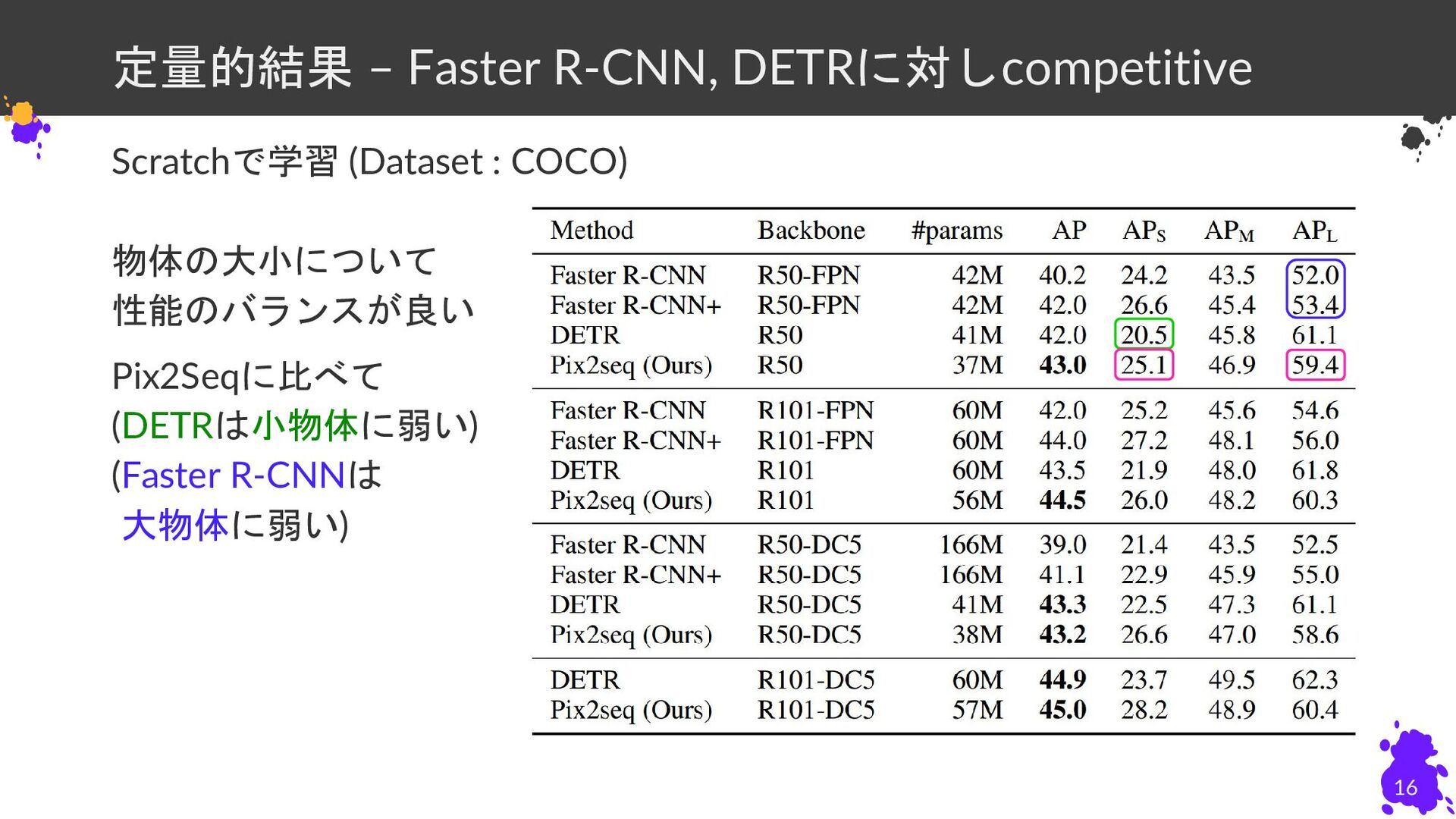
定量的結果 – Faster R-CNN, DETRに対しcompetitive Scratchで学習 (Dataset : COCO) 物体の大小について
性能のバランスが良い Pix2Seqに比べて (DETRは小物体に弱い) (Faster R-CNNは (大物体に弱い) 16
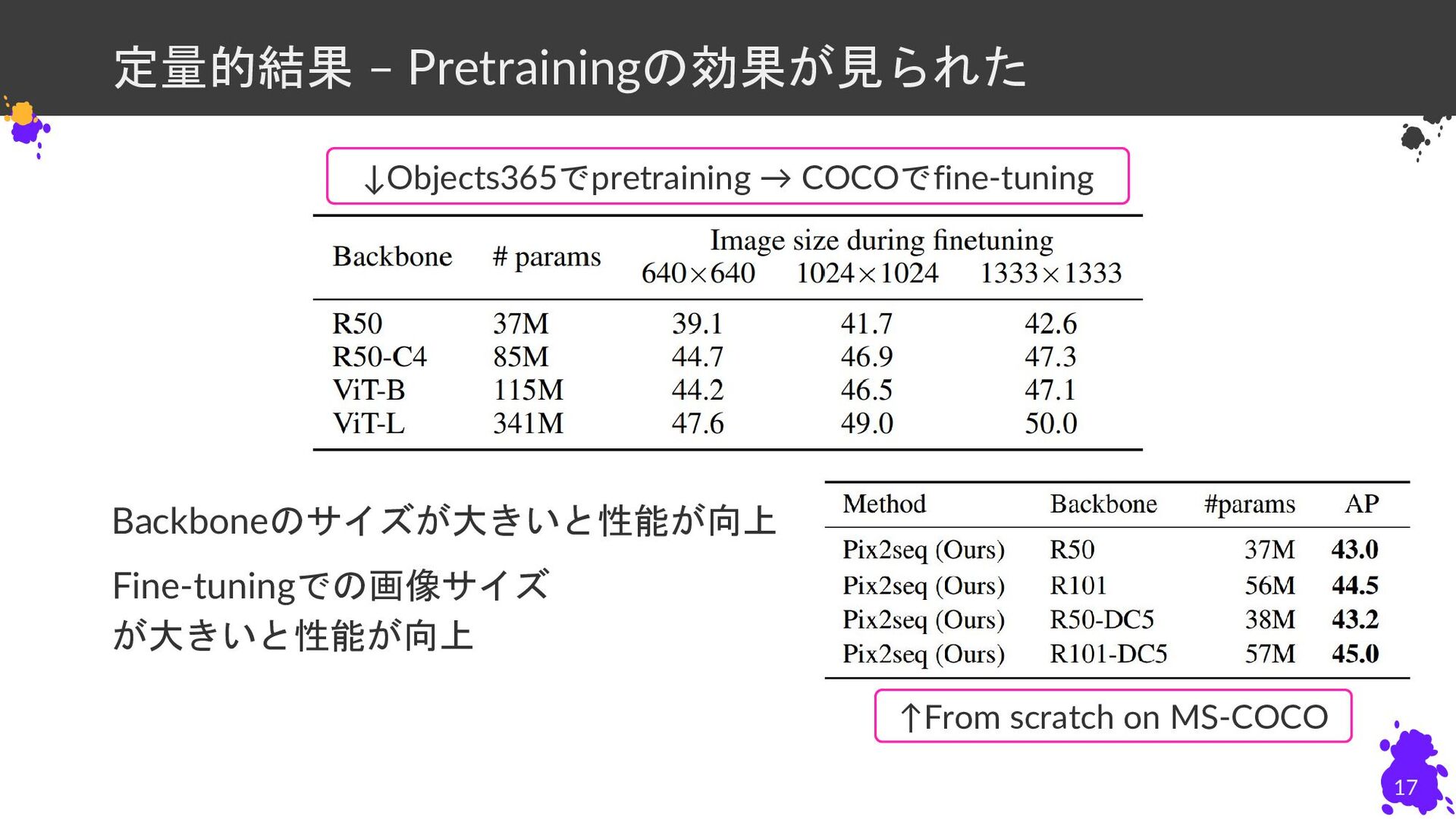
Backboneのサイズが大きいと性能が向上 Fine-tuningでの画像サイズ が大きいと性能が向上 定量的結果 – Pretrainingの効果が見られた 17 ↑From scratch on
MS-COCO ↓Objects365でpretraining → COCOでfine-tuning
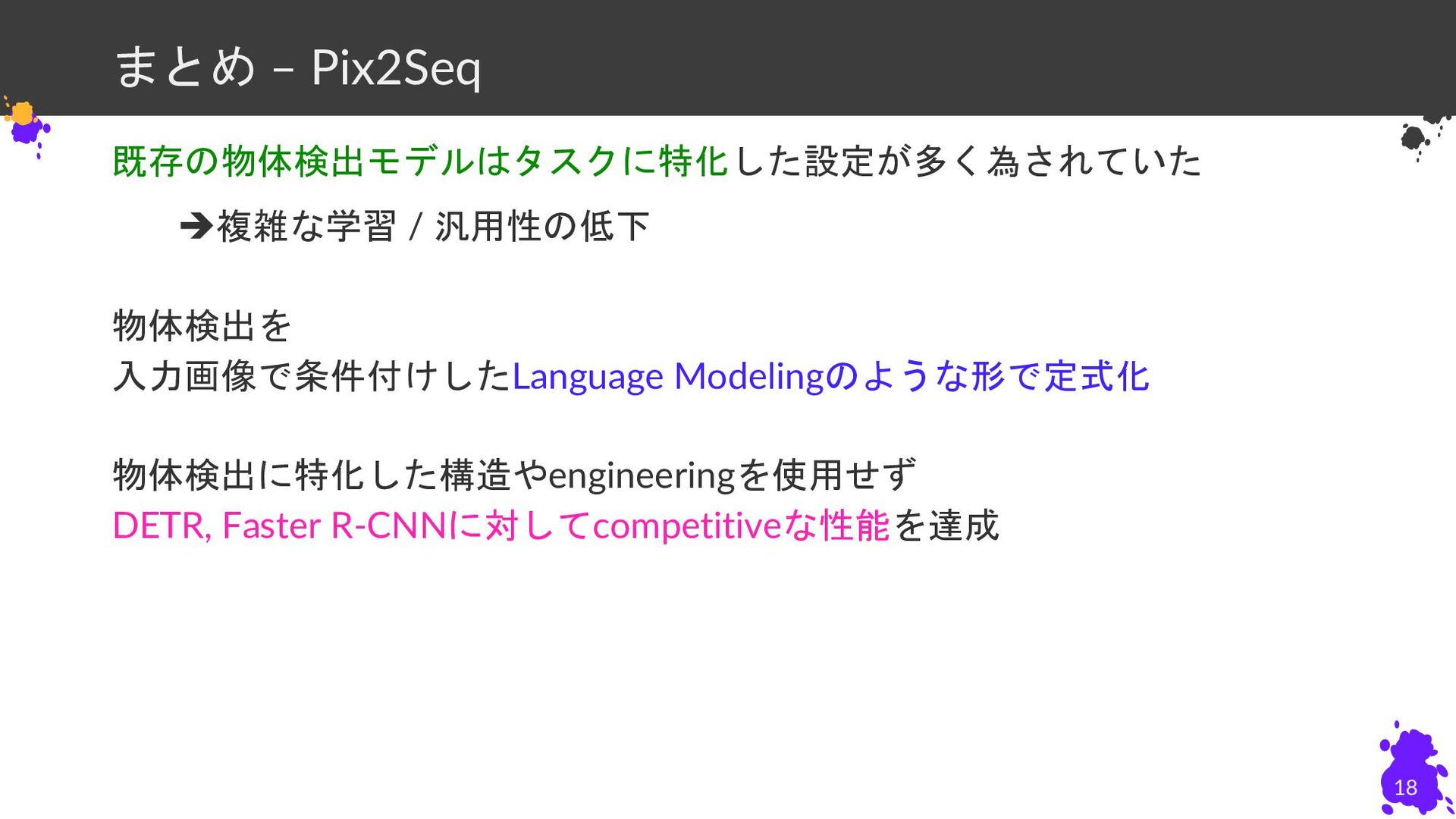
まとめ – Pix2Seq 既存の物体検出モデルはタスクに特化した設定が多く為されていた ➔複雑な学習 / 汎用性の低下 物体検出を 入力画像で条件付けしたLanguage Modelingのような形で定式化
物体検出に特化した構造やengineeringを使用せず DETR, Faster R-CNNに対してcompetitiveな性能を達成 18
Appendix – Links • Paper (ICLR2022) • Discussion @OpenReview •
Official Implementation (TensorFlow) • Official Blog • Demo (Colab.) 19
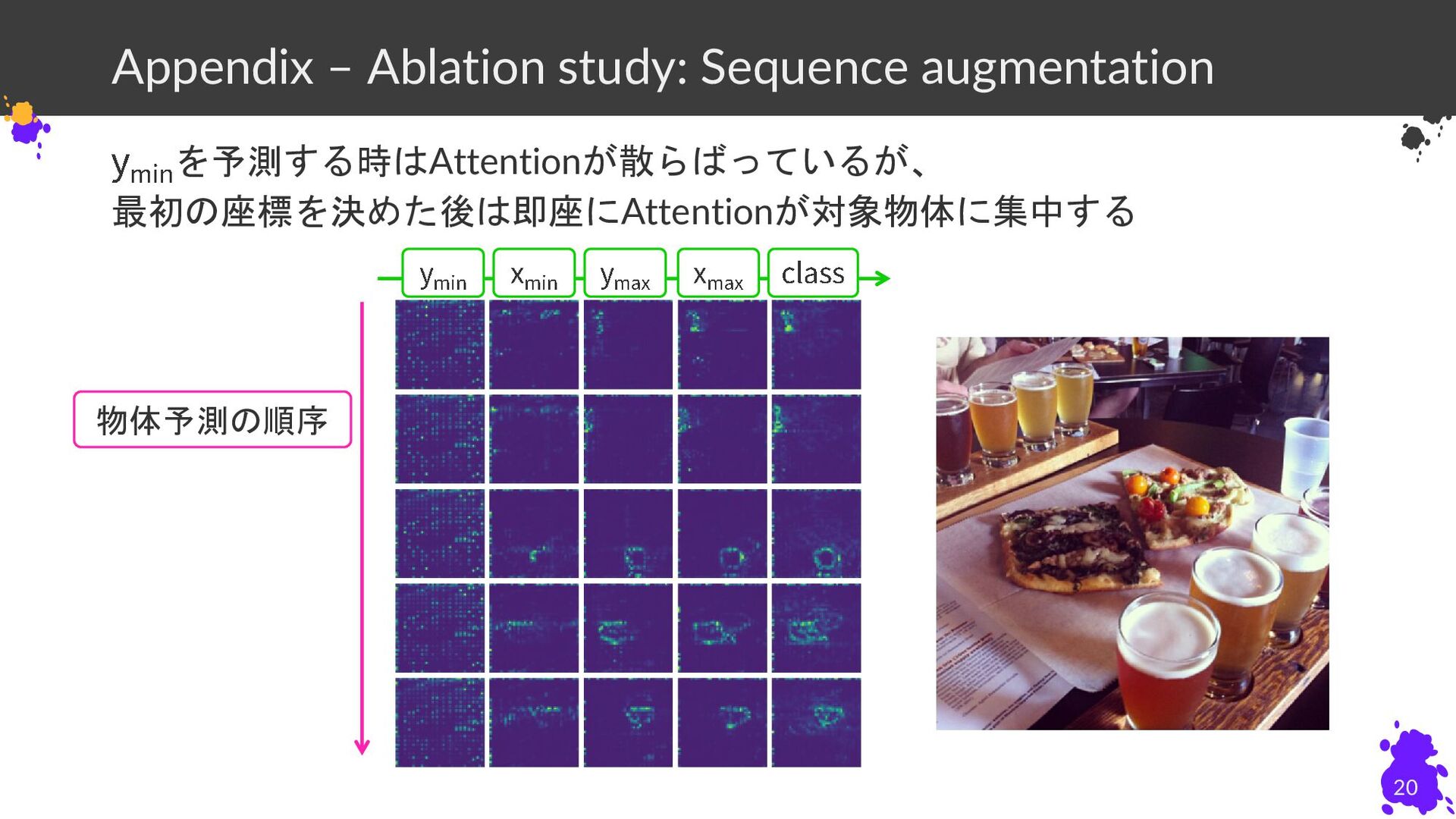
Appendix – Ablation study: Sequence augmentation 20 を予測する時はAttentionが散らばっているが、 最初の座標を決めた後は即座にAttentionが対象物体に集中する 物体予測の順序
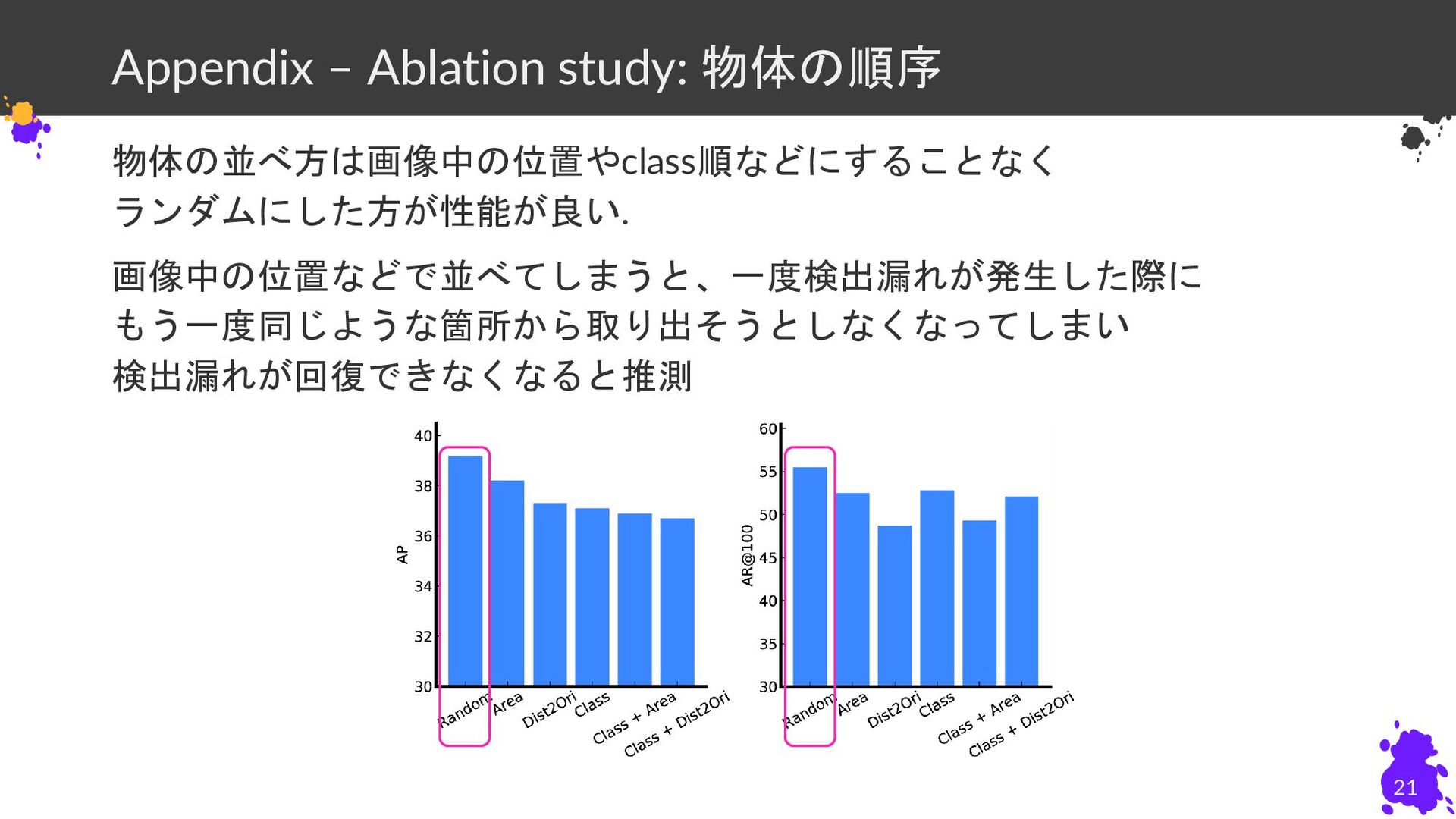
Appendix – Ablation study: 物体の順序 物体の並べ方は画像中の位置やclass順などにすることなく ランダムにした方が性能が良い. 画像中の位置などで並べてしまうと、一度検出漏れが発生した際に もう一度同じような箇所から取り出そうとしなくなってしまい 検出漏れが回復できなくなると推測
21
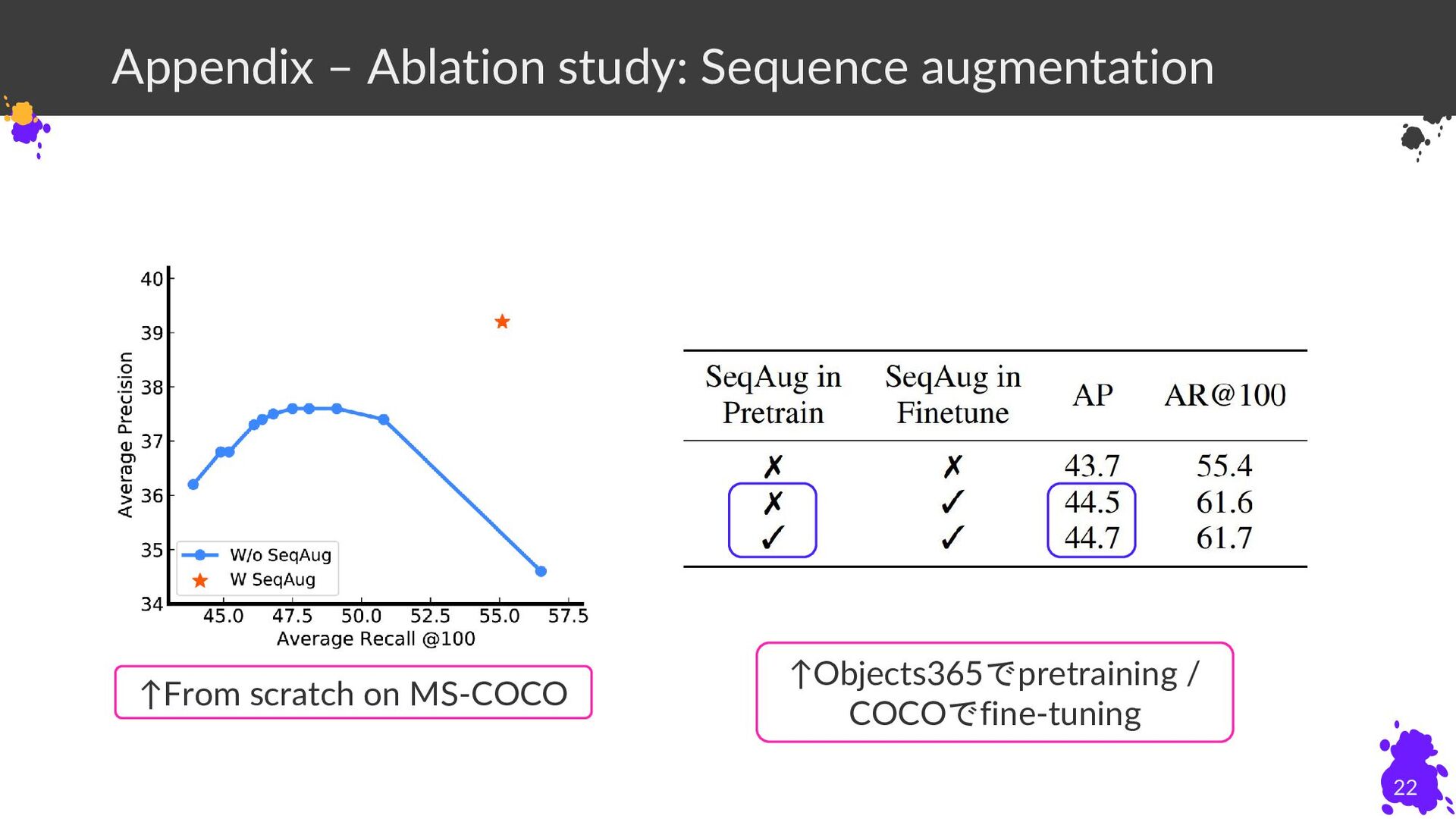
Appendix – Ablation study: Sequence augmentation 22 ↑From scratch on
MS-COCO ↑Objects365でpretraining / COCOでfine-tuning

 SiteGround - Reliable hosting with speed, security, and support you can count on.


 keio_smilab
 prog893
 codmoninc
 teamlab
 satoshi7
 ueponx
 nealle
 nttcom
 ivry_presentationmaterials
 occhi
occhi
 persolserverworks
 takanorip
 shogo4131
 uxyall
 bluesmoon
 baasie
 schlessera
 ivargrimstad
 lemiorhan
 nikkihalliwell
 62gerente
 pwiseman
 paigeccino
 samanthasiow
 jmmastey
![関連研究 – 既存の物体検出モデルは “Task-Specific” 5 Faster R-CNN [Ren+, NeurIPS15] •](https://files.speakerdeck.com/presentations/54fd84c3d14546f599494f96bbde39a9/slide_4.jpg)
![LMにおけるDecoderの入力は [ 1 1 1 1, class1, classL, EOS] EOSが](https://files.speakerdeck.com/presentations/54fd84c3d14546f599494f96bbde39a9/slide_11.jpg)