morphology is naturally defined on a complete lattice, and requires a total order. ▶ Grayscale values have a natural total order. ▶ Color, multispectral or learned feature vectors do not. ▶ Lexicographic orderings are possible, but become unsuitable as the dimension grows. Standard solution Standard solution: construct an h-ordering, i.e. a surjection h : T → L onto a totally ordered lattice L, v i ≤h v j ⇐⇒ h(vi ) ≤ h(vj ) Our proposition Reorder the leaves of a Binary Partition Tree representing and image using both hierarchy and feature similarity O. Lézoray Vector Ordering Derived from Binary Partition Tree Leaf Reordering for Mathematical Morphology 2 / 13
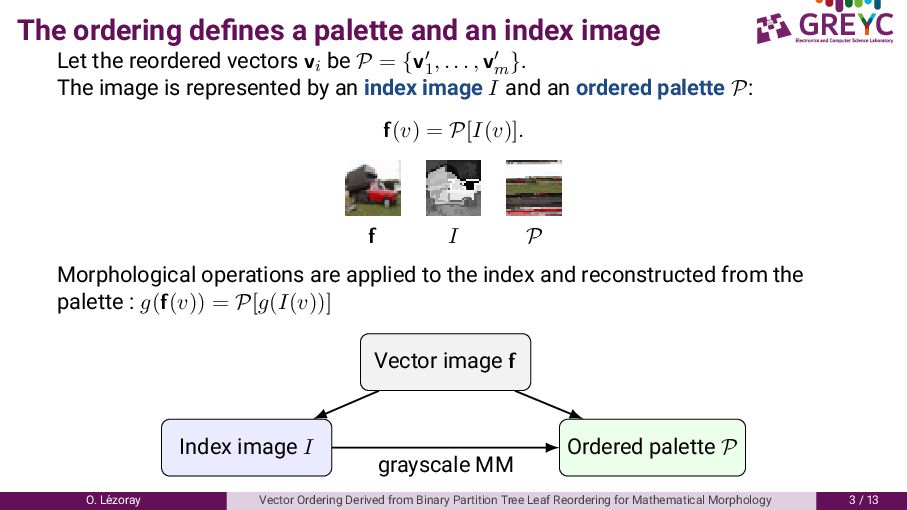
the reordered vectors vi be P = {v′1 , . . . , v′m }. The image is represented by an index image I and an ordered palette P: f(v) = P[I(v)]. f I P Morphological operations are applied to the index and reconstructed from the palette : g(f(v)) = P[g(I(v))] Vector image f Index image I O. Lézoray grayscale MM Ordered palette P Vector Ordering Derived from Binary Partition Tree Leaf Reordering for Mathematical Morphology 3 / 13
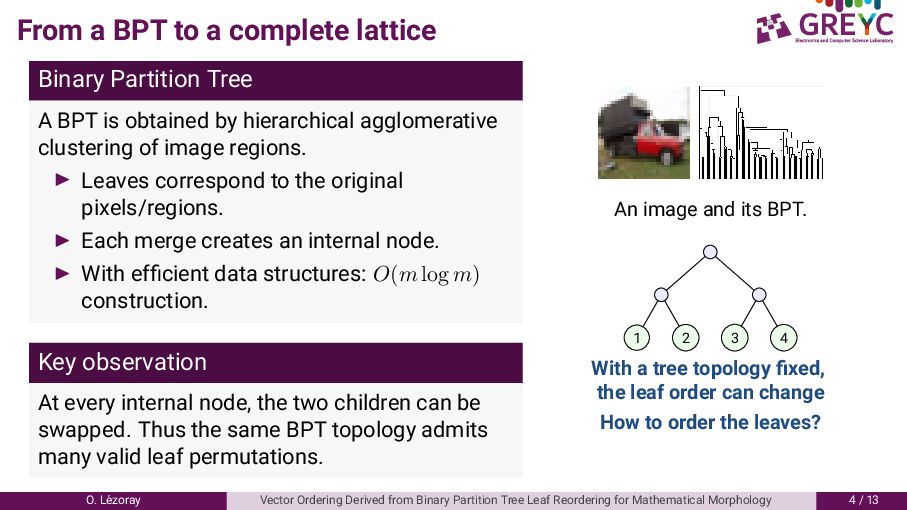
A BPT is obtained by hierarchical agglomerative clustering of image regions. ▶ Leaves correspond to the original pixels/regions. ▶ Each merge creates an internal node. An image and its BPT. ▶ With efficient data structures: O(m log m) construction. 1 Key observation At every internal node, the two children can be swapped. Thus the same BPT topology admits many valid leaf permutations. O. Lézoray 2 3 4 With a tree topology fixed, the leaf order can change How to order the leaves? Vector Ordering Derived from Binary Partition Tree Leaf Reordering for Mathematical Morphology 4 / 13
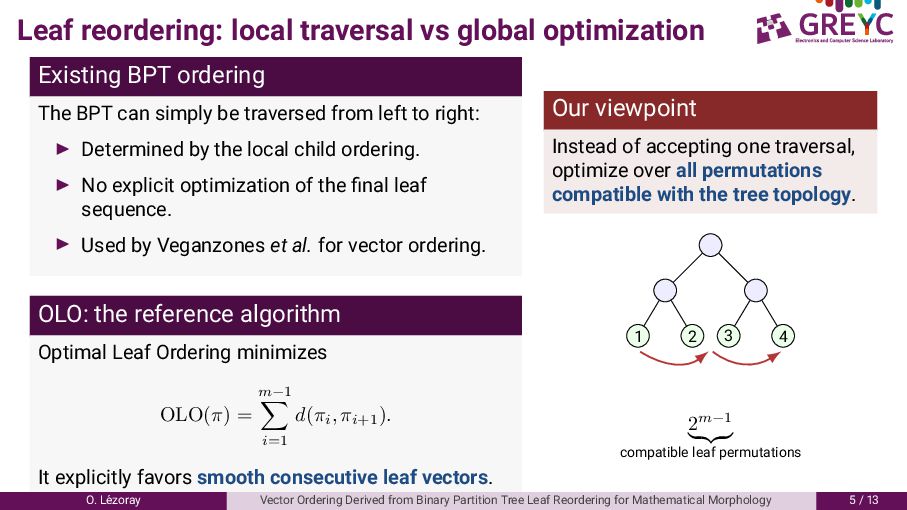
The BPT can simply be traversed from left to right: ▶ Determined by the local child ordering. ▶ No explicit optimization of the final leaf sequence. Our viewpoint Instead of accepting one traversal, optimize over all permutations compatible with the tree topology. ▶ Used by Veganzones et al. for vector ordering. OLO: the reference algorithm Optimal Leaf Ordering minimizes OLO(π) = m−1 X d(πi , πi+1 ). i=1 1 2 3 4 2| m−1 {z } compatible leaf permutations It explicitly favors smooth consecutive leaf vectors. O. Lézoray Vector Ordering Derived from Binary Partition Tree Leaf Reordering for Mathematical Morphology 5 / 13
leaf order π = (π1 , . . . , πm ): UltraMixed(π) = m−1 X [h(LCA(πi , πi+1 )) + λ d(πi , πi+1 )] i=1 where d is the Euclidean feature distance and λ ≥ 0 controls the trade-off ▶ h(LCA) keeps consecutive leaves close in the hierarchy. ▶ λd keeps consecutive vectors similar. ▶ Produces a path that respects both the tree structure and the original data similarities. ▶ As OLO: can be solved by dynamic programming. O. Lézoray Vector Ordering Derived from Binary Partition Tree Leaf Reordering for Mathematical Morphology 6 / 13
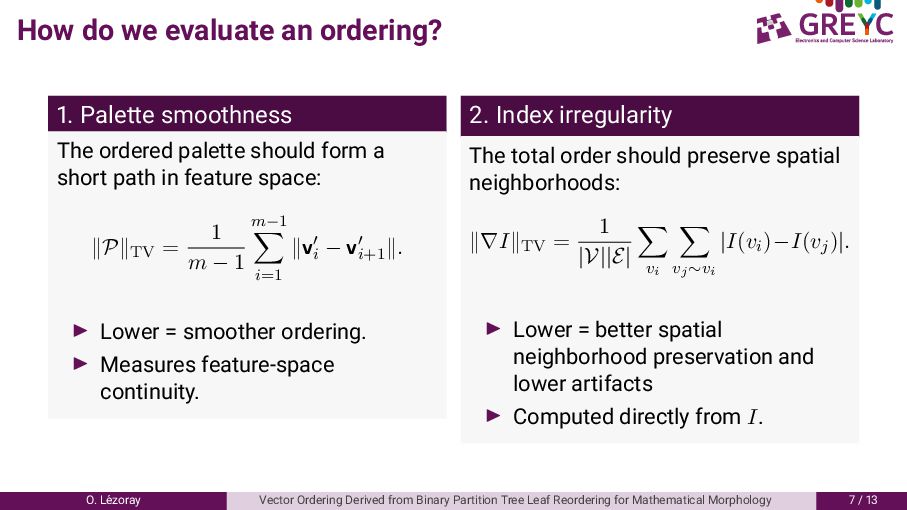
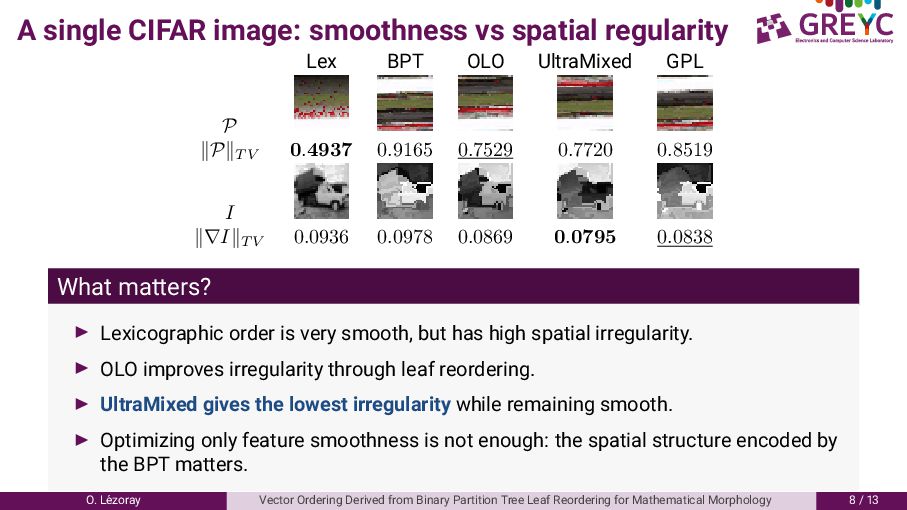
Index irregularity The ordered palette should form a short path in feature space: The total order should preserve spatial neighborhoods: m−1 ∥P∥TV = 1 X ′ ∥vi − v′i+1 ∥. m−1 i=1 ▶ Lower = smoother ordering. ▶ Measures feature-space continuity. O. Lézoray ∥∇I∥TV = 1 X X |I(vi )−I(vj )|. |V||E| v v ∼v i j i ▶ Lower = better spatial neighborhood preservation and lower artifacts ▶ Computed directly from I. Vector Ordering Derived from Binary Partition Tree Leaf Reordering for Mathematical Morphology 7 / 13
OLO UltraMixed GPL P ∥P∥T V 0.4937 0.9165 0.7529 0.7720 0.8519 I ∥∇I∥T V 0.0936 0.0978 0.0869 0.0795 0.0838 What matters? ▶ Lexicographic order is very smooth, but has high spatial irregularity. ▶ OLO improves irregularity through leaf reordering. ▶ UltraMixed gives the lowest irregularity while remaining smooth. ▶ Optimizing only feature smoothness is not enough: the spatial structure encoded by the BPT matters. O. Lézoray Vector Ordering Derived from Binary Partition Tree Leaf Reordering for Mathematical Morphology 8 / 13
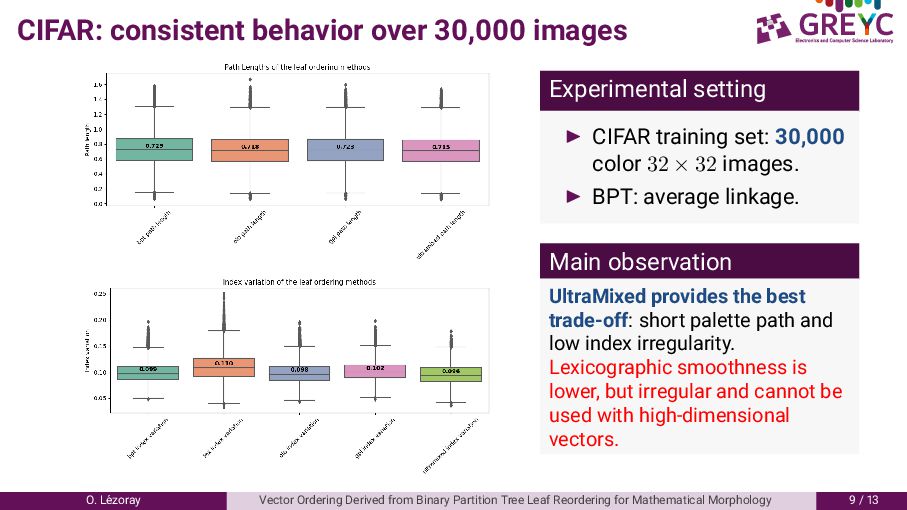
training set: 30,000 color 32 × 32 images. ▶ BPT: average linkage. Main observation UltraMixed provides the best trade-off: short palette path and low index irregularity. Lexicographic smoothness is lower, but irregular and cannot be used with high-dimensional vectors. O. Lézoray Vector Ordering Derived from Binary Partition Tree Leaf Reordering for Mathematical Morphology 9 / 13
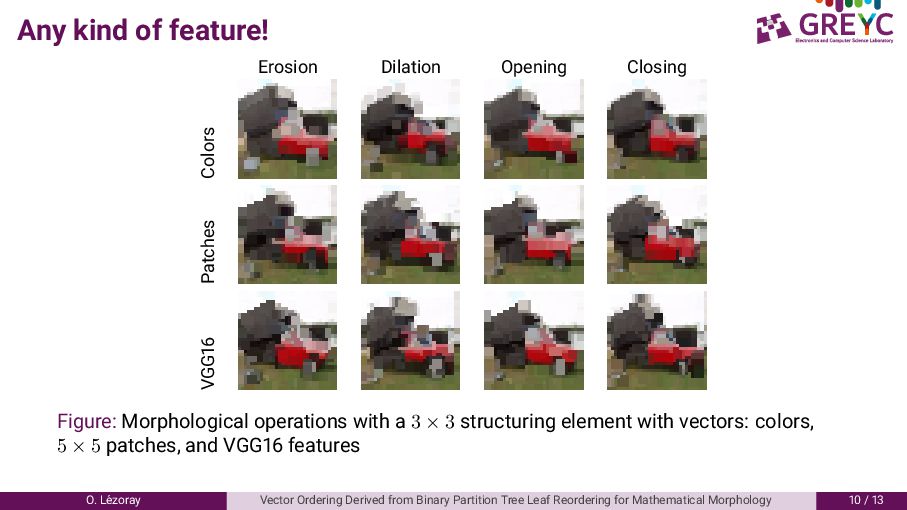
Erosion Figure: Morphological operations with a 3 × 3 structuring element with vectors: colors, 5 × 5 patches, and VGG16 features O. Lézoray Vector Ordering Derived from Binary Partition Tree Leaf Reordering for Mathematical Morphology 10 / 13
Dilation Opening Closing Figure: Comparison with Veganzones [1] with a 11 × 11 structuring element. O. Lézoray Vector Ordering Derived from Binary Partition Tree Leaf Reordering for Mathematical Morphology 11 / 13
orderings for multivariate mathematical morphology. 2. The proposed UltraMixed objective combines two complementary sources of information: hierarchical structure + feature similarity 3. UltraMixed gives a strong balance between palette smoothness and low irregularity, with coherent morphological results. 4. The approach is generic and can operate on high-dimensional feature representations. Future work Improve the scalability of leaf-reordering methods for large images and larger feature sets. O. Lézoray Vector Ordering Derived from Binary Partition Tree Leaf Reordering for Mathematical Morphology 12 / 13


 lezoray
 gpeyre
 rikkabotan7
.png) satai
satai
 yukako_nakano
 kzmssk
 institutdelelevage
 microbaseinc
 hotchpotch
 ftakahashi
 tomonom
 stuffmc
 thoeni
 erikaheidi
 stephenakadiri
 portentint
 baasie
 inesmontani
 katiecoart
 akihiro_kokubo
 lara
lara
 nonsquared
 axbom
axbom



![Comparison with Veganzones et al. Original image UltraMixed [1] Erosion](https://files.speakerdeck.com/presentations/f2dc522d653742bdbd72f6a456fc4e0f/slide_10.jpg)