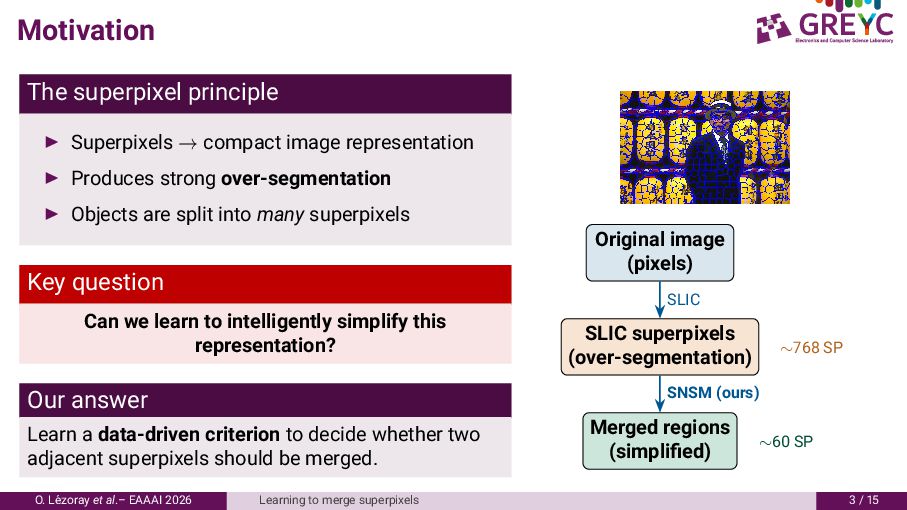
▶ Produces strong over-segmentation ▶ Objects are split into many superpixels Original image (pixels) Key question SLIC Can we learn to intelligently simplify this representation? ∼768 SP SNSM (ours) Our answer Learn a data-driven criterion to decide whether two adjacent superpixels should be merged. O. Lézoray et al.– EAAAI 2026 SLIC superpixels (over-segmentation) Learning to merge superpixels Merged regions (simplified) ∼60 SP 3 / 15
thresholds, poor generalization across textures Square patches [Huang, 2024] Pixels outside both superpixels are included Average pooling [Liu, 2018] Discards internal feature diversity of superpixels SNSM (ours) NetVLAD + siamese, fully learned ▶ Existing methods rely on hand-crafted rules or lose structural information ▶ Our approach replaces heuristics with learned pairwise affinities Region Adjacency Graph: green = mergeable, red = not mergeable O. Lézoray et al.– EAAAI 2026 Learning to merge superpixels 4 / 15
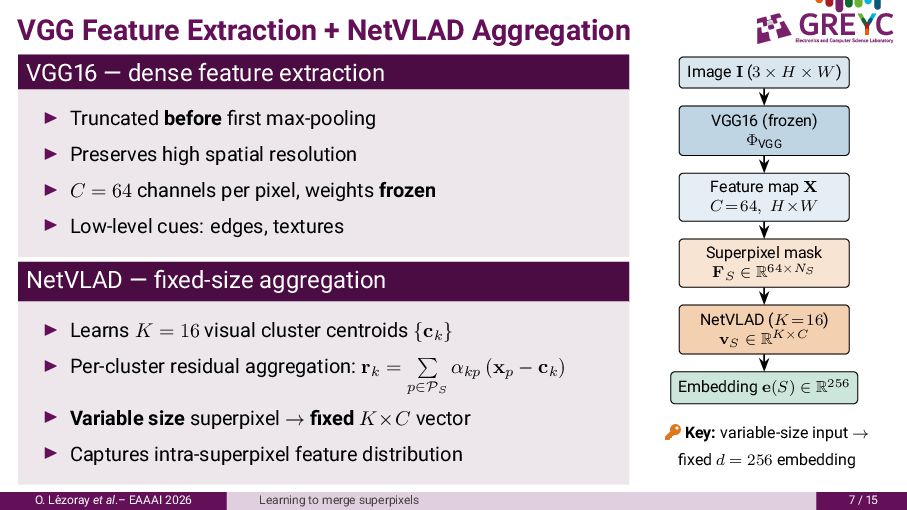
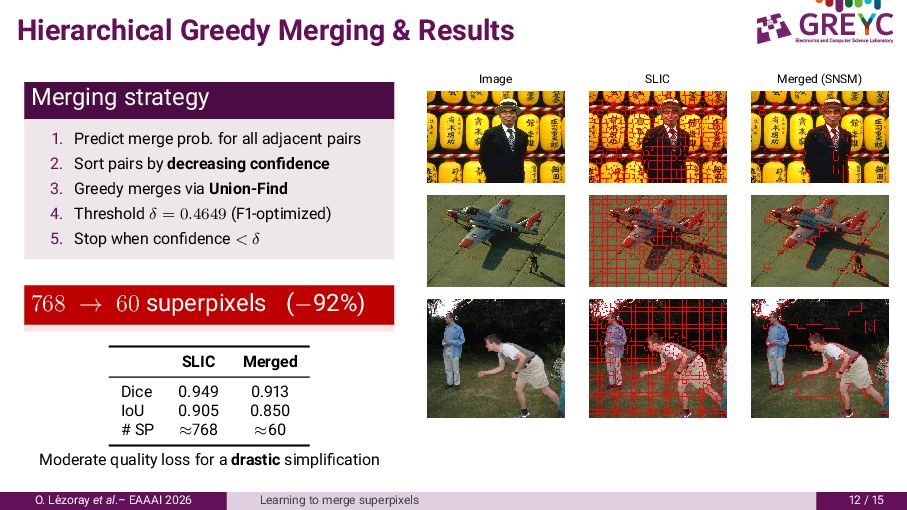
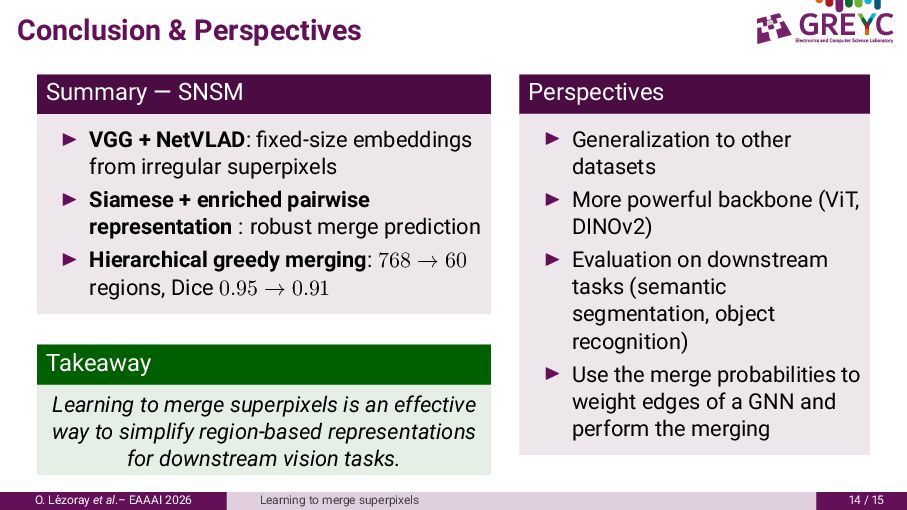
NetVLAD: fixed-size embeddings from irregular superpixels ▶ Siamese + enriched pairwise representation : robust merge prediction ▶ Hierarchical greedy merging: 768 → 60 regions, Dice 0.95 → 0.91 Takeaway Learning to merge superpixels is an effective way to simplify region-based representations for downstream vision tasks. O. Lézoray et al.– EAAAI 2026 Learning to merge superpixels ▶ Generalization to other datasets ▶ More powerful backbone (ViT, DINOv2) ▶ Evaluation on downstream tasks (semantic segmentation, object recognition) ▶ Use the merge probabilities to weight edges of a GNN and perform the merging 14 / 15


 lezoray
 institutdelelevage
 murakawatakuya
 shunk031
 kinoue_smarthr
 recsyslab
 koide3
 stktu
stktu
 takasehideki
 beale
beale
 dk999
dk999
 ept
ept
 mojombo
 mclloyd
 greggifford
 davidcarrasco
 nikkihalliwell
 madoxten
 sabderemane
 pedronauck
 livdayseo
 kastner
 eileencodes
 geshan
![Limits of Existing Approaches Method Limitation Heuristics [Barcelos, 2024] Manual](https://files.speakerdeck.com/presentations/aeb1bf09896f4eb3bdb96a7e7dfa05eb/slide_3.jpg)