Upgrade to Pro — share decks privately, control downloads, hide ads and more …

AI-First Mindset: How AI is Reshaping Teams and...

Sponsored · Ship Features Fearlessly Turn features on and off without deploys. Used by thousands of Ruby developers.

AI-First Mindset: How AI is Reshaping Teams and Leadership

AI is everywhere, but having access to tools is not the same as having a mindset shift. This talk is about what it actually means to go AI-first: not as a shortcut, but as a new way of thinking, working, and leading.

Drawing from personal experience, we will explore how to build reusable working patterns with AI, why the best teams obsess over problems before reaching for solutions, and how leaders can create the psychological safety that makes real experimentation possible.

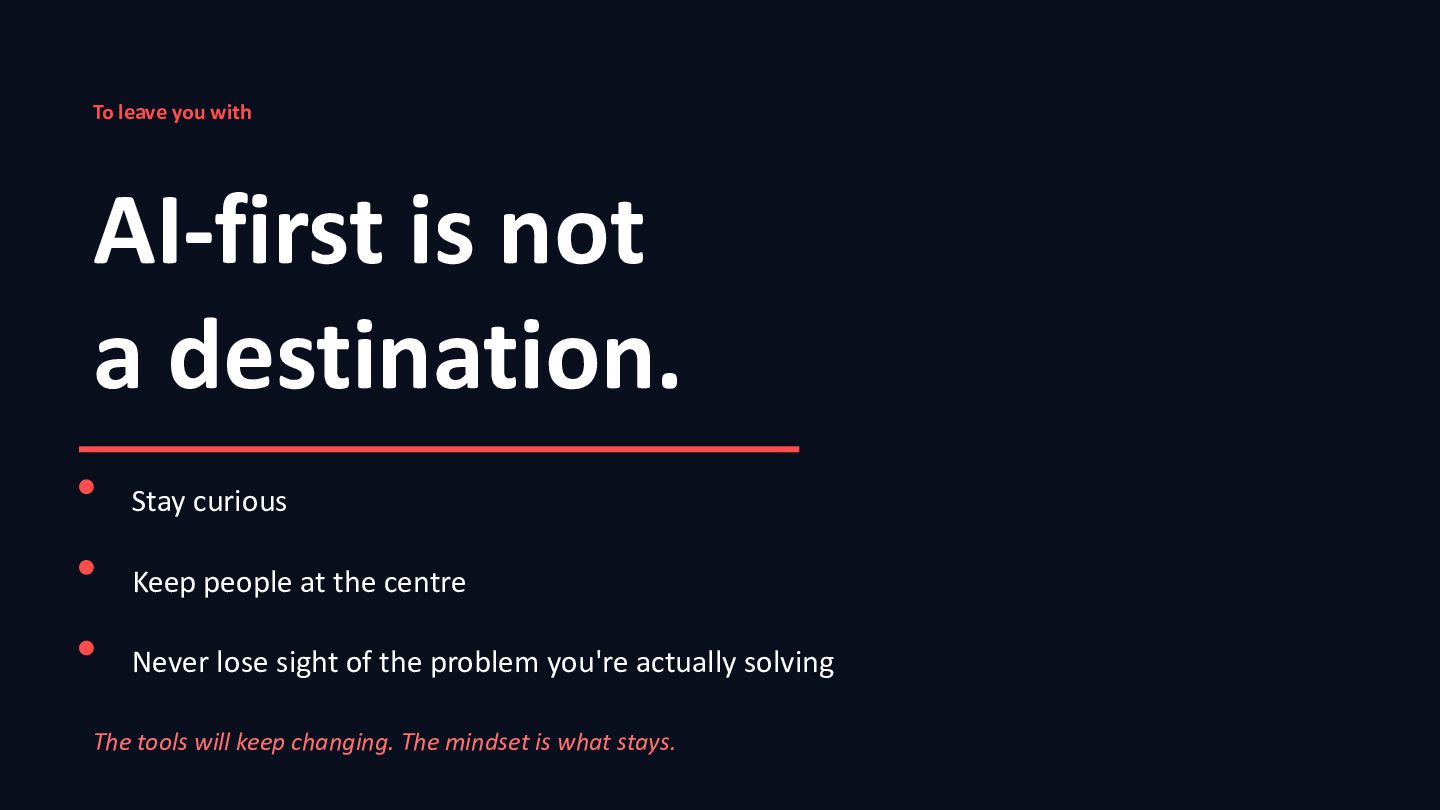
The tools will keep changing. What matters is the mindset: stay curious, keep people at the centre, and never lose sight of the problem you are actually solving.

You will leave with at least one concrete thing to try with your team. See you!

Content delivered by Alin Miu and Magda Miu

Avatar for Magda Miu

Magda Miu

May 18, 2026

More Decks by Magda Miu

Other Decks in Technology

Transcript

  1. AI AI-First Mindset How AI is Reshaping Teams and Leadership

    Magda Miu · Alin Miu · CodeCamp Bucharest · May 7, 2026
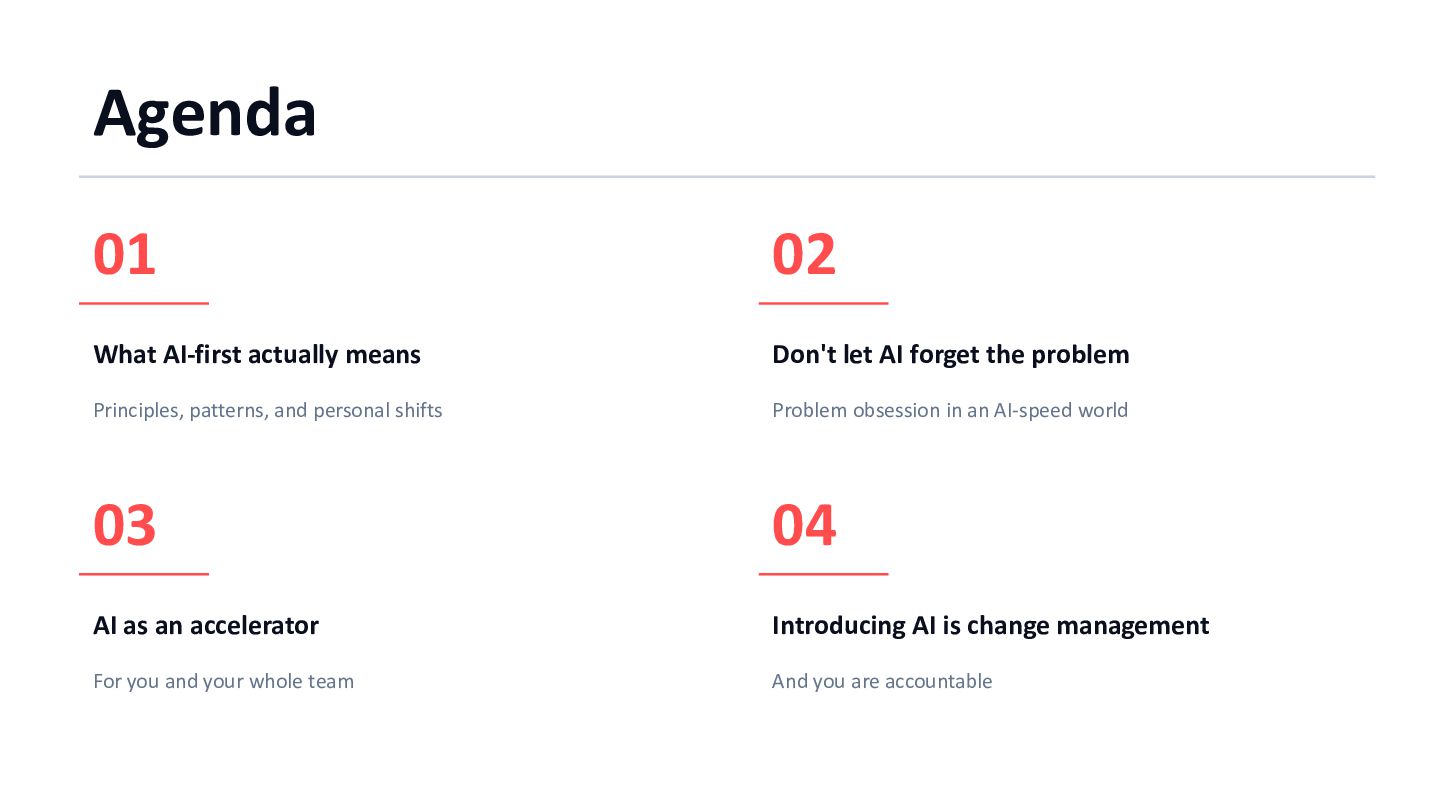
  2. Agenda 01 What AI-first actually means Principles, patterns, and personal

    shifts 02 Don't let AI forget the problem Problem obsession in an AI-speed world 03 AI as an accelerator For you and your whole team 04 Introducing AI is change management And you are accountable
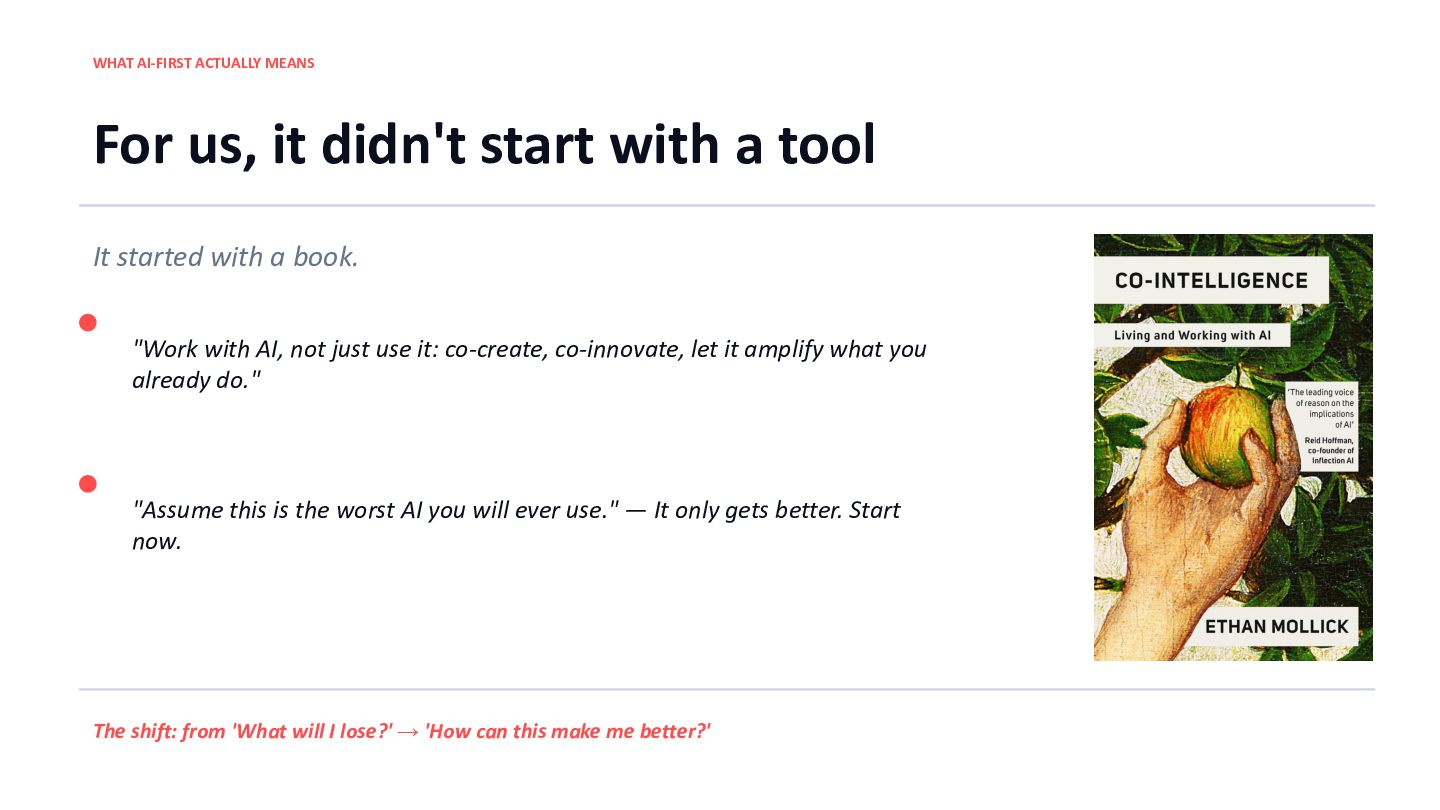
  3. WHAT AI-FIRST ACTUALLY MEANS For us, it didn't start with

    a tool It started with a book. "Work with AI, not just use it: co-create, co-innovate, let it amplify what you already do." "Assume this is the worst AI you will ever use." — It only gets better. Start now. The shift: from 'What will I lose?' → 'How can this make me better?'
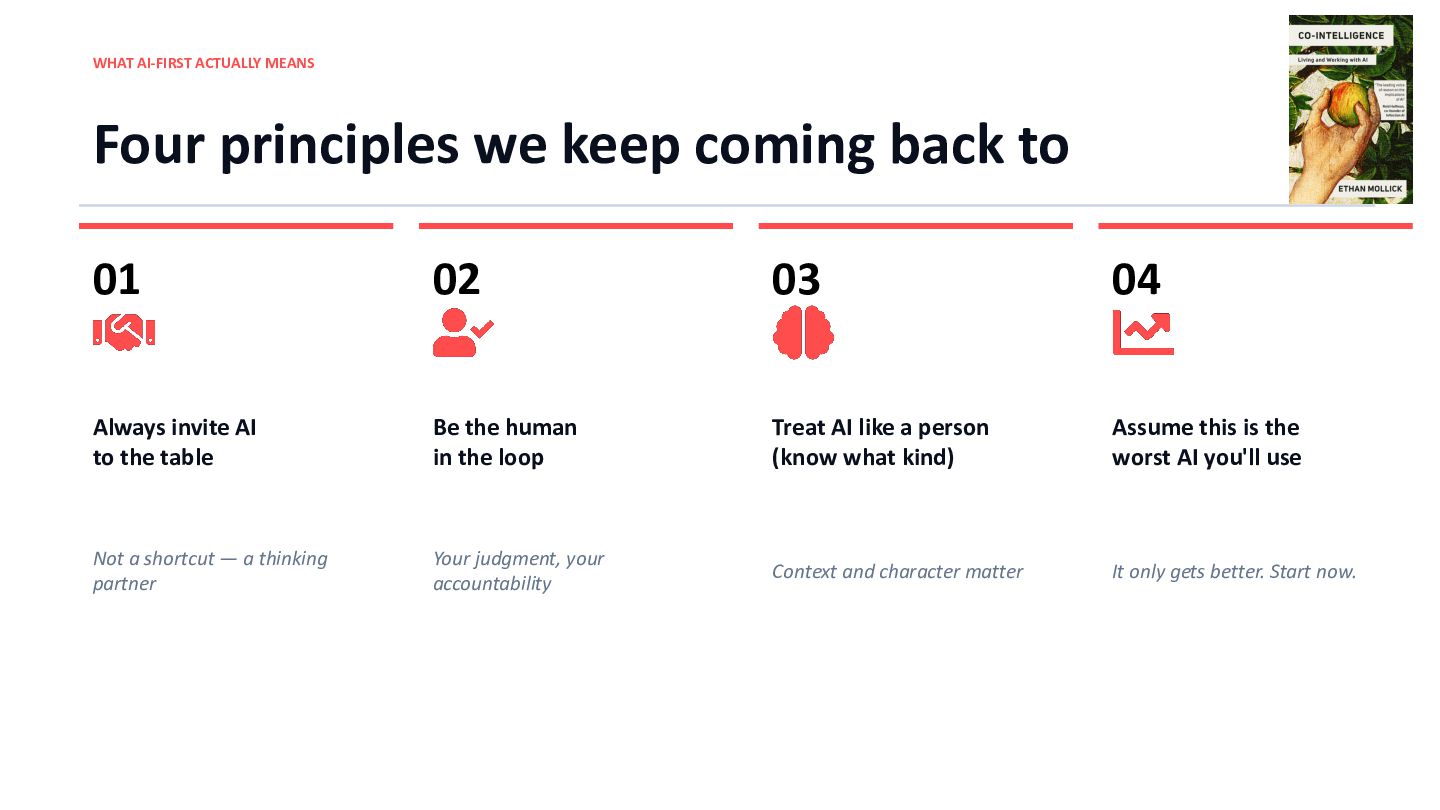
  4. WHAT AI-FIRST ACTUALLY MEANS Four principles we keep coming back

    to 01 Always invite AI to the table Not a shortcut — a thinking partner 02 Be the human in the loop Your judgment, your accountability 03 Treat AI like a person (know what kind) Context and character matter 04 Assume this is the worst AI you'll use It only gets better. Start now.
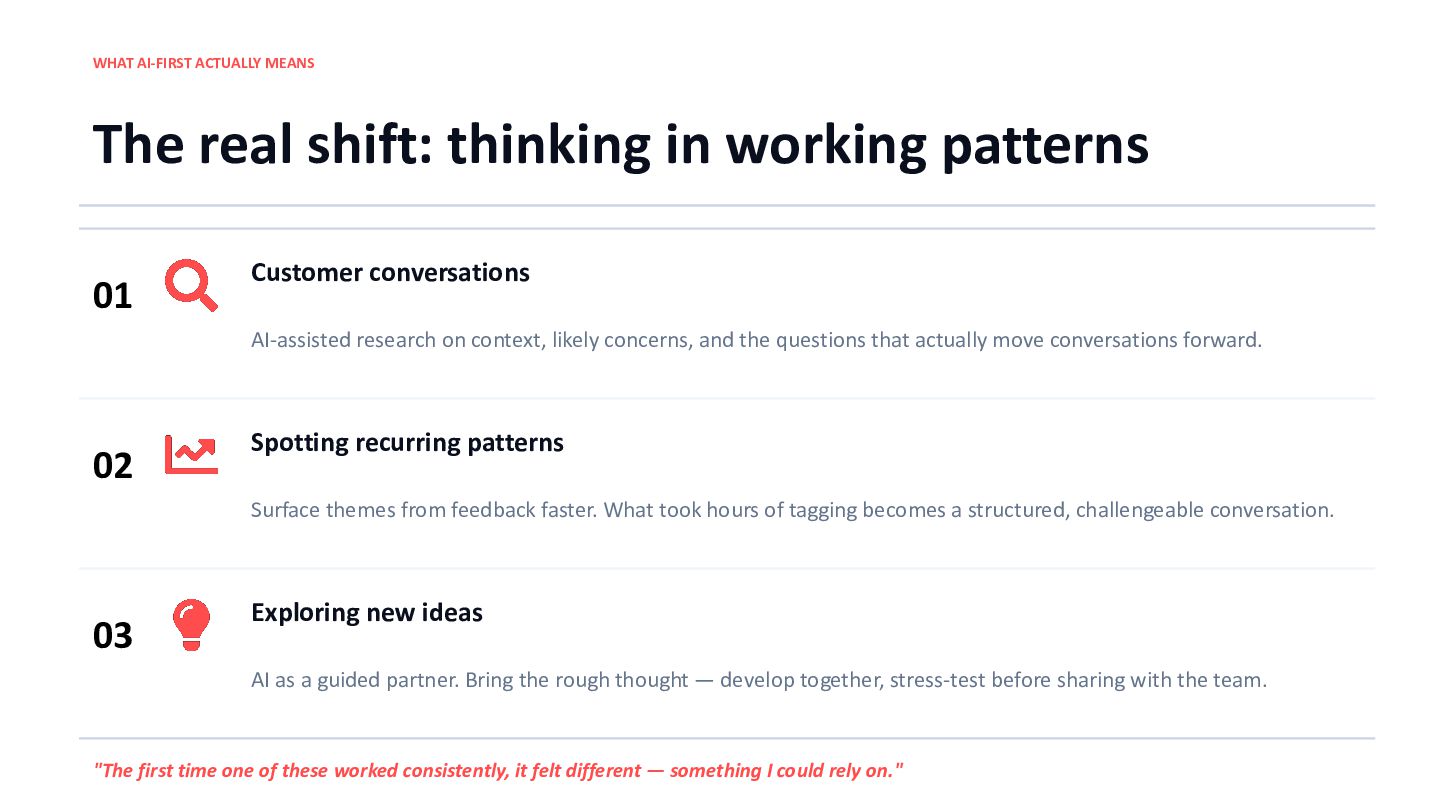
  5. WHAT AI-FIRST ACTUALLY MEANS The real shift: thinking in working

    patterns 01 Customer conversations AI-assisted research on context, likely concerns, and the questions that actually move conversations forward. 02 Spotting recurring patterns Surface themes from feedback faster. What took hours of tagging becomes a structured, challengeable conversation. 03 Exploring new ideas AI as a guided partner. Bring the rough thought — develop together, stress-test before sharing with the team. "The first time one of these worked consistently, it felt different — something I could rely on."
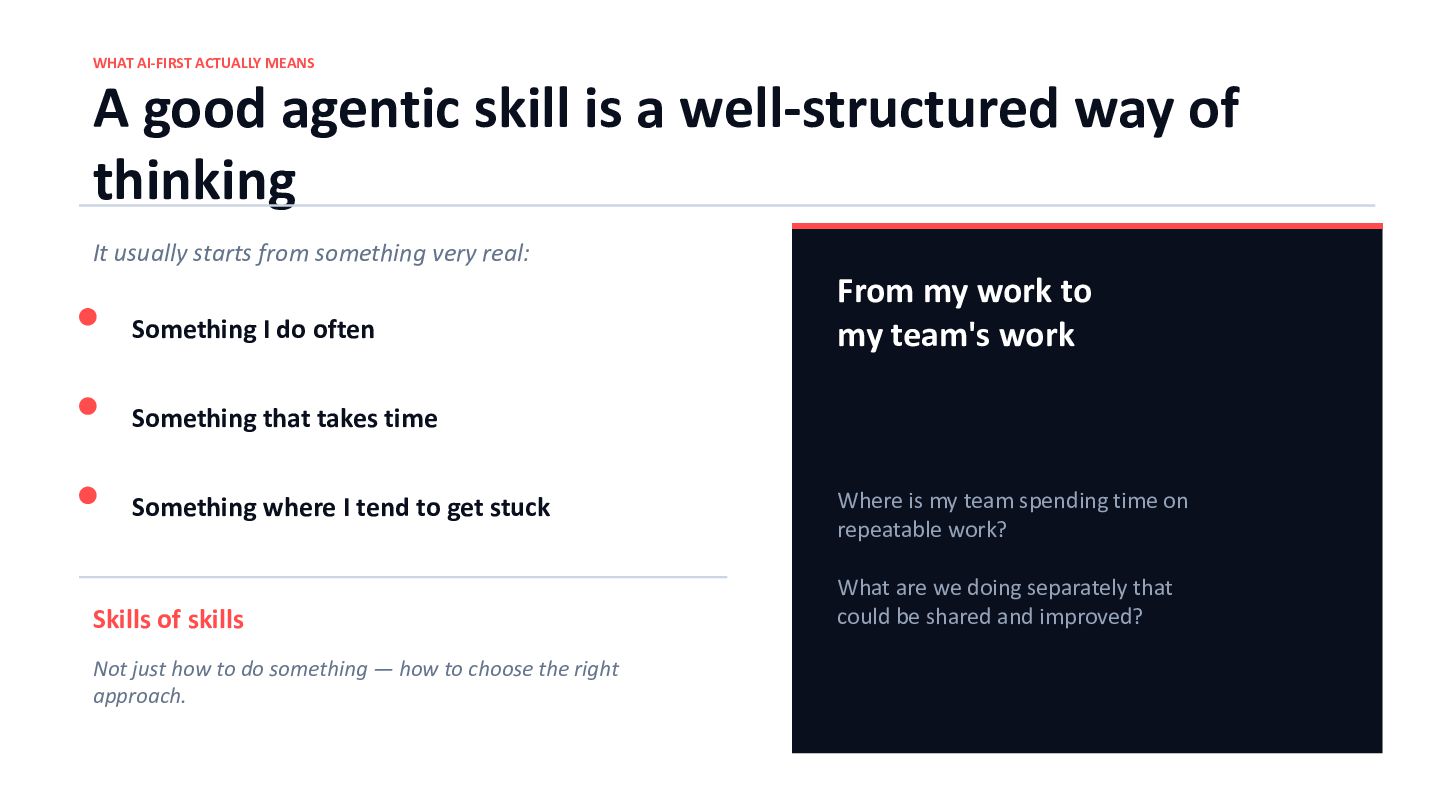
  6. WHAT AI-FIRST ACTUALLY MEANS A good agentic skill is a

    well-structured way of thinking It usually starts from something very real: Something I do often Something that takes time Something where I tend to get stuck Skills of skills Not just how to do something — how to choose the right approach. From my work to my team's work Where is my team spending time on repeatable work? What are we doing separately that could be shared and improved?
  7. 02 Don't let AI make you forget the problem A

    faster answer to the wrong question is still the wrong answer.
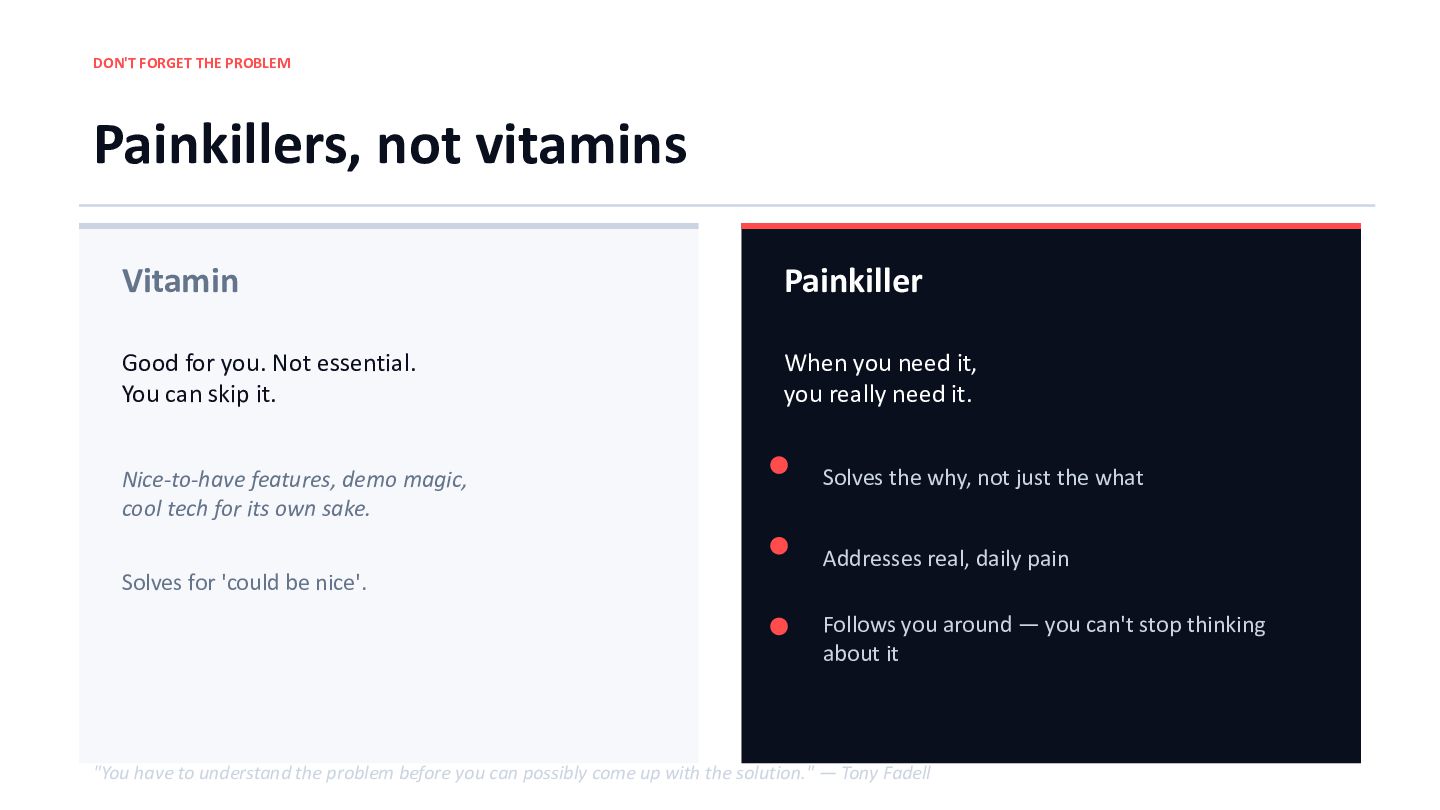
  8. DON'T FORGET THE PROBLEM Painkillers, not vitamins Vitamin Good for

    you. Not essential. You can skip it. Nice-to-have features, demo magic, cool tech for its own sake. Solves for 'could be nice'. Painkiller When you need it, you really need it. Solves the why, not just the what Addresses real, daily pain Follows you around — you can't stop thinking about it "You have to understand the problem before you can possibly come up with the solution." — Tony Fadell
  9. DON'T FORGET THE PROBLEM Why teams skip the problem anyway

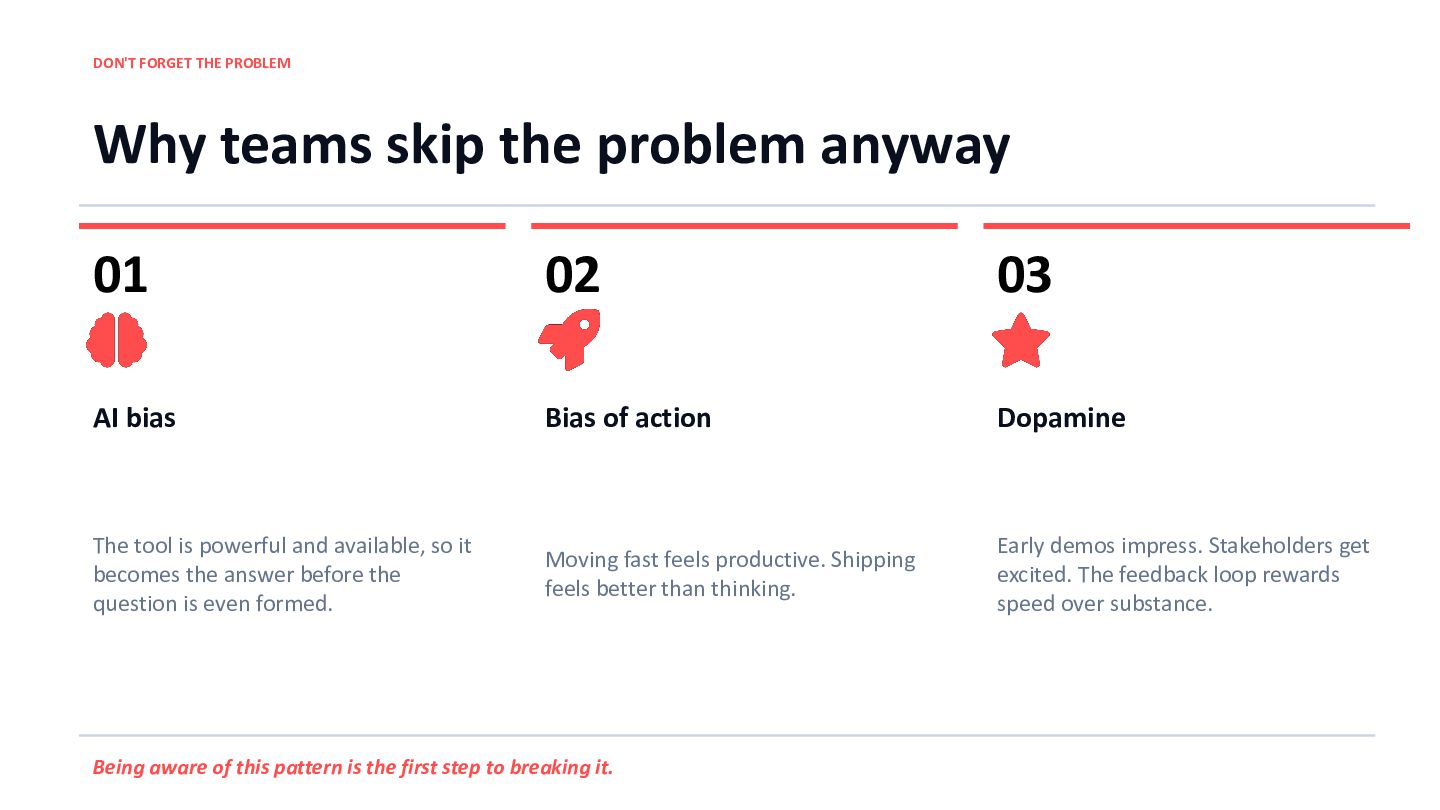
    01 AI bias The tool is powerful and available, so it becomes the answer before the question is even formed. 02 Bias of action Moving fast feels productive. Shipping feels better than thinking. 03 Dopamine Early demos impress. Stakeholders get excited. The feedback loop rewards speed over substance. Being aware of this pattern is the first step to breaking it.
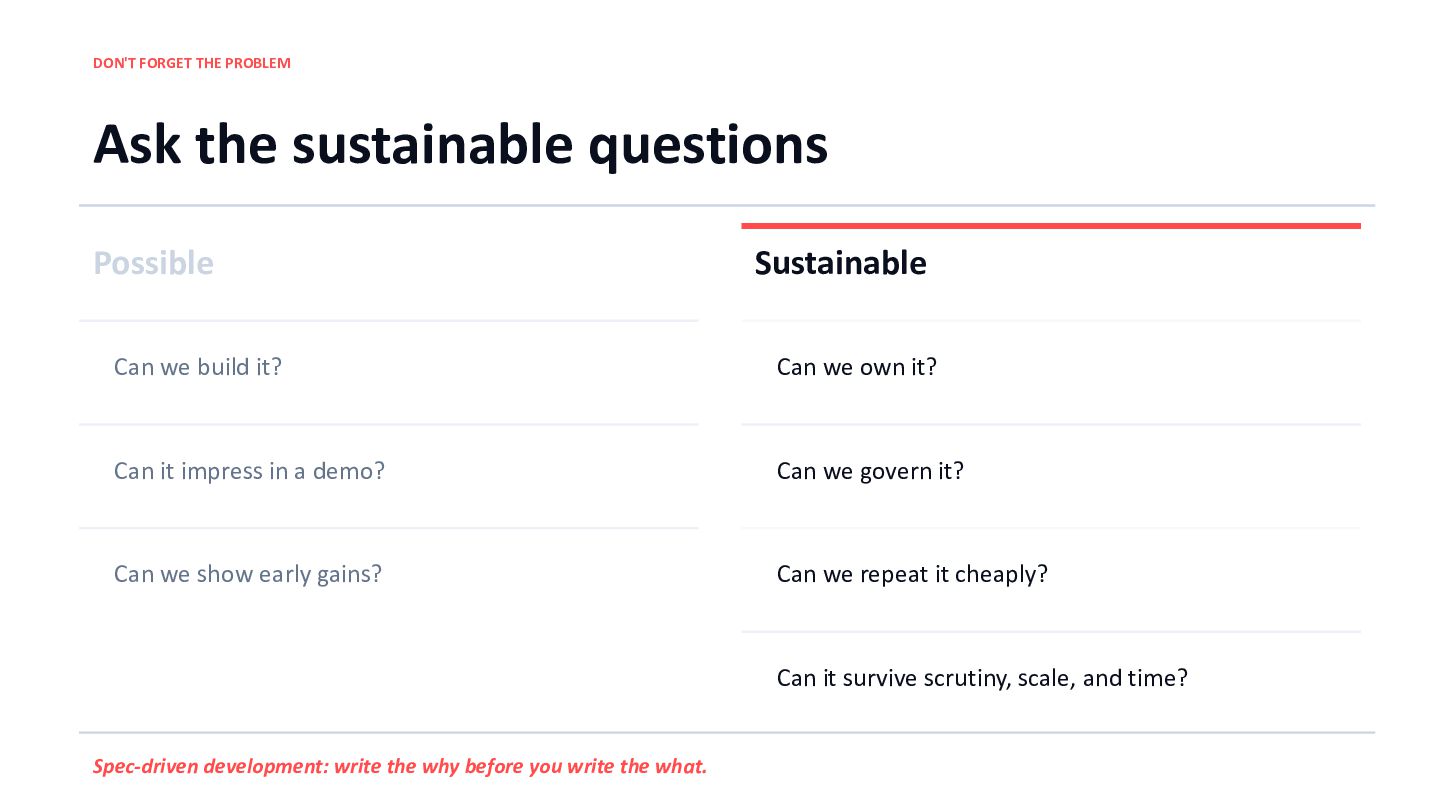
  10. DON'T FORGET THE PROBLEM Ask the sustainable questions Possible Sustainable

    Can we build it? Can it impress in a demo? Can we show early gains? Can we own it? Can we govern it? Can we repeat it cheaply? Can it survive scrutiny, scale, and time? Spec-driven development: write the why before you write the what.
  11. 03 AI as an accelerator for you and your team

    The shift: from scarcity to abundance. From fear to curiosity.
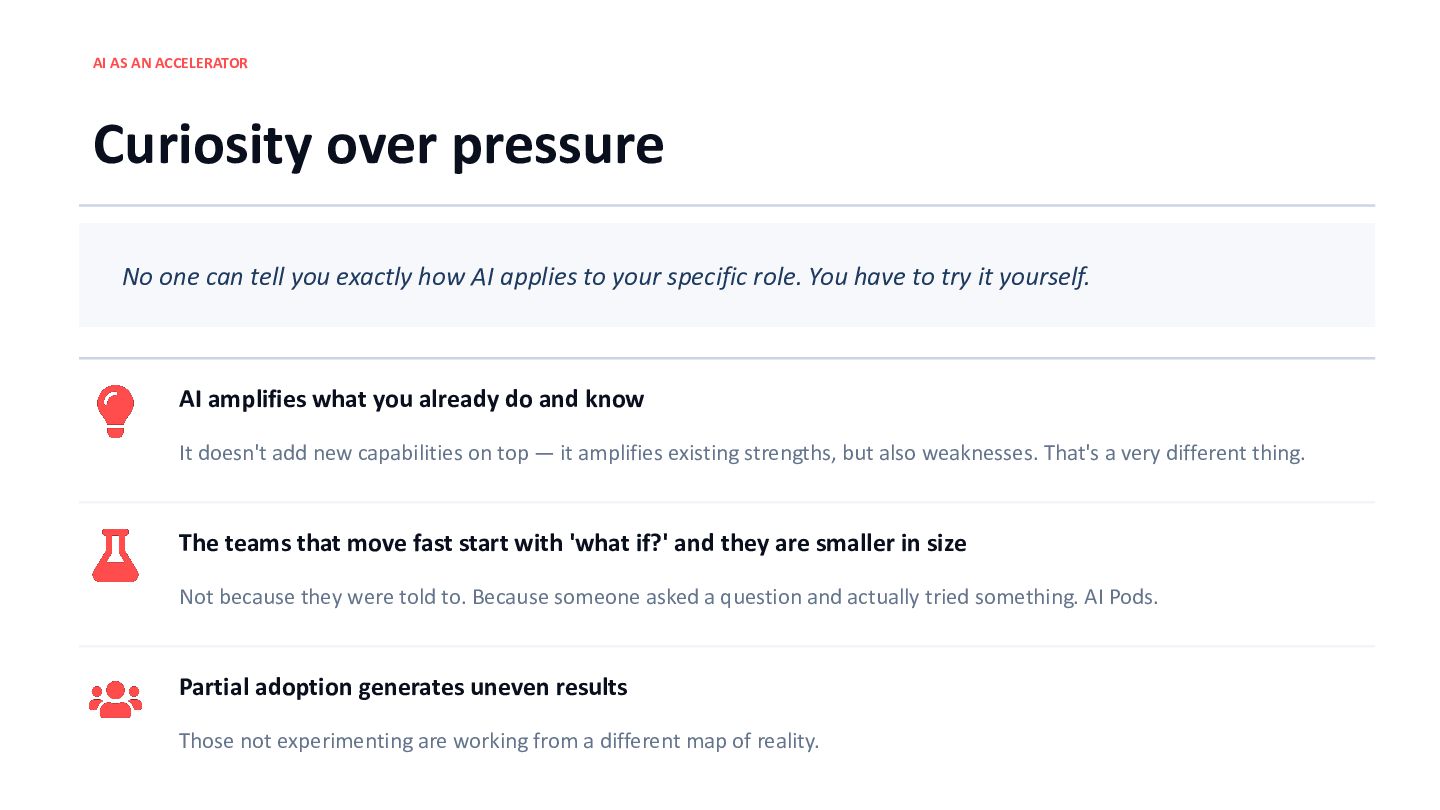
  12. AI AS AN ACCELERATOR Curiosity over pressure No one can

    tell you exactly how AI applies to your specific role. You have to try it yourself. AI amplifies what you already do and know It doesn't add new capabilities on top — it amplifies existing strengths, but also weaknesses. That's a very different thing. The teams that move fast start with 'what if?' and they are smaller in size Not because they were told to. Because someone asked a question and actually tried something. AI Pods. Partial adoption generates uneven results Those not experimenting are working from a different map of reality.
  13. AI AS AN ACCELERATOR The whole team needs to be

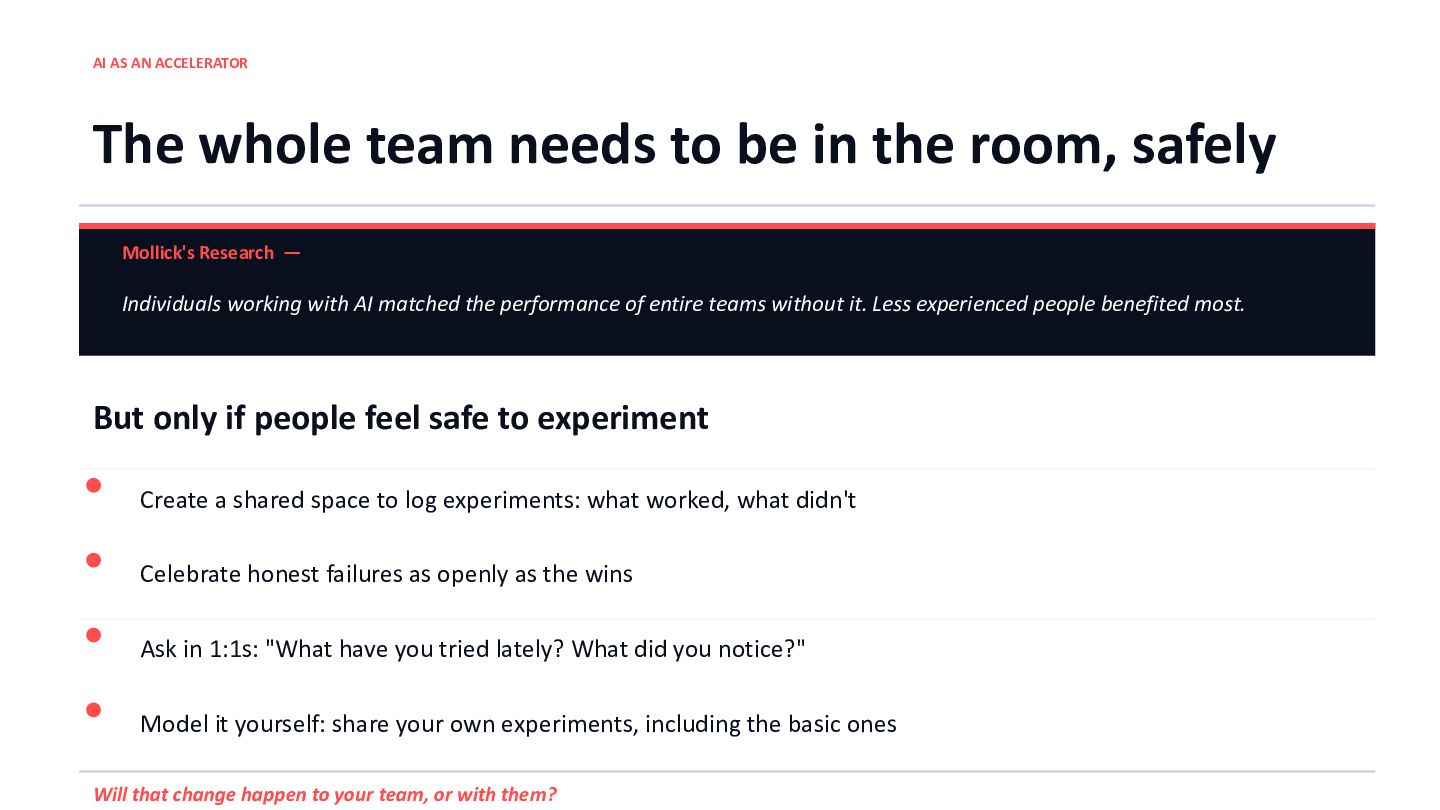
    in the room, safely Mollick's Research — Individuals working with AI matched the performance of entire teams without it. Less experienced people benefited most. But only if people feel safe to experiment Create a shared space to log experiments: what worked, what didn't Celebrate honest failures as openly as the wins Ask in 1:1s: "What have you tried lately? What did you notice?" Model it yourself: share your own experiments, including the basic ones Will that change happen to your team, or with them?
  14. INTRODUCING AI IS CHANGE MANAGEMENT What actually worked: demos and

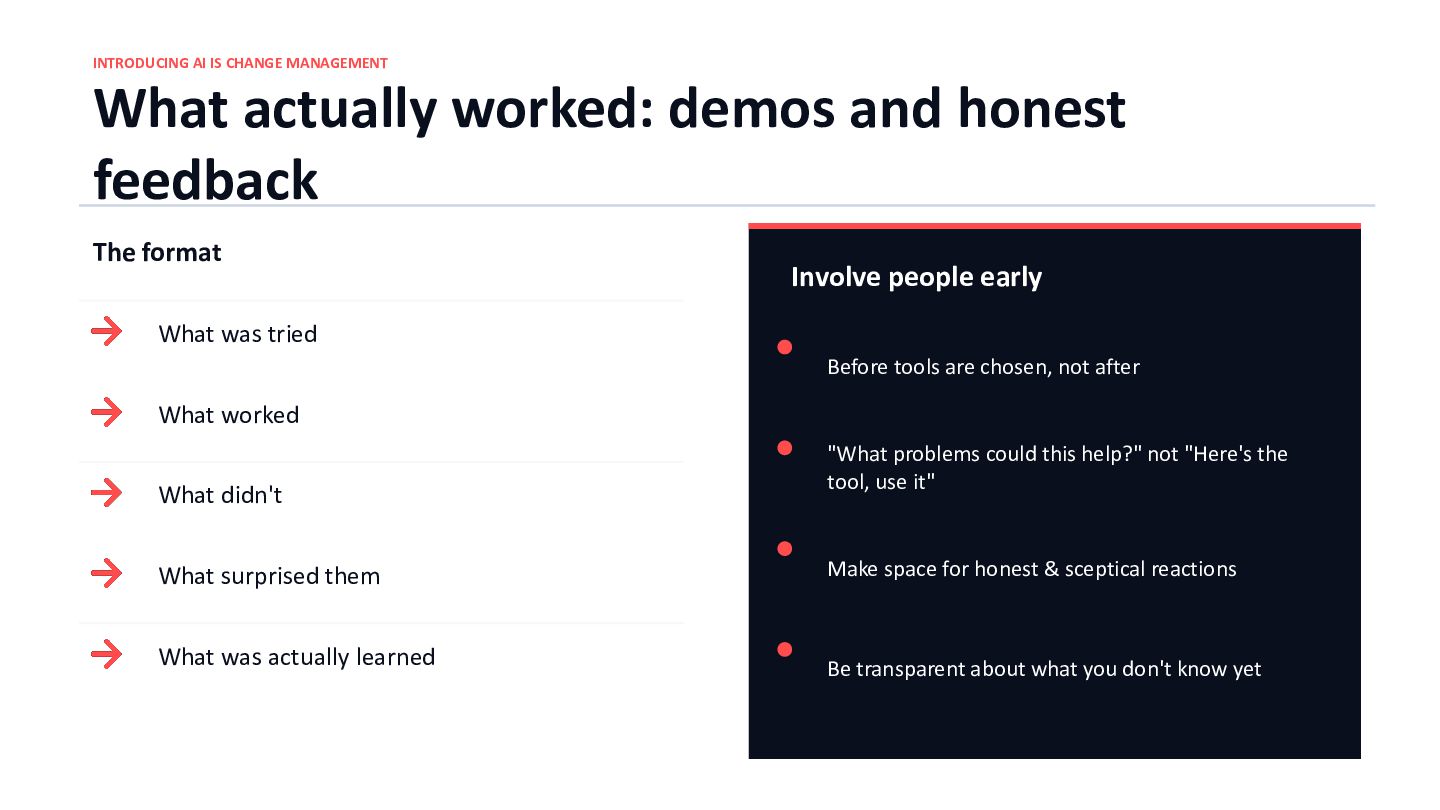
    honest feedback The format What was tried What worked What didn't What surprised them What was actually learned Involve people early Before tools are chosen, not after "What problems could this help?" not "Here's the tool, use it" Make space for honest & sceptical reactions Be transparent about what you don't know yet
  15. INTRODUCING AI IS CHANGE MANAGEMENT The skills that matter most

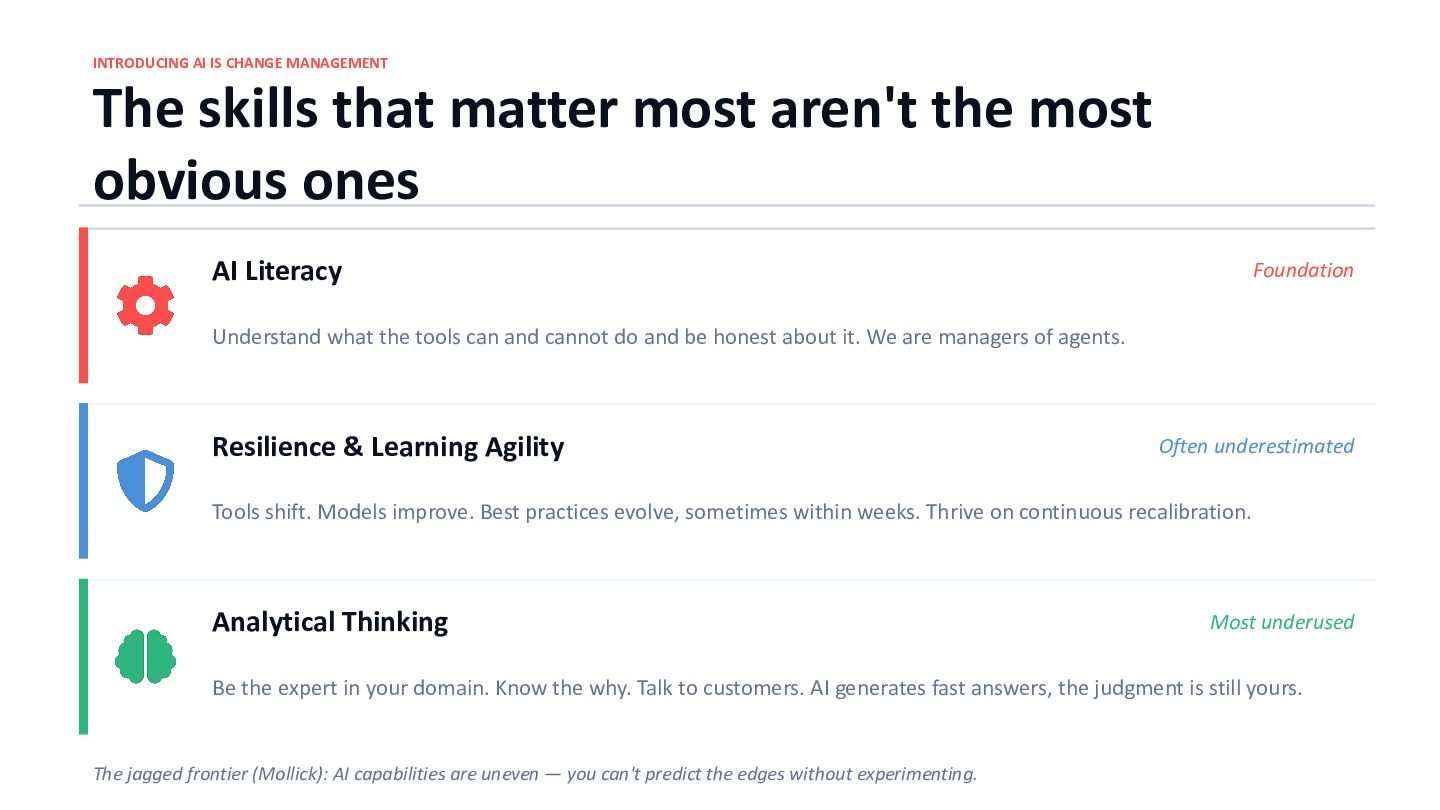
    aren't the most obvious ones AI Literacy Foundation Understand what the tools can and cannot do and be honest about it. We are managers of agents. Resilience & Learning Agility Often underestimated Tools shift. Models improve. Best practices evolve, sometimes within weeks. Thrive on continuous recalibration. Analytical Thinking Most underused Be the expert in your domain. Know the why. Talk to customers. AI generates fast answers, the judgment is still yours. The jagged frontier (Mollick): AI capabilities are uneven — you can't predict the edges without experimenting.
  16. INTRODUCING AI IS CHANGE MANAGEMENT You are accountable for every

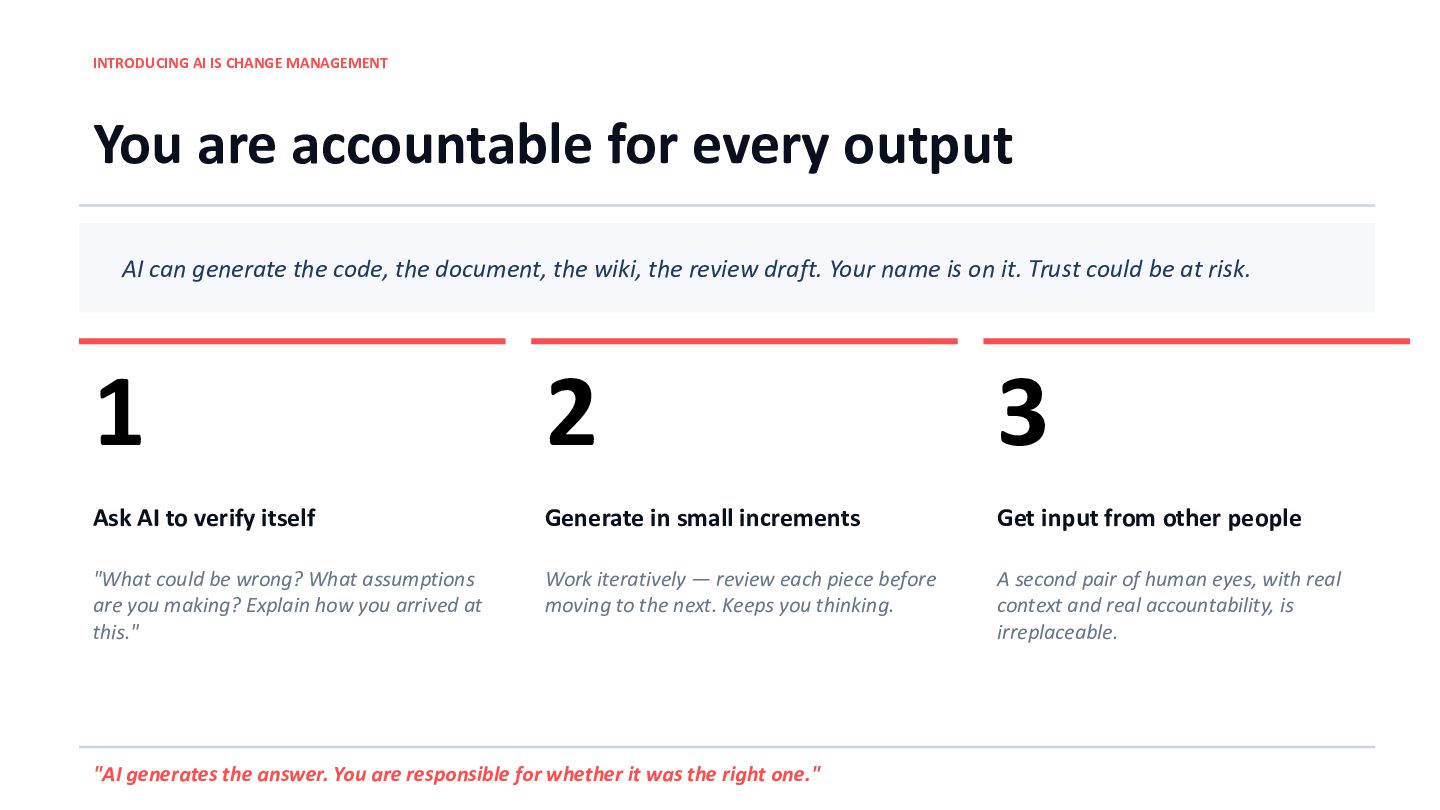
    output AI can generate the code, the document, the wiki, the review draft. Your name is on it. Trust could be at risk. 1 Ask AI to verify itself "What could be wrong? What assumptions are you making? Explain how you arrived at this." 2 Generate in small increments Work iteratively — review each piece before moving to the next. Keeps you thinking. 3 Get input from other people A second pair of human eyes, with real context and real accountability, is irreplaceable. "AI generates the answer. You are responsible for whether it was the right one."
  17. AI MATURITY FRAMEWORK LEAP Four levels of engineering AI adoption

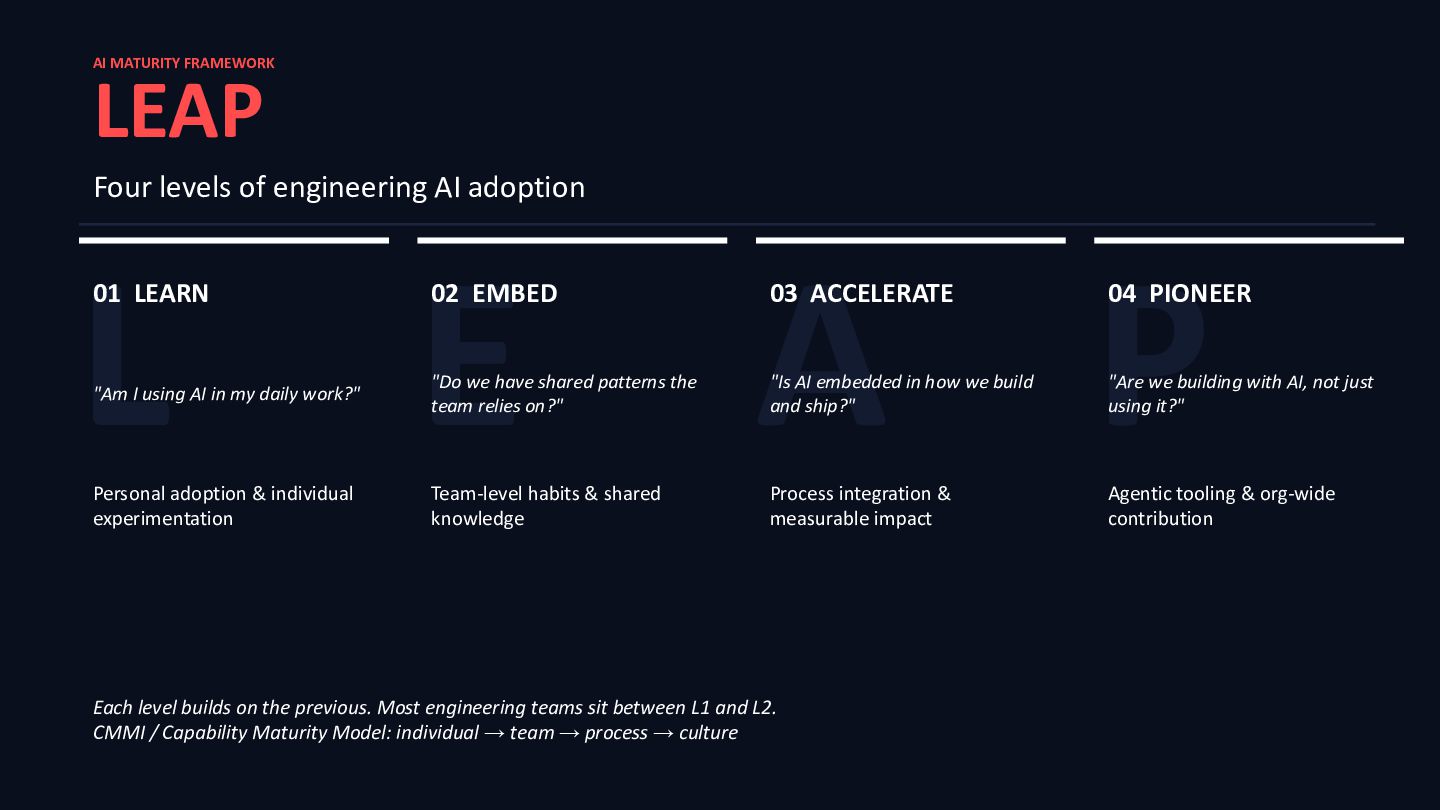
    L 01 LEARN "Am I using AI in my daily work?" Personal adoption & individual experimentation E 02 EMBED "Do we have shared patterns the team relies on?" Team-level habits & shared knowledge A 03 ACCELERATE "Is AI embedded in how we build and ship?" Process integration & measurable impact P 04 PIONEER "Are we building with AI, not just using it?" Agentic tooling & org-wide contribution Each level builds on the previous. Most engineering teams sit between L1 and L2. CMMI / Capability Maturity Model: individual → team → process → culture
  18. AI MATURITY FRAMEWORK LEAP — Level 1 & 2 L1

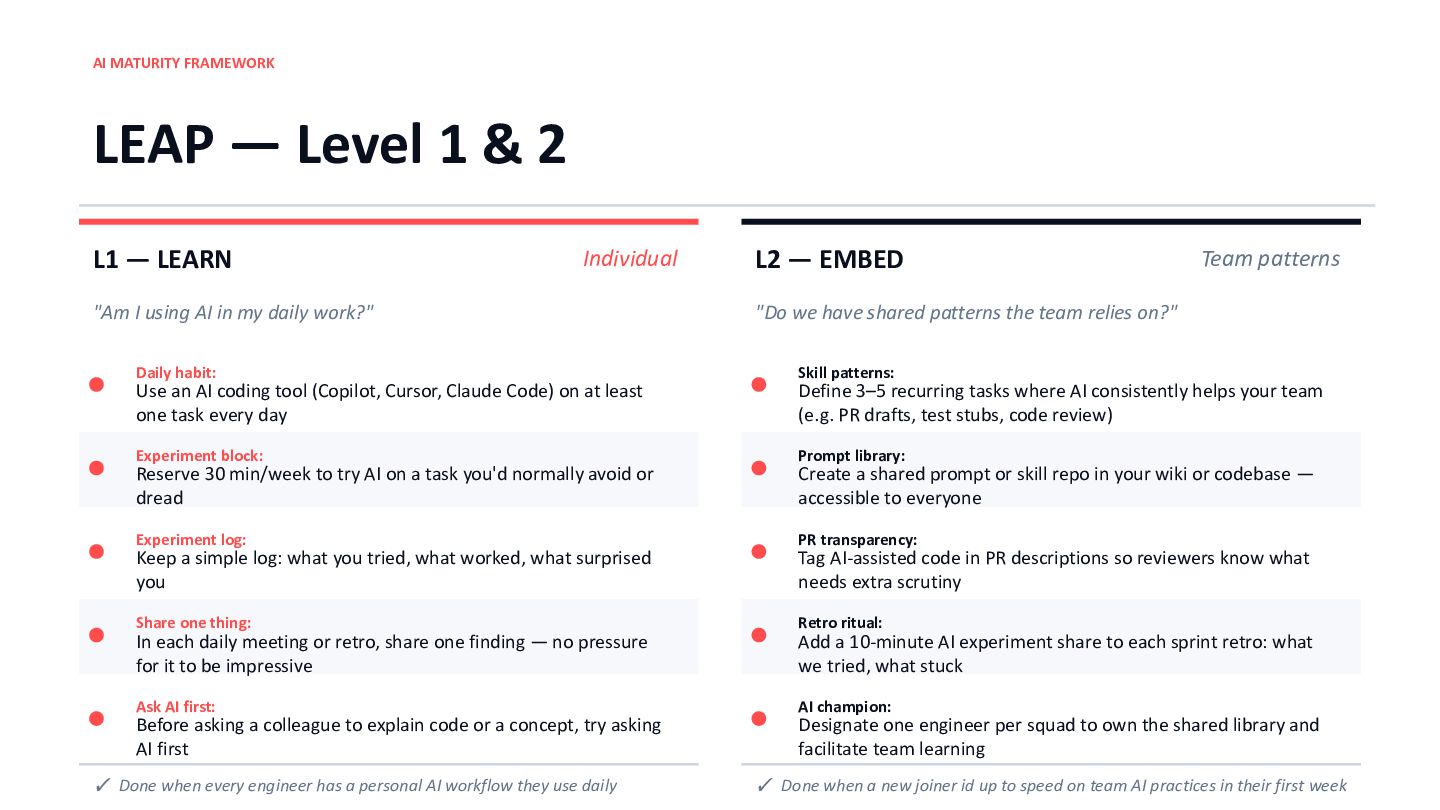
    — LEARN Individual "Am I using AI in my daily work?" Daily habit: Use an AI coding tool (Copilot, Cursor, Claude Code) on at least one task every day Experiment block: Reserve 30 min/week to try AI on a task you'd normally avoid or dread Experiment log: Keep a simple log: what you tried, what worked, what surprised you Share one thing: In each daily meeting or retro, share one finding — no pressure for it to be impressive Ask AI first: Before asking a colleague to explain code or a concept, try asking AI first ✓ Done when every engineer has a personal AI workflow they use daily L2 — EMBED Team patterns "Do we have shared patterns the team relies on?" Skill patterns: Define 3–5 recurring tasks where AI consistently helps your team (e.g. PR drafts, test stubs, code review) Prompt library: Create a shared prompt or skill repo in your wiki or codebase — accessible to everyone PR transparency: Tag AI-assisted code in PR descriptions so reviewers know what needs extra scrutiny Retro ritual: Add a 10-minute AI experiment share to each sprint retro: what we tried, what stuck AI champion: Designate one engineer per squad to own the shared library and facilitate team learning ✓ Done when a new joiner id up to speed on team AI practices in their first week
  19. AI MATURITY FRAMEWORK LEAP — Level 3 & 4 L3

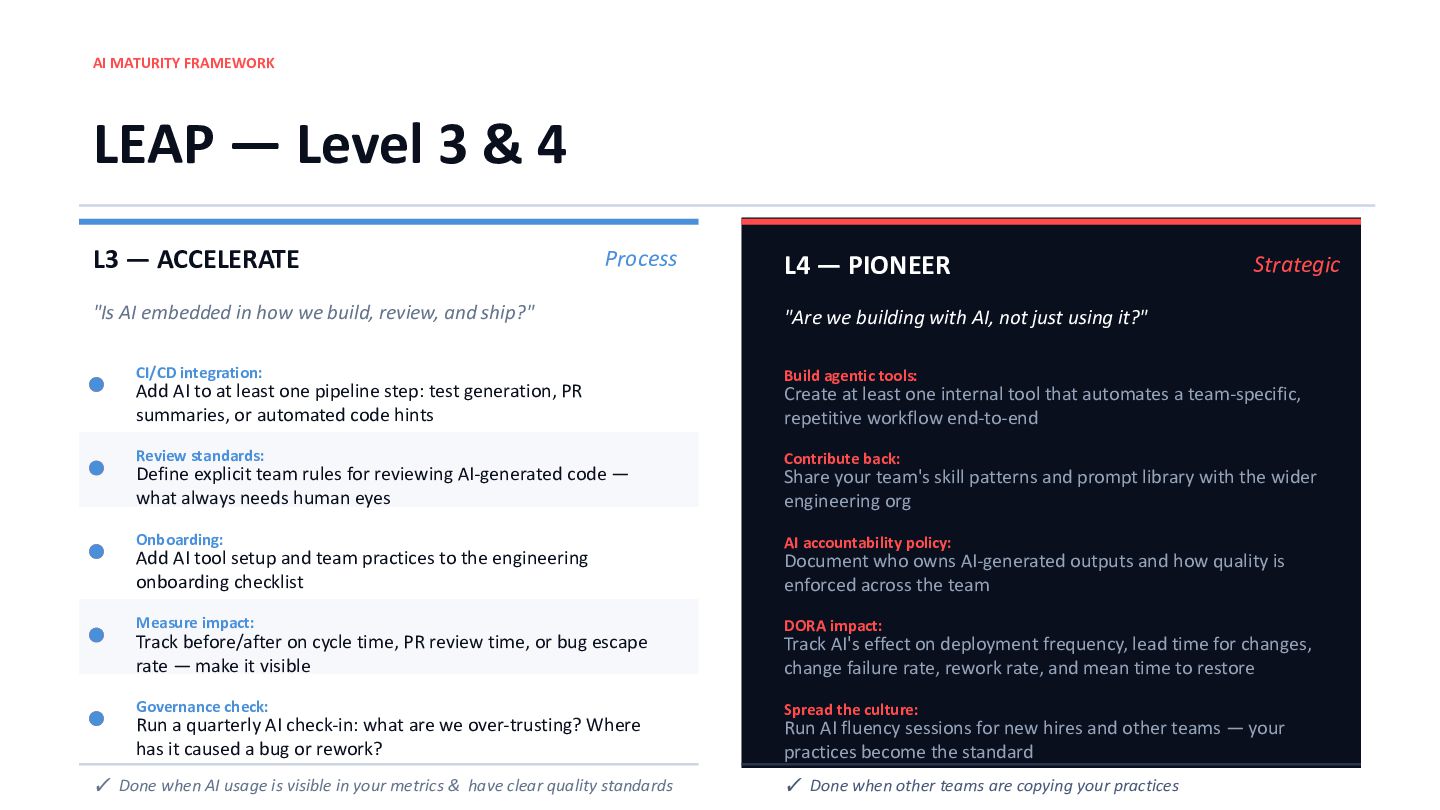
    — ACCELERATE Process "Is AI embedded in how we build, review, and ship?" CI/CD integration: Add AI to at least one pipeline step: test generation, PR summaries, or automated code hints Review standards: Define explicit team rules for reviewing AI-generated code — what always needs human eyes Onboarding: Add AI tool setup and team practices to the engineering onboarding checklist Measure impact: Track before/after on cycle time, PR review time, or bug escape rate — make it visible Governance check: Run a quarterly AI check-in: what are we over-trusting? Where has it caused a bug or rework? ✓ Done when AI usage is visible in your metrics & have clear quality standards L4 — PIONEER Strategic "Are we building with AI, not just using it?" Build agentic tools: Create at least one internal tool that automates a team-specific, repetitive workflow end-to-end Contribute back: Share your team's skill patterns and prompt library with the wider engineering org AI accountability policy: Document who owns AI-generated outputs and how quality is enforced across the team DORA impact: Track AI's effect on deployment frequency, lead time for changes, change failure rate, rework rate, and mean time to restore Spread the culture: Run AI fluency sessions for new hires and other teams — your practices become the standard ✓ Done when other teams are copying your practices
  20. AI MATURITY FRAMEWORK Where is your team right now? L1

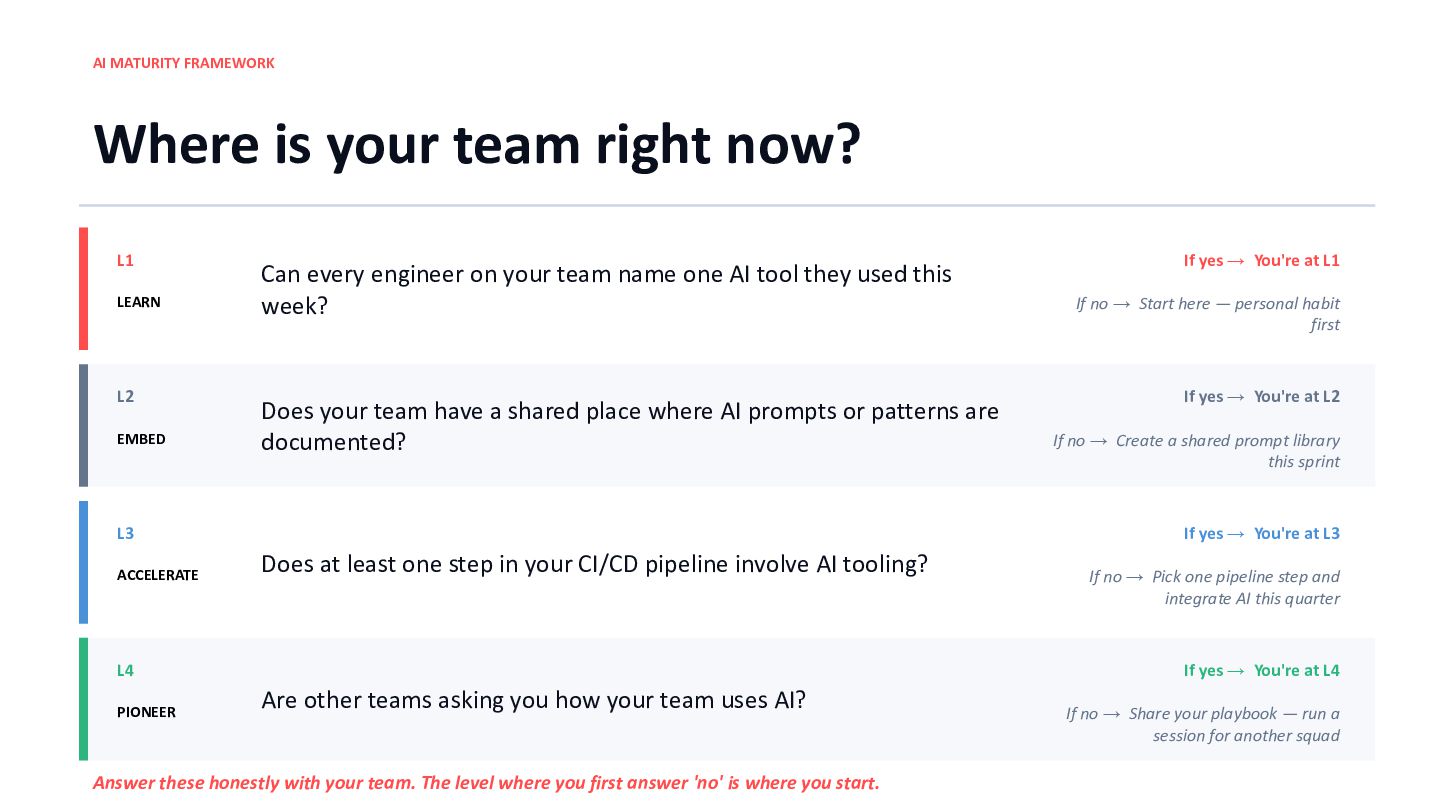
    LEARN Can every engineer on your team name one AI tool they used this week? If yes → You're at L1 If no → Start here — personal habit first L2 EMBED Does your team have a shared place where AI prompts or patterns are documented? If yes → You're at L2 If no → Create a shared prompt library this sprint L3 ACCELERATE Does at least one step in your CI/CD pipeline involve AI tooling? If yes → You're at L3 If no → Pick one pipeline step and integrate AI this quarter L4 PIONEER Are other teams asking you how your team uses AI? If yes → You're at L4 If no → Share your playbook — run a session for another squad Answer these honestly with your team. The level where you first answer 'no' is where you start.
  21. To leave you with AI-first is not a destination. Stay

    curious Keep people at the centre Never lose sight of the problem you're actually solving The tools will keep changing. The mindset is what stays.